
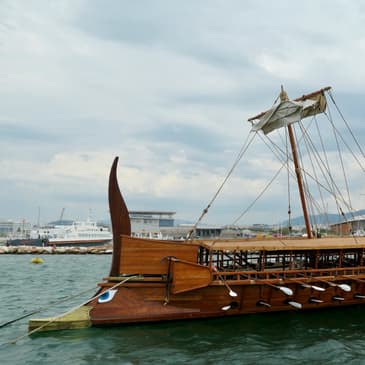
In the final installment of a four-part series on the Greeks and the Persians, Emily and Cam discuss both the Battle of Salamis and the Battle of Plataea, and finish off with some remarks about the Serpent Column—a living monument to the accomplishment of the Greeks.
Visit our homepage to subscribe, to find us on social media, and to contact us by email:
Links
- Our Blog Post on the Serpent Column.
- The first episode in this series (The Persians and the Greeks, Part I: The Rise of the Persian Empire).
- The second episode in this series (The Persians and the Greeks, Part II: Darius, Great King, King of Kings).
- The third episode in this series (The Persians and the Greeks, Part III: Xerxes and the Road to Thermopylae).
----------
00:12 - Introduction
00:58 - Xerxes on the Acropolis
- 01:18 - The aftermath of Thermopylae and Artemision: Xerxes in Central Greece
- 04:22 - The Athenians face a dilemma
- 07:03 - The Pythia, the wall of wood, and the evacuation of Athens
- 12:46 - The Persians in Athens
14:52 - Blessed Salamis
- 15:26 - Dissension among the Greeks
- 19:21 - Xerxes, his commanders, and Artemisia the wise advisor
- 24:29 - Themistokles’ Gambit
- 32:21 - The Battle of Salamis
- 36:17 - Xerxes puts Mardonius in charge and heads for home
39:15 - The Campaign and Battle of Plataea
- 39:19 - Mardonius, Alexander, and an offer to the Athenians
- 41:11 - Spring 479: Mardonius’ capture of Athens, and its aftermath
- 43:23 - All roads lead to Plataea
- 48:21 - The Battle of Plataea
56:09 - Epilogue: the Serpent Column, from Delphi to Istanbul
61:07 - Wrap-up
Hello. Welcome to Have Toga, Will Travel, a podcast exploring the Mediterranean world, ancient and modern, through the eyes of two former classics professors. I'm Emily.
Cam:I'm Cam.
Emily:And we're your hosts.
Cam:And if you're just tuning in for the first time, what you're going to experience today is part four of our series on the Greeks and the Persians. In our last episode, we followed Xerxes' invasion of the Greek mainland in 480 BCE, and we took the story as far as the battles of Thermopylae and Artemisium.
Emily:Today, we're going to finish the story of his invasion by talking about the next battles, those of Salamis and Plataea. Now, this is probably going to be another longish episode, so, you know, sit back, relax, get comfortable.
Cam:Grab yourself a drink.
Emily:Yeah.
Cam:Right. So we ended the last episode by noting that Xerxes must have felt pretty good after the battles of Thermopylae and Artemisium. His army had turned the pass at Thermopylae, opening up the coastal route deeper into central and southern Greece. And on the third and final day of the battles, the Persian fleet had inflicted some serious damage on the Greek fleet.
Emily:Now at this point, the Greek forces are falling back, both the survivors of Thermopylae and the fleet that had fought at Artemisium. And there's really nothing to stop Xerxes's force from driving southward towards Athens and then towards the Peloponnese.
Cam:And over the next few days, this is precisely what Xerxes did. In the neighborhood around Thermopylae itself, the Persians did immense damage to the lands, towns, and cities of the Phocians and the Locrians.
Emily:Now, the Phocians and Locrians were people living in central Greece who had sided with the Greek states who had not submitted to Xerxes. And contingents from both of these places had fought against the Persians at Thermopylae, and they refused to surrender even after the pass was turned. So Xerxes and the Persian army, as they march through central Greece, punish these locations with widespread pillaging, destruction, murder, all of the awful things that come with that kind of military campaign.
Cam:As Xerxes and the army moved further south, Boeotia, the next region that the army entered, was spared the worst of this. Most of the city-states in this part of central Greece had submitted to Xerxes when Xerxes had sent out envoys the previous year to demand their surrender.
Emily:Now, our interesting little character we mentioned in the last episode, Alexander I of Macedon, he is going to later claim credit for keeping a close eye on the Persians to make sure that they didn't harm the territories of cities that had submitted. Now, how much of this can we trust, and how much of this, again, is just another example of his efforts to launder his reputation later on?
Cam:Yeah, it's a little bit hard to tell. He was pretty good at trying to reassure the Greeks that he'd been on their side all along.
Emily:Oh, yeah. Now, what the Persians do do in this area, though, is they requisition supplies and they conscript Greeks into their army.
Cam:In Boeotia, however, Xerxes did destroy two city-states, Thespiae and Plataea. The Thespians, of course, had sent 700 soldiers to fight at Thermopylae, and those 700 soldiers had stayed at Thermopylae till the end, alongside Leonidas and the Spartans, at the cost of their own lives. The rest of the Thespians were able to evacuate, in part because the sacrifice of their fellow citizens gave them the time they needed. But in revenge, Xerxes and the Persians ransacked and burnt the abandoned city.
Emily:Now, they also do the same thing to Plataea. And if you can remember back—you can go back and listen to our episode one—the Plataeans had been allies of the Athenians for years and had been the only city-state to come and fight alongside Athens at Marathon in 490, 10 years earlier. They'd also helped crew the Athenian ships at Artemisium. And at this point, surrendering really isn't an option for them. So on the way back from Artemisium, they actually asked the Athenian fleet to basically drop them off at home so that they can evacuate their people and get them out before the Persians arrive.
Cam:And burn the town as they had at Thespiae.
Emily:Yes, and burn the town as, yes, as they're going to do.
Cam:Meanwhile, of course, the Greeks who had fought at Thermopylae and at Artemisium were in full retreat. The Greek fleet sailed around Cape Sounion into the Saronic Gulf. That's the waters off of Athens. There, the Athenians, who crewed the largest single contingent in the combined fleet, persuaded the Spartan commander to put in at Salamis. This is a large island in Athenian territory just off of the coast of Athens itself.
Emily:Because, of course, to get the Spartans to participate at all, you had to agree to let them have supreme command. And so even though the Spartans don't really have a naval contingent to speak of, they are still commanding the navy because they have to be in charge.
Cam:Right. This must have been very frustrating to the Athenians since they had pretty much half of the ships in the fleet and they still have to sort of constantly hem and haw and argue and squabble with the Spartans to get anything done.
Emily:Especially about naval matters that they know more about. Anyway, so fleet is at Salamis, They get there, and they discover that the Peloponnesian city-states have no intention of sending more forces north to try to stop the Persians from entering Athenian territory from Boeotia.
Cam:Instead, the Peloponnesians seemed determined to do what they'd sort of been threatening all along. They wanted to shelter in the Peloponnese, that is, all of southern Greece connected to the rest of the Greek mainland by the narrow little isthmus at Corinth, And their plan is to fortify that Isthmus to try to keep the Persians out of the Peloponnese altogether. They're not really interested in fighting in central Greece anymore.
Emily:Now, of course, this puts the Athenians in something of a predicament, because they aren't really capable of keeping the Persians out of their territory themselves. And at that point, their only real options are surrender or evacuate.
Cam:Now, they really don't want to surrender, because among other things, surrendering would mean the end of their democracy. We're told that Xerxes was accompanied by the sons and grandsons of Hippias. Hippias, as we've mentioned in a bunch of different episodes, was the last Athenian to rule Athens as an autocrat.
Emily:And the person that the Persians were trying to restore to power 10 years earlier at Marathon.
Cam:And now his sons and his grandsons were eager to reclaim what they saw as their birthright, power over the city of Athens.
Emily:This really leaves the Athenians with only the option to evacuate, which is a huge undertaking, logistically and otherwise, given that Athens has a much larger population than most other Greek city-states, probably somewhere on the order of 150,000 people, men, women, and children. And this number doesn't include the several tens of thousands of enslaved people that would also be evacuated as well.
Cam:It does seem, however, that the Athenians had prepared for this possibility, mostly because they had interpreted a prophecy that they had received from the famous oracle at Delphi to mean that they should prepare to do exactly this.
Emily:So sometime before Xerxes actually enters Greece, Athens had sent emissaries to Delphi, probably around the time when Xerxes' envoys are showing up saying, hey, give us earth and water. And so they send emissaries to Delphi. They get a response from the Pythia, who is the priestess of Apollo. In this case, we actually know her name, Aristonike. They receive a prophecy that seems pretty bad. It basically says, y'all are screwed. The Persians are going to destroy tons of cities, including yours. Just get out while you can. Now, we can question to what extent the Pythia is really making a prophecy here, and to what extent is she reading the geopolitical environment and trying to give an oracle that preserves Delphi's reputation.
Cam:Yeah, Delphi definitely had a stake in this since, you know, they want to remain the preeminent oracular site in Greece. So you really don't want to give bad advice in a high-stress situation like this.
Emily:Yeah.
Cam:And what that meant is the Athenians really didn't know what to do. This is not a great prophecy. The Athenian envoys don't want to go home with nothing but a pile of bad news. What seems to have happened, though, is that one of the leading citizens of Delphi felt sorry for them.
Emily:Yeah, I heard it too. "Sorry."
Cam:My Canadian-ness coming out there in that vowel. Anyway, one of the leading citizens of Delphi feels pity for them and advised them to approach the god again to ask for another prophecy, this time as suppliants. And what that means is that they're supposed to go in sort of a disheveled state and make a big show of being at the mercy of the god and see what happens. So the Athenians do this. Again, they go into the temple, they have a conversation with the Pythia, and this time she gives them an oracle which still seems kind of bad, but is at least slightly more optimistic. It's delivered, like all of her oracles, in poetry.
Emily:Dactylic hexameter, the meter of epic.
Cam:Very fancy language.
Emily:Yep.
Cam:But the gist of it is this. The Pythia sort of predicts that Attica is going to be ravaged and plundered, but that a wall of wood will stand. She predicts that the Athenians should not try to oppose the army, at least not yet, and she ends by saying something like, blessed Salamis will destroy mother's sons.
Emily:Now, you may think that this oracle doesn't really sound clear at all, and you would be right. Prophecies delivered by the Pythia about really weighty issues are rarely clear, which is a great way for the oracle to preserve their reputation, right? Either way, you can find a way to show that the oracle was correct whenever happens.
Cam:Right. You leave a whole bunch of onus on the person receiving the prophecy to do the really hard work of figuring out what it means.
Emily:Yeah. So the debate in Athens then becomes, what is the wall of wood? Now, a lot of people think that this is a reference to the Acropolis, which had at one point been protected by a wooden stockade. However, another argument gets made that the Wall of Wood is actually in reference to the Athenian ships.
Cam:Now, the story we're told is that most people in Athens inclined toward the first interpretation, in large part because those arguing that the prophecy was about ships got caught on the bit about Salamis and Salamis destroying mother's sons. And people were really worried that this meant that if they tried to rely on the fleet, they'd basically lose a catastrophic battle and all get killed. And this really wasn't resolved until an Athenian named Themistocles stepped forward and gave his own interpretation of the prophecy.
Emily:And we mentioned Themistocles in our last episode. He was the commander of the Athenian contingent in the Greek fleet at Artemisium. And he had come to prominence in Athenian politics earlier in the 480s by advocating that Athens should use a new vein of silver that had recently been discovered in their territory to pay for a fleet of triremes, which the Athenians then follow and do.
Cam:Now at this moment, he comes forward and he makes an argument about the language used in the prophecy that the Athenians have received from the Pythia. In that prophecy, Salamis is described as blessed or holy. And Themistocles' argument is basically that the Pythia probably wouldn't have used that word if she was prophesizing that the entire Athenian navy was going to be destroyed there. So in his view, what the last couple of lines of the prophecy must have meant was that at Salamis the Persians would find themselves wrecked. And the Athenians as a whole decided at that moment to favor his interpretation, to rely on their fleet, and to prepare to abandon Attica and to fight if necessary by sea.
Emily:So when the Greek fleet returns from Artemisium, they're at Salamis, and it's clear that an army from the Peloponnese is not coming to help, the Athenians are ready to evacuate. The fleet takes the Athenians, their families, their enslaved workers and servants, and whatever property they can carry to the nearby island of Salamis, which is again, just across a narrow straits from the mainland and is part of Athenian territory. It also takes some people to the island of Aegina, which is near Athens.
Cam:A separate city-state.
Emily:Separate city-state, but near Athens. And then across the Saronic Gulf to a city-state called Troezen in the Peloponnese, which for those of you who know your mythology, Troizen is the home of the Athenian hero Theseus.
Cam:So everybody in Attica evacuates. All that is except for the diehards who refused to accept Themistocles' interpretation of the prophecy and insisted that the Wall of Wood was a reference to the old stockade on the Acropolis. They chose instead to climb the Acropolis and barricade themselves in there and fortify it to withstand a siege, where they were probably joined by whoever else was unable to flee Athens. Unfortunately, the old people, the infirm people, and so on.
Emily:So the Persian army probably enters Attica, I mean, that is Athenian territory, in early September of 480, probably about a week or so after the Battle of Thermopylae ended. And they destroy as much of the farmland as they can as they drive south towards Athens, and then they lay siege to the Acropolis.
Cam:Now, to their credit, those holed up in the Acropolis managed to put up a pretty good fight. The Acropolis, after all, is a well-fortified stronghold. In 480, it didn't look quite as it does today, but it already did have some of the massive walls that you can see on the south side in particular, where the Athenians had filled out the hilltop to support the podium for a big, fancy new temple they were building on the site of the later Parthenon.
Emily:The defenders of the Acropolis also reject efforts of the sons and grandsons of Hippias to persuade them to surrender. And the siege wears on, really until a handful of Persians manage to find a way to scale the cliffs on the east side of the Acropolis undetected. And they are then able to open the gates on the west side of the Acropolis to the rest of the Persian army. The army storms in, kills everyone they encounter, plunders the temples, and set everything on fire. And of course, these temples, as we talked about in our episodes on the Acropolis, are going to not be rebuilt for 40 years until Pericles comes along with his building program that does give us the Parthenon.
Cam:Right. So were it not for this sack of the Acropolis by the Persians in 480, maybe the Parthenon as we know it would never have existed.
Emily:Which is just a weird thing to think about.
Cam:Yes.
Emily:Yeah.
Cam:Right. So this is a bad moment. Athens has been sacked. The Persians are in command of the Acropolis, and things were probably looking pretty dire. And as you can imagine, even though the Athenians themselves had mostly evacuated Athens and Attica, the Persian capture of the Acropolis was definitely not good for the morale of the Greek fleet at Salamis.
Emily:They could have seen Athens burning from where they were easily.
Cam:They had a pretty good view, actually.
Emily:Yeah. So can you imagine that sitting there in your fleet, watching your city burn and not knowing if you'll ever be able to get back.
Cam:No, it must have been pretty rough. Now, as you may remember, the Greek fleet was really a composite fleet. The Athenians had the largest contingent, but there were contingents from a whole bunch of other Greek cities in the fleet as well. And as they watched Athens burn, they continued an argument that had already been running for days about strategy. A bunch of commanders in the Greek fleet were arguing that the fleet as a whole should leave Salamis, sail towards the Isthmus of Corinth and prepare to defend the Peloponnese against the Persians, rather than hanging out near a city that was on the verge of being captured and sacked. And of course, when the Persians did capture Athens, that view just gained further weight. And as the city fell and as the Greeks watched it burn, most of the commanders in the fleet cast a vote to abandon their position at Salamis.
Emily:Now, the Athenians, unsurprisingly, are really not happy about this decision.
Cam:I'm shocked.
Emily:And so our friend Themistocles kind of bursts into the tent of the Spartan commander and argues against this decision. And he points out that there is a good chance that if they leave Salamis, the fleet's just going to break up and the Greeks will then all be sitting ducks.
Cam:Now, we have to remember this point that Themistocles had probably been arguing with the Spartan commander more or less nonstop during the entire campaign, all the way up to Artemision, all through the battles at Artemision and all the way back, the whole time while the fleet is parked here at Salamis. And the Spartan commander is probably good and tired of all of this by this point. What he decides to do, though, is hold another conference. So he summons all of the commanders of the Greek fleet together again, and Themistocles stands up and starts arguing with all of them. And basically, he argues that moving the fleet is just going to expose a bunch of city-states on the northeastern coast of the Peloponnese to attack from sea, and will be totally counterproductive. And he also argues that the Greeks will never have a better chance to force an engagement that they might actually win than at this moment, when they're fighting in the Straits of Salamis, where relatively narrow waters will prevent Persians from exploiting their advantages: namely, their numbers (they had a slightly larger fleet than the Greeks did) and their skill at ramming. The Phoenician contingent in the Persian fleet was particularly renowned for this.
Emily:Yeah. And we'll talk a little bit more about that when we get into the battle itself. But this meeting is not really going well for Themistocles. And actually, there's a point at which the Corinthians actually make fun of him and tell him that since he technically doesn't have a city-state anymore to call his home, he should just sit down and shut up. And this is where Themistocles delivers a rather famous response, which I think actually raises an interesting issue about what is a nation, if you will. He says that as long as the Athenians still had their ships, they still had a state, and one more powerful than any other Greek state, even if they didn't have a territory, that the city-state is its people, not its land.
Cam:Yeah, it helps when you can keep your people together and deliver that kind of a threat, for sure.
Emily:Yeah.
Cam:And much of what Themistocles had to say in this moment was a threat. After reminding everybody that the Athenians were still powerful, even if their physical city had been overwhelmed and burnt, he made it clear to everyone that if the Greeks chose to abandon Salamis, the Athenians were prepared to sail away completely to somewhere in Italy, leaving the rest of the fleet on its own. And at that point, the Greek fleet really would be unable to handle the Persians, and the Persians would basically be able to land anywhere they wanted to in the Peloponnese, circumventing all of the efforts of the Spartans to keep them out by fortifying the Isthmus. And this threat ultimately seems to have convinced the Spartan commander that, yeah, okay, for the time being at least, we have to keep the fleet here.
Emily:So not long after this debate happens, the Persian fleet finally arrives in the waters off of Athens. So the Persians take up a position at the main harbor of Athens, which at the time was a place called Phaleron. And from here, they could have been able to kind of look across the straits towards the island of Salamis and see the Greek fleet assembled there. And if you go to Athens today, I mean, you can get this vantage. And for my money, the best place is to go up Mount Lycavitos and sort of stand there and look out. And you can see the island of Salamis right there and the very narrow straits of water, which of course today are filled with like cargo ships and all sorts of things. But you can see really clearly what that geography looks like and how narrow it is and how close they were when they were sort of drawing up.
Cam:On a particularly clear day in Athens, which doesn't happen a lot because Athens is kind of smoggy, but on a particularly clear day, you can actually see clear across the Saronic Gulf. So you can see over the island of Aegina, which at the time was an independent polity of its own, all the way to the Peloponnese, to Troezen, where other Athenians had been evacuated in 480. Anyway, what Herodotus says is that as Xerxes and his people were lounging around in Phaleron, Xerxes held a conference with his commanders to deliberate about what to do next. Here we get a bit of a funny story about how the Persian court works, because of course Xerxes himself, as the king, as the champion of the god Ahura Mazda on earth, doesn't want to sully himself by actually having conversations with people. So what he does instead is have his cousin Mardonius sort of convene the assembly and go around and take a poll of the various different commanders one by one, asking each of them, what do you think we should do? And then reporting back to Xerxes. And what Mardonius discovered is that all of the commanders of the Persian fleet were in favor of an attack, all but one. And the one person who opposed that plan was Artemisia, queen of Halicarnassus in Caria, a part of what is now southwestern Turkey, Herodotus' own hometown.
Emily:Now, in Herodotus' narrative, he generally has this sort of trope he uses of the wise advisor, and that's the role he puts Artemisia into here. Now, this may not actually reflect how the real Artemisia thought and interacted. But I think it's interesting that Herodotus chooses to put her in that role. I think partly it's just like, you know, hometown shout out. But also, it's quite possible that Artemisia, given that she's the only female commander, might actually be bringing a different perspective to the battle. Either way, whatever it was, Artemisia herself must have been a fascinating woman.
Cam:So fascinating, in fact, that she is the central character in the sequel to 300, which somehow manages to be even worse than the original.
Emily:Oh, gosh, they do not do her character justice, too. And that's what is really annoying about that movie. Like, oh.
Cam:But actually, I want to amend one of the things we said in our last episode. We called 300 the worst movie ever, I think, in our last episode. I think the sequel is even worse.
Emily:Oh, yeah, no. And it's what they do to her character is so disturbing.
Cam:Yes.
Emily:Right? You just can't. Oh, I don't even want to talk about it.
Cam:Anyway, back to the real Artemisia.
Emily:But Artemisia ruled what was a fairly powerful and cosmopolitan city-state that had been subjected to Persian power about half a century earlier when Cyrus the Great was conquering that part of Anatolia. Now, Halicarnassus, which is modern-day Bodrum, was a very multicultural, multi-ethnic, multilingual place. So you had people speaking Greek, along with, you know, Carians and probably Persians and other Iranian peoples all kind of living together.
Cam:Artemisia became the ruler of this place when her husband died, and she more or less stepped into his position and took power herself. And what's kind of interesting here is that, again, according to Herodotus, she did have an adult son whom she could have easily enough sent to represent her on this expedition. But she had the sort of personality that really drove her to do this herself. She wanted to be there and to command Helicarnassus' naval contingent in Xerxes' army.
Emily:Yeah. And I'll point out, despite her depiction in 300, this puts Artemisia probably in her 40s. So think about, you know, middle-aged woman who is probably tired of everybody's garbage, and not like some, you know, 25-year-old waif. Anyway, Artemisia's advice to Xerxes at this point is that his best bet is just to wait and not attack. Because if he does wait, the Greek fleet's probably going to break up at some point because, you know, the Greeks just can't get along for that long with each other. And they'll also probably run out of provisions. The Peloponnesians are going to get frustrated and won't want to stay to fight for the Athenians, and that's going to particularly become pertinent if Xerxes orders his army to keep advancing towards the Isthmus. Like, at some point, the Peloponnesians are going to, like, ditch and go to protect the Peloponnese instead.
Cam:Now, Artemisia's advice here seems like pretty sensible strategy, and it may even be what the Persians ultimately intended to do after this conference ended. Because even though Herodotus himself was convinced that Xerxes had resolved to attack immediately and gave orders to that effect, the Persians initially not only moved out their fleet closer to Salamis to present a threat, they also ordered at least part of the army to advance simultaneously toward the Isthmus of Corinth, perhaps as a feint designed precisely to drive panic into the Peloponnesians and to bring about the breakup of the Greek fleet.
Emily:Now, if this was their plan, the Persians almost succeeded in triggering that breakup, because as soon as the Greeks learn about the movements of the Persian fleet and army, they immediately begin to argue again about whether or not to stay at Salamis or to fall back to the Isthmus.
Cam:I sort of feel bad for the Spartan commander here because he probably thought that this issue had been resolved and now he's got a whole bunch of other Greek commanders basically charging his tent to start this argument all over again. Probably not a fun time. But more importantly, this is where the story takes a weird and interesting turn. Our two sources for what happened next, Aeschylus and Herodotus, both tell us that somebody from the Greek camp at Salamis showed up at the Persian camp, presented himself to the Persian commanders, and reported that the Greek fleet was about to break up and getting ready to sail away.
Emily:Now in Aeschylus's version, which comes out in "The Persians", that person is anonymous. We don't know who it was. Aeschylus depicts him as like an of fate, or an agent of the gods set to lure Xerxes into a fatal act of hybris.
Cam:In Herodotus, that person has a name. In Herodotus, that person is actually Themistocles' enslaved servant, his paedagogus, the guy who takes care of his kids, a guy named Sicinnus. And in the story we get in Herodotus, Themistocles, realizing that the Peloponnesians are about to win this argument and that the fleet actually is going to stay away from Salamis, comes up to force them into a fight. Basically, what he does is order his paedagogus, Sicinnus, to deliver a very specific message to Xerxes. The Greek fleet is about to break up. You, Xerxes, can either let them disperse, which, I mean, you know, that's a perfectly sensible plan, or you can win a glorious victory by attacking them now, precisely while they're at odds with one another and unlikely to resist you effectively.
Emily:Now, Sicinnus, when he does this, presents himself as a defector. And he sails across to deliver the message. And of course, Xerxes, who is interested in increasing his own glory, takes the bait and decides that he'd rather have the glorious victory than simply let the Greek fleet break up. And so he orders a portion of the Persian fleet to sail around Salamis to block the straits on the western side, the far side, so that the Greeks can't get out the other way. Because currently, the Persian fleet is set up east of where the Greek fleet is. And then the rest of the Persian fleet takes up their stations on the east side and they prepare for battle.
Cam:Now, this is kind of a weird story, and it may seem a little difficult to believe at first glance, but maybe not if we recognize that internal squabbles were what the Persians expected from the Greeks. Because after all, their experience of the campaign so far had been that individual Greek city-states didn't get along very well with one another, and that certain Greek states were much more likely to surrender when push came to shove than to stand with the rest of the Greek forces against them.
Emily:And if we think about it, right, in the end, only 31 or so Greek city-states out of dozens, if not hundreds, actually participate in some way in this alliance against the Persians. So Xerxes and his commanders were probably primed to be receptive to exactly the kind of intelligence that Sicinnus brought them.
Cam:The other thing is, that this story helps us understand what otherwise, in hindsight, seems to have been a huge mistake on Xerxes' part. That is, forcing a battle in conditions that didn't favor the Persians one bit because it prevented them from exploiting their advantages. So first of all, we've mentioned that the Persian fleet was probably bigger than the Greek fleet. The Greeks had 300 ships or so. Herodotus claims 378, half of which were from Athens, the rest of which were from about 19 other Greek city-states. The precise number is a little hard to determine, but somewhere in that range.
Emily:And whatever the number, the Persian fleet was definitely bigger. And it was drawn from coastal cities all over the western parts of the Persian Empire. So this includes the Greek parts of Anatolia, Cyprus, Phoenicia, which was a noted maritime culture in antiquity, and Egypt.
Cam:And at the same time, Herodotus seems to think that the Persian fleet, or at least contingents within the Persian fleet, was better suited to fighting the kind of battle for which the warships of the day, triremes, were designed. And that was a ramming battle. After all, the trireme is essentially just a ram with a couple of hundred oars attached to it. And what Herodotus argues is that Persian ships—Phoenician ships, I guess, if we want to be technical about it—tended to be lighter, and more maneuverable than the Greeks'.
Emily:And the Phoenician sailors had a particularly well-developed naval skill that the Greeks feared. And this is a trick called the diekplous, which in Greek means something like "a sailing through and out." And basically, this is a maneuver where the Phoenician or Persian ship would sail through a gap between two enemy ships and then turn around quickly and then ram the enemy ship from behind.
Cam:Yeah, the thing is, you know, these ships take a lot of work and practice to maneuver correctly because you've got 170 oarsmen. Those guys have to be trained well enough to row in sync and to respond to the commands of the bosun and that kind of thing. It's not easy to do.
Emily:Yeah. And so this maneuver was particularly fancy and required a lot of training and skill.
Cam:Yes. Not something you can just hop into a boat and do.
Emily:Yeah, no.
Cam:What all these factors meant was that it really was best for the Persians, if they wanted to fight a naval battle, to do it in open waters, where they could, first of all, exploit their numbers, and secondly, exploit their maneuverability. What they definitely do not want to do is fight a battle in a place like the Straits of Salamis, where they just simply didn't have the sea room to play to their strengths.
Emily:Now, it's easier to understand why Xerxes and his commanders choose to launch an attack in waters that were not good for them if they believe that the Greeks were going to try to escape rather than fight.
Cam:And so, responding to this intelligence, the Persians did prepare to fight.
Emily:And I'll just point out how critical good intelligence gathering has been throughout this process. And it really is something I think we underestimate when we think about warfare. But it's a combination of logistics and intelligence that really give you the advantage. So how to put it? The military needs the nerds.
Cam:Right.
Emily:Because those are the people that actually like provide critical elements to military success.
Cam:And also, it seems, to provide critical pieces of misinformation to the other side.
Emily:Well, again, that's where the good intelligence gathering, like can you trust the source of the intelligence? Are you interrogating this enough? Or are you letting something that feeds into things you want to believe already to lead you astray?
Cam:Yes. And this conversation has no contemporary political overtones at all.
Emily:No.
Cam:Anyway, so the Persians resolved to fight. They had already blockaded the western end of the Straits of Salamis so that the Greeks couldn't escape that way. They had also stationed soldiers on a little island called Psyttaleia, an island in the strait where disabled ships could be expected to wash up. And the orders of those soldiers were to kill any Greeks who ended up there.
Emily:So close to dawn, the rest of the Persian ships row out into the straits to force a battle. And Xerxes himself actually takes a position up somewhere on the lower slopes of Mount Aigaleo on the mainland, where he can overlook the straits and watch the battle. Now, the Greeks, who have now realized that their escape route is blocked, are really left without a lot of options. And they sail out to meet the Persian fleet.
Cam:What followed was a confused and confusing battle. It's really difficult to reconstruct because Herodotus really only gives us a few snapshots of how it unfolded.
Emily:Yeah. And even the description in Aeschylus' Persians is pretty chaotic as well.
Cam:Herodotus has a lot of stories about the battle and two in particular, I think, give a good feel for how messy this engagement must have been. So the first of those stories is a story about a ship and a crew from Samothrace. That's a Greek island in the northern Aegean, which was under Persian control, and its crews were fighting on the Persian side. This ship from... Emily's laughing because I've flubbed this line three or four times now. You probably won't hear much of it on the recording, but if you're wondering why she suddenly cracked up, that's why.
Emily:So tell me about the ship from the Samothrace.
Cam:Yes, okay. So, right. This ship from Samothrace rammed an Athenian trireme, only to be promptly rammed in turn by a ship from Aegina, that island just off the coast of Athens itself. As their ship was starting to sink, the marines on the Samothracian ship cleared the deck of the ship from Aegina, and then they were able to board and capture it, again, as their vessel was literally sinking underneath their feet.
Emily:Another story that we get is that Artemisia, who was trying to escape from an Athenian ship that was chasing down her own vessel, makes the decision to ram a ship commanded by another Carian ruler—so, one of her allies. And this move makes the Athenians think, oh wait, that's not a Persian ship, that's a Greek ship, and we should leave them alone. And she actually manages to escape by basically sacrificing an allied ship.
Cam:So everything's a big mess. And the kind of chaos we see in these two stories was probably pretty widespread, especially as the battle progressed and the size of the Persian fleet became a real problem. Herodotus tells us that the waters were so narrow that the Persians actually became packed in closely enough with one another that they couldn't really fall back or maneuver when they needed to. And for that reason, they became easy pickings for ships on the Greek side.
Emily:And the Persians who'd been stationed on this island of Psyttaleia also ran into problems. Because the Greeks managed to land a force there as the fleet is driving the Persian Navy back, and that force surrounds and kills the Persians stationed on the island. And in Aeschylus, he sort of presents this as like the inverse of Thermopylae, right? The Persian contingent is weakened by a shower of missiles, and then the Greeks close in to finish it off.
Cam:Yeah, in Aeschylus, it's interesting because it's really played up for the horror of the situation. And it's clear that the audience is really supposed to feel for the Persians who are cut off alone and just, you know, being cut down and killed by the Greeks. Anyway, after absorbing a lot of punishment, what was left of the Persian fleet finally withdrew back to Phaleron, and the battle ended, probably late in the day. Now, the Greeks initially seemed to have believed that they'd probably need to fight again. They'd have to do this all over again the next day.
Emily:Yeah. But for whatever reason, the Persian commanders aren't confident that they're going to win another engagement. And so Xerxes orders the fleet to fall back and actually fall back across the Aegean. Xerxes decides that he is content with sacking Athens as his own personal victory and glory. And he himself decides to return to Asia. Herodotus claims that he does so partly at the urging of Artemisia. But, I mean, Xerxes did also have, you know, a fairly large empire to run and had spent a lot of time on this Greek campaign at this point. So he probably had other things he needed to get back and attend to.
Cam:So what Xerxes decided to do was to give overall command in Greece to his cousin and his brother-in-law, Mardonius. And Mardonius' instructions were to bring the Greeks to heel. And with that, Xerxes set off for home.
Emily:Now, the Greek fleet does actually pursue the Persians for a bit as they sail across the Aegean. The Persians basically withdraw to an island, Samos, which is a large island just off the coast of Anatolia. But eventually, the Greeks sort of give up the chase and instead turn their attention to attacking some of the nearby islands that had sided with Xerxes before they eventually return to Salamis.
Cam:Yeah, this is a weird bit. And Herodotus sort of depicts this as an effort of Themistocles to shake down a bunch of people he doesn't like by attacking their cities.
Emily:Yeah.
Cam:Which, you know, I wouldn't put that past Themistocles.
Emily:Yeah, no.
Cam:But anyway, so the Greeks loot the wrecked Persian ships at Salamis. And they use the proceeds of looting all of these ships to commission a bunch of victory monuments as gift to the gods at the Isthmus, at Salamis, and at Delphi. They finally realized this is a really big moment, potentially even a turning point in the war.
Emily:Now that said, the campaign overall is by no means over. Mardonius is still in command of a very large land force of both infantry and cavalry that remains capable of doing a lot of damage and executing Xerxes' command to bring the Greeks to heel. But the Persians now no longer enjoy the naval superiority that they had, which means, among other things, they no longer have the same ability they did to keep the army supplied by sea.
Cam:For that reason, Mardonius couldn't stay in Attica. His supply lines would have been way too long. So he made the decision to fall back instead for the winter to regions further north, where cities had surrendered to the Persians, especially Thebes in Boeotia in central Greece, and Larissa in Thessaly. And that meant that the Athenians could return home, if only to a city that had been sacked, and both sides hunkered down to wait out the winter and to wait for the new campaigning season that would come with the spring of 479.
Emily:Now, of course, over the winter, we're not just sitting around waiting. So Mardonius spends the winter planning, collecting intelligence, which also includes a bunch of oracular prophecies from oracles all over the known world. And at some point over the winter, he comes up with a strategy, which is to try to split the Athenians off from the rest of the Greek alliance. since they have the most powerful contingent of the fleet. And to do this, he sends our friend Alexander I of Macedon to negotiate with the Athenians on his behalf.
Cam:So Alexander heads south towards Athens. Somehow the Spartans learned of his mission, and they sent envoys of their own because they were afraid that the Athenians might actually come to terms with Xerxes. Alexander and the Spartans both delivered speeches at Athens in front of the Athenian people. Alexander offered them terms from Mardonius. What Mardonius was offering was the right for the Athenians to keep their own government, to preserve their democracy with no further worry about the sons of Hippias or whatever, so long as they remained loyal to Xerxes, and to sweeten the pot, he said that the Persians would help them conquer and add any territory they wanted to their own. The Spartans, on the other hand, stood up and delivered a speech in which they really tried to argue that the Athenians shouldn't surrender to Xerxes, but should stay united with the rest of the Greeks.
Emily:Now, this is actually a pretty good offer on the part of the Persians to the Athenians, but the Athenians are not in a mood to surrender. They're still, you know, pretty angry and horrified at what the Persians did to their city, both sacking the city, but also burning and destroying the temples. And they take a kind of, what do you call, moral or ethical position, that they are not willing to help the Persians enslave other Greeks. And so thus, Alexander returns to Mardonius, having failed in his mission to secure the cooperation of the Athenians.
Cam:And so when spring came, the Persians and the Greeks both began to mobilize. A Greek fleet of about 100 ships got together and sailed to Delos. That's the island in the center of the Cyclades, sacred to the god Apollo. And their mission was to hang out there in case the Persian fleet attempted to come back westward again.
Emily:In the Peloponnese, the Spartans and the other Peloponnesians are hurrying to expand and fortify the wall that they'd been building across the Isthmus.
Cam:And as for Mardonius, he gathered his forces, the Persians and the other Iranians that Xerxes had brought with him from Asia, along with Greeks from the conquered states—so the Greeks of Thessaly, Boeotia, and other areas in northern and central Greece. And with this force, Mardonius moved south, his eyes on Athens, which had, of course, rejected his generous terms.
Emily:The Athenians make the decision again to evacuate Athens and relocate to Salamis. They had gotten the news that Mardonius was coming south, and there was no sign whatsoever that the Spartans and Peloponnesians were going to come out and help confront Mardonius and keep him out of Athenian territory. So as they had just done the year before, the Athenians felt they had no choice but to give ground to avoid complete destruction of their people.
Cam:And the Persians capture an empty Athens again. At this point, Mardonius tried to negotiate once more. So he sent a messenger to Salamis to offer the Athenians the same terms he had offered them over the winter, thinking, well, now the Athenians have lost their city again, and now that the Spartans don't seem to be willing to help at all, maybe I can talk some sense into them. The Athenians, however, still refused to accept. In fact, they were so angry that when one of the Athenian counselors stood up and said, hey, maybe Mardonius has a point, the others stoned him to death. And then, we're told by Herodotus, their wives went and stoned to death his wife along with his children.
Emily:Yeah, that's actually pretty horrific.
Cam:It is a horrific story. Yeah. But it says something about the mood of the Athenians that this story was actually credible.
Emily:Yeah. Now, that said, the Athenians are still justifiably frustrated that the Spartans, who were like, don't yield to the Persians, have yet again hung them out to dry. And the Athenians send emissaries to Sparta, basically being like, yo, what's up? Help us. And the Spartans, again, stonewall the Athenian emissaries for days, argue that they're busy celebrating a religious festival and they can't do anything else while that's going on, which is definitely a "sure, Jan" moment. I'm sure the Athenians were like, you have to use this excuse like three times now. We're not buying it.
Cam:It was probably getting a little stale at that point. However...
Emily:It's the Spartan equivalent of like, oh, we can't, we're washing our hair.
Cam:Yes. However, a politician from a state allied to Sparta happened to be in town at the time, and he had the courage to come forward and point out the obvious to the Spartans. And that was, if the Athenians were to surrender, Mardonius would have a powerful fleet at his disposal, the entirety of the Athenian fleet, and would basically be able to sail around and do whatever he wanted in the Peloponnese, regardless of this fancy wall that the Spartans and their allies were trying to build across the Isthmus.
Emily:I'm not sure what it says that you needed someone to come and point that out to you. It makes me think maybe the Spartans weren't great at military strategy.
Cam:Yeah, or at least that people were perfectly happy to make that argument in the years after the invasion when Greeks fought with one another all the time about who did or did not take the
Emily:side of the Persians and so on. Fair enough, yeah.
Cam:But anyway, the Spartans finally, for whatever reason, decided that they did need to act, especially if they were to prevent Athens from making a separate peace of its own with the Persians. And finally, they ordered out a fairly powerful force.
Emily:Which is really the first time they've done this in the entire conflict.
Cam:Exactly. So at this moment, 5,000 Spartans started to march north, accompanied by several thousand enslaved helots, that's the subject population of the Spartan state, to serve as light support. And at the same time, the Spartans sent out summons to their allies in the Peloponnese, who also started assembling forces who were ordered to follow and catch up with the Spartans.
Emily:Now, you may not expect this, but for Mardonius, this is probably the second best outcome he could have hoped for, first being Athens surrendering. Because if the Greeks are going to come out against him as a whole, it means potentially he can fight a single decisive battle and more or less end the campaign. And so he orders his troops to destroy as much of Athens as they can, and then fall back towards Boeotia.
Cam:His goal here was to find a position on favorable ground for his army, which was heavy in cavalry, and where he would have friendly cities nearby from which he could draw provisions and support. So he chose a spot in Boeotia on the Asopus River, which ran through a nice broad plain between the friendly city-state of Thebes and the smaller city-state of Plataea, which was about 10 miles or (16 kilometers) south of Thebes. Plataea, of course, as we mentioned a couple of times, was the only city-state that had fought the Persians alongside the Athenians at the Battle of Marathon 11 years before, and which had been sacked as Xerxes had moved through the area. The Persian army set up on the north side of the river and promptly started building a stockade a little bit behind their position on the road to Thebes to serve as their fortified camp.
Emily:Meanwhile, the Greek forces are assembling. So the Spartans are marching north, they sort of pause at the Isthmus to let their Peloponnesian allies catch up with them, then they head into Attica, where they find the Athenians assembled and waiting to join with them, and then the combined force then turns north towards Boeotia. Now this is possibly the largest Greek army that had up to that point in history ever been assembled in one place. So it was probably on the order of about 40,000 heavily armed infantry, and maybe double that number of lightly armed support troops, which includes the Helots, as we mentioned, who were neighboring Greeks the Spartans had enslaved.
Cam:So sometime in mid-summer, the Greeks crossed over Mount Kithairon, one of the mountains that marked the frontier between Attica, Athenian territory, and Boeotia. As they crossed over, they could undoubtedly look down into the plain and see the Persian forces gathered on the north side of the river, several tens of thousands of infantry supported by a large and intimidating cavalry force.
Emily:Now, the Greeks are rightly afraid of the cavalry. They don't really have cavalry to speak of, so they decide to station themselves in the lower foothills of Mount Kithairon, where the terrain offered them some protection from the Persian horse.
Cam:And there things stood for a while. Neither side wanted to be the first to cross over the river and force a full-scale attack. But Mardonius finally made the first move by ordering cavalry detachments to cross the river and to advance on the Greeks and harass them. Now, Persian cavalry fought primarily with javelins and, in some cases, bows. So what they would do was ride up, discharge their missiles. They would throw their javelins, fire their arrows, and wheel away and do it all over again. And this for the Greeks was actually pretty annoying— pretty traumatic, I would say, actually—since the Greeks didn't have much cavalry of their own, they had only a few archers. And as a result, these attacks were really damaging.
Emily:And these attacks go on for a while until the Greeks kind of get lucky and they managed to kill a Persian cavalry commander. And this actually gives the Greeks an opportunity to relocate their forces slightly west, a little closer to Plataea, but importantly relocate to an area where there is a spring that delivered more water, which is really important in the summer in Greece.
Cam:Yes, not a lot of free-flowing water in the summer in parts of Greece.
Emily:No.
Cam:Mardonius repositioned his own force to keep pace with the Greeks. Both forces are still on opposite sides of the river. And then Mardonius renewed his cavalry attacks, now on an even bigger scale. And those cavalry attacks went on for 10 long days. For this whole time, the Persian cavalry tormented the Greeks, riding up, harassing them by throwing javelins, by shooting arrows, and then riding away before the Greeks could cause any serious damage. And to make matters even worse, toward the end of this 10-day period, the Persians were able to foul the spring from which the Greeks had been drawing their water, which meant that the Greeks really couldn't stay there anymore because, again, August, Greece, it's hot. They need to find a fresh and reliable source of water.
Emily:Now, this leads, of course, to a lot of tension in the Greek camp around what do we do? And so the Greek commanders make the decision to relocate yet again in order to base themselves near another water source. And at this point, the Persians are close enough to the Greeks that they actually decide to risk a night march to do this so that they can protect themselves from an attack better when they're on the move.
Cam:That was the plan anyway, but things went almost comically wrong. As the army started this relocation at night, everybody except the Athenians and the Spartans, all of whom must have been on their last nerve after standing there in the summer heat getting pelted with javelins and arrows for days and days and days, basically broke. And instead of moving towards the assigned place, they kind of panicked a little bit, and withdrew all the way to the walls of Plataea.
Emily:Now, the Spartans, however, kind of actually get stuck because one of their senior commanders doesn't want to move at all, not even to the new location that they decided on, because he thinks it's dishonorable, etc., etc. And so the Spartans actually spend most of the night arguing with each other. The rest of the army is moving, and the Spartans stay there and argue about what to do. Eventually, they commit to the decision to move to the new location, but they do it so late that when the dawn comes, they are well away from their destination, and they are accompanied by a small force from a place called Tegea that was one of their allies. They're well away from their destination, and they're basically out of contact from the rest of the army.
Cam:So they're functionally isolated. For Mardonius, this must have seemed like a gift from heaven. And he promptly ordered his own army to advance at the double in pursuit of the Spartans and the Tegeans, who I'm sure the Persians could have seen there quite plainly isolated from the rest of the Greek army.
Emily:Just imagine dawn coming up and them being like, oh crap. We're in the middle of—we're like sitting ducks out here.
Cam:Yeah, this was not a good place for the Spartans to find themselves, for sure.
Emily:Yeah. Now, at the same time, some of the Greek contingents in the Persian army are sent out to obstruct the Athenians, who are the one group who'd actually gotten to the rendezvous point, if you will, to block them from being able to come in and support the Spartans and the Tegeans. And so Mardonius is able to keep the Spartans and Tegeans isolated in the fight.
Cam:So Mardonius himself is bent on ending this thing here and now. And he seems to have been enthusiastic enough that he and the units immediately around him actually probably outpaced much of the rest of his own army. And so he too caught up with the Spartans before the rest of his main force could come up. At that point, a furious battle erupted as the Spartans and the Persians around Mardonius started to fight with one another. And initially, at least, it seemed like a battle in which the Persians and the Spartans seemed more or less equally matched.
Emily:However, at some point during this fight, Mardonius himself is killed. And at that point, the battle turns. With Mardonius dead, the Persians begin to panic, and they break their lines. And that includes both those fighting the Spartans and the other forces that were holding the Athenians off. And the Persian forces flee back to their fortified camp that they had built on the road to Thebes. And when they get there, they do actually manage to rally for a while and hold off the Greeks who are, of course, pursuing them towards the camp.
Cam:In spite of the fact that the Persians were holding off the Greeks early on, the Athenians eventually catch up with the Spartans outside the Persian camp, and they are able to help the Spartans breach the camp's stockade. And at that point, the Spartans and the Athenians broke into the Persian camp, where they promptly began killing their exhausted and panicked enemy. And that ultimately ended both the battle at Plataea and the immediate Persian threat to the Greek mainland.
Emily:Now, on some level, Mardonius lost because just of plain old bad luck. Getting killed is kind of bad luck. But the fact that he got killed at a sort of decisive moment after his army had actually successfully worn down the Greeks during days of cavalry attacks against which the Greeks had had little defense and probably were ripe for the Persians to come in and finish off.
Cam:Yeah, the entire battle had not gone well for the Greeks at all. They were basically outmatched strategically and tactically. They do deserve some credit, though, because they proved to be surprisingly stubborn and resilient.
Emily:I'm shocked.
Cam:I know, right? Nobody who's ever been to Greece would believe this at all. But again, they literally stood there for days and took all of this punishment from the Persians. And you can imagine that had they not done that, had they broken earlier, Mardonius may have been less frustrated, less impetuous, a little bit more patient. And the Greek coalition may well have fragmented and disbanded.
Emily:Just on its own.
Cam:Right. All of these people may have gone home rather than sit there and be pelted day after day by the Persians. And in that case, Mardonius would have been able to pick off city-states one by one.
Emily:As it was, though, the Greeks managed to hold together long enough to win a decisive victory, which of course feels like a theme as we've talked about these events. And that victory at Plataea is amplified by events at sea when the Greek fleet manages to catch the remnants of Xerxes' fleet on the Anatolian coast and destroy it.
Cam:And although technically speaking, fighting between Greeks from the mainland and the Persians would continue for another 30 years, that fighting would take place away from the mainland itself as the Athenians and their allies were able to carry the war away from Greece into the islands and into Anatolia.
Emily:However, that is a story for another time, which I'm sure we will get back to. But for now, we're going to end by noting that the Greeks who sacked the camp of the Persians were completely astonished by the amount of treasure that they found there.
Cam:To hear Herodotus tell it, the camp was stuffed full of precious gold and silver plates, goblets, jewelry, fancy clothes, fancy tents, all sorts of luxurious items, many of which, to be fair, had probably been plundered by the Persians from Greek temples.
Emily:So as was common and expected, the Greeks use a portion of the spoils to thank the gods. And in this case, they thank Zeus at Olympia, Apollo at Delphi, and Poseidon at Isthmia.
Cam:Now the thank offering that the Greeks gave to Apollo at Delphi with the share of the spoils that they dedicated to him was a bronze column, which was made to look like three snakes entwined together. At the top of that column, the three snake heads essentially formed a platform on which sat a golden tripod. On the lower parts of the column, on the coils of the serpents, the Greeks engraved the names of the 31 city-states that had fought against the Persians in the war, at Thermopylae, at Artemisium, at Salamis, and at Plataea.
Emily:And that column stood at Delphi for almost 800 years, until in 324 CE, when the Roman emperor Constantine the Great took it from Delphi and used it to decorate the Hippodrome in his new capital of Constantinople.
Cam:And it's still there, in modern-day Istanbul, in what is now called Sultanahmet Square, which essentially sits on top of what used to be the Hippodrome in Constantinople. It's not quite what it once was. It's weathered because, of course, it's been standing in the open for 2,500 years. It's broken. The golden tripod that once sat on top of it was stolen long ago in antiquity and melted down. And the heads of the serpents that formed the platform at the top of the column had broken off by the 17th century. But if you look closely at the coils on the lower part of the column, you can still see the inscription, which spreads over 11 coils. The inscription says, "By these the war was fought. The Spartans, the Athenians, the Corinthians, the Tegeans."
Emily:"The Sikionians, the Agenitans, the Megarians, the Epidaurians."
Cam:"The Erchomenians, the Phleiasians, the Troezenians, the Hermioneans."
Emily:"The Titynthians, the Plataeans, the Thespians, the Mycenaeans."
Cam:"The Ceans, the Melians, the Tenians, the Naxians, the Eritreans."
Emily:"The Chalcidians, the Styrians, the Haleans, the Potidaeans, the Leucadians."
Cam:"The Anactorians, the Cythnians, the Siphnians, the Ambraciots, the Lepreans."
Emily:I think for us, you know, when we had the opportunity to see this column, it was really an emotional experience because things like this just don't survive. And this testimony to bravery, to courage, to sheer stubbornness and a lot of luck feels like a way of touching the past in a way that we don't normally get to do. So actually, just even sitting here recording this and talking about it has been kind of emotional for the two of us. And, you know, I'm just going to say, and I'm sure this is a somewhat controversial opinion, I would really love to see this column go back to Delphi where it belongs. I think I'll just leave that there.
Cam:Well said. And with that, I think we'll end this. We do have some pictures of the serpent column. We'll post those on our blog, along with a few comments about what you see when you go to Istanbul these days, if you want to go look at it. And next time, I think we're going to do something completely different.
Emily:Yeah, we're really going to take a hard pivot here.
Cam:We'll do something lighter, something more fun. We're going to talk about what is probably one of the greatest movies of all time about the ancient Roman world.
Emily:That's a bold statement.
Cam:I'll stand by it.
Emily:Okay.
Cam:That movie, of course, is Monty Python's "Life of Brian." So look for that episode in a couple of weeks.
Emily:So that's all for today. I'm Emily.
Cam:I'm Cam.
Emily:This has been Have Toga, Will Travel. Subscribe wherever you get your favorite podcasts. And you can follow us on all the socials or at havetogawilltravel.com. If you have topics or questions for us, please feel free to reach out. And tell a friend about us.
Cam:Thanks for listening, everybody.