Emily and Cam talk about the ancient Persians and the growth of their empire in the first episode of a series on the conflict between the Persians and the ancient Greek world.
Visit our homepage to subscribe, to find us on social media, and to contact us by email:
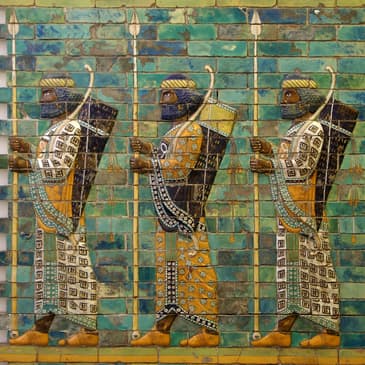
Cover photo adapted from an image by Jakub Hałun (Persian Warriors, Pergamon University, Berlin)
----------
00:12 - Introduction
01:07 - Who were the Persians?
- 01:11 - The ancient Persians, the ancient Iranians, and the Indo-European dispersion
- 02:52 - The Old Persian language (and a digression on Persian names)
- 08:35 - Zoroastrianism and the religion of the ancient Persians
13:59 - The Rise of the Persian Empire
- 14:23 - The Middle East in the 6th Century BCE: Persia and its neighbors
- 16:29 - Herodotus and the legend of Cyrus the Great
- 20:06 - Cyrus the Great and his conquests
- 24:04 - Cyrus’ successors: Cambyses and Darius
- 24:48 - The Persian Empire in 500 BCE
25:12 - The Structure of the Persian Empire
- 25:25 - Cooperative local elites and the obligations of empire
- 26:35 - Satraps, provinces, and the Iranian diaspora
28:45 - The Ideology of the Persian Empire
- 29:04 - Cyrus as champion of local gods in Babylon and Judah
- 30:49 - Darius as champion of Ahura Mazda
32:47 - The Mechanics of Empire in the Age of Darius
- 32:52 - Imperial ideology and imperial violence
- 34:00 - Local elites and imperial entanglements: the story of Syloson of Samos
38:04 - Wrap-up
Hello. Welcome to Have Toga, Will Travel, a podcast exploring the Mediterranean world, ancient and modern, through the eyes of two former classics professors. I'm Emily.
Cam:I'm Cam.
Emily:And we're your hosts. So today we're going to tackle a different part of the ancient world. we're going to look at ancient Persia. Now, the Persian wars have come up several times, but before we really get into talking about the wars themselves, we thought it was important to talk about ancient Persia itself and the Persian Empire, and that's what we're going to do today. So we're going to talk a little bit about who the Persians were, talk about their language and culture, but also their empire, how it comes to be, and what this imperial structure looks like.
Cam:We know there's at least one listener who's really been waiting for this series of episodes. So, Giles, wherever you are, these ones are for you.
Emily:Yes, Giles. We were thinking about you when we put these together.
Cam:All right. So let's start by talking a little bit about who the Persians were. When we use the word Persians in an ancient context, we're really referring to a group of Iranians who settled in the region we know as Parsa, what is now the Fars province of modern Iran. They settled there probably around 1500 BCE. This is an area situated on the east side of the Persian Gulf. Parts of it are mountainous, and parts of it are at the western edge of what we usually call the Iranian Plateau, which extends quite a bit further east all the way up basically to modern Afghanistan. Broadly speaking, the Iranians were peoples with closely related languages and cultural practices who entered what is now modern Iran probably in the second millennium BCE.
Emily:Yeah, and this movement of Iranians was part of a larger kind of linguistic and cultural dispersion that brought people speaking Indo-European languages from somewhere in Central Asia, West through what are now modern-day Iran, modern-day Turkey, and into Europe, and East through what are now Afghanistan and Pakistan into India. And of course, this Indo-European migration is what brings a lot of the languages that we know into Europe and Western and Southern Asia and encompasses the largest modern-day linguistic family.
Cam:When and where this happens remains a point of controversy, which we probably can't get into in a lot of detail here in what is supposed to be only an hour-long podcast. But I have noticed that Indo-Europeans have been in the news a lot lately, since there is a recent study which suggests that their homeland seems to be in the North Caucasus, rather than has been argued more often in recent years east of the Caspian Sea. That's still a point of debate, so only time will tell. But for the moment, let's talk a little bit about the Persian language, and in particular Old Persian, the language the Persians spoke in the period in which they entered into conflicts with the Greek world. Old Persian is a part of the bigger Indo-European language family, which means ultimately it's related to a whole lot of European languages, including English. It belongs to a very specific branch in the Indo-European family, the Indo-Iranian branch, which split from the larger family sometime in the third millennium BCE. And modern Farsi, spoken in contemporary Iran, is a direct descendant of old Persian.
Emily:Of course, the Indo-Iranian branch is also going to give us other languages like Sanskrit and Hindi and things like that.
Cam:Now, even though these different languages in the broader Indo-European family were related to one another, most were not mutually comprehensible. There were real differences between them in terms of syntax, vocabulary, morphology, and most importantly, phonology, that is the basic speech sounds in a language. But because we're nerds, we're going to illustrate differences in phonology by talking a little bit about Persian names and how those names get brought over into other languages.
Emily:So when we—and I say we, I mean us in this moment, but also we collectively— when we use Persian names, we're not actually using the Persian names. The names that we tend to use are, and you can track this, the Latinized version of Hellenized versions of the actual Persian name. And we're going to take you through a few examples of these. First, one of the characters, characters, one of the figures that we have mentioned before—
Cam:He is a character.
Emily:He is a character, that is true. Darius—or in English, you might even hear people say Darius— so this is the Latinized version of the Greek Dareios, which is the Hellenized or Greekified version of the Persian name Darayavahush. And this means in Persian something like holding firm the good. And for the language nerds out there, the name Darayavahush actually shares a common Indo-European root with words we have in English like firm, throne, and dharma.
Cam:Likewise, the name of Darius's son, Xerxes, is the Latinized version of the Greek name Xerxes, which in turn is the Greekified version of the old Persian name Kshyarsha, means something like ruler among kings. And it too shares a common root with words that have come into English, most notably shah, and interestingly enough, checkmate.
Emily:Shamat, the king is dead.
Cam:Oh, okay.
Emily:And then we have the queen that we talked about last time, Atossa. Now, Atossa, hopefully, is the same in Latin and Greek, but her Persian name was actually Hutautha, and it seems to mean something like bestowing richly or well-granting, and it shares a common root with words like euphemism or eugenics, that EU prefix. It might possibly, because the etymology is a little uncertain, it might share a common root with a word like thaw as well.
Cam:And finally, we'll touch on Cyrus, who is one of the main characters we're going to talk about in today's episode. That name comes from the Greek name Kouros, which once again is a Greekified version of an Iranian name, in this case Kurush. But the weird thing here is that this name in its Iranian form may itself be a borrowing from another people who lived nearby the ancient Persians, a people called the Elamites. These were people living in what is now southeastern Iraq, essentially. They spoke a language that doesn't seem to be related to anything else we know.
Emily:Yay, linguistic isolates.
Cam:All right. And in their language, kurash was a word that meant protector or shepherd. And we think this name passed into Persian as Kurush.
Emily:So why do all these linguistic changes happen between languages? A lot of this change happens because one, Greek and Latin are inflected languages. So the ending of the words is what tells you their syntax. And so Greek and Latin will both tweak the endings of names so that it conforms to their noun forms. So for example, O-S, A, and E-S are common endings for names in the nominative case in Greek. But say in Latin, O-S isn't an ending, U-S is. So Latin will take all Greek names that end in OS and turn them into a US. Now that's one reason. The other reason is that Persian contains sounds that just don't exist in Greek. And the Greek, in some ways, is doing its best to try to approximate them. And you can actually see this today if you go to Greece. Modern Greek, for example, lacks sounds like ch and j and ch, right? Which are some of the sounds we heard in these names coming out. So if you've ever had the experience of being in a Greek bar and you order a gin and tonic, if you listen to a Greek person pronounce gin, they're going to say something like tzin because they use the TZ together to try to approximate that sound. And with the CH sound, they'll use a TS. There's a word soureki in Greek, which is actually trying to approximate a word chorek in Turkish. And then with SH, we lived in Chicago for a long time, and Chicago gets rendered in Greek as Sicago. They turn it into an S. And so this is part of the other thing that's happening there, this attempt to render in your language sounds your language doesn't have.
Cam:Now, in terms of culture, one of the things we want to touch on briefly is ancient Persian religion. Loosely speaking, ancient Persian religion can be described as an early form of Zoroastrianism. Although it's a bit of a simplification to use this term, because there are a whole lot of debates about when we can use this term to describe ancient Iranian religion or religious belief.
Emily:The name Zoroastrianism comes from this figure named Zoroaster, or sometimes called Zarathustra. And he is a religious reformer whose life is dated anywhere from the mid-2nd millennium BCE to the 6th century BCE. So a pretty wide range of possible dates here.
Cam:Yeah, that's not a narrow band.
Emily:No. And prior to him, it seems that the ancient Iranian religion was very similar to the historical Vedic religion of what we might call ancient Hinduism.
Cam:Not surprising, because what you're looking at here is a process in which Indo-Iranian speakers and speakers of various languages in India ultimately come from the same root.
Emily:Yeah. Now, Zoroastra's sort of big reform is that he promotes the worship of one god from a pantheon of gods, and that god is called Ahura Mazda, and he marks all the other gods as daivas, which means something like gods to be rejected.
Cam:We're simplifying a lot here, but what this produces essentially is a very dualistic system, a system in which it's believed that reality consists of two fundamentally opposed principles. On the one hand, you've got Ahura Mazda, who is a god associated with wisdom, truth, order, creation, all of that good stuff. And on the other, you have the god Angra Mainyu, sometimes described as The Lie. And this is a figure that represents destruction, anti-creation, disorder, decay, basically all of the bad opposites of the things that Ahura Mazda represents.
Emily:Yeah, it's a very binary opposition.
Cam:Although there are debates about whether or not this system should be categorized as a polytheistic one in which there are a whole bunch of gods, a monotheistic one in which there is one real god, or henotheistic, which is closely related to polytheism, except you're in a universe in which there may be multiple gods, but one of them is clearly paramount.
Emily:And as a result of this binary opposition, Zoroastrianism in this context sort of sees the world as like a battleground between the truth and The Lie. And the world that we live in is this space of like mixture and confusion that needs to be fixed. There's this idea that there had been one perfect world existence, and then The Lie, the sort of evil principle enters and corrupts existence. And that is when eternity, immortality yields to history. And history is the arena in which this battle between the truth and lie is fought. However, Angra Mainyu, The Lie, cannot win this fight because in the end, he is fundamentally incapable of creation because he is anti-creation. And this battle will end eventually, and it will end with the restoration of and the return to eternity, an eternal world. Right.
Cam:But lucky us, we get to suffer along the way. This battle sort of works its way out in the world that we experience.
Emily:Yeah.
Cam:So in this particular view, death and decay constantly pose dangers to life and creation. And human life as we know it, for that reason, is sort of a constant struggle between the bits of us that are immortal and the bits of us that are vulnerable to decay.
Emily:Yeah.
Cam:And that struggle continues even after death, when decay enters the body instantly, and our flesh decays, but our bones stay behind. These are conceptualized as an eternal part of what we are.
Emily:Yeah. And so in ancient Persian religion, the handling of dead bodies is an inherently corrupted profession because you're constantly touching dead bodies, and death is decay, and decay is contagious. And so basically, the bodies would be left out to rot in a particular area away from everything. And then after the flesh was gone, the bones would be collected and buried because those are not subject to decay and therefore you can handle them.
Cam:Ex-carnation.
Emily:Yep. On the metaphysical side, after death, you go to what's called the bridge of judgment and the truthful and the liars are divided. And so the truthful are sent up to the house of the song and the liars are sent down to the house of The Lie to be purified for the moment when everyone will be returned to this sort of uncorrupted eternity.
Cam:Now, as we'll see in a bit more detail later, these religious ideas percolate all through the Persian view of the world around them. Among other things, the Persian saw the world as one organized in what seem to have been concentric circles, with the center as the part of the world closest to Ahura Mazda, and thus, in some sense, the best. And the further you moved out from the center, the more you move into those outward circles, the more degraded things conceptually become. So the good radiates out from the center, which in this particular case was the Persian heartland, roughly, again, the Fars province of modern-day Iran.
Emily:So that's a very rough overview of Persian religion worldview stuff. Cam's never going to forgive me for making him do that religion stuff.
Cam:Not my strongest subject.
Emily:But now we're going to turn in a little more concrete way to the Persian Empire and how the Persian Empire develops. So we're going to start with some context. So we're in the Middle East in the first half of the sixth century BCE. Now this is a very complex geopolitical environment with a history spanning a couple thousand years already. In the first half of the sixth century, the center of gravity is probably Babylon, which is about 50 miles or 80 kilometers south of modern-day Baghdad. And Babylon is the capital of what we call the Neo-Babylonian Empire, which controlled most of what is now Iraq and the Levant, so sort of Syria, Jordan, Israel, and had influence all the way up into what is now modern Turkey. And it's rivaled by Egypt under the Saite dynasty, which is ambitious to rebuild its empire in the Levant.
Cam:To the west, there was a relative newcomer on this scene, the Kingdom of Lydia, which had begun to build an empire of its own in what is now Western Turkey in the early decades of the 6th century BCE. And finally, to the east, in what is now Western Iran, there was the powerful kingdom of the Medes, another Iranian people closely related to the Persians, who probably controlled a fairly extensive network of vassals on the Iranian plateau. Their kingdom was based at ancient Ecbatana, modern-day Hamadan, a city roughly halfway between modern-day Baghdad in central Iraq, and Tehran, the capital of Iran, which is situated about 60 miles or 100 kilometers inland from the southern shore of the Caspian Sea.
Emily:So that's the context. Persia, or ancient Parsa, is the region in the southwest part of what is now Iran, so west of where the Medes are, west and south of where the Medes are. As we mentioned, right, it's more or less the modern Iranian province of Fars, which was on the east side of the Persian Gulf. And it seems that ancient Persia was actually several separate polities in antiquity, most of which in that moment were probably vassals of the king of the Medes to a certain extent.
Cam:Now, by the middle of the 6th century, the ruler of one of these polities in ancient Persia, specifically a place called Anshan, was the guy we now know as Cyrus the Great, that is Kurush, to give him his ancient Persian name. We have a bunch of stories about his childhood, none of which, interestingly enough, are actually written by ancient Iranians. The stories we have all come from Greek authors. It's a weird feature of the Persian Empire that they did not have a native tradition of writing history. The most important Greek version we have is the version we find in Herodotus, the great Greek historian of the middle 5th century BCE. And according to Herodotus, Cyrus was actually the grandson of the ruler of the Medes, a guy named Astyages, who, apart from being Cyrus's grandfather, was also Cyrus's overlord. Herodotus's stories about Cyrus draw on what is clearly folklore, And as such, they're pretty colorful.
Emily:Yeah, so Herodotus tells a few stories about dreams that Astyages has about his daughter, who is Cyrus's mother. And one of them is that he has a dream that she urinates and floods all of Asia with her urine.
Cam:Yeah, it's a disturbing dream, I imagine. And Astyages and his advisors interpret it to mean that if he has a grandchild through this particular daughter, that child will rise to rule all of Asia, which Astyages does not like. And he views this as a threat to his own power. So what he decides to do is marry off his daughter, to whom Herodotus gives the name Mandane, to a nobody. In this case, to the Persian ruler of this dinky little place, which we know as Anshan.
Emily:So after he marries his daughter off, our friend Astyages, Herodotus tells us, has another dream about his daughter, wherein a vine sprouts from her womb and grows to spread all over Asia.
Cam:Another pretty disturbing dream. And this dream, in the view of Astyages and his advisors, just reinforces the theme of the first dream. Astyages has tried to marry off his daughter to a nobody, but that daughter is still going to bear a son that will come to rule all of Asia. Again, Astyages doesn't like this, so he decides to act a bit more directly. He decides he's going to recall his daughter to court, and when the child is born, he'll kill that child by exposing it.
Emily:This never works in ancient stories.
Cam:It really doesn't, so don't be shocked when it doesn't work in this particular story either.
Emily:Astyages makes one of the classic blunders. So after the child is born, he gives a child to one of his advisors, Harpagus, to expose. Harpagus gives it to a shepherd to expose. And the shepherd instead takes the baby home to his wife. "I've got this kid I'm supposed to expose." And she's like, "well, my child just died. We'll keep this one instead and just raise this one as our own." And her name, interestingly, Herodotus gives it as kynē, which means female dog in Greek.
Cam:Yeah, a lot of overlap with other stories that you may have heard about other famous figures in antiquity. So the one that all you Latin kids will probably know by heart is the story of Romulus and Remus being suckled by a she-wolf.
Emily:Yes, and wolves and dogs not that far apart.
Cam:No, so here is our female dog basically rearing the abandoned child. Very, very common story pattern.
Emily:Yeah.
Cam:So Cyrus survives.
Emily:Now, if all of this is true, clearly Cyrus's relationship with his grandfather didn't get off to a great start. And that's going to kind of show in that, you know, in the late 550s BCE, Cyrus, who has regained his status as a child of Mandane, attacks and overthrows his grandfather, Astyages. And presumably, he is then able to assert his own authority over Astyages' former vassals and laying down the foundation for what would become the Persian Empire, functionally by taking over the Median Empire.
Cam:Now, from there, according to Herodotus, Cyrus expanded his young empire quickly, beginning in the 540s with a war against the young Lydian kingdom in what is now Western Turkey. This war, we're told, was triggered in part by the ambitions of the Lydian king, a guy named Croesus, who was trying to expand his own little burgeoning empire into central and eastern Anatolia, where Cyrus may have had vassals already. And those ambitions, it seems, prompted Cyrus to attack.
Emily:Now, Croesus himself gets some fun little stories in Herodotus too. In particular, there's the somewhat famous one where Croesus, before he goes to war against the Persians, first he tests all of the oracles in the known world. And it comes back that the Delphic oracle is the only one that's reliable. So he then asks the Delphic oracle, all right, well, should I go to war against the Persians? And gets the message back, if you go to war against the Persians, a great empire will fall. And Croesus is like, great, let's do it.
Cam:Another classic mistake here.
Emily:Yeah, because in the early to mid 540s, Cyrus is going to overwhelm the Lydian kingdom, probably has Croesus executed, and then of course imposes his authority over Croesus's former imperial subjects, including, and we'll get into a bit more detail in this later, Greek cities on the west coast of Anatolia.
Cam:So with his defeat of Croesus, Cyrus controlled an extent of territory that consisted now probably of most of western Iran and most of what is now modern Turkey. But he wasn't yet done. Next, he took on the Neo-Babylonian Empire. He fought a decisive battle in October of 539 BCE, sacked and destroyed a place called Opus, not too far from Babylon itself, massacring and enslaving its population. The sheer scale of the violence he doled out in this particular occasion prompted the Babylonian elite to depose their own ruler, a guy named Nabonidus, and to open the gates to Cyrus. Cyrus's capture of Babylon in 539 brought the entirety of what we call the Neo-Babylonian Empire into Cyrus's hands. That is, most of Iraq and most of the Levant.
Emily:Cyrus is then going to spend the next few years probably fighting to bring what is now eastern Iran and parts of Central Asia into his empire. And this leads to campaigns in ancient Bactria, which is more or less modern-day Afghanistan, and Sogdiana, which is roughly modern-day eastern Uzbekistan and western Tajikistan. And it seems that Cyrus is probably killed during these campaigns somewhere around 530.
Cam:And that brings us to one last great story from Herodotus. There's a recurring theme in Herodotus' story about Cyrus, that Cyrus goes too far at the end of his life, tries to conquer territories that don't belong to him, including the territory of a queen named Tomyris. She, of course, doesn't like this, and she tells him directly that she'll sate his thirst for blood. And in the end, she does. When she and her followers defeat Cyrus in a final climactic battle, she has his head cut off, and she shoves it into a wineskin full of blood and sort of taunts it by saying, ha ha, I told you I'd quench your thirst for blood.
Emily:I kind of wish she had just drunk his blood out of his skull. I think that would have been kind of badass.
Cam:That probably would have been a bit more satisfying, yeah. But we can't choose the stories that Herodotus tells us. Anyway, once Cyrus was dead, his immediate successors continued conquests that drove the expansion of the Persian Empire. His son Cambyses personally led a campaign that resulted in the conquest of Egypt in the 520s. When Cambyses in his turn died rather young, in about 525, power was usurped by Darius the Great, who, to be honest, probably murdered Cambyses' brother in order to get power himself. And Darius and his generals pushed the frontiers of the empire out further in several directions. In Libya, in the southwest, in the Indus Valley, essentially modern Pakistan in the far East, and in the Black Sea, where Darius campaigned in what is now Romania and Bulgaria.
Emily:So by 500, the Persian Empire was the largest empire in the history of the world to that point. It stretched from Egypt to the Black and Aegean seas in the West, all the way to what is now Pakistan in the East. It really was a true world empire that incorporated tens of millions of people with an almost unbelievable diversity of languages, religions, and cultures.
Cam:The sheer size and diversity of the empire brings us to our next major question. How was this thing organized? As we've mentioned, at its height, the empire encompassed a whole bunch of different peoples and cultures. There was never any real intention to make everyone within the empire Persian, whether in culture, in language, or religion. Nevertheless, power was centralized in the king, who governed with the help of a couple of groups of people. First of all, cooperative local elites or rulers who had been incorporated into the empire along with their peoples, and governors called satraps who were the king's representatives in larger regions that we might as well just call provinces.
Emily:Now, these cooperative local elites or rulers were critical because it was hard for the Persians, or really for any empire, to manage the conquered peoples or polities directly. So instead, what they do is they impose obligations on conquered peoples and then expected the local rulers or governments to deliver on those obligations. And those obligations are military service and tribute, in this case, usually paid in gold or silver.
Cam:Right. This is a tribute in the sense in which was meant before the Hunger Games came along and redefined the term for people of a certain generation.
Emily:That generation is not yours.
Cam:It's not mine, no. Satraps, on the other hand, were officials who kept watch over large provinces that could encompass a whole bunch of different conquered states or peoples. And they were put into place basically because the massive extent of the empire meant that the king really needed a way to assert power in places that he couldn't be physically.
Emily:Yeah, it's about 1600 miles by road from western Turkey to Persepolis, which is Darius's ceremonial capital. And it's about the same distance from there to the eastern reaches of Afghanistan, to the other border functionally.
Cam:Right. Those are huge distances by the standards of ancient empires. It could take up to two weeks for a fast messenger to get from one frontier to the center. So one of the things the Persians did was, again, create a bunch of provinces, at least 20 in the early to mid-5th century, governed by these satraps.
Emily:So you mentioned the Persian couriers, right? And actually, the US Postal Service takes its motto from Herodotus' description of those Persian couriers, like the official, I guess, mail service of ancient Persia, that neither rain nor slow nor sleet nor dead of night. I don't know the rest of it.
Cam:No, but you're right that it is almost a word-for-word quotation from Herodotus.
Emily:Yes, describing the Persian courier service, which, of course, that kind of communication is critical in an empire that large.
Cam:Sounds like a subject for an episode at some point in the future.
Emily:Perhaps. Anyhow, back to the satraps. The satraps' job is to make sure that the subjects in their province pay their tribute and supply soldiers when necessary. And they're also responsible for suppressing rebels in their province and protecting the frontiers. And the satrap is actually, again, another Greek rendition of a Persian title, xšaçapāvan, which means something like protector of the realm.
Cam:Yeah, and they were there in the provinces, supported by members of a larger Persian and Iranian diaspora. Basically, other aristocratic Persians and or Iranians were given lands in conquered territories by the king, as were military colonists who sometimes held land in exchange for explicit promises to provide military services in order to help keep conquered populations down.
Emily:Now, behind the logistics of organizing an empire like this, there's also an underlying ideology that helps the empire justify what it's doing. And empires that last do so not just because of their military power, but because they develop an ideology to justify their existence. And the Persian Empire is no different. The main argument that gets developed by Cyrus and Cambyses was that they conquered in order to defend traditional local gods. So Cyrus, for instance, presented himself in Babylon as the champion of that city's god, Marduk, that he was chosen by the god himself to punish the last neo-Babylonian king who, as the argument went, had not lived up to his obligations to his god and his people.
Cam:And more famously, Cyrus presented himself as the champion of the Hebrew God when he ordered the rebuilding of the temple in Jerusalem and released captives who had been taken from Judah to Babylon after Nebuchadrezzar II sacked Jerusalem in 586 BCE. And that's basically how he gets remembered, interestingly enough, in the Old Testimony. The Old Testimony.
Emily:It's been a long time since that Catholic school upbringing, isn't it?
Cam:That's how he gets remembered in the Old Testament. There we go. In the book of Isaiah.
Emily:Your great, great uncle, the monsignor, if he were still alive, would not be happy to hear that.
Cam:Yes, yes, he would weep. Anyway. So in the book of Isaiah, we get Cyrus described, right? "Thus says the Lord to Cyrus, you shall be my shepherd to carry out all my purpose, so that Jerusalem may be rebuilt and the foundations of the temple may be laid. Thus says the Lord to Cyrus, his anointed." So that's a pretty clear and solid example of Cyrus using local religious beliefs, using local traditions to his own advantage to present himself as a ruler who will truly champion the interests of populations that had, in his view, been oppressed by his rivals.
Emily:Now, this ideology continues to be developed further under Darius, and here we see strong evidence for a more elaborate ideology that builds on Cyrus's presentation by invoking Persian religious themes specifically. So in his inscriptions, Darius presents himself as Ahura Mazda's representative on earth. He is chosen by the god to fight back Angra Mainyu and the forces of chaos and to bring order, peace, and justice to the world and to his grateful subjects. And in a very famous relief sculpture carved on Darius's tomb, those subjects, the disparate peoples of the empire, come together to raise and support a dais on which the figure of Darius stands.
Cam:It's a pretty powerful image. It makes the argument that the subjects consent to Darius's rule, that they recognize the benefits of empire. And this is an argument that Darius's successors, starting with his son Xerxes, basically build on.
Emily:Yeah. It weirdly reminds me of the depiction of the Leviathan from Hobbes's Leviathan.
Cam:Yeah, no, I can see that. Yeah. Funny, I always look at it and I see a bunch of Smurfs holding up the King Smurf, but I guess that maybe just reflects something about our different upbringings.
Emily:I really want to know why you think the people look like Smurfs. Are they blue?
Cam:That's the hats that a lot of them are wearing.
Emily:Oh, the hats, right. Okay. Now, it is easy to look at these imperial ideologies and think that they are purely self-serving, right? These are the things you say to convince people that you aren't like a total sociopath as you conquer them, but you don't really believe them. Now, that view may be true, but it may go a little too far because it is entirely possible that someone like Darius did actually believe the ideological arguments he was making. He might actually believe he is Ahura Mazda's representative on earth.
Cam:Yeah, this is a question that we can't ultimately answer, right? Because you can't get into their heads to really see what they were thinking. But for our purposes, what's important here is that even when the imperial rulers believed that they were bringing peace in order to the world by conquering everybody and forcing them into their empires, that process, of course, produces a whole lot of violence. And that's true of pretty much every empire in world history. I don't care if we're talking about the Athenian Empire, the Roman Empire, whatever.
Emily:The British Empire.
Cam:The British empire—Persian empire was really no exception here. And most obviously, it was created initially through war and conquest, which was often incredibly violent.
Emily:But at the same time, it continues to generate violence, since the king and his supporters could be quick to label those outside the empire, and even those within the empire who weren't so happy with Persian rule, as allies of chaos or as people misled by Angra Mainyu who need to be suppressed or who need to be
Cam:brought back into the light forcefully. Right. It's easy to fall into that kind of pattern when your worldview is fundamentally one in which the forces of light are constantly engaged in this existential battle with the forces of chaos.
Emily:Yeah.
Cam:But at the same time, because the Persian Empire, like other empires, depended fundamentally on cooperative local elites, who often benefited personally from creating relationships with imperial rulers, local political figures in areas both inside or outside the empire often invited imperial involvement— imperial entanglement, to quote a wise man from Star Wars— along with the violence it entailed, often to help them get the upper hand in their local political struggles, but of course with massive consequences for everybody else living in their communities.
Emily:Yeah. And so Herodotus, again, has a story about this. In this case, it's a story of Darius and a Greek aristocrat named Syloson that shows how local politicians could pull in imperial might even outside of the empire. So to set the story up, here's some context. So it's the beginning of the 6th century. The west coast of Anatolia, what is now Turkey, was home to several dozen Greek city states. Fun fact, the central part of western Turkey here was known in antiquity as Ionia, which is actually where the Persians get their name for the Greeks in general. They called the Greeks Yauna after Ionia. Anyway, the Greek city-states in this part of the world were conquered by Croesus and incorporated into the Lydian Empire he ruled in the first half of the 6th century. And then in the 540s, After Cyrus defeated Croesus and the Lydian Empire, the Greek city-states were reconquered by the Persians after they tried to reclaim their autonomy and were then integrated into the Persian Empire.
Cam:Now, the Greek islands just off the coast of what is now Western Turkey were not conquered at this point. But they definitely came under the influence of this massive empire that had just annexed all of mainland Ionia into its structure. Our friend Syloson was a Greek from one of these islands, specifically a Greek from the island of Samos, which is just off the coast of Anatolia. His brother, Polycrates, was the island's ruler, in Greek parlance, a tyrant. When Cambyses invaded Egypt and levied ships and soldiers from Greek subject states in western Anatolia to support his campaign, a whole bunch of adventurers from Greek islands that were not yet under Persian control also went along, thinking this would be a great time, including our friend Syloson. And according to Herodotus, while Syloson was in Egypt, he met the future Persian king Darius, who at that point was a member of Cambyses' royal guard. And the story we get is that they got to chatting and Darius really, really liked the scarlet cloak that Syloson was wearing. In a fit of generosity, Syloson took it off and presented it to Darius as a gift.
Emily:Now, flash forward a few years. Syloson has now been exiled from Samos after the death of his brother, the tyrant, and he is eager to return and claim power himself. And so he presents himself at the court of Darius, who is now the Persian king, and asks for a favor. He would like the island of Samos. Darius agrees and sends a military force to capture the island on Syloson's behalf, which he did. And after a fairly bloody invasion that, as Herodotus claims, resulted in the massacre and enslavement of many Samians, Syloson is put in charge and then governs his native island for several years, presumably as a loyal ruler of a subject state in the Persian Empire.
Cam:So it's a great little story, by some measure of great. Syloson gets what he wanted, restoration to Samos, and political power. Darius too gets what he wants, another territory folded into the empire, brought under the just and loving care of the Persians, governed by someone who would preserve imperial order on Darius's behalf. And the only real losers here, of course, are the Samians, many of whom were now dead, enslaved, or subjects of both Syloson and the Persians, whether they wanted to be or not.
Emily:And the Syloson story is not just like a one-off example. Listeners who've been following us from the beginning might see similarities between this story, and the story of Hippias, the Athenian tyrant whom Darius had hoped to reinstall at Athens when the Persians landed at Marathon in 490.
Cam:And in the next couple of episodes, we're going to talk in a lot more detail about Persian relationships with Greek city-states on the western frontier of their empire, and trace the origins of both Darius's campaign against Athens in 490, and his son Xerxes' campaign against the entirety of Greece 10 years later.
Emily:The events known as The Persian Wars.
Cam:So I guess that's it for today.
Emily:I'm Emily.
Cam:I'm Cam.
Emily:And this has been Have Toga Will Travel. Subscribe to our show wherever you get your favorite podcasts, and follow us at havetogawilltravel.com or on all the socials. And if you have any questions or any topics you'd like to see us cover, please feel free to reach out.
Cam:And if you liked this episode, tell a friend about us. Thanks for listening, everybody.