Emily and Cam continue their discussion of the conflict between the Persians and the ancient Greek world. In this episode, they chat about Cyrus’ son Cambyses, about the rise to power of Darius, and about Darius’ relationships with Greeks on the western frontier of his empire.
Visit our homepage to subscribe, to find us on social media, and to contact us by email:
Episode Links
The first episode in this series (The Persians and the Greeks, Part I: The Rise of the Persian Empire).
Part I of our series on the Athens Marathon, which includes a discussion of the Battle of Marathon and the legend of Pheidippides.
Wikipedia’s article on Darius’ Bisitun Inscription, which includes photos.
Image credits:
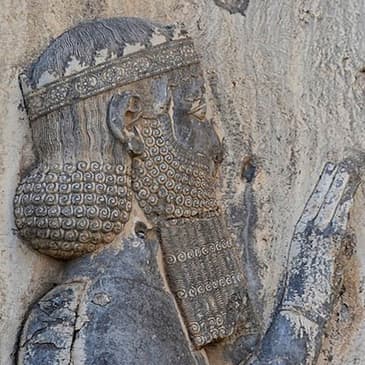
Cover / instagram image adapted from a photo by Lee van Dorp (Wikimedia Commons), which shows a closeup of Darius as he is depicted on the Bisitun Inscription.
Social sharing image adapted from a photo by Korosh091 (Wikimedia Commons), which shows the Bisitun Inscription's main relief.
----------
00:13 - Introduction
01:31 - Sources for the reigns of Cambyses and Darius
03:01 - Cambyses, son of Cyrus: portraits of his Reign
03:27 - Herodotus’ take on Cambyses: a mad and murderous king
11:59 - A more sympathetic take: the Apis inscriptions, the Udjahorresnet inscription, and what they tell us about Cambyses
16:35 - The Death of Cambyses and the rise of Darius
17:01 - Herodotus’ tale of the usurper Smerdis and the (Persian) Magnificent Seven
21:06 - Darius’ Bisitun Inscription and the “Official” story of his rise to power
28:02 - Darius and the Greeks
28:41 - Darius’ Scythian Expedition and the Greeks of Ionia and Aeolia
32:01 - The Ionian Revolt and its causes: Aristagoras and Naxos, plus the problem of tyranny, tribute, and triremes
39:39 - The Athenians and the sack of Sardis
43:00 - The Marathon Campaign: Darius seeks revenge
44:58 - Wrap-up
Hello. Welcome to Have Toga Will Travel, a podcast exploring the Mediterranean world, ancient and modern, through the eyes of two former classics professors. I'm Emily.
Cam:I'm Cam.
Emily:And we're your hosts. Now last time we talked about the rise and expansion of the Persian Empire. Today, we're going to expand on that a bit more as we wade into what are normally called the Greek and Persian Wars.
Cam:That means we're going to focus more on the rise of Darius, who is the Persian king who first invaded the Greek mainland.
Emily:Now, today's discussion will have a lot to say about Darius' relationships with the Greeks, and will set up at least one more episode, maybe more than that, in this series, which will focus on Darius' son Xerxes and the well-known battles of Thermopylae and Salamis.
Cam:It's also going to give us a chance to explore the ways in which some of our historical sources diverge from one another and or agree with one another. And the stories of Darius' rise to power illustrate those issues really well. So what we'll do is spend a couple of minutes talking about the sources. Then as an entry point into our discussion of the rise of Darius as king, we'll talk a little bit about Cambyses, the son of Cyrus. And finally, we'll turn to Darius himself and talk in some detail about his relationship with the Greek world.
Emily:So when it comes to sources, our main narrative source is primarily Herodotus. This is the Greek historian who writes a history of the Greeks' relationships with the Persians and tries to understand how the Persian Wars came to happen.
Cam:Arguably one of the greatest writers in the history of the world.
Emily:Oh yeah, no doubt. Herodotus is interested primarily in historical causation, right? Why things happen. And to compile his histories, he interviews lots of people to gather stories about events and the key players in those events. Now, the accounts he gathers are not necessarily reliable, but he feels compelled to present what he hears. And in some cases, he doesn't think the stories he's telling are reliable either. He'll tell you that, like, this is what they told me, but I don't know.
Cam:When it comes to Darius, Herodotus seems to have inherited both official Persian stories, and I say official in scare quotes, that tended to be pro-Darius, as well as some other traditions, mostly Egyptian, that took a pretty dim view of Cambyses, the son of Cyrus, the Persian king whose death ultimately brought Darius to the throne.
Emily:On the other hand, we also have other evidence in the form of inscriptions, both in what is now Iran and in Egypt, and even a few documents from Egypt preserved on papyrus. Now, these are really interesting because they don't always align with the narratives that we find in Herodotus that he's getting from his sources.
Cam:So the story of Darius's rise to power really begins with Cambyses. And the stories about Cambyses really do allow us to explore some of the issues about sources that we've already raised. To remind you where we are, Cambyses was the son of Cyrus the Great, founder of the Persian Empire, and became king when his father died around 530 BCE, probably fighting off somewhere in eastern Iran.
Emily:So as we mentioned last time, Cambyses, while he's king, invades and conquers Egypt. And as we mentioned in the story of Syloson, Darius was one of his guard on this campaign. Now, Herodotus portrays Cambyses as someone who is mentally unwell, who is prone to excessive behavior, and who dies in a way meant to emphasize that the gods have, let's say, a keen sense of irony.
Cam:To give you a flavor of some of the stories Herodotus tells about Cambyses, we can start with the story of the Apis Bull.
Emily:I love this story.
Cam:It's a great story.
Emily:And not just because I passed my Greek language exam in grad school because I knew this story.
Cam:Right, let's not confess to the world how rusty your Greek language skills were at that particular moment in time.
Emily:Hey, whatever, man. I got lucky and I worked it.
Cam:So Apis, if you don't know who he was, was a god, essentially the son of Hathor, who is an Egyptian goddess who, among other things, is the symbolic mother of the pharaohs. And Apis had a habit of being incarnated into the world in the form of a calf who was identified shortly after birth because of a particular set of markings it carried on its head, which marked it out as divine, as the incarnation of a god. And when this calf was discovered, it was essentially adopted by the priests and given the sort of life appropriate to a god made manifest on earth, you know, getting its pick of whatever it is cows eat, that kind of stuff. I don't know, what else do cows aspire to do?
Emily:I mean bulls aspire to a few other things i'm guessing.
Cam:So they probably get their pick of cows as well i'm guessing?
Emily:Heiffers, yeah. Anyhow, so during the reign of Cambyses an Apis Bull is born and Cambyses kind of loses his cool a little bit when he comes back to Egypt from attempting to invade Ethiopia. That invasion had failed. He comes back in the middle of a festival, welcoming a new Apis Bull. And he gets, let's say, a little annoyed because he thinks the Egyptians are making fun of his failure. And he tries and fails to kill the Apis Bull, but he wounds the Apis Bull in the leg and it dies a few days later. Cow killer! Sorry, I can just see that scene from Oh Brother.
Cam:Yeah, it's an interesting story because, you know, the reason Cambyses flips out is he can't believe that the Egyptians believe that this calf is actually a god. So he makes fun of their religious beliefs and ends up killing the calf.
Emily:Yeah.
Cam:And also flogs the priests and executes a bunch of the Egyptians who happen to be there celebrating the discovery of the new Apis Bull.
Emily:Everything is obviously about Cambyses.
Cam:Everything, yeah. Ah, narcissism.
Emily:Yep.
Cam:But this reflects back directly on something we had mentioned in our last episode, and that is that Cyrus and Cambyses, perhaps, and Darius, all of these kings presented themselves to some extent as the defenders of local gods. And in this particular story, what you have is Cambyses violating that strategy. And the story, therefore, sort of casts Cambyses as unworthy of being a king.
Emily:Now, this is not the only unsavory thing that Cambyses gets up to. Herodotus also tells us that Cambyses murdered his brother Smerdis, sometimes called Bardiya— we get two different names for this person in the sources. We're mostly going to call him Smerdis. But he murders him in a fit of rage and paranoia. Can't imagine where we've seen those two characteristics already come up about Cambyses. Anyhow, Cambyses gets angry here because the Ethiopian king had taunted him before he tried to invade Ethiopia, right, the invasion that failed, by giving his bow over to the Persians and saying, you can invade my country when some Persian can string and draw this as effortlessly as I can. Now, unfortunately for Smerdis, he is the Persian who gets further than any other Persian in stringing it. He strings it. He even manages to draw it a couple inches. So good for him.
Cam:Now, enraged by this, because of course it marks out his own failure—
Emily:Yes, of course. Cambyses did not do as well as his brother did.
Cam:He did not. So Cambyses freaks out a bit and sends Smerdis back to Persia. He's dismissed from the Egyptian expedition. But after Cambyses sends his brother home, he has a dream. And in this dream, Smerdis sits on Cambyses' throne in Persia and his head touches the sky. This is a dream that doesn't take a whole lot to interpret accurately, I don't think. Cambyses is worried that his brother is going to usurp the throne, basically, and become king. So Cambyses decides to get a jump on Smerdis before this can happen, and he orders his henchman Prexaspes to murder his brother, which Prexaspes does. It's convenient, I suppose, when you have a guy who has the title henchman, and you can just dispatch him on all these errands like this.
Emily:Was henchman his title?
Cam:Well, in my head, it was his title. Yes. I mean...
Emily:I was like, is this a formal thing in the Persian court? "I'm the henchman!" I mean, he's a Persian king. He has a lot of henchmen.
Cam:Yeah, he does have a lot of henchmen. This is getting us into the weeds. But later sources do talk about officials who have titles like the king's eyes, things like that. So there are these quote unquote special agents, if we want to think about them that way, who get up to shady business on the king's behalf.
Emily:Okay. Now, beyond these two stories, I mean, Cambyses generally gets up to a bunch of other, like, bad stuff. Among other things, he actually is going to go on to kill Prexaspes' son, right? The guy who just killed his own brother for him.
Cam:This is a great way to reward somebody who does your dirty work for you.
Emily:Yeah. He gets angry—here's a theme—when he learns from Praxaspes that Persians suspect that Cambyses is maybe drinking too much and starting to lose it. And so he declares that he will prove he is in full command of himself by shooting an arrow at Praxaspes's son. Now note, Praxaspes is just relaying the message. Anyway, he decides that if he can shoot Praxaspes's son through the heart, then clearly he has all his faculties, and he successfully does so.
Cam:Which clearly proves that he's totally sane.
Emily:Yes. Talk about a heads I win, tails you lose. If she drowns, she's not a witch.
Cam:Yes.
Emily:Like, yeah.
Cam:And then finally, according to Herodotus, after carrying on in this kind of way, Cambyses finally gets the death that he deserves. This is a bit of a long story, and it starts when Cambyses learns that a man who looks exactly like his dead brother Smerdis, and who even has the same name, is claiming to be his brother, and hence the legitimate king of Persia.
Emily:Now, Herodotus tells us that this guy, the false Smerdis, if you will, was a religious official known as a magus. Now, a magus is probably a member of a hereditary priestly class, and it's the word from which we derive the word magician. This magus is also not a Persian. He's a Mede, and he is the sort of usurper, claimer of this false identity.
Cam:Now, when Cambyses figures out what has happened, he jumps on his horse, intending to ride back to Persia and to fight for what is his, drive out the usurper. But inconveniently for him, the bottom of his scabbard pops off as he's jumping up onto the horse, and he accidentally stabs himself with the exposed tip of his sword in the leg—interestingly enough, exactly in the same spot where he had stabbed the apis calf.
Emily:Now, the wound is not immediately fatal, but it goes septic, and Cambyses dies. Not, however, before confessing that he has killed the real Smerdis, and the man claiming to be his brother is an imposter, right? Because he had had his brother killed secretly. And as a result, no one believes him when he says that this is an imposter claiming the throne. But with the death of Cambyses, this false Smerdis, if you will, is able to claim outright the kingship of Persia.
Cam:Now, in all of these stories, Herodotus is clearly making Cambyses out to be a bad king, right? Somebody who is unworthy to wield power because he abuses his subjects, Egyptian and Persian, and his own friends and his family. But this is where things get a little bit interesting because other bits of evidence complicate this picture in various ways. Above all, they suggest that Cambyses fell victim to a couple of hostile traditions, one Egyptian and one Persian, and that these hostile traditions made their way into Herodotus' research.
Emily:So we'll start with the Egyptian evidence, right? And this evidence paints a picture of a king who sought to fulfill his religious obligations as ruler of Egypt, but who also unavoidably made some enemies in the process.
Cam:Right, we have several inscriptions from Egypt which kind of make that point. The first is an inscription on the mortuary statue of a guy named Udjahorresnet. This was an Egyptian official who earned titles and status in Cambyses' court after Cambyses took power in Egypt. He depicts Cambyses as a pious king who was eager to worship and protect the goddess Neith, an important goddess who was honored at Sais. That's a place in the northern delta, about 70 miles to the northwest of modern Cairo, which was the home of the Saite dynasty, the last native Egyptian dynasty to rule Egypt. Udjahorresnet is also the guy responsible for composing Cambyses' name and titles as a pharaoh. The name Cambyses used, just in case you're curious, and I know you're burning with curiosity, was Mesutire, a name that translates roughly to the offspring of Ra, the sun god.
Emily:We also have inscriptions commemorating a dead Apis Bull from the reign of Cambyses. Now, Apis Bulls, when they died, were mummified and interned in sarcophagi at Saqqara, which is about 10 miles south of modern Cairo. The sarcophagus of one of the Apis Bulls buried there is inscribed with the name and titles Cambyses used in his role as pharaoh, as is a commemorative stele there as well. And these suggest that the adult Apis that died in Cambyses' reign was buried with full royal honors, sponsored by the king, that is Cambyses. And so interesting, right, that there is an Apis bull that does die during the reign of Cambyses, but he doesn't seem so hostile towards it in the inscriptions that survive.
Cam:Yeah, you know, and it doesn't, I guess, prove that the story told by Herodotus is wrong, but it's enough to make us skeptical, I think.
Emily:Yeah, yeah.
Cam:So added to that, we have at least one interesting document preserved on a papyrus, which possibly illustrates that Cambyses, even if he tried to be a king who honored his religious obligations, nevertheless struggled with a problem that was really common in a lot of empires. Namely, in any state conquered by an imperial power, some members of the local elite will emerge as winners, basically by cooperating with or accommodating themselves to the new regime, while others become losers, basically by opposing the new order, and get kind of angry about this. And what we have from Egypt is an old edict issued by Cambyses, which survives on the reverse side of a later document. So the original papyrus was reused. And what this document suggests is that Cambyses may have tried to reduce the amount of commodities to which some temples were entitled by custom. The details here are a little bit murky, but you can imagine that while people like Udjahorresnet did well under Cambyses, these people who accommodated themselves to the regime and earned titles and status, at least some important religious priests were losers in the way things were reshuffled after the Persians took power and were hostile to Cambyses, to his administration, and ultimately to his memory after he was dead.
Emily:And we know that Herodotus did extensive inquiries in Egypt in preparing his histories, and he very may well have picked up on that negative tradition. The Egyptian priests really were keepers of the historical tradition there anyway. So it would make sense that he talked to priests and that he talked to priests that had this negative view. And this is especially pertinent given how Persian sources deal with Cambyses. So the Persian take on Cambyses is a little more complicated. But to understand why, we need to talk a little bit about what happened after Cambyses dies. Now, the short, short version is that Darius became king after killing a rival who claimed to be Cambyses' brother. Now, naturally, Darius argues that his rival's claim to the throne was false, and his was true, and thus he is the rightful king.
Cam:Now, a version of this story found its way to Herodotus, who gives us a masterful narrative full of the kind of colorful detail for which Herodotus is justly famous. We've already mentioned one of the key details. A magus, who also happened to be Median rather than Persian, but who looked exactly like Cambyses' brother Smerdis and appears to have had the same name, declared himself king after Cambyses secretly had the real Smerdis, his brother, killed. Now, according to Herodotus, the false Smerdis' scheme was finally exposed because a Persian aristocrat, Otanes, got a little suspicious that this wasn't necessarily Cyrus's son. Further, and this becomes an important, if somewhat bizarre, detail in the story, Otanes remembered that the Magus, Smerdis, had committed a crime of some sort in the past, and that Cyrus had had him punished by cutting off his ears.
Emily:Now, coincidentally, Otanis's daughter, Phaedymia, had been one of Cambyses's wives, And she, like all the rest of Cambyses' wives, were claimed in turn as wives by the new king, who married them partly to help establish his legitimacy. So Otanes gives his daughter a mission. Wait until the king is asleep, and then feel under his headdress to see if he had ears.
Cam:Why he goes to bed with a headdress is a detail that is left unexplained by Herodotus, just in case you're curious.
Emily:Yes. The best I can come up with is that, really elaborate hairstyles trying to protect them while you sleep, possibly.
Cam:That's possible, but also he has no ears, right? So he's trying to disguise that from people.
Emily:Yeah, but didn't the Persians like rock the long hair?
Cam:They did, yes.
Emily:And there is some serious hairstyling going on in those images that we get of them.
Cam:Fair enough.
Emily:Anyhow, details aside, Phaedymia follows her father's instructions and discovers that her husband Smerdis has no ears, and she relays this information to her father.
Cam:Otanes now knows that the king is an imposter and not actually the son of Cyrus. So he decides he has to do something. Not only has Cyrus's legitimate dynasty been overthrown, but now there's a Mede on the throne instead of a Persian, and that clearly can't stand. So Otanes recruits six other helpers, including Darius. And together, these seven men enter the palace, manage to gain access to the king, and kill him along with his immediate supporters. Otanes, Darius, and the five other conspirators then debate what form of government would be best for the Persians. There's an argument for democracy, there's an argument for some kind of aristocratic government, but the solution they finally settle on, thanks largely to Darius' argument, is monarchy. There will once again be a king. conveniently enough for Derise.
Emily:This is one of those parts of Herodotus that kind of reminds me of Thucydides when you're like, yeah, this never happened.
Cam:The funny thing is that Herodotus tells you right at the beginning, people never believe me when I tell this story, but it really did happen.
Emily:Yeah. Yeah. I mean, sure, Herodotus.
Cam:Who knows?
Emily:I mean, I love Herodotus, but like, I just, I can't, I can't go with him on that one.
Cam:In any case.
Emily:Yeah. So after this debate, all seven men agree that the king will be chosen randomly from the seven of them. They're all going to assemble on horseback at dawn, except for Otanes— Otanis himself actually opts out of the opportunity to become king. And what they decide, they're going to meet at dawn, and the rider of the first horse to neigh will be the king. Now, Darius, with the help of his groom, decides to game the system. So the groom makes sure to conceal a mare nearby that Darius's stallion really, really likes. And so Darius's stallion, sensing the mare, is the first to neigh, and Darius becomes king.
Cam:Hey, presto. Now, most of this story sounds completely ridiculous, probably because it is. But what's really funny here is that the core elements actually replicate some of Darius's own claims about how he became king, claims which Darius himself memorialized on the Bisitun inscription. Now, the Bisitun inscription is an inscription high up on a cliff, about halfway between modern Baghdad and modern Hamadan. It's a trilingual inscription. That is, it's carved in three languages: Old Persian, Akkadian, and Elamite. And for all you nerds out there, here's your great bit of trivia for the day. This is essentially the Rosetta Stone of cuneiform writing systems. The Old Persian can be deciphered rather easily because it's closely related to later forms of Persian.
Emily:And it's, yeah, Indo-European.
Cam:Exactly. And once scholars had a handle on how Old Persian was being represented in the cuneiform writing system used on the inscription, they were then able to decipher the other two languages. And now, thanks to that, we can read Akkadian and Elamite as well.
Emily:Although it took over a century to complete that decipherment. The Rosetta Stone was like 20 years or something. That went really fast. But the cuneiform took a lot longer because there was just a lot less to work with.
Cam:Yeah. And Akkadian and Elamite are also pretty complex languages written in pretty complex scripts.
Emily:Yeah. And Elamite's an isolate.
Cam:Yes. And another funny detail, not really funny, interesting detail, is that there is an older script used for Elamite that was only deciphered literally, I think, two or three years ago.
Emily:Oh, wow.
Cam:Linear Elamite.
Emily:Is that going to help us get to linear A?
Cam:We'll see.
Emily:Probably not.
Cam:Yeah.
Emily:Anyway. So back from that tangent. So the Bisitun inscription itself tells the story of Darius leading an effort to liberate the empire from an imposter son of Cyrus. And here the name Bardiya is used. And Bardiya is the Iranian name that eventually comes into Greek somehow as Smerdis. Please don't ask me how that happened. So he leads his effort to liberate the empire. And he also then has to defeat a whole bunch of rebels who rise up against Persian power in a number of provinces around the empire during this period of succession. And this inscription is accompanied by a relief depicting Darius trampling a rebel leader as he stands in front of nine others who are bound and chained at the neck. And he raises his hand in greeting to the god Ahura Mazda, who is floating over the scene. And scene.
Cam:It is a pretty striking relief. So maybe we should link to it in our show notes so people can see what it looks like.
Emily:And it's way up high. Like, this is not legible to anyone passing by.
Cam:The inscription is not legible for sure.
Emily:Yeah, the inscription is not legible.
Cam:But the relief really stands out.
Emily:Oh, yeah, yeah, yeah.
Cam:Anyway, one of the aspects of this story that's really important for us right now is the fact that Darius here literally claims that Cambyses had killed his own brother secretly. And also claims that a magus, here named Gaumata, took advantage of the situation to lead a rebellion in Persia by claiming to be Bardiya, son of Cyrus, brother of Cambyses. So it really is a version of the story that we find in Herodotus. There are a few differences, some of which are minor. So for instance, in Herodotus, Cambyses takes his brother with him to Egypt, sends him home, and has him assassinated later. In Darius, Cambyses has his brother killed before he leaves for Egypt. But, you know, that's not as significant as some of the other differences. The major difference is that in the Bisitun inscription, Darius casts all of this as a cosmic struggle between two gods. Angra Mainyu, the Lie, and Ahura Mazda, the god of justice and wisdom and so on.
Emily:In the inscription, Darius presents himself as the agent of Ahura Mazda and is helping the god right an injustice, right? The injustice being the usurpation of Persian power by a wicked magus. And he then ascends to the kingship in accordance with the god's will. So we have this portrayal of himself as the true rightful ruler Ahura Mazda has chosen. He also claims to be the rightful ruler because of a relationship to Cyrus, the father of Cambyses. And Darius claims that they are both descendants of Teispes, who is a son of Achaemenes, from which we get the term Achaemenid dynasty, which is sometimes what the dynasty of Cyrus is referred to as. But if you do the math on this and like chart the family tree that makes him like Cyrus's second cousin once removed. So it's not actually a particularly close relationship. Maybe he's stretching it a bit here to be like, I'm related to Cyrus. Okay, I mean, yeah, but not that closely. And then after sort of these assertions to his right to be king, he then talks about all of these other rebellions that he put down. And he claims that all of those rebels are followers of the Lie, and that he is able to put them down again with the help of Ahura Mazda.
Cam:Now, as a claim to power, some of this seems pretty shaky. Especially, yeah, these bits where he tries to argue that because he's Cyrus's second cousin once removed or whatever, he is somehow, you know, a legitimate successor to the throne. Maybe it happened the way Darius claimed and the way that Herodotus describes following the basics. But to a lot of people, it seems much more plausible, much more probable even, that Darius simply murdered the son of Cyrus, the brother of Cambyses, to claim power for himself.
Emily:And you know, the wave of revolts happened after his accession to power maybe seem to support this. Although, if you're gonna rebel, power transitions are the time to do it.
Cam:That's true. Although the rebellions that followed Darius's accession were pretty bad.
Emily:Yeah, okay, fair enough.
Cam:So, you know, maybe he was perceived as illegitimate.
Emily:Yeah.
Cam:But anyway, if this is the interpretation we prefer, it helps explain the hostility of the surviving traditions about Cambyses. Basically, it means it was necessary for Darius to argue that Cambyses murdered his own brother, Cyrus's other son, and that Darius himself came along and killed an imposter and righted an injustice, rather than murdering the legitimate heir to the throne.
Emily:And this negative tradition also helps in that it generally portrays Cambyses as impious and someone who violates the gods and doesn't behave the way he's supposed to when it comes to the gods. And so he is, you know, unworthy of the kingship as well.
Cam:Right. Just accentuates Darius's own...
Emily:Awesomeness.
Cam:His own awesomeness. That's a good word for it. All right. Well, then let's talk a little bit about Darius himself, or as he styled himself...
Emily:I love this part.
Cam:Darius the Great King, King of Kings, King of Lands containing all sorts of men, King on this great Earth far and wide. And in particular, let's talk a little bit about his relationship with the Greek world.
Emily:You know, I think the one thing you got to say about Darius is, you know, he is nothing but humble.
Cam:Well, humility, of course, is a core attribute of rulers of world empires, as we all know.
Emily:It's totally a thing that was a priority in antiquity, too.
Cam:Absolutely.
Emily:Yeah. Yeah. So in many ways, Darius himself was probably a usurper. You know, functionally. But he does govern the empire as a fairly dynamic and assertive king. So in particular, he's going to follow in the model of Cyrus and Cambyses as conquerors, expanding Persian power and the Persian empire in all directions, as we talked a little bit about last time. And this includes what we call the Scythian expedition. And this is a military expedition which Darius led in person in the late 510s BCE against peoples in what is now southern Romania, Bulgaria, and Ukraine, where he attempted to subdue a nomadic people known to the Greeks as the Scythians. Now, this campaign ultimately fails, but it did create opportunities for Darius to form personal relationships of patronage with Greeks from city-states in Ionia and Aeolia, which were on the west coast of what is now Turkey, what we call in antiquity Anatolia. Now remember,
Cam:Greek states in this part of the world had been conquered and incorporated into the Persian Empire by Cyrus in the 540s. Most did retain some kind of local government, but those city-states owed obligations to the Persian kings. First, they owed tribute, which they normally paid in gold or silver, and they also owed military service. And what this meant is that when Darius launched his expedition in the Black Sea regions, he drew heavily on the manpower of these Greek states because they were right there on the frontier most adjacent to the part of the world in which he was fighting. Many of those Greek states were governed at the time by autocrats, or to use the Greek label for them, tyrants. These were wealthy and powerful aristocrats, many of whom had probably come to power with Persian support. So these were people like Syloson. We discussed him a lot in our last episode. And if you remember, Syloson became the ruler of his home island of Samos with the help of
Emily:Darius. Now, because Darius was leading this expedition in person, and these aristocrats are part of it, this gives them lots of time to hang out in the king's court, create personal relationships, cultivate Darius to seek rewards and favors. And according to Herodotus, these relationships are what's going to save Darius from disaster. So the fleet that's accompanying Darius is crewed and commanded mostly by Greeks. And they have to form a pontoon bridge, right, a bridge of boats across the Danube so that the army can cross into what is now Ukraine. Now, there is a moment where the Greek commanders actually have a chance to break the bridge up and maroon Darius in Scythia, but they turn it down. And they turn it down because, at least as Herodotus tells us, they need Darius in order to stay in power themselves. So they can't afford to abandon him in Scythia and go home because he is the reason they are in power and stay in power.
Cam:Now, as we've mentioned, Darius's campaign in Scythia ultimately failed. But that campaign, and equally importantly, the relationships Darius created with Greek aristocrats, played a big part in triggering the next major event we're going to talk about, an event that really kicks off what we think of as the Greek and Persian wars proper. Specifically, the failure of the campaign and Darius' relationships with Greek aristocrats in Western Turkey helped spark the Ionian Revolt, a major uprising that lasted from about 499 to 495 BCE, in which the Greek city-states of what is now Western Turkey, along with city-states in Cyprus, and a bunch of other states in non-Greek areas nearby, tried to reclaim their autonomy from the Persian Empire.
Emily:Now for Herodotus, the main cause of this revolt was pretty personal. And of course, Herodotus does like a good story. So the chance to tell a story like this, he's definitely going to jump in on. So what he tells us is that one of Darius's Greek friends, we'll use that loosely, a guy named Aristagoras, who is the ruler of Miletus, which is one of the most powerful Greek city-states in Western Turkey, Anatolia, messed up a military expedition so badly that Aristagoras felt that rebellion was his only option. Now, Herodotus tells us that Aristagoras wanted to expand his own power by conquering Naxos, which is a wealthy Greek island in the Cyclades, so the islands that surround the island of Delos.
Cam:Delos is an important island symbolically because it's...
Emily:The home of Apollo and Artemis.
Cam:Yes.
Emily:I know my mythology. I made you climb to the top of Mount Cynthus.
Cam:Yes, we did. It's not the worst mountain we've ever climbed
Emily:No It didn't involve me shouting curse words at you at any point in time for making me climb it.
Cam:You didn't try to murder me once
Emily:I've never tried to murder you
Cam:I'll let that pause speak for itself
Emily:You really gonna throw me under the bus like that? Really? Is that what we're doing here? Anyway, back to our story. So Aristagoras asks the local satrap, right, the governor of the province, a guy named Artaphernes, who's Darius's brother, he asks him for Persian help on this expedition. And with Darius's okay, Artaphernes gives Aristagoras ships and men and assigns him a Persian co-commander, a guy named Megabates, who is one of Darius's cousins. And they set out.
Cam:Now, unfortunately for Aristagoras, the attack went badly. He and his fellow commanders had been aiming for surprise, but the Naxians heard about the impending attack anyway, were on their guard, and had successfully prepared to withstand a long siege when the fleet arrived. A siege that the fleet itself was not prepared to fight. According to Herodotus, the Naxians were alerted when Aristagoras and Megabates argued with one another, and Megabates was so angry that he decided to sabotage the entire expedition and then blame Aristagoras for the screw-up. Aristagoras at that point decided to revolt rather than slink back to Darius, tell him what had happened, and potentially face punishment, which one would imagine would have entailed either being stripped of his position or maybe even executed outright.
Emily:Now this story does sound a little far-fetched, but it's not implausible given the dynamics of Empire. Right? Clients and subordinates are constantly vying for distinction in the eyes of the king and competing for honor. And this leads to lots of rivalries between men like Aristagoras and Megabates.
Cam:Right. This tends to assume sort of a zero-sum character, right? The way you win honor in the eyes of the king is by finking out your friends and accusing them of getting up to all sorts of bad deeds.
Emily:Yeah.
Cam:But at the same time, even if there were these personal factors in play, there were definitely a whole bunch of other system-wide factors that contributed to the Ionian Revolt by priming a lot of citizens in the Greek states of western Anatolia to rebel. First, the fact that lots of Ionian tyrants were clearly Darius' clients created a whole bunch of tensions in these city-states because it interfered with what otherwise would have been the natural political competition among aristocrats in Greek city-states. In a lot of Greek city-states, what you constantly had were aristocrats vying with one another for election to office and for the status and honor that came along with that. And if you've got the Persians sort of weighing the scales down with their own thumbs, you can imagine how that would generate a lot of anti-Persian sentiment and a lot of hostility toward the people who were propped up by the Persians among members of the elite who were marginalized. At the same time, tribute and military service were things that the Greeks did not like, and Greeks constantly compare having to pay tribute and having to perform military service to being enslaved.
Emily:Now, the tribute part was definitely annoying, but the military service was probably the one that weighed more heavily. The citizens of Greek city-states, when called to perform military service by the Persians mostly served in the Navy because a lot of these city states were coastal and the people living there were experienced sailors. Fun fact, Greeks still very experienced sailors.
Cam:Yeah, they have the largest merchant marine in the world still, I think.
Emily:Yeah, yeah, yeah. And I think some large percentage of all international shipping is owned by Greeks.
Cam:I think it's like 25 to 30 percent.
Emily:Yeah. Anyway, but antiquity service in the fleet was not fun at all. The state-of-the-art in naval technology at the time was the trireme, what would be called a trieres in ancient Greek. And this is an oared warship powered by about 170 rowers who sat in three oar banks on each side of the ship.
Cam:And if you happen to be in Athens, you can actually go and see a life-sized replica of an ancient trireme if you wander down to Neo Faliro and visit the Averoff Ship Museum.
Emily:Yep, the Olympias.
Cam:The Olympias. Not just a replica of an ancient trireme, but also a commissioned vessel in the Hellenic Navy.
Emily:Yep.
Cam:Anyway, working on one of these ships was hot, sweaty, and physically taxing, especially during the summer, which, coincidentally, was the peak campaigning season. If you were an oarsman on one of the top banks, at least you got some fresh air. But those on the lower two tiers of oars had to work in very cramped and stuffy conditions. and they were constantly drenched in sweat. Not just their own sweat, but also the sweat of the people above them, which just kept raining down on them more or less nonstop as everybody pulled those oars.
Emily:Yeah, and you hope sweat's the only thing raining down on you?
Cam:Yes.
Emily:Now, as we mentioned, Greeks had been called upon for this kind of service in the Scythian expedition. And again, probably for additional campaigning in the northern Aegean in later years. And they probably weren't all that happy about it.
Cam:Yeah, so you can definitely see how that would have been a factor. alongside the more personal factors that Herodotus really focuses on. But whatever the ultimate causes of this revolt in 499, Aristagoras found plenty of willing rebels when he went looking for support, and the resulting conflict took the Persians about five years to suppress. That victory of the Persians over the rebels may have been the end of the story, except that a couple of Greek states across the Aegean had come to the aid of the Ionians early in the revolt, including Athens. We told parts of this story in our very first episode when we talked about the Athens Marathon. We encourage you to go back and listen to that if you haven't done so already. But the important detail here is that in 499, when the Ionian Revolt broke out, Athens, at least from the Persian perspective, was actually considered to be a subject state in the Persian Empire.
Emily:Now, why is this? Well, we'll tell you. Because the Athenians had, in the eyes of the Persians, recognized the supremacy of Darius a few years earlier. Right after the birth of Athenian democracy, the Athenians were desperate to find allies against several of their neighbors, including the Spartans, and Artaphernes, the satrap, offered them protection if they gave the symbolic tokens of submission to Persian power, which is earth and water. The Athenians did so, and thus the Persians saw them as part of their empire after that.
Cam:That made it particularly irritating to the Persians when the Athenians sided with the Ionian city-states in 499. Now, the Athenians did have some reason for doing that. They had quickly soured on the Persian alliance, mostly because the Persians didn't really provide much in the way of tangible help when the Athenians needed it. But even worse, the Persians had tried to force the Athenians to recall Hippias, the autocrat whose expulsion from Athens had paved the way for the creation of the democracy in the first place. So in 499, the Athenians were very much in an anti-Persian mood, and what that meant is that when Aristagoras showed up at Athens looking for help, the Athenians were quick to support the Ionians.
Emily:So the Athenians send a force that lands on the coast of western Anatolia in the first year of the war, and this force helps the Ionians sack the city of Sardis, which was the Persian administrative capital of western Anatolia and the seat of Darius's brother Artaphernes. And Sardis has quite the striking citadel. It's incredibly steep and fairly dramatic to look at. We have friends in grad school who tried to get to the top of it, and it did not go well. Everyone was okay.
Cam:Nobody was injured permanently.
Emily:Yes, but that made for some stories when everyone got back. Anyhow, so they sacked Sardis. Now, this actually doesn't work out all that well for the Athenians who were there, because their force actually gets intercepted by the Persians on the way back to the coast and gets beaten up pretty badly. But the Athenian participation in the revolt marks them as rebels in the view of Darius. Although this is not without some confusion, since according to Herodotus, Darius's first question when he is told what has happened at Sardis and that these Athenians have rebelled against him is, "Who are the Athenians?"
Cam:I mean, to be fair, it's a little hard to keep track of everybody when you rule an empire that spans the entirety of the known world.
Emily:Yeah, fair enough. And like Athens is pretty fringe.
Cam:Yes, it's way off, way off across the Aegean on the western edge of the empire, tiny little place on a map. But anyway, Athenian defiance during the Ionian revolt probably accelerated further Persian advances in the Aegean. Precisely because, from the Persian perspective, once Darius was of course reminded who the Athenians were, the Ionian revolt could not be considered fully over if a rebel state that had participated in the revolt remained unpunished.
Emily:Yeah. But the Persians probably would have been looking to expand that way anyway, because that was right at the fringes of where they were. And if you're an expansionist empire, like that was going to happen eventually, but probably happened faster.
Cam:Yeah, that's true. We have to remember that even though Greek authors, of course, see Greece as the most important part of the world, from the Persian perspective, it was sort of just like this little fringe place, again, off on the edge of the frontier. Not that important, but it was a useful place for a king to campaign if he wanted to make a statement. because one of the things Persian kings loved to do was demonstrate their role as Ahura Mazda's representatives on Earth, bringing order to a world in chaos, by going off and thumping on people who refused to submit to that order.
Emily:Now, all of this sort of ultimately results in the marathon campaign in 490 that we talked about in our first episode. Darius is going to send a force across the Aegean to bring all of the Cycladic islands under Persian control and to punish Eritrea and Athens, the two city-states on the far side of the Aegean that had supported the rebels in the Ionian revolt.
Cam:And although the Persians took many of the islands and captured Eritrea, the campaign against Athens itself failed when the Athenians managed to defeat the Persian invasion force at Marathon, and then made their heroic march back to the city to prevent the Persians from taking it while the army was away and the city was undefended.
Emily:So for the time being, mainland Greece was safe, but conditions are set up for the grudge match. And the man to pursue it is not going to be Darius, but his son Xerxes, who is going to invade Greece and try to conquer all of it 10 years later in 480.
Cam:But that, as they say, is another story. And we'll come back to that next episode.
Emily:So that's all for today. I'm Emily.
Cam:I'm Cam.
Emily:And this has been Have Toga Will Travel. Find us wherever you get your favorite podcasts or at havetogawilltravel.com. You can follow us on all the socials. And if you have any questions or topics you'd like us to cover, please feel free to reach out.
Cam:And if you like this episode, please do tell a friend about us. Thanks for listening, everybody.