Emily and Cam dive into Xerxes’ decision to invade Greece, and tell the story of his expedition as far as the Battle of Thermopylae. (Featuring a very brief digression on "300".)
Visit our homepage to subscribe, to find us on social media, and to contact us by email:
Links
- The first episode in this series (The Persians and the Greeks, Part I: The Rise of the Persian Empire).
- The second episode in this series (The Persians and the Greeks, Part II: Darius, Great King, King of Kings).
- Our episode on Aeschylus’ Persians (Aeschylus’ “Persians”: The OG Greek Tragedy).
- Our episode on heroes in the ancient Greek world (Holding Out for a Hero—in Ancient Greece).
----------
00:12 - Introduction
01:18 - The Last Years of Darius
02:38 - Xerxes, King
05:39 - Xerxes’ Project: The Invasion of Greece
10:31 - Planning Xerxes’ Campaign
- 11:00 - The Mt Athos Canal and Supply Depots in the Northern Aegean
- 12:39 - Ships and Cables
- 14:07 - Mustering the Army
14:28 - Xerxes Travels from Susa to Sardis
- 16:59 - Early Greek Responses to Xerxes’ Plans
- 17:15 - Initial Rumors
- 18:02 - Xerxes Demands Earth and Water
- 20:00 - The Range of Greek Responses: Submission, Accommodation, Resistance
- 25:35 - Greek Spies in Sardis
- 26:04 - Strategy and the Problems of Interstate Rivalries
27:28 - The Coming Storm
- 27:54 - Xerxes Crosses the Hellespont: the Pontoon Bridges
- 29:51 - Xerxes Counts his Forces (and why we should doubt Herodotus’ numbers)
- 34:27 - The March to Therma and the Kingdom of Macedonia
- 37:14 - The Greeks at Tempe and the Submission of the North
39:46 - Thermopylae and Artemision: Greek Plans and Preparations
- 40:10 - The Geography of Thermopylae and Artemision (with a digression on “300”)
- 43:04 - The Greek Forces
48:33 - Thermopylae and Artemision: The Battles
- 48:58 - Spartan Hairstyles and Xerxes’ Frustrations
- 51:56 - The First Day of Fighting: Stalemate
- 43:30 - The Second Day of Fighting: Xerxes, Ephialtes, and the March of the Immortals
- 57:23 - The Third Day of Fighting: The Last Stand
65:12 - Wrap-up
Hello. Welcome to Have Toga Will Travel, a podcast exploring the Mediterranean world, ancient and modern, through the eyes of two former classics professors. I'm Emily.
Cam:I'm Cam.
Emily:And we're your hosts.
Cam:So here we are at the beginning of an exciting episode. It's the third episode in a series that we're doing on the Persians and the Greeks. So if you've missed the first two, maybe you want to go back and have a listen to them. In the first one, we talked a little bit about the rise of the Persian Empire under its founder, Cyrus the Great. And in the second one, we talked about his son Cambyses and then Darius, who became king after Cambyses died. And that's a great episode featuring a bunch of kooky stories about the kinds of shenanigans that both Cambyses and Darius got up to. Today, we're going to focus on Darius's son Xerxes, And what we're going to talk about is the fateful moment in the late 480s when Xerxes decided to invade the Greek mainland. There's a lot to talk about when it comes to Xerxes, so we're going to split this up into two episodes. Today, we're only going to get as far as the Battle of Thermopylae, and this will still be probably our longest episode so far.
Emily:So the last episode ended with the defeat of Darius's commanders at the Battle of Marathon. And we talked about the Battle of Marathon a great deal in our first episode.
Cam:Our first episode ever.
Emily:Yes, our first episode ever. And so this campaign was a failure on the part of Darius. It had been designed to bring the Athenians to heel, whom Darius had seen as rebels against Persian power.
Cam:Now, after the failure of the marathon campaign, it seems possible, even probable, that Darius would have tried again, especially given the fact that the Persians had been clearly expanding in the West throughout his reign. And of course, the Greek historian Herodotus certainly thought that the Persians had their designs on all of Greece.
Emily:However, whatever Darius's intentions were about going back and teaching Athens a lesson, he gets distracted by a couple things, you could say. So number one, there is a rebellion in Egypt that he has to go deal with. And then number two, he dies sometime late in 486. So this is after ruling for 36 years. And he is thus unable to pursue revenge against Athens.
Cam:I'm told that dying can be pretty distracting. I have that on Reliable Authorities.
Emily:Really? Should we check your sources on that one?
Cam:Maybe, maybe. I can give you footnotes later.
Emily:Okay.
Cam:Anyway, when Darius died, his son Xerxes became king.
Emily:Kshayarsha.
Cam:Kshayarsha is his Persian name, yes. Xerxes's rise to the kingship was not necessarily inevitable. And that's because Darius, like many Persian aristocrats, was polygamous. And he had sons with at least two different wives that we know of.
Emily:Yeah. And Xerxes was apparently not the oldest of his sons. According to Herodotus, the oldest son of Darius was a man named Artobazanes. He was the son of Darius and the daughter of one of Darius's close supporters, a man named Gobryas. And Darius had married her before he became king and apparently had three sons with her.
Cam:Xerxes was definitely the son of a later marriage. However, what gave Xerxes a bit of an edge is that he, unlike Darius's elder sons, was a grandson of Cyrus the Great, the founder of the Persian Empire. His mother was, in fact, Atossa, the daughter of Cyrus the Great, sister of Cambyses and of Bardiya, the Bardiya whom Darius and his supporters had probably killed so that Darius could become king. And she became one of Darius's wives after Darius ascended to the throne.
Emily:And of course, this is the same Atossa that comes up as a character in Aeschylus's Persians, as Xerxes's mother.
Cam:Definitely. And we have an episode all about Aeschylus's Persians. So if you haven't listened to it yet, go look it up.
Emily:Yeah. Now, Herodotus reports that Darius deliberated for a long time over which son he should designate as his successor. And clearly, he ultimately settled on Xerxes, possibly simply because Xerxes was the oldest of his sons, who was also a direct descendant of Cyrus. But it's quite possible that decision could have gone in a different direction.
Cam:Yeah, and Xerxes himself seems to have been a little sensitive about this issue. There is an inscription commissioned by Xerxes, which has been found at Persepolis, Darius's royal city. And in that inscription, Xerxes recognizes that he was only one of Darius's sons, and thus not necessarily the person who was fated to become king. But he makes an argument that he ultimately did become king because, of course, of the support of the god Ahura Mazda, the same god who supported Darius.
Emily:Yeah. Now, Xerxes has his hands full pretty much from the moment he becomes king. The rebellion in Egypt is still ongoing, and so Xerxes and his commanders need to get in there and suppress that pretty quickly, since Egypt was arguably the wealthiest province in the Persian Empire.
Cam:And just as Xerxes and his commanders were wrapping that up, another rebellion broke out, this time a lot closer to home, in Babylon, probably in 484. So this too needed to be put down really quickly by Xerxes and his commanders. So it wasn't actually until a few years after he became king that Xerxes was able to turn his mind to other things and to pursue projects of his own.
Emily:Now, the project that Xerxes is going to pursue that will come to define his reign, at least from the point of view both of Herodotus and modern historians, was the invasion of mainland Greece. Now, why Xerxes settled on this project is a question we can't answer precisely. We don't have any firsthand account of why he chose to do this or how he made his decision. And we don't have any Persian records that elucidate this decision. We really just have Herodotus.
Cam:Yeah, so we're kind of a prisoner to Herodotus's interpretation. And Herodotus basically tried to explain Xerxes' decision by invoking three factors. First of all, in Herodotus's account, Xerxes was facing a lot of pressure from other Persian aristocrats who were eager to earn distinction and glory under the new king.
Emily:Because this is how you make a name for yourself and like, get in good with the new king.
Cam:Exactly. And here the most important person singled out by Herodotus is a guy named Mardonius, Xerxes' cousin, and in fact also his brother-in-law, since Mardonius had married a daughter of Darius. Now, Mardonius had a long career already at this point, but he had been disgraced during the reign of Darius because, while he was fighting to expand Persian power in the northern Aegean, he tried to lead a fleet of warships around Mount Athos in northern Greece in 492, only to have the entire fleet wrecked when a storm blew up and smashed the fleet on the rocks.
Emily:Foreshadowing for things that are going to come.
Cam:Yeah, that foreshadowing may be a little bit too much on the nose. But in any case, from Mardonius's perspective, the ascent of a new king to the throne offered a good chance at redemption if only he could trigger some kind of major expedition and get himself appointed to a leading role within it.
Emily:And do well.
Cam:Yes, That's also a critical thing he had to control.
Emily:So the second factor that Herodotus mentions is Xerxes's own appetite for conquest. According to Herodotus, Xerxes was ambitious to make his empire coextensive with Zeus's sky. And this sort of ties into the third factor Herodotus identifies, which is divine will. One of the arguments Herodotus seems to make is that the gods had decided that the Persian empire had overgrown its limits and needed to be cut down. And Xerxes' desire to make his empire so large, of course, then feeds into this idea of the gods pushing back on that. And we definitely also saw this idea of the gods thinking the Persian empire needs to be cut down coming up in the Persians, Aeschylus' play as well.
Cam:Yeah, it's a funny element of Herodotus' argument. Basically, the gods goad Xerxes into committing an act of hubris that they can then punish, if you want to think about it that way. So it's not clear what to do about these arguments that Herodotus presents. I think most of us these days are inclined to dismiss any argument that revolves around divine will, obviously. But the other two arguments are not totally implausible. Mardonius's ambition, the ambition of other Persian aristocrats, and Xerxes's own ambition to do something great. But all that said, it's possible to get into this in a little bit more detail by looking at some sources that get into Persian views of kingship and empire. Now, we've touched on some of these already in the previous couple of episodes, but just to remind you, the Persian kings, from Darius onward at the very least, did have a strong ideology emphasizing their role as the agents of the god Ahura Mazda and their mission to bring order and peace to a world that was in chaos. And you can imagine how that ideology, if you're trying to live up to it, will drive a certain amount of imperial expansion.
Emily:Secondly, the Persians are heavily influenced by royal symbols and ideologies used by rulers in Near Eastern empires that came before them. And especially here, we're talking about the Assyrians and the Babylonians. The rulers of those empires memorialized their campaigns in inscriptions, and in particular, they really focused on campaigns where they campaigned up to and across the frontiers, and especially across the seas that were, in the ancient conception of geography, thought to lie at the four corners of the world.
Cam:So given these views of empire and the world and geography, it's easy to see how a new Persian king like Xerxes, the grandson and the son of two kings famous for their conquests, felt a lot of pressure to perform a similar feat. Additionally, mainland Greece probably looked like a natural target for this kind of imperial campaign, if Xerxes wanted to lead one in person, since Darius had laid the groundwork already by campaigning across the sea in that part of the world and, notably, had failed.
Emily:So, you know, Xerxes can show his dad up.
Cam:Yes.
Emily:Now, having made the decision to lead a campaign against mainland Greece, Xerxes and his people began to plan it meticulously. Preparations for this invasion probably began shortly after Xerxes suppressed the Babylonian rebellion. So probably sometime in 484. So four years before the invasion is actually going to happen.
Cam:And the reason it took so long was there were a lot of pressing projects to complete before the invasion itself could kick off. One of the most pressing projects was the construction by the Persians of a canal across the Mount Athos Peninsula. Xerxes and his commanders were both definitely anticipating a campaign by both land and by sea. And they were worried that what had happened to Mardonius in 492 could happen again, and they really did not want to see another major fleet wrecked on the rocks of Mount Athos. So they decided to engineer a canal that would enable ships to bypass the dangerous waters around Mount Athos by simply cutting across the peninsula instead. Now Mount
Emily:Athos is on a very narrow peninsula that projects like a long finger from a part of northern Greece called the Chalkidiki into the Aegean Sea. The narrowest part of it is about two kilometers or a mile and a quarter wide. And the Persians spend three to four years cutting a canal here, right? And of course, this is hand tools only, you know, all of that. And what's kind of cool is that you can still see remains of it. The canal itself has been silted and filled in and is no longer open to the water, but you can actually still see the chisel marks and stuff in the stone where the Persians carved this out.
Cam:Yeah, it's pretty cool. And that's only one of the major projects that the Persians were undertaking. The other thing they were doing during these four years of preparation was constructing a series of enhanced fortifications and supply depots at several places in the northern Aegean that they already controlled. And of course, as the date for the invasion drew closer, they also started a major wave of shipbuilding, both warships and supply ships.
Emily:Now, this shipbuilding activity was presumably happening in key harbors in Phoenician cities of the Levant and in Greek cities in Anatolia and on the southern coast of the Black Sea. These were the cities that were generally charged with equipping and crewing fleets in the Persian service. And so that's presumably where this shipbuilding activity was happening.
Cam:And one weird aspect of this was the Persian decision to manufacture a bunch of cables that could be used to string together a pontoon bridge. One of the things the army was clearly going to have to do was cross the Hellespont, that is the modern Dardanelles. This is a narrow channel that connects the Aegean Sea with the Sea of Marmara.
Emily:For your World War II buffs, this is not far from Gallipoli.
Cam:Right. Gallipoli is on the European side of the Dardanelles.
Emily:Yes.
Cam:Anyway, according to Herodotus, Persian engineers constructed a whole bunch of cables made out of either papyrus, that's a variety of plant that grows in Egypt, or flax. These are different kinds of plants that have different kinds of properties. And if you want the nitty-gritty details, papyrus will give you a cable or a rope with a high breaking strength. It's very stiff and very strong, but it doesn't have a lot of give. Whereas flax will give you a rope or a cable with a high tensile strength, which means it can stretch a little bit more before it totally fails.
Emily:And they're both fibers that cope well with being wet because they are water plants.
Cam:Yes. And we'll come back to these cables in a bit when we talk about the crossing of the Dardanelles.
Emily:Now, after all of this preparation, finally, an order is issued to those chosen for the army of the invasion to assemble at a place called Critalla in Cappadocia, which is roughly now north-central Turkey. And this is probably happening sometime in the summer of 481.
Cam:Right. So by 481, things are well underway. And in the spring of 481, Xerxes himself finally set out in person to take command of this expedition. He seems to have set out probably from Susa, one of the Persian Empire's primary royal capitals, now situated in what is southwestern Iran. It's about 25 miles from the southeastern corner of Iraq and Iraq's border with modern Iran.
Emily:Xerxes' ultimate destination is going to be Sardis. We talked about Sardis last time. It is in western Turkey. It was the former capital of Croesus' kingdom, his Lydian kingdom, and was the Persian administrative capital of the western provinces. And the distance that Xerxes is going to cover between Susa and Sardis was over 1,600 miles, or 2,700 kilometers.
Cam:Yeah, that's a long way to go. The Persian Empire was really, really big. 1,600 miles or so from its western frontier to Susa, and maybe an equal distance from Susa to sort of the far reaches of the empire in what is now modern Pakistan. Now, the Persians were capable of covering this distance pretty quickly. They had fast messengers who could, working in relays on horseback, cover a distance of about 1,600 miles in a couple of weeks. But of course, Xerxes was traveling in state, partly to make a show, to be seen by his people, to demonstrate his mastery over the huge vastness of the Persian empire, and to hobnob with Persian aristocrats and the rulers of little subject states along the way. So his trip may have taken somewhere on the order of three to four months.
Emily:Now, his route probably takes him west from Susa to Babylon, where he could, of course, display his renewed authority in the wake of the rebellion that he put down there. And then it probably turned north through the remainder of what is now Iraq into eastern Turkey, northwest to Critalla. We're not quite sure where Critalla was, but it was probably roughly east-northeast of modern Ankara. And there he's going to rendezvous with his army that has assembled. Then they are all, Xerxes and the army, going to move west across the remainder of what is now Turkey to Sardis in this sort of massive display of military might. And then Sardis is where the army is going to spend the winter of 481 to 480 as they wait for the spring and campaigning season to come.
Cam:So let's talk a little bit now about the initial reaction of the Greeks. By the late 480s, it must have been clear to Greek cities in the northern Aegean and on the Greek mainland that something was up.
Emily:Yeah, that's going to be a thanks, Captain Obvious.
Cam:Yeah, that's a bit of an understatement, right? If nothing else, merchants sailing in the Aegean between cities on the mainland and cities in Anatolia and so on would have noticed shipbuilding in the ports that they visited in what is now Western Turkey, and in the Levant as subject states, including Greek subject states in what is now Western Turkey, built or refit warships to serve in the campaign.
Emily:They also probably noticed the construction activities happening on the Mount Athos Peninsula, where the Persians are spending a few years building that canal, as well as at the other Persian strongpoints in the North Aegean, the reinforcement of fortifications, and the buildup of supply depots. So, of course, seeing all of this, they would have been able to report on it when they returned home.
Cam:And just in case they hadn't gotten the message, any further doubt that the Persians were planning something major would have been dispelled when Xerxes, sometime in the autumn of 481, dispatched messengers from Sardis to cities in the Greek mainland to demand earth and water— that is, the traditional signs of subjection to Persian power. And most Greek states on the mainland, we're told by Herodotus, received ambassadors like this and were given the same set of demands.
Emily:Now, Darius, Xerxes' father, had done a similar thing. So probably in 492, he had also sent messengers asking for earth and water. But at that point in time, it wasn't completely clear that there was a massive invasion that was about to descend on the Greek world.
Cam:Right. And Darius's decision to send messengers to the Greek world to ask for submission has unfortunately been immortalized in one of the movies that we hate more than any other movie on Earth. And that is 300. This is the scene where you get the Persian ambassador talking to Leonidas and Leonidas screams, "This is Sparta!" and kicks the guy into what in the movie is a weirdly open, unprotected massive well in the center of the city that anybody can just stumble into.
Emily:Did that actually happen?
Cam:Well, Herodotus says that yes, the Spartans chucked the Persian ambassadors into a well. And likewise, the Athenians chucked ambassadors that showed up to Athens in 492 into the pit used to execute criminals.
Emily:Yeah.
Cam:And that actually becomes relevant a little bit later in Herodotus. There's another story that looks back to that, which we'll get to in a few minutes.
Emily:Now, of course, in 481, the circumstances are different than they were in 491, because now in 481, it is quickly apparent that a massive invasion is coming, and that Xerxes himself is present at Sardis. So he is keeping close tabs on what's happening with these messengers.
Cam:Now, Xerxes's demands for submission undoubtedly caused a whole bunch of panic and a wide range of reactions in different Greek city-states. Undoubtedly, a bunch of Greek city-states thought it was probably best to simply submit because there was no practical way they could defend themselves against a full assault. Remember, Greece is not a political unit at this moment in time. What you've got is a Greek world consisting of dozens, hundreds of independent little city states. And in particular, Greek city states along the North Aegean coast would have been particularly vulnerable to Persian attack, both by land and by sea. So for cities in that position, surrendering just seemed definitely to be the path of least resistance.
Emily:Now, on the other hand, some city-states saw Xerxes' demands as an opportunity. Most famous, the Aleuadae, a powerful family that controlled Larissa in Thessaly in central Greece, saw early and prompt submission to Xerxes as a way to gain favor with Xerxes, which they could then use to dominate their rivals and other nearby city-states. So they saw this as a chance to enhance their own power.
Cam:Yeah, and that seems to have been something that happened more often than we typically acknowledge, and Herodotus definitely has stories like that about some other places as well. Even elsewhere, though, a debate over what to do in response to these Persian demands must have been pretty intense. And in the end, according to Herodotus, a small number of states that don't seem to have been really willing to submit right away, sent envoys to get together and talk about things at the Corinthian Isthmus. The Isthmus is a narrow little neck of land a few miles wide that connects the Peloponnese, this blob that sort of hangs off the end of southern Greece, with the rest of the mainland. There's a very important sanctuary there dedicated to the god Poseidon, where there was a recurring series of games, much like the Olympic Games. And this was neutral ground, essentially, where representatives from Greek city-states that often did not get along particularly well with one another could come together and try to talk about a potential unified defense against the Persians.
Emily:Now, the key city-states participating in this discussion were Sparta, which controlled a network of allies that it could exert influence over and bring into the fight, and the other one is Athens. Now, Sparta sees itself as the leading city-state of Greece, and the Spartans, like the Athenians, probably regarded submission to the Persians as being akin to enslavement. And that's actually an idea that comes out in this story about the wrath of Talthybius. Now, Talthybius is a figure from Homer's Iliad. He was the herald of Agamemnon, the leader of the Greek army, and he was worshipped as a hero in Sparta.
Cam:If you're wondering what it means to be worshipped as a hero, we have an episode about that too.
Emily:So we mentioned the story about how the Spartans had thrown the Persian envoys into the well in 492. Well, this apparently angers the spirit of Talthybius. And the Spartans start noticing bad omens. All of the embassies they send out start going badly. And they come to the conclusion that they have angered Talthybius by throwing the Persian envoys into the well.
Cam:Right. General practice in the ancient world is that heralds and envoys are sacred in some sense, right? They are under the protection of the gods, and you're not supposed to mess with them. And when you do, the gods get a little bit annoyed.
Emily:So eventually the Spartans decide they have to placate the gods. And so they send two Spartan messengers to Xerxes in the Persian court, basically a sacrifice. You can kill us as sort of payment for what we did to your envoys. Now, the Persians demand that they perform proskynesis, right? This formal prostration in front of Xerxes. They refuse because they see this as slavish behavior, that they are not there to engage in. They are there to be, you know, sacrifices.
Cam:Yeah, it's part of a larger rhetorical argument in Herodotus that the subjects of the Persian kings were slaves to the king. And proskynesis is just one of the many proofs that that relationship is one of slavery, not a relationship between free peoples.
Emily:Now, Xerxes actually does not end up killing the Spartan messengers because he basically says something like, "I'm not going to kill you because I am more civilized than you Greeks are."
Cam:Yeah, it's a nice moment where Xerxes gets to display his magnanimity.
Emily:Anyhow.
Cam:Anyway, this meeting at the Isthmus led to a flurry of diplomatic activity between Sparta and its allies on the one hand, Athens on the other, and a few other Greek states that were involved in the negotiations. Maybe three or four dozen initially, although that number would slowly get wittled down. Representatives of these various states who met at the Isthmus laid out a plan. Step one was to send embassies to other states in Crete and in Sicily seeking help. Step two was to gather some intelligence about Xerxes' forces, which at that particular time were still in Sardis. So what we get in Herodotus is a story about the Greeks sending spies to Sardis to infiltrate the town and snoop around in Xerxes' army, figure out what they were dealing with. According to Herodotus, those spies were promptly caught, but rather than execute them, Xerxes actually gave them a friendly personal tour of the army's camp so that the Greeks could see how powerful the army was. Xerxes is hoping that they would all surrender rather than try to resist what was the largest army anybody had ever seen.
Emily:At the same time, the Greeks also begin to deliberate about what a common strategy would look like. And here, the nature of interstate politics in Greece becomes a real problem. So there are lots of rivalries between individual Greek city-states, which made cooperation and coordination among them incredibly difficult. And famously here, the rivalry between Sparta and Argos, which is another major city-state in the Peloponnese, this rivalry persuades the Argives not to cooperate in any kind of alliance. Basically, they decide they hate Sparta so much that they would rather side with the Persians than side with the other Greeks.
Cam:Yeah, not long before this, the Spartans and Argives had fought a major war, and several thousand Argives had been cut off by the Spartans in a forest, which the Spartans had then set on fire. So the Argives were not particularly happy with the Spartans at this particular moment in time. But even in the absence of that kind of deep-seated rivalry, it really was challenging for city-states with divergent interests and different priorities to formulate common policies that would be satisfying for everybody. And wrangling between representatives of these different city-states probably continued for much of the winter of 481 and 480 as Xerxes and the Persians prepared to advance into Greece.
Emily:So as we mentioned, Xerxes and his army spend that winter in Sardis. And when the spring of 480 comes, that's when the campaign proper is really going to begin. The army comes out of winter quarters in Sardis and heads towards the coast. And then they're going to turn north along the west coast of Turkey to Ilion, or what we might know as Troy, and up the coast to the Hellespont. There at the Hellespont, as we mentioned, his engineers have planned to construct two pontoon bridges. So pontoon bridge is a bridge of boats lashed together. They are going to use more than 700 ships to get between the two sides of the Hellespont. And the longest sort of section here across the water is going to be almost a mile. So about three quarters of a mile or just over a kilometer. And they're going to use those cables made of flax and papyrus together so that the strengths of each rope complement each other to make for a strong bridge that is also flexible.
Cam:Yeah, this was a challenging project. And according to Herodotus, anyway, the first attempt fails, because even when you line up your ships so that their bows and sterns are facing into the current, weather can still muck up all of your plans, and the first bridge basically breaks up. So they have to reconstruct this thing and fix their cables and all of that. And this leads to a very famous moment dramatized by Aeschylus in the Persians, where Xerxes orders his people to take whips and punish the Hellespont for breaking up that first bridge. And for both Herodotus and Aeschylus, this becomes proof positive of Xerxes' hubris. He has attacked the Hellespont, which is conceptualized as a divinity, and that's just something you can't do.
Emily:Conceptualized by the Greeks as a divinity.
Cam:Yes, yes. But by Xerxes too, at least in the Greek version of the story.
Emily:Okay, okay. Fair enough.
Cam:Yes. Anyway, using these bridges, Xerxes and his army crossed from Asia into Europe, stepping foot into Europe on the Gallipoli Peninsula, what was in ancient times the Chersonnese Peninsula. A few days later, probably in May, they crossed the Hebros River. That's the modern Evros River in Greek, or the Meriç in Turkish, which is now the boundary between Greece and Turkey. And there they paused for several days at a Persian strongpoint, a place called Doriskos, where there were a bunch of supplies laid up. The army rested a bit, and famously, Xerxes counted his forces.
Emily:Now, Herodotus gives us some detail here about both the number and composition of the Persian forces. Herodotus claims that between the infantry and the cavalry, so the land army as a whole, there is 1.7 million warriors. And then in the navy, there are 1,207 triremes, each of which would have been crewed by about 200 people, which gives us just under a quarter of a million personnel, 241,400 to be precise.
Cam:Herodotus also gives us a lot of detail about the composition of Xerxes' forces. He tells us that the oarsmen and sailors in the fleet were mostly Egyptians, Phoenicians, and Greeks, along with a few other people from Anatolia, that is, residents of coastal cities on which the Persians depended for their naval manpower. The marines stationed on each ship, on the other hand, there were about 30 per ship, were Iranian, these people recruited from the central Persian heartlands. But then in a famous extended passage, Herodotus describes a land army recruited from literally every single people in the empire. And in a really long list, reminiscent of another very famous list in Homer's Iliad, he catalogs those forces. And he describes the clothing and the weapons of all of these different peoples of the empire in very, very, very loving detail.
Emily:Which is actually different from Homer, because Homer doesn't get into clothing and weaponry and stuff. He's just giving sort of the counts.
Cam:Heroes and numbers, yes.
Emily:Which honestly, if you're someone who has an interest in, say, clothing history and things like that, this is actually a really cool passage to read.
Cam:Yes.
Emily:Now, these numbers that Herodotus gives us are fairly large, and modern historians are pretty skeptical, both of his numbers and of his description of the army's composition. Now, the number is just implausible, mostly on logistical grounds. Ancient empires, even the most powerful, were incapable of mustering and moving a force that size while also keeping it fed and watered.
Cam:Especially when it's got, like, horses and—
Emily:Yeah.
Cam:Yeah.
Emily:Like, talk to anyone who's been in the army and like logistics are what will make or break anything. That's why you're never supposed to get involved in a land war in Asia. So modern guesses put the land army at several tens of thousands to maybe the low hundred thousands. And the fleet was probably coming in at more like 300 triremes.
Cam:People are also skeptical about Herodotus' descriptions of the composition of the army. And the problem here isn't that the Persians could have recruited troops from all over the place. It's that even though Herodotus describes an army recruited from all over the place, when he actually describes the fighting, the peoples he mentions are far more limited. Mostly he talks about Iranians from the central heartland of the Persian Empire, the Persians themselves, the Medes, and the Kissians, and also nomadic peoples called the Sakai. This is a term that refers loosely to people from nomadic groups living in a fairly broad area ranging from the Caspian Sea to modern Afghanistan. Apart from these guys, the only other people who really get mentioned in actual descriptions of the fighting are Greeks from subject states that had already submitted to Xerxes or been conquered in the previous generation. And this is not to say that there was absolutely no one from, say, India or a place like that. But most historians these days think that Herodotus was influenced mostly by Persian presentations of their empire, either in some kind of written text or the relief inscriptions that you get at a place like Persepolis, where there really are representations of people from all over the world.
Emily:All this said, it's easy to see why the Greeks probably thought Xerxes had brought the entire rest of the world marching against them. Even with an army that was 80,000 soldiers, so a sort of middle-ish estimate, that army would have seemed unbelievably huge to residents of most Greek city-states. Because most Greek city-states could typically only muster a military force of a few hundred or maybe a few thousand soldiers. So we're talking about an army that even at a moderate estimate is going to be an order of magnitude and more larger than what any Greek city-state could put together.
Cam:Yeah, it's a lot of people. Yeah. Now, after resting this massive army at Doriskos for a bit and giving the ships a break as well, Xerxes then ordered army and fleet to move westward across the northern Aegean, that is ancient Thrace, keeping pace with one another as they moved. And again, there was a logistical challenge here. It's hard to keep an army fed, especially an army of tens and tens and tens of thousands of people. The easy way to do it is to ship supplies. So the fleet wants to pace the army to keep the army supplied. But the other concern here is that the ships being used in this particular campaign, as we've mentioned in previous episodes, were oared warships that had really large crews and not a lot of space on board. So in order to allow your crews to eat and sleep, you really have to beach those ships every night to let them off. So the land force has to be present to provide a fairly secure beachhead. So for that reason, fleets and armies tend to move together. And Xerxes' fleet and Xerxes' army would have moved westward across northern Thrace in tandem with one another.
Emily:It probably took a few weeks for the army and the fleet to arrive at the next major stopping point. And that's a place called Therma, which is near modern-day Thessaloniki. And that in antiquity was on the border between the ancient kingdom of Macedonia and the Chalkidiki Peninsula. And they probably got there in mid to late July. Now, a lot of the coastal Greek cities along this route were probably already under Persian influence and now had been firmly made subject to Xerxes as the army advanced through their lands. And of course, the Persians are not just like asserting their influence by walking through, they're also conscripting people from these city-states into their army.
Cam:The Kingdom of Macedonia itself was at that point ruled by Alexander I, an ancestor of the more famous Alexander.
Emily:Who was technically Alexander III.
Cam:Alexander III. The Kingdom of Macedonia at that time was already probably a Persian vassal state. It had been under Persian influence for a while. Later, this would cause Alexander I some embarrassment, because, of course, the Greeks are going to do rather better than anybody expected against the Persians. And interestingly enough, what you get in Herodotus are a bunch of stories that seem to paint a portrait of Alexander as somebody who was secretly working for the Greeks all along. And of course, maybe that was true, but they seem to me rather more like efforts on the part of Alexander to launder his reputation later.
Emily:Yeah, he comes across as kind of like slimy and untrustworthy.
Cam:He does, right. So his efforts to launder his reputation are not entirely successful.
Emily:No, he's really trying though. Oh my goodness. He's a special boy in Herodotus. Anyhow, while this is going on with the Persian army, the Greeks have not been just like twiddling their thumbs. All of this diplomatic wrangling that had been going on does actually produce the first major strategic decision these Greek city-states are going to make. There had been appeals from several city-states in Thessaly, in sort of northern-central Greece, which bordered Macedonia, asking for help. And so the Greeks decide to send a force to defend the Tempe Gorge. Now, this is one of these sort of narrow points that the Persian army is going to have to pass through. It's a narrow river valley. It's about 60 miles southwest of Thessaloniki. And it sits between Mount Olympus (yes, that Mount Olympus) and another mountain called Mount Ossa. And this is really the route that's going to give access from the coast into northern Thessaly.
Cam:According to Herodotus, the Greeks sent about 10,000 infantry to help the Thessalians hold the pass. But curiously, they abandoned the position shortly after arriving there.
Emily:We don't really know why.
Cam:Herodotus blames it on the fact that the Greeks got there and discovered that the position could be easily turned. There was another pass around a shoulder of Mount Olympus that could sort of get the Persians around the Tempe Gorge. And to be fair, there are other passes that can get you around the Tempe Gorge, although this seems like a weird mistake for the Greeks to have made, especially if they're being advised by Thessalian supporters. So people have fumbled for other explanations. And one other thing that was probably a factor here was that not too far south from the Tempe Gorge is Larissa, a major city-state in northern Thessaly, the home base of the Aleuadae, who were firmly pro-Persian because, as we've already mentioned, they were hoping to use a Persian alliance to dominate their neighbors. And it's possible the Greeks just didn't feel they could hold the position with a potential threat right behind them like that.
Emily:And just a side note here, Tempe has been in the news in recent years, if you've been following anything in contemporary Greece, because there was a really major, awful train accident that happened there three years ago. It's been quite a significant event in modern Greek life and politics. But the immediate consequence of deciding not to defend Tempe during the Persian invasion is that basically all of Thessaly promptly then decides to submit to Xerxes because they don't feel like they can hold out. There's no good position to defend. And so they decide to submit, along with a whole bunch of other city-states in central Greece.
Cam:So things didn't look good at that moment.
Emily:No.
Cam:Greek allies reconvene at the Isthmus to try to decide what happens next. And after a bunch of further wrangling, they decide to make another attempt to stand against the Persians. This time, they're going to do it both by land and by sea. And the decision was that the infantry would take up a position at a place called Thermopylae, and the Navy would station itself nearby at a place called Artemision.
Emily:All right. Now you've probably heard of Thermopylae. And we're going to talk—
Cam:If for no other reason than you've probably seen the awful, horrible movie we mentioned earlier that neither of us like.
Emily:I don't think they got that impression when you described it the first time.
Cam:When I described it as the worst movie ever. Okay. Well.
Emily:Yeah. That's a whole different story about going to see that movie. This is—sorry. This is going to be a random aside, which, feel free to cut later. We decided we had to go see it like out of professional whatever obligation because our students would be watching it. And so we were in Virginia and went up to a like a second, third run even, movie theater near George Mason. And we watched 300. And we noticed that the movie Hot Fuzz, which we'd also never seen, was showing not long afterwards. So we watched 300. We grabbed some food nearby. We came back and watched Hot Fuzz. And wow, that was an amazing palate cleanser. And we sort of left joking, like, we saw two comedies tonight, but one didn't know it was. Anyhow.
Cam:Back to Thermopylae...
Emily:Back to the actual site of Thermopylae. So we want to take a second here to talk about the geography of Thermopylae. Thermopylae is on one of the two major routes that runs through central Greece, but it's the only route that offers opportunity for naval support. The name Thermopylae comes from its hot springs. That's what it had been known to prior to this battle. And in antiquity, this was a narrow pass of land between the mountains and the sea. Now, if you go there today, the modern coast is much further away due to silting and things like that. But if you go there today, the highway that runs through Thermopylae is roughly where the ancient coast would have been. So it does give you a sense of how narrow that space was.
Cam:Yeah, and likewise, Artemision is the name of a cape at the north end of the big island of Euboea, modern Evia. Artemision was named for a sanctuary of Artemis situated there on the north coast of the island, and later it came to give its name to the strait that runs between the island of Euboea and mainland Greece. That strait is important because it essentially gives access to the Malian Gulf, that is the waters right outside of Thermopylae. So ships bound for further south in Greece either enter the Malian Gulf and continue south between Euboea and the mainland, or they have to sail all the way around the big island of Euboea.
Emily:But if you want to provide naval support, you can't sail around the island. You got to go through the Gulf. Now, this geography dictates the strategy and tactics of both sides of this fight. As we mentioned, the Persian land army and its fleet are co-dependent on one another, so the Persians want to move the army and the fleet in tandem along the coast, so they want to control both Thermopylae and the Straits of Artemision. The Greeks want to control both places equally badly to block said Persian advance.
Cam:So, with the plan set, the Greek forces gathered and headed toward Thermopylae and Artemision as the Persian army began in advance through the Tempe Gorge into Thessaly. The Greek fleet was really big, again, by ancient standards. According to Herodotus, there were 271 warships. Slightly under half of these were Athenian ships crewed by Athenian oarsmen.
Emily:And it's worth stressing that a fleet of this size would have demanded a lot of manpower. We're talking about at least 170 oarsmen per ship and maybe about 30 marines. So this is working out to a naval force of about 54,000 people. And that is actually more than the total adult male manpower of even really big Greek city-states like Athens.
Cam:Yeah, Athens at the time had an adult citizen male manpower of probably only 30,000 people. And Athens was an order of magnitude bigger than a lot of Greek city-states. So this is a lot of people rammed into these halls. By contrast, the infantry force that the Greeks sent to Thermopylae seem shockingly small. Herodotus suggests that it amounted to somewhere between only 6,000 and 7,000 heavy infantry, that is people equipped with some kind of body armor, a large shield, and close-range weaponry, supported by an unknowable number of lighter-equipped infantry, some of whom were undoubtedly the enslaved attendants of the heavy-armed. Herodotus goes on to say that there were about 2,400 heavy infantry from the central and southern Peloponnese, including the famous 300 Spartans, whom we'll have to touch on in more detail in a bit, obviously, who were in turn commanded by one of the two Spartan kings, a guy named Leonidas.
Emily:Additionally, we have another 700 or so heavily armed soldiers from the northern Peloponnese, 400 from Thebes, and 700 from a small city state called Thespiae. And both Thebes and Thespiae are located in central Greece in an area called Boeotia. And then finally, we have 2,000 troops or so from areas immediately around Thermopylae, so particularly the areas of Phokis and Locris.
Cam:Now, no matter how big we think the Persian army was or wasn't, a force of 6,000 to 7,000 seems ridiculously small for the job it was assigned—to block that Persian army from advancing further into Greece.
Emily:Although if the space is narrow enough, a small force can hold against a much larger force if the larger force can't use its numbers.
Cam:Right. But you have to have a follow-up plan.
Emily:That's true.
Cam:Which the Greeks do not seem to have had. So the question becomes, why did the Greeks commit so small an army to the defense of the pass at Thermopylae? Herodotus does actually try to explain this. And what he says is that Greek city-states, especially in the Peloponnese, were distracted at the moment by religious festivals.
Emily:This is not the first time this has happened.
Cam:It's not the first time this has happened. I mean, the Greeks did take some of these festivals very, very seriously. One was the Karneia, which was a festival celebrated in a lot of cities in the Peloponnese in honor of the god Apollo. And the other was the Olympic Festival, because it was an Olympic year. So there was a big festival to Zeus happening at Olympia as well.
Emily:Olympia is in the Peloponnese.
Cam:In the Peloponnese, in the Western Peloponnese. And what Herodotus says is that the Greeks were hoping that this small force could hold the pass at Thermopylae long enough for these festivals to be celebrated to completion and long enough for Greek states to send reinforcements north.
Emily:Yeah, and this wasn't just a convenient excuse of Peloponnesian city-states not wanting to risk their forces defending city-states very far from where they were.
Cam:Yeah, that's one of the things that becomes a point of conflict in Herodotus. A lot of states in the Peloponnese thought that the best option for survival was just to defend the Peloponnese, basically to fortify the Isthmus of Corinth and set up some kind of a defense there. And they do not seem to have been really interested in fighting further north than that. And you can see traces of this even in Herodotus' discussion of Thermopylae, because one of the things he says is that when the Greek army gets to Thermopylae, and when the Persians arrive and the Greeks see how big the Persian forces are and freak out, they immediately take up this argument again. Maybe we just fall back to the Peloponnese and defend it.
Emily:Because that's going to make the Persian army smaller?
Cam:Yeah, right.
Emily:Now, of course, another reason the land army might have been small that has nothing to do with Peloponnesian reluctance is that the fleet, as we mentioned, demanded a great deal of manpower. So city-states that were contributing to the fleet, like Athens and Corinth, probably didn't have a lot of extra manpower to commit to a land force. They're probably using most of their manpower in the fleet.
Cam:Yeah, Athens and Corinth definitely had the biggest naval contingents there and really couldn't spare the manpower to do both things. I think you can still criticize the Spartans in particular, though, for only sending 300 people.
Emily:We were busy. Yeah, we were also busy during Marathon. I mean, you know, sorry, we have this religious festival we have to do, and we're not in immediate danger, so have fun.
Cam:Yeah, it's hard to really sort out to what extent that's sincere and to what extent it's just sort of a smokescreen.
Emily:A convenient excuse.
Cam:Right, to conceal the fact that there's a lot of pressure to just defend the Peloponnese.
Emily:Yeah. Ultimately, it's hard to say what happened, but as we're going to see, the modest size of the land army in particular doesn't turn out great for the Greeks. Now, the Greeks probably arrive at Thermopylae and Artemision around mid-August. The Persians seem to arrive a few days later, although not without incident. At least at sea, we are told by Herodotus that a storm wrecks a number of Persian ships en route to Artemision.
Cam:The fleet that shows up near Artemision, though, is still larger, according to Herodotus, than the Greek fleet.
Emily:Yeah.
Cam:But once both the Persian army and Persian fleet were in place, both the Persians and the Greeks seem to have waited. Mostly because, according to Herodotus, Xerxes expected the Greeks to grow increasingly anxious as they saw just how big his army and his fleet were,
Emily:and to retreat rather than stand against him. Well, in all fairness, he's not completely wrong there, as we've discussed.
Cam:Yes, the Greeks clearly did freak out a bit. But in the end, Xerxes was disappointed.
Emily:Now, the Greeks have camped at the narrowest part of the Thermopylae pass. And there's actually remains of an old defensive wall there at the time that was blocking part of the pass. And so the Greeks decided they could use that for their own defense. And not long after the Persian army arrives, of course, the Persians send spies out to take a look at what the Greeks are doing. And they see the Spartans outside the wall, exercising and doing their hair. And when he hears about this, Xerxes is quite confused, and he does not understand. And so he summons a man named Demaratus, who is a former Spartan king who is now in the Persian court, and he asks him, what is going on here? And Demaratus explains to him, Spartans do their hair before battle. And so that this fact that the Spartans are doing their hair indicates that they really do intend to fight.
Cam:We probably have to make a little bit of a digression here because there's another story that's often associated with this particular moment.
Emily:Yes. Does not come from Herodotus, though.
Cam:Right. The story is that sometime in this period before the battle, Xerxes sent a message to Leonidas, the Spartan king who was nominally in overall command of the Greek forces at Thermopylae. And that message said, lay down your arms. And Leonidas responded with a very curt Spartan reply, "molōn labe", a weird little phrase that means something like, once you've come at us, take them.
Emily:It's a participle of attendant circumstance.
Cam:Right. There's a joke here, right? The Spartans are known for extremely short phrases. So this story plays on that expectation.
Emily:Their laconic tendencies.
Cam:Exactly. Yes. This story plays on that expectation. This phrase has become embedded in popular culture as an expression meaning come and get them.
Emily:Which is exactly what the Persian army is then going to do.
Cam:That is what will happen. But no matter how great this story is, we don't know that this is anything Leonidas ever actually said.
Emily:Yeah, it's probably apocryphal.
Cam:Yeah, the problem is it comes from a very, very late source. It comes from Plutarch, who is writing, I don't know, 600 years after the battle.
Emily:700 years after the battle.
Cam:And there's no way to know where it comes from. It's not a story that was known to Herodotus anyway, who is by far our best source. And if Herodotus had known this story, I'm sure he would have told it.
Emily:Yeah, no doubt. Anyway, Xerxes still doesn't believe Demaratus that the Greeks are actually going to fight. But after four days go by and the Greeks make no move to retreat, he decides that he has to attack. And he does so early on the fifth day, which happens to also be the same day that the Greek fleet out in Artemisium decides to sail out to challenge the Persian ships.
Cam:Now, what Herodotus tells us is that once Xerxes ordered an attack against Thermopylae, Iranian troops from Media and Kissia led the charge, probably in several waves. Each of these waves was beaten back by the Greeks after intense hand-to-hand fighting near the wall at the narrowest point of the Thermopylae Pass. There, the Greek contingents in the little defensive force took turns bearing the brunt of the fighting after each wave.
Emily:Now, the failure of the Persian army to resolve the battle quickly shouldn't be that surprising. because the Persians were attacking a very narrow, fortified position that also required an uphill charge against an entrenched enemy. Yeah, and that's a point worth making,
Cam:mostly because one of the preoccupations in Herodotus and in later writers is that the Persians sucked.
Emily:Yeah.
Cam:And that, you know, what we're looking at here is evidence that the Persians couldn't fight wars very well, which is just a goofy assumption to make.
Emily:Yeah, anyone would have had trouble if they were in the Persians' position in this battle.
Cam:Yes. Now, that said, the Persian navy didn't fare much better on that first day of fighting. It sailed out from its anchorage late in the afternoon to take on the Greek fleet. But that battle was very indecisive, although Herodotus sort of implies the Persians came off the worst.
Emily:So that's the first day. On the second day, the fighting goes much like it did on the first day. This time, however, it seems that Xerxes changes up tactics a little bit, and he sends in members of the Persian royal guard, who were known to the Greeks as the immortals, to lead the attack this time. So he's sending in the elite crack troops on the second day, but they don't actually accomplish much more than the Medes and Kissians had accomplished the day before.
Cam:And likewise, at sea, the Greeks sailed out again late in the day of the second day of the battle to force another confrontation. That battle too was indecisive, although once again, Herodotus sort of implies that the Persians suffered more than the Greek fleet did.
Emily:Now, at this point, Xerxes was undoubtably frustrated, but he finally gets a lucky break in that his people are contacted by a local man named Ephialtes, who offers to guide the Persians along a path that makes its way up a river ravine, and then along the shoulder of the mountains overlooking Thermopylae, and then will come out behind the Greek position. So basically giving them a way to turn the Greek position.
Cam:Yeah, and this would end up being a persistent problem with military plans based on defending the pass at Thermopylae.
Emily:In subsequent historical—
Cam:Yeah, it is a pass that can be turned if you can find that side path. And there are a bunch of historical moments where people do precisely that. You know, in 279, a bunch of Gauls, for instance, invading Greece, turned the pass against Greeks trying to hold it. In 191, the Romans fighting a campaign in Greece, would turn it. And then, as recently as 1821, there were battles in the area during the Greek War of Independence in which the Turks also essentially forced their way through Thermopylae.
Emily:There have been instances of the pass successfully being defended. In 254 CE, the Romans hold the pass against an invasion of Goths. And it sort of works in World War II. British and, well, Anzac forces technically, but Allied forces are attempting to stop or slow down the German invasion of Greece. And they don't hold the pass, but they do use it to stage a strategic retreat to keep German forces at bay for the Allied forces to fall back.
Cam:All this is a way of saying that Xerxes and his commanders understood the nature of the problem and the best way to get around the problem, and that was to find a way to turn the pass at Thermopylae. So when Ephialtes came forward, claiming that he knew a path that would take them around behind the Greek position, they pounced on it immediately. And Xerxes ordered the immortals to set out at dusk on that second day so that they could get themselves into position to attack the Greeks from behind the following morning.
Emily:Now, Xerxes is ordering them to do something that is not easy. This path is going to entail a march of about 16 kilometers or 10 miles. It's going to be in the dark. It's going to be over mountainous terrain. And they've already spent most of that day fighting. So they are exhausted. And then they've got to be prepared to fight again the next day after doing this march with basically no sleep.
Cam:And they did it. This was, from the Persian perspective anyway, a real act of heroism, the fact that the Immortals are able to pull this off. And by daybreak, they had arrived near the summit of this secondary route, where they encountered a detachment of Greeks from Phokis, who had been stationed there by Leonidas to prevent just this kind of maneuver, to stop anybody from turning the path at Thermopylae.
Emily:They knew it could be turned. They knew where the path was. Now, the Phokians are unable to block the Persian advance, and they are basically driven to higher ground when the Persians attack with arrows. And then the Persians basically just go by them. Once they get them out of the way, they just like keep on going.
Cam:And that's how the third day of fighting began, a day that would, of course, go very, very badly for the Greeks. According to Herodotus, the first hint that something was wrong occurred in the morning when the seer Megistias got up to read the omens from the sacrifice and sensed that disaster was on the way.
Emily:Now, more pointedly, of course, Greek scouts and lookouts posted in the heights saw the Immortals advancing down from the pass and, of course, hurry to bring the news to Leonidas and the rest of the army. And this is where the Greeks are forced to make a tough choice. Namely, what do we do?
Cam:In the end, they decided that the position was really not tenable and most retreated.
Emily:A tactical retreat.
Cam:Exactly. Leonidas himself remained behind with his 300 Spartans, along with the 400 Thebans, who were kind of there as hostages since the Greeks rightly suspected that the Thebans were inclined to submit, but also the 700 Thespians who volunteered to stay with Leonidas. Along with these people, there were probably several hundred enslaved attendants who were there more or less by compulsion, especially Spartan helots, who generally accompanied the Spartans themselves on campaign and were there to provide close support and things like that.
Emily:Yeah. And so this is the force that's going to cover the retreat of the rest of the Greek forces. Now, why did these people in particular make the choice to be that force that got left behind? And Herodotus tells us that Leonidas wanted to win glory for Sparta, but he also knew that there was a prophecy from the oracle at Delphi that either a Spartan king must die or Sparta itself must be destroyed. And so Leonidas is going to take up this prophecy as his fate and sacrifice himself so that Sparta is not destroyed.
Cam:Now, the bit about glory is entirely plausible. The Spartans were, after all, weirdos with a bit of a reputation for having a death wish, for being unwilling to back down if they didn't absolutely have to. But the bit about the prophecy, again, seems like a story concocted after the fact, probably at a moment when the Spartans could be criticized for not doing enough at the Battle of Thermopylae. In other words, this seems like a bit of an excuse. Sure, we didn't send a lot of people to Thermopylae, but we sent Leonidas knowing that he had to get killed in order to save the rest of Greece, thanks to this prophecy that we had received from Delphi.
Emily:Sure, Jan.
Cam:Yes.
Emily:So, another question is, why did the Thespians decide to stay? Well, in this case, Thespiae, as we mentioned, is located in central Greece in Boeotia. It's one of the few city-states in Boeotia that hasn't surrendered already to the Persians. And there is going to be no other really location for the Thespians to defend their city. If the Persians get through Thermopylae, Thespiae is going to be exposed. And so by staying and fighting and presumably delaying the Persian army further, that's going to give their city-state a chance to basically evacuate. They can get messengers to them, the pass is turned, the Persians are coming, get out. And so they are functionally using this as a way to defend their city-state and give them a chance to escape the Persian army.
Cam:And it's worth restating that this really is an act of courage, no matter what we think about this story about "molōn labe." Since most of the people who agreed to remain alongside Leonidas did so expecting that they would probably get killed. But they believed that it was worth it in order to give the rest of the force time to slip away, and maybe delay long enough that places like Thespii could be evacuated.
Emily:Yeah. They knew at that point it was a mission they probably weren't going home from.
Cam:Right.
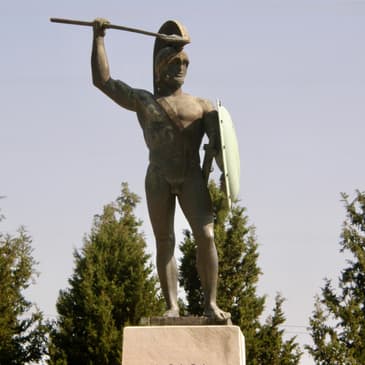
Emily:And if you go to Thermopylae today, there's, of course, a famous monument there to Leonidas and the Spartans, et cetera, et cetera. But eventually, I want to say about 25 years ago, a monument was also put up to the Thespians who stayed because they never get any credit for it. And so there is a headless monument there to the Thespian soldiers, and it's headless precisely because they don't get remembered for their bravery. It gets overshadowed by Leonidas and the Spartans and the sort of hold that has had on storytelling and whatever, but they deserve just as much credit for their bravery and for their sacrifice.
Cam:Yeah, the Spartans had a really good PR department in the wake of the Battle of Thermopylae, and they really took over the narrative.
Emily:Yeah. So if you're ever in Thermopylae, make sure that you pay not just homage to Leonidas and Spartans, but then make sure you give the thespians their props as well.
Cam:Yeah, to Damophilus and his thespians. Yes.
Emily:Now, they do know that they're going to die, but rather than kind of wait for the inevitable, the remaining Greek forces advance out well in front of this defensive wall that they've been holding into a wider part of the pass. And there they force a fairly intense battle with Xerxes's main force.
Cam:At this point, Leonidas himself was killed in the fighting. And according to Herodotus, this produced a truly Homeric moment as the Persians and the Greeks fought furiously with one another to take possession of Leonidas' body. The Persians want to grab it as a trophy, and the Greeks, of course, want to prevent that from happening.
Emily:Yeah. And this is a story that happens a lot in the fighting in the Iliad, the fights over bodies. And it seems that in this case, the Persians fought quite bravely and stubbornly. Herodotus is full of imagery of unwilling Persians having to be whipped to go into battle. But at the same time, he also acknowledges that several of Xerxes' brothers died fighting in the front ranks against the Spartans and the Thespians on this last day.
Cam:Right. They're doing exactly what Persian aristocrats are expected to do, essentially, right? Lead their men from the front. Eventually, the Greeks were able to push back the Persians just enough to secure Leonidas' body, and they fell back, retreating through the wall, to take up a final defensive position on a little hilltop behind their original position, all except for the Thebans who surrendered to Xerxes. By now, the Immortals had also arrived, having descended from the heights, and the Greeks were quickly surrounded. The last moments of the fight here would have been pretty ugly. The Persians essentially showered the Greeks with missiles, mostly arrows, to weaken them, and then finally closed to finish off any survivors, and Thermopylae fell.
Emily:Yeah. Cue moment of silence for the dead at Thermopylae. Now, simultaneously, we still have the naval battle ongoing. And on this third day, the Persians are finally able to do some real damage to the Greek fleet. And the Greek naval commanders had already made a decision that they should fall back when the news that Thermopylae has been lost reaches them, and that more or less clinches their decision that it's time to go. Now, there is a sort of last-ditch effort, so to speak, to save the expedition. As the navy is retreating, the Athenian commander, Themistocles, cuts a message in Greek into some rocks that encourages the Ionians, the Greeks from Anatolia, who are in the Persian navy, to defect. And the message, according to Herodotus, is, "You are wrong to play against your ancestral lines. At least you should adopt the position of neutrality. But if that Persians had too great a hold on you, deliberately fight below your best."
Cam:That seems like an awfully lengthy message to scrawl into rocks when you're busy trying to retreat.
Emily:It does. I'm sure there were attempts somehow to convince Greeks in the Persian army that they owed more loyalty to the Greeks fighting the Persians than they owed to the Persians. But yeah, do I believe this story? I'm not sure.
Cam:In spite of that potential gesture of defiance from Themistocles, Xerxes at this point had a lot of reasons to feel good and to feel optimistic. His forces had defeated the first real resistance they'd encountered. Not only that, they'd won a pretty difficult fight at Thermopylae, and they won it through basically good, professional, tactical decision-making, finding a way around that pass, sending the Immortals to surround the Greeks, and they could look at the weeks to come and see that the path through central Greece to Athens was now wide open. Maybe Xerxes even felt he'd be able to go home victorious within a couple of months. As some of you probably know, that's not what happened.
Emily:No, but that is going to be stories for our next episode.
Cam:That's right. So we'll continue this in a couple of weeks when we talk a little bit about Xerxes at the Battle of Salamis and about his cousin Mardonius at the Battle of Plataea.
Emily:So until then, I've been Emily.
Cam:I'm Cam.
Emily:And this has been Have Toga, Will Travel. Subscribe wherever you get your favorite podcasts or follow us at havetogawilltravel.com or on all the socials. And if you have a question or a topic you'd like to see us cover, please feel free to reach out.
Cam:And if you liked this episode, tell a friend about us. Thanks for listening, everybody.