
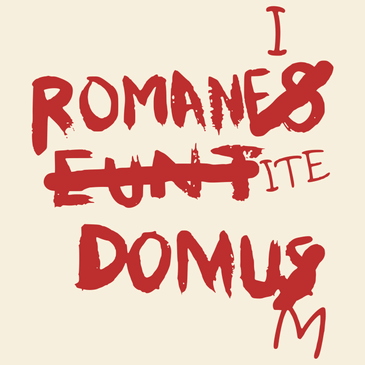
Emily and Cam chat about whether Monty Python's Life of Brian is truly the greatest movie about ancient Rome (as Cam claimed in the last episode). They also explore what "truths" the movie might expose about life under Roman occupation, and contemplate the Pythons’ love for Aristophanes.
Visit our homepage to subscribe, to find us on social media, and to contact us by email:
Cover photo adapted from an image by Grufo (Wikimedia Commons).
----------
00:11 - Introduction
01:54 - Monty Python: A Primer
- 02:25 - Five Brits and an American: Monty Python comes together (probably at a bar)
- 04:00 - The Pythons venture into feature-length films
06:56 - Production, Release, Reception
- 06:58 - On location in Tunisia
- 08:00 - The man they call Brian: the basic plot of the movie
- 09:52 - George Harrison to the rescue!
- 11:13 - Brian banned!
- 12:08 - The peculiar case of Aberystwyth, Wales
13:38 - Some cringey bits: viewer beware!
- 13:53 - Blackface and ethnic slurs
- 15:20 - Stan / Loretta: mildly transphobic, or surprisingly progressive?
- 16:56 - Some ableist-seeming jokes
19:02 - The Pythons do history hilariously
- 20:45 - Women and agency
- 22:59 - Businesspeople and professional pride
- 24:36 - Gladiator games, Python-style
- 28:10 - British and Roman imperialism, or what have the Romans ever done for us?
- 32:54 - Ridiculous resistance groups (Splitters!)
- 37:33 - Everyday acts of genuine resistance
- 41:21 - Prophets, saviors, and messiahs—in Roman Judea and elsewhere
45:08 - The Pythons as PhDs of Comedy
- 45:42 - Learned spoofs of literature and film: The Iliad and Spartacus
- 48:15 - Silly costumes, silly names, silly plots: the Pythons pay homage to Plautus and Aristophanes
- 54:39 - Romanes eunt domus!
- 56:55 - The art of nudity: the Pythons spoof Zeffirelli
59:14 - Wrap-up
Hello, welcome to Have Toga Will Travel, a podcast exploring the Mediterranean world, ancient and modern through the eyes of two former classics professors. I'm Emily.
Cam:I'm Cam.
Emily:And we're your hosts. So today we're taking a break from the last, you know, several episodes of fairly heavy content on the Persians and the Greeks to focus on something a little more fun, Monty Python's Life of Brian.
Cam:If you've seen it, you'll know that it's a funny and very silly movie, but we like it because it still manages to be incredibly insightful, and it taps into questions and issues that people who study the ancient Mediterranean world actually do talk about.
Emily:Well, that's why you like it.
Cam:Well, yes. Guilty. I like it independently of that.
Emily:Okay.
Cam:We can talk about that more later.
Emily:All right. A quick reminder before we get into the topic at hand is just to let you all know that we did put up a blog post on our webpage that ties in with our last episode. It features a couple of pictures of the serpent column that Cam took in Istanbul. And as a reminder, the serpent column is the most tangible remnant of the war between the Persians and the Greeks, which now stands in Istanbul. There's also pictures as well in the post of other monuments that, like the column, the serpent column, once stood in the Hippodrome of ancient Constantinople.
Cam:So if you do get to the end of this episode and you find you've got an appetite for more serious content, you can always go check out the blog on our webpage. That's havetogawilltravel.com. And while you're there, of course, feel free to subscribe to our show on your favorite podcast platform if you haven't done so already. But with all that out of the way, now for something completely different.
Emily:So first of all, just in case people don't know, we're going to start with who is Monty Python?
Cam:It seems strange to me that people might not know, but you're right that there are probably a bunch of listeners who have maybe not encountered Monty Python.
Emily:I mean, I think everyone remembers the first time they heard about Monty Python, it was like, oh, who's he? And then of course, you've just added yourself as not knowing who Monty Python is. So Monty Python is not a person, it is a group. It is specifically a sketch comedy group founded in the UK, and it was formed in 1969.
Cam:Right. It was originally formed by six members, five Brits and an American. The British members were John Cleese, Graham Chapman, Eric Idle, Michael Palin, and Terry Jones. And the lone American was Terry Gilliam, who, unlike the other five, was primarily a guy with a background in animation rather than the sort of weird slapstick performance that the other five members specialized in. And they came to prominence with a sketch comedy show called Monty Python's Flying Circus, which started in 1969 and ran until 1974.
Emily:And the way the Pythons, as they get called, got together. So Terry Jones and Michael Palin both met while they were students at Oxford. John Cleese, Graham Chapman, and Eric Idle all met while they were students at Cambridge. So a fairly well-educated bunch.
Cam:Yes.
Emily:And then John Cleese is going to meet Terry Gilliam in New York City while he's there touring with the Cambridge Footlights, which was a student sketch comedy group at Cambridge. And they basically got to know each other from various other projects that they were all working on prior to forming Monty Python. And then they decided to get together and start this group.
Cam:And that group really quickly became known for a satirical style that can be described in any number of ways. Absurdist, subversive, anti-authoritarian, stream of consciousness, just plain old goofy and weird. It also featured a lot of Terry Gilliam's stop motion animation, which was also really surrealist and weird.
Emily:But good weird.
Cam:Good weird, yes. Once they'd established themselves in their sketch comedy show, they also started venturing into the world of movies. These movies tended to feel a lot like sketch comedy shows themselves, a series of vignettes sort of stringed together. And in most of these films, each of the principal performers ended up playing multiple different characters.
Emily:Yeah. So their first technical film release was 1971. It was called And Now for Something Completely Different, which actually wasn't technically a movie per se. It was really sketches from the first two seasons of Flying Circus that they re-sort of did to be released as this movie. And the goal was to try to break into the American market by releasing these sketches compiled together as a film. They're going to then follow that up with an actual film, which hopefully you've heard of before. This is 1975's Monty Python and the Holy Grail, which is, I would say, a fairly brilliant movie for what it is. And not only did the Pythons star in it and write it, two of them, the two Terrys, Terry Jones and Terry Gilliam directed the film. And it famously, they were supposed to have a big fight scene at the end, and they basically ran out of money. And so if you ever watch it, you're like, the end is weird, it's because they ran out of money. And they're like, how do we make it work? And that's what they came up with.
Cam:It's a brilliant movie. And it was followed by another movie, I would say equally good. And that's the movie we're talking about today, Monty Python's Life of Brian, which they shot in 1978 and released in 1979. At this point, members of the group had moved on to their own independent projects for the most part after Flying Circus had ended. So they came back together specifically to make this film. It was once again directed by a member of the troupe, this time by Terry Jones as sort of solo director. And in parallel to that, a friend of the Pythons actually shot a documentary called The Pythons, interviewing the cast members and so on while they were on location filming the movie.
Emily:Yeah. And you can find this online. If you look, if you put it in the right search terms, you can find this documentary online.
Cam:And finally, in 1983, they released a third feature film, Monty Python's Meaning of Life.
Emily:The movie does contain my initial graduate school advisor's—one of his favorite songs ever is in that film. And one of our friends did it at his retirement party.
Cam:Which song is that?
Emily:It's called The Penis Song.
Cam:Oh, okay. Yes. I vaguely remember that now.
Emily:Oh, yeah. John put on like the full tuxedo.
Cam:I remember both the version in the movie and our friend's stirring rendition of that particular song.
Emily:It was quite well done.
Cam:Yes. This movie of all of the three is the one that feels most like sketch comedy because it really is a series of sketches strung together on the thinnest of plot threads ever.
Emily:I'm not sure I even remember what the plot thread is on that.
Cam:There we go. Yeah.
Emily:Yeah. The others at least nominally have a story. But they're all delightful in their own ways.
Cam:Yes. All right. So that's enough about the troupe.
Emily:Yeah.
Cam:Let's talk a little bit about the movie.
Emily:So as we mentioned, right, the film was released in 1979. It was shot mostly in Tunisia. They shot at Ribat, which is a fortified monastery in Monastir. They shot at the Casbah in Sousse and at the Roman Theater of Carthage. Interestingly enough, the Casbah now houses the Sousse Archaeological Museum. And then for all my like Star Wars people out there, the final scene of Life of Brian, the crucifixion scene, is shot near Matmata. And there's a hotel there in that town that was used for Luke's home on Tatooine in the first Star Wars movie.
Cam:The weird cave hotel.
Emily:Yes. And in the process of shooting in Tunisia, they were actually able to use some leftover sets from Franco Zeffirelli's Jesus of Nazareth that had shot there a few years earlier.
Cam:Always the best way to make a movie on a budget, just reuse other people's sets and props sometimes.
Emily:Yeah, but even more fitting, given the plot of Life of Brian that they're using leftover sets from Jesus of Nazareth.
Cam:Anyway, the film itself is about a man named Brian, born in Roman-occupied Judea at the same time, and in fact, immediately next door to Jesus. Sounds like a great premise for a movie. Brian grows up to get entangled with a bunch of anti-Roman movements in Judea, and he himself ends up getting crucified as a rebel.
Emily:So the film presents the world of Judea under Roman occupation as full of people who are looking for solutions to the position they find themselves in, in that they are occupied by this foreign power. And so you get both various resistance groups popping up, right, who are sort of trying to physically rescue people from occupation. And then you also get a bunch of like prophets and saviors and people claiming to be messiahs and all sorts of stuff who are sort of promising like a metaphysical escape from occupation.
Cam:Our character Brian in the movie willingly gets himself involved in the resistance groups. He also finds himself accidentally getting cast as a messiah by some of the other characters in the film, despite all his efforts to avoid that and his protestations that he is not actually the messiah.
Emily:Only the true messiah would deny that he's the messiah.
Cam:Precisely.
Emily:Our title character, Brian, is played by Graham Chapman, who really wanted to play this role. He had had a horrendous drinking problem. I think it went back to his college days. And when they'd been doing Flying Circus, he had been at times too drunk to function. He had the DTs, the whole nine yards. And he wanted to play this part so badly that he actually got sober so that he could play Brian and stayed sober for the rest of his life. He also knew that John Cleese was just waiting to take the role from him.
Cam:Yeah, not even the role of King Arthur in Holy Grail could get him to change his ways. It took Brian in this particular film.
Emily:Yeah.
Cam:Anyway, this was a film that proved controversial even before it was released. It was originally financed by EMI, but they got cold feet at the last minute, probably because they actually bothered to read the script at some point. At least I think that's the joke that Eric Idle always made. And at that point, the Pythons were in a bit of a bind, literally about to go to Tunisia and start primary photography.
Emily:Yeah, and EMI was like, no money for you.
Cam:Yeah. So in steps a hero, probably an unlikely hero, George Harrison.
Emily:Of the Beatles.
Cam:And he, it's said, took out a second mortgage in order to raise enough money, at least to help raise enough money to give the Pythons the four million pounds they actually needed to go and make this film. This is what a super fan looks like, if any of you people need ideas for Christmas presents for us. And in exchange, George Harrison actually does get a small cameo in the film. It's very, very quick, very, very small, very easy to miss.
Emily:Yeah.
Cam:It happens what, an hour and eight minutes in?
Emily:Roughly.
Cam:In sort of like an interior crowd scene where he passes by the camera really, really quickly.
Emily:Yeah. And when he was asked, like, why did you take such a big risk, right? And put your house up basically to fund this movie. George Harrison's response was that he wanted to see the movie.
Cam:As good a reason as any to finance one of these things, I suppose.
Emily:Yeah.
Cam:If you've got the money.
Emily:Now the film when it came out—as you can imagine, if the financers are getting cold feet—the film attracted a lot of attention. It got protested a lot upon its release. It was banned in many places. So it was banned in, was it banned in Norway?
Cam:Yes.
Emily:It was banned in Norway. And so in Sweden, they advertise it as like the film so daring, it was banned in Norway. I mean, even in the UK, you know, it gets banned by town councils and all sorts of things. And kind of infamously, one UK town council member who had voted to ban it, when he was asked, he admitted that he'd actually not seen the movie.
Cam:Yes, I'm shocked.
Emily:He voted to ban it based on the recommendation from some group that he...
Cam:Shocked, I say, that he'd do something like that without actually watching the film.
Emily:I know. And he's, of course, not the only one. But yeah, there's several stories like that.
Cam:So there's a funny story linked into this about the town Aberystwyth in Wales, where the film was, I guess, sort of unofficially banned.
Emily:People thought it was banned, but it had just been declared inappropriate.
Cam:Right.
Emily:But it wasn't formally banned.
Cam:So many years later, in 2008, a town mayor finally got around to informally unbanning it.
Emily:Yeah, it was actually when she went to unban it that they realized it was never technically banned.
Cam:Okay, well, let's go through this ceremony anyway. And what's really interesting here is that mayor was Sue Joan Davies, who actually plays one of the characters in the film, the character Judith, who is a core member of the resistance group that Brian ends up joining.
Emily:Yeah, yeah. So yeah, she got elected mayor. She was like, we're unbanning my movie. And she I think a couple of the pythons came to the showing they had of it and stuff. Now, the controversy around the film was, you know, wholly around fears that the film's religious overtones were blasphemous. I can't remember which one of the pythons it is. I think it was Eric Idle. It was Eric Idle or Palin, I think, who was like, we're not blasphemous, we're heretical. There's a difference.
Cam:I mean, what's funny about this whole controversy is that, you know, Jesus appears in the film in one scene.
Emily:Yeah, and he's treated very positively. Like, he's not, you know.
Cam:It's not really a film about...
Emily:No. But, which is funny, there's all this controversy, but that's actually not what we are interested in talking about today.
Cam:No, there's lots of other stuff to talk about as far as this movie goes. Before we get there, though, it is important to acknowledge that this is a film produced in a very specific time, in a very specific context. And so there definitely are bits that don't hold up quite as well as they could 45-ish years later. And I think the worst one of these, the scene that really stands out most to me anyway, is right in the opening scene where there is a moment of blackface. John Cleese is playing Balthazar, one of the three wise men who have come to greet the baby Jesus and inadvertently stumbled into the wrong building. They greet the baby Brian instead. It's really jarring and it's not even necessary. That's the annoying thing because they've got his face obscured by a pretty elaborate mask and headpiece anyway.
Emily:Yeah, yeah. So you can't actually see much of his face and he's enough shadow that you could probably just have not done it.
Cam:Yeah, that was totally unnecessary. And again, really jarring to a modern audience.
Emily:Yeah. Another scene that is disturbing for viewers is a scene where our character Brian, who is Jewish in the film—
Cam:And having a bit of an identity crisis.
Emily:Having a bit of identity crisis because he's just learned that his father was a Roman.
Cam:Naughteus Maximus.
Emily:And he has a moment where he's like really asserting that, you know, he is Jewish and he is proud of it. And in doing so, he uses a lot of functionally ethnic slurs to say, I am this and I am proud of it. And, you know, that can be jarring as well to hear. And I think even though it's done in this way of like reclaiming identity, it is problematic because, of course, the actor (and none of the pythons) are actually Jewish. And so it feels a little not good.
Cam:Yes. Another scene that's worth mentioning is a scene that takes place again early on in the movie—
Emily:We're just like, we're just like, here are all the— Well here you know here are the things you
Cam:Well here, you know, here are the things you gotta watch out for. The scene we're going to talk about next is not quite like that, it's less problematic, but still it might be jarring. It's a scene that takes place in an amphitheater as the resistance group that Brian will join, the People's Front of judea, is sort of sitting there chatting as they watch the games. And what ends up happening is that a character played by Eric Idle, a character named Stan—a very traditional name in first century Judea—
Emily:Yeah, yeah. All those Stans running around the...
Cam:Yeah. Asserts to the other members of the PFJ that he wants to be a woman and that he wants to be called Loretta. And this leads to a bit of back and forth between Eric Idle's character and John Cleese's character, Reg, who is the leader of the PFJ. And John Cleese in his classic outraged voice is really going after the Eric Idle character for this. And is really incredulous. And what do you mean you want to be a woman, et cetera, and so forth. Now, the thing here is that even though this is in the moment, a little bit, I don't know.
Emily:It reads as very transphobic.
Cam:Yeah. But in later scenes, John Cleese's character, Reg, is perfectly content to call Eric Idle's character Loretta. to accept that he wants to be a woman.
Emily:Yeah.
Cam:So that scene ends up actually being weirdly progressive in a way, right? I mean, there's the initial argument about things, but then everybody moves on. And hey, guess what?
Emily:Character is Loretta.
Cam:Life carries on as normal.
Emily:And it's all fine.
Cam:Yeah.
Emily:One other perhaps troubling bit is a couple of the Roman characters. So Pontius Pilate, a name you might know, and then Biggus Dickus.
Cam:Yeah, slightly not safe for work there.
Emily:Not a real name. Both have speech impediments. So Pontius Pilate can't say his Rs and Biggus Dickus has a lisp. And the characters are sort of mocked for this by the population at large, mostly. And, you know, this reads as ableist, right? Mocking people with speech impediments. But the other thing that's going on here is really this is a, what do you want to call it?
Cam:They're punching up, it turns out, I think, anyway.
Emily:In a way, like, this is really about class issues that come out of British society. So this is, in many ways, really trying to be a dig at the British aristocracy.
Cam:They talk weird. They have funny names. They have houses full of pornographic art, you know, the usual stuff.
Emily:They have these weird affectations that nobody takes seriously. And so it's maybe not the best way to do this, but that's what we think they're trying to do there. And of course, the mockery of them, even in the movie, is not so much about the speech impediment is about people who have no power mocking those who do have power for whatever they can. So a sort of way of resisting authority. And it's just a funny side note, Pontius Pilate is wearing this like gold laurel crown, wannabe laurel crown, which is kind of funny because now when you go to Athens, you can find those all over like the touristy areas being sold.
Cam:So many people buy those and wear them around Athens.
Emily:It is. And it's just like, oh, anyhow, that's all I could think of now when I see that headdress on Pilate.
Cam:Yeah. And that's it. That's basically the end of our list. Although I do want to add just one pet peeve, which has to do with the costuming. It's just—
Emily:It's probably a prop, not a costume, but—
Cam:Props, sorry. So the prop people are to blame for this. I noticed, and this is like such a nerdy little thing to notice, but I noticed that the Romans go through the movie carrying around spears that don't have spear points. Instead, the spear ends in what is clearly a butt spike rather than a spear point. And again, this is a total nerdy little detail, but those are two different bits of hardware.
Emily:All right. So last episode, you said that this was perhaps the greatest movie made about ancient Rome. And I would like you to defend that or to explain that take.
Cam:I did say that.
Emily:You did say that.
Cam:At the moment, I said it mostly as a joke since we had been talking about some pretty heavy stuff and I wanted to lighten the mood. But, you know, I went back and thought about it and I stand by that comment.
Emily:Do tell.
Cam:Okay. Well, first of all, if I think about all of the movies about the Roman Empire that I've seen in my life, this one I've watched way more than any other. It's not even close. I've seen this, what, probably between 12 and 15 times, something like that.
Emily:Not as many times as I've seen a funny thing happen all the way before them.
Cam:Granted. I don't think I've seen any other movie about the Roman world more than twice, maybe. So that says something. But the other thing I noticed when we were rewatching the movie in preparation for this episode—I should say that this was the first time I've rewatched it in many years, actually— and what I noticed on that rewatch was that it's full of humor that actually asks real questions about what life was like in the ancient world. Probably not intentionally, necessarily, but these are clever guys, and they think about things from the point of view of humorists. So, you know, they ask questions about behavior and things like that. And it turns out that a bunch of the scenes, again, probably accidentally, now raise issues that connect in various different ways with the sort of things that historians argue about when they talk about the ancient Greek and Roman worlds.
Emily:Okay, fair enough.
Cam:If you want me to get more specific, here's an example.
Emily:Did I ask you to get more specific?
Cam:I could see it in your eyes. So here's my example. Early in the movie, I think it's the third scene in the film, Brian and his mother, played by Terry Jones, decide to spend the afternoon going to see a public stoning. Now, this doesn't sound like the sort of scene that makes for good comedy, but it actually is a hilarious scene for a whole bunch of different reasons. One of which is that the stoning is being presided over by John Cleese as sort of his manic, outraged, best, shouty John Cleese. But the other underlying joke here is that all of the people at the stoning are actually women who have disguised themselves as men.
Emily:Because women aren't supposed to be there.
Cam:Exactly. By putting on these ridiculous fake beards.
Emily:And some of the women are actually Pythons dressed as women pretending to be men.
Cam:Yes. Most clearly Eric Idle, who is right there in the front and has a pretty funny moment. You know, and this scene proceeds more or less as you would expect in a Monty Python film, which is nothing goes according to plan. And basically the guy who is there to be executed for taking the name of the Lord in vain decides this can't possibly get any worse. So he starts doing a little song and dance and chanting God's name and the crowd gets excited and a few of them start to throw rocks early and John Cleese tries to control this. And it all ends with John Cleese being the guy who gets stoned instead of the condemned criminal. Now, what's kind of interesting about that scene, now that I've been a historian for however many years, is that I know that there's actually a whole lot of interest in how women negotiated day-to-day life in the ancient world, given that a lot of them were living in societies that tried to deprive them of agency in various ways. And that's sort of what's going on in this scene. Women who have been explicitly denied of agency who are claiming it anyway by sort of manipulating structures, manipulating rules to get what they want, which in this case is to participate in a good old-fashioned stoning.
Emily:And they do kind of, in that scene, even take the law into their own hands, right? When they go after the John Cleese character in that scene.
Cam:Yes, right. Because the punchline there is that John Cleese accidentally takes the name of the Lord in vain while he's trying to control everything, and they promptly stone him to death. As a couple of Roman soldiers hang out in the background and just sort of roll their eyes.
Emily:The Roman soldiers do a lot of that in this movie. And on the topic of things that we don't see a lot in the literature, this movie does also, I think, intentionally or not, expose some aspects of daily life, albeit in comedic Python-esque ways. Now, their goal was probably not to create some sort of accurate depiction of daily life in the Roman Empire, but they still do manage to capture some of these interesting moments. And so one that comes to mind is there's a moment in the market where Brian needs to buy like a disguise because he's trying to run away from Roman soldiers. He's in a rush. And so he just wants to buy it and go. And so asks the shopkeeper the price. Sure, fine. Here's the money. And then the shopkeeper gets very bent out of shape because he should haggle for it. Of course, Brian's trying to just get through this as fast as possible. And the shopkeeper is like, no, there's a ritual that we have to go through for this to work. And I mean, it's funny, but also the shopkeeper is kind of insulted, right? That this is part of his skill set.
Cam:Right. He's a professional. And Brian is not respecting that as he tries to buy the silly fake beard so he can disguise himself.
Emily:Yeah. And that seems to speak to, you know, that there is a sort of professional pride among like shopkeepers and artisans and what they do and how they do them.
Cam:Yeah, absolutely. This has been a big subject of research, actually, just in recent years, right? Lots of people have written about this. You've got people who are sort of looked down upon and maligned to some degree by the aristocracy, the literate class that produces most of our sources. But when you look at some of the inscriptions and things like that that they leave behind, they're constructing their own ideas of basically skill and honor and things like this. And they really do take that professional identity very seriously.
Emily:Yeah. We also get in the movie a depiction of Roman gladiatorial games, which we have discussed on an earlier episode here. And some of it is, you know, accurate-ish. Right? Like the two gladiators that you see are like in proper, proper, if you will, costumes, right? So you have a Murmillo and a Retiarius, which is a very classic pairing.
Cam:The Murmillo is the heavily armed gladiator.
Emily:And the Retiarius has the net and the trident. And, you know, the fight, of course, goes humorously. And we'll talk more about that in a little bit. But around the games, there's details that are off. So for one, they call the performance space the Colosseum, which hopefully, as you now know, if you listen to our episode on the Colosseum, Colosseum is not actually what that type of architecture was called in antiquity. It would have been called an amphitheater. And actually, to the best of our knowledge, there was not an amphitheater in Judea, period, in antiquity. And of course, the timing of the show is they call it the children's matinee. There was not a children's matinee, obviously. And the midday show would not have been gladiators, it would have been public executions, which traditionally would happen at the midday.
Cam:To be fair, that's what this could have been, depending on how you read that scene, right? Because the one gladiator is like, I'm not happy about this at all. I'm just going to try to run away.
Emily:Yeah.
Cam:And I'm not sure if that's a joke about the actual games or if it's just a joke about, you know, theatrical performances where you should expect not to get the A-list team when you're going to a matinee performance.
Emily:Oh, yeah, that could be. That could be. But one of the things that's kind of funny during that scene is the stands, if you will, the seating is really empty. And honestly, it's probably because they just didn't have the budget to pay for extras to fill it. But it actually made me think, I wonder if the midday shows in antiquity, the sort of midday chunk was less well attended.
Cam:Because it was hot.
Emily:Because you're in the middle of the day and so there's no shade because the sun's right overhead. It's hot. And that's when you do the public executions. Nobody really wants to be there. The money that you're spending on the gladiators you're putting in the morning and the afternoon when you can get a bigger crowd. And so it actually made me think like, oh, maybe this is—not that they were trying to— but maybe this is kind of what the midday shows have been like. The executions are the part that people are like, I'm going to go get lunch and go chill in Taberna for a bit.
Cam:That would not have surprised me.
Emily:And come back later.
Cam:Yeah. But you know, the other thing that's fun about that scene and other scenes like it in the movie is that I think the film does a pretty good job of imagining what street life in particular in the Roman world might have been like. So here in the Colosseum scene, you've got Brian wandering around as a food vendor selling snacks. In another scene, you've got all sorts of people haggling in the street, trying to sell trinkets in the street, all that kind of stuff. Things which we now take for granted, I think, when we watch movies about Rome. But back then, that's still, I think, an interpretation, right? Which—maybe not completely novel, but at least fairly fresh still. And I suppose the last thing that's worth pointing out here is that the other thing that happens in that Colosseum scene is Brian comes into contact with our friends, the PFJ, the People's Front of Judea. And here, you know, again, you're playing on the fact that these bits of public infrastructure, amphitheaters and baths, were meeting spots for people who mostly lived their lives on the street, outdoors doing stuff.
Emily:Yeah, I guess, especially during the midday show when the crowds are low, it's a great time to just like...
Cam:To sit and conspire against the Romans.
Emily:Yeah. Yes. And that actually brings us to one of the bigger issues that we think the film kind of engages with, which is the sort of reactions to and against an imperial power and imperialism more broadly. And this is something that the film really does a lot of. So there's a fairly famous scene from the movie where the PFJ is having one of their secret meetings and, oh, the Romans are so awful. And John Cleese's character, Reg, poses this, what he intends to be a rhetorical question of...
Cam:At the end of a very heated call to go and rebel, yeah.
Emily:Yes. What have the Romans ever done for us? And then there's a very quiet voice that kind of goes like, well, the aqueduct. And then this leads to a bunch of other people chiming in one by one until you end up with this long list of things. And so then the Reg character like, well, other than sanitation, the aqueducts, roads, irrigation, medicine, education, wine, public baths, public safety and order and peace, what have the Romans ever done for us?
Cam:You're right. This is probably one of the best known scenes in the film. And it's hilarious. It's hilarious to watch it. Again, a lot of that is just John Cleese being John Cleese, you know, and playing against the other Pythons.
Emily:Yeah.
Cam:But part of what's interesting here is the way this is tied in in various debates about empire and imperialism. And here it's worth mentioning that the British members of Monty Python were all born in the late 30s and early 40s, back when George VI was not just king, he was also emperor of India.
Emily:Yeah.
Cam:So John Cleese, I think, was eight years old when India gained its independence, for example. So the end of the British Empire and the debates that swirled around that and around decolonization in the years afterward is something these guys actually lived through. So they're probably up to their eyeballs in arguments about the British Empire and British imperialism and whether or not the British Empire was good, stuff like that. So you can definitely see that coming into play here, this idea of the white man's burden that gets developed by Rudyard Kipling.
Emily:Yeah.
Cam:That the British Empire was a civilizing force, bringing civilization to people who didn't have it. And of course, we can look at that and say, no.
Emily:Yes.
Cam:Right. But it actually, it sort of reflects the way Romans could think about empire as well.
Emily:Yeah, no, for sure. And we see this in the literature, right? In some contexts, the Romans sort of frame themselves as civilizing.
Cam:Yes.
Emily:Civilizational.
Cam:Bearers of humanitas.
Emily:Yeah. So, you know, Tacitus says that when, say, the Britons start adopting Roman dress and customs, that that's read as a sign that they are civilized. Although at the same time, he sort of says, maybe this isn't a good thing because this civilization of the Britons is sapping their manly vigor. But, you know, it does speak to the fact that this was an idea out there, right? That like the Romans are bringing civilization when they conquer these places.
Cam:Yeah. Harder argument to make in the East.
Emily:Yeah. And of course, the Romans also think they're bringing order and, you know, peace and good government, nice orderly things that the Romans do well.
Cam:Yeah, that's the point that gets made in the Aeneid, right? This Roman will be your gift, government. Go out and govern the world justly or whatever. Been a while since I've read the line.
Emily:I'm not gonna—it's tu proles? I don't remember it.
Cam:Yeah, not one of the ones you can quote like that.
Emily:No, no. And it's...
Cam:This is a story maybe that I shouldn't tell, but Emily once wowed Alex Trebek by finishing a line he started in Latin from the Aeneid.
Emily:The first line of the Aeneid, man. He and I shared a line of Latin poetry. And everyone in that studio, like, you could feel the shock in the room. It was beautiful.
Cam:It was a cool moment. Back to empire. So, you know, this scene in which there's an argument about whether or not the Roman Empire was good does reflect the way that Romans, like all imperial powers, thought about what they were doing in the world.
Emily:Yeah. Even if the subtext of that scene is actually the British Empire, not the Roman Empire.
Cam:Yes.
Emily:Yeah.
Cam:But the other thing it brings up, at least in a indirect way, is the fact that people living in places that were conquered by the Romans and turned into provinces often had ambivalent feelings about empire, or at least some of them did. Because empire always creates conditions in which some people can better their lot in life by cooperating with the imperial power.
Emily:As we talked about with the Persians.
Cam:Yeah. So, you know, again, this scene, which I mean, really is a classic comedy scene, nevertheless raises all of these really sticky and deep issues about empire and its dynamics.
Emily:Yeah.
Cam:And then there are a bunch of scenes that revolve around the idea of resistance. And they do so by focusing on our dear, dear friends, the PFJ, the People's Front of Judea. And a lot of these scenes, what they have in common is this idea that resistance groups can be pretty ineffective, in many cases because they spend a whole lot of time fighting with each other or internally rather than doing the actual hard work of resisting imperial power.
Emily:Yeah, so one of the running jokes here is that there's all this sort of petty infighting between these various resistance groups. When Brian meets up with the People's Front of Judea, he initially asks if they are the Judean People's Front, which is a different group, and gets—
Cam:Splitters!
Emily:Gets told to like, go away.
Cam:Not so politely, but yes.
Emily:And the line is, the only people we hate more than the Romans are the Judean People's Front and the Judean Popular People's Front. We hate the Romans, but we hate those other resistance groups even more.
Cam:And this gets dramatized in an even more overt and silly way when the PFJ decides to stage a raid on Pontius Pilate's palace and kidnap Pilate's wife. And they sneak into the palace and they promptly run into members of a rival resistance group, basically on the same mission.
Emily:Yeah.
Cam:And there's an argument. They start fighting. There's a moment where Brian attempts to bring them all back to the collective purpose here by reminding them that they should focus on the real enemy.
Emily:The Judean people's front?!—
Cam:Everybody says in unison. Brian is like, no, the Romans! But he's unable to really contain this. And these two resistance groups end up just pummeling each other as Roman soldiers come around the corner and again, just sort of shake their heads and roll their eyes.
Emily:Just kind of stand there and watch it.
Cam:Yeah. And this is often interpreted—and I think the Pythons have flat out said that this is the case— this was mostly intended as a critique of contemporary leftist politics in 1970s United Kingdom. But, you know, again, you can see that this scene does actually have some resonances with the ancient world. Because, you know, as we've mentioned a couple of times already, imperial power tends to create these kinds of splits, these kinds of factional disputes. We saw that a little bit when we were talking about the Greeks and the Persians last few episodes. The Roman world was no different.
Emily:Yeah, the Greeks were just lucky that they were able to kind of—
Cam:Get it together long enough to fight back Xerxes.
Emily:Get it together long enough, come together long enough, get over those petty differences long enough to win a major victory.
Cam:Well, I mean, if the Judean People's Front had stumbled their way in there, that would have been totally different.
Emily:I have nothing to say. I don't know.
Cam:It was a bad joke. I don't really expect a response.
Emily:In addition to the sort of petty infighting, another running joke about these groups is their just ineffectiveness. They actually just don't get anything done. And not just because they get into fights with other groups when they try to actually do something, but they have just really unreasonable expectations. So this plot to kidnap Pilate's wife entails holding her hostage with the threat that they will kill her if Pilate does not dismantle the Roman state in three days.
Cam:I think that's what you call a maximalist demand.
Emily:That's not a realistic demand.
Cam:Not even in the world of the film, yeah. If it's an unrealistic demand in the context of a Python film, you know you've got a problem.
Emily:And then the last thing is that these resistance groups ultimately, like, fixate on the symbolic rather than the practical. So at the end, our hero Brian is executed, he's crucified by the Romans, and the PFJ as an organization doesn't really help him. They're totally prepared to see Brian as a martyr for the cause rather than do anything to help him escape. And he's like, please help me get out of this. I don't want to be a martyr. And they're like, this is great. We support your, you know—
Cam:Yes, they come and give him a touching farewell ceremony, basically.
Emily:Yes. Yes, they decided to sing him for he's a jolly good fellow. Yes. Now, I will say that the character Judith, who's a member of the PFJ, she does actually try to save Brian in a very practical way. It backfires and it doesn't work. And then she has heard from the PFJ that Brian is martyring himself and she just believes that Brian's doing this willingly and won't sort of hear explanations to the contrary. So the movie really does dig into these resistance groups hard as sort of not being effective for various reasons. But one thing the movie does show is these little acts of resistance that everyday people were taking outside the context of being some sort of organized resistance.
Cam:Yeah, and that's something that the movie does in a couple of scenes that are both, I think, really well done, even though they might read as problematic at first.
Emily:Yeah, and these scenes are kind of true to life in many ways. So we already mentioned the mockery of Pilate by the crowds, which is clearly a form of resistance in some way, right? Like you're going to mock the person with power who's this occupying power, and you can get away with it.
Cam:Right. They get away with it here in part because Pilate is a dummy, as played by Michael Palin. Actually, he's an aristocratic dummy who doesn't even grasp the possibility that he could be anything other than perfect and won't get his own way and that somebody would dare to mock him.
Emily:Yeah, which is, of course, part of the mockery of the aristocracy there. But then we get a delightful gag that gets developed over a series of short scenes where you have Eric Idle and Terry Gilliam playing basically dungeon workers, working in this sort of prison that Brian's getting thrown into. And they're not Roman. And every time anyone tries to interact with them, they all get very sort of frustrated very quickly because Eric Idle's character has a pretty bad stutter, and Terry Gilliam's character kind of just like grunts. I mean, for lack of a better word, Terry Gilliam does tend to play like troll-like characters anyway.
Cam:Yes.
Emily:And so people just try to avoid them. They just don't want to deal with them. And, you know, it's—the scenes are funny, but are we mocking someone with a stutter? And is that—
Cam:Yeah, it's rough because Eric Idle's timing is so perfect. So you really want to laugh. You really do. But at the same time, you can read this as a series of ableist jokes.
Emily:Yeah. But then we get the punchline in the last of these scenes.
Cam:Yeah. So in the last of these scenes, one of the Romans comes and tries to get information out of them. And of course, Eric Idle stutters, and Terry Gilliam just sort of grunts, and the Roman gets frustrated and goes off. And then Eric Idle and Terry Gilliam turn to each other and go on having a perfectly normal conversation with each other about something—I don't remember what it was, but it was something fairly important and intellectual. And, you know, the whole joke here is that what you've got are a couple of guys who have no power at all. I read them as people who are enslaved.
Emily:Possibly, yeah.
Cam:And what they're doing is reacting against that absence of power by doing their best to annoy and irritate and frustrate the people who actually do have power over them.
Emily:Yeah, they're pretending to be stupid. They're pretending not to be able to speak well, and none of it's true.
Cam:Yeah, it's the way they push back in a society that deprives them of agency.
Emily:Yeah.
Cam:And I mean, on some level, that's got to be rooted in the dynamics of class in the United Kingdom in the period in which all of these guys grew up.
Emily:Yeah, I'm sure they've seen something like that. I mean, maybe not at that level, but yeah.
Cam:Yeah. But at the same time, there's been a lot of interest lately in ancient history in the way that enslaved people try to push back against the systems that keep them enslaved. And one of the things that seems pretty clear now is that enslaved people in antiquity, much like enslaved people in the Americas, often did do things like engage in petty acts of sabotage, act stupid, just do things to really frustrate the people who had power over them, because that was really the only way that they could exercise that kind of agency.
Emily:Yeah. And in the case of the movie, right, the Romans have no idea that they're being put on. They just think that these characters are, you know, stupid and not worth dealing with.
Cam:Right. So it's a really interesting scene for that reason, if for no other.
Emily:Yeah. You get to the final scene of those characters where you get the punchline and then you understand what they've been doing the whole time.
Cam:Yeah, exactly.
Emily:Now, sort of on the other side of things, the other thing that you have running around Judea, as we mentioned, is all these like savior movements, if you will. So one of the main sort of subplots of the second half of the film features Brian being mistaken for the Messiah. Now, this is unintentional.
Cam:And it really annoys him.
Emily:And it really annoys him. He does not want to be cast as this. And the film sort of uses this subplot to satirize people who are kind of uncritical and happy to follow anyone whom they believe can make their lives better. And people who want to be told what to do, they're willing to forgive anything of that figure if they believe it'll make their lives better.
Cam:And this leads to some really funny scenes.
Emily:Yes.
Cam:There are scenes in which Brian, you know, trying to run away from these people who want him to be the messiah drops a gourd that he's been carrying since he lost the haggling incident with the shopkeeper. He drops his shoe and various factions of the people following him around are trying to interpret these as one kind of sign or another. And that leads to some good bits. But also in one of the most famous scenes in the movie, Brian opens his bedroom door in the morning and stands there, full frontal nudity, only to discover that there are thousands of people outside of his window waiting for him to do Messiah or Savior things. And in that scene, he tries to persuade them that they should think for themselves. They're all different. They're all individuals. And of course, they just parrot this back to him. Yes, we're all different. We're all individuals.
Emily:And so here as well, it is also possible to see kind of echoes of ancient reality. Because the ancient world was full of prophets ranting away in public. I mean, everywhere. Soothsayers, prophets, people who claimed, you know—
Cam:Learned interpreters of omens.
Emily:Yeah. Miracle workers, all of that. And of course, in a world where gods were believed to be present everywhere, and that prophecy and divination, all this stuff, was a legitimate way of knowing about the world, this kind of stuff could really sway people.
Cam:Yeah. So there's a great example. Comes out of what we know about one of the big slave rebellions in Sicily, the first one to be precise, which happened in the 130s BCE. This was a moment in which a lot of enslaved people rebelled against the Romans and Greeks who had bought up big estates on Sicily. And the guy who emerged as the leader of this movement, a guy named Eunous, emerged as a leader partly because he was able to perform miracles. He had some trick where he was able to make it seem like he was breathing fire or something like that, claimed to have the gift of prophecy. And you can really sort of understand why if you are an enslaved person trying to rebel against authority, taking this long roll of the dice, you would want to follow somebody who claimed to be in communication with the gods and could tell you whether or not things were going to work out. So this sort of stuff really happened a lot. And that, of course, became a lot more complicated in a place like Roman Judea, where you have a dominant local religious tradition that was already infused with the idea that a messiah would come and help the people deliver themselves from the power of the Romans. So this aspect of the movie actually does, I think, evoke a lot of real currents in antiquity.
Emily:Yeah. And that first century of Roman occupation in Judea is particularly rife with those movements.
Cam:Yeah. And, like, the hundred years after the moment in which this movie takes place, there's not one but two major rebellions in Roman Judea brought about in part by, let's say the cultural insensitivity of some of the Romans who governed the area, right?
Emily:Why do we need to know about the people we're governing?
Cam:Yeah, exactly.
Emily:So we've talked a lot about the history, and that is a sort of really interesting, fun aspect of this movie, but that's not the only way that it evokes the ancient world. Now, the Pythons are very clever, they're very well-educated, they're very literate, and that also comes out in this film, because we get bits of comedy that flow directly out of ancient comedy. But then we also get comedic takes of kind of famous scenes from more serious material about the ancient world or from the ancient world.
Cam:Yeah. So if we think about moments in which the movie presents really comedic takes of serious pieces of literature, there are a couple we could probably read that way. And the first is the scene that takes place in the amphitheater, where basically what happens is two gladiators are introduced into the amphitheater. The heavily armed Murmillo is played by a big muscular actor, and the Retiarius is just this sort of old skinny little guy. So it's not an evenly matched fight by any stretch of the imagination, and the Retiarius promptly throws down his equipment and starts to run. The scene proceeds with the Murmillo chasing him around the amphitheater for a while, until the Murmillo finally dies from a heart attack. That's kind of a silly scene, but we think it might be an intentional callback to a famous scene in The Iliad in which Achilles chases Hector around the walls of Troy multiple times before Hector finally gives it up and Achilles is able to catch him.
Emily:No, I totally think that's the reference. I mean, it's funny, but I think if you've read The Iliad, it would be hard not to want to do something like that and not think about that scene.
Cam:Right.
Emily:One of the other scenes that is riffing on a more serious, I'll say piece because it's a film, not a piece of literature. And this, this I have no doubt that this reference is intended. So when Judith goes to try to save Brian from crucifixion, what's happened is that Pilate has said, okay, you know, I'll let one person go. And the crowd is shouting fake names at him to make him say Rs.
Cam:Because he can't pronounce Rs.
Emily:Because he can't say his Rs well. And so finally Judith runs up and she's like, Brian, save Brian. And because there's an R in his name, the crowd is down with, yes, save Brian. So pilot agrees to save Brian. And so they go to the condemned prisoners and they're like, which one of you is Brian? And some random person, not Brian, says, I'm Brian. And then Brian tries to assert that he's Brian. And then like everyone's like, no, I'm Brian. No, I'm Brian. No, I'm Brian. So they're like, OK, we're going to let the first guy go. And of course, if you listen to our episode on Spartacus, this is clearly a reference to the famous scene at the end of Spartacus, where they're like, if you tell us who Spartacus is, you give him up, we'll execute him and the rest of you can go. And so all of them stand up and say, I am Spartacus. No, I am Spartacus. Right. And they all are willing to die with him. And of course, here it's completely inverted, right? Like, they're all claiming Brian so they can get free and our actual Brian ends up being executed.
Cam:And then, of course, there are lots and lots of aspects of this movie that seem to be direct callbacks to the comedy of antiquity, in particular Aristophanes, probably the most famous, dare I say it, the greatest of the ancient comic playwrights.
Emily:At least the Greek ones.
Cam:Sure, yes. I don't know. I'd probably take Aristophanes over Plautus.
Emily:Oh, it depends on what I was watching for.
Cam:All right. Well, fair enough. But you can see this in a lot of places. One of them is in the fact that you end up with men playing women, as in the famous stoning scene where Eric Idle is one of the women in the crowd. Men playing women playing men, in point of fact. But also like lots of overdone costumes on the part of men who are playing women like Terry Jones playing Brian's mother.
Emily:Yes. I mean, the fake breasts are kind of ridiculous. I mean, they're massive, but they're also like right at his waistline.
Cam:Yeah, they're pretty ridiculous.
Emily:It's just really overdone. And of course, Aristophanes would have been really overdone. And of course, in his plays, you had characters running around with just giant fake phalluses on.
Cam:Yes, a stock part of the Greek comedic costume.
Emily:Which when we get around to doing an episode on Aristophanes, we will talk more about.
Cam:I'm sure everybody's really looking forward to that.
Emily:That might be a not safe for work episode.
Cam:It's going to be a not safe for work episode. Yes, for sure. But there are other touches like that too. There are tons of silly fake names, which are a stock feature of Aristophanic comedy and Plautine comedy. So Pontius Pilate's friends, his Roman aristocratic buddy has a very not safe for work name, Biggus Dickus. We've obviously talked already about Brian's father's name, Nauteus Maximus. And then, of course, there's Biggus Dickus's wife, Incontinentia Buttocks.
Emily:Now, I will say, when we were rewatching this movie, when they introduced Biggus Dickus and his wife Incontinentia, Cam was laughing so hard I thought he was going to spill the wine he was drinking. You were almost in tears at that scene.
Cam:It's a great scene. And what makes it great is Michael Palin playing Pontius Pilate. And his timing is just so perfect. For those of you who haven't seen the movie, the whole point of the scene is that Pontius Pilate has sort of clued into the fact that some of the Roman soldiers think his buddies have dumb, strange names, and is really angry about that, and is trying to get them to crack up so that he can haul them away for torture or execution. And it leads to just a hysterical scene in which Michael Palin is sort of sauntering around trying to get these guys to laugh. And he plays it so straight. That's the great thing. So straight. And the timing is just so perfect.
Emily:Oh, man. Although I think I laughed more at how hard you were laughing at the scene. But—
Cam:Be that as it may...
Emily:You very rarely laugh that hard at things. So, you know, it's delightful from my perspective. And, you know, we mentioned Plautus does these kind of made up, fake, ridiculous, silly names. And one sort of interesting point of commonality that this movie has more with Plautus than with someone like Aristophanes is that the Pythons are setting this piece in a different place and culture from their own, much like Plautus does, right? Plautus has most of his stories in Greece, even though he's writing in Rome. Aristophanes is—not only is he writing about Athens in contemporary Athens, he's writing about real people in the audience that he names in his plays. So it's much more direct. So that is, I'd say, a point where the film has more in common with Plautus than Aristophanes.
Cam:More Plautine than Aristophanes, yeah.
Emily:Yeah. But I will say, from a plot perspective, this film definitely has more in common with Aristophanes. Because the plots of Plautus are less absurd. They might be convoluted.
Cam:Right. They're more situational rather than totally absurd and crazy.
Emily:Yeah. And Plautus is definitely not really satirical.
Cam:Right.
Emily:I think any kind of way we would really recognize, unlike Aristophanes.
Cam:Yeah. And on the topic of ridiculous plot points, there's one moment in the life of Brian where Brian, fleeing from Roman soldiers, climbs up a tower. The tower is actually part of the Ribat Monastery. That's where the thing is actually filmed. But he climbs up to a tower and there's nowhere to go. And he falls off, basically. And as he's plummeting towards the ground, he just happens to get caught by an alien spaceship that swoops down for no reason whatsoever, picks him up, and then jets off again. And it leads to a bizarre, surreal scene in which he's flying around with a couple of aliens for, I don't know, two minutes while another alien ship tries to blast them to smithereens. And finally, the ship he's in crashes, and he's able to get back to the chase.
Emily:Why is there an alien spaceship? We don't know.
Cam:It's got to be a joke on the deus ex machina as a theatrical convention in ancient theater. It's got to be.
Emily:Maybe, maybe. But one of the funny things about that alien spaceship is that the aliens in said alien spaceship look a lot like the two aliens from the Simpsons cartoon.
Cam:Yeah, they do. They have three eyes instead of one, but yeah.
Emily:But they're similar looking critters, right? The... Kang and Kodis, the aliens. And I just can't help but wonder, did Matt Groening draw inspiration?
Cam:Yeah, this is a tribute to the life of Brian?
Emily:Yeah.
Cam:Maybe, yeah.
Emily:Because it just looks a lot like it. One of the other comedic sort of elements, again, kind of in keeping with the Aristophanic tradition, is that the film has moments of self-awareness. So in Aristophanes, right, you have moments where characters will address the crowd, they'll talk about people in the crowd. And so it's kind of meta-theatrical in that way. And this film isn't like that. It's not like people are talking to the camera or there's some sort of pretense that we're breaking the fourth wall, if you will. But there is kind of a funny moment where we do get this sort of self-aware moment, which is our hero Brian has just slept with Judith from the PFJ.
Cam:In his mom's house.
Emily:In his mom's house. And his mom catches them. And the mother throws out this line about Judith, leave the Welsh tart alone.
Cam:Delivered in Terry Jones's falsetto, of course.
Emily:Yes. Now, we are in ancient Judea. Wales is nowhere near this. But the actress playing Judith is herself Welsh.
Cam:As is Terry Jones.
Emily:Yes. And so this is sort of that moment of breaking the illusion of we are ancient Judeans. Nope, she's Welsh. We all know she's Welsh. We can hear her accent. And it's one of those lines that you'll miss if you're not listening. And you're like, wait.
Cam:And finally, like all good Aristophanic comedy, The Life of Brian does have some great satire of the contemporary world. We've touched on that a little bit, I guess, by talking about resistance groups and the way that film's portrayal of resistance groups picks up on thinking in the 1970s about ineffective leftist groups. But the scene we're thinking about right now is the famous Romanes eunt domus scene.
Emily:I mean, this might be my favorite scene in the whole movie. Every time I taught Latin, I would show this.
Cam:So the setup here is that Brian is trying to join the People's Front of Judea. But before they let him join, the PFJ is going to make him prove himself. So they set him a task, and that task is to go vandalize some Roman public monuments with the phrase, Romans go home. The problem, though, is that Brian is not very good at Latin.
Emily:Yes, because of course they do do it in Latin. They don't do it in English, even though everyone is speaking English and there's no Latin anywhere else in this movie.
Cam:So instead of painting Romani ite domum—
Emily:Which is Latin for Romans go home.
Cam:Brian writes Romanes eunt domus, which gets all three of the words wrong in various different ways. John Cleese, as a Roman centurion, then comes around the corner and catches Brian in the act. And we think that's it for our hero, of course. But instead of taking Brian into custody for vandalism, John Cleese's Roman centurion is instead really enraged that Brian can't get the Latin right and delivers an impromptu Latin lesson right there.
Emily:At sword point.
Cam:At sword point, along with all sorts of physical abuse. I mean, it's a great scene because, you know, John Cleese as the Roman Centurion is actually getting really angry about points of grammar.
Emily:Yeah. Oh, yeah, yeah.
Cam:How many Romans? This has got to be a scene that plays on the experience of British schoolboys in the 50s.
Emily:Yeah. And evil Latin teachers.
Cam:So I'm sure many of those schoolboys were smacked with rulers and things like that.
Emily:Learn their Latin declensions, you know—
Cam:The old-fashioned way, the way that Romans learned Greek, for example.
Emily:You know, at the end of a stick, you know.
Cam:Yes, exactly. Yeah.
Emily:Although, in all fairness, showing it to students I'd be like, so y'all, I could be so much worse.
Cam:Yeah.
Emily:And so the final comedic element we're going to talk about, which we've kind of touched upon earlier, is the use of nudity in this film. There are some debates about whether there was truly nudity in Aristophanes. And we do have several plays where female characters who don't speak appeared naked on stage. And so there's some debate about were these actual women appearing naked— so presumably either enslaved women or prostitutes who were hired to do this because there weren't actresses, otherwise, you only had men on stage— or is this a man in like a naked lady costume? And how you think it might go affects how you read the scene. But you know this film well it doesn't have a lot of nudity in it does not shy away from it, and so as Cam mentioned earlier there is a moment where Brian is full frontal nudity on camera. And i will say when i saw this as a teenager that was really unexpected, like you don't see full frontal male nudity and i was like, what?
Cam:I'm sure it was pretty unexpected for people in the theater in 1979 too!
Emily:Because you're kind of getting something that's that's kind of like the Romeo and Juliet, Zeffirelli, right? Brian is waking up after his night with Judith. He's going over to the window, right? And in that, you know, Romeo is naked from the back, but you don't get the scene from the window. And we're here, so we get that scene, Brian over the window, opening the shutters. And then you get the scene from the front where the entire crowd is outside and there is, you know, Graham Chapman.
Cam:Yes.
Emily:And with not a stitch on. And so it's, you know, it is played for both the shock and the humor of it.
Cam:Yes.
Emily:We do get some partial female nudity of Judith in this scene. They're using her hair strategically.
Cam:Right.
Emily:And it's pretty clear, I think, that she's wearing, the term is a merkin, which is basically like a pasty for the genitals. So while it looks like she's naked, I'm pretty sure that she actually has fake pubic hair on the merkin that you're seeing there. So it's meant to read like female nudity, but I don't think it is. I don't know that. I could be totally wrong.
Cam:And that in itself is funny, if that's what they're doing, right? Like, they're totally flipping around—
Emily:Yeah, they're flipping the thing of like, oh, the woman's naked and the man will sort of strategically cover.
Cam:Yeah.
Emily:And now there's, you know, Graham Chapman as naked as he could be and Judith gets the strategic cover.
Cam:Right. Well, with that stirring discussion of nudity in The Life of Brian, I think maybe...
Emily:We can get into it more if you want.
Cam:I think maybe it's time to wrap this up. So I think that's where we'll end for today. We'll be back on April the 15th with the first of two or possibly three episodes on Hadrian's Wall in Northern England. We're going to talk about its history, what it is, what it's doing there, but also what it's like to hike along it since we've done that twice now.
Emily:Twice, yeah. East to West and West to East.
Cam:Yep.
Emily:So that's all for today. I'm Emily.
Cam:I'm Cam.
Emily:And this has been Have Toga, Will Travel.
Cam:So if you like this episode and you want to support us, please tell a friend to give us a listen. This actually really, really helps the show grow. It's probably one of the most direct ways you can support us.
Emily:And as always, you can follow us wherever you get your favorite podcasts or at havetogawilltravel.com or on all the socials.
Cam:Thanks for listening, everybody.