
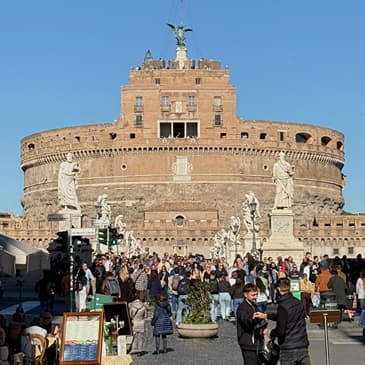
Did you know that the popes constructed a palace on top of a mausoleum built by the Roman Emperor Hadrian? Before he died, Hadrian commissioned a magnificent tomb for himself on the right bank of the Tiber River, just north of the ancient walls of Rome. Over the centuries, that tomb would become a fortress known as the Castel Sant’Angelo, then a papal residence, and finally a museum. In this episode, Emily and Cam cover the history of the monument and describe what it’s like to explore it today.
Visit our homepage to subscribe, to find us on social media, and to contact us by email:
If you liked this episode, buy us a coffee:
Links to other episodes we made that touch on Hadrian:
- Hadrian Tours the Roman World
- Hadrian in Athens
- Hadrian’s Wall, Part I: The Romans in Britain and the Imperial Frontier (the first of four episodes on Hadrian’s Wall)
- Thermae Romae: A Japanese Film about Ancient Roman Bathing—and Time Travel!
The cover image is our own photo of the Castel Sant’Angelo!
----------
00:11 - Introduction: What is the Castel Sant’Angelo?
- 04:51 - When and where was Hadrian’s Mausoleum built?
- 05:05 - A brief history of Hadrian’s Mausoleum
- 06:00 - The Mausoleum of Augustus: Hadrian’s inspiration
- 08:44 - How was Hadrian’s Mausoleum different from that of Augustus?
- 10:08 - The location of Hadrian’s Mausoleum and the Pons Aelius across the Tiber
11:47 - What did Hadrian’s Mausoleum look like? We attempt a verbal reconstruction.
- 12:08 - The outer fence and Hadrian’s peacock statues
- 12:32 - The square “basement”
- 14:04 - The main drum
- 15:02 - The superstructure, the hanging garden, and the statue of Hadrian
16:35 - When did Hadrian’s Mausoleum become a fortress?
- 17:15 - From Tomb to Castellum: Honorius joins the Mausoleum to the Aurelian Walls
- 17:39 - Justinian’s forces repel the Ostrogoths from Hadrian’s Mausoleum
- 19:30 - The monument gets a new name: Gregory the Great, the plague of 590 and the intercession of Archangel Michael, and the Castel Sant’Angelo
- 20:29 - The Church of St. Michael and a digression on the Castel’s statues
22:43 - When did the Castel Sant’Angelo become a papal residence?
- 23:43 - From Theophylact to the House of Orosini: the Castel as the stronghold of powerful families connected to the papacy
- 26:23 - A digression on the Passetto di Borgo, the protected walkway of the popes
- The evolution of the Castel from the 14th to 16th centuries: new fortifications, and fancy new apartments
- 27:22 - A digression on the curious escape of Benvenuto Cellini
- 28:27 - The Castel Sant’Angelo in the 17th and 18th centuries (and Bernini’s new design for the Ponte Sant’Angelo)
33:41 - When did the Castel become a museum?
- 33:49 - Italy takes control of the Castel Sant’Angelo after unification
- 34:10 - Mariano Borgatti makes a museum
35:21 - What is it like to visit Hadrian’s Mausoleum and the Castel Sant’Angelo?
- 35:55 - The approach: the bridge and the curtain wall
- 36:47 - The lower courtyard
- 37:57 - The remains of Hadrian’s Mausoleum: the dromos, the helical ramp, and the Hall of Urns
- 44:32 - The Angel’s Courtyard and the papal apartments on the lower level (featuring the Apollo room and the aedicula of Leo X designed by Michelangelo)
- 49:28 - The perimeter walkway, Alexander’s Courtyard, and the rooms of the second level (featuring the rooms of Paul III, née Alessandro Farnese)
- 56:12 - The apartments of the third level (the library, the cagliostra, the Halls of Adrianeo and the Festoons, the Treasure Room)
- 59:33 - The rotunda and the rooms of the fourth level
- 60:00 - The Angel’s Terrace and the return to earth
63:22 - Final impressions of the visit
65:48 - Wrap-up and next episode (on Centurion and The Eagle!)
Hello. Welcome to Have Toga, Will Travel, a podcast exploring the Mediterranean world, ancient and modern, through the eyes of two former classics professors. I'm Emily.
Cam:I'm Cam.
Emily:And we're your hosts.
Cam:Right. So welcome back, everybody. If you've been following along for the last couple of episodes, you'll know that we've been talking a lot about the Roman Emperor Hadrian. So we've done two episodes now recently. One was on Hadrian's wanderings around the Roman world, and the other was on Hadrian's time in Athens. Today we're going to bring you something sort of on topic still. We're going to stick with Hadrian, but we're going to talk about one of his last monuments, really one of his stranger monuments, at least in its modern incarnation, and that is his mausoleum in Rome.
Emily:Now Hadrian's mausoleum is better known today as the Castel Sant'Angelo. It's an imposing monument that has served a range of purposes over the centuries, the four main ones being the mausoleum, a fortress, a papal castle, and now a museum.
Cam:Yeah, and if you're an opera person, you may know that at the end of Puccini's Tosca, and I guess at the end of the play on which the opera is based, the title character, Tosca, throws herself off of the top of the Castel Sant'Angelo.
Emily:Yeah, in this case, the Castel, one of its sort of like side purposes amidst its other roles was as a prison. And that's the role that comes into play in Tosca.
Cam:Lots of famous people kept there over the years.
Emily:Yeah, we'll talk a little bit about them today. So the Castel is located in the Borgo neighborhood, which is across the Tiber River from the Campus Martius and the old city of Rome. And it sits at the end of a bridge known today as the Ponte Sant'Angelo.
Cam:Today, of course, the Castel Sant'Angelo is firmly in the heart of the city of Rome. That was not the case when it was first built. When Hadrian had it constructed, it would have been outside the ancient city walls of Rome in an area of the city that had become home to a bunch of big villas and things like this owned by some of Rome's wealthy elite.
Emily:Yeah. And part of the reason for this was that in antiquity, there was actually a prohibition against burying people within the city walls or within the city boundary, technically, I guess.
Cam:Right. So roads in and out of the city tended to get lined with tombs. And if you're ever wandering around in Rome and you want to see a good example of what that may have looked like, you can take a stroll along the Via Appia and see the remains of a lot of tombs all along that route heading south from Rome itself.
Emily:Yep. Definitely recommend that walk.
Cam:Yeah, it's a great walk. Anyway, both of us have been to Rome a bunch. And, you know, if you've been to Rome too, you'll know that it's really impossible to miss the Castel Sant'Angelo if you're wandering around in the city anywhere near the Vatican or in the northern part of the old city. But weirdly, even though we've been to Rome a bunch, neither one of us had ever actually visited the site. And we finally did so last November when we took a short trip to Rome after doing the Athens Marathon for the second time.
Emily:Now, I will say, like, despite having seen it before, you know, at a distance when we went to visit it this time, it sort of shocked me how large it is and how imposing it is. You know, it's this, I kind of think it looks a bit like a wedding cake in its structure, but it's both massive and kind of squat and solid looking at the same time.
Cam:Yeah, it's this sort of imposing hulk at the end of the Ponte Sant'Angelo. But it's also deceptive from the outside because, you know, you sort of get an impression of mass.
Emily:Yeah.
Cam:But it was only when we went inside and climbed up through the core of the old mausoleum and got to the more modern layers that I recognized just how huge it is.
Emily:Yeah, it looks massive, but you don't realize how much is going on inside because so much is hidden by the walls, right? You see this sort of square outer wall, you see the center drum that just looks like wall and then a little like tower on top of that. And you don't realize how much is actually going on that you can't see from the outside.
Cam:Yeah. You know, once you get inside, you realize what a crazy monument this is.
Emily:Yeah. And we're going to talk about that.
Cam:Yeah. It really is a palace plopped down on what used to be a gigantic tomb.
Emily:But then hidden from view from the outside for the most part.
Cam:Just as crazy as it sounds.
Emily:Yeah. So first of all, what we're going to do today is we're going to go over the history of this building and sort of how it gets to be the way it looks today. And then we're going to talk about what it's like to visit it and what that sort of journey through the interior is like.
Cam:Right. As we'll see, this is a long and crazy history that takes the structure through several different phases of use, from mausoleum to fortress, to papal residence, and finally to a modern museum.
Emily:Yep.
Cam:So I guess let's dive in, and we'll start by talking about how this thing came to be and what it looked like in the first phase of its existence when it really did serve as the mausoleum of Hadrian and other members of Rome's imperial dynasties.
Emily:So the mausoleum was initially constructed between 125 and 139 CE. Now Hadrian actually dies in 138, So the construction is completed by his successor, Antoninus Pius. And Hadrian is buried there, as is his wife, Sabina, his adopted son, Lucius Aelius, who was supposed to be his heir but dies before Hadrian. And then all of the emperors who succeed Hadrian are buried there up through Caracalla, who dies in 217. So that includes Antoninus Pius and his wife, Faustina, and their children, Marcus Aurelius, and his children, including Commodus, whom you may know from the Gladiator movie.
Cam:Joaquin Phoenix.
Emily:Yes. And then the Emperor Septimius Severus and his wife Julia Domna, as well as their sons, Geta, and then finally Caracalla.
Cam:Probably it was designed from the outset to be a dynastic tomb.
Emily:Yes.
Cam:It was modeled on the earlier mausoleum of Augustus. Augustus's mausoleum itself is an interesting and crazy structure, largely in ruins these days.
Emily:Although they are restoring it.
Cam:Yeah. It sits not too far away on the other side of the Tiber River. Originally, Augustus' mausoleum consisted of a great big drum at its base, which was about 89 meters in diameter. The whole monument would have been 45 meters high. It essentially consisted of a concrete core covered on the outside with travertine. That's a nice solid building stone and some marble. And it would have been topped with a statue, bronze statue, of Augustus himself.
Emily:Yeah, and the Mausoleum of Augustus was itself modeled on the original mausoleum, which is the tomb of a man named Mausolus.
Cam:Appropriately enough.
Emily:Who was a ruler in Halicarnassus who built this massive tomb to himself and gives his name to this style of building, the mausoleum. And that was one of the seven wonders in the ancient world. That combined with traditional Etruscan tumulus tombs, and the Mausoleum of Augustus would have had like an earth top with cypress trees planted on it, which is drawing from the Etruscan tradition.
Cam:Right, and then a central column supporting that statue of Augustus.
Emily:Yeah.
Cam:Anyway, this tomb was used by a whole bunch of members of Augustus's close and extended family. Several people were buried there before Augustus himself died, including his right-hand man and son-in-law Agrippa and two of his three grandsons. Augustus himself is laid to rest there as well. And then later, all of the Julio-Claudian emperors and their close family members were buried there too. So basically all of the emperors up until the Flavian dynasty. At that point, things change a little bit, and the Flavians would use their own space elsewhere in Rome on the Quirinal Hill. Nerva, the first post-Flavian emperor, was the last person laid to rest in Augustus's mausoleum. And then Trajan famously had his ashes deposited in the base of his famous column, which stands now in the forum that also carries his name.
Emily:Yeah, so up until Hadrian's time, most of the preceding emperors had been buried in the Mausoleum of Augustus. And then the Mausoleum of Hadrian sort of picks up this role. So as we mentioned, the Mausoleum of Augustus is located in the Campus Martius. It's about 800 meters away from where the Castel Sant'Angelo stands. And when it was built, it would have dominated the Campus Martius. It was originally surrounded by gardens, and it would have been a really substantial monument in this area.
Cam:Hopefully in the near future, you'll be able to get a sense of what it looked like in its glory, since, as we've mentioned already, there's a restoration project underway that's turning it into a new monument and museum space with pleasant gardens of its own.
Emily:But critical, not yet open.
Cam:It's not yet open, or at least it wasn't the last time we were in Rome.
Emily:Now, the Mausoleum of Hadrian, the Castel Sant'Angelo, emulates Augustus' mausoleum, but it also differentiates itself in particular ways. So among the similarities, it keeps the same orientation, a north-south orientation. The squared kind of base of the castel has the same dimensions as the outer diameter of Augustus's tomb, and it's about the same height. The construction is similar in that both have a core that is concrete and aggregate, faced with tuff and travertine.
Cam:That said, Hadrian wanted his monument to stand out, So there are some differences between the mausoleum he created and the older mausoleum of Augustus. The most notable difference is that Hadrian's monument was enclosed by a large square base, and the whole thing seems to have been much more lavishly decorated. All of its elements were faced in nice white marble. The whole approach to the monument and to the central burial chamber was also elaborated and a lot more complex than the approach to Augustus's mausoleum. Of course, to get to Hadrian's mausoleum, you had to cross a bridge, a big impressive bridge that we'll talk about in more detail in a bit. And then once you entered the monument, there was a crazy spiral radial walkway that would get you up to the main central chamber.
Emily:Yeah, as opposed to Augustus's, which just had a straight sort of entrance walkway.
Cam:As far as we can tell, yeah.
Emily:Now, Hadrian also decided to locate his mausoleum in an area where it could also dominate the view. The Campus Martius was much more built up by the time Hadrian was building his mausoleum. And so it didn't present quite the opportunity that it had when Augustus built his.
Cam:Location, location, location.
Emily:Yep. So he picks a property across the Tiber River that belonged to the imperial family called the Gardens of Domitia. Domitia was either a wife or relative of Nero, and this was a very lavish estate. And thus it allowed for this bigger monument to really dominate the area.
Cam:And of course, the whole complex was approached by a monumental bridge, the Pons Aelius, named after Hadrian himself, of course, which Hadrian built across the Tiber River at this point. Much of the superstructure of the current bridge, the Ponte Sant'Angelo, was reworked in the 16th and 17th centuries. But it stands on Roman foundations and on Roman arches. The three middle arches on that bridge are the arches that actually supported Hadrian's Bridge. So when you're walking across that thing today, you're walking on a structure that is being supported on arches that are now 1900 years old.
Emily:Now, the design of the bridge today, obviously, is not ancient. The sort of Baroque statuary on it of the angels that you see today was actually designed by Bernini in the 17th century. And if you're curious, the angels are carrying attributes of the Passion of the Christ. But the original bridge in antiquity would have also had statuary on it as well.
Cam:Yeah, though unfortunately we don't know much about what that statuary looked like because it's all lost.
Emily:Yep.
Cam:One of the unfortunate facts about Hadrian's Mausoleum is that because it was faced with marble and had bronze statuary and stuff like that, it's been subject to a lot of plunder over the years. So it's a little difficult to imagine what it may have looked like in its glory in the middle of the second century. But we're going to do our best here to talk about what a viewer may have seen. And we'll start with the outer fence that ringed the whole complex. This seems to have been a relatively low wall, but its main feature were bronze peacock statues that stood on top of it. And some of those peacock statues, I think two of them actually, still exist today, and you can find them in the Vatican Museum.
Emily:Yeah, and the peacock was a symbol of immortality, so a fitting decoration for the mausoleum. Now, as we mentioned, the bottom of the mausoleum has this square base structure. Although base is not a great term because it doesn't actually support anything. It sits around the center cylinder, but is not a wall because it would have been covered. So...
Cam:The technical term is basement, although that's confusing because these days basement means something underground, which this was not.
Emily:Yes. So the square part.
Cam:The square part.
Emily:That we mentioned that shares dimensions with the Mausoleum of Augustus, right? So it was 89 meters on each side. And this part was about 12 meters tall, and it would have been faced with white marble. So you would have had large rectangular panels on the bottom half and then squared blocks above that.
Cam:In the center, of course, there was a monumental entryway, which in antiquity was flanked on either side by inscriptions recording the names of people whose remains had been deposited in the tomb, as well as by bronze statue groups, which again, we don't really know what they looked like because they've been long gone.
Emily:At the corners, there would have been Corinthian pilasters, the square columns, and those would have been topped with large sculptural groups. Although, again, we don't know what those would have depicted.
Cam:And of course, this whole external square wall, whatever you want to call it, was probably topped with an elaborate frieze and cornice. So those, you know, molded, sculpted elements that lie in the top of ancient structures. In this case, the frieze probably represented lions' heads running all the way around the building.
Emily:And within that base sat the main drum, and this would have been about 21 meters tall, so it would have projected above the square base by about 9 meters, and was about 67 meters in diameter. Now, like the base, this too was faced with white marble, and it probably also had a frieze and cornice at the top. In this case, we think the frieze featured bulls' heads linked by garlands.
Cam:Yeah, there are fragments of this still surviving. Some of them are built into later parts of the structure, and you can see them if you wander around the courtyard and look closely for them. Anyway, on top of this big drum, along its outer rim, were, we think, statues, which were placed all around its circumference. These were, we think, in marble, although, again, none of them really survive. But there are some fragments still visible within the complex as a whole. They're the heads of fairly colossal statues, and judging from the size of the heads, these statues on top of the drum were about six meters tall, all designed to impress, clearly.
Emily:And then there would have been a superstructure on top of the drum, and this would have consisted of two other much narrower concrete cylinders, and they formed a tower that extended upwards by another 20 plus meters.
Cam:In antiquity, this tower was probably not visible. These days, most people think that it stood at the center of basically a mound of earth that was placed on top of the main drum. And that mound of earth would have supported a hanging garden of some sort, maybe cypress trees, like we think the Mausoleum of Augustus.
Emily:But even though this superstructure wasn't visible, those cylinders on top performed an important function. They supported a massive bronze statue of Hadrian in a four-horse chariot or a quadriga. So if you want a sense of what this would look like if you're in Rome, there are similar statues on top of the monument to Vittorio Emanuele II, also known as the wedding cake.
Cam:Which you can see across the river when you're on top of the mausoleum of Hadrian.
Emily:Yeah, yeah. So you can look across and see what a statue like that looks like. But the statue that existed on Hadrian's mausoleum was probably on a much larger scale.
Cam:Alas, nothing of it survives. Bronze statues in particular...
Emily:Nothing survives. Sorry. I was a little late with that. Bronze statues. Just go.
Cam:Bronze statues in particular tended to get melted down after the ancient period because, of course the metal was really valuable and could be used for other things, including as we get into the medieval and renaissance periods, cannons.
Emily:Yep. On the topic of medieval and renaissance periods, let's talk about what happens to this monument during the medieval and renaissance periods.
Cam:Right. As we sort of anticipated, this thing looks very, very different today. The marble is all gone for one thing. It's been plundered, reused in other buildings, or cooked in kilns to make quicklime for mortar. The sculpture is all gone for similar purposes or to be melted down into cannons or what have you. And today, what you have left is sort of a squat pile of rocks, it looks like, with a Renaissance palace on top of it. So the question is, how do we get there? What's the history of this building that produces the modern Castel Sant'Angelo?
Emily:So its purpose actually changes even in antiquity, because during late antiquity, it is converted into a fortress. So sometime in the early 5th century, probably around 403, The castel is incorporated into the Aurelian walls by Honorius. And this is actually when the building starts being called a castellum, which means fortress, fort, castle, something like that.
Cam:And famously, it features heavily in stories about the efforts of Justinian to reconquer Italy for the Roman Empire. In 476, the last Western Roman emperor had been deposed by the Ostrogoths and by their king Odoacer. But in the middle of the 6th century, Justinian I, ruler of what we like to call the Byzantine Empire today, launched a series of campaigns to reclaim Italy.
Emily:And during the Ostrogoths, the Castellum had continued to be used as both a fortification and a prison. And when Justinian's forces attack the city of Rome, the Castellum shows up in a story about the defense of Rome. And the writer Procopius tells us that after Justinian's general had captured Rome, he and his forces then have to defend against a counterattack from the Ostrogoths. And the Roman troops who had stationed themselves in the Castel Sant'Angelo end up basically using bronze and marble statues from the mausoleum, from the tomb, end up throwing those down against the Gothic forces to fight them off.
Cam:Yeah. So that's, you know...
Emily:That's what happened to some of the statuary.
Cam:That's probably what happened to a lot of the statuary. It gets knocked off in this battle. Anyway, after a lengthy series of conflicts, the area around Rome eventually became the Duchy of Rome under more or less Byzantine control. Although eventually, by the middle of the 8th century, as the popes in Rome expanded their own influence and political power, the popes were able to consolidate their own authority over what would eventually become known as the Papal States, which they governed themselves.
Emily:Now, it actually is in this, let's say in this tumultuous period that in the late 6th century, Castel Sant'Angelo earns its current name. In 590, there is a plague in Rome, and there are rumors swirling of an angel and a devil roaming the city. And the story that we get in later high medieval sources tells us that Pope Gregory the Great orders a penitential procession and prays for the city to be saved.
Cam:And, as the story goes, as he was crossing back across the Pons Aelius toward what is now the Vatican, he had a vision and saw the Archangel Michael hovering over top of the mausoleum, putting his sword away. Naturally, so the story goes, Pope Gregory interprets this as a divine sign that the plague is about to end thanks to the intercession of Michael, and lo and behold, it does.
Emily:So from this point on, the mausoleum starts to be called the Castel Sant'Angelo, the castle of the saint angel?
Cam:Yes.
Emily:Of the sacred angel?
Cam:Yes. I mean, the angel, right?
Emily:The angel, yeah.
Cam:Michael is probably the angel.
Emily:Yes, Michael is the angel in question.
Cam:Yes.
Emily:And so we're told by sometime in the 9th or 10th century, there is a church to Saint Michael built on top of the mausoleum in the highest chamber of that old Roman tower superstructure that had been there, and that there was a wooden statue of Michael on top where the statue of Hadrian and his chariot had once stood.
Cam:I'm sure that wooden statue was nowhere near the scale of Hadrian's whole bronze statue.
Emily:No.
Cam:But it's funny, right? Because there's a long history of statues on top of first the mausoleum and then the castel. And that history gets kind of interesting in its own right. So we don't know how long that original wooden statue was up there. But it was replaced sometime probably in the 10th or 11th century at a wild guess with a marble statue, which then had a good long run before finally being destroyed in 1379.
Emily:Yeah, it's kind of a messy story where there's a schism in the Western Church, where there's a Pope in Avignon and a Pope in Rome, and there's some fighting and there's an uprising in Rome that destroys the statue.
Cam:So then we need a third statue. This third statue was apparently another marble statue, this time with impressive bronze wings. So we're getting more and more, I don't know, ostentatious, more and more in the spirit of Hadrian's original statue, maybe. But alas, this too was destroyed. This time, apparently, when a lightning bolt hit the castel and set off a gunpowder explosion, which, you know, probably blew off the top half of that tower.
Emily:That's not a sign or anything.
Cam:No.
Emily:So in 1497, a fourth statue is put up. This one is made of bronze. It doesn't last that long. It lasts about 30 years. Then it gets melted down for cannons during a war in 1527.
Cam:Then we get to a fifth statue. This one also a marble statue, also with bronze wings. This one still exists. It's no longer on top of the Castel. It stands in one of the courtyards, so you can admire it up close as you're touring the complex.
Emily:Yeah. And then finally, that statue, when it is removed, it is replaced with the current statue, which is a bronze statue put up in 1753.
Cam:Right. That statue is still standing.
Emily:Yes. It's had a little bit of work done, but it's still there.
Cam:All right. So after that digression on the statuary on top of the castel, let's get back to its evolution from mausoleum to fortress to castle and so on. We've covered the transition to a fortress. The next stage is the development of the monument into a residence of the popes. This is a process that unfolds across several centuries, but the 15th and 16th centuries are the critical period. And that's when the Castel, or at least the top bits of the Castel, are remodeled into the luxurious papal palace you see today when you visit the monument.
Emily:Yeah. And the big names here are the popes, Nicholas V, Alexander IV, and in particular, Paul III. Now, lots of popes are going to be involved in this process, but these are the big ones to know.
Cam:Yeah. The history of the papacy is horribly, horribly complex and convoluted. We can't even really begin to scratch the surface.
Emily:Yeah, medieval Italian history in Rome is real messy.
Cam:But the important thing to know here is that a lot of these popes were really, really well connected to important Italian and I would say specifically Roman families. And as a consequence, as the Castel Sant'Angelo develops, it really does become a stronghold or a residence for members of these powerful families that are connected in various ways to the papacy. One of the earliest moments along the trajectory from fortress to lavish papal residence is a moment in the early 10th century, when the Pope, Sergius III, appoints, as his military commander, if you will, of the city, a guy named Theophylact I, technically the Count of Tusculum, but also the effective military ruler of Rome. Theophylact, while resident in Rome, basically used the Castel Sant'Angelo as his own private residence.
Emily:Yeah, so Pope Sergius III is actually going to end up having an affair with Theophylact's daughter and have an illegitimate child with her. And the descendants of Theophylact are going to basically control the papacy for the next century.
Cam:Yeah, this is another crazy aspect of medieval papal history is just how many popes have kids with, again, members of wealthy, well-connected Roman families.
Emily:Yeah. And then later in the 10th century, a different family is going to take over the Crescenzi family. And at this point, the castel actually starts to be known as the Castrum Crescenti, which means the camp, the fort of the Crescenzi. And this family also is basically controlling the city of Rome through various popes who are either from the family or just like puppets for the family. Although they lose some of their prestige when they support two of the anti-popes.
Cam:Do we want to even get into what anti-popes were?
Emily:No, we don't even want to get into what anti-popes were.
Cam:All right, let's skip right past the anti-pope issue. And we can just go on to mention that the castel then changed hands a couple more times. One of the interesting people who comes into possession of the castle is a guy named Peirleoni. He was a Roman noble whose family was actually of Jewish origin, although he himself converted to Catholicism in the 11th century and was granted control of the castle by Pope Pascal II.
Emily:And then later in the 13th century, the Orosini family is going to take control of the castel after obtaining it from a family member who happens to become Pope, Pope Nicholas III. And they control it until 1365 when control of the castel is ceded back to the church.
Cam:Finally, right. It's no longer the exclusive fiefdom of some rich family.
Emily:Yeah.
Cam:So that guy, Pope Nicholas III, also may have been the guy who created a very interesting structure known today as the Passetto di Borgo. This is a crazy enclosed and elevated passageway that sits on top of older fortifications and connects the Vatican with the Castel Sant'Angelo. Way back in the 6th century, during the fighting between the Goths and the Romans over control of the city, the Goths built a defensive wall through what is now the Borgo neighborhood. In the 9th century, Pope Leo IV elaborated on this older fortification by building some ramparts and a walkway on top. And then at some point, either in the 13th or 14th centuries, one of the popes—
Emily:Either Nicholas III or Boniface IX.
Cam:One of these guys actually turned that walkway into a covered and protected corridor so that the popes could flee from the Vatican all the way into the Castel Sant'Angelo without having to go outside.
Emily:So as we mentioned, during the 14th century, there's this, you know, Pope in Avignon, Pope in Rome, what's going on? It's all kind of messy. But eventually, the papacy does return to Rome under Pope Gregory in 1377. And from this point onward, the Castel becomes basically a refuge for the popes. It becomes the home of the Vatican Archive and Treasury, as well as serving as a tribunal and prison. And there were some famous prisoners held here, including Benvenuto Cellini and Giordano Bruno. Cellini is particularly famous for making his escape during a party and using knotted sheets to lower himself down from one of the bastions, in this case, the San Giovanni bastion.
Cam:Yeah, although to be fair here, we know this through his own autobiography, I'm pretty sure. So who knows how accurate some of these details are? Because the thing is, of course, that escape attempt, if it actually happened, fails, and he ends up imprisoned in the Castel for like another year after this alleged escape attempt.
Emily:Fair enough.
Cam:It's after Pope Gregory's return to Rome that the development of a lot of the fortifications that you can still kind of see on site takes place. So starting with Boniface IX in 1379, the whole complex, including its bastions, its ditches, and its curtain walls, get built up and rebuilt up multiple times.
Emily:And there is need for fortifications here because there's a lot of rival powers attempting to control Rome, and so the fortifications of the castel become an important element in the defense of Rome.
Cam:Yeah, especially since they're sort of a linchpin connecting it from the Aurelian walls to the 9th century walls.
Emily:Yeah, yeah, to the Vatican, yeah. For example, in 1382, the castel is actually besieged and taken, which forces Pope Urban VI to flee Rome. And this happens because Louis I of Anjou is attempting to claim the kingship of Naples from Charles Durazzo. Now, both Louis and Charles at various points had been heirs of the previous ruler of the kingdom of Naples, Queen Joanna. And so they're fighting for control. And—
Cam:To make this all more complicated—
Emily:There's still a pope hanging out in Avignon who has promised a kingdom to Louis I that doesn't actually exist. The phantom kingdom in Emilia and Romana in Italy that he says that Louis I can have if he can get in and unseat the pope from Rome. So on his way to Naples, Louis like, let's take Rome and get the Pope. And he, yeah, it's all like, this is what I mean by it's messy. And if I just butchered some of the medieval Italian history there, I apologize.
Cam:Popes, anti-popes and pocket princes, oh my.
Emily:Oh my God, there's so many. There's so many like, it's...
Cam:So lots of work trying to shore up these fortifications. So the Castel in this period is primarily serving again as kind of a fortified manor house, I guess you could call it. But finally, by the mid-15th century, while Pope Nicholas V is sitting on the papal throne, the Vatican starts to build the first real proper papal residence on top of the structure, as well as modernizing some of those fortifications by adding towers along the perimeter of what had been the square base in Hadrian's day.
Emily:Yeah. And then Alexander IV Borgia, who became Pope in 1492, carries out some major fortification work. So he updates the fortifications with four new bastions. He adds a ditch, as well as updating the papal apartments and luxuriating them.
Cam:Yes.
Emily:And making the papal apartments more luxurious and adding frescoes and fountains and gardens, to the point that subsequent popes often preferred the accommodations at the castel to those at the Vatican.
Cam:I mean, as we'll see when we talk about the tour, you can get some sense of what that looked like. It's just crazy up there how elaborate and luxurious and so on all of this was. But, you know, these fortifications served their purpose because in 1527, when Clement VII was pope, Rome was attacked and put under siege by Charles V. Charles V is one of these really just crazy, ridiculous people in history who, in addition to being the Archduke of Austria and the King of Spain and the Lord of the Netherlands and Burgundy, etc., and so forth, also claimed the title of Holy Roman Emperor, which often put him into direct conflict with the papacy. He laid siege to Rome in 1527, at which point Clement VII and thousands of others had to take refuge in the Castel, where they managed to weather out that siege.
Emily:Yeah, so it served its purpose.
Cam:Exactly.
Emily:Yeah. In 1542, the Castel is going to undergo extensive renovation by Pope Paul III, and a lot of what you see today in the papal palaces is his work.
Cam:And a little later, the popes decided to shore up the fortifications even more by commissioning a big, fancy, modern trace italienne. If you're a fortification nerd, you'll know what this is. If you aren't, basically what it is is a star-shaped series of bastions and outer embankments designed to protect the whole structure from cannon fire. That no longer exists, although you can still trace its outline if you walk around the complex, you've got a park there now surrounded by roads that follow the old trace lines of this fancy modern fortress.
Emily:Modern being...
Cam:Modern, yes.
Emily:Yes, modern...
Cam:For 1550.
Emily:Yeah, modern in the 1550s. Now, in the early to mid-17th century, Pope Urban VIII is going to tear down some of the older inner fortifications, as well as a tower that had basically guarded the entrance to the complex from the bridge. And he's going to build and improve the curtain walls and reinforce the star fortifications.
Cam:And finally, 40 years later or so, Pope Clement IX is going to put a lot of attention into remodeling the bridge, the Ponte Sant'Angelo. And this is the period when Bernini designs the bridge as it exists today, which is lined with statues of 10 angels, five on a side, although he himself sculpted only two of these.
Emily:And so this is sort of where the Castel Sands up until the modern period. You know, it continued to be used as a prison. But after the unification of Italy in 1870, the Castel San Angelo is going to become property of the state of Italy. And here, it's no longer being used as a papal residence. It's now being used as a barracks and a prison for the state of Italy. And then in 1901, it is officially designated as a national monument.
Cam:At that point, the Italian government decided to restore it and to transform it into a museum. The person whose name is most closely associated with the conversion of the monument into a museum is Mariano Borgatti, who had some weird ideas about what that should entail. His dream was to transform it into a structure that looked as much as possible like the Castel Sant'Angelo of the 15th and 16th centuries. So that meant restoring a lot of the paintings and frescoes inside the Renaissance buildings, also knocking down that modern Trace Italienne, that kind of thing. And that really has dictated the character of the monument today. Initially, it housed the Museum of Italian Military Engineering, which moved to its own building in 1939.
Emily:Yes, that building is now called the Historic and Cultural Institute of the Engineer Corps.
Cam:And then in 1925, it became the Museo Nazionale di Castel Sant'Angelo. And since then, it has remained continuously open to the public with progressive restorations, cleaning up various rooms inside.
Emily:So that's how we get from the Mausoleum of Hadrian to the modern museum that you see today. Now, we want to talk a little bit about what it's like to actually visit the Castel today, what you're going to see and how that journey through the monument works, because it really is a journey.
Cam:Yeah, we had thought that we could probably kill a couple of hours by going to the Castel Sant'Angelo? That was a huge mistake.
Emily:That was a huge mistake. We needed so much more time than we left for it.
Cam:It really is shockingly, shockingly huge once you get inside it.
Emily:Yeah, it's one of those things that I'll say when we go back to Rome that I want to go do again and see the things we missed, like the passeto.
Cam:Yeah, we need a lot more time. Anyway.
Emily:Yeah, anyhow. So when you are visiting the Castel today, more than likely you are going to approach it from the Ponte Sant'Angelo, right, the bridge that's named after it. And we definitely recommend this approach. You really do get a sense of how imposing this structure is, and it really just does dominate your whole perspective as you're walking across the bridge. It's really cool.
Cam:Once you've crossed the bridge, you enter the complex through the main gate in the Castel's curtain wall. Much of what you see of that wall, along with the angular bastions on your left and your right as you approach the gate, was built in the 16th century. It does, however, mostly sit on the same line as the square base of Hadrian's original monument. So even though Hadrian's original components here are long gone, you can still get a sense of spatially what that looked like in relation to the rest of the monument.
Emily:Yeah. And you can wander around between this curtain wall and the drum, the castel itself, if you want. I mean, there are important things down here, like the ticket office and some bathrooms. But there are other things. There's some papal oil storage rooms down there. There's an area called the Firing Squad Courtyard. And there are some fragments of the ancient statues that once sat on top of the drum.
Cam:This is a weird little area, because in Hadrian's day, none of this would have been open. It would have had a roof. It would have been covered over, creating an unbroken structure from the outer face of the square base to the drum itself.
Emily:Yeah.
Cam:And as you come in and look at the central drum, it's worth getting a sense of where the remains of the ancient structure give way to the Renaissance palace. Again, in Hadrian's day, the whole thing would have been sheeted in white marble. All of that is long gone. But what you can see pretty clearly are blocks of Roman stone that sat between the concrete core and the marble shell.
Emily:Yeah. And they look unfinished.
Cam:They do look really, really unfinished. And then, of course, sitting on top of that, you can see the relatively modern brickwork, mostly of the 15th and 16th century.
Emily:And the entrance to the massive central drum is directly opposite the main gate. And this first passageway you enter is called the dromos. And to get down there, you actually need to go down a bit because the level of the present courtyard between the walls and the drum is actually much higher than the ancient ground level. And that's where we're going to start out.
Cam:Now, the dromos here is an impressive, tall, vaulted corridor faced with blocks of travertine. Those sit in front of basically the concrete that forms most of the actual core of the drum. In antiquity, those blocks of travertine also would have supported a marble veneer, probably yellow marble imported from Numidia, judging by some of the surviving fragments. And this would have been attached to the blocks you can see today with metal brackets that would have fitted into the holes that you can still make out along the wall.
Emily:Yeah. And at the end of this walkway is a niche where a massive statue of Hadrian would have stood in antiquity.
Cam:We think it was probably an acrolithic statue, which means that it had a wooden core for the most part, a sculpted stone head, and then some kind of covering obscuring the wooden core. Maybe a sheet of thin stone. We're not entirely certain. Would have been very impressive.
Emily:Yes. Now from here, the passage is actually going to turn to the right, and you're going to start going up what the museum calls the helical ramp.
Cam:This is actually part of the original structure. It is a wide sloping ramp that leads you upward along a spiraling route along the inner circumference of the drum.
Emily:Now most of what would have decorated this walkway is now gone, but you can still see traces of the original mosaic flooring in places. And the walls, of course, which are exposed brick now, would have had a marble veneer in antiquity.
Cam:And you can tell because, again, there are socket points for those metal brackets that would have held the veneer. But what's really cool here is the brickwork itself is fantastic.
Emily:Yeah, you wouldn't realize that that was interior.
Cam:Yeah, yeah. No, it's, I mean, that brickwork is laid like you were supposed to see it, even though you were clearly not supposed to see it. Along the way, the ceiling of this ramp is also punctuated by four vertical shafts designed, it seems, to provide light and air to the ramp. And they're situated actually at the four main points of the compass as you ascend the ramp. Worth remembering that this spiral ramp was a notable difference between the mausoleum that Hadrian built and his model, Augustus's mausoleum, which had just a much more simple straight line approach.
Emily:Yeah. Now, once you've gone around this walkway enough that you've basically made a full circuit of the mausoleum, the route, which is still continuing to move upwards, turns in towards the center of the structure and heads up and across a bridge, which is called the diametrical ramp, and will lead you into a room at the center of the building called the Hall of Urns. And this is where the ashes of Hadrian and those buried here would have been kept.
Cam:Now, the bridge, importantly, is not original. The current structure was built in the 19th century, but it seems to be on the line of a 15th century original, which was there as part of the Renaissance-era castle. And the problem is that climbing up that bridge gives you a distorted view of the Hall of Urns, which in antiquity you would have entered from its floor level.
Emily:Now, from the floor level, the hall would have seemed much higher and much more imposing than it does from the 19th century bridge, which is sort of elevated and kind of in the middle of the room. And the Hall of Urns, again in antiquity, would have been sumptuously decorated. There would have been marble veneer over the large travertine blocks that you see now.
Cam:That room also contains three arched niches on the east, west, and northern sides. And these, we think, are the niches that probably housed the sarcophagi in which the cremated remains of Hadrian, his wife Sabina, and his adopted son, Lucius Aelius, were placed. Finally, there are some high window openings in the vault that seem to be aligned so that during the summer solstice, sunlight would align with those niches.
Emily:But there is some question as to when...
Cam:Were they original or not?
Emily:Yeah, whether they were original or not.
Cam:That's true of a lot of features of the Castel Sant'Angelo today. It's not always entirely clear when certain modifications were made to the structure. Yeah.
Emily:Now, there is nothing left of the burials. However, there was a red porphyry sarcophagus found in the Hall of Urns. It then gets reused as a tomb for the Holy Roman Emperor Otto II in the 10th century, which was later destroyed by a fire. But the lid of this sarcophagus has been preserved. And in the 17th century, it gets transformed into a baptismal font by Carlo Fontana, and is now located in St. Peter's Basilica.
Cam:Yeah, this is an interesting example of the reuse of monuments in Rome. And if you go wandering around Rome, you'll see this all the time.
Emily:And the red porphyry sarcophagus, high likelihood that it's actually Hadrian's?
Cam:Yeah, porphyry is a rich, reddish marble, and it tended to be used by members of the Roman imperial family. Anyway, as we've noted, the chamber also probably housed the remains of later emperors up to and including Caracalla, who died in 217, although we don't know exactly how their remains would have been laid out in the chamber. And here it's also worth pointing out that some people, a minority, but some people have also argued that this chamber held everybody except for Hadrian, whose remains were actually placed in maybe one of the chambers in the tower that supported the Quadriga statue, but we just don't know.
Emily:Yeah, we don't know. Now, this room has sort of an interesting life as well, because in the 15th century, this room gets turned into a casemate as part of the fortifications. And that lower path that you just walked up actually all gets buried and filled in and is going to stay that way until the 19th century when it's excavated. When it's turned into a casemate, the other thing that happens is that there are two rooms kind of added in this space for use as prisons, which also get removed in the 19th century renovations.
Cam:And for a short time, that's where Benvenuto Cellini was imprisoned.
Emily:Yeah.
Cam:Maybe before that crazy escape attempt.
Emily:Maybe.
Cam:After which he was stuck in the other dungeon for like a year or something like that.
Emily:Yeah.
Cam:The modern route takes you across that bridge from the Hall of Urns and up a 15th century staircase. And as you follow that staircase up, you emerge into a small, roughly rectangular courtyard on the next level. And this is where you as the visitor will really pass out of, more or less, the Roman monument and enter the papal palace. The courtyard you enter, now called the angel's courtyard usually, sits on top basically of the main drum of Hadrian's monument.
Emily:The courtyard is named for a statue of the archangel Michael that sits in the courtyard. And this is one of the statues that used to stand on top of Castel. So this was the fifth statue that had been up top. It was actually sculpted by an apprentice of Michelangelo, and it gets moved to the courtyard in 1910. Now, of course, it had been moved down from the top of the building long before that, but it gets put here in the courtyard in 1910, and that's when the courtyard gets the name the Courtyard of the Angel. Prior to that, it had been called the Courtyard of Honor.
Cam:Now, this courtyard is open to the sky, but enclosed on all sides by the lower portions of the Renaissance structure. Serious construction here probably started in the 1400s. Before that, let's say 400 to 500 years earlier, all of this would have looked very, very different because it would have been largely open, perhaps with the remains of the earthen tumulus that crowned that drum in antiquity.
Emily:And in the middle, you would have been able to see the remains of the Roman tower that once supported the statue of Hadrian in the quadriga, which stretched up for several more stories. That tower is now encased in the papal residence that you see on your left as you come up the stairs into the courtyard. And we'll talk more about those papal residences in a second. But first of all, we'll talk about the rooms on your right as you enter the courtyard. And this is a series of rooms known as the Lower Armory.
Cam:These are actually built along the western edge of the drum's upper rim. So they're essentially on the external wall of the modern Castel Sant'Angelo. Their name betrays their original function. They were armories, although they now house exhibits. And I think this is where we saw an exhibit of historical iconography, tracing the appearance and history of the Castel, as well as some really interesting little dioramas that show what this complex looked like at various different moments in its history.
Emily:Yes. Now, on your left, as we mentioned, is the Papal Palace. It is a tall, multi-story complex housing the papal residences. And this complex stretches from the north rim of the drum to its south rim, and it encases the old Roman tower superstructure.
Cam:On this level, it houses a bunch of different rooms, all of which were created, laid out, decorated by various popes. Immediately to your left from the top of the staircase are the rooms of Clement VIII, Pope during the late 16th and early 17th centuries. These days, these are used mostly as a temporary exhibition space. Otherwise, their most impressive feature is a fireplace that once sat in the guardhouse at the castle's entrance.
Emily:From the rooms of Clement VIII, you then move into the room called the Hall of Justice. This is in the core of that Roman superstructure, and the tradition holds that this is where trials were conducted. It also has a 16th century fresco of the Archangel Michael.
Cam:Further south, as you continue along the left-hand side of that courtyard, you get to the Hall of Apollo. Like a lot of the rooms in the Castel, this is a ridiculously elaborately decorated Renaissance room built originally by Nicholas V, the Pope during the 15th century, although a lot of the decoration that you will see is later. It's 16th century.
Emily:And Nicholas V is the one who initially builds a papal residence there.
Cam:Right. The current decorations are mostly frescoes of Apollo and the Muses, but the room is really famous for its ceiling, which is elaborately painted and is one of the most well-preserved and intact Renaissance ceilings in the entire castel.
Emily:And then from here, you'll move into the rooms of Clement VII, another 16th century pope, infamously the one who took refuge in here during Charles V's sack of Rome.
Cam:And then at the south end of the courtyard is, I think, one of the most interesting features on this level, and that is the facade of a small chapel, the chapel of Leo X, who was Pope in the early 16th century. This is generally not open to the public, but what makes it really cool and worth noting is that its facade was designed by Michelangelo. So it's a great example of early to mid 16th century sculpture. It is an aedicula, so basically it looks like the facade of a classical temple, you know, with representations of an architrave and a pediment and little niches for statues and things. Definitely worth taking a look so you can say, hey, I've seen another sculptural piece by Michelangelo, as if you're not going to see enough of these when you're wandering around in Italy.
Emily:Well, yeah, and you can't miss it, right? It's just there in the wall.
Cam:Right.
Emily:And so from this level, from the angel's courtyard, there are stairs that take you up to level two. And on level two, there's a walkway, an open air walkway that basically follows the circumference of the original drum. And from the openings in the wall here, you actually get some really nice views of the city of Rome.
Cam:Yeah, a lot of those openings are canon embrassures, obviously. They give you a confined but still really nice view of various points of the city.
Emily:And they take you all, you can go around the whole monument here.
Cam:On this level, you'll find a bunch of interesting things. Importantly, more bathrooms. The only other set you'll find, I think, in the whole complex. But you've also got a bookshop, a little cafe, and a series of rooms called the Upper Armory, located, appropriately enough, right above the Lower Armory, where you'll find a bunch of temporary exhibits.
Emily:Yeah, when we were there, there was an exhibit on John Paul II, a photography exhibit of his time as Pope. And just as a quick mention, some of the other exhibits we saw in the Castel while we were there was an exhibit on Rome and the invention of cinema, and an exhibit on the Castel Sant'Angelo in the early 20th century when it's being turned into a museum called Castel Sant'Angelo, 1911-1925, The Birth of a Museum.
Cam:Yeah, the exhibits rotate, so it's a little bit hard to predict what you're going to be able to see when you visit the monument.
Emily:Yeah.
Cam:But the thing that stood out to me when we went into the exhibit on John Paul II was one picture of the Pope done up in his red robe, sitting on his throne against a red background, clearly at the end of what was a really, really long day. He's slumped over with his head in his hand. And you can see him thinking, oh my gods.
Emily:Yeah. And it's interesting because he's not centered in the picture. He is in a bottom corner and this sort of red field behind him, which I'm assuming is done in the editing process...
Cam:Yeah. It's a really extraordinary photo, which I think gets it. Just how miserable that job can be sometimes.
Emily:He might have just been tired.
Cam:Yeah, that's what it looks like. He looks like he's carrying the weight of the world on his shoulders, basically. It really does.
Emily:Yeah, it was a very striking picture.
Cam:Anyway, it's on this level that you'll also find a bunch of other papal apartments from the Renaissance period. There's also another courtyard, which occupies the east side of the monument. So it's on the other side of that central papal complex from the angel courtyard. It's on a slightly higher level because it sits on top of a series of storerooms and the historical prisons, which are not open to the public, unfortunately, for the most part. There's also back there a little bathhouse. The papal bathhouse, if you will, with a boiler and a charming little bathroom. But that, too, wasn't open, unfortunately, when we were visiting the monument.
Emily:Yeah, so the storerooms and prisons are on that lower level with the angel courtyard. But you don't see them when you're down there because they're not usually open. Up here, you also have the loggia of Julius II, another 16th century pope. A loggia is basically an open gallery, a room or space that's open to the air that allows for air circulation.
Cam:An arcade.
Emily:An arcade, depending. An arcade could be one, yeah. And this loggia overlooks the Tiber River and the bridge and is elaborately painted on the ceiling and walls.
Cam:Yeah, it's a nice space. You get a nice view from it. And actually, as you're approaching the Castel Sant'Angelo and you're crossing over the Ponte Sant'Angelo, you can see the loggia and you'll see people hanging out in there sort of admiring the view as you approach the structure itself.
Emily:Now up here, there's also a series of rooms, mostly the responsibility of Pope Paul III.
Cam:The most important of those is the aptly named Pauline Room. Paul III is responsible for a major remodeling of the papal apartments. He, like a lot of these popes, was a member of a well-connected family. His birth name was Alexander Farnese. So he's connected to the family that created that impressive piazza and the palazzo that goes along with it. And the room named in his honor, not surprisingly perhaps, is the most lavish room in the whole complex. Every single surface is painted with frescoes dating from the 16th century, most of which show scenes from the lives of Alexander the Great and St. Paul along the long walls. And then on the short walls, you have scenes depicting Hadrian and Michael. So this is a person who obviously thought fairly highly of himself.
Emily:Yeah. I'm going to decorate the room with the two most famous people to have my names.
Cam:Yes.
Emily:My birth name and my pope name.
Cam:Exactly. Yes.
Emily:And also clearly shows that the connection of the castel to Hadrian has not been forgotten.
Cam:Yeah, this is an issue that we were chatting about the other day, right? As we noted in our episode on the Colosseum, I don't know, many months ago now, the function of the Colosseum actually gets forgotten and has to be rediscovered by antiquarians in the Renaissance period. Here it seems that people never really forgot what the Castel Sant'Angelo was. That connection with Hadrian was always remembered, even as the function of the building changed drastically over the course of the centuries.
Emily:Yeah. Another one of Paul III's rooms is called the Perseus Room. This was the Pope's study and earns its name because it was decorated with scenes from Ovid's Metamorphoses.
Cam:It's an interesting set of stuff that these popes are reading.
Emily:Yeah.
Cam:Ovid doesn't seem like appropriate papal literature to me, but what do I know?
Emily:I don't know. It's not like you were raised Catholic or anything.
Cam:Right. But then we get the Cupid and Psyche room, which is, again, an interesting choice. Also a room commissioned by Paul III. And here we have frescoes which seem to tell the story of Cupid and Psyche as derived from Apuleius, a famous Roman novelist, who is again, not the kind of author I would expect popes to be reading necessarily. Anyway, this room, plus the Perseus room and the Pauline room, form the inner core of what we usually call the Farnese apartment, right over the Hall of Apollo and the rooms of Clement VII on the lower level.
Emily:Yeah. Now off of the Pauline room is a little corridor called the Pompeian Corridor. It's a narrow passage that is decorated with motifs inspired by ancient Roman wall paintings. And it's actually going to connect the Pauline room to the library above it. And you can use this to get up to that next level, the level three, as it gets called in the map.
Cam:If it's open.
Emily:If it's open. We did not see this corridor, and we're not sure if it wasn't open or if we just missed it.
Cam:I'm pretty sure it wasn't open. I don't like to think we would miss something like that.
Emily:Me too, but you know, it's a big monument and we could have missed something.
Cam:Yes. Anyway, if you go back out onto the circular walk around this level on the rim of the monument, you will find between the cafe and the bookshop, another staircase leading up to a higher level, level three. Level three is well above the main walls of the mausoleum itself. So the rooms up here all really sit in that central structure that spans from the northern rim to the southern rim with the courtyards on either side of it.
Emily:Now, if you are lucky enough to take the Pompeii corridor up, the first room you're going to encounter is the library, which was also part of the Farnese apartment. This was the principal antechamber. And its name actually comes from not necessarily being a library, but its name is given to it in the 20th century and comes from an association with the treasury room on this floor, and particularly the role of the treasury room and housing the papal secret archive. The library here is, again, elaborately painted, both the walls and the ceiling.
Cam:To the north of that, along the structure's northernmost wall, is a room called the Cagliostra. This was built in 1545 as a loggia, as one of those open, arcaded rooms where you could sort of stand there and gaze out at the view in the distance. In the 18th century, though, it was walled over and turned into a prison, a discreet and, dare I say, elevated prison for those prisoners of high status whom the papal authorities didn't want mixing with the rabble in the nasty little cells underneath the courtyard of Alexander. It's named after the alchemist, Count Cagliostro, otherwise known as Giuseppe Balsamo, who was held here in the late 18th century by the Inquisition.
Emily:Now, off the library, there are two small rooms, the Hall of Adrieneo, which is decorated with motifs invoking the Roman Empire and the Emperor Hadrian, and the Hall of Festoons, which is decorated with painted festoons of fruit and flowers.
Cam:And then in the very center of this level is the Treasure Room. This is another one of the rooms that occupies the ancient Roman superstructure. It sits right above the Hall of Justice. These days, the walls are lined with really elaborate wooden cabinets. But behind those cabinets, you can still see the original Roman brickwork, which probably also supported a marble veneer. We don't exactly know what this room did in the original Roman structure, but it was clearly decorated in a way that signaled its importance. More recently, it used to house the Papal Secret Archive.
Emily:And then from, let's say, the mid-15th century, it actually became the official strongroom of the papal states.
Cam:And I think they still have it laid out, right, with the iron chests installed by Sixtius V. And those once held what was called the Sanction Treasury. That was basically a reserve fund that could be used for defense. And those chests are secured with an impressive series of six locks.
Emily:Now, in the 19th century, this room was converted to a prison cell.
Cam:These popes kept a lot of prisoners.
Emily:Yeah, the Italian state also kept prisoners.
Cam:This was probably a prison cell under the Italian state. Yeah. Still, I wonder what those popes got up to with all these prisoners and all these secret cells. Probably best not to speculate. So instead, let's just move on to the staircase that sits between the library and the treasure room, which will take you up to the next level, level four. And on this level, the first things you encounter are the round hall, sometimes called the rotunda, and the hall of columns.
Emily:Now, the round hall is not surprisingly a circular room located above the treasury. And again, we're still in this sort of ancient Roman superstructure. And this is traditionally believed to be the site of the first chapel constructed here that was dedicated to the Archangel Michael. And this space now houses the original metal armature of the current Michael statue that sits on the top when that was replaced during a restoration project in the 1980s.
Cam:It also seems that the rotunda and the room below, the treasure room, were once one room in the Roman period, and that the ceiling slash floor that now separates them is much later. And again, that just emphasizes how important that treasury room was in the Roman structure, even though we have no idea what it was for. There are scholars who suggest that this is where Hadrian's ashes were kept. That set him apart from, you know, the less important members of the imperial family whose ashes were deposited in the Hall of Urns. Anyway, from here, if you go up a little bit higher, you will find yourself on the Angel's Terrace. And this is the high point of the modern structure, right below the statue of the Archangel Michael, which sits on top of the monument itself.
Emily:And this is where you're going to get the best views of the day. If you think you had good views on, like, level two where the cafe is, it's nothing compared to what you'll get up here. There's a large terrace up here, and you can get an almost 360-degree view of Rome, interrupted by the statue of Michael itself. And you can get a pretty up close view of that statue. I actually got a whole like video panorama of the view you get from there.
Cam:It is wickedly impressive. I mean, I think that's the best view we had of the city of Rome, with the possible exception of the view from the top of the Janiculum on top of the Pontifical North American college. We were brought up there by a friend of yours, Emily, by Charlie.
Emily:A former student who is studying to be a priest in Rome.
Cam:Yeah, and that was a really, really killer view as well.
Emily:Yeah, that was a really, yeah. We had a lovely time hanging out there and chatting with him.
Cam:It's harder to get up there to take in the view than it is to get up to the top of the Castel Sant'Angelo to take in the view, though. So definitely go to the Castel Sant'Angelo for the view, if for no other reason.
Emily:Yeah, yeah, it's a really phenomenal view. And what makes it good is not just that you're high, but that you get such a wide sort of panoramic sweep. You're not just confined to like a window or something.
Cam:Yeah, exactly. Anyway, after you've had your fill up here, and you can linger here for a long time—
Emily:And people do tend to do that.
Cam:Yeah, again, it's really, really spectacular. You will find a staircase that takes you back down from the side of the courtyard. The Castel here is pretty good at keeping traffic moving one way so that the way up to the Angel Terrace doesn't get totally congested.
Emily:Yeah, so it's a different staircase to go down.
Cam:Yeah, so you end up taking a different route back down than you did coming up.
Emily:Yeah. And on the way back down, the path will give you the option to exit or to divert to explore the bastions. There is a walkway that will take you all the way around the top of that outer wall and bastions. And if you want to do the Passeto di Borgo, if you want to walk that walkway between the Vatican and the Castel, you access that from the San Marco bastion. Now, I will note, if you want to do the Passetto, it is an addition to the basic ticket. So you have to pay more. It's not included in your basic entry. And we did not do it.
Cam:We didn't have time, unfortunately. So it's something for our revisit. It's like 800 kilometers long, so it is not a short walk.
Emily:No, it's 800 meters long.
Cam:It's 800 meters long. You know that's what I meant.
Emily:800 kilometers.
Cam:Yes. Definitely not a short walk, but even 800 meters is not a short walk.
Emily:No, no, it's almost a kilometer.
Cam:Yeah. And that's basically it. That's the site. Yeah. Again, it's an absolutely crazy site. I think it's one of the most interesting sites in Rome just because of the really long history of the structure and because of the way that as you move through it, you experience all of these different layers.
Emily:Yeah. And it really is layered. I mean, not just metaphorically, but literally as well.
Cam:Yeah. And for me anyway, very little can beat that moment where you come up out of the drum into the angel's courtyard and you've got the bulk of the papal palace to your left.
Emily:And it's huge.
Cam:And it's huge. You're just like, what on earth is going on up here?
Emily:You have no idea it's there until you come up to that courtyard. What, like, because the mausoleum structure itself is so massive that, you know, the stuff on top seems small until you're in that courtyard. And then that stuff is like, oh, no, this is big.
Cam:It's huge. It's just, it's so ridiculous.
Emily:Yeah.
Cam:It's good to be the Pope, apparently. At least in the Renaissance period. I mean, get to live in these fancy digs.
Emily:You're going to dig yourself a hole here that I am not going to pull you out of.
Cam:Yes. We don't need to dwell on all the stories of popes having illegitimate children with the daughters of their noble friends and so on. So do we have any final thoughts apart from that?
Emily:I'm really glad we visited this. And I'm kind of annoyed that I had never done it before.
Cam:Yeah, it's not something that is recommended as a top tier site in most of the guidebooks. And that really is unfortunate, because it really is a spectacular monument well worth the visit. I mean, you still want to do things like go to the Colosseum, obviously, but the Castel Sant'Angelo, I think, should be up there on your list as well.
Emily:Yeah, for sure. And again, it's cool in the way that it, I mean, like many of these buildings was used throughout time, but that the way that that is preserved and you don't really have a long period where it falls in a disrepair. And then, you know, the modern museum site has to kind of reconstruct and rebuild from not a lot, like it maintained that active use and you get to see that. And so it gives the monument a more alive feeling, for lack of a better word.
Cam:Yeah. It's a similar feeling that you'll get, you know, as you're tromping around other places in Rome and you can sometimes trace the construction of Renaissance palazzos on top of older foundations or the incorporation of ancient columns into more recent buildings, that kind of thing. This just gives it to you in a much more compact way.
Emily:Yeah. So very glad we visited. We'll definitely go back again.
Cam:Yep, for sure. So we're nearing the end of this little series we're doing on Hadrian.
Emily:A little series.
Cam:Our four-episode series, as it turns out, which builds on top of the four-episode series we did on Hadrian's Wall a while back.
Emily:Yeah, it's been a lot of—and unintentionally Thermae Romae.
Cam:Yeah, so a lot of Hadrian content.
Emily:It's been a lot of Hadrian this year.
Cam:So we'll wrap this up with one more episode next time, which will touch on Hadrian. We're going to talk about a couple of movies that take place in Roman Britain during and after the time of Hadrian.
Emily:And they're focused around Hadrian's Wall in particular.
Cam:Right. And those two movies in question are The Eagle and Centurion. The second of those is terrible.
Emily:Spoiler alert.
Cam:Spoiler alert. So that should be fun to talk about for that reason alone. The Eagle is better, but, you know, a really complicated movie in how it does or does not choose to engage with the whole problem of imperialism. And we can get into that in a lot more detail.
Emily:We'll get into that in more detail next time. I'm hoping that Centurion is not as bad as I remember it being.
Cam:Yeah, maybe it'll be better on second viewing, but I'm not holding my breath.
Emily:Yeah. Well, that's what you have to look forward to next time.
Cam:Right. Us trashing a movie, I think.
Emily:We will not. No, we're better about it than that.
Cam:All right. So yeah, tune in next time.
Emily:We can do an episode. We're just like, all the movies we hate, and then we trash them.
Cam:Well, we're definitely going to do that with 300 at some point.
Emily:Are we? Don't make me watch it again.
Cam:All right. Let's wrap up.
Emily:Okay. Well, that's all for today. I've been Emily.
Cam:I'm Cam.
Emily:And this has been Have Toga, Will Travel. Subscribe wherever you get your favorite podcasts or follow us at havetogawilltravel.com or on all the socials.
Cam:And again, please tell your friends all about us. That's one of the best ways we can get more listeners for the show. Thanks for listening, everybody. We'll talk to you next time.