
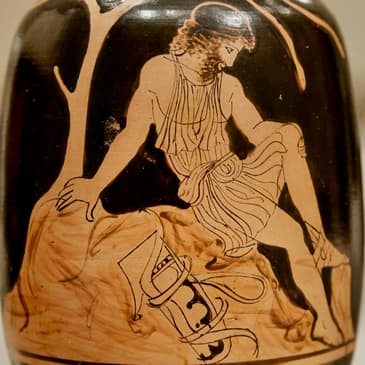
When modern authors and filmmakers like Christopher Nolan adapt ancient myths and characters, they are following an old and well-worn precedent. In this episode, Emily and Cam explore how the Athenian playwright Sophocles adapted a well-known story about Odysseus and used it in his play, Philoctetes, to explore questions about deception, persuasion, and intractable situations.
Visit our homepage to subscribe, to find us on social media, and to contact us by email:
Links to our episodes dealing with the Odyssey:
- Our overview of Homer’s Odyssey.
- Our episode about Christopher Nolan’s Odyssey.
- Our episode about the “The Return”, Uberto Passolini’s splendid 2024 adaptation of Homer’s Odyssey.
Links to our other episodes touching on ancient drama (or adaptations thereof):
- Aeschylus’ Persians: The OG Greek Tragedy.
- Something for everyone! Plautus and “A Funny Thing Happened on the Way to the Forum”.
Cover image: adapted from a photo by Jastrow, Wikimedia Commons.
----------
00:11 - Introduction
02:50 - Sophocles’ Philoctetes
- 02:55 - The performance: 409, at the end of the Peloponnesian War
- 03:07 - Athenian Tragedy in the late 5th century: actors and the chorus
- 05:37 - The competitive context
07:26 - The Myth of Philoctetes
- 07:39 - Son of Poias
- 07:57 - Philoctetes, the Trojan War, and Lemnos
- 09:37 - Philoctetes and the Bow of Herakles
10:30 - Philoctetes: Plot Summary
- 10:43 - The opening scene: a plot is hatched
- 13:22 - The encounter with Philoctetes
- 15:10 - The “merchant” enters the scene
- 18:00 - Philoctetes’ seizure and Neoptolemus’ moral crisis
- 18:57 - Odysseus’ surprise entry
- 20:21 - Odysseus and Neoptolemus have a spat
- 21:35 - The epiphany
22:17 - Sophocles’ innovations
- 22:54 - Lemnos: a deserted island
- 23:25 - Neoptolemus replaces Diomedes
- 24:36 - A digression on other plays about Philoctetes: Aeschylus and Euripides
25:57 - Odysseus in Philoctetes
- 26:10 - Odysseus as trickster
- 27:14 - The Homeric precedent
- 28:23 - Sophocles’ move: Odysseus, disguise, and a destabilization of trust: are the minor characters who they say they are?
35:26 - Deception in Philoctetes
- 35:35 - Is Odysseus the play’s “bad guy”?
- 38:43 - The chorus has a different view!
- 39:10 - Philoctetes isn’t a straightforward “good guy”!
- 40:48 - Neoptolemus: is deception good when you do it to help someone else?
- 43:57 - Sophocles doesn’t give us easy lessons
44:43 - Intractable Problems
- 45:04 - The impasse
- 46:33 - The epiphany of Heracles and what it might mean
- 48:47 - A happy ending for Philoctetes—and for Odysseus!
- 50:15 - The value of deception: an open question (and Sophocles’ brilliance)
51:21 - Wrap-up
[00:00:11] Hello, welcome to Have Toga, Will Travel, a podcast exploring the Mediterranean world, ancient and modern, through the eyes of two former classics professors. I'm Emily. I'm Cam. And we're your hosts. All right, so we're still stuck in Odyssey fever. Homeric hellhole? I mean… Yes, something like that. Like the rest of the world, to be fair. So in this episode, and in the next one, we're going to expand on our last couple episodes in which we've talked about the Odyssey.
[00:00:42] by looking at two plays from Athens in the classical period that engage either with Odysseus himself or with the Trojan War more broadly. And as we'll see in both of these episodes, adapting ancient myths in the way that modern authors and filmmakers do isn't just a product of our own times. Ancient authors themselves did this whole bunch as well. Yeah, they really did. So today we are going to talk about a play where Odysseus is a key character. Sophocles' play Philoctetes.
[00:01:12] Now this play is set near the end of the Trojan War and was written about 250 years after the Homeric epics had achieved something like the form in which we now have them. Middle of the 7th century, BCE, if you don't remember and if you care. Yes. With disclaimers for people who think the Homeric epics were actually formed much later. Anyway, the Trojan War was a rich source of material for Greek tragedians like Sophocles who pulled stories from this mythical tradition all the time.
[00:01:41] It's worth pointing out that Greek tragedians in general often drew heavily on mythological stories. And they often added their own twists to those myths along the way. Now we have already talked about Aeschylus' Persians, the one surviving example of a tragedy based on a historical topic rather than a mythological one. But plays like that about historical moments were more of an exception rather than the rule.
[00:02:07] So what we're going to do today is take a look at Sophocles' Philoctetes and we're going to examine how Sophocles adapted an ancient myth featuring Odysseus in a way that allowed him to exploit the complexity of this particular character to explore problems in which he was really interested, deception and persuasion. We're going to start with a brief overview of the play itself and the context in which it was produced. And then we're going to touch briefly on the myth of Philoctetes that formed the background of the play.
[00:02:36] And then we'll describe the plot in some detail. And then we'll explore how Sophocles uses the play to think about the issues that really seem to interest him here. So deception, persuasion, irreconcilable differences, things like that. That sort of thing. Yeah. All right. So let's get started. And we'll start by talking a little bit about the play itself. So Sophocles' Philoctetes was performed in 409 BCE.
[00:03:01] That's towards the tail end of the Peloponnesian War and about 65 years after Aeschylus wrote the Persians. Now, there has been a lot of development in the nature of tragedy in those intervening years since the Persians. And one of the big changes that's happened is that we have introduced a third actor. So in the Persians, we had a chorus and two actors who performed all the roles.
[00:03:24] By the time the Philoctetes is performed, we have a third actor, which allows for more complex stage interactions. And it's actually going to be a key element to our discussion of the play and to how we might understand the character of Odysseus in it. So just as a reminder, the structure of Greek tragedies is built around alternating scenes and choral songs or odes.
[00:03:46] Scenes are when actors engage in dialogue with each other or sometimes just monologue and with a chorus of 12 to 15 people, depending on the period we're talking about. Choral odes, on the other hand, are songs that the chorus performs. They involve a lot of singing and dancing and sometimes interaction with the characters if the characters are still on stage at the moment. During these choral odes, an actor may stay on stage or the actor may exit. Sometimes all of them will exit.
[00:04:15] Sometimes just one of them will exit. It depends. But since plays can only use two or three actors, depending on the period we're talking about, these choral odes can actually be moments where actors can go offstage, change their masks, change their costumes, so they can come back on afterwards as a new character. And generally speaking, when you have three actors, two of those actors are going to end up playing multiple characters. Right. Worth reiterating a point that we probably made when we talked about the Persians, which is this is a masked performance style.
[00:04:42] So the actors are wearing masks all the time to represent different characters. Yes. Anyway, tragedy as a genre was basically being invented in the 5th century and continued to develop through that entire period. And importantly for us, this doesn't necessarily mean that tragedy meant the same thing to the Greeks that it means to us. That is a piece with a sad ending, that kind of thing.
[00:05:06] Instead, the most consistent element in 5th century tragedy is probably simply that a tragedy is a play that looks at a pretty serious theme and explores that theme in a pretty serious way. As opposed to a comedy, which is going to either satirize serious issues and serious people, or it's going to take serious matters and look at them in kind of a flippant or light way, something like that. We should really do an episode on comedy itself. We will at some point. Yeah.
[00:05:35] We've got lots of them we can talk about. Yeah. Anyway, the other important thing to remember is that these plays were written for competition. So at the most important dramatic competition, which happened at the city Dionysia or the Great Dionysia, depending on what you want to call it, three playwrights were chosen about a year before the festival. And those playwrights would each write four plays to submit for the competition. And these four plays would include three tragedies and a satir play.
[00:06:04] The satir play was a more comedic style play, a farce almost, or burlesque. Mythological burlesque. There we go. Yes, that's a good way to put it. Where the same topics of tragedy were explored, but the playwrights would treat them in kind of an over-the-top ridiculous way. They're called satir plays because in these performances, the chorus dressed as satirs. Yeah. The traditional sort of half-man, half-goat critter. Yes.
[00:06:31] Now, in the case of the Philoctetes, we actually know how Sophocles' plays that year did. They won first prize that year. However, what we don't know are the other plays that Sophocles wrote that would have accompanied the Philoctetes. Do we know just out of curiosity who the other competitors were? No, I don't think so. That's unfortunate too. But you know, Sophocles was arguably the most successful of the three surviving tragedians, if we're measuring just in terms of number of victories and competition.
[00:06:59] Yes, and he was active for a really long time, right? From the middle of the 5th century down into the... Yeah, his first win actually is against Aeschylus. In the 450s. Yeah, their careers overlap. I think even actually the 460s. I think the late 460s. Okay. I'd have to check. And then his last victory comes with Oedipus at Colonus, costumously. Yeah, but even this play in 409, I mean, he is the grand old man of Athenian theater at this point. His career is roughly 60 years as a playwright. Yeah. All right.
[00:07:27] Well, let's move on and talk a little bit about the source material. That is the myth underlying Sophocles' Philoctetes. And I guess the logical place to start is with Philoctetes himself. Who was this guy? Well, in Greek myth, Philoctetes was the son of Poyas, a king in Thessaly, a northern region in Greece. Poyas was probably based somewhere along the northwest coast of Thessaly, although we have to say that the ancient sources aren't quite consistent about where in Thessaly Philoctetes was from.
[00:07:57] Now, Philoctetes is one of the Greek leaders who led men to Troy, and thus the earliest mention of him in literature is in the Iliad. In the catalog of ships in book two, the Iliad tells us that he led seven ships to Troy, but had been abandoned by the Greeks on the island of Lemnos after he was bitten by a snake and developed a festering wound.
[00:08:21] However, the catalog also hints that Philoctetes will eventually come to Troy and that the Greeks will remember him. Right. And this is the critical bit of the story. He is abandoned on Lemnos because he's got this snake bite that produces a festering and smelly wound that just won't heal. How he gets that snake bite varies a little bit depending on who is telling the story. In this particular story, he seems to trespass in a sanctuary and is bit by the sanctuary snake.
[00:08:51] Now, the remainder of Philoctetes' story, his actual arrival at Troy, is told in one of the lost poems of the epic cycle, what's called the Little Iliad. So we only have a rough sense of it from basically summaries that survive from antiquity. And what seems to happen is that eventually the Greeks are going to get a prophecy from a Trojan seer they've captured named Hellenus, and the prophecy tells them that they need Philoctetes to win the war.
[00:09:18] So Odysseus and Diomedes go get Philoctetes from Lemnos. They bring him to Troy. He is healed by the sons of Asclepius, who is the god of healing, and his sons are accompanying the Greek army. And then eventually Philoctetes is the person to kill Paris. And is instrumental in the capture of Troy. Yes. Philoctetes is also described in the mythic tradition as a great archer. And another critical element of the story, which as we'll see gets a lot of play in the play,
[00:09:48] is that he possesses the bow and the arrows of Heracles, which he acquired after Heracles died. The story here is that either he or possibly his father was a close companion of Heracles. And as Heracles lay dying, tormented by poison, was the one to actually light the pyre on fire. Are you laughing at light the fire on fire? No, it's a joke that gets made in. Yeah, it's a funny thing that happened on the way to the forum, which we've talked about. I think we might actually mention that joke in our episode.
[00:10:18] A fire pyre. A fire pyre, yes. Anyway, in gratitude for this service, Heracles hands over his bow and his arrows to Philoctetes. Come on, baby, light my fire. Yes. Okay. Let's talk about the plot of the play. Yes. It's a complicated play, so we're going to go into a bit of detail here. Yes. So it is worth keeping in mind when playwrights are creating these stories, they can choose where they start the story and where they end the story.
[00:10:43] So when the play opens, Odysseus and Neoptolemus, who is the son of Achilles, have just landed on Lemnos on their mission to get Philoctetes. And Lemnos here is depicted as a completely uninhabited island.
[00:10:59] Odysseus fills Neoptolemus in on the backstory of what's happened, that he was ordered to abandon Philoctetes on the island because whenever Philoctetes' wound was acting up, his, you know, groans and cries of pain interrupted the sacrifices and just generally annoyed everybody.
[00:11:17] And so the sons of Atreus, that is Agamemnon and Menelaus, who were the kings of Mycenae and Sparta respectively and leaders of the war effort, ordered Philoctetes to be gotten rid of and abandoned. But now, says Odysseus, he's here to capture Philoctetes, bring him back to Troy, and he wants Neoptolemus' help baiting Philoctetes into a trap.
[00:11:40] Odysseus claims that Troy simply can't fall unless the Greeks have Heracles' bow, which now belongs to Philoctetes, all of which comes as a surprise to Neoptolemus, since Neoptolemus at this point thinks he's the person fated to bring about the fall of Troy. Yeah, and it's worth adding that Neoptolemus is fairly new to the war effort, like they've gone and gotten him at the end of the war because there was a prophecy about him as well. Right. So that's the plan. But Odysseus says there's a problem. Philoctetes isn't going to come to Troy willingly because he hates both Odysseus and the sons of Atreus.
[00:12:10] And Odysseus and Neoptolemus can't simply take the bow from him by force because, of course, it has magical arrows that never miss their mark and Philoctetes will simply kill them both. So Odysseus has come up with a clever and somewhat sneaky plan to achieve his goal. He wants Neoptolemus to befriend Philoctetes by pretending to be Odysseus' enemy and the enemy of the sons of Atreus.
[00:12:34] Now, Neoptolemus is at first incredibly reluctant to go along with him because he thinks it's wrong to fool somebody using deception. But Odysseus eventually persuades him that this is the best way to get what he wants, which is victory at Troy. Odysseus then exits the scene, returning to the ship. But before he goes, he promises to keep in contact with Neoptolemus if necessary by using one of the ship's crew members as a messenger.
[00:12:59] And what he says is that the messenger will come in disguise as somebody else, as the captain of a passing ship, so that there's no way at all that Philoctetes will suspect anything is going on. So Odysseus exits and Neoptolemus is joined by the chorus, who in this case are sailors from their ship. And they have a song in which the chorus expresses some pity for what Philoctetes has gone through. But then Neoptolemus tells them to be quiet because he can hear somebody approaching.
[00:13:26] And that somebody, to nobody's surprise, turns out to be Philoctetes, who's positively overjoyed to see fellow Greeks on the island. Especially when he learns that Neoptolemus is the son of Achilles, whom he fondly remembers. Philoctetes then tells the whole gang his story. He dwells a little bit on how rough life has been for him on this island, where he's been stuck for 10 years by himself with a wounded foot that makes it difficult to walk.
[00:13:50] And he stresses that he's survived only because of his own resourcefulness and because he has the bow of Heracles for hunting game. And of course, he ends this little speech by declaring how much he hates Odysseus and the sons of Atreus and prays that the gods will make those people suffer. Now this is Neoptolemus' opening. So he tells Philoctetes that he hates all the same people that Philoctetes does and that he hopes one day to take vengeance on them. And then he proceeds to tell his own tale of woe.
[00:14:17] Namely that after the death of his father Achilles, Odysseus had come to fetch him and declare that it was up to him to capture Troy. But when he arrived at Troy, Odysseus refused to hand over the weapons and armor of Achilles, which the sons of Atreus had previously awarded to him after the death of Achilles. And the sons of Atreus now back up Odysseus. So Neoptolemus claims that he left Troy because of this and is now sailing home.
[00:14:46] Right, because Philoctetes understands this as a huge insult to Neoptolemus and an attack against his honor. And for that reason, he bonds with Neoptolemus over their shared hatred of the common enemies here, Agamemnon, Menelaus, and to a certain extent Odysseus. And then he begs Neoptolemus to rescue him from the island. The chorus and Neoptolemus express pity for him. And at the end of another little choral song, they agree to take him on board. Now as the song finishes, we have a new entrance. Ta-da!
[00:15:15] The supposed ship captain, who's often referred to as a merchant in our texts, enters. Just like Odysseus promised. And he has pretended that he has landed on the island for water. Learned that Neoptolemus was there on the island and decided to bring him news. Namely that the Greeks have sent out men to find him and bring him back to Troy.
[00:15:37] He also claims that Odysseus and Diomedes have also set out to try to find Philoctetes and bring him back to Troy as well. When Neoptolemus hears all this, he asks why suddenly the Greeks are sending out people to take both him and Philoctetes. And what the pretend ship captain says is that the Greeks have received a prophecy from the Trojan seer Hellenus, whom they've taken captive.
[00:16:01] And that prophecy is that Troy will not fall unless the Greeks can persuade Philoctetes to voluntarily leave Lemnos and come and rejoin the army at Troy. Now once the supposed ship captain has delivered his message, he leaves. And Philoctetes declares that he will never rejoin the army. And that he and Neoptolemus need to leave immediately before the various groups of people trying to find them, find them.
[00:16:28] And in a key scene that indicates just how much he's come to bond with and trust Neoptolemus, Philoctetes hands him the bow of Heracles so that Neoptolemus can admire it. Now Neoptolemus and Philoctetes in the chorus are just about to head back for the ship. But at that moment, all of a sudden, Philoctetes' wound flares up and he basically has a seizure apparently brought on by the poison that remains in the wound.
[00:16:52] And as the pain grows worse, Philoctetes begs Neoptolemus not to abandon him and more importantly to guard Heracles' bow so that nobody sneaks in and takes it while he's defenseless and unconscious. Then Neoptolemus and the chorus watch in horror as Philoctetes writhes in pain and passes out. But once Philoctetes is unconscious, the chorus turns to Neoptolemus and tells him, All right, this is the time to act. We should take the bow and get back to the ship as quickly as possible.
[00:17:21] But Neoptolemus decides this isn't the way to go. He's interpreted the news, in quotation marks here, brought by the false ship captain about Hellenus' prophecy as Odysseus' way of telling them that they don't just need the bow itself. They also need Philoctetes and Philoctetes actually needs to come willingly. So instead of hightailing it for the ship with the bow, Neoptolemus and the chorus decide to stay there, wait for Philoctetes to wake up and work on him to come voluntarily.
[00:17:50] When Philoctetes does wake up, he's incredibly grateful to them for watching over him and for waiting and declares that he's ready to leave with them, though he doesn't yet know exactly where they're going. Now at this point, however, while Neoptolemus is helping Philoctetes to his feet, he has something of a moral crisis. He becomes sort of increasingly distressed to the point that Philoctetes repeatedly asks him what's wrong.
[00:18:14] And eventually, Neoptolemus blurts out the details of the whole scheme and tells Philoctetes that they're not actually taking him home, but to Troy. Philoctetes, understandably, is both angry and horrified at this moment. And he immediately demands that Neoptolemus hand back Heracles' bow. Neoptolemus refuses, on the grounds that he needs the bow to bring about an end to the Trojan War.
[00:18:39] This, again, understandably doesn't make Philoctetes particularly happy, and he launches into a pretty lengthy speech in which he attempts to play to Neoptolemus' better nature, and to what he perceives accurately to be Neoptolemus' discomfort at participating in this whole deceptive scheme. But just when it seems like Neoptolemus is going to relent and hand the bow back to Philoctetes,
[00:19:03] Odysseus pops out of the bushes and shouts that Neoptolemus will never do such a thing, and that both the bow and Philoctetes are going to Troy whether Philoctetes likes it or not. Odysseus does try to take some of the sting away by reminding Philoctetes that he is equal to the best of men, that he's fated to take Troy, that sort of thing. But Philoctetes is having none of this, and he categorically refuses to do what Odysseus wants.
[00:19:31] He alternates between threatening to throw himself off of Lemnos' cliffs to kill himself, and calling down curses on Odysseus. So Odysseus tries one final move. He says, okay, fine, we don't need you anyway. I can use the bow just as well as you can. And then he and Neoptolemus exit to get the ship ready for departure. But the chorus in this case, who's feeling sorry for Philoctetes, stays behind. Philoctetes has a moment here. He's lost in grief.
[00:19:59] He's imagining what's going to happen to him now, that he's not just trapped alone on this island with his wounded foot, but also no longer has the bow of Heracles to help him hunt and get food. The chorus is sympathetic, but they also seem to think that Philoctetes should just accept what's happened and sail to Troy with them anyway, rather than to stay here alone on Lemnos. Now, somewhat unexpectedly, Odysseus and Neoptolemus come back on stage together, although they're clearly in the middle of an argument.
[00:20:29] Neoptolemus declares that he is ashamed for deceiving Philoctetes and that he wants to return the bow. Odysseus tries to argue him out of it and then threatens him. But when Neoptolemus doesn't back down, Odysseus finally just exits. Then Neoptolemus again asks Philoctetes to come with them. And when Philoctetes says no, Neoptolemus returns the bow to him. Then we get what I think is another funny moment, when Odysseus jumps out of the bushes a second time, tries to prevent Neoptolemus from handing back the bow,
[00:20:57] but he has to run away when Philoctetes actually tries to kill him with Heracles' bow. Now again, Neoptolemus tries to persuade Philoctetes to go with them to Troy. He tries to argue that this is what's best for Philoctetes. That is, if he comes to Troy, he can be healed by the sons of Asclepius and he can win glory. And also, this is what Hellenus' prophecy has said will happen. But ultimately, Philoctetes simply can't abandon his enmity against Odysseus and the sons of Atreus. And instead of agreeing to go to Troy,
[00:21:27] he urges Neoptolemus to stick to his original promise and to take him home. Neoptolemus relents and he begins to help Philoctetes toward the ship. So we seem to be at this moment where Neoptolemus has dropped the plan. He's going to take Philoctetes home. Everything has kind of gone sideways. And then at that moment, Heracles suddenly appears in a divine epiphany. And he declares that Zeus has a plan for Philoctetes. That like Heracles, Philoctetes will win glory through his labors and suffering.
[00:21:56] And that he will go to Troy. He will kill Paris. He will sack the city. He will win the prize for valor. And he will be healed. Presented with Heracles as God suddenly appearing right in front of him, Philoctetes resolves to go, finally, to Troy, to satisfy fate, to satisfy the advice of his friends, and the command of the God. End play. So that's the plot of the play. It's worth noting again that playwrights, like Sophocles,
[00:22:23] regularly diverge from the quote-unquote known or pre-existing versions of the myth. And that includes even myths that belong to the epic tradition and the story of the Trojan War, which would have been, you know, well-established at this point. When they did this, they were doing it because they were essentially exercising artistic license to meet a variety of different goals, whether that was to keep the audience engaged by doing something a little bit surprising, or to focus on ideas or themes that interested them. Right.
[00:22:50] Again, this is in competition, so you've got to impress your audience. Right. And here in the Philoctetes, Sophocles made two main changes to the basic story that most people would have been familiar with. First, in the play, he presents the island of Lemnos as a deserted island. That's not how it was in the epic tradition. So what Sophocles is doing here is really highlighting what Philoctetes is suffering.
[00:23:17] Not only does he have this nasty, nasty wound that won't heal, he's also been marooned alone on an uninhabited island for 10 years. The other main change is who goes to get Philoctetes. Now, in the epic tradition, there is this prophecy that the Greeks need Philoctetes to come to Troy in order to conquer it. But the people that go get him in the epic tradition are Odysseus and Diomedes. Now, to have Neoptolemus participate instead of Diomedes, as Sophocles does here,
[00:23:47] Sophocles is actually reversing the chronology of some events in the epic tradition. And in this case, the little Iliad is the text at play. Because in that, the mission to bring Neoptolemus to Troy actually comes after the mission to get Philoctetes. Yeah, and one of the funny things here is that Sophocles actually signals that he is fully aware of the tradition because he actually has the pretend ship captain reference the traditional story.
[00:24:11] This change allows Sophocles to introduce a younger man, Neoptolemus, into the story as a character who can really foreground some of the ethical issues the play raises because Odysseus is able to exploit his youth and experience. Right, unlike Diomedes, who is perfectly happy to go along with whatever Odysseus wants in, say, the Iliad. And the bloodier it is, the better. Yes, yes. As a side note, and just as a point of trivia, we do know that two of the other great Athenian
[00:24:41] tragedians whose works survive also wrote plays about Philoctetes. Both of these were written before Sophocles' version, but neither one of them unfortunately survives. And in fact, Sophocles also wrote another play about Philoctetes. This is a popular character in tragedy. Yeah, the other play was called Philoctetes at Troy. So our tragedian Aeschylus, his Philoctetes, we don't know much about. We know that Odysseus is the primary figure in getting Philoctetes to come to Troy.
[00:25:07] And we know that he tells some sort of false story that Agamemnon has died. And that's about all we know. I think the speculation here is that this was a play that probably only involved two actors. And then in Euripides' play, Odysseus and Diomedes sailed to get Philoctetes. But in Euripides' play, there was an added complication. The Trojans had also sent a delegation to try to convince Philoctetes to help them instead. And that's really all we know about the other versions.
[00:25:32] So we don't really know enough about them to know how they handled the story or any of the sort of details therein to be able to say how Sophocles' version may or may not have referenced them or interacted with those other plays or other innovations that those playwrights might have introduced to the story. Right. So Sophocles is not at all alone in making changes to these inherited myths. Yeah.
[00:25:57] So one of the things we can do now that we've talked about those changes and about the overall plot of the play is explore what Sophocles is trying to do here, especially with Odysseus. And I guess we can start just by noticing that the play really, really focuses heavily on Odysseus as a deceiver, as a trickster. In fact, Odysseus in the play states straight up that he is totally okay with deception if it brings benefit of some sort.
[00:26:27] There's some great quotes like, lying is not shameful if it brings salvation. Or whenever you do something for a benefit, it's okay not to hesitate and do whatever it takes. Yep. And my favorite bit is when he says something like, you know, there's a time when you need somebody sneaky and deceptive. And when that time comes, I'm your guy. But at the same time, if you need somebody virtuous, I'm the most pious dude of the bunch.
[00:26:53] So this willingness to engage in deception to achieve one's ends really underlies the fundamental moral issues of the play. And this is highlighted in the initial dialogue between Odysseus and Neoptolemus when Neoptolemus is shocked by Odysseus' suggestion that deception is ever acceptable. Yeah. And this portrayal of Odysseus as somebody who is happy to engage in tricks and deceit
[00:27:20] is flowing right out of how Odysseus is characterized in the Homeric poems. In the Iliad, there's a very famous extended chunk called the Dolinnea. It's in book 10. There we go. And in this little vignette in the Iliad, Odysseus and his ride or die buddy Diomedes... They really are. Yeah. They go on a night raid to spy on the Trojans. While they're out, they capture a Trojan named Dolon. And they basically lie to him to get him to reveal some critical information.
[00:27:49] And then of course, kill him, even though he begs for his life. And they take his information and they go off and they kill somebody who is prophesized to cause a problem for them. And steal his horses. And they kill a bunch of his men too while they sleep. So it's a great, cheerful, heartwarming episode. Yeah, it's pretty dark. And then of course, in the Odyssey, as we've talked about, Odysseus lies, uses disguises all over the place. And his skill at disguising himself and creating false stories about his identity is so highly
[00:28:18] developed in the Odyssey that even people who know him well do not recognize him. Now in this particular play, Sophocles builds on this pre-existing characterization of Odysseus and runs with it. And he takes it way further by using this aspect of Odysseus to basically destabilize the audience's ability to believe or trust almost every other character who takes the stage, except maybe Philoctetes himself.
[00:28:45] To understand how, it's important to remember that the action of the play revolves mostly around the relationship between Neoptolemus and Philoctetes. They have lots of conversations on stage with each other, while a series of other characters, the False Merchant and Heracles in particular, arrive on stage and reshape the course of the action. Now, it's worth reminding you here that apart from the members of the chorus, the play only used three actors.
[00:29:12] The structure of this play means that one actor played Neoptolemus, another actor played Philoctetes, and the third actor played all of the other characters. That's Odysseus, the Merchant, and Heracles. Yes. Now, it is a little unusual in a play with three actors to have two performers only play one character each. Usually, you'll have one performer who only plays one character. All this leads to a critical dramatic question.
[00:29:39] Are we meant to see the characters played by the guy playing Odysseus as separate characters, or are they all just Odysseus in disguise? We already know that the Merchant, for example, is not at all who he says he is. This is a character disguising himself as a Merchant Captain. Odysseus has told us it's going to be some random crew member, but it's also easy to believe that this is potentially Odysseus himself. Yeah.
[00:30:04] The one thing we know for sure is that that character is lying about his identity and his purpose. So regardless of who the character says he is, we're pretty sure that we, the audience, cannot trust he is who he says he is. We have to believe that that's someone in disguise. Now, given how invested Odysseus is in making sure this mission is successful, it raises the question, why would he trust one of his men to manipulate the situation better than he could?
[00:30:31] Even the Odyssey, Odysseus really isn't one to delegate this kind of work. Like, he does tend to take it on himself. So who is the Merchant? Is it one of Odysseus' men in disguise, or is it Odysseus himself in disguise, posing as a Merchant? Right. And so then if you look at Heracles, that too should probably, I think, be a question in our minds and the minds of the audience who was watching this in 409 BCE. Is that really Heracles, or is that another character in disguise, like, say, Odysseus,
[00:31:01] using this opportunity to put his deception to work once again and get Philoctetes to agree to come to Troy? Generally speaking, this isn't a question you'd normally ask about characters in a Greek tragedy. Even though actors typically played multiple roles, usually the audience would just sort of take for granted that a character is who that character claims to be. However, at the same time, in his plays that survive, of which granted it's only 7 out
[00:31:28] of over 120, we can see Sophocles playing with the meta-theatrical impact of what gets called role doubling. But basically, the impact of which characters are played by the same actor. And some of the examples from his other plays tend to involve characters who are somehow opposed to one another being played by the same person. So in the women of Trocus, or the Drachinii, depending on what you want to call it, the actor
[00:31:57] who plays Daenera also plays Heracles. Daenera is Heracles' wife, but she's also responsible for his death. And they are, let's say, not in a good place relationship-wise in that play. Or in his Electra play, the same actor plays Orestes as plays Clytemnestra. And so in that play, Orestes is the son of Clytemnestra and kills her in that play. So you actually have the actor exiting as Orestes, I'm going to go kill my mother.
[00:32:23] And then immediately you have cries offstage as soon as he exits of Clytemnestra shouting, oh my gosh, you're killing me. And it's the same actor who's doing that. And this role doubling can convey an extra level of meaning to the audience, who of course would have been aware that these characters were being played by the same person, that there were only three actors. And not only that, they probably would have recognized the actor's voice underneath the masks of the various characters. Right.
[00:32:52] So because this particular play has already established the precedent that characters are not necessarily who they say they are. And because Sophocles is somebody who is known for this sort of metatheatrical manipulation, and because the character directing the deception in this play is Odysseus. The master of disguise. It's almost impossible not to ask here if Heracles is really Heracles. It's the very nature of Odysseus' character in general and his presentation in this play
[00:33:20] in particular that really makes this question a live one. Now, there is a scholar, Hannah Roisman, who has argued that we have to actually imagine that Odysseus is watching everything unfold between Neoptolemus and Philoctetes, and that he jumps into the action one way or the other, so either as himself or in disguise as the merchant ship captain or Heracles, when things are moving in a bad direction relative to his ultimate goal. Yeah.
[00:33:48] And if you look at the structure of the play, you know, Odysseus states explicitly at the beginning that he's going to send somebody out in disguise as a merchant captain if he thinks Neoptolemus is taking too long. Which sort of implies that Odysseus is lurking somewhere nearby, keeping tabs on what's going on so that he or another person in disguise can intervene. And Heracles does appear at the moment where it seems that Neoptolemus might finally have been persuaded to take Philoctetes home to Greece instead of Troy, and that everything
[00:34:18] is really going to fall apart. It might seem a little shocking to imagine that Odysseus could be so bold here as to impersonate Heracles, who story-wise in any way is a god now. This is after his death and after his apotheosis. It's worthwhile pointing out, though, that in the Odyssey, he lies to Athena. Yep. But Athena then goes on to say, you really just can't help yourself. You'd lie to anybody. Yeah. Man, woman, child, god, whatever. And of course, he also lies to his own father in Odyssey, which is, you know, not good.
[00:34:47] Well, especially because he does it after he's already killed the suitors. He's already revealed himself to almost everyone else on Ithaca. Yeah. But he still goes and lies to his father. Right. So I think the audience would be perfectly happy to accept Odysseus as somebody who would just lie to whomever. And in the end, this question about who is Heracles at the end of the play actually has implications for how we understand the central questions of the play. Namely, when, if ever, is deception acceptable?
[00:35:17] And what happens when you have two sides that are irreconcilably opposed to one another? And those are the questions that we're going to jump into now. So let's start with the question of deception. Woohoo! Is it or is it not ever acceptable to use deception when you're trying to persuade somebody to do something for you? And here, you know, at first glance, it's really easy to see Odysseus as the play's bad guy and to assume that the play is suggesting that we should reject his approach, right?
[00:35:46] You should not do what Odysseus does here, which is to sort of assume that the ends justify the means and just go for it. After all, one of the things the play does is put a lot of work into making the audience feel sympathetic to Philoctetes, who, unlike Odysseus, has a much more traditional or heroic view of what makes for ethical behavior. He really emphasizes courage, physical courage. He emphasizes plain speaking rather than deception.
[00:36:15] And he really, really emphasizes a very classical tenet, which is to help your friends and to actively harm your enemies. And the play creates this sympathy mostly by showing us how both Neoptolemus and the chorus come to feel pity for Philoctetes, and by suggesting that Neoptolemus does seem to agree that helping one's friends and not deceiving them are really the best courses of action.
[00:36:43] At the same time, Philoctetes and Neoptolemus both actively criticize Odysseus' methods and approach. Naturally, Philoctetes, who hates Odysseus, does this the most aggressively in the play. So among other things, he says straight up that Odysseus has an evil mind and has used that evil mind to coerce Neoptolemus in becoming clever in evildoing himself. And Philoctetes also consciously evokes Homer's famous adjective describing Odysseus in the very
[00:37:10] first line of the Odyssey that is polytropos of many ways by calling Odysseus polymekanos, which means of many devices, of many schemes. So it really does carry a connotation that's much more like cunning or scheming rather than... Flexible. Flexible, yeah. And in a way that's... It's not a good way. Now, Philoctetes is the most aggressive character when it comes to criticizing Odysseus in this play.
[00:37:39] But Neoptolemus himself also expresses a whole bunch of reservations about how Odysseus operates. So as we've seen at the beginning of the play, he expresses a lot of discomfort about Odysseus' initial plan to deceive Philoctetes. And he really needs to be talked into going along with the plan by Odysseus, who both asserts his own authority as the senior figure here, somebody a lot older than Neoptolemus, and of course argues that sometimes we have to do things we just don't enjoy doing in order
[00:38:08] to get the results we want, and that's okay. And then later, when Neoptolemus re-enters to speak to Philoctetes and return the bow after initially going off to the ship with Odysseus, Neoptolemus again emphasizes that it was shameful and wrong for him to have deceived Philoctetes and to have taken the bow by treachery. Right. So lots of reasons here to think initially that the play is trying to position Odysseus as the bad guy and that we're supposed to reject his approach.
[00:38:35] But predictably, perhaps, things are not actually that simple, and there are some bits of the play that push against that interpretation. So for one thing, the chorus, at least one moment in the play, actually does say that they see some good in what Odysseus is doing. As they tell Philoctetes, while Philoctetes is sort of bemoaning his fate, Odysseus, no matter what else you might think about him, no matter what else he might have done, has
[00:39:02] at the very least successfully achieved something good for his friends, by which they mean the entire Greek army at Troy, basically by taking the bow from Philoctetes. But at the same time, the play doesn't let the audience assume that Philoctetes is a straightforward good guy whose ethics and behavior are unquestionably better than Odysseus's. The chorus and Neoptolemus both criticize Philoctetes' code of behavior by pointing out that
[00:39:29] he is being completely inflexible, even to the point of self-sabotage. Because Philoctetes is locked into this principle that one should help one's friends and actively work to harm one's enemies, and this is really central to his self-conception. And of course, what this means is that Philoctetes isn't even willing to listen to anything Odysseus has to say because he has decided that Odysseus is firmly in the enemies category, even though
[00:39:55] Philoctetes might actually end up better off if he listened to Odysseus. Yeah, it's important to note here that Odysseus' plan is potentially in Philoctetes' own self-interest. If Philoctetes cooperates, not only will he get off of Lemnos, which is something he very, very much wants, but he'll also have a chance to demonstrate his heroic qualities in a very real way at Troy. And to be healed. And to be healed, yes, very importantly. And the chorus, when left alone with him, repeatedly points this out to him and gets to the point
[00:40:22] where they have to say something like, you are really not thinking clearly and you really, really don't have to stay here broken alone and die. A little later, Neoptolemus is going to make a similar argument to Philoctetes. He's going to tell him that he's clinging sort of perversely to his position and rejecting even well-meaning advice and that he should relent and go along with Odysseus' plans because that plan is actually going to work out better for Philoctetes.
[00:40:48] And then finally, in a very interesting turn, the play has Neoptolemus, another character with whom we're really supposed to sympathize, using potentially deceptive rhetoric himself in an effort to get Philoctetes to relent the plan to go to Troy. And yes, you can argue that this plan clearly serves Neoptolemus' own interests. But as presented in the play, it seems that Neoptolemus sincerely believes the plan is also the best thing for Philoctetes. Again, he'll get healed, he'll win glory and all that.
[00:41:18] And so in his mind, arguably, he's using deception to work toward a good result. And again, this is a character with whom we're supposed to sympathize. Yeah. So in that sense, the play seems to be inviting us to think that maybe deception is okay, at least when it's used to produce a result that's actually good for somebody. Neoptolemus has two moments where he engages in some sort of deception. Now, the first one we've talked about a bit, right? In his initial story to Philoctetes, he tells Philoctetes that he is going home from Troy
[00:41:45] because he has been wronged by the sons of Atreus regarding his father's armor. And in that story, we know that some of the details about the events at Troy are true, but that the final element that he's going back to Greece is false. But we actually don't know the extent to which Neoptolemus's description of his own feelings and reactions are true or false. And it raises the question of, you know, to what degree is he committed to this deception and artificially constructed a story and lied about himself to appeal to Philoctetes'
[00:42:15] own situation? And to what extent is he speaking the truth about himself and just lying about going home to Greece? And if he's speaking the truth about himself there, that helps explain why he and Philoctetes bond so quickly. Because they actually do have gripes against Odysseus. Yeah. And if he's not telling the truth, then to what extent is that bond illusory or built on a falsehood in and of itself? Right. But the other moment in which Neoptolemus really engages in deception is also very interesting.
[00:42:41] This is a moment in which he manipulates and expands on information that he's been fed about Hellenus' prophecy. Now, it's important to remember here what Neoptolemus has learned about the prophecy at various different points in the play. At the beginning, he seems to believe that he himself is the one who's fated to take Troy, whereupon Odysseus immediately tells him, no, no, no, no, no, that's true, but you also need the bow of Heracles. Then midway through the play, the merchant captain shows up and adds the information that
[00:43:09] no, actually Philoctetes himself has to come to Troy and has to come willingly. But when Neoptolemus is trying to persuade Philoctetes to come willingly later in the play, he tells Philoctetes that the prophecy has revealed that Philoctetes himself will be healed by the sons of Asclepius if he comes to Troy. But there's no moment in the play in which Neoptolemus has actually learned this himself. And so then it raises the question of whether this is deception on the part of Neoptolemus or not.
[00:43:39] In this case, it would be a deception based on his own hopes for what might happen, that is Philoctetes gets healed. And it's a deception meant for Philoctetes' own good, but it's still potentially deception nonetheless. Yeah, again, from a character with whom we're supposed to sympathize here. Yeah. At this point in the play. So where that leaves us, I mean, who knows? It's all very complicated, right? And it all seems to suggest that Sophocles isn't trying to give us an easy lesson
[00:44:04] or an easy answer about the role of deception when it comes to personal and, by extension, political relationships. Instead, he's pushing the audience to really grapple with these questions. Questions like, is it okay to play fast and loose with the truth in a persuasive speech when you're trying to get somebody to do something that is actually good for them or for the larger community? What makes Sophocles so good? Yeah, and I will say that, you know, Sophocles would have no doubt whatsoever
[00:44:31] that the humanities are important because they focus on precisely this sort of thing. I always like to say that Sophocles is interested in the messiness of human life. Yes, very much. And what do you do in situations where there's no good answer? Right. That's a good way to put it. Yep. Especially since the next thing we're going to talk about is that other question. What do you do in a case where you end up in an intractable situation? Yeah, where you have two sides that are adamantly opposed to one another and there's no middle ground. And persuasion has failed. And persuasion has failed.
[00:44:57] And the ending of the play really drives home this predicament by presenting us with this very kind of situation. Persuasion has failed. And before Heracles arrives, we're at a total impasse. Neoptolemus has not been successful in persuading Philoctetes to come to Troy. And it's even unclear what Neoptolemus is going to do in this moment. He might actually take Philoctetes back to Greece. Or maybe he's lying to him and is going to take him to Troy anyway. We don't know. Right.
[00:45:23] And again, the issue here is that Philoctetes will not let go any of the enmity he feels towards Odysseus and the sons of Atreus. Even though that would actually help him because he would get healed. He would win glory. He would return to human society. All that good stuff. And on the other side, right, Odysseus is not going to relent. He's not going to, you know, make amends to Philoctetes in any way that Philoctetes is going to find acceptable. Yeah. Sorry we abandoned you on this island for 10 years. Yeah. Yeah.
[00:45:50] And it's, of course, even if there were something Odysseus could do to make amends, it's unclear whether it would actually win Philoctetes over. And like appeals to logic and to self-interest really have fallen flat in the face of Philoctetes' resentment and anger. Anger is the weight of the dark side. Yes. The play, though, presents it as fully justified. Yes. No, I'm deep for this issue. Yes.
[00:46:12] So even with the weight of all of the mythological tradition, too, where Philoctetes needs to go to Troy, the audience at this point in the play is left in this situation where they really don't know what's going to happen. Will Philoctetes go or won't he? Because the impasse is so unresolvable, it seems, that the play might just explode the tradition itself and go off in some weird direction. Yeah. But in the end, what the play is asking us by posing this situation is how do we get out of a situation like this?
[00:46:42] And it seems that the appearance of Heracles is somehow our answer. This is how you get out. So if by having Heracles enter at the end, the play is trying to give us an answer to this conundrum, and it may not be, it's not necessarily a pretty answer.
[00:47:00] Right. If we assume for a second that Heracles actually is Heracles and not Odysseus in disguise, then Sophocles' answer to this impasse seems to be that the only way out of it is really divine intervention, that there are problems that human beings alone can't solve. And if we think that Heracles is Odysseus in disguise, then the answer seems to be that deception or manipulation has to be used to solve these problems.
[00:47:26] And perhaps even that that deception needs to be done by someone incredibly skilled at it, and perhaps even a little unsavory or ruthless to execute it well. And neither one of these are particularly encouraging answers. And so maybe the way the play ends, it's really asking us if there is any other way out of these situations, or are we left hoping for a miracle or a simulation of one?
[00:47:53] If there's any sort of optimism we can extract from the ending, it's something like, you know, our capacity to love is the one thing that can get us past these deep-seated enmities and hatreds. Because it is the appearance of Heracles specifically. It's not any other god that appears. I mean, you could have any god appear and be like, Philoctetes, you must go to Troy. But then it's Heracles, who is his old dear friend.
[00:48:16] And that affection that Philoctetes has for Heracles makes him not just, I'll do it because you're a god telling me what to do, but I'll do it because I want to do right by you as my friend. And that affection that he has for his friend overcomes his hatred and does lead to him willingly going to Troy to honor his friend. And so it fits into his ethics while getting the sort of result that we want.
[00:48:41] Right, even though that entails cooperation with his enemies, with Odysseus and the Atredae. And what's kind of interesting about this play is that even though in many ways it ends with this really fraught question about human existence, it also kind of has a happy ending, right? Philoctetes is going to go to Troy. He is going to get healed. He's going to be a hero. His life will be kind of restored to him. The Greeks are going to get what they want.
[00:49:11] I mean, it's a sad ending for the Trojans, but thus the story goes. The Trojans don't get a happy ending in any of these stories. So yeah, it's a happy ending that doesn't necessarily feel happy, but that's where the play leaves us. Yeah, and one last thing that makes the ending even more complicated is the fact that Odysseus gets a happy ending too, of sorts. Philoctetes is willingly going to Troy with the bow of Heracles where he's going to help end the war. That's basically exactly what Odysseus has wanted since the beginning of the play.
[00:49:39] Right. So no matter what you think about Heracles or who might be Heracles, the play ends on this note where Odysseus is clearly somebody who gets things done through clever plans. Whatever we think about his ethics or his tactics. Either he gets credit for at least setting the conditions in which the play is resolved, or if you think that Heracles is really Odysseus in disguise, then he gets credit for figuring out what exactly it is that will get Philoctetes to relent.
[00:50:09] Basically, his dead friend Heracles. And for staging a situation in which Philoctetes gets precisely that. Right, and that puts us right back into the position of trying to figure out whether or not it's okay to use deception when persuading people to act, especially when people are stuck on a response that you just can't reason them out of. This doesn't surprise me, I guess, simply because that is a theme in a lot of other Athenian literature. Oh yeah, no, totally.
[00:50:33] The problem of, you know, trying to coordinate together in pursuit of a goal when there will always be somebody who disagrees violently with both the nature of the goal and the proposed solution or path for getting there. Yeah. That's politics. Yeah, it's politics. That's what makes democracy messy in particular. Yeah, but it's also partly what makes just being a human messy. Yes.
[00:50:55] But that is, I think, one of the incredible things about Sophocles' work, is that he engages with these hard questions and doesn't necessarily give us easy answers. Right. And again, that goes back to my earlier point. This is why the humanities matter. Thinking through the problem is the important part. Often just as important as getting to a solution. Well, you can't get to a solution if you don't think through the problem well. Yes. Yeah. That's a better way to put it. Anyhow. Yeah, we should wrap up. We're going to wrap up here.
[00:51:23] Next episode, we are going to continue this engagement with tragedies and talk about the Trojan War by talking about Euripides' Trojan women. One other reminder, we do have a blog that complements the podcast in various different ways. Some of you may have been following it. If not, now's a good time to check it out. Especially since we just put up a new post. It's a photo essay about the Palamedi fortress in Nathplion.
[00:51:49] And this is a dive on our part into a more recent period of Greek history that some of you may find interesting. So that's all for today. I've been Emily. I'm Cam. And this has been Have Toga Will Travel. Subscribe wherever you get your favorite podcasts. And follow us at havetogowilltravel.com or on all the socials. And if you liked this episode, please tell a friend all about us. That really helps people discover our show and it helps us grow. Thanks for listening, everybody. Bye. Bye.