The emperor Hadrian didn’t just build a wall across Britain! During a career that involved a “world tour” to pretty much every province of the Roman Empire, he rubbed elbows with provincial aristocrats; showered gifts on the cities of the empire; climbed a couple of mountains and hunted at least one big cat; hung out for years in Greece; murdered the odd senator; and loved, lost, and deified his cherished friend Antinous. Listen as Emily and Cam hit the highlights of his career.
Visit our homepage to subscribe, to find us on social media, and to contact us by email:
If you liked this episode, buy us a coffee:
Links to other episodes we made that touch on Hadrian:
- Hadrian’s Wall, Part I: The Romans in Britain and the Imperial Frontier (the first of four episodes on Hadrian’s Wall)
- Thermae Romae: A Japanese Film about Ancient Roman Bathing—and Time Travel!
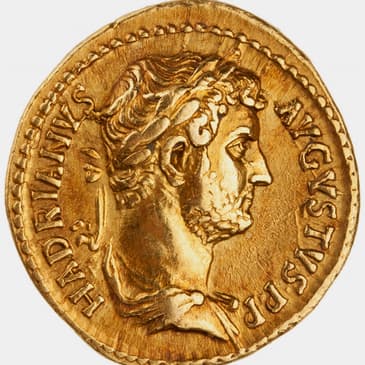
Cover image adapted from a photo of a gold coin minted between 134 and 138 CE, depicting Hadrian in profile and bearing the legend “Hadrianus Augustus P(ater) P(atriae)” (Hadrian Augustus, Father of his Country). American Numismatic Society, Wikimedia Commons.
----------
00:10 - Introduction
02:22 - Not Quite Emperor
- 02:28 - Hadrian’s early life
- 03:26 - Ward of Trajan
- 04:55 - Domitian, Nerva, and Trajan’s path to imperial power
- 05:57 - Hadrian’s career under Trajan during the Dacian Wars, the Parthian War, and the Rebellion of the Jewish diaspora
- 09:24 - Trajan is dead, long live Hadrian
11:23 - New Frontiers
- 11:24 - Hadrian’s lack of interest in expanding the Roman Empire
- 11:37 - Earlier emperors and wars of conquest
- 12:08 - Hadrian abandons Trajan’s conquests
- 13:16 - Hadrian, Nigrinus, and the execution of four senators
14:53 - Hadrian’s World Tours
- 15:02 - An inward focus
- 15:41 - Hadrian tours the provinces (of a really big empire!)
- 17:45 - Hadrian the intellectual: a conversation with Apollo’s oracle at Delphi about Homer
- 19:33 - Hadrian the adventurer: lighting, lions, and bears, oh my!
- 21:14 - Inspecting the army and securing the frontiers
- 23:01 - Hadrian and imperial patronage: local elites, imperial benefactions, and loyalty
26:47 - Antinous: a short digression
- 27:06 - Antinous’ background
- 27:48 - Antinous’ death and speculations about its cause
- 29:07 - Hadrian’s grief, the deification of Antinous, and Antinous at Tivoli
32:28 - The Olympian: Hadrian in Greece
- 32:48 - Hadrian’s early fascination with Greek culture
- 34:28 - Hadrian’s first trip to Greece: Athenian citizen, Eponymous Archon, and friends with Epictetus and Plutarch
- 37:55 - Hadrian Reborn: the Emperor and the Eleusinian Mysteries
- 41:52 – Hadrian’s plan for the Panhellenion and the Sanctuary of Zeus
- 43:17 - Hadrian among the gods: Hadrianus Olympios, Hadrianus Panhellenios
46:32 - Rebellion in Judaea
- 46:54 - The Bar Kokhba Rebellion
- 47:47 - Untangling the roots of the rebellion: a messianic movement?
- 48:50 - Imperial plans and Judaean politics
51:05 - Succession Crisis
- 51:22 - Imperial succession in the Roman World
- 52:24 - Hadrian’s potential successors
- 54:19 - Two adoptions, a death, and two murders
57:39 - Legacy
60:42 - Wrap-up
[00:00:11] Hello. Welcome to Have Toga, Will Travel, a podcast exploring the Mediterranean world, ancient and modern, through the eyes of two former classics professors. I'm Emily. I'm Cam. And we're your hosts. So we've reached the end of a little arc of episodes based around the Odyssey in some way. I think we've been talking about the Odyssey or various spinoffs for four episodes now? Yeah, that's about right.
[00:00:33] So what we're going to do today is switch gears a little bit, and we're going to head back to Rome. And in particular, we're going to spend some time talking about the Roman Emperor Hadrian, who ruled Rome from about 117 CE to 138. Yeah. Hadrian has been a point of commonality in several of our recent pre-Odyssey episodes, in particular those on Hadrian's Wall and on the movie Therami Romai.
[00:00:58] And I'm just going to issue a little apology now. My voice is a little tired this morning because... Too much screaming at the baseball game last night. Too much screaming at the baseball game last night. And I'm a little hoarse today, so I just want to put that out there. Fair enough. But anyway, yeah, we're going to dive into Hadrian and talk a little bit about who he was and why he features so prominently in ancient Roman history and in modern thinking about ancient Rome's legacy.
[00:01:23] So if you've heard of Hadrian at all, it's probably because either of Hadrian's Wall, which we talked about, or perhaps because of his relationship with a young man named Antinous. Yeah, it's hard to avoid knowing anything about Antinous if you've spent any time at all in museums since his statues are everywhere.
[00:01:41] Yeah. However, if you dive a bit deeper into his story, you'll discover that he's also known for other things, including adopting an approach to the Empire that differed quite significantly from the practices of his immediate predecessor Trajan, and from earlier emperors as well, many of whom had worked to expand the Empire. So we're going to dive into a bunch of these issues today in this episode. We're going to start by talking a little bit about Hadrian's life before he became emperor.
[00:02:08] Then we'll talk about some of the changes he made to the management of imperial expansion. And finally, we'll turn to his relationship with the provinces of the Roman Empire, and in particular to his relationship with the Greek world. So there was probably no indication in Hadrian's early life that he was ever going to become a Roman emperor.
[00:02:28] He's born in January in the year 76 CE. He was either born in Rome or in Italica in Spain, which was a Roman town near what is now Seville or Sevilla. And his early life was pretty far removed from the imperial court and the powers of center in Rome. Right. He was from a relatively distinguished family. So he and his parents were descended from Romans who had settled in Spain centuries before.
[00:02:56] And his father, in fact, was a Roman senator who enjoyed a moderately successful political career, I guess you would call it. But when he's born in 76, Rome is being ruled by the emperor Vespasian. Vespasian was the first emperor, if we don't count the emperors in the year of four emperors, who was not a relative by blood or adoption of Augustus. And Vespasian had two sons, both of whom were to succeed him. And those were the emperors Titus and Domitian.
[00:03:26] Hadrian had what was probably a normal childhood, I guess, for somebody who was a member of the Roman aristocracy. But in 86, his own personal circumstances changed fairly dramatically because his father died while he and his sister were both minors. He was 10. Yes. In this kind of a situation, when a Roman child had no living father or grandfather, he or she was generally entrusted to one or more guardians, whose job was basically to look after the child as a ward and manage the child's future inheritance.
[00:03:55] In the case of Hadrian and his sister, they had two guardians, one of whom was his father's first cousin, who also happened to be his father's closest male relative. And that's a man that we will know as the future emperor Trajan. Right. But in 86, Trajan too was somebody whom no one would have pegged as the future emperor.
[00:04:13] That said, Trajan's father had been a little bit better connected than Hadrian's father had been in that he had served as one of Vespasian's military commanders during the civil war that brought Vespasian to power. And he had been rewarded by Vespasian with political office in Rome and a series of governorships in the provinces. And like his father, Trajan too got off to a pretty strong career.
[00:04:36] That would get a boost a few years later in 89, when there was an attempted coup against the emperor Domitian, Vespasian's second son. Trajan made a big show of staying loyal and leading a legion to support Domitian. After that, he probably held a series of governorships and military commands in the early to mid 90s. And then in 97, so 11 years after he becomes Hadrian's guardian, and this is when Trajan was in his mid 40s and Hadrian was 21,
[00:05:04] life took an even more unexpected turn for both of them. Now, a year earlier, so in 96, the emperor Domitian had been assassinated in an internal palace coup. And because Domitian had no clear heir or successor, the Senate chose one for him. In this case, a man we generally call Nerva, who was a 65-year-old senator who also, like Domitian, had no living sons.
[00:05:30] Not too long after he became emperor, in part because he had no living sons, Nerva formally adopted Trajan, who, as we sort of mentioned, was an up-and-comer at that point. A few months later, Nerva himself died of old age, and Trajan suddenly became emperor. And suddenly, Hadrian was not just the closest living male relative of Trajan, he was the closest living male relative of the emperor. It's quite the shift there. Yeah, it's a big jump.
[00:05:57] And Hadrian's career, not surprisingly, quickly accelerated after Trajan became emperor. He had already held minor offices in Rome and posts as a junior officer in three different legions. And he'd also married the granddaughter of Trajan's sister. This is a woman named Sabina. And he'd held several other important political offices in fairly quick succession. And Sabina would, of course, have been, if you do the family tree, Hadrian's second cousin once removed. I'm going to trust you on that one.
[00:06:26] I can check my work later. All right. Anyway, after that, Hadrian then went on to serve with Trajan in both of Trajan's wars against the Dacians, who were a people living in what is now basically Romania. And in 108, about a year after Trajan conquered Dacia and turned it into a Rovan province, Hadrian was made consul at the age of 32, which was a full 10 years younger than, legally speaking, Romans were normally entitled to hold the consulship.
[00:06:55] And as Mel Brooks might put it, it's good to be the closest living male relative of the king. Okay, I didn't pull it off nearly as well as he did, but it's the thought that counts, right? Yeah. We're a far cry from where we were when we first started. I'm still never going to be a stand-up. No. Anyway, at this point, Hadrian's career actually sort of fizzled out a bit, and he seems to have been hanging around in Rome with not much to do. As it happened, though, this did give him the opportunity to travel,
[00:07:25] which he shortly did, like many young Romans. And like many young Romans, he ended up spending a couple of years in Greece. It's like the ancient Roman equivalent of the gap year, basically. Yeah, except he's in his 30s and years, plural. And yeah. We'll talk more about that trip in a bit. Yeah, we'll talk more about that in a bit. But by late 113, he seems to be back in Trajan's direct service. Trajan was marching east to take up a war against the Parthian Empire.
[00:07:55] And the Parthians were an Iranian power on the empire's eastern frontier, roughly in an area that had been controlled by the Persian Empire at earlier points in time. And this war is really going to kick off in earnest later in 114. Now, Trajan's plan seems to have been to conquer a big chunk of Mesopotamia, basically what is now modern Iraq. That plan seems to have started off well enough. Over the next couple of years, Trajan advanced through Armenia and Mesopotamia,
[00:08:24] basically parts of modern Turkey, modern Armenia, and modern Iraq, and drove pretty far south. And then early in 116, he takes the Parthian capital Ctesiphon, which is about 25 miles southeast of what is now Baghdad, and then marched all the way to the Persian Gulf. Just to say he'd done it, apparently, it seems. First Roman emperor to make it that far, if it matters to anybody. But at that point, things started to fall apart a little bit.
[00:08:51] Parthian forces had been counterattacking basically behind his line of march, so Roman control of Mesopotamia was a little bit tenuous. To complicate matters further, he faced some revolts. Members of the Jewish diaspora, living in Crete, Cyprus, and Egypt, all seemed to have revolted more or less simultaneously. And so too did the Dacians, this people that he had conquered only a few years beforehand. And of course, if that wasn't bad enough, on top of all of this, Trajan was becoming increasingly ill,
[00:09:20] and he appears to have suffered the effects of one or more strokes. So at some point in late 116 or early 117, Trajan, suffering from these personal health problems and dealing with revolts and counterattacks and all that, decided he needed to return to Rome. And at that point, he appointed Hadrian as military governor of the province of Syria, and also arranged for him to hold an important political office, the consulship. That's the highest political office Romans could normally hold,
[00:09:49] and the thinking here is that by appointing Hadrian to the position, Trajan was marking Hadrian out as his official heir. However, Trajan delayed in actually adopting Hadrian until it was almost too late. Trajan, like Nerva before him, did not have a son of his own. Yeah. He adopts Hadrian while he is literally on his deathbed somewhere in southwest Turkey in the early summer of 117.
[00:10:17] And in fact, he did it so late that there were actually rumors that he hadn't done it at all, and that the adoption and the paperwork, let's say, was arranged by his wife, Platina, who had always been a big fan of Hadrian. And so there's this idea that maybe there is this plot, and even if there wasn't, the adoption was still pretty irregular from a legal perspective. But nonetheless, we're going to say Trajan adopted Hadrian. Sure, let's go with that. We don't have to comment on the trope of sneaky imperial women getting up to no good
[00:10:47] when the emperor isn't looking. Nevertheless, when Hadrian received a letter saying that he'd been adopted formally by Trajan, and then pretty much the next day, another one saying that Trajan had died, his soldiers in the Syrian command immediately acclaimed him emperor, which meant that for all intents and purposes, Hadrian was in fact emperor, although it would take a while for the Senate to bow to the inevitable and confer on him the necessary authority to rule the empire,
[00:11:13] recognizing him under a new imperial name, Imperator Caesar Trajanus Hadrianus Augustus. At that point, he was 41 years old and master of the Roman world. Now, as we've noted already, Hadrian differed from earlier emperors in at least one important way, and that is, he does not seem to have been interested at all in expanding the empire. Now, his predecessors had expanded the empire almost as a matter of course.
[00:11:41] Right. Although Trajan had been the first emperor in a while to add major new provinces as a result of conquest, the first since Claudius actually conquered and annexed Britain in the 50s, expansion had never really stopped in the interim. Instead, the emperors that followed Claudius had steadily enlarged the territory under Roman control by slowly but steadily pushing out the frontiers here and there, whether through conquest or by gobbling up small client kingdoms when their rulers died.
[00:12:08] So Hadrian made what must have looked like a complete U-turn to his contemporaries. One of his earliest decisions, made almost immediately after the army acclaimed him emperor, was to formally abandon the three new provinces that Trajan had created in the east. And these were Greater Armenia, Mesopotamia, and Assyria. All of which actually had already probably mostly been overrun by Parthian counterattacks at this point
[00:12:32] anyway, so dropping the provinces may be more of a formality. But nonetheless, that's one of his first moves. And then a few months later, he withdraws Roman forces from a big chunk of what is now eastern Romania, which had also been annexed by Trajan. Now, it's easy enough to understand why he did all of this. He had inherited an extremely unstable situation featuring a war against a neighboring imperial power, the Parthians, as well as all of
[00:12:58] these internal rebellions that we've mentioned, all at a moment when he hadn't even consolidated his own position yet. So in kind of abandoning these conquests, his goal was probably to deploy whatever forces he had in order to stabilize the situation as quickly as humanly possible so that he could then concentrate on really becoming emperor. Now, this move was, however, extremely unpopular among the
[00:13:21] Roman elite. They had prioritized imperial conquest for centuries. And this started back when Rome was still a relatively young republic and long before there were ever emperors even on the horizon. So this was a really key part of Roman aristocracy worldview. And in this context, Hadrian has a major falling out with a distinguished senator and general by the name of Awidius Negrinus, whom Hadrian had removed from
[00:13:49] his position as governor of Dacia. And that falling out was actually serious enough that orders were apparently issued for Negrinus' execution, along eventually with the executions of three other high-ranking Roman aristocrats. Hadrian, in the autobiography he wrote, which no longer survives, would later deny that he had issued the order to kill these people. And he blamed the decision on the captain of his imperial guard, who also had been his guardian when he was younger, alongside the
[00:14:16] emperor Trajan. But of course, nobody would believe Hadrian. Yeah, I'm shocked there. Yeah, shocking, I know. And the deaths of these four men really set a sour tone for the first few years of his reign and would sort of come back periodically to haunt him. No, I totally didn't do it. Yeah. This guy who reports to me did it. Right. Yes, the captain of my guard, who acts completely independently at all times as responsible. For those of you who did actually watch Thermae Romae,
[00:14:42] the voiceover at the beginning of that movie begins with, you know, oh, the Romans thought that Hadrian was a tyrant because he murdered all these people at the beginning of the reign. So there's a touch point for you. Yeah. Now, after all of the chaos surrounding his accession ends, and he's able to get things under control, Hadrian returns to Rome, but he remains mostly uninterested in expanding the empire. In fact, he is so uninterested. How uninterested was he?
[00:15:12] He was so uninterested that he turned his focus inward, let's say. So in part, he turns his focus to Rome and Italy, where he commissions a bunch of buildings, including his complete redesign of the Pantheon, which originally had been built by Agrippa, Augustus's lieutenant. And which is still one of the most outstanding buildings in Rome. So if you go see it, you can actually go inside. It was converted into a church long ago. And it used to be free to go into, but it's not anymore. Right. But you can actually go stand in a more or less intact Roman building. It's pretty cool.
[00:15:40] It is pretty cool. Anyway, more interestingly, Hadrian devoted a lot of his time to traveling outside of Italy and touring the empire. And in fact, he would spend more than half of his reign, which lasts more than 20 years, outside of Italy. Up to this point, that had definitely not been the norm. So Roman emperors had been much more closely focused on Rome and Italy than Hadrian would be. Yeah. And governed through like letters and...
[00:16:06] Which Hadrian still does. It's just that his court is mobile rather than planted in Rome. Yeah. So right, as we talked about, he had spent almost his whole first year as emperor outside of Italy, in this case, dealing with crises both in the East and in Dacia. And then later in his career, he's going to make two major multi-year trips to other parts of the empire. One from 121 to 125, and another from 128 to 134.
[00:16:32] Now this really was a bit of a project because in Hadrian's day, the empire beyond Italy was really, really big. How big was it? Again, I'm never going to be a standup. How big was it? How big was it? So starting in the Northwest, it included at that time, what is now England and Wales, and then ran through France and Spain. Its northern edge then ran roughly eastward along the Rhine and Danube rivers, all the way through what is now Romania to the Black Sea.
[00:17:00] And in the East, it incorporated most of what is now western and central Turkey, as well as Syria, Lebanon, Jordan, Israel, the West Bank, Gaza, parts of Saudi Arabia, and of course, Egypt. And then its southern border ran west along the northern edge of the Sahara to what is now Morocco. During his three trips as emperor, he visited pretty much every single province of this huge empire. I think there are only a handful where we do not have actual evidence that he was there, and we can guess that he probably was anyway.
[00:17:28] So you're saying Walter Kage beat him by visiting all of them? Well, Walter Kage demonstrably visited all of them. Okay. Right. Shout out to Walter Kage, a professor at the University of Chicago when we were both there. Dear, dear professor who unfortunately left us several years ago. Anyway, in part, Hadrian seems to have done all of his traveling simply because he enjoyed it. For one thing, the sources kind of give us the idea that he was a naturally curious person
[00:17:53] who loved learning things and had a real drive to become an expert on lots of subjects and would argue with other people in his entourage about subjects ranging from, you know, theology to architecture and all sorts of things like that. We don't know anyone like that. No, not at all. Wait, what are you saying? Yeah, we were doing a whole podcast on it, dear. Yeah. But there actually is a really good story about his trip to Delphi and one of his early visits to Greece.
[00:18:21] So he had just been visiting Greek city-states in Ionia, which is on the western coast of what is now Turkey, and a whole bunch of these various places claimed to be the birthplace of Homer. Now, Hadrian is determined to find out what the truth is. So, like any good Greek or Philhellene would do, he goes to Apollo's oracle at Delphi to ask the oracle where Homer is from.
[00:18:46] Now, the priestess at Delphi is known as the Pythia, and the Pythia answers Hadrian in several lines of hexameter verse, which is the, like, old-school way of delivering oracles. And apparently the Pythia, kind of smartly, decided that she didn't really want to get involved in an argument between a bunch of city-states in Ionia. Why? I mean, what could be more fun than that? The Delphic oracle is nothing if not political. Right. And yeah, so she answers that Homer had been born somewhere else entirely.
[00:19:15] And she says that Homer had been born in Ithaca. So not only in Ithaca, but also that Homer was the son of Telemachus and thus the grandson of Odysseus. So look, we have an odyssey connection. Yeah, a weird odyssey connection. Yeah. An answer probably that satisfied nobody at all. Oh, yeah, no. Now, at the same time, the sources also make it pretty clear that Hadrian was a bit of an adventure junkie. The best modern biography of Hadrian, written by the historian Anthony Burley, captures that pretty well in its title.
[00:19:45] The book is called Hadrian, the Restless Emperor. So among other things, Hadrian had a habit of, say, hiking up mountains whenever someone pointed out an impressive summit in one of the provinces. He wanted to reach the top of it. And that doesn't sound like anyone in this room. Again, what are you saying? Anyway, in one famous incident, he climbed up to the top of Mount Cassius, which sat on the border between what is now modern Turkey and modern Syria, to offer sacrifice at the top and to watch the sunrise.
[00:20:15] And apparently, while he was up there, the summit was actually struck by lightning. And that lightning bolt not only killed one of his attendants, it also basically incinerated the sacrifice. Hadrian, though, was unscathed. Didn't touch him at all. Which, as you can probably bet, he took as a pretty important omen. I mean, wouldn't you? Yeah. I mean, he's clearly Zeus's favorite. I mean, ooy. Hadrian also really liked hunting. And really, really liked hunting dangerous game in particular.
[00:20:44] So he's known to have killed at least two bears and a lion. Really big cat. Another shout out to Walter Kagey. Now, he possibly actually killed these creatures with the help of the famous Antinous, whom we will come back to later. Yeah, it's worth just pointing out here that, of course, they're not doing this at range, right? They are hunting bears and lions the old-fashioned way with spears and hounds. So this is a pretty dangerous thing to do. Yeah.
[00:21:13] But apart from, you know, his curiosity and apart from his sort of his habit of seeking adventure, Hadrian in his trips also seems to have had some other more practical goals. And one very practical goal, we think, was to assess and improve the empire's defenses. So the sources we have emphasize that he was clearly interested in inspecting the legions
[00:21:39] wherever he went and making sure that the soldiers were maintaining high standards of discipline, that kind of thing. But he's even more clearly interested in ensuring that the Romans could control and monitor the movement of peoples from the outside of the empire, especially in parts of the world where populations tended to be more mobile or nomadic or had traditions of raiding. Hadrian's Wall is just the most obvious example of this interest. We've talked about Hadrian's Wall in a lot of detail in our past episodes, four of them,
[00:22:09] in fact, if you go digging through our archive. But the very short version of the story here is that Hadrian commissioned a fairly impressive wall in the north of what is now England that ran for 80 Roman miles across Britain at one of its narrowest points, between the mouth of the Tyne River in the east to the Solway Firth in the west. And the wall was probably designed to make it easier for the Romans to control people in the north of Britain where agriculture and settlements were less important than they were to the
[00:22:36] south and where people relied more heavily on animal herding and other strategies that involved seasonal movement. Right. There's no better way to control people than to sort of mess with their economic well-being and to sort of make them recognize your authority as they're just trying to make a living. But anyway, similar structures, arguably on a less impressive scale, were also built in Numidia in the south of the empire and in parts of what is now Germany to enclose the land between the Rhine and Danube rivers.
[00:23:02] But another practical goal of Hadrian's travels was to engage in a broad display of imperial patronage. And he did this by showing himself, the emperor, to the people of the empire as someone who cared about them by showering them with gifts and benefits and thus, of course, earning their loyalty in exchange. Now for Hadrian, as it had for a lot of other emperors, this took a very specific form.
[00:23:28] He really liked to shower gifts and benefits on cities in the empire simply because cities, most of which, of course, controlled extensive areas of surrounding countryside, really were the backbone of Roman imperial power. Yeah, the Roman imperial government was actually pretty thin on the ground in most provinces, especially if there were no military forces stationed nearby. So it really only consisted of the governor of the province and the members of his staff,
[00:23:55] many of whom would either be the governor's friends or enslaved people or formerly enslaved people belonging to his own household. Right. There wasn't really much of a professional bureaucracy. No, no. It was just like the dude and his entourage. Yes. And what that meant in practice was that most actual governing in the province tended to be in the hands of members of local elites who were based in cities, especially in parts of the empire
[00:24:19] like Italy and in Greece, these provinces that had long been home to relatively well-developed city-states in antiquity. Members of the elites who lived in these cities were really well-placed to form relationships with the local governor or even with the emperor himself and to ask for favors for themselves and for the cities in which they lived. Things like adjustments to the amount of territory the city controlled, help financing a new aqueduct, help restoring an old temple,
[00:24:47] help paying for an annual festival in honor of the emperor that the local elites would, of course, manage and sort of earn a bunch of reflected glory, that kind of thing. Yeah. So lots of people benefited from this sort of arrangement. First of all, the urban populace gets access to a new piece of infrastructure. Or a fancy festival. Or a fancy festival. Yeah. And the local magistrate who could claim to have been the one to persuade the emperor in the first place to make that gift would, of course, receive a lot of kudos for it.
[00:25:15] And then finally, the emperor himself benefited, right? The emperor earned the gratitude, often very publicly shown, in the form of a statue or inscription commissioned by the local elite, and thus hopefully also earned loyalty and stability from them. As we've sort of anticipated already, Hadrian really isn't unique in giving cities and their elites his patronage in this way. It had been a time-honored practice as long as Rome had emperors.
[00:25:41] And before Rome had emperors, elites in local cities had tended to compete with one another to earn status locally through giving gifts and bequests and things like that, like this. But Hadrian really does this on a huge scale, like a much larger scale. And we know that he gave gifts or favors to more than 130 cities across the empire. And since our evidence is incomplete, we suspect that he did so for many others as well. We just don't have proof.
[00:26:09] Yeah. Those 130 cities are only the ones where we can definitely prove that he was active giving aqueducts and stuff like that. But, you know, as you've already mentioned, there are probably lots more that we don't know about. Yep. And his long trips across the empire definitely made it a little bit easier for representatives of cities to approach him to ask for these kinds of favors. What we should probably imagine is that when he paused at a major city in a province like Taraco in northern Spain, embassies from places all around probably came to present him with their own requests.
[00:26:38] So he would have been mobbed nearly everywhere he went by the representatives of local communities, all sort of descending on wherever he happened to be at that particular moment in time. Yeah. And while we're talking about his trips around the empire, it's probably worth mentioning that at some point during one of these trips, Hadrian meets a young man named Antinous. Now, we've mentioned Antinous before. He came up in our discussion of Thermai Romai because his
[00:27:04] death features in that movie. But as a reminder, Antinous was a teenager from a place called Claudiopolis in Bithynia, what is now modern-day Bolu in Turkey, which is roughly east of Istanbul, halfway between there and Ankara today. And Hadrian seems to have met him when he was in the area somewhere around 123. We think, yeah. We don't actually get much mention of him at all in the sources before references to the year 130. So it's a little hard to tell.
[00:27:34] Yeah. But Antinous, you know, is widely believed, both now and in antiquity, to have been Hadrian's lover. The younger partner in the sort of traditionally Greek kind of relationship that paired an older man with a younger one in his mid to late teens. Now, Antinous would unfortunately end up dying in Egypt during one of Hadrian's later trips in 130 or so. And he died of drowning in the Nile River. We don't exactly know what happened.
[00:28:00] In the autobiography he wrote, Hadrian, of course, claimed that it was all an accident. But, of course, there were tons of rumors that he had died in some other way. Every conspiracy theory you could possibly want. The darkest one sort of holds that Antinous had been sacrificed, either voluntarily or not, in order to ensure that Hadrian would have a long life. Modern historians have sometimes also suggested that he may have just been flat-out murdered
[00:28:28] by somebody else in Hadrian's entourage who was jealous about his influence with the emperor. And then there's also speculation that Antinous might have killed himself for one of any number of reasons. Either he was unhappy being with Hadrian and couldn't get out any other way, or possibly because he had reached an age at which his role as Hadrian's lover was no longer honorable, but Hadrian was unwilling to end the relationship. And, of course, the conspiracy theories
[00:28:56] go on and on, and this continues to be a cause for great speculation even today. And in the end, we're just—we're never going to know why Antinous died or how it happened. Whatever happened, though, Hadrian appears to have been overwhelmed with grief, and there's no reason to doubt that that was genuine. No, dude goes a little overboard. Yeah. So the thing that he does that really sort of stands out is that he has Antinous declared a god
[00:29:20] and basically institutes divine honors for Antinous. And these actually lasted in some parts of the empire until very late in the fourth century when the emperor Theodosius started banning pagan religious practices of various kinds. And this move of Hadrian's actually has clear parallels with how Alexander the Great reacted after the death of his best friend and probable lover Hephaestion.
[00:29:45] Yeah, and I'm sure that comparison, that self-comparison Hadrian makes with Alexander is definitely intentional. Oh, come on. But, you know, it's also sort of paving the way, at least in people's minds, I think, for his own potential deification. Oh, yeah. And, you know, that'll take a step forward when his wife Sabina dies a few years later and is deified while Hadrian is still alive and so on.
[00:30:09] Anyway, there were at least 28 temples that we know about built and dedicated to Antinous throughout the empire. And likewise, statues of him were widespread. At least 115 survive in museums today, which makes him one of the people from classical antiquity with the greatest number of surviving statues. Yeah, you sometimes see him talked about as the best-known face from antiquity. Yeah, and once you've seen one statue of Antinous... Yeah, they're really easy to spot. They're very distinct.
[00:30:39] It's so funny that we know his face so well, but we know so little about who he was. We know nothing about him otherwise, yeah. Four of those statues, though, at least, were found in Hadrian's own private villa, a very famous villa at Tivoli, just outside of Rome. Interestingly, one of those statues from Tivoli actually depicts Antinous as Osiris, which seems to be somehow connected to Antinous dying in Egypt, but Osiris also being a god associated with coming back from the dead and a sort of resurrection.
[00:31:08] And there's something interesting happening there. Yeah, and there was a whole interesting section of his villa, too, that was themed around Egypt called the Canopus that, among other things, included a big reflecting pool, which seems to have been meant to represent the Nile complete with the statue of a crocodile. Maybe Antinous got eaten. Well, maybe. But, you know, there's the joke in Thermae Romae, right, that Antinous gets reincarnated as the crocodile. Yeah, well, I wonder if they're actually not drawing on this little bit from Tivoli. Yeah.
[00:31:38] Now, I will say, we call Tivoli a villa. That's really underselling what it was. It was a massive complex that covered an area of at least a square kilometer, so bigger than the city of Pompeii, and it included over 30 buildings plus gardens and water features and all sorts of stuff. A theater and other crazy things like that. A theater, multiple bath complexes. It's huge. And you can visit it today, although what you visit today is not the entirety of the property because some of it's still privately owned.
[00:32:07] Yeah, no, it's a great place to visit. It's good to be the king. That stuff's ridiculous. Like, I just, wow. And I will say, other than Egypt, right, there were other parts of his villa at Tivoli themed around other different parts of the empire, including a lot of areas themed around the Greek world. And this leads us into a discussion of Hadrian's relationship with the Greek world. Yeah, Hadrian ended up spending a lot of time in Greece. He was particularly interested in the
[00:32:34] city-states of the Greek world, both those in what had become the province of Achaia, really that southern and central Greece, as well as those elsewhere, especially in western Turkey, the Roman province of Asia. And that interest was, of course, undoubtedly linked to his fascination with Greek literature and culture, which he'd actually developed at a very young age. Now, by Hadrian's day, Roman aristocrats had been learning Greek at a young age for centuries. This was one of the
[00:33:03] markers of an aristocratic education in Rome was being able to read, write, and speak Greek. Yeah, and Greek culture was particularly fashionable in the time of Domitian at Rome in the 80s and in the early 90s. This is the early stages of what we often call the second sophistic. That was a broad intellectual movement in the Greek part of the empire. It's really focused
[00:33:27] on literature and speaking and writing and things like that, which lasted for 150 years or so, at least. A renaissance, if you will, of Greek culture. Now, even as a child, Hadrian had, let's say, extraordinary interest in Greek culture. There's a story that from around the age of 10 or so, he was actually jokingly called Greikoulos, which means a little Greek, for his affection for Greek literature and culture, although in this case, it's actually meant as something of an insult.
[00:33:56] Right. It's like a nerd. I think that's how we should take it anyway. All right. But he would eventually also become known for wearing a beard, which was very much a Greek thing to do, not a Roman one. When you look at Roman portrait statues from the Republican period and from the early first century CE, those Romans are almost all clean-shaven. Hadrian, however, makes beards a thing in Rome for the first time in probably forever.
[00:34:22] Yeah. Yeah. So it is interesting to compare portraiture before and after, because you can see that. Yeah. Now, not surprisingly, his love of Greek culture was given a major boost in the early 110s when Hadrian, as we described then in his late 30s, spent some time in Greece. Before he became emperor. Before he became emperor. Yeah. At this moment, again, he was in a bit of a lull in terms of his career. So it was a good time for a trip. And it seems, as far as we can tell, that Hadrian probably left Rome as early
[00:34:52] 110 or the beginning of 111. Now, we don't have much information on how he spent his time there, but it seems clear that he probably spent at least a year in Athens himself. Yeah. And one of the things that happened is he actually acquired Athenian citizenship, which was a huge honor since Athens, like a lot of other Greek city-states, had traditionally been very, very stingy with grants of citizenship. And they continued to be like that even after being incorporated into the empire.
[00:35:20] In Athens, he has also made what's called the eponymous archon for a year. So archons in Athens were the highest civil magistrates. And the eponymous archon, among other things, is the magistrate who gives his name to the Athenian calendar year in which he held office. So when did this happen? This happened during the archonship of Hadrian. Yeah. And that would give you the year. Now, the Athenians obviously had a lot of incentive to be nice to Hadrian at this point
[00:35:48] in time. He was, after all, the emperor's closest living male relative. And for that reason, he was a very good person to have as a friend. And all of that must have contributed to the experience of being in Athens, which, I mean, being in Athens is awesome and great and fantastic anyway. But it probably also really helps when everybody is praising you everywhere you go and asking you for favors and telling you what a fantastic person you are. Yeah. So a little tidbit about his time in Athens, the Athenians actually put up a statue
[00:36:16] in the Theater of Dionysus and Hadrian's Honor, which had an inscription that listed his military and administrative appointments in Rome up to that point in time. I can tell that Emily's like, man, how do I get my statue in the Theater of Dionysus? No, I'm actually thinking, how dare he? Okay. That's better. Right. So apart from holding the Archonship in Athens, Hadrian probably also spent a bunch
[00:36:42] of time while he was in this part of the world wandering around in other parts of Greece. We know, for instance, that at some point he met and possibly spent some time studying with Epictetus. Epictetus was a Stoic philosopher who had been enslaved, actually, to one of the emperor Nero's secretaries. The secretary himself was a former slave of Nero. And Epictetus, after being set free, had become a fairly famous philosopher.
[00:37:06] Hadrian also met Plutarch, who was a prolific writer, best known for his biographies of famous Greeks and Romans. Plutarch was from a place called Chironaea in central Greece, where he had spent most of his life. And he also had important connections with Apollo's oracle at Delphi as well. And all of this gives a good sense of what Hadrian's interests were like and what the social circles in which he moved while he was in Greece looked like. He clearly loved spending time with intellectuals.
[00:37:34] And he also seems to have been really, really attached to Athens, where he probably spent more time than anywhere else during his various visits through the empire. Athens was like the college town of the Roman Empire. Yeah, that's a good way to put it. Young aristocrats ended up there a lot. Well, but also was an intellectual center and a center for learning and all of that. And Hadrian's interest in Greece only seems to have deepened over the rest of his career,
[00:37:59] which included three separate visits there once he became emperor. And these visits there were not only about awarded gifts and favors, as he was wont to do, to individual cities and communities, although he did do lots of that in Greece, and especially in Athens, which gained a number of impressive new buildings and improvements thanks to him. But it seems to also have been really about immersing himself in Greek culture in a really meaningful way.
[00:38:25] Right. So one of the things he did was participate in the Eleusinian Mysteries. These were part of an important religious festival that was celebrated every year in the autumn at Eleusis, a district of the city-state of Athens. They honored the goddesses Demeter and Persephone. And it seems participation in these mysteries conveyed some kind of knowledge or benefit to participants that gave them a leg up in the afterlife.
[00:38:50] The mysteries were open to anyone, regardless of origin, wealth, status, gender, anything, provided that the person could understand Greek and had not killed an innocent person. The mysteries were celebrated in a festival that lasted for 10 days. And the centerpiece of that festival was a procession on foot from Athens to Eleusis. That's a distance of 30 kilometers or roughly
[00:39:17] 20 miles. So it took you all day to walk out there in this procession. And then you would follow that with an overnight vigil. The next night, those who had already participated in the mysteries once before could attend, I don't know, a bonus ceremony, I guess, called the Epopteia, at which something extra was revealed, right? Some extra kernel of knowledge that would benefit you in the afterlife. Sadly, participants in this part of the festival were definitely sworn to secrecy.
[00:39:46] So we don't really know what it entailed. I mean, we generally don't know much of what the mysteries entailed because all participants were sworn to secrecy. Yes, but this was like really, really secret. And we know very little about what happened, which is actually really impressive given how long these went on, how many people throughout the ancient Mediterranean world were initiates into it, just how little information we have about it.
[00:40:12] Yeah, we don't know much other than what hostile Christian writers would later have to say about it. Yeah, that's yeah. Yeah. So it's kind of fascinating. So Hadrian himself was initiated into the mysteries for the first time during his first visit to Greece as emperor in the fall of 124. And during his second visit in the autumn of 128, he participated in the super secret part, the Epopteia. And this was an important enough moment to him personally that he had the imperial
[00:40:40] mint in Asia issue a special commemorative coin. So on one side of this coin, you have Hadrian holding a sheaf of wheat, which is a symbol of Demeter, and had the legend, which I'm going to do the full unabbreviated version, Hadrianus Augustus Pater Patriae Renatus, which means the emperor Hadrian, father of his country, reborn. And the reborn indicates that his participation in the Epopteia had transformed him in some significant way.
[00:41:10] Interestingly, on the other side, the coin featured an image of Augustus, the only Roman emperor apart from Hadrian himself who had become an initiate of the mysteries. Which I mean, I find it kind of funny that Nero actually never gets initiated. Because Nero was so obsessed with Greek culture. I'm pretty sure Nero just didn't have the patience to walk 30 kilometers. Yeah, but it's also interesting that he couldn't convince them to do it otherwise. Right, yes. If that's the reason. He couldn't have them waive that pesky little requirement to actually hoof it from Athens to
[00:41:39] Eleusis. Yeah, I mean, this is all wild speculation on other parts. Naturally, yes. What's the point in having a podcast, though, if you can't engage in wild speculation? Yes. At least we're usually up front when we're doing it. At some point, Hadrian decides, though, that he doesn't just want to be a benefactor of individual Greek city-states. He actually wants to be a benefactor of the Greeks as a cultural group or as a people. And so he decides to create a new organization for Greek cities
[00:42:09] in the empire called the Panhellenion, which means all the Greeks. This is kind of a weird organization. It was intended to be based at Athens, which for Hadrian, as we've seen, was probably the spiritual heart of Greece. It was to be under the protection of Zeus. It was to give Greek city-states in the empire the ability to get together, to settle disputes amongst themselves, to sort of unionize, I guess, and approach the Roman government as a
[00:42:36] unified body. It was going to be in charge of celebrating a festival every four years, a festival featuring games that Hadrian envisioned as operating on the scale of the Olympic Games. And ultimately, it was to meet in the great temple of Olympian Zeus in Athens. Now, this temple had been under construction for almost 650 years at this point. It had been started by Peisistratus going back to pre-Persian invasion.
[00:43:05] Yeah, the middle of the 6th century. In the middle of the 6th century by Peisistratus or his sons. And it was just, it was never finished. And Hadrian decides to finally finish this temple. Now, the Greeks, especially the Athenians, responded enthusiastically to Hadrian's project and to all the goodies that came along with the Panhellenion. And that response made Hadrian's approach to the Greek part of the empire a real success, probably one of the biggest successes
[00:43:34] of his reign. So among other things, Greeks started referring to Hadrian with two new titles. One was the title Olympios, which technically commemorated his completion finally, after close to 700 years of the temple of Olympian Zeus in Athens. And the second was Panhellenios, which commemorated his creation of the Panhellenion, the organization of all of the Greeks.
[00:43:57] Now, significantly, these were both titles that were also often applied to the god Zeus himself. And their use by the Greeks in referring to Hadrian was, of course, meant to draw a very clear parallel between the emperor and the god. And this was just one of several ways in which the Greeks used symbolism normally associated with the gods to honor Hadrian for his achievements. Right. So there were a number of statues of Hadrian, four, I think, according to the writer Pausanias,
[00:44:28] which were placed very prominently in the temple of Olympian Zeus, right outside of the central cella in which the statue of Zeus himself stood. And then there were altars dedicated to him in Athens and in other Greek cities. And finally, the guy in charge of the Panhellenion was, among other things, the priest of Hadrian Panhellenios, responsible for conducting religious celebrations in honor of
[00:44:53] the emperor. All of this stuff was designed really to emphasize his superhuman status. It's a weird feature of Greek city-state culture, right? These were political organizations that grew up with some notion of equality. They didn't have a good vocabulary for expressing absolute power. So when they found themselves under the authority of first Hellenistic kings and then Roman emperors, the vocabulary they adopted to talk about that relationship was the vocabulary of the gods,
[00:45:21] which was the other sort of supreme power that governed the life of Greek city-states. Yeah. Weird stuff. Yes. And I just, I'm going to refrain from going down a few rabbit holes on that one right now. That's probably best. Yes. You can probably guess what I'm thinking. Anyhow, back to Hadrian. No, not at all. I have no idea what you were thinking. Anyway, back to Hadrian.
[00:45:46] Yeah. Like I was saying, back to Hadrian. So Hadrian actually himself is in Athens in 132 during his third visit and is able to witness the formal inauguration of the temple of Olympian Zeus and the Panhellenion, which must have just been an incredibly high point in his career for him and in his life. Yeah. But sadly, that moment was probably also one of the last like that that he enjoyed. This was
[00:46:13] certainly his last visit to Greece. It seems that he had probably planned to come back in 137 when the first set of games associated with the Panhellenion were staged, but he wasn't able to, both because of his health and because of a political crisis in Rome that we'll come back to in a couple of minutes. Well, at least he went out on a high note. Yeah. Yeah. So Hadrian's relationship with Greece, you know, is clearly an example of a case in which
[00:46:37] his relationship with a couple of provinces and the people who live there went really well. But it is important to point out that there's also one very clear example of the opposite, a case in which his relationship with a province and the people who lived there went very, very badly. Right. That example is a major rebellion that took place against Hadrian, the Roman imperial government in the province of Judea. It's a rebellion often called the Bar Kokhba rebellion
[00:47:05] after the guy who emerged as its leader, Shimon ben Kosiba, often called Shimon Bar Kokhba in later sources. Now, this rebellion broke out sometime in 132, probably in the spring or summer, and it lasted more than three years and required a lot of effort on the part of Hadrian and the Romans to defeat it. Hadrian mobilized at least six legions for the war, which would have been
[00:47:30] 30,000 infantry plus auxiliaries and other detachments and things like that. Yeah. And it actually seemed like it was serious enough that the emperor felt that his presence was necessary there because there are some inscriptions suggesting that he was actually in Judea, at least during the early stages of Roman efforts to contain this. But anyway, the causes of this rebellion are actually pretty difficult to untangle. The sources are basically a mess. But I think it can plausibly be interpreted as an uprising by people in Judea who really
[00:48:00] did want to restore an independent and Jewish state. The name Bar Kokhba means son of the star and seems to have some messianic significance. Yeah. And the coins minted by the rebels all had legends engraved in ancient Hebrew, and they bore imagery of things like the Ark of the Covenant and so on. So there's something very important there being communicated about the identity of Judea.
[00:48:26] Yeah. The main inciting factor seems to have been Hadrian's plan to found a new Roman colony on the site of Jerusalem, which had been mostly destroyed by Vespasian and Titus during an earlier rebellion. And this destruction, famously or infamously, included the destruction of the Second Temple and marks a really significant turning point in Jewish history. Yeah. Historians have mixed views about what really set off this rebellion. But recently,
[00:48:55] some at least have suggested that Hadrian was actually trying to do the same thing in Judea that he'd done elsewhere in the empire. Show her benefits of various kind on the province in the hope of winning its loyalty. And that basically what happened is the whole plan backfired on him. Now here, it's worth remembering points we've made about how empire works, right? It depends on cooperation or collaboration, depending on how you want to look at it, between the imperial power and
[00:49:21] the local elite in areas incorporated into the empire. But members of those local elites in this situation had complicated views of their own. So some were perfectly happy to go along with the imperial power because they stood to gain by doing so, and others did not. They might have found themselves marginalized in local competitions for power and status or any one of a number of other reasons. In Judea, this was all way more complicated than it was in other parts of the empire,
[00:49:50] because there were serious disagreements amongst the people of Judea themselves, both elite and non-elite, about whether or not their monotheistic beliefs in Yahweh could be reconciled with membership in a polytheistic empire where the emperor himself was often honored with ceremonies and symbols that drew on the vocabulary of communication with the gods. So what we end up with is a major rebellion that Hadrian and his commanders crushed in a really
[00:50:20] ruthless manner. So they killed and enslaved tens of thousands of people in the process of putting down this rebellion. Yeah, it was really, really violent. And the whole episode is a good reminder that empires, even when they seem peaceful and stable on the surface, even when their governments are acting in ways that they think are good for the structure as a whole, it doesn't matter. Empires always create new hierarchies that definitely benefit some people, but often at the expense of others. And in so
[00:50:49] doing, really do lay the groundwork for violent episodes like this. And Hadrian's reaction to the Bar Kokhba revolt definitely shows that even though he generally enjoys a pretty good reputation today, he could be incredibly ruthless when the right circumstances arose. Yeah, and I guess we can wrap up by talking a little bit more about the problems he ran into at Rome near the end of his life, political problems really surrounding the issue of succession,
[00:51:17] all of which sort of emphasize that point that he could be really, really ruthless when he wanted to be. This gets a bit complicated, but the important thing here is to remember that imperial succession in the Roman world was itself a tricky business. For much of its history, Rome had been a place where formal political power was not transmitted from father to son, right? Political power had to be won through competition for office. And that actually remained true under the first few imperial dynasties after Augustus established a
[00:51:46] new autocracy. Although emperors very much wanted to transmit their wealth, their status, and their political power and authority to their close male relatives, if they could, not all of them had really close male relatives, the actual formal powers that made the emperor the emperor were not things that could be just transmitted that way. Instead, they remained something that, in a technical sense, had to be awarded by the Senate and the people of Rome. And that fact made succession a
[00:52:13] politically sensitive issue because senators, when they wanted to, felt free to weigh in on it. As we talked about with the senators appointing Nerva. Yeah. When Domitian dies without a clear air. Right. Now, Hadrian, like Trajan before him, had no children of his own. And as his health started to deteriorate in the mid-130s, he started thinking about who he could name as his heir to his own
[00:52:38] wealth and presumably to his own political power. And he didn't really have great choices. Right. There were a couple of men to whom Hadrian was particularly close, it seems, and who also had the pedigree to be put in charge of the whole empire. Both, however, were almost 90 years old. Maybe not a great successor to a 60-year-old. Yeah, exactly. So, one of these guys was his sister's husband, his brother-in-law, a guy named
[00:53:04] Ursus Seurianus. And the other was a guy named Marcus Agnus Verres, who also seems to have been a relative of Hadrian somehow, although the family connection isn't entirely clear, just given the status of our evidence. Now, these men are old. Neither of them, though, had living sons. But they did have living grandsons. Both of whom, of course, would have also been related to Hadrian. And both of whom Hadrian had favored in
[00:53:31] various ways with public honors. But both of these grandsons were still pretty young. So, Seurianus' grandson, Salenator, was the older of the two, and he would have been about 24 at this time. And he was Hadrian's grandnephew. The other one, Marcus Agnus Verres' grandson, who was also called Marcus, would have been about 15 at the time. Now, this guy is actually going to eventually become the Emperor Marcus Aurelius. But definitely not certain at this point. Not, definitely not.
[00:54:01] All of this puts Hadrian in a bind, basically. Since none of these four people made for good, obvious candidates who could inherit both his own wealth and ideally be given the formal powers that made somebody the Emperor in the first place. Two of them were too old, two of them were too young. Yes. So Hadrian's solution was to adopt someone else entirely, a man named Lucius Caonius Commodus.
[00:54:25] Now, this, of course, Succession Crisis features in Theramiroma, and Caonius is a character in it. A character indeed. But that's probably about where the similarities between that movie and what really happened. I don't think this guy was the ladies' man. He seems to be in the movie. No. But yes. Yeah, it's an odd choice because in real life, Caonius was in notoriously poor health. He seems to have been suffering from tuberculosis. But at the same time, he did have a strong pedigree. And in fact, he had been the son-in-law
[00:54:55] of one of the high-ranking senators that Hadrian had put to death at the beginning of his reign. Yeah, that's a weird irony. But probably more importantly here, he had already arranged a betrothal between his daughter and the 15-year-old Marcus. That is the eventual Marcus Aurelius. Right, Hadrian's relative. So the thinking goes that Hadrian's plan was essentially to make Caonius his heir and promote him as a candidate for imperial power in the hope that both his estate and his
[00:55:23] position as emperor would ultimately be passed down in turn by Caonius to Marcus, at least in part. Side note here, Caonius did already have a son of his own. Which complicated things a little bit. Yes. In the event, though, Caonius actually died before Hadrian did. So Hadrian's plans had to be scuppered and- Back to the drawing board. Exactly, back to the drawing board. And what he would end up doing is arranging for the adoption of another prominent aristocrat,
[00:55:51] Antoninus, who would in fact become the next emperor, Antoninus Pius. But only on the condition that Antoninus in turn adopt both young Marcus and Caonius' own son, Lucius. But prior to this, so before Caonius had died and Hadrian had adopted Antoninus, something kind of ugly happened. There was some sort of falling out between Hadrian and his brother-in-law and his grandnephew.
[00:56:18] And Hadrian has his grandnephew Salonator executed and then compelled his brother-in-law, Saruianus, to commit suicide. What happened here is actually totally unclear. We just don't know. This is a theme. Yeah, the sources for Hadrian are not great. The best guess, though, is that Salonator, you know, a young man of 24 with high ambitions, I'm sure, and probably thought pretty highly of himself, decided to stake everything on
[00:56:46] a roll of the dice here and tried to upset Hadrian's adoption of Caonius, probably hoping that he himself would ultimately emerge as the ruler of the Roman world and, of course, the heir of Hadrian's fabulous, fabulous wealth and all that good stuff, and that he paid the price for whatever it was he tried to do, as did his grandfather. Yeah. Now, Hadrian himself will die in 138 at the age of 62, and, as we said, is going to be succeeded by Antoninus, known as the Emperor Antoninus Pius.
[00:57:15] And after Antoninus... Then Marcus Aurelius. And Lucius Verus. And, yeah, do we? I mean... They're co-emperors for a while, actually. For a while, but, like, nobody ever counts Lucius Verus. Well, no. But it is kind of interesting that Hadrian's fallback plan here actually ends up working. Yeah, yeah. Yes. And Antoninus carries through with it. Yeah, yeah. Right. So that's Hadrian, in brief. In brief. So it's worth just finishing, you know, for 30 seconds or so by talking a little bit about his legacy and what can we say about that?
[00:57:45] And I guess the easy answer here is it's complicated, right? Yeah. On the one hand, since the days of Edward Gibbon, you know, famous historian of the Roman world, Hadrian has typically been seen as one of the so-called good emperors, specifically the five good emperors who ruled during the second century CE. Right. That runs from Nerva, Trajan, Hadrian, Antoninus Pius, Marcus Aurelius. Yes. We're ignoring Lucius Verus. Yeah, nobody counts him. I told you. Poor Lucius Verus.
[00:58:13] But the fact that he's counted as one of these five good emperors doesn't mean that he was unproblematic, right? As we've seen, there were problems. Yeah, right. His reign begins and ends with a lot of internal violence within the imperial power structure. Yeah. But also, you know, you have all the revolts at the start of his rule. And near the end. And near the end, yeah. Yeah. But all that violence aside, it is true that his reign did mark something of a turning point
[00:58:37] in how the empire was managed, and in particular, the role of conquest and expansion in the Roman world. It's not that the Romans ever abandoned the idea that expansion could be a good thing, a desirable thing, especially for ambitious aristocrats who saw military service as a way to establish their own credentials. But the Roman Empire would never expand with nearly anything like the velocity it had expanded at under the reins of previous emperors.
[00:59:05] And it never reaches the size that it did. Under Trajan. Under Trajan, yeah. Hadrian is also really critical in promoting this idea that the emperor is the patron of everyone in the empire and not just his own sort of more narrow pool of clients. Right. And the way he did that was just by being visible. Yeah. Right? Like, you know, it was a big... And his benefactions. Yeah. But it's a big deal that he did it in person. Like, it's a big deal that he went to, you know, the middle of nowhere in, I don't know, Spain. Right?
[00:59:34] Because there were people who suddenly saw an emperor for the first time in their lives ever. Yeah. Yeah. They'd been, like, nominally ruled by this person they've never seen or encountered or... Yeah. So, you know, he really is critical in pushing that idea that the emperor can be a source of protection. For everyone in the empire. Yeah. Yeah. And finally, he also leaves a lasting impact on the material culture of the empire, just in terms of all the buildings and structures that he created. And all the statues of Antinous everywhere. All the statues of Antinous everywhere. Yeah.
[01:00:02] And of course, one of his more famous buildings that survives today is his mausoleum, better known as the Castel San Angelo. Now a palace of the popes. Now a palace of the popes. Actually, now a museum. Yes. No longer a palace of the popes. Who doesn't want a palace built on top of a tomb? Come on. That's so awesome. I mean, we've been there. Yeah. But actually, this is going to be the topic of one of our upcoming episodes. Yeah. Is the mausoleum of Hadrian slash the Castel San Angelo. Right.
[01:00:29] So we're going to do an episode on the Castel San Angelo, and we're going to do an episode on Athens in the age of Hadrian. We're not entirely sure what orderly will come. Or at least that's what Cam says we're going to do. That's my plan at the moment. We'll see how it shakes out. We will. But we should probably wrap up. This has been a long episode. So I've been Emily. I'm Cam. And this has been Have Togo Will Travel. Subscribe wherever you get your favorite podcasts. And follow us either at havetogowilltravel.com or on all the socials. Yeah.
[01:00:56] If you want to reach out to us and ask questions, leave comments, you can do that on any of those channels. We have a contact us button on the webpage, and we actually do pay attention to that. There are real living humans who have gotten responses from us. That is true. And I think that's about it. As always, we appreciate it if you can put in a good word for us with friends who might be looking for a podcast to listen to. That kind of word of mouth really helps the show grow. Thanks for listening, everybody.