
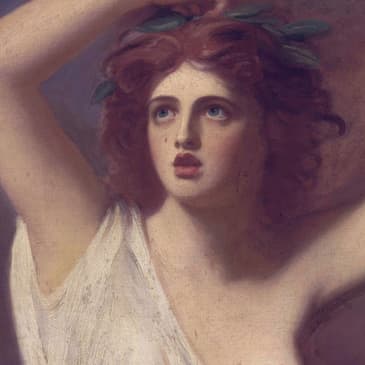
In “Trojan Women”, the Athenian playwright Euripides highlights an aspect of the Trojan War neglected by Christopher Nolan in “The Odyssey”: the true horror of Troy’s capture and destruction. In this episode, Emily and Cam break down Euripides’ play. Produced at Athens mere months after the Athenians captured Melos (where the Athenians killed all of the men and enslaved the city’s women and children), Euripides’ play offers a powerful and moving depiction of war’s impact on its victims by exploring the suffering and heroism of three Trojan women: Hecuba, Cassandra, and Andromache.
Visit our homepage to subscribe, to find us on social media, and to contact us by email:
If you liked this episode, buy us a coffee:
Links to previous episodes mentioned in this show:
Watch Michael Cacoyannis’ film version of the Trojan Women on Daily Motion.
Cover image adapted from a photo of George Romney’s “Lady Emma Hamilton as Cassandra”, taken by Jan Arkesteijn (Wikimedia Commons).
----------
00:10 - Introduction
02:16 - Content Warning!
02:53 - Euripides’ Trojan Women
- 02:56 - Euripides and his work
- 06:49 - The Play’s Context: the Peloponnesian War and the sack of Melos
11:12 - Plot Synopsis
- 11:14 - Poseidon and Athena hatch a scheme
- 13:16 - Talthybius, Hecuba, and the Allotment of the Captives to Agamemnon, Neoptolemus, and Odysseus
- 15:09 - Cassandra
- 16:05 - Andromache
- 17:16 - The agon: Menelaus, Helen, and Hecuba
- 21:57 - The funeral of Astyanax and the death of Troy
23:00 - War and Suffering: Hecuba and Talthybius
- 23:26 - Christopher Nolan’s Odyssey and Euripides’ Trojan Women: a difference in perspective
- 25:09 - The Pain of Hecuba, Cassandra, and Andromache (and a digression on Odysseus)
- 29:35 - Hecuba: Leadership and Resilience
- 33:11 - The Empathy of Talthybius
39:23 - Agency and Humanity
- 39:46 - The women as heroes
- 39:54 - Cassadra’s vengeance
- 40:42 - Andromache, Neoptolemus, and Astyanax
- 41:57 - Hecuba
- 43:04 - Helen and Talthybius
45:04 - Fortune is Fickle
50:57 - The Victors and their Comeuppance
- 51:20 - Nolan’s view on war and society
- 52:12 - Euripides and the wrath of the gods
- 54:54 - Digression: Michael Cacoyannis’ “Trojan Women”, featuring Irene Papas
55:53 - Athens and the Trojan Women
59:11 – Final Thoughts and Wrap-up
Hello. Welcome to Have Toga Will Travel, a podcast exploring the Mediterranean world, ancient and modern, through the eyes of two former classics professors. I'm Emily.
Cam:I'm Cam.
Emily:And we're your hosts.
Cam:So welcome back, especially if you're a relatively new listener. We've noticed that we've picked up a few new people since our Odyssey episodes. So if you haven't been following us for a long time, welcome. We're really glad to have you with us. And of course, we're really glad to have all our regulars with us too. What we're going to do today is continue our discussion of ancient literature that intersects with the Trojan War in some way. This is our way of continuing our conversation about Nolan's Odyssey. In particular, we're going to talk about another Greek tragedy, Euripides' Trojan Women, which is a play set in the immediate aftermath of the Sack of Troy, and which looks very specifically at its impact on the civilian victims of war, the women of Troy in this particular case.
Emily:Now, this is one aspect of the Trojan War story that we thought Nolan's movie didn't engage with as well as it could have. For as much as the film claimed that the Sack of Troy was horrific and that the violence it entailed was harmful, even to the perpetrators, the film resolutely downplayed and sanitized the violence and its true consequences, as opposed to the consequences the film kind of made up, wherein the end of the war somehow violated some sort of cosmic social order that led to the unraveling of society.
Cam:Now, to be fair, Nolan, as you may remember from our last episode, is not the first person to adapt Trojan War stories to tell the kind of stories he wants to tell. Ancient authors did this all the time. The Trojan War in particular was a really rich source of stories and myths for Athenian playwrights to draw on in the 5th century in particular.
Emily:So today we are going to talk about the Trojan Women. We're going to go over the play's background and its context. We're going to give a brief summary of the play, and then we're going to talk about some of the key themes of the play.
Cam:Now, before we get started, we just want to let you know that the Trojan Women is a really heavy play, and it deals with some pretty heavy topics. So we're just going to forewarn you that we're going to be dealing with things like enslavement, sexual assault, murder (including child murder), and suicide. So if you need to take a break to gather your thoughts, feel free. And if you're listening with a young one, maybe be prepared to field some questions or to guide them through some discussions of some pretty heavy material.
Emily:Shout out to my nephew. So first of all, let's talk about the context that the play was written in. So as we mentioned, it's written by the playwright Euripides. He is the youngest of the three great tragedians whose work survives until today. And Euripides was born somewhere around 480 BCE. So that puts him about 15 years younger than Sophocles. Although fun fact, they will both die within a year of each other in 406 slash 405 BCE.
Cam:Now, even though Euripides was an Athenian born and bred, the story that we have is that in his later years, he retired to the royal court in Macedonia, where he died. In that sense, he was actually following the example of his predecessor, Aeschylus, who also went and spent time in a royal court late in his career. In that particular case, the court of Hero I in Syracuse, Sicily. And part of what's at stake here, I guess, is the fact that outside of Athens, people really were interested in Athenian tragedy. And one of the ways you could sort of make your mark in the aristocratic life of the late 5th century BCE, if you were an ambitious autocrat in one of these royal courts was to invite one of these playwrights out to your home to produce plays for you.
Emily:Now, by some measure, Euripides was not particularly successful in his own time relative to the other two great tragedians who survive, if we're measuring success by the number of victories that you had in competition. So Euripides wrote over 80 plays, but he only had four victories, which is considerably lower than the other two.
Cam:Even if he had fewer victories than did and Sophocles, Euripides nevertheless seems to have been a lot more popular than either author. So from that particular point of view, maybe he was the most successful of the Athenian playwrights. It seems that only Homer was more widely read in antiquity itself than Euripides was.
Emily:And the result of this is that almost three times the number of plays of Euripides survive as compared to Aeschylus or Sophocles. So for Euripides, we have 19 plays that survive, And for Aeschylus and Sophocles, we have seven each. So it's a pretty sizable difference.
Cam:Yeah. And in fact, there's a story that in antiquity, after the Athenians launched and lost their ill-fated expedition against the island of Sicily, Athenian captives who were basically held in awful conditions in a quarry would perform Euripides, would sing some of his songs and things like that just to basically keep themselves occupied. The later author Plutarch would elaborate on this story by actually arguing that some of these Athenian captives earned their freedom because they were able to impress their captors in Syracuse and teach them some Euripides.
Emily:And there's actually a novel that just came out a couple years ago called Glorious Exploits.
Cam:Yeah, it's a really good novel.
Emily:It looks at this exact phenomenon. And not only that, the play they're performing in that novel is the Trojan Women.
Cam:Yeah, which would have been—
Emily:New!
Cam:Yeah, if not the most recent Euripides, pretty new.
Emily:Yeah.
Cam:Definitely.
Emily:No, Glorious Exploits is definitely worth a read.
Cam:It is. It's, you know, it's a dark novel, but no darker than the play we're about to discuss, I guess. So consider this training.
Emily:Yeah. Anyhow, Euripides is also clearly respected by his contemporaries. He has a sort of like weird literary symbiotic relationship with the comic playwright Aristophanes. Euripides actually shows up as a character in a couple of Aristophanes' plays that survive. And a verb actually gets coined to express the mutual significance of their literary relationship and basically how the two playwrights feed on one another. The verb is "euripidaristophanuzein", which means something like to speak like Euripides Aristophanes.
Cam:Say that three times fast.
Emily:Euripidaristophanuzein!
Cam:Anyway, our play today, The Trojan Women, was performed in 415 BCE, along with two other tragedies Euripides wrote, and a satyr play, right? So this was a trilogy plus satyr play submitted to a competition. The other two tragedies performed alongside it were Alexandros and Palamedes. The first dealt with, I think, the youth of Paris from the Trojan War story. Palamedes dealt with an episode during the Trojan War in which Odysseus and one of his rivals, Palamedes, went at each other. And then the satyr play, Sisyphus, is a little bit harder for us to grasp. I don't think we know nearly as much about that.
Emily:I mean, in all fairness, none of these other plays survive, and we only know them through fragments and bits like that, so we know very little about the plays themselves.
Cam:Right. Anyway, Euripides' suite of four plays placed second in that year's competition. There were three playwrights, so he sort of came in right in the middle.
Emily:Now, it is thought that the Trojan women in particular might have been written in response to Athens' actions on the island of Melos that had just happened.
Cam:This was a turbulent time in Athens. Technically, the Athenians were at peace after a fairly long war with Sparta—
Emily:It's going to get longer, though.
Cam:It's going to get longer, yes. The first phase of the Peloponnesian War. But the Athenians had been working to enhance their own position in the event that the peace broke down. They had, for example, supported Argos, one of Sparta's ancient rivals in the Peloponnese, at the Battle of Mantinea in 418. And as the Trojan Women was actually performed, the Athenians were on the brink of launching a major expedition against city-states on the island of Sicily.
Emily:And in the middle of all this, about six months before the play was produced, Athens had conquered colonized the island of Melos. Melos had been the only island in the Aegean that had not already been incorporated by the Athenians into their empire. And if you've read your Thucydides, you will know this situation from the rather famous passage in Thucydides, the Melian Dialogue. So because Melos will not willingly join the Athenian Empire, Athens basically forces them to by laying siege to the island, and when they capture it, they execute all of the male citizens and enslave all of the women and children from Melos and resettle the island with their own people.
Cam:Now, it's sometimes argued, as we've already mentioned, that Euripides wrote this play in response to what the Athenians had done on Melos. That's maybe not as likely as it sometimes seems simply because a playwright like Euripides had to put in his proposals as it were a full year before the competition. So he would have put in his proposals before Melos was actually captured.
Emily:Although even if he didn't write in response to Melos, it I think would be hard for the audience not to be thinking about that when the play is performed.
Cam:Right. Whatever you think about whether or not this was written specifically in response to Melos, however, it's important to note that Melos was not an isolated incident. The Athenians at this point had a track record of dealing out similar fates to other communities. There had been six incidents like this in the past 50 to 60 years, including three recently in the course of the first phase of the Peloponnesian War. And honestly, another major city-state, Mytilene, on the island of Lesbos, only narrowly avoided a similar fate in 427.
Emily:All of these incidents entailed a lot of violence, especially when communities are taken by storm. So there was probably functionally a massacre, followed by a selective enslavement of women, and particularly young and pretty boys.
Cam:And in fact, ancient Greek had a verb for this sort of mass enslavement, "andropodizein." It's related to one of the many, many words that the Greeks had for enslaved people, "andrapodon," which means something like man-footed thing. So it's a word that really sort of dehumanizes the enslaved person. And "andrapodizein" as a verb meant to essentially reduce the population of a city to the status of things. That's uplifting.
Emily:Yeah, yeah. So given that context...
Cam:Yeah, let's move on to the synopsis of the play.
Emily:Yeah, let's talk about the play. So the Trojan Women is set the day after the sack of Troy. The city is still burning, and the play focuses on the fates of the women of Troy. Now, interestingly, it opens not with the women themselves, but with a conversation between the gods Poseidon and Athena. Now, Poseidon had supported the Trojans during the war, and he actually blames Athena for the destruction of the city.
Cam:This conversation between Poseidon and Athena, however, reveals that Athena has taken against the Greeks. And she's done so because during the sack of Troy, Ajax the lesser— there are two Ajaxes in the Trojan War stories—
Emily:There are. This is the other Ajax.
Cam:The other Ajax. Ajax the lesser had sexually assaulted Cassandra, a priestess of Apollo and the daughter of Priam and Hecuba. And he'd done so basically in Athena's temple, even though Cassandra had sought sanctuary there at the statue of Athena, and most of the other important Greek characters stood around and let it happen.
Emily:Now, it's worth noting here that Athena's primary complaint is not what happened to Cassandra, but the fact that it happened in her temple and that thus her temple was violated. So let's not give Athena too much credit here, because she's really sort of put out by her own prerogatives being insulted rather than the violence that's happened.
Cam:Yeah, she views it as an assault against her in some weird way rather than an assault against Cassandra specifically. But anyway, as a result of what Athena interprets as an attack against her, she and Poseidon plot together to harm the Greeks as the Greeks return home. And of course, Poseidon, because he's miffed about the fall of Troy anyway, is all on board with this plan.
Emily:Yeah. Now, this dialogue ends fairly quickly, and the bulk of the play is really going to be built around the now former queen of Troy, Hecuba. So while Poseidon and Athena have been talking, Hecuba has been basically lying, collapsed on the ground, in the middle of the performance space.
Cam:And once Poseidon and Athena finish their dialogue, they leave the stage. And at that point, Hecuba rises from the ground and she mourns. She laments what has happened to Troy as the chorus for this particular play, which is made up of other women of Troy, enter the stage and join her in song and express their own anxiety about what will happen to them next, where they will end up, to whom will they be enslaved.
Emily:Right, because offstage, the Greeks are dividing up and drawing lots to see who gets which woman. And as Hecuba and the chorus draw towards the end of their conversation, Greek herald Talthybius enters with news of how these lots have fallen. And it's worth noting that Talthybius here is the vehicle by which the Greeks (or the Greek army) and the captive women are going to communicate.
Cam:Right. Some of the real villains of this play, Agamemnon and Odysseus, never actually appear on stage.
Emily:No.
Cam:We just learn of what they've decided or what they've said by means of Talthybius.
Emily:Yeah.
Cam:Now in this scene, in his first interaction with Hecuba, Talthybius delivers some really grim news. He tells Hecuba that Hecuba's daughter, Cassandra, has been claimed by Agamemnon, that her daughter, Polyxena, has been assigned, let's say, to the tomb of the dead Achilles in some way that remains, at least for the time being, vague and unclear. And finally, Hecuba's daughter-in-law, Andromache, wife of Hector, has been assigned to Neoptolemus, the son of Achilles, and the protagonist, interestingly enough, of the play we talked about last time. And Talthybius ends this conversation by announcing that Hecuba herself has fallen to Odysseus.
Emily:Now, over the course of the play, we are going to meet other women from the whale household, functionally as they are being led away to the ships to be taken away from Troy.
Cam:So the first of these characters to enter the stage is Cassandra, who has been chosen by Agamemnon. And when she first enters, she comes in in a way that suggests that she's either out of her wits and maybe a little bit unstable or just totally overcome by grief. It's a little hard to tell which.
Emily:Yeah, although the other characters think she's out of her mind.
Cam:Yes.
Emily:Now, despite her, let's say, excited state, she is able to reclaim enough lucidity to prophesize that she will be the reason Agamemnon will pay the price for killing her father and brothers.
Cam:If you're not that familiar with your Greek mythology, if you don't remember the details, the thing to remember about Cassandra is that she has the gift of prophecy, but she's also cursed in the sense that her prophecies are normally ignored or not treated as real prophecies by the people with whom she interacts. After her conversation with Hecuba, she's taken away by Talthybius. And the next character to enter the stage is Andromache, the widow of Hector, who comes in with her young son, Astyanax, on a wagon piled up with loot that has been claimed, much like her, by Neoptolemus as his share of the spoils. And she brings more bad news for Hecuba. She reports to Hecuba that Hecuba's other daughter, Polyxena, is dead. She's been murdered, sacrificed essentially by Neoptolemus as a blood offering to his father Achilles.
Emily:And while she's speaking with Hecuba, Talthybius re-enters the scene with a piece of truly devastating news, that the Greeks have decided that Astyanax, Hector's young son, must be killed.
Cam:Now, as you can imagine, this is a really, really awful moment for Andromache and for Hecuba. And Talthybius steps into this point and cautions Andromache that she shouldn't resist this too much and not anger the Greek army, or the Greeks might retaliate by not allowing Astyanax to be buried properly. Although in the end, as we'll see, Andromache herself will not get the chance to bury Astyanax anyway, because she'll be led away by Neoptolemus first.
Emily:And then finally, we do have one of the Greek leaders who shows up after Andromache leaves, and that is Menelaus. And Menelaus shows up looking for Helen, the ostensible cause of the Trojan War. Helen is being held among the captured women, and he claims that he wants her so that he can kill her either here or back home.
Cam:At that point, Helen herself enters the stage. and judging from the dialogue, she does so in style. Unlike a lot of the other captive women who have had their hair shorn off, she shows up in all of her finery. And she actually demands that she have a chance to defend herself against Menelaus and to show him why it would be unjust for him to kill her. Hecuba is not happy about this, obviously. She thinks Helen bears a lot of the blame for the Trojan War and wants her punished. So Hecuba demands that she too have a chance to speak so she can essentially prosecute the case against Helen and advocate that Helen should be killed.
Emily:Immediately.
Cam:Immediately, yes. There on the spot.
Emily:No taking her back to, like, Sparta.
Cam:Right.
Emily:Kill her now.
Cam:Yes.
Emily:And this debate between the two of them constitutes what is called the agon of the play. I don't know that we've talked about this before.
Cam:No.
Emily:But the agon is the central rhetorical debate in a tragedy that's focused on an argument usually of two opposing principles, where you have two opposed characters that each make a speech articulating their case, and then after those speeches, they engage in some back-and-forth dialogue with each other, which is called Stichomythia. And many tragedies, but not all of them, have an agon. The agon usually doesn't solve any problems, but does sort of lay out what the stakes are of the two different sides of this argument that is somehow central to the play itself.
Cam:And here the two sides in this particular Agon are obviously Helen and Hecuba. Helen stands up and argues that other people and the gods, in particular Aphrodite, and not her, carry the responsibility for Troy's destruction. She blames Priam and Hecuba for allowing Paris to live in the first place. We have a backstory which essentially involves the exposure of Paris as a young boy.
Emily:Yeah, there's some prophecy that he will be bad news for the city.
Cam:Right, although he's brought back into the city and re-accepted into Trojan society so he doesn't actually die. She then goes on to blame Menelaus for leaving her alone with Paris when Paris comes to visit Sparta. She blames her second husband, Deiphobus.
Emily:Actually, he's like her fourth husband.
Cam:Her fourth husband, Deiphobus. Okay.
Emily:But her husband after Paris dies.
Cam:Yes, for not letting her leave Troy after Paris gets killed. And above all, of course, she blames Aphrodite for contriving the whole situation in which she's handed over basically as a prize to Paris for Paris's support of Aphrodite in the beauty contest myth that lies at the heart of the Trojan War story.
Emily:Yeah. Although she also makes the point, though, that had Aphrodite not won the judgment of Paris, that Greece would be subject to barbarians. So this is having to do what Aphrodite wanted was like a small price to pay for the Trojans not invading Greece, which somehow seems to be the thrust of that argument, which is weird. Now, on the other side of the debate, Hecuba argues that Helen is responsible for her choices and her actions, and that blaming Aphrodite is just a way to cover her own choices and deflect them. And Hecuba claims that Helen was enamored with the wealth and the power that came from being with Paris and having people fawn all over her. And she points out that Helen never tried to get away from Troy or to escape or do anything else that might indicate that she wanted to leave, including trying to kill herself. Like, Hecuba would have taken a suicide attempt as a sign that Helen did not want to be there, and Helen did not do that. And so clearly, she didn't really regret her decisions.
Cam:Now, in spite of the fact that it really looks like Hecuba makes the strongest argument in this particular Agon, it doesn't really seem to change anything. And in fact, Menelaus might be even less inclined to kill Helen after the end of the debate than he was beforehand.
Emily:Yeah. And Hecuba actually, I think, made the point that Menelaus should kill her now, because the more time he spends with her, the less likely he will be to kill her. And at the end of the debate, Menelaus is like, go ahead and take her to my ship. Maybe I'll kill her when we get back to Greece. You can just feel Hecuba rolling her eyes through the script.
Cam:She knows that Menelaus is very susceptible to Helen's wiles.
Emily:Yes. That's never gonna happen. But after Menelaus leaves with Helen, Talthybius then enters with the body of Astyanax, which he is carrying in on his father Hector's shield. And then Hecuba and the chorus mourn over the body of Astyanax and perform, you know, basic burial rites, what they can do given their circumstances.
Cam:And then finally, as the play draws to a close, Talthybius comes back on stage to lead Hecuba away into slavery. Hecuba, however, breaks away at the last minute and tries to kill herself by running into the flames that are now consuming Troy. But alas, Talthybius and his men stop her, lay their hands on her, and she and the other women are finally taken away to the ships to sail off into their new lives as women enslaved to the Greek commanders.
Emily:Yeah.
Cam:End of play.
Emily:End of play. It's a bummer of an ending.
Cam:It is not a happy play, even by the standards of Greek tragedy.
Emily:Even if you know the whole time what's going to happen, it's still a pretty tough ending.
Cam:Yeah.
Emily:So now that we've given a brief synopsis, let's talk about how the play works and the way it engages with key themes around warfare. And, you know, we can begin by noting that this play is widely viewed as an anti-war play. And in that sense, it does have a basic commonality with Nolan's Odyssey film, but it builds its perspective in a very different way.
Cam:Yeah. So if you remember our review of The Odyssey, we made the point that Nolan's Odyssey uses the Trojan War to basically make the argument that war damages even the victors. That's the main focal point of his approach here. And it does that—
Emily:Because he's got to focus on the dudes.
Cam:Right.
Emily:Sorry. You should probably cut that later.
Cam:I'm going to leave it in now. And he does that by arguing that war traumatizes the people who fight it, even on the winning side, and by somehow bringing about the breakdown of social bonds by basically encouraging them to sort of throw all scruples to the wind.
Emily:Yeah. The Trojan Women, on the other hand, is much more interested in the impact of warfare on its victims and those who aren't actively part of the fighting. So, I mean, if we want to call them collateral damage or whatever, the civilian and non-combatant population.
Cam:Right. So in Euripides' play, the impact of war on the perpetrators, i.e. the Greeks, is really only of minor interest, and the conclusions you can draw from it are a little bit ambiguous. And we'll touch on those conclusions a little bit more later. But for now, what's really worth noting is that the Greek leaders, especially as represented by Menelaus, who's the only one of the Greek leaders to appear on stage, really seem kind of unfazed by what's going on and disconnected from anything other than their own immediate wants and needs.
Emily:As we'll see, though, the herald Talthybius that we've talked about presents an interesting contrast to Menelaus and the other leaders and seems to point to a disconnect between the callousness of the Greek leaders and the experience of an individual soldier who is still capable of recognizing the humanity of the women of Troy.
Cam:But ultimately, instead of focusing on the victors, once again, this play really does emphasize the experiences of the Trojan women themselves. And so that's what we're going to dive into next.
Emily:Yeah. Now, at this point in the story, we can more or less assume that all of the Trojan men are dead.
Cam:Right. And what we're looking at now is what happens to the civilian or non-combatant population, the people who are taken after a victorious army captures a city and are essentially reduced to objects, to literal possessions, to the status of things as the play proceeds, and yet continue to try to assert their humanity at the same time.
Emily:Now, the three royal Trojan women, Cassandra, Andromache, and Hecuba, on some level represent the losses women experience at three different stages of life. So you have Cassandra, who is the the young woman, the unmarried young woman. Andromache is the middle-aged woman, right? The mother who has young children still at home. And then Hecuba represents the women of old age, right? The woman who is a mother, but her children are all adult and grown.
Cam:All of these characters, as well as the women who constitute the chorus in this particular play, have definitely lost family members here. Hecuba, to start with, has lost her husband Priam, as well as all of her sons, and at this point, at least one daughter.
Emily:And probably grandsons.
Cam:Grandchildren, all of that. Andromache has lost her husband, Hector, and Cassandra has lost her father, Priam, as well as all of her brothers.
Emily:Now, not only that, these women are about to be separated from one another and parceled out to the victorious Greeks in a lottery to determine who gets what share of spoils. And this is also a process that will involve separating children from their mothers as well.
Cam:And in this particular play, that process involves a lot of savage irony to just really drive home the pain and the suffering of the women. So for example, Andromache is to be awarded to Neoptolemus, the man who killed her father-in-law Priam. Hecuba is to be awarded to Odysseus, who is often regarded as the guy behind the whole Trojan horse scheme that ends up bringing about Troy's defeat. Although if we want to get really technical about this, Epeius is the guy who actually builds it.
Emily:Yeah. Hecuba does not have nice words for Odysseus.
Cam:No, Odysseus is characterized in really, really harsh terms in this play.
Emily:When she finds out she's going to him, she has like a three-line insult of him. He is a foul and deceitful person, an enemy of justice, a lawless, poisonous beast.
Cam:Yeah, this is an even harsher characterization than we saw in the last play we discussed, the Philoctetes, where Odysseus is also not really a great guy. It's also worth mentioning here that the middle play in the trilogy of tragedies here that Euripides had presented for competition was the Palamedes. And as far as we can tell, that particular play involved a conflict between Odysseus and Palamedes, whom Odysseus regarded as a rival of sorts and who he didn't like. So in the Palamedes, Odysseus schemes to have Palamedes murdered for treason. So again, we don't know much about that play, but we can sort of guess, I think, that Odysseus was not a particularly nice character in that play either. Anyway, that's a bit of a digression, but it's worth mentioning just because Odysseus.
Emily:And just to drive home the suffering of these women, at the end of the play, Hecuba and the chorus are there to witness the final destruction of their homeland by fire. So right before the play ends, the women respond to a noise they hear, which they then realize is the crashing of the citadel of Troy as it collapses under the fire. And that is sort of the moment for them where Troy is truly gone.
Cam:Now, as you've probably been able to gather, This is a play in which a lot of really bad things happen to Hecuba, to Andromache, to Cassandra, and the rest of the characters. And simply because the play has such an intense focus on these women and all of the bad stuff that happens to them, you'll sometimes encounter the critique that it's a play in which there's not really much of a plot. Instead, it's just basically a parade of suffering.
Emily:That is how one of my professors in college put it.
Cam:Yes.
Emily:And it's true, there is a lot of suffering that happens in this play. And yes, the bad news continues to accumulate over the course of the play. But I think to dismiss it on those grounds is to miss the somewhat subtle character study that is at the heart of this play. And this character study revolves primarily around the character of Hecuba and, you know, to a certain extent around Talthybius, both of whom have, you know, very interesting and in the case of Hecuba, very powerful character arcs. And this is part of what builds the intense sympathy for what the women of Troy are experiencing.
Cam:Right. So Hecuba is really at the core of this play. And it's Hecuba's responses to what she and the others suffer that really draw in the empathy of the audience.
Emily:So as we mentioned, when we first see Hecuba, she is alone and collapsed on the stage. And as she rises, she is forcing herself to pull herself up and says that, you know, she's trying to pull herself together to model perseverance for the other Trojan women. Even after everything that's happening, she is still acting as a queen and a leader, even as her own grief is incredibly intense.
Cam:And as the play progresses and the suffering just gets multiplied and multiplied, Hecuba manages to summon even more reserves of strength and resilience to keep going.
Emily:Now, this is not to say that she doesn't grieve during the play. She certainly does right from the beginning and in response to each new piece of bad news she receives. But importantly, she resists the impulse to give in to that grief and controls it enough that she can help the other women on stage get through their suffering.
Cam:And in doing so, she really emerges as a strong leader. The strongest leader on the stage by far. So for instance, she attempts to calm Cassandra, as Cassandra is sort of locked in in her ravings. She consoles Andromache and tries to help her find some equanimity amidst the horror.
Emily:She's going to channel her anger at Helen into very clear rhetoric and an almost legal indictment of Helen's actions.
Cam:And she even manages to keep enough composure to give her grandson Astyanax a burial. Even though the death of Astyanax represents really the end of the Trojan royal family and is a burden that really must have been overwhelming for that character.
Emily:Yeah. And it's really only at the end of the play, at the moment when she is finally forced to leave and to be taken away from Troy and have all of her previous ties severed, that she changes her approach and she attempts to kill herself. And my question at the end of the play, right, is it that she's finally overwhelmed by her grief and her loss? Or was this her plan all along, right? To do what she could for the other women as long as she could, and then to die with Troy? And I don't know that's a question in the end we can really answer. But for me, you know, this role of Hecuba is an incredibly intense and rich role for a performer. And of course, in a modern theater, particularly for an older woman, who don't get roles like this all the time. Like, this is a really cool role. This, and when we talked about the Persians, Atossa. So it's just like really phenomenal roles for older female characters.
Cam:At least in a contemporary context.
Emily:In a contemporary context, yes.
Cam:In the ancient world, these roles all would have been played by men.
Emily:Yes, but very compelling characters who are older women, and they get just great, great stuff here to work with. Sorry, can't turn off the theater person thing.
Cam:Now, while Hecuba is definitely the focus of this play and really does a lot to draw in the audience's sympathy, Talthybius plays a pretty important role too. Since even though he isn't one of the victims of the war, the play, interestingly enough, gives him a character arc that helps emphasize the suffering of Hecuba and the other Trojan women. And it does that by allowing the audience to see the toll the events that Talthybius is witnessing is taking on him as the play progresses.
Emily:So Talthybius really does struggle to cope with what has happened and what is happening. And as the play goes on, we see how clearly he comes to recognize the humanity of these women and that he feels bad about what is happening, even as he is part of the system carrying it out.
Cam:His position as a herald has actually primed him to adopt this stance, especially with Hecuba, whom he clearly knows by name.
Emily:And he points out their previous interactions.
Cam:Right. And that's the point here. As the messenger of the Greeks, he had had opportunities over the course of the war to come into contact with Hecuba and to speak with her a little bit. So he's had way more interaction with her than any of the other Greek characters have.
Emily:Yeah. And his sympathy for the women, which seems to grow over the course of the play, helps highlight the awfulness of the violence and the loss that they are enduring.
Cam:So in his initial entrance, as we've already mentioned, he's come to announce to whom each woman has been allotted. And although he's clearly speaking from the perspective of the victors, I think the audience quickly learns that he's got a little bit of discomfort about the news that he's come to deliver.
Emily:So when, for instance, it becomes clear that Hecuba is disturbed by the fact that Cassandra will be going to Agamemnon as his slave, and then doubly disturbed when she learns that Cassandra is going to be Agamemnon's concubine, Talthybius does try to argue that it is an honor to be selected as the concubine of a ruler. Now, Cam and I have some debate about this, because I think when Talthybius is saying this, he really, at that moment, does not realize how bad the news he's delivering is, that he's like, but this is like an honor. And you think he's trying to...
Cam:Yeah, part of what Hecuba reacts to is the fact that Cassandra is being claimed as Agamemnon's concubine, even though as essentially a maiden dedicated to Apollo, she should be free from that sort of thing. And one way to read this is to see Talthybius's statement that it's actually an honor to be selected as the concubine of a king as a reaction to what he sees on Hecuba's face as he delivers that news.
Emily:Yeah, you see it as a consolation as opposed to like, what do you mean this is a bad thing? So the point that Talthybius starts from is up for debate, and the Greek is ambiguous, and Cam and I sit on different sides of this.
Cam:But part of the reason I interpret it the way I do is because, you know, you then watch Talthybius deliver the news about Polyxena to Hecuba. And again, Polyxena has been murdered. She's been sacrificed by Neoptolemus to the ghost of Achilles. And Talthybius can't really bring himself to say that, right? He does his best to talk around it, to speak in metaphors, and again, to try to spin it as well as he can by sort of saying something like, well, don't worry about her so much. She's been released from her pain.
Emily:Yeah, well, sacrifice is different from being a concubine.
Cam:Well, yes.
Emily:We're not going to argue about this again. Y'all, the arguments we've had about this play and getting ready for this episode. Anyhow, as Talthybius goes on, when he has to reveal to Hecuba that she has been given to Odysseus, he tries to make it sound not quite so bad by pointing out that Odysseus' wife Penelope, whom presumably Hecuba will be serving, is known far and wide as a good woman and will treat her well.
Cam:So that's how Talthybius really interacts with Hecuba in his early scene with her. By the time he comes back to make his second entrance into the play, to announce that Astyanax will be killed, he's no longer speaking solely from a Greek perspective, though. And in this scene, it's clear that he's disturbed enough by what he's required to tell Hecuba and Andromache that he actually explicitly criticizes the decisions the Greek leaders have made to kill Astyanax. He characterizes it as a cruel decision and, quote unquote, a great evil.
Emily:This decision had been made because the Greeks were persuaded by Odysseus that the son of Hector cannot be allowed to survive. But that's clearly not a view that Talthybius shares. And he not only sees how the women will view this news, but he acknowledges how the women will view this news.
Cam:And in fact, the highest expression of all of his sympathy comes after Astyanax has been killed. When Talthybius enters with the body of Astyanax, that body is being born on Hector's shield. Not only does he bring the body back so that Hecuba can mourn and bury her grandson, he also actually takes it upon himself to be the one who washes and cleans the body of Astyanax to spare Hecuba from that particular task.
Emily:And it's worth pointing out here that cleaning a body and preparing it for death is work that would have typically been done by women. So Talthybius's actions here are remarkable on two levels. One, that he's performing what is, you know, women's work. And two, that he's doing it to spare the feelings of these captives of war. For whom he has no obligation to treat well.
Cam:Right. And that is really a small but subtle way of acknowledging both the humanity of Hecuba and Andromache, but also his own humanity. And in combination with what he said earlier about the decision of the Greek leaders to kill Astyanax, this reflects a noticeable shift in his acknowledgement of Hecuba's pain and suffering. It's all out in the open now.
Emily:Yeah. Yeah. And he is right there with them.
Cam:Yes.
Emily:On some level. Now, it may sound like we're definitely in this, like, parade of suffering vibe.
Cam:Yes.
Emily:But the play doesn't just build sympathy for the women of Troy by highlighting their suffering. It also shows them doing something very human, which is attempting to exercise agency and take some control of their lives by doing what they think is right, even though as women and as women who've been enslaved, they have very little power at this moment. And by doing this, the play positions the women in a way as heroes and not just victims.
Cam:Yeah. So for example, Cassandra actually leans into her fate as Agamemnon's quote unquote prize or concubine. And here, you know, there's an important context that everybody in the audience would have known. And that was the tradition that Agamemnon was murdered almost immediately when he returned from Troy, either by his wife Clytemnestra or by her lover Aegisthus. Here though, Cassandra, who has the gift of prophecy, emphasizes that she herself is going to help to avenge the deaths of her father and her brothers by somehow becoming one of the instruments of Agamemnon's destruction. And in making that argument, she is actually able to transform what would otherwise be a full-on naked tragedy into a victory for herself and for the other Trojans.
Emily:We also see Andromache asserting agency in at least two ways. So first, even though she has been claimed by Neoptolemus, and even though Hecuba tries to persuade her that her life will be less painful if she can just reconcile herself to her new role as Neoptolemus' wife, Andromache refuses to simply be a thing that Neoptolemus possesses, even though she, as we mentioned, is literally brought on a stage in a cart full of stuff that Neoptolemus is taking home. And Andromache resolves to do her best to remember Hector and to be true to him, even if this means that Neoptolemus might punish her.
Cam:Second, even though she can't stop the Greeks from murdering her son, Astyanax, she is somehow able to put aside her hatred for Neoptolemus and to persuade Neoptolemus to leave behind Hector's shield so that Astyanax can be buried with it. And this is really an accomplishment, given both that Andromache, again, doesn't really like Neoptolemus very much, makes that clear, and also that Hector's shield was incredibly valuable to Neoptolemus as a symbolic prize.
Emily:And then finally, there's Hecuba. And as we've anticipated somewhat, Hecuba does a lot to assert agency. And here we want to highlight four key things that she does. One, she works to prevent the other Trojan women from giving in to despair, even though she's carrying just as heavy a burden, if not more, than they are.
Cam:Second, she tries to ensure that Helen gets what's coming to her by speaking against Helen in that agon that we've talked about.
Emily:Three, Hecuba ensures at the very end that Astyanax does receive as fitting a burial as it's possible to give him, even as Troy is burning down around them.
Cam:And finally, Hecuba tries to kill herself at the end of the play by throwing herself into the flames as Troy burns. This might not seem like something praiseworthy at first glance, but it really can be read here, at least in part, as a final effort on her part to strike back at her captors by depriving them of something that matters to them, namely control over her and over her body.
Emily:Yeah, this is her ultimate assertion of control over herself.
Cam:Yes, exactly.
Emily:Now, additionally, some of the other characters, other than these three main Trojan royal women, also get moments of agency that sort of emphasize the importance of that in this moment. So, first of all, we have Helen. For whatever you think about Helen, Helen does use all of her powers of rhetoric and manipulation to save herself.
Cam:Arguably successfully, because the audience would have known that Helen ends up back in Sparta with Menelaus, essentially drugging him in order to assure harmony within the household.
Emily:Yeah, yeah, she gets to go back and be queen.
Cam:Yeah. But within this play, Talthybius is an even more interesting example. Because as a member of the Greek army, and as someone who in some sense expresses the will of that Greek army and its leaders, he too is constrained in what he can do. He's not somebody who necessarily has a lot of personal power and agency. And so, for example, at the end, he has to stop Hecuba from killing herself because that's his job. He's there to make sure that Hecuba and the other women are taken as enslaved people to the ships. But actually, in spite of that, he's done what he can in the rest of the play to exercise agency on his own volition by doing what he thinks is right, namely by washing the body of Astyanax so that Hecuba doesn't need to do it herself.
Emily:So yeah, she doesn't have to see her grandson injured and bloodied and, you know, as nice as he can make him look for her. And on some level, this characterization of Talthybius is in sort of marked contrast to Menelaus as a representative of the Greek leadership, right? Who both seems unfazed by the war or by what's happened, but he can't even like muster up enough anger to even stay mad at Helen. Like he's, you know...
Cam:Menelaus is so punchable in this play.
Emily:Yeah, he really is.
Cam:He's just really, yeah, he really sucks.
Emily:He's useless and disconnected from everything, right? And that creates a real contrast with Talthybius.
Cam:Right. So we've talked a little bit about how the play builds sympathy for Hecuba and the other Trojan women. We've talked a little bit about how their own efforts to exert agency sets them up as heroes in this play. What we're going to do now is turn to another major theme here, and that is fortune. And what's interesting here is that the efforts of Hecuba and the other captives to assert their own agency becomes especially poignant because of how those efforts intersect with this other major theme of the play, namely that the course of a human life is unpredictable, that fortune, whether good or bad, is not constant. And you can't ultimately evaluate whether or not somebody has had a happy life until they're dead and you can look at their life as an entire picture.
Emily:Yeah. And this is an idea that recurs constantly in ancient Greek literature. Now, granted, the presentation of the idea, this idea of fortune, can be shaded in different ways in different contexts, but the underlying idea remains the same. And in this play, particularly since it's coming from the perspective of the Trojan women in the aftermath of the war and from Hecuba in particular, it has something of a negative vibe, particularly the idea that good fortune is temporary.
Cam:Right, and that gets emphasized in some important lines in the play. So Hecuba at one point says that you shouldn't consider anyone to be blessed with good fortune until they die. And here she is echoing a very famous line from Herodotus when Solon makes this point to the Lydian king Croesus. And then in a conversation with Andromache, she sort of uses Troy as a metaphor by making the argument that the gods build up something from nothing and then destroy something that seems lofty and like can never be toppled.
Emily:And it's worth noting that the play strongly implies that there isn't any way to avoid these bad turns of fortune entirely. Now, generally speaking, it's a good idea not to anger the gods or really do anything that attracts their attention. But even if you can avoid that, that's not going to keep bad things from happening. Really, bad things are just going to happen to people, like waves on the sea.
Cam:So given that is a basic operating assumption, the question is then, how do you respond to that? And Hecuba, I mean, given that she's experiencing all this suffering, asserts at moments in the play that actually it's kind of pointless to try to fight your fate and that you shouldn't do that. So for instance, in her very first speech, she invokes the metaphor of the ship at sea to say that you should sail with your fate and not try to sail against it.
Emily:Yeah. And later in speaking to Andromache, Hecuba tells her that sometimes the only thing you can do in sailing a ship, right, is let the waves carry you along rather than try to fight against them. And this is her metaphor for dealing with the low points in life.
Cam:Now, this may seem to cut against the points we just made about agency. But actually, this view of fate doesn't necessarily absolve people at all from making choices. Because people, even in the midst of really bad stuff, can choose how to react to the vicissitudes of fortune. They make choices. They exercise some agency. And doing that actually seems to be what keeps Hecuba going for most of the play. And that says something profound, I think, about human nature and about the fundamental hope most of us have that things will ultimately get better. As Hecuba says at one point to Andromache, in death there's nothing; in life, there's hope.
Emily:And I think the metaphor of sailing is still true here, right? When you hit the storm, you have to decide how to approach it and what's the smartest choice. And so I think even those sailing metaphors are still arguing, you can't help the storm coming up, but you can help how you steer through it.
Cam:Yeah, I think so too.
Emily:Yeah. And even the debate between Helen and Hecuba highlights the importance of choices amidst terrible fortune, even if it does so in ways that involve a lot of irony. Because that debate raises questions about what role the gods play versus individual accountability in describing one's actions.
Cam:Right, and Helen claims that she was the victim of other people's poor choices, right? Menelaus' choice to leave her unattended with Paris, for example, as well as the whims of the goddess Aphrodite, which she simply couldn't resist.
Emily:Yeah. Hecuba, on the other hand, as we've mentioned, portrays Helen's claim that what happened was mostly Aphrodite's fault as a way to evade responsibility for her own choices and desires.
Cam:Now, the irony here is that Helen is claiming to be a passive victim of fate, even as she's clearly exercising a lot of agency by asking, demanding even, that Menelaus allow her to speak in order to defend herself. And she is, in fact, someone who's very good at making choices, even when in the grip of fate. She's been able to read situations and manipulate them to her benefit. And ultimately here, she's able to evade her own death sentence.
Emily:And yet, in the most savage irony of all, Helen is in no way held to account for those choices. And in the end, others suffer much greater consequences for her choices than she does.
Cam:Right. And this is all grossly unfair.
Emily:Yes.
Cam:But the inherent unfairness of it all and the unpredictability here is really par for the course in a world in which gods are really ultimately inscrutable and unknowable. You just don't know what's going to happen. But, and I think this is one of the main points the play is making, that doesn't take away the importance of hope and of human agency.
Emily:And on a different note, this also points to the value of enjoying what you have while you have it and not taking things for granted because you can lose them. And the play would argue, you probably will at some point.
Cam:Yep. On that note, let's shift gears a little bit. And I just want to point out that the play's treatment of fortune, and the reminder in particular that good fortune is not permanent, does in a weird way bring us back to Nolan's idea in his movie, The Odyssey, that war can potentially harm even the victors. But it gets at that in a very different way than Nolan does himself. As a reminder, in his Odyssey, Nolan uses the Trojan War to make an argument that war damages even the victors. Those who win wars are themselves traumatized by the act of fighting it. And in fighting it, as I put it earlier, they often sort of throw all restraint or whatever to the wind, and that encourages the larger breakdown of the social bonds that keep the whole world together.
Emily:Now, in the Trojan Women, the Greek leaders are not portrayed at carrying any protracted guilt for what they've done, nor is there any sense that their actions harm some sort of universal social bond. Even though the play does show how warfare destroys a community, in this case, the community is that of the Trojans. And we do see how war can impact individuals like Talthybius, even though we don't see that same impact on the Greek leader Menelaus.
Cam:Right. And instead, what the play does is it argues that victors who get up to bad behavior, like the Greek leaders do in this play, are in a sense likely to bring about a change in fortune even more quickly than it would otherwise happen by doing something that you really shouldn't do, and that's attracting the attention of the gods in a negative way.
Emily:Yeah, which gets emphasized, of course, in the opening of the play in the dialogue between Poseidon and Athena. And the critical decisions that the Greeks have made that bring about this attention are all things that happen offstage, but we do get other characters on stage talking about them that makes clear their impact. So prior to the start of the play, and this gets talked about particularly in the opening dialogue, Ajax the Lesser has assaulted Cassandra in Athena's temple after pulling her away from the statue of Athena where she was claiming sanctuary, while the other Greeks sort of let it happen.
Cam:Now apart from the violence done to Cassandra herself here, Ajax and the Greeks have violated an important religious principle. That principle basically, is that when people flee to a temple and claim sanctuary, they are under the protection of the god of that sanctuary, in this case, Athena. And really, that protection ought to be respected. So dragging somebody away from the statue and violating sanctuary in that sense is definitely something you're not supposed to do.
Emily:Yeah. Additionally, Agamemnon has claimed Cassandra as his concubine, even though Cassandra has been promised a life as a maiden or an unmarried woman by Apollo.
Cam:Now, the play is very, very clear and very explicit that the Greeks are going to suffer because of some of these things that they've done. Again, we have that conversation between Poseidon and Athena in which the two gods basically collaborate to ensure that the Greeks, all of them, suffer on their way home because they violated Athena's temple in refusing to do anything about Ajax's offense against Cassandra.
Emily:And Cassandra herself also strongly implies that what we know will happen to Odysseus and Agamemnon after they leave Troy is in part a product of their actions described in this play. That Agamemnon's dishonoring of Cassandra's status as a woman dedicated to Apollo and Odysseus arranging the death of Astyanax.
Cam:So yes, I guess this play does sort of make the point that war can harm the victors. But if so, it's doing so mainly by suggesting that war just gives people a lot more opportunities than they would otherwise normally have to screw up in the way that will invite the negative attention of the gods.
Emily:Yeah. And, you know, I will just point out, there's a really excellent film depiction of the Trojan women from the 70s directed by the Greek Cypriot filmmaker Michael Cacoyannis, which honestly, we should at some point talk about his Greek tragedy films. It's got an international all-star cast, including Catherine Hepburn as Hecuba. And so if you want to see, you know, a film adaptation of this, that is out there and easily available. And what I really enjoy about the film is that the opening sequence is the night of Troy's capture. And the way it sets the tone for the story, I think is really well done. But yes, we should talk about that movie in more detail at some other point in time.
Cam:Yes. Most of Cacoyannis' films are straight up masterpieces. So definitely worth speaking about.
Emily:Also, Irene Papas plays Helen.
Cam:Right. What would Cacoyannis be without Irene Papas?
Emily:What would Euripides be without Aristophanes?
Cam:Yeah, fair enough. Anyway.
Emily:That's not a fair comparison at all. Oh my God. They're like... Anyway, before we close out, it is worth just bringing this play back to its own context and to thinking a little bit about maybe how Athenians might have responded to this play when they first viewed it in 415. Now, we'll just preface this by saying there were probably a lot of different responses. It was probably not a uniform response by everyone in the audience. But I think it's safe to say that the characterization of the Trojan women in this play probably did invite the audience, at least, to think deeply about the experiences of victims of war.
Cam:Right. And that must have been a very resonant theme in the spring of 415, given that that was a moment only a few months removed from the Athenian capture of Melos, during which, as we've mentioned a couple of times, they ended up killing all of the men at Melos and enslaving all of the women and children.
Emily:Now, Athenians and Greeks more generally probably did take for granted, to some extent, the idea that victors in warfare were entitled to enslave those they captured in war. And they probably did tend to dismiss or at least minimize the perspectives and experiences of those that they enslaved.
Cam:This play, though, I think, really does push the audience to confront and empathize with the perspectives and experiences of people whom they might otherwise have tried to marginalize or ignore, possibly even to a point that would have made them really uncomfortable when they thought about what had just happened at Melos.
Emily:And at the same time, the play's references to the inevitable change in fortune of the Greek leaders at Troy can easily be read as a possible warning to the Athenian audience that their own fortunes could change too.
Cam:Right, especially if they behaved in ways that invited the attention and anger of the gods. And here again, it's worth pointing out that at this very moment, as this play was being performed, the Athenians were already starting to contemplate launching a whole new war against city-states on the island of Sicily. With all of the risks for disaster and stuff that this could entail, and of course now in hindsight, we know that those risks were considerable.
Emily:Yes, I think it was more disastrous than they could have ever imagined. Which, of course, is one of the larger ironies of this play, right? If Euripides was trying to ask the Athenians to think carefully about the costs and dangers of war before launching a new imperial adventure, he, in the end, turned out to be much like the Cassandra that he writes, where he is gifted with prophecy to which no one paid attention. And it is, of course, Cassandra in the play who states quite clearly, anyone who thinks rightly steers clear of war. And alas, the Athenians will not. And that is sort of the larger tragedy, right? Is they don't heed this warning and end up in one of the worst disasters for them of antiquity.
Cam:Yep. On that note, I guess it's time for us to wrap up.
Emily:Yeah.
Cam:Any final thoughts? It's hard to banter given all of the material we've just talked about.
Emily:Yeah, but no, this is a play I really love. I think it's a really beautiful play. It's a really powerful play. It's got some really incredible characters in it. So it's a play that I feel so grateful that we have and that managed to survive the centuries for us to be able to read it and engage with it, even if it is really hard on a lot of levels.
Cam:My final thought isn't going to be nearly as eloquent as that.
Emily:It never is.
Cam:No, I know. I know where my talents lie and where they don't. But I just want to reiterate a point I made in our last episode when we talked about the Philoctetes. Euripides, Sophocles, these are all people who really understood the whole point of the humanities as a discipline, as a field of study. What's going on here in all of these Greek tragedies is that the writers are inviting us into the perspectives and subjectivities of people who are not us.
Emily:Yeah.
Cam:And that's a skill, both to invite the audience into somebody else's subjectivity, but also responding as an audience is a skill too that you have to practice.
Emily:Yeah, for sure.
Cam:And that's where I'll leave it.
Emily:You don't give yourself enough credit.
Cam:Anyway, let's wrap up.
Emily:Yeah.
Cam:Oh, and we forgot to tease our next episode. We're going to go back to Rome, right?
Emily:We're going to go back to Rome.
Cam:And we're going to talk about Hadrian for a bit.
Emily:We're going to talk, yeah. We've talked a lot about things Hadrian does, and now we're actually going to talk about Hadrian.
Cam:We'll talk about Hadrian himself. So look forward to that in a couple of weeks.
Emily:Well, that's all for today. I've been Emily.
Cam:I'm Cam.
Emily:And this has been Have Toga, Will Travel. Subscribe wherever you get your favorite podcasts, and you can follow us at havetogawilltravel.com or on all the socials.
Cam:And if you like this episode, please go and tell your friends all about us. That kind of word of mouth really helps the show grow. And that's exactly what we want. Thanks for listening, everybody.