Athens was the city the Roman Emperor Hadrian loved most in the world, and he left his mark there by commissioning a bunch of new monumental public buildings for the city and its people. In this episode, Emily and Cam talk about the long and sometimes tense history of Romans building things in Athens, Hadrian’s own architectural sensibility, and some of the key structures he left behind (including the Library of Hadrian and the Temple of Olympian Zeus).
Visit our homepage to subscribe, to find us on social media, and to contact us by email:
If you liked this episode, buy us a coffee:
Links to other episodes we made that touch on Hadrian:
- Hadrian Tours the Roman World
- Hadrian’s Wall, Part I: The Romans in Britain and the Imperial Frontier (the first of four episodes on Hadrian’s Wall)
- Thermae Romae: A Japanese Film about Ancient Roman Bathing—and Time Travel!
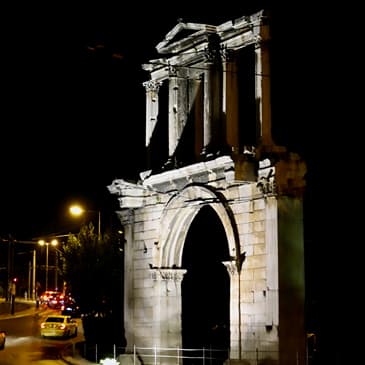
The cover image is our own photo of the Arch of Hadrian by night!
----------
00:10 - Introduction
03:29 - Athens: A Brief History
- 03:38 - The buildings of the fifth century BCE: products of the Athenian empire
- 04:23 - Athens in the Fourth Century
- 04:43 - Athens under Macedonian and Roman Domination
- 05:26 - Athens and its fame as an artistic, intellectual, and religious center
- 07:07 - Gifts from powerful rulers (and a digression on the Stoa of Attalos)
12:00 - Augustan Athens
- 12:27 - Architecture and political messaging in Athens under the Romans
- 14:10 - The Odeion of Agrippa and the Athenian Agora
- 18:28 - The Temple of Rome and Augustus on the Acropolis
- 21:08 - The Roman Agora: the Gate of Athena Archegetis
24:06 - Hadrian’s Athens
- 24:34 - Hadrian’s architectural style
- 25:07 - Hadrian builds a great big aqueduct
- 26:30 - The Eridan0s River gets a makeover
- 27:13 - North of the Acropolis: the Pantheon and the Library of Hadrian
- 32:09 - South of the Acropolis: Hadrian’s Gymnasium and the temple of Zeus Panhellenios
- 33:53 - South of the Acropolis: the Temple and Precinct of Olympian Zeus (and Hadrian among the gods)
- 44:53 - The Temple of Olympian Zeus Today (featuring a story about a magic pomegranate)
48:23 - The Arch of Hadrian
51:21 - Wrap-up
Hello. Welcome to Have Toga Will Travel, a podcast exploring the Mediterranean world, ancient and modern, through the eyes of two former classics professors. I'm Emily.
Cam:I'm Cam.
Emily:And we're your hosts.
Cam:Welcome back, everybody. And if you're joining us for the first time, we're really glad to have you with us. We've got a fun episode for you today. It's the second episode in a short series on the Roman Emperor Hadrian.
Emily:In our last episode, we talked about Hadrian and how he approached governing the Roman world, which he ruled from 117 CE to 138. And we spent a lot of time talking about how much he traveled outside of Rome, about half the time he spent as emperor.
Cam:Yeah, and among other things, he spent a lot of that time in Athens. Athens, in fact, was the city of Roman Empire that he probably spent more time in than any other city other than maybe Rome itself.
Emily:He genuinely seems to have loved Athens, and we can't really blame him, can we? We also love Athens.
Cam:Yeah, Athens is a totally lovable place.
Emily:And of course, we see Hadrian's love for Athens manifest in a few different ways.
Cam:Right. So one of the things we talked about in a fair amount of detail last episode was the fact that Hadrian was initiated into the Eleusinian Mysteries, a really big component of Athenian religious life.
Emily:Also, he made Athens the center of a new multi-state, and we use state loosely here—
Cam:I was going to use superpoliadic, but I decided not to.
Emily:(And everyone's grateful they didn't have to pull their dictionaries out for that one. But that's your $10,000 word of the day, people. Superpoliadic.) A new multi-city-state organization called the Panhellenion, which consisted of a bunch of Greek city-states in the Roman Empire, whose representatives came together in Athens to host games, celebrate Hadrian himself, and deliberate about common priorities.
Cam:And of course, he left his imprint on the city's urban landscape by commissioning a bunch of impressive new public buildings. Today, what we're going to do is focus mostly on that last aspect of his time in Athens by looking in a lot more detail at how Athens changed while he was emperor. And I'm going to state that this is not just an excuse to talk about random archaeological sites in Athens.
Emily:No, of course it's not.
Cam:We actually do have a story to tell.
Emily:So on one hand, Hadrian probably did make more of a mark on the city than any other single person had.
Cam:But on the other hand, when he commissioned new buildings and things like that, he was actually following a well-established precedent. For a long time, Athenians and the rulers of powerful imperial states outside of Athens had used architecture to negotiate their relationships with one another, and in particular to express the relationship of the Athenian past to changing political realities.
Emily:So in this episode, we're going to explore how Hadrian changed Athens by commissioning buildings that merged Roman and Greek traditions. We'll start by talking a little bit about Athens after the classical period and how it came to rely on buildings gifted by rich outsiders. And then we'll touch on the tensions between Greek and Roman architectural styles that we can see in buildings commissioned during the age of Augustus. And then finally, we'll talk about Hadrian's building projects in Athens and the message he wanted his architecture to communicate.
Cam:All right, so let's start by just saying a few words about the city of Athens after the classical period, after the 5th and 4th centuries BCE. It's fair to say that when most people think about Athens, they think about the Acropolis and the major monuments up there. Things like the Propylaia, the ceremonial entrance to the Acropolis, and of course all of the temples, the little temple of Athena Nike, the temple that most people call the Erechtheion, and of course the Parthenon.
Emily:And of course, this is for good reason. These structures have dominated the skyline of Athens for centuries since they were built, and even to a certain extent up to today. But it's important to remember that these were products of a very specific historical moment, and that is the second half of the 5th century BCE, when Athens controlled an empire consisting of more than 100 other Greek city-states in the Aegean and commanded the wealth to build impressive buildings like this.
Cam:Athens was a very different place after the 5th century BCE, and it never again had access to the kind of state resources on the level that would let it do this. For much of the 4th century BCE, although it remained a relatively wealthy and powerful city-state, it nevertheless had no access to the kind of empire it had possessed in the 5th century.
Emily:And then, from 338 until 229 BCE, it was mostly dominated by the rulers of Macedonia. And although it did regain its independence in 229, that independence was fairly precarious, since the Athenians had to carefully cultivate and negotiate alliances with major powers at the time, like the Attalid Kingdom of Pergamum in western Turkey, and increasingly the Romans.
Cam:And then finally, from about 150 BCE or so, Athens was definitely part of Rome's empire, even if for much of that time it was a privileged imperial possession in the sense that it did enjoy a fair amount of internal autonomy.
Emily:Now, even though Athens no longer had either an empire of its own during this period, or the kind of wealth that would have enabled it to undertake massive construction projects, it did have something else that kept urban development from stalling out completely, and that is a huge amount of prestige and renown across the Mediterranean world.
Cam:That prestige had two main sources. First of all, there was the fame that Athens enjoyed as one of the key Greek city-states alongside Sparta and some other allied powers that had repelled the invasion of the Persian ruler Xerxes way back in the years 480 and 479.
Emily:See our episodes on the Persian invasion of Greece.
Cam:Right.
Emily:And number two is the reputation it held as a center of artistic, intellectual, and religious culture. And this I referenced in our last episode was sort of Athens was like the premier college town of the Roman Empire.
Cam:Yeah, that's a good way to put it.
Emily:Because this was, after all, the city that had been home to literary giants. So, for example, you had the playwrights, Aeschylus, Euripides, Sophocles, Aristophanes, and dozens others whose names we know, but whose works don't survive, but would have been available in antiquity.
Cam:It was also a city of philosophy. It was the city where Socrates, Plato, Aristotle, and Zeno had all taught their philosophies, and where their successors would keep their schools and traditions alive right through the entire period of the Roman Empire.
Emily:As we mentioned, it was also the home of the Eleusinian Mysteries, one of the most popular mystery religions (as we call them) in the ancient world, and that probably drew thousands of pilgrims to Athens every fall.
Cam:Now, the prestige Athens enjoyed was something that actually really appealed to the rulers of the powerful kingdoms and empires that dominated the Mediterranean from the late 4th century BCE onwards. And that starts really with Alexander the Great in the 330s BCE, and it extends right through the Roman period.
Emily:Right, because everyone wanted to attach themselves to Athens and its accomplishments, both past and present, in some way. And one of the ways that they did so was by donating gifts to the city in exchange for recognition and plaudits. And often those gifts consisted of funding for new buildings or new buildings commissioned directly by wealthy non-Athenians. So think like the college alum who comes back and dedicates a building that you may need, you may not need, but they want their name on it and they want the building there and they want all the credit for it.
Cam:Yeah, that's a great analogy.
Emily:Yeah.
Cam:And you can see an example of this kind of building in Athens today, albeit reconstructed. It's the stoa commissioned for the city in the middle of the second century BCE by a guy named Attalus, I guess formerly Attalus II, who was at that point the ruler of Pergamon. That's a kingdom in what is now western Turkey. And this building was commissioned and built on the east side of the classical Agora in Athens, on the north side of the Acropolis.
Emily:Now, a stoa is basically a long portico. So it's a structure with columns supporting a roof, and it's designed to provide protection from the weather. In Athens, this mainly means protection from the sun, and of course, also sometimes rain. And you could find relatively simple stoa in otherwise open public spaces in lots of Greek city-states.
Cam:But the stoa that Attalus commissioned for Athens wasn't just any run-of-the-mill stoa. No, no, no.
Emily:Of course not.
Cam:It wasn't just a portico. It was a deluxe stoa. So, Emily has lost it.
Emily:Just the way you said that, a deluxe stoa.
Cam:It was deluxe.
Emily:No, it was. Just the way you said it was funny.
Cam:So it was a pretty deep structure, actually, with two stories. And each of these two stories had an internal row of columns, as well as the external one that fronted the agora. So basically, on each floor, you had two aisles within the structure. Each of those two stories also had a line of 21 shop fronts along the rear wall, each of which had its own individual door.
Emily:It really was a remarkable structure, and you can actually go see a reconstruction of it today. So you can go stand and experience what this would have been like. In the 1950s, the American School for Classical Studies, with the help of individual donors, including a Rockefeller, rebuilt the Stoa of Attalus more or less to its original plan. I actually got to meet a woman who was there at the dedication when it first opened. And I may get her story wrong because I'm remembering a story from about 25 years ago. So let's just call it apocryphal at this point. But she was saying that, you know, the Americans wanting to be very egalitarian, wanted to invite everyone who'd worked on the building to be there for the dedication, including, you know, all of the construction workers and everything. And so lots of local Greek people had been involved in that. And apparently the party got a little rowdy towards the end of the night, and some of the Greeks who were there started breaking dishes, and this was much to the appallment of some of the non-Greek, more hoity-toity guests.
Cam:Yeah, well, and how would somebody like Rockefeller react into that? That's a great question.
Emily:I know. My memory is that she kind of found the story kind of delightful and found it all very funny.
Cam:It would have been a fun party.
Emily:Yeah, she was, I think, an archaeologist at the time.
Cam:At the school, yeah.
Emily:Yeah.
Cam:But like we said, this is a really, really cool building. And, you know, if you wander into it in hot weather, you will be amazed at how cool it seems inside just because of the shade created by the structure and because of the ventilation provided by the open front.
Emily:Yeah. And you should walk into it because that building now houses the museum for the Agara excavations.
Cam:Yes, which is a really, really great little museum.
Emily:Yeah. And, of course, it does rain in Athens. And when it rains, the roof is lined with water spouts carved like lion's heads. And you can watch the water come pouring out of the lion's mouths. Although, other story here is that when it was built, they were all very excited to see what it looked like when it rained. They're waiting for it to rain, and they realized they'd missed a critical part of the lion's heads. They had not given them tongues. And so instead of the water sort of spurting out the way they wanted it to in a nice spout, it kind of dribbled out the sides of the lion's mouth.
Cam:That's sad. They've since fixed that because we've seen them spout out.
Emily:Yes. Yes, we got to sit there across Adrianou Street and have lunch and watch the rain come down.
Cam:Anyway, this is just one of several structures like this that were commissioned for the Athenians by the rulers of Pergamon and by other important people during the second century BCE.
Emily:But as Athens becomes steadily incorporated into the Roman Empire, first under the late Republican government of Rome and then under the emperors, this dynamic of outside rulers gifting buildings to Athens becomes a little more complicated.
Cam:Right. It's worth remembering here that architecture, especially the kind of monumental public architecture that we're talking about here, is often not just functional. It's also designed to communicate very specific messages to people.
Emily:And since Athens increasingly existed in a world in which it was dominated politically by Rome, which also had its own architectural traditions, the creation and sponsorship of buildings in Athens by important Romans could be politically charged.
Cam:So there is an interesting collection of buildings that date from the period in which Augustus became the emperor of the Roman world. I guess the first Roman emperor if we want to go there.
Emily:I mean, you've definitely argued against that point.
Cam:I would say Caesar, but that's a topic for a different episode, I think. But this collection of buildings created during the Augustan years makes this point about architecture very, very nicely. And we're going to illustrate that point a little bit more by talking about three of these buildings. The Odeon, or Concert Hall of Agrippa, the Temple of Augustus in Rome on the Acropolis, and the so-called Roman Agora.
Emily:Now, what these buildings show is that there's an ongoing tension between Romans who are interested in the classical history of Athens, but who nevertheless saw Athens as a Roman possession and wanted to make that clear in the architecture. Got that on one hand. And on the other hand, the Athenians, who were willing to acknowledge the new political reality in which they found themselves, but also trying to find ways to assert the importance of their own history and culture, even within the Roman Empire. And as we'll see later, it's exactly this tension that Hadrian will inherit when he becomes emperor and starts commissioning buildings in Athens himself.
Cam:So the first building we want to talk about is the Odeon of Agrippa. Agrippa was basically Augustus's right-hand man. He was eventually Augustus's son-in-law as well, and he commissioned his Odeon sometime after 20 BCE, probably supervising aspects of its design along the way.
Emily:Now, an Odeon was a lecture hall, as we might call it. It was a roofed and enclosed auditorium generally used for music performances. So you might also sometimes hear it called a concert hall. And generally speaking, it's a type of building that had been a lot more common in Greece than in Italy at this point in time. And the name itself, Odeon, is coming from the Greek. But it was becoming increasingly popular in Italian cities as well.
Cam:Now, unfortunately, there's not a whole lot left of this building today. If you go to the Athenian Agora, and of course you should, What you'll see are mostly its foundations, along with bits of four large statues and their bases, added in the late 2nd century CE as decorations during a major renovation of the structure after the original roof collapsed.
Emily:That said, as far as we can tell, the Odeon, as built by Agrippa, was very Roman, let's say, in its scale and in its placement. So first of all, it was huge. Very big.
Cam:How big was it?
Emily:I will tell you. So the interior had 18 concentric tiers of seats and was capable of seating about a thousand people.
Cam:That may not seem like a lot compared to, say, the Theater of Dionysus on the other side of the Acropolis, which could seat probably anywhere between 12,000 and 18,000 people, maybe even more depending on whose estimate you follow. But for an indoor auditorium, that's actually a whole lot.
Emily:So yeah, for a point of comparison, it's a third roughly the size of the seating capacity of Carnegie Hall.
Cam:Yeah, which is pretty good for 20 BC.
Emily:But what's even more impressive is that the roof of Agrippa's Odeon had a span of about 25 meters, and this span had no visible internal supports.
Cam:And this was way bigger than any similar structures in Greece at the time, especially structures like this that had no internal supports for the ceiling.
Emily:Yeah.
Cam:But it was on par with the kinds of buildings that Roman builders were experimenting with in Italy at the time.
Emily:And just to emphasize its size, the entire structure was tall enough to tower over everything else in the Agora, including both the Stoa of Attalus to the east and the smaller so-called middle Stoa that sat immediately behind the Odeon.
Cam:And not just that. The second thing that really emphasizes the Romaness of this building, I guess, is the fact that Agrippa plopped it down in a very prominent spot in what had previously been the open space of the Agora, where it dominated the view of anybody entering the Agora from the north and heading along the road to the Acropolis.
Emily:Now, to understand why this matters, it's important to know that the Agora had been one of the main, if not the main, political and social nerve centers of Athens for centuries. It, in many ways, was the heart of the democracy. It was a large, open space in the city, right beside some of the most important public buildings. It had been home to an important city market and a place where people could generally gather to shop, hang out, and do what Athenians love to do, which is talk politics.
Cam:So Agrippa's decision to plop a huge building down in this previously open space really did make a statement. Not just a statement about Roman wealth, which was, of course, considerable, but also about the power of Rome to transform the entire ancient social and political rhythm of a city that had been incorporated firmly by this point into the empire, even if that city retained a nominal degree of internal political autonomy.
Emily:It's also a way of stomping down on anything that might be going on there that you don't like.
Cam:It could be, yes.
Emily:Right, like it's a way of breaking up that public space in a way that it can't be used as a public space anymore.
Cam:Yes. He's not the last person to plop down an oversized monument to himself where it doesn't belong. It's okay to have feelings about that.
Emily:No, I'm just trying not to say anything that's going to get me into trouble. Now, at the same time, there are buildings that were built in the same period that were funded or approved by the Romans, but were actually commissioned by the Athenians. And these buildings make very different kinds of statements about Roman power and Athens' relationship to it.
Cam:The Temple of Rome and Augustus on the Acropolis is a good example of this kind of building. Like Agrippa's Odeon, it unfortunately doesn't really survive, at least not as an intact building, although a bunch of pieces from it are still up there on the Acropolis. Now, this was a building designed to celebrate both Rome and Augustus himself, both of whom were personified as gods and given the kinds of honors due to gods.
Emily:Now, we have no doubt that this temple was approved by Augustus himself, but importantly, the inscription that was displayed on the building tells us that it was commissioned and built by the Athenians.
Cam:So this building was what archaeologists call a monopteros. It was a circular arrangement of columns. In this case, those columns were ionic. So these are the slender Greek columns with what looks like a scroll at the top forming the capital. And there were nine of them standing on a traditional stylobate. That's the sort of base of a temple. And those columns were crowned by a cupola, which probably sheltered some kind of statue that stood in the middle of the columns.
Emily:And this temple was placed directly in front of the main entrance to the Parthenon on the Acropolis. And so, as a result, it occupied a pretty prominent position in the city's religious landscape. This was a very visible signal of the political importance of Rome at this particular point in time. But, importantly, its scale was pretty modest compared to the Parthenon itself, which, of course, continued to dominate the Acropolis, even though this temple was there in front of it.
Cam:And interestingly, the honorific inscription on the temple of Rome and Augustus was carved in what was an intentionally old-fashioned style of lettering, which made it look like the inscriptions of the Athenian Golden Age way back in the 5th century BCE.
Emily:So the whole thing seems designed to both acknowledge the reality of Roman power, but also to, let's say, domesticate it or Athenianize it in some way.
Cam:Athenianize it, yeah.
Emily:Not just by linking Roman power to the long sweep of Athenian history with the archaizing inscription, but also by subordinating Roman power to the glory of Athena, whose temple literally did tower over this structure.
Cam:Then finally, there's one other structure we want to talk about from the Augustan period, and that's the so-called Roman Agora, or Roman Market of Athens. Happily, unlike the Odeon and the Temple of Rome and Augustus, this structure actually still exists. And you can actually go and visit it. At least in part, since about half of it, to be fair, is still unexcavated and lies beneath later buildings.
Emily:Unless it snows and they close the site early.
Cam:Well, no, then you can't visit it, obviously, yes. It does snow in Athens, surprisingly.
Emily:Yeah, and I don't blame the site guards who are like, I am in the shed with no heating and the snow will shut everything down if we don't get out
Cam:There's a reason it closes, yeah
Emily:We do know, thanks to an inscription, that the Roman agora was paid for mostly by the Roman Emperor Augustus, who made it a gift to Athens in response to a request by an Athenian citizen named Eucles.
Cam:Like the classical agora, this structure was designed mostly as an open space. But unlike the older agora, this one was enclosed by walls on all sides in what was then, in 10 BC or whenever, a contemporary architectural style. Now, originally in Augustus' time, the Roman agora was entered by one gate on the western wall.
Emily:Now, this original gate, which still stands, was and still is fairly monumental. It has Doric columns that support an architrave and a pediment. A pediment, if you don't remember, is the triangular feature on the front of a classical temple that sits above the architrave and the columns. All of this makes the gate look like a temple front or possibly a Propylaia from a sanctuary.
Cam:At the same time, that pediment supported a statue of one of Augustus's grandsons, Lucius Caesar, who was probably represented here on horseback.
Emily:Son of Agrippa.
Cam:Right, Agrippa's kid. That combination of elements, the Doric Propylaion, the statue of Lucius Caesar on top of it, made this a really weird structure. On the one hand, it clearly acknowledges Roman power, both with that statue of Lucius and with an inscription naming Augustus as the guy who paid for the whole thing.
Emily:On the other hand, though, the Doric style of the entrance was self-consciously retro and, as we said, evoked the look of a classical Greek temple.
Cam:Importantly, the same inscription that names Augustus as the guy who paid for the whole project also dedicates the whole thing to Athena Archegetis, roughly speaking, Athena the Founder, who, of course, was a thoroughly Athenian goddess.
Emily:So in that sense, the structure functioned very much like the Temple of Rome and Augustus. It acknowledges the political realities of the world in which the Athenians found themselves at the time, but at the same time tried to tie that new reality to the Athenian past and express a relationship between Athena and Rome that definitely emphasized Athena.
Cam:Right, so that's the Athens that Hadrian encountered when he visited it some 120 years after the time of Augustus, along with the architectural traditions that he inherited from the past. Athens was, when he first visited, still a city with plenty of monuments from its classical history. But of course, at the same time, it was also home to new monuments that sought to put that past into conversation with later political realities, and especially with the reality of Roman power.
Emily:Now, as Emperor, Hadrian is going to dive headfirst into this process by commissioning buildings that continued the conversation, but he did it in his own particular style.
Cam:And as we'll see, it was a style that was a lot more similar to those Athenians who commissioned buildings in honor of Augustus than it was to say the style of Agrippa.
Emily:The style acknowledged both Hadrian's role as the Roman ruler of the Mediterranean, and at the same time leaned heavily into the very long and very Greek history of Athens.
Cam:So let's get into this by talking about some of his projects. And the first project we want to talk about is a mostly functional one rather than a monumental one, but it's still really, really cool. It's his aqueduct, which carried water from the foothills of Mount Parnes into Athens over a distance of about 20 kilometers.
Emily:Now, this was a mostly subterranean aqueduct, which consisted of elaborate underground galleries that were quite deep in some sections and linked by wells that collected and channeled groundwater. And it fed into a reservoir that still sits today underneath Plataea Dexameni in Kolonaki neighborhood of modern Athens. And that reservoir then fed a bunch of smaller branches that carried water to different parts of the ancient city.
Cam:Now Greeks had known and built aqueducts like this for centuries, but Hadrian did it here on a typically Roman scale. His system supplied something like 116 liters of water per second to the city, even in the summer.
Emily:And he monumentalized his achievement in a decidedly Greek style. The reservoir under Dexameni had an entrance that featured a very nice and very Greek ionic portico with an inscription on it.
Cam:And actually, you can see the bases of two of the columns from that portico still in site, right next to what is now an open air movie theater in the Plataea, which is a very nice place to go hang out.
Emily:Yeah, it's a lovely Plataea. I have sat there many a time.
Cam:While we're talking about water, I just wanted to point out that Hadrian also seems to be the guy who built a channel for the Eridanos River, one of the three rivers that flowed through Athens. It now flows underneath the city. But if you happen to be in Monastiraki Square, right in the middle of a square, there's a cutout that allows you to sort of look down and see the Hadrianic bed of the Eridanos River through which water still flows. And if you go into the subway station right next door, they have a museum on one of the lower levels of the subway station where you can see a lot of that Hadrianic channel of the Eridanos.
Emily:Yeah, it's pretty cool.
Cam:It is. It's so cool.
Emily:The mighty Eridanos.
Cam:Yes. Anyway.
Emily:Cool as the aqueduct is, Hadrian's other projects perhaps show his style a little more clearly. And the ones that we're going to talk about were grouped into two areas of Athens. One group was on the north side of the Acropolis, and one was on the south. So on the north side of the Acropolis, to the east of the classical Agora, Hadrian built at least one and possibly two major structures.
Cam:Right, there's one that we're a little unsure about, and that is a temple which is situated just off of the appropriately named Adrianou Street, which cuts across much of the northern part of downtown Athens. There's not much to see there anymore. Really, there are just a bunch of foundations that sit in an excavated and vacant lot between a couple of shops. But as far as we can tell, there used to be a pretty substantial building here of the second century CE. And it's usually thought that this was the temple to all of the gods, the so-called Pantheon, which Hadrian built, at least according to the Greek writer Pausanias, who was about a generation younger than Hadrian. If you know Athens. It's just a block down from Dr. Fish, which is one of those creepy spas where you stick your feet in an aquarium and have—
Emily:Fish eat the dead skin off of it.
Cam:Yes, exactly.
Emily:I feel like it's a thing only tourists do.
Cam:Do tourists even do this?
Emily:I don't know. I mean, that was not there when I first started going to Athens.
Cam:Now a staple of Adrianou Street. It's been there for years.
Emily:The other building here on the north side of the Acropolis is the so-called Library of Hadrian, And its ruins are a lot more impressive and also something you can visit. Now, the Library of Hadrian is just north of the Roman Agora, and the remains of its monumental entranceway are just off of Monastiraki Square. So you can check out the river and then just walk up the block to the Library of Hadrian.
Cam:This was a very interesting and very impressive complex that really did reflect Hadrian's style. It evoked both imperial Roman architecture and contemporary buildings in the eastern Greek part of the Roman Empire.
Emily:So first of all, the whole thing was enclosed by a large wall. The monumental entrance, which was on the west side, looked for all the world like the front of a small temple with ionic columns, an architrave, and a pediment.
Cam:And on either side of the entryway, there was a wall of massive marble blocks, which extended for about 100 feet in each direction. And that wall was fronted by 14 columns, seven to either side of the entranceway, all of which probably supported statues.
Emily:The northern half of this wall still survives today, and it gives a good sense of how impressive it must have been when it and the entryway were all intact. Its general appearance would have screamed Roman to anybody walking by in Hadrian's Day. It evoked the big imperial fora of Rome itself, which were often closed off from the rest of the city by an enclosure wall.
Cam:But if the exterior of the structure screamed Roman, the interior would have felt much more familiar to cosmopolitan Greeks of the 2nd century CE. Much of the interior was taken up by a large courtyard, which measured maybe about 200 feet by 200 feet.
Emily:The courtyard had a long ornamental pool and was surrounded on all four sides by porticos. As we're told by Pausanias, there were a hundred columns supporting these porticos made of marble, fine marble, imported from Phrygia.
Cam:Very fine stuff.
Emily:Yes.
Cam:And finally, across the courtyard from the entrance, there was a tall building that ran the whole width of the courtyard.
Emily:So in its layout, the interior looked very much like the kind of bath complexes that you would find in big Greek cities in Asia Minor, which had courtyards that would be used for wrestling, that would be surrounded by porticos, etc. Now here, though, the building that is attached to this courtyard is not a bathhouse.
Cam:No, instead it's this thing we call the library. It had five rooms, and one, the large central room, definitely served as a place with shelves that held scrolls in their wooden cases.
Emily:So kind of like a library.
Cam:Yeah, a library, essentially.
Emily:Well, and it's not unheard of for large bath complexes in the Roman world to have libraries attached to them. Two of the other four rooms in this building, in this case, the ones in the northeast and southeast corners, were pretty clearly some sort of lecture halls with tiered seating.
Cam:So the whole complex gives the vibe of a cultural center, basically, of some sort, where well-off Athenians could hang out, go see talks on philosophy, read through scrolls, and chat with each other while strolling around in the porticoes or around the pool in the courtyard.
Emily:So in that way, it must have felt very Greek, very Athenian, in spite of its look from the front, which again was very Roman, and sort of nicely expresses Hadrian's interest in Greek intellectual life.
Cam:So those are some of the major things Hadrian seems to have built to the north of the Acropolis in Athens. But he was also very, active commissioning and building structures on the south side of the city, particularly in the southeast corner, which is now dominated by the precinct of his most famous building of all, the Temple of Olympian Zeus.
Emily:Now, there are three structures in this part of the city worth talking about. One is, of course, the temple itself, but there are also a couple other smaller structures that Hadrian built. And so we're going to start with the two smaller ones. First of all, on the southeast side of the Ilissos River, which put it just outside the ancient city proper, he built a gymnasium. Like the library, it also featured porticos with 100 columns. Not much of it is left now, but it is worth pointing out that gymnasia were a decidedly Greek building, and so this structure probably felt very Greek even if it carried Roman elements.
Cam:Second, we're told that he built a temple dedicated to Zeus Panhellenios, Zeus patron of all the Greeks or something like that, and possibly also to Hera. This temple is generally thought to have sat immediately to the south of the massive temple of Olympian Zeus, although there's not much left of it today.
Emily:Now, among other things, this temple might have contained a shrine dedicated to Hadrian himself. We do know that the Athenians paid divine honors to Hadrian as Hadrian Panhellenios, because an inscription tells us that one of the titles of the official in charge of the Panhellenion was priest of Hadrian Panhellenios.
Cam:Sadly, this structure too doesn't really survive to any great extent, so it's otherwise difficult to get a feel for what it actually looked like.
Emily:But Hadrian's most significant project of all, as we mentioned, was definitely completing the Temple of Olympian Zeus, which is built on a small ridge in what was the southeast part of the city.
Cam:This temple and its precinct were both truly massive once they were finished. Like Hadrian's library, they also evoked both contemporary Roman architecture and native Greek architectural traditions. Though as we'll see, it seems to have been the Greek aspects that were definitely the most eye-catching.
Emily:Now, first of all, Hadrian cannot take credit for building the temple itself from scratch, because this building had been under construction for a bit, really for almost 650 years when Hadrian decided to finish it.
Cam:Right. It had been started by Peisistratos and his sons. These are people who had controlled Athens as autocrats in the late 6th century BCE before Athens became a democracy. And they probably started work on the site in the 520s or so BCE.
Emily:But the work was interrupted only a few years after it started.
Cam:Essentially, Peisistratos' sons lost their hold on power in Athens. And in 508, the classical Athenian democracy was established, at least in its early form.
Emily:Yeah. And the new democracy was not interested in carrying on the project, undoubtedly partly because of money and expense, but in part because they saw it as a project designed to glorify the people that they came to regard as tyrants, and they didn't want to do that. Yeah. Funny enough, the democracy was not interested in contributing to the monumentalization of the tyranny.
Cam:Yeah. I mean, I can think of one or two buildings that I would love to see knocked down two and a half years from now.
Emily:Yep.
Cam:Anyway, the foundations the Peisistratids built would end up being the foundations used in later stages of the building.
Emily:So after the Peisistratid period of construction, let's say, comes to an end, the next major stage of construction that we can identify with some confidence took place about 350 years later, in the early 2nd century BCE. And in this case, it was sponsored by Antiochus IV, also known as Antiochus Epiphanes, who was the ruler of the Seleucid Empire.
Cam:Right. So one of the breakaway kingdoms that emerged after Alexander the Great died and his broke up. So work on the temple probably started again, not too long after Antiochus became king of the Seleucid Empire in 175 BCE. But alas, he didn't live too much longer after that, and construction probably stopped when he died in 164.
Emily:Just point of fact, Cam says Seleucid, I say Seleucid, same thing, just different ways to pronounce it.
Cam:Yes, it's a total potato-potato situation.
Emily:Yes.
Cam:Cicada-cicada.
Emily:Yeah. Again, at the death of Antiochus, it is hard to say for sure how much work had been completed by his architects and how much was left for Hadrian. But the general consensus is that most of the columns had been set up and possibly even finished, and that the walls of the temple were more or less complete, if not the temple's actual superstructure.
Cam:Yes.
Emily:This all brings us to Hadrian's interventions into the Temple of Olympian Zeus. Now, for starters, Hadrian finishes the actual temple itself. Now, as we said, it's not clear how much work Antiochus had left behind undone, but it does seem likely that Hadrian had to finish the superstructure and some of the decorative elements of the building.
Cam:The second thing he did was commission the statue of Zeus that would occupy the central position in the temple's cella. And according to the writer Pausanias, who saw it probably a couple of decades after it was finished, this statue was not only one of the largest statues in the ancient world at that time. It was also a chryselephantine statue. That means it's one of these statues which has an internal wooden skeleton or frame and an outer skin of ivory and gold and looks massive and shiny and impressive and all that good stuff.
Emily:Now, Hadrian is not content just to finish the temple. He also builds a massive artificially leveled terrace on which the temple now sits.
Cam:On the west side, where the terracing was most extensive to level the whole thing off, the whole area was supported by watertight vaults, which probably doubled as cisterns, actually, that were linked to Hadrian's aqueduct, which held water and supplied water under pressure to a bunch of nearby bath buildings and fountains and things like that.
Emily:And then finally, he built an enclosure wall. There's a theme here, an enclosure well to surround the terrace on all sides, effectively turning the terrace into a closed precinct with a ceremonial gate—that is a propylaion—on its northern side.
Cam:So the result is a truly stunning complex that featured both Roman and Greek elements and put them into interesting conversation with each other.
Emily:The terrace and the precinct that Hadrian created to house the temple was huge. Almost twice the dimensions of a soccer field or a football pitch, depending on where you are. And compared to an American football field, it's about twice the length and more than two and a half times the width.
Cam:The whole thing was paved with marble flagstones, and the enclosure wall that surrounded the whole precinct definitely gave it a distinctly Roman feel. Just like the enclosure wall at the Library of Hadrian, it probably evoked the imperial forums of Rome.
Emily:Now, the temple itself was also executed on a truly grand scale. Like most classical Greek temples, it aligned with its long sides sitting roughly on an east-west axis so that the main entry to the temple was on the east side.
Cam:The stylobate, that's the platform on which the whole thing sat, measured about 50% bigger than the Parthenon stylobate in each dimension. So this is a really, really, really big temple.
Emily:And on that stylobate sat a cella, that's the internal room of the temple, surrounded by a literal forest of columns. So on each of the short sides, which were the east and west sides, viewers would have seen three rows of eight columns in front of the cella, and those would have supported the pediment. And then on the long sides, the north and south sides, viewers would have seen two rows of 20 columns each.
Cam:Those columns are about 17 meters tall. That's 56 feet. And they're built in the Corinthian order. And point of trivia for you, this was the largest marble building in the Corinthian order ever built in the ancient world. Corinthian columns, for those of you who don't remember what they are, are basically a species of ionic column with a much more elaborate capital shaped like...
Emily:Acanthus leaves.
Cam:Like acanthus leaves, yes.
Emily:And the Romans love them.
Cam:They go all in for the Corinthian capitals.
Emily:Because they're fancy.
Cam:Yes.
Emily:They're just very elaborate.
Cam:Yes.
Emily:I want to make a joke about Romans just having the taste of nouveau riche, but...
Cam:You laugh, but there are some really good articles about the way that Romans in the Republican period decorated their houses. And it was gaudy and awful because it was basically just sort of jamming sculptures from every place you had conquered in the whole world into one room with no rhyme or reason.
Emily:They're so gauche.
Cam:Yes. Anyway.
Emily:Anyway. Now that we've criticized Roman's interior decorating.
Cam:Yes.
Emily:So, while the precinct screamed Roman with its enclosure wall, the temple itself was very Greek in all respects.
Cam:And as far as we can tell, the decorative elements of the temple were 2nd century BC in style. And that includes those Corinthian columns. As we've said, the Romans loved Corinthian columns. But the Corinthian order itself was originally Greek and was particularly popular in the Hellenistic period after the death of Alexander the Great. The overall Greek style of the temple makes sense because a lot of the work was probably completed by Antiochus. But whatever Hadrian did, whatever elements he added were entirely consistent with that.
Emily:Also, it lacked the massive podium, which is the raised platform that Roman temples typically sat on, and instead sat on the sort of very Greek classical stylobate, which is much lower. And then finally, the statue of Zeus inside the temple, as we've already noted, was chryselephantine. And that was a style of statuary that was consciously retro in the world of the 2nd century CE.
Cam:Right. It really echoed the statue of Athena Parthenos.
Emily:And of course, the temple of the statue of Zeus at Olympia.
Cam:Right. Both of which are 5th century BCE statues.
Emily:And so the result is, once again, a structure that captured Athens' Greek identity, even while giving it a distinctly Roman twist.
Cam:Finally, it's worth saying a few words about the statues that were dedicated in the precinct after Hadrian finished the complex. There were a lot of these.
Emily:So, for example, each city that became a member of the new Panhellenion dedicated a statue representing itself as well as a statue of Hadrian.
Cam:And Hadrian himself featured prominently in other ways. So, for instance, we're told that four statues of Hadrian stood immediately in front of the temple's entrance. And behind the temple, there was a big colossal statue of Hadrian that was dedicated by the Athenians themselves.
Emily:Statues of Hadrian were so prominent in the precinct that it's sometimes thought that Hadrian had the temple dedicated not just to Zeus Olympios, but also to himself as the joint occupant of the temple.
Cam:Yeah, as we noted last episode, Hadrian himself acquired the title Olympios, which he shared with the god. And under that name, he was clearly given honors of the kind normally given to gods. So for example, altars were dedicated to Hadrian Olympios around the city, probably used to make sacrifices in his honor, that kind of thing.
Emily:But it's important to be careful here. The statues in the sanctuary clearly emphasized Hadrian's extraordinary status, but they equally drew a pretty clear distinction between him and Zeus, since Zeus was, after all, the only occupant of the temple. And it was Zeus' statue that occupied the inner chamber of the cella, not Hadrian's.
Cam:Yeah, Hadrian statues, though certainly prominent within the precinct, were definitely placed outside of the temple, whether in front or behind. And this would have left no doubt in anybody's mind that it was Zeus to whom the temple and the sanctuary itself were dedicated.
Emily:Now, this doesn't mean that Hadrian didn't want and didn't pursue divine honors. But the main place that those divine honors were celebrated was probably in the temple of Zeus Panhellenios, which became strongly associated with the cult of the emperor.
Cam:Here, on the other hand, in the precinct of Zeus, Hadrian was clearly subordinate to the god, in spite of the shared title Olympios. And that presumably was a gesture on his part that definitely gave a nod to the importance of the Greek elements of the complex that we've been talking about, and ultimately to the traditional gods of Athens and the gods of the Greeks.
Emily:So today, if you go to visit the Temple of Olympian Zeus, in many ways the whole complex is a pale reflection of what it used to be. But the ruins are still evocative enough to give a good sense of how impressive everything would have been when it was intact.
Cam:Sadly, only 15 of those 104 Corinthian columns still stand. 13 of these are clustered on the southeast corner of the stylobate. These are the columns that would have stood in front and to the side of the front left corner of the cella, so immediately to your left if you were standing in front of the building.
Emily:You'll also be able to see the two other standing columns a little ways down, and these both belonged to the second row of columns on the long south side.
Cam:And finally, there is a 16th column, which survives, but is not still standing. That one fell over in 1852, and its drums basically sit where they landed.
Emily:Now, the marble paving stones that lined the surface of the terrace are long gone, as are big chunks of the enclosure wall on the north end.
Cam:But on the east, west, and south sides, that enclosure wall is still mostly intact and is really, really impressive. You can get a good look at its west face by walking south down Leophoros Andrea Syggrou, the major street which runs down the west face of the complex.
Emily:And you can also walk to the south end of the complex and peek over the top to see just how high it is there. And this is the part of the terrace where the need for infill was most pressing. And it's pretty steep, especially given how not steep it is on the other side.
Cam:Yeah. Back in the day, you used to be able to wander around below the south side of the wall, but that hasn't been true in years, unfortunately.
Emily:Yeah, no. Now, I will say, though, just because the temple is not intact anymore doesn't mean you still can't make offerings to the gods there. So we had students we took to Athens in 2022, and it was cold that March in Athens.
Cam:It was snowing, yeah.
Emily:Yeah, it snowed.
Cam:That's because Giles cursed us with bad weather.
Emily:Yeah, we've already discussed how Giles cursed us on that trip. And so our last day with the students, we were doing a walking tour and we were— we were near, I think, the Roman Agara and the students were passing around a pomegranate. One of them had bought a pomegranate and they decided it was magic because the pomegranate was warmer than the air temperature. So then everyone had to touch the pomegranate because it was weirdly warm.
Cam:The lucky pomegranate.
Emily:And it was the lucky pomegranate. And then everyone had to touch it. And later that day, the three young women whose pomegranate this was went back to the temple of Olympian Zeus. The weather had actually improved since the morning. And they decided to offer the pomegranate to the gods. And they took a little video of this, which they then shared with all of us. It was like, they kind of took the pomegranate and kind of like tossed it into some bushes.
Cam:And poof, it disappeared.
Emily:And it disappeared. They could not find it. And this video is really cute because it's them like, all right, let's do it. And then they're like, wait, where'd it go?
Cam:That's good evidence that the god accepted the sacrifice.
Emily:Yeah, yeah. Zeus is still accepting offerings there.
Cam:Yeah, it's still a place of magic.
Emily:Yeah, it was pretty cool. And we were actually really, like, touched that they did this and then sent us the video of it.
Cam:Look, they learned something about how ancient Greek religion worked. Mission accomplished.
Emily:Our intention was not to turn students into pagans.
Cam:If that happens, though, I don't really object.
Emily:Anyway, delightful story.
Cam:Yes. Anyway, as we wrap up here, because this has been a long episode, so we might as well push through to the end, it's still worth talking about one last Athenian monument from Hadrian's day. And that's the great big arch that stands immediately to the northwest of the sanctuary of Zeus, just outside the precinct wall.
Emily:So apart from the Acropolis and of course the Parthenon, this might be actually one of the most recognizable ancient monuments of Athens. It stands near an important intersection, so tons and tons of visitors walk past it on way up to the Acropolis, and probably millions of drivers go past it every year.
Cam:In antiquity too, it would have been pretty prominent. It sat over a busy road, which now runs underneath the modern Lysicratous Street, and that road ran through the arch from the Acropolis area on its way to the city wall and the valley of the Ilissos River beyond it.
Emily:It's a monument with two stories. The first story is basically what we think of when we imagine a Roman-style triumphal arch. It's a nice sturdy arch made of marble blocks.
Cam:But on top of that, there's a second story, which consists of Corinthian columns and pilasters. A pilaster is basically a squared column. These both have the, you know, the acanthus leaf capitals that we've been talking about. Those columns and pilasters on the second story support an architrave and a pediment.
Emily:But they also frame three rectangular openings. And the middle opening itself was in antiquity closed by a thin marble sheet that probably had a painting of the Athenian hero Theseus on the side looking toward the Acropolis and a painting of Hadrian on the side looking toward the Temple of Olympian Zeus.
Cam:This structure is called, appropriately enough, the Arch of Hadrian, and it was commissioned and set up by the Athenians in honor of the emperor.
Emily:Now, importantly, at the top of the first story, the arch had an inscription on both of its sides.
Cam:On the side facing the Acropolis, the inscription reads, This is Athens, the ancient city of Theseus.
Emily:However, on the side facing the temple of Olympian Zeus, it says, This is the city of Hadrian and not of Theseus.
Cam:This, we think, is probably the monument that most accurately captures what it was that Hadrian wanted the Athenians to think about him. He didn't necessarily want to be seen as a god. He didn't necessarily want to be seen even as the Roman emperor. What he wanted was to be seen as somebody who shared with Theseus the distinction of being a founder of Athens, the city that seems to have meant so much to him. And that's it. We're at the end, finally.
Emily:Yeah, I suppose in the end, we understand on some level why Hadrian thought Athens was such a special place.
Cam:It definitely is.
Emily:Although, please don't start wearing a beard.
Cam:No, I'm not going to cultivate the Hadrian's beard.
Emily:Okay. Also, don't pick up some guy in Bithynia.
Cam:No, I'm not going to do that either.
Emily:So next time, we're going to kind of continue this theme of Hadrian the Builder, but we're going to take it back to Rome and we're going to talk about Hadrian's Mausoleum, which is now known as the Castel Sant'Angelo. We mentioned this in our last episode, and that's going to get us into Roman history after the Classical period. Do you have anything else you want to add?
Cam:Not really, except to say that next episode should be pretty interesting because what we're looking at is a tomb that became a palace, which is just a weird combination.
Emily:Yeah. Also a fortress.
Cam:Also a fortress.
Emily:And now a museum.
Cam:And now a museum. Yes, there we go.
Emily:Yeah.
Cam:It's been everything to everybody.
Emily:So that's all for today. I've been Emily.
Cam:I'm Cam.
Emily:And this has been Have Toga Will Travel. Find us wherever you get your favorite podcasts, or you can follow us at havetogawilltravel.com or on all the socials.
Cam:And if you like this episode, please do tell a friend about us. That's one of the best ways to get more people listening to us.
Emily:Yeah.
Cam:Thanks for listening, everybody.