
What are the origins of ancient Greek comedy? It turns out, we know a lot less about this than you might think! In this episode, Emily and Cam talk about the evidence for the early phases of scripted comedy at Athens (such as it is), and about the festival contexts in which comedy was performed. And, as a bonus, Emily muses about how bad the evidence is for one of comedy’s most important festivals, the Lenaia.
Visit our homepage to subscribe, to find us on social media, and to contact us by email:
If you liked this episode, buy us a coffee:
Links to other episodes we mention here:
- At Play in the Theater of Dionysus (our episode on the Sanctury and Theater of Dionysus in Athens).
- Aeschylus’ “Persians”: The OG Greek Tragedy (our episode on the oldest surviving play from ancient Greece)
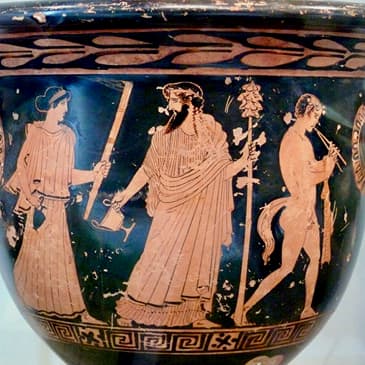
The cover image is adapted from a photo of an Athenian red-figure bell krater (ca. 440 BCE) featuring a Maenad, Dionysus, and Silenus (Walters Art Museum 48.74), taken by Ad Meskens.
----------
00:10 - Introduction
02:05 - What are the origins of theater in ancient Athens? (A review)
- 02:13 - The worship of Dionysus and the City Dionysia
- 02:50 - The Dithyramb and the origin of theater
- 04:02 - The legend of Thespis
- 04:59 - Features and development of Greek drama: Masks, actors, and the chorus
12:08 - What are the origins of Greek comedy?
- 12:10 - Comedy at the City Dionysia
- 12:42 - Aristotle’s theory on comedy’s origins: comedy and the komos
- 14:43 - Vase paintings of the 6th century: early comedy?
15:37 - When and where was Greek comedy performed?
- 16:22 - The City Dionysia: the great theater festival of Athens
- 23:13 - The Rural Dionysia: theater in the townships of Athens
- 25:36 - The Athesteria and the Lenaia
- 28:58 - The Lenaia: a conspiracy of the scholiasts?
32:33 - Final thoughts and wrap-up
Hello. Welcome to Have Toga, Will Travel, a podcast exploring the Mediterranean world, ancient and modern, through the eyes of two former classics professors. I'm Emily.
Cam:I'm Cam.
Emily:And we're your hosts.
Cam:So welcome back, everybody. And if you're new, we're really glad to have you here with us too. We've got an exciting episode ahead for today. We've just wrapped up a long series of episodes on the Roman Emperor Hadrian and a bunch of topics connected to him. And what we're going to do today is shift gears a little and turn our attention back to the Greek world. And we're going to launch a new series of episodes on a subject near and dear to Emily's heart, Greek comedy.
Emily:So in several episodes so far, we have discussed a few Greek tragedies, and we've also talked a bit about the origins and context of Greek tragedy, in particular in our episode on the Sanctuary of Dionysus.
Cam:Which, of course, you should listen to if you haven't done so already.
Emily:Obviously.
Cam:But today we're going to kick off a pair of episodes that will give an overview of some of the basics when it comes to Greek comedy, partly because there are interesting things to say about its origins and so on, and partly because what we want to do is set up some future episodes on specific comedic plays.
Emily:So in this episode, we're going to start by reviewing the origins of theater and drama in Athens, and then we'll talk more specifically about the origins of comedy. And just to be clear here, when we say comedy in these episodes, what we mean is scripted comedy. So there are other kinds of performance happening in the ancient context that are funny, that are humorous, but they aren't scripted comedies. And so that's specifically what we're looking at today. So after we talk about the origin, we'll finish with a discussion of when and where comedic plays would have been performed. And then in our next episode, we're going to talk in more detail about what comedy looks like as a genre and how it changes over the fourth and fifth centuries.
Cam:All right, that sounds pretty good to me.
Emily:Well, you wrote that line.
Cam:And we'll dive right in by talking a little bit about the origin of theater in Athens to refresh everybody's memories. So the first thing that's important to remember here is that theater in Athens really originates in the context of the worship of Dionysus. And in particular, theater is associated with one of the big festivals at Athens that was celebrated in honor of Dionysus, the so-called City Dionysia. This was a festival which probably established sometime in the 6th century BCE. And as we'll see a little bit later, the traditional date for the birth of tragedy in the context of the festival is 534. And that's a date that's given to us both by Aristotle and by a text called the Parian Chronicle.
Emily:So we know when, but how does scripted drama emerge? So one of the elements of the worship of Dionysus, broadly speaking, was something called the Dithyramb. The Dithyramb is a choral song in honor of Dionysus, and the performance of the Dithyramb incorporated singing, dancing, and some narrative content. So it was telling a story.
Cam:Now, annoyingly enough, we don't really know the origins of the Dithyramb either, although we can say that the earliest mention of Dithyrambic competitions comes from the 7th century BCE in the poetry of a guy named Archilochus. And in the historical period, anyway, by the early 5th century at Athens, the Dithyramb was performed in competition by choruses selected from each of the civic tribes of Athens who basically competed against each other to earn a prize in honor of the god Dionysus. They competed in two categories. There was a men's competition and a boys' competition. Each chorus of men or boys consisted of 50 people, and at Athens, let's say from the late 6th century onward, there were 10 civic tribes, which meant that you had 10 choruses of boys competing in the festival along with 10 choruses of men.
Emily:Now, when it comes to tragedy and the Ditharamb, the story that we get, at least according to Aristotle is that there is a man named Thespis, T-H-E-S-P-I-S. And somewhere in the 530s, Thespis, who is performing with a dithyrambic chorus, steps out of the chorus and engages in a dialogue with them. And this is the beginning of drama, right? So drama is one actor and the chorus in conversation with one another.
Cam:The name Thespis, of course, is where Thespian comes from.
Emily:Yes.
Cam:And there is still a road named after Thespis, nestled on the east slope of the Acropolis, not too far from the theater of Dionysus itself.
Emily:Yes, there is.
Cam:Anyway, we can quibble, I guess, about whether or not Aristotle actually is reliable here, whether he had access to a good source of information.
Emily:Yeah, I mean, who knows, right? I mean, he's writing, what, 200 years after this would have happened?
Cam:Yeah.
Emily:I'm sure it's at that point already the stuff of legend.
Cam:Exactly. So lots of unknowns. But I think what we can say is that from its very beginning, tragedy did actually retain strong choral elements, which, you know, suggests that there may be some relationship between tragedy and dithyrambic competitions. Choral song and dance is a key component of Greek tragedy, especially in the 5th century, and it remained so. And throughout the 5th century, Greek tragedies featured a chorus of between 12 and 15 members.
Emily:Yeah, depending on the time. Other things that show up in Greek tragedy are, for example, masks. So the performers, both the chorus and the actors in a Greek tragedy would have worn masks. And part of what this does is it enables the actors to play multiple characters. And another thing that's worth mentioning here is that all of the performers would have been men. So the masks also enable male performers to play female characters.
Cam:Now that said, Greek drama was not static, and there were important developments over time. And one of the most important developments had to do with the number of actors who took the stage alongside the chorus. If we're to believe Aristotle's story, in the beginning, drama featured one actor playing against a chorus. But at some point in the 5th century, drama evolved to include three actors plus the chorus.
Emily:Yeah, but the chronology here is really unclear. So our oldest surviving play dates to 472, which is the Persians by Aeschylus that we talked about earlier this year.
Cam:Many months ago now in another episode. But the point there that's worth restating is that because our oldest surviving play dates from 472 BCE, there's a period of about 60 years there where drama was being performed and we don't really have any written texts that reflect on it. So it's hard for us to know exactly what was going on. So for example, Aeschylus, the first playwright whose works survive, was born around 525, round about the time, according to the legend, that Thespis actually invented tragedy as a genre. The first time he competed at the Great Dionysia was in 499, and his first victory wasn't until 484.
Emily:Yeah, so the oldest play we have is still almost 30 years into his career and over a decade after his first victory.
Cam:Yeah.
Emily:Now, Aristotle, who is our primary source for the history of drama, claims that Aeschylus is actually the one who introduced the second actor. And we can say for sure that by the time we have a play of Aeschylus, we need two actors to do that show. So we do know that whenever the second actor was introduced, it was before 472.
Cam:And Aristotle likewise claims that Sophocles introduced the third actor, along apparently with the technique of painting the skēnē building, which sat behind the performance in the theater. Sophocles himself was born in 496 or so and competed for the first time in 470, we think, winning for the first time in 468. That could be taken as sort of a range of dates in which the third actor could have been introduced. But all of this sort of, again, presupposes that Aristotle is right. And I guess the reason to be suspicious here is because it looks a little bit too pat, right? Thespis invents it. Aeschylus adds an actor. Sophocles comes and adds a third actor.
Emily:Yeah.
Cam:Yeah.
Emily:Yeah, like, you know, the two great playwrights working in this period are the ones who made these substantive changes, right? Like, I might be willing to go with Aristotle on Aeschylus introducing the second actor, but the Sophocles thing just feels a little too...
Cam:Yeah.
Emily:I'm going to call it too neat a story.
Cam:Yes.
Emily:Now, that said, we do know for sure that we have a third actor by 458, because that's when Aeschylus' Oresteia premiered, and we need three actors to do that show. All the plays that survive that are older than the Oresteia do not require three actors. And this includes Aeschylus' Suppliants, which is kind of a weird play in that it's the only play we have where the chorus is actually the main character in the story. So, odd little play. But yeah, only need two actors for anything older than the Oresteia. So, somewhere between 472 and 458 in that, what is it, 14-year period, a third actor is introduced.
Cam:Now, that said, even as the number of actors changes, the chorus and choral elements remain really, really important to Greek tragedy. And again, that's because tragedy seems to be growing, at least in part, out of organic Greek choral traditions. And that's an aspect of Greek tragedy that actually becomes difficult for other cultures to deal with because it really is a very peculiarly Greek thing. And it was alien to cultures elsewhere that get interested in Greek tragedy.
Emily:Yeah, so they like don't know what to do with it or how to think about it. And it also means that the chorus is usually one of the first things to get minimized or eliminated once other cultures start engaging with Greek tragedy and putting it on.
Cam:And finally, I guess it's worth noting in that context that the word theater ultimately means a place where you go to watch and see things, right? Not necessarily to hear them.
Emily:Which is interesting, right? Because audience, our word audience is, of course, related to the word for hearing, but theater is about seeing.
Cam:Right. And that really puts a lot of emphasis on the visual aspect of these performances, which really did seem to be central to the experience in the Greek imagination. And one way to sort of put that into perspective is, you know, when Greek stage plays, there was a guy called a choregos who was responsible for essentially producing the work of the poet whose play was being performed.
Emily:He's the money.
Cam:And he had to use his own money, right? He was doing this as a benefaction to the city-state, essentially. But very quickly, choregoi started competing with one another to outdo one another when it came to putting on a great show. So they'd spend a lot of money on really elaborate costumes, on, you know, all respect to Aristotle, on painting the scenes, probably before the days of Sophocles.
Emily:Probably.
Cam:And things like that. And again, that's just to sort of drive home the point that these are big shows with high production values, lots of costumes, lots of people running around on stage singing, all that sort of good stuff.
Emily:Yeah. One of my favorite, probably apocryphal stories, but it's a good story nonetheless, is that during a production of the Oresteia in the third play, the Eumenides, the chorus is the Furies. And when the furies first come on stage, they were so terrifying that a woman in the audience went into labor.
Cam:Yes. The furies, for those of you who might not be totally up on your Greek mythology, are mythological critters who basically punish crimes committed by people against their relatives. And yeah, so that story just highlights how much effort must have gone into presenting these mythological beasties as really terrifying apparitions on stage.
Emily:Yeah, yeah.
Cam:And actually, as we'll probably talk about in more detail in a bit, comedy provided the opportunity for some really fantastical over-the-top costumes and masks and things like that, too.
Emily:Yeah, even more so than tragedy did, right?
Cam:All right, let's talk about the origins of comedy.
Emily:Okay. So to a certain extent, tragedy and comedy develop together as drama, but they're also different in significant ways. And if the origins of tragedy are obscure, those of comedy are even harder to discern. So what we do know is that comedy makes its first appearance in the city Dionysia in 487. Now, at this point, tragedy is already well established, but by the time comedy becomes part of the festival, it too has to have been developing for some time.
Cam:Here, too, Aristotle tries to explain where comedy comes from, but it's pretty clear from his discussion that the origins and development of comedy were obscure even to him.
Emily:I mean, he more or less says that.
Cam:Yes. Anyway, in his view, nobody took comedy really seriously until it was first entered into the city Dionysia— the first time a magistrate known as the eponymous Archon granted a comedic poet a chorus that could be used to stage a presentation.
Emily:Yeah, so basically funded it. Yes. Yes, you get a choregos and a chorus.
Cam:We're going to make some rich guy fund your play.
Emily:Yes.
Cam:Now, Aristotle goes on to say that in his view, while tragedy derived ultimately from dithyrambic competitions, comedy came from something called the komos.
Emily:Now, etymologically speaking, the word comedy does seem to derive from the words komos, which means a revel, and then the word odē, which means song.
Cam:Put those together, you get comedy.
Emily:Komoidea, right, in Greek. And so a komos was a celebratory festival procession. And in particular, there were, let's say, ribald songs that would be sung as part of these processions, really phallic songs that would get sung as part of these processions. And that comedy kind of grows out of these raunchy, phallic songs that would be sung as part of a komos.
Cam:Yeah, and as we'll see later, phalluses were pretty central to all sorts of aspects of the worship of Dionysus.
Emily:Yeah, they are.
Cam:But anyway, it's worth remembering that Aristotle didn't really have a lot of serious source material to use while he was looking to the origins of comedy. So what we're really getting in his text here is an argument rather than any kind of concrete fact.
Emily:Yeah, I mean, he mentions a couple other possible derivations and origins for the word comedy and for the genre, which points to like nobody knows and everyone's kind of maybe got their own take on it.
Cam:Yeah, I mean, he and his colleagues are doing what we're trying to do. It's just they're doing it a little bit closer in time to the source than we are.
Emily:Yeah. Well, and of course, modern scholars have not really been able to add much to this discussion. There are some vase paintings that start in, you know, the sixth century that seem to show performers dressed in elaborate and vaguely absurd costumes. So people dressed as birds, people dressed in costumes that involve riding dolphins.
Cam:Yes.
Emily:Some of them are dancing to music that's being played by a flute player or an aulos player, which aulos is the ancient flute, which would have been one of the instruments that accompanied dramatic performances. So it's possible that what's being depicted on these vases is an early form of comedy or one of comedy's ancestors, but we just don't know because it's not like the vase painter labeled it, "This is what I'm doing here."
Cam:Yeah. Ultimately, we're working with just a total lack of evidence on some level. But if it's hard to sort of say anything concrete about the development of comedy, we can definitely say things about the context in which comedy was performed.
Emily:Although this gets tricky too, as we'll see.
Cam:At least we have some evidence about this. So as we've sort of hinted already, drama, that includes both tragedy and comedy, was generally performed in the context of festivals. And at Athens, those festivals tend to be festivals in honor of the god Dionysus. We've touched on this before in previous episodes, including the episode on the sanctuary of Dionysus itself, which of course housed the biggest and most important festival for Dionysus in Athens, the city Dionysia, which was one of several festivals and not necessarily the oldest one.
Emily:Yeah. So the city Dionysia was held annually around the spring equinox. It was a multi-day festival that included a parade or what's called pompē in ancient Greek, dithyrambic competitions, dramatic competitions, and that was tragedy initially. And then, as we've said, comedy gets added in 487.
Cam:By the 5th century, the city Dionysia had grown into an elaborate five-day celebration. And it really began with the pompē, the parade. A few days before the festival formally started, the statue of Dionysus was brought out of its temple on the southern slopes of the Acropolis and was taken outside of the city. And it was carried to a spot somewhere along the road that ran to Athens from Eleutherai. That's a place in the northwest part of Attica, which had long been associated with the god Dionysus.
Emily:Yeah, the temple seems to be somewhere near where Plato's academy would eventually be.
Cam:Yes. And the statue of the god was then brought in in a big parade that involved lots of singing, Lots of people, lots of big sculpted phalluses being paraded along with the statue. Really just a big old party.
Emily:And then the next day was held what was called the proagon. So this literally means before the competition. So this is when the announcement of the plays that are going to be performed is made. The judges for the competition are selected. And then also there is a honoring praising of both notable citizens and foreigners who had benefited the city in the previous year. And then a final component, and this may seem a little weird, is that children who had been orphaned because their fathers died fighting for Athens, who were coming of age that year, so becoming adults, were given armor at state expense, which I think's a little messed up, right? Like, your father died fighting for the state. Now you're an adult. Here's your armor so you can go fight for the state.
Cam:It's worth noting, just sort of as a digression for some additional context that the spring equinox is more or less the point at which sailing really resumes full scale in the Mediterranean after a winter lull. And this is the time of year during the fifth century when all of the cities in the Aegean that were subject to the Athenian Empire sent their tribute to Athens and sent envoys to Athens. So a lot of this stuff is sort of designed in part to impress the subjects and the allies.
Emily:And this is why you're also getting like foreigners praised who've benefitted the city. This festival is for the Athenians, but it's also for Athens' relationship to other city-states.
Cam:Exactly. So after the Proagon, we then had two days dedicated to the Dithyrambic contests. And during those days, those choruses of boys and men would compete. Again, there were 10 choruses of boys, 10 choruses of men, each chorus representing one of the civic tribes of Athens. A tribe being an artificial civic division into which all citizens were allocated.
Emily:So yeah, the men's courses compete one day, the boys' courses would compete the other. And then we get three days for dramatic contests. So each day, a tragedian is going to present his plays. One tragedian per day, and each tragedian is presenting four plays.
Cam:Each tragedian had been selected several months in advance in a complicated process, too, that produced those who had the privilege of competing that year.
Emily:Yes. Well, it was a year in advance. They were chosen a year in advance. But we don't know what that process was like.
Cam:And then there was the comedic competition. How this worked really varied depending on the precise moment in time we're talking about during the fifth and fourth centuries, but it usually involved a competition between either three or five comic playwrights.
Emily:Yeah, and we don't actually know how it was set up, and it may have varied. So what you have to imagine is either, yeah, you have one day where all the comedic plays go, or at the end of each tragedy day's events, then a comedic playwright would present his play. If you had three plays, then they would go on the days of the tragic contest. If you had five plays, then you'd have them on the days of the tragic contest and the dithyrambic contests. But it may have been different in different periods of time.
Cam:Yeah.
Emily:Now, as a reminder, for the tragic competition, there were three playwrights. Each playwright was expected to present three tragedies and one satyr play. So four plays all together.
Cam:Yeah. A satyr play is sort of a weird burlesque take on tragedy, I guess.
Emily:Yeah, a mythological burlesque.
Cam:Mythological burlesque in which the chorus, appropriately enough, was dressed as satyrs. Those are the half-man, half-goat figures that you may know from Greek mythology if you're up on your Greek mythology.
Emily:Now, for the comedic competition, it's a little different, right? Each playwright only presents one play. It's not as involved for that playwright as it is for the tragic playwright.
Cam:So each of these days of competition made for a pretty long day at the theater, since each of the three tragedies probably took, what, an hour and a half?
Emily:Yeah, that's probably a fair estimate.
Cam:Maybe an hour for the satyr play, although that's harder to tell because we only have one surviving example of a satyr play on which to draw any sort of conclusion.
Emily:Yeah, we've got like one and two thirds satyr plays that survive.
Cam:Yeah.
Emily:Yeah, and of course the satyr play is also kind of, it's not quite a send up of tragedy, but it's sort of parodying themes and topics that show up in tragedy and taking a sort of humorous take on them.
Cam:Yeah. And I suppose the last thing we'll say just before moving on from the great Dionysia is that we've focused here mostly on the playwrights themselves because we're interested in the genre. But of course, what made the festival really go were a whole bunch of other people who collaborated with the playwright to some extent to actually produce these things. So in addition to three actors for much of the fifth century in tragedy, you had that chorus of 12 to 15 people. And then you had the choregos, who was funding the whole production. And the competition itself involved a whole bunch of judges and so on who allocated the prizes. So this was a really big deal and a really important component of the festival.
Emily:Yeah. And winning was a big deal.
Cam:Winning was a really big deal.
Emily:Yeah.
Cam:As is the case in, say, the Oscars, where, you know, the most important award is usually...
Emily:The best picture, which goes to the producer.
Cam:Yes. The choregos got most of the glory here.
Emily:Yes. Yes, he does.
Cam:But the playwrights and the actors could become famous too.
Emily:Oh, yeah. Well, we know the names of more playwrights than we do choregoi.
Cam:Choregoi, yes.
Emily:But winning was such a big deal that we actually have a category of monument called choregic monuments, which are the monuments that victorious choregoi producers would put up in honor of their wins.
Cam:Yeah. And in Athens today, there's a street called the Street of the Tripods, which is a reference to the trophies that they would erect after their successful victories in the competition.
Emily:Now, other than the city Dionysia, there are actually some other festivals to Dionysus where drama might be performed. So the first one that we're going to mention here is the rural Dionysia. This is not just one festival, but it's like smaller local festivals to Dionysus that would have been held in December, and they would have been held in various demes, that is districts, in Athenian territory.
Cam:Yeah, a deme was basically, I mean, township might be the best translation. There were 138 of these, maybe 139, something like that, in the territory controlled by Athens, in Attica. Now, obviously, because these rural Dionysia were being celebrated in these little townships, which were all much smaller chunks of the Athenian city-state, they were more local and smaller than the city Dionysia, goes to figure.
Emily:Well, and of course, part of the reason that they're smaller is not only because they're local, but also like it's not sailing season in the Mediterranean. So nobody else is coming to them. They really are very, very local.
Cam:Yeah. Although, you know, how many dignitaries would tromp all the way up to, I don't know, Oinoe or something like that?
Emily:Yeah, but like Piraeus has a rural Dionysia that was actually a pretty big one.
Cam:Piraeus has a pretty big theater.
Emily:Yeah. And some of these, not all of them, but some of these would have included dramatic performances, both tragedy and or comedy. But these were actually often plays that had been done at the previous year's City Dionysia. So, you know, you got like a revival already, right?
Cam:Yeah. This is like the road version of Broadway shows, basically.
Emily:Yeah, basically. Yeah. And these dramatic performances particularly would have happened in the larger demes around Athens. So like Piraeus and Eleusis and Ikaria.
Cam:As we've already mentioned, some of these deems had big fancy theaters of their own.
Emily:Yep.
Cam:Some survive now in Attica.
Emily:Yep.
Cam:All of this speaks to the way that plays circulated after their first performances or competitions. And one of the things we have to imagine here is that there were traveling troops of performers who were taking these plays around, certainly within Attica, that is the territory controlled by the city-state of Athens, but also arguably around the Greek-speaking world as a whole, no later than the 460s or so, possibly before 472, which is the date of our earliest surviving play.
Emily:Yeah. And we know that the playwrights for sure were circulating and you're not having a playwright come to put on a show without performers. And in some cases, right, the playwright was also an actor. So Aeschylus acted in his plays. So another festival to Dionysus that may have had some connection to drama is a festival called the Anthesteria. This was a festival that was held in late January, early February, around the full moon at that time of year. And in this case, we don't know that there were any formal performances at the Anthesteria, but there was some sort of rehearsal or something that happened there at which performers for the city Dionysia seem to have been selected. We don't really know a lot. That's what we know.
Cam:The more important festival, though, that we need to talk about was the Lenaia. This was a festival that was particularly significant for the performance of comedy, because at the Lenaia, comedy actually took precedence over tragedy. So this is the opposite of what happened at the city Dionysia. The first comedic competition, so far as we can tell, happened at the Lenaia in 442 BCE, and then 10 years later, in 432, tragedy was added to the festival. As far as we can tell, the Lenaia featured five comedies, each written by a different comedic author. And on top of that, two tragedians competed in the festival, each of whom produced two tragedies.
Emily:So nine plays total at its peak.
Cam:Yes.
Emily:And the Lenaia is actually where many, at least half of the surviving plays of Aristophanes—who is our only surviving fifth century comedic playwright— this is where they premiered at the Lenaia.
Cam:Now the Lenaia took place in the winter in January. So it was a little smaller, a little more intimate than the city Dionysia, in part because there weren't a lot of people from abroad there. That said, its exact dates are uncertain because there aren't any clear dates for it expressed in any version of an Athenian calendar that we have.
Emily:Yeah, so people sort of make an argument based on when there are gaps in the calendar where you could fit a festival in. We're told, and this actually gets commented on in Aristophanes, that performances for the Lenaia happened at the Lenaion. Now, no one knows for sure where this was or even what it was. But eventually performances for the Lenaia are actually moved to the Theater of Dionysus.
Cam:Right. The Theater of Dionysus must have been much larger than any other performance venue. Yeah. Oh, for sure. So I'm sure that's part of why it gets moved there. Yeah. We also know very little about what else happened at the Lenaia apart from the dramatic competition. There is a parade attested as part of the festival, which is not a surprise since parades or pompēs were a pretty common component of a lot of religious festivals in the Greek world. But everything else we know, quote unquote, is basically speculation based on a couple of kinds of evidence. First, there are arguments about the etymology of the word Lenaia. Some people think it comes from the word meaning winepress, lenos, or perhaps from Lenai, which is an alternative for Maenad, right? The sort of ecstatic women who accompanied Dionysus. Otherwise, all we have to really go on are vase paintings, which are sometimes thought to be associated with the Lenaia, mostly because they seem to be depicting Maenads.
Emily:Yeah. So it's talking about, well, I think it derives from this word, and we have these vase paintings that show women possibly worshipping Dionysus. So therefore, these are the depictions of the Lenaia.
Cam:It all gets very circular.
Emily:It's a very circular, yeah. Now, okay, I have my own little conspiracy theory about the Lenaia. It's not really mine. Other people have said this too. And this all came out of an article I wrote that has been accepted for publication, but it's never going to come out because the publication is defunct now.
Cam:Uh, that sucks. We could always just dump it on our blog if we really wanted to.
Emily:I guess we could.
Cam:Yeah.
Emily:I'd have to probably clear it with...
Cam:Yes.
Emily:Yeah. Anyway, I was trying to figure out when the Lenaia happened because the timing of Lenaia would be an interesting component of the argument that I wanted to make.
Cam:About the frogs.
Emily:About the frogs, Aristophanes' play. And I...
Cam:But about frogs in real life, too.
Emily:Yes. I went down some real rabbit holes, fun rabbit holes, but real rabbit holes. And I got to this point where I was starting to wonder whether the Lenaia was actually a separate festival in its own right, or was it just a theatrical competition that got added to the Anthesteria?
Cam:Right. So some critical background here. The Anthesteria is already kind of weird in, well, in several ways. But one of the ways in which it's weird is that each day of this festival seems to be named on its own almost as a separate sub-festival in a way that makes it seem like the Anthesteria is not actually a thing.
Emily:Yeah, like it's this confederation of mini festivals that lead to a bigger one. It's like the EU. It's the EU of festivals.
Cam:Okay, yes. Sure, why not?
Emily:As opposed to like the United States, right? Like, I don't know. And so, yeah, each day has its own name, which is, like I said, weird. So why not have a theatrical competition that gets its own name within this larger thing?
Cam:Added along with all these other days that already have their own names.
Emily:Yeah. And like the funny thing about this is, is that it's really difficult to construct an argument that they were different.
Cam:You mean the Lenaia and the Anthesteria?
Emily:That Lenaia and Anthesteria were different festivals and not at all connected without basically relying on arguments that cut both ways. And what this ends up, meaning you can't make a strong argument either way, right? So arguments that they are different rely on some comments made by scholiasts. So scholiasts are writers basically of ancient commentaries. They're taking texts and like making notes on them. Scholiasts are writing much later. It's not like they're contemporary with the texts being written.
Cam:Right. They're classicists who are working in like the second century BCE instead of now.
Emily:It's like people writing about Shakespeare today.
Cam:Yes, right. Yes.
Emily:And so the scholiasts are not consistent in their comments. And so one of the things you have to do if you're using scholiasts' comments is you have to dismiss some of them. And so basically you get an argument of like, well, you can't trust this because scholiasts aren't always trustworthy, except in these other cases where I absolutely need them to be trustworthy and take everything they say. And then you also get the argument that the Lenaia is, you know, talked about separately in account inscriptions from Athenian records, right? This much money was allocated to this thing.
Cam:Right, but so are the individual days of the Anthesteria.
Emily:But so are the individual days of the Anthesteria. So that actually doesn't work at all.
Cam:So yeah, there's a lot of confusion in the ancient sources about these two festivals.
Emily:Which of course means that the evidence is at best inconclusive, and we just don't know in the end. So we talk about them like they're separate festivals, but I don't know. There's still part of me that's like, maybe not, but we'll never know. But yeah, that was just a slight journey down that rabbit hole that I went down.
Cam:Yeah. We'll never know barring new inscriptions anyway. It's always possible that something will turn up.
Emily:Yeah.
Cam:So anyway, this episode hasn't been super long, but we've covered a lot of material. So I think we'll pause it here. And I guess one of the key takeaways here is that it's a bit difficult to talk about the origins of scripted comedy just because there isn't a whole lot of evidence for what was going on in the theater before the 470s or so. And the other main takeaway is that all of these plays, tragedy, comedy, in an Athenian context, are really being performed in festivals to Dionysus. Festivals at Athens itself, whether it's the great Dionysia, the Lenaia slash Anthesteria, whatever, and also in the rural Dionysias throughout Attica as a whole.
Emily:Yeah.
Cam:Anything else we want to toss out there before we end the episode?
Emily:I don't know. I don't want classicists coming after me for suggesting the Lenaia is not a real thing.
Cam:You're assuming that classicists actually listen to us.
Emily:Oh, that's fair. I don't know, man. I'm not the first person to come up with that idea. And like, I thought I was just asking a really easy question. When did the Lenaia happen? And then it was like, nothing is real and everything is made up and what?
Cam:Well, yeah, I mean, the scholiasts had no idea clearly what was going on when they were writing in like the second century BCE. And the situation just hasn't really improved since then at all.
Emily:Yeah, no. But no, I don't really, I think, have anything else to add on the context other than, you know, despite their differences. I think it's still pretty clear that the development of comedy and the development of tragedy are in some ways running in parallel with each other. But they're also intersecting and affecting each other, too, in ways that I wish we had more plays to understand better.
Cam:Yeah, and we're going to talk about that in a little bit more detail, I guess, next time when we talk about the relationship between, say, Aristophanes and Euripides.
Emily:Which we've already touched on a little bit in some of our earlier episodes.
Cam:Yeah, but that reminds me we should tease the next episode, too, right?
Emily:We should.
Cam:We are going to talk about comedy as a genre, what it looked like, what it was like to experience. And then we're going to talk a little bit about, I guess, the two greats.
Emily:The two surviving.
Cam:The only surviving authors of Greek comedy. That's Aristophanes and Menander. They're separated by a few decades. And we'll talk a little bit about the development of comedy between their respective periods.
Emily:Yeah.
Cam:So I guess that's it.
Emily:Tragedy, not tomorrow. Comedy, tomorrow.
Cam:Comedy, tomorrow.
Emily:And tonight.
Cam:Tonight. All right. Let's wrap up.
Emily:Well, that's all for us today. I've been Emily.
Cam:I'm Cam.
Emily:And this has been Have Togo Will Travel. Subscribe wherever you get your favorite podcasts, or follow us at havetogawilltravel.com or on all the socials.
Cam:And if you liked this episode, please do share it with a friend. That sort of word of mouth really helps us grow the show. Thanks for listening, everybody. We'll see you in two weeks.