
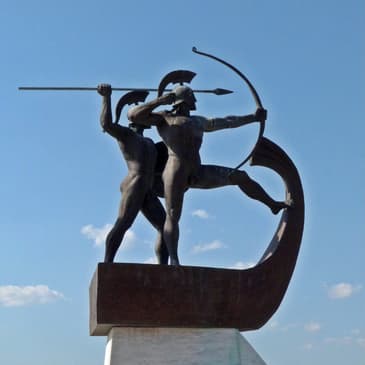
Emily and Cam break down “The Persians”—the oldest surviving Greek tragedy, which offers a surprisingly sympathetic take on the enemies of Athens.
Visit our homepage to subscribe, to find us on social media, and to contact us by email:
Cover photo adapted from an image of the Salamis Soldiers' monument, by Ziegler175:
----------
00:10 - Introduction
01:43 - Aeschylus and his historical context
- 01:56 - The subject of the play (and its peculiarity)
- 03:06 - The Battle of Salamis and the Persian Wars
- 05:10 - Aeschylus’ Career
06:22 - The Persians in performance
- 06:30 - The Dionysia of 472 BCE and Aeschylus’ tetralogy
- 08:35 - Pericles as producer (choregos)
- 09:09 - A synopsis of the play
- 11:12 - The structure of Greek Tragedies (or, how do we know that the Persians only needs two actors apart from the chorus?)
14:03 - Interpreting the play: sympathy for the Persians?
- 15:06 - The survival of the play: evidence of its popularity?
- 16:04 - Triumphalism vs. a recognition of common experience
- 17:06 - Differences between Greek and Persians in the play: archers vs. spearmen, autocracy vs. autonomy, proskynesis and lamentation
- 20:36 - Aeschylus argues for common experiences: the Persians as Homeric heroes, the horrors and the costs of battle, and Aeschylus’ rejection of the “effeminate Persians” trope
26:37 - The play’s main theme: empire and hubris
- 27:00 - Xerxes and his bad decisions
- 27:56 - The gods’ desire to punish Xerxes
- 28:53 - The hubris of Xerxes, or the hubris of the Empire? (Featuring Emily’s rant about hubris in ancient and modern thought)
- 34:27 - Aeschylus, the gods, and Athenian imperialism
- 36:55 - The social function of tragedy: thinking through big problems
- 37:28 - What staging the Persians can tell us about the play
39:12 - Wrap-up
Hello. Welcome to "Have Toga, Will Travel", a podcast exploring the Mediterranean world, ancient and modern, through the eyes of two former classics professors. I'm Emily.
Cam:I'm Cam.
Emily:And we're your hosts.
Cam:Today's kind of a big day. It's January 11th when we're recording this. A few days ago, I think on maybe the 8th, we hit 1,000 downloads, which, I mean, doesn't sound like a lot, but it's pretty good, I think, for a small little hobby podcast that we write, produce, and promote all on our own.
Emily:Yeah, and that we record in our office.
Cam:Yeah. But of course, a lot of credit here is due to our listeners, who are the ones who have been downloading it.
Emily:Yeah.
Cam:So thanks, everybody, for listening.
Emily:We're glad that you're enjoying it.
Cam:Yeah.
Emily:So in our last episode, we talked about the Theater of Dionysus and the dramatic competitions that took place there. And along the way, we also mentioned that the oldest surviving play is Aeschylus' tragedy, The Persians. What we're going to do today is dive into this play a little bit and explore the play and its significance.
Cam:We'll touch briefly on the play's historical context, and then we'll focus heavily on how the play works, how it may have spoken to an Athenian audience that watched it in the theater of Dionysus in the early 5th century.
Emily:And we're also going to use this episode to kick off kind of like a little mini-series on the Persian Empire and its interactions with other states and civilizations in the ancient world.
Cam:Hopefully we're not setting ourselves up for a whole lot of work there, but that's the plan.
Emily:Plans can change. The best laid plans of mice and men gang aft agley.
Cam:All right, so let's start by talking a little bit about Aeschylus' Persians, both about Aeschylus himself, the author, the play, and the historical context in which Aeschylus created the play. And we'll start by noting that this is a play on a historical theme. It's a play that found its inspiration in what we usually call the Persian Wars. That's the series of conflicts that took place between the Persian Empire and the Greek world from the late 6th century onward, and that included, among other things, the Battle of Marathon, which has featured a couple of times in our past episodes. That historical focus is a little unusual, since Athenian tragedies tended to draw inspiration mostly from what we would consider mythological stories, not from contemporary history. Aeschylus' Persians is in fact the only surviving play that draws inspiration from a recent historical event like this, although we do know of a couple of others by a guy named Phrynicus, specifically one called The Fall of Miletos, which was produced in about 493 BCE, another one called the Phoenissae, which shared a lot with the Persians. And what the Persians does is stage the reaction of people at the Persian court, the Queen Atossa and a bunch of other Persians to news about the Persian defeat at the Battle of Salamis, which took place in the summer of 480 BCE.
Emily:So let's talk a little bit about the Battle of Salamis. Now, this was a naval battle. It was a major milestone in the Persian wars, much like the Battle of Marathon. Now, we've talked about the Battle of Marathon, and right, the Athenians were successful at that moment in repelling the Persian invasion in 490 BCE. But that is not the end of the story of the Persian Wars. And we're going to talk in more detail about the Persian Wars in a subsequent episode. But for now, we're just going to say that 10 years later, after Marathon, in 480 BCE, the Persians are going to invade Greece again, this time under the command of Darius's son Xerxes. So Darius was the Persian king when Marathon happened. In the intervening 10 years, he dies, his son Xerxes has taken power. And Xerxes is going to invade with a much larger force and with intentions not just to bring Athens to heel, but to subdue the entire Balkan peninsula and put it under Persian control.
Cam:This was a challenging moment for the Greek world because the Greek world consisted of several hundred little city-states, which normally did not get along very well with one another. So when it became clear that Xerxes was going to invade the Greek mainland, a lot of Greek states simply submitted to Persian power. A small group, however, of about 31 Greek city-states, decided to resist the Persian invasion, including Athens. And in the summer of 480 BCE, a combined Greek navy led by and primarily manned by the Athenians won a major victory against the Persian navy in the Straits of Salamis, just a few kilometers from Athens itself. And that victory turned out to be pretty important because it effectively stopped the Persians from advancing further into Greece. The major Greek land victory would come a year later at the Battle of Plataea, and after that the Persians would withdraw their forces from mainland Greece proper, although they would continue to be major players in the Aegean.
Emily:Now the playwright of "The Persians", Aeschylus, and yes he says Aeschylus and I say Aeschylus—
Cam:Sometimes I say both.
Emily:I've heard it both ways.
Cam:I've said it both ways definitely already.
Emily:So Aeschylus himself was part of the Athenian forces that fought in the Persian Wars. We mentioned in our Marathon episodes that Aeschylus had fought at Marathon and took great pride in this. He probably also was part of the forces at Salamis and at Plataea as well. Aeschylus himself would have been about 35 when the Battle of Marathon happened and about 45 when Salamis and Plataea happened. And as we mentioned, right, his brother died at Marathon. That was all he wanted on his tombstone was that he had fought at Marathon. So this had been a really, a set of really critical events in the life of Aeschylus himself. And what this also means is that his play, The Persians, is the only surviving account of any event during the Persian Wars that was actually written by an eyewitness, which is actually pretty cool. This play was produced when Aeschylus was about 53, early to mid-50s, and it would have put him about two-thirds of the way through his dramatic career when he wrote this play.
Cam:Now, as we discussed in a lot of detail in our last episode, Greek tragedies like this were generally performed in festivals in honor of the god Dionysus. And this particular play was performed as one play in a series of four, all written by Aeschylus, at the City Dionysia in 472. As far as we can tell, it was the second play in this series of four, all of which would have been performed in the same day during the dramatic competition of the festival. The first play was a play called Phineus. The third was a play called Glaucus. And then finally, after the three tragedies were performed, there was a satyr play called Prometheus the Firelighter.
Emily:We don't have anything that really survives of these other plays, but based on the name and some fragments, we can make some guesses as to what they were about. So the Phineus was presumably about the blind king Phineus, who was tormented by the harpies and whom eventually Jason and the Argonauts are going to rescue from the harpies. Glaucus, two possibilities here. It was either about a Corinthian king named Glaucus who was eaten by his own horses because either he angered Aphrodite or he had trained his horses to eat human flesh and then he ran out of people to feed to them.
Cam:That's a bummer.
Emily:So he gets eaten. Or it's about a different Glaucus who was a Boeotian farmer. So he was from the area near Thebes, who ate a magical herb that transformed him into a sea deity and made him part fish, but also gave him the gift of prophecy. And then finally, the satyr play, Prometheus the Firelighter, was a comic portrayal of Prometheus's theft of fire, where he takes fire from the gods and gives it to humans. And we have some fragments that seem to indicate that there is a satyr, or satyrs, in the chorus who want to embrace and kiss the fire, and they are cautioned not to because they will burn their beards otherwise.
Cam:Sounds like good stuff. Now, we also know that Aeschylus' series of four plays won first prize at this particular competition.
Emily:Go, Aeschylus.
Cam:Woohoo. And interestingly enough, the producer who won alongside Aeschylus for producing this series of four plays was none other than Pericles, a big and important political actor of the mid-5th century in Athens, who at this particular point in his life was only 26 and was really making his first foray into the world of politics.
Emily:Yes, this is the same Pericles who will initiate the building program that gives us the Parthenon.
Cam:Yes.
Emily:This was his first big boy job. And this was his first political venture here.
Cam:Yes.
Emily:So let's talk a little bit about the play itself and the story it tells. We're going to do kind of a quick synopsis of the play. Now, the action, as we mentioned, is set in the Persian court. And the chorus is a chorus of old Persian men who open the play by lamenting the fact that all the young men in Persia have gone with the king, Xerxes, to invade Greece. And we'll just remind you that a Greek tragedy consists of a chorus and then a couple actors who are performing all the roles. So our chorus here is Old Persian Men. Now, while the chorus is on stage (and they stay on stage for the entire play), the queen, Atossa, who's the mother of Xerxes, enters and tells the chorus about a dream she had where Xerxes tried to yoke to his chariot two women who represent Persia and Greece, only for the second, that is the one representing Greece, to fight back and shatter the yoke and send Xerxes down from his chariot. The queen is quite concerned about this. She and the chorus talk about it. And then a messenger enters to announce the Persian defeat at Salamis, and he narrates the events of the battle in great detail. And then he exits. And then the chorus and queen, of course, obviously become quite distraught at the great loss of young lives that they've just been told about.
Cam:Atossa and the chorus then pray for the gods below to send up the ghost of Darius, that is, the husband of Atossa and the father of Xerxes. Darius's ghost then enters the scene. Atossa tells him what's happened, and Darius replies that clearly this calamity has been brought about by the gods because Xerxes has done something to invite punishment. After some further back and forth between Darius and Atossa, and Darius and the chorus, Darius and Atossa both exit. And finally, at the end of the play, Xerxes himself appears on stage, dressed in rags and obviously not in great shape. And he laments his defeat and the losses he suffered as a consequence of the Battle of Salamis.
Emily:So that's our play. Now, last time we mentioned that in this play, we only actually need two actors. We talked about the fact that Greek tragedy never used more than three actors, but this one we only need two actors for. And so we want to talk real quickly through how that works when we've got four characters other than the chorus for those actors to play. Now, first, it's important to note that the structure of Greek tragedies is built around alternating scenes where our actors are engaging in dialogue, and choral songs, what are also sometimes called choral odes. So the scenes are the actors are having their dialogue or monologue with the other actors or the chorus or whoever else is on stage with them. The choral odes are the songs where the chorus performs by singing and dancing. Now, sometimes an actor will stay on stage during the odes and the other actors will exit. Sometimes all the actors exit. It kind of depends on the play. But during the ode, that does give actors the chance to change masks or costumes and re-enter after the ode as a new character.
Cam:In the Persians, there are never more than two speaking characters apart from the chorus on stage at the same time. The queen Atossa is the first character to enter. She has scenes with the chorus and with a messenger who comes in to deliver news of the Battle of Salamis and then exits at the end of his scene before we get a choral ode. Atossa herself—or the actor playing Atossa, rather—also exits and re-enters, prepared to summon the ghost of Darius.
Emily:Yeah, she's actually had a bit of a costume and prop change during that choral ode as well.
Cam:Of some sort, yeah, although it's a little bit difficult, I guess, to know exactly what happens there. The next scene has Atossa and the ghost of Darius together. And presumably here, the actor who had originally played the messenger re-enters the scene, now playing Darius. And after that conversation between Darius and Atossa, Darius exits, followed soon after by Atossa. And then after the next choral ode, Xerxes enters the stage, apparently with no other character. Since there aren't any other characters apart from the chorus on stage when Xerxes is present, Xerxes could theoretically be played by either of the two actors who have been playing the other characters, but priority would probably have gone to the actor who plays Atossa, as the so-called protagonist—that is, the primary actor or the actor who plays the main character in these plays.
Emily:And up to this point, Atossa has been the main character. But now that she is offstage, you presumably are going to bring your first actor or your primary actor back for whoever is the main character subsequent.
Cam:Right. Especially since Xerxes' role here is just so important, really, for the emotional climax of the play.
Emily:Yeah. So that's the plot and outline of the play and sort of how its structure works. We're going to talk a little bit about what this play means. We're going to talk a lot about what this play means, actually. So we've already mentioned that this play is a little unusual and that it deals with a contemporary historical topic rather than a mythological one. But there's another really striking thing about this play. And in particular, it's that it seems sympathetic to the Persians. Although you will find lots of people who argue that there's absolutely no way this play could be sympathetic to the Persians, we definitely fall on the side of it is—and I'll refrain from saying something snarky like, because we can read. Now, the big question then that prompts is why or how would an Athenian playwright like Aeschylus, who was fighting against the Persians, write a play only a few years after these battles, and Athens is still engaging with the Persians in different ways around the Aegean, how could he write a play that allows us to feel sympathy for the Persians. And it is worth mentioning the fact that this play survives actually speaks to its positive reception in antiquity. Most Greek tragedies survive because they become school texts in antiquity. So they have a much higher usage, right? They're being read more, which means there's more copies of them, which means they have a better chance of survival because they are sort of standard school books, functionally. "The Persians" was one of only seven plays of Aeschylus to survive. And just to give you a sense of proportion, Aeschylus wrote somewhere between 70 and 90 plays. Seven survived. So at best, 10% of his output. And they all survived through the same mechanism, which is the school text manuscripts. So we can say that this play was well-received in antiquity. But we do still think that the play does actually create some sympathy the Persians. And we're going to talk a little bit more about why we think that.
Cam:Well, right. I mean, there are two basic ways that you could read this. One is that it's a piece of triumphalism. And this is a view that sort of imagines that the audience would sit there and feel great and cheer at the disasters that they hear about as the messenger delivers his news at the Persian court and as Xerxes comes in and sort of laments his lot.
Emily:Which no doubt there probably were people who felt that way.
Cam:There may well have been, yeah.
Emily:I'm sure that the audience had a varied reaction even in Athens, and let alone when the play sortof —and tragedies expand beyond the city of Athens.
Cam:Yes, but I think there's another view, and that other view basically is an argument that the play actually sort of tries to get at the common humanity between Greeks and Persians, the commonality of experience, by really narrowing the differences between Greeks and Persians in a way that makes the Persian chorus and Atossa and Darius and Xerxes characters to whom the Athenians can really respond.
Emily:Yeah.
Cam:So I think what we'll do next is just explore a little bit the way in which the play tries to minimize the differences between Greeks and Persians and invite the audience to sympathize with the characters who are on stage. Now, first, it's important to recognize that Greeks and Persians are definitely portrayed as different from one another in some way in the play. And this comes out mostly when the chorus of old Persian men explains Athens and the Athenians to the queen Atossa. Atossa has had this dream. She's anxious. In the play, anyway, her character knows nothing about Greece, about Athens. So she's really puzzled about how her son Xerxes could possibly be in jeopardy. So she's asking the chorus a bunch of questions to try to understand what's going on. And the chorus tells Atossa what they know. And they draw a contrast, for example, between Persians who fight mostly with the bow— they're archers— and the Greeks who fight in heavy armor with thrusting spears. So that's sort of a surface level difference between the two. Although in Greek thinking, it also brings up a whole bunch of other baggage because hand-to-hand combat is sometimes perceived as more courageous in the 5th century than combat at range. The other way this comes up in the play is in a contrast between authoritarian rule over others and autonomy. The Persians have a king who rules over a fairly big empire, and Atossa thinks in terms of that model. So when she's trying to figure out what the Athenians are like, one of her questions to the chorus is, "Who is master at Athens?" And the chorus responds by saying, "Oh, the Athenians are no man's slaves or subjects." They're free men, basically. And Atossa can't process this in her head. She can't fathom that the Athenians could possibly win a war when they have no one person directing their strategy.
Emily:Yeah. And one of the other differences that we get in the play is that when the chorus greets Atossa, we get a reference to this action called proskynesis in Greek.
Cam:And probably we actually get it depicted on stage.
Emily:Yes, also, we get a reference to the that indicates the course performed proskynesis when Atossa enters. Now, proskynesis is a practice of bowing or prostrating oneself before someone or something else. But it's specific in the Persian court because the degree to which you have to bow depends on your status relative to the other person. And performing proskynesis is a regular practice when coming to the Persian king or ruler. And this is a weird thing for the Greeks, because for the Greeks, that kind of prostrating oneself or bowing even is something that should only be done before the gods. So this is a real cultural tension between the Greeks and the Persians. One of the other potential differences here is this idea that the Persians engage in excessive lamentation. And it's not just lamentation, but they do it too much. But that said, this idea is actually probably not all that foreign to the Greeks and, like, how do we define excessiveness in this context?
Cam:Right. The Greeks read Homer all the time. And the Iliad in particular is full of scenes in which, you know, people like Achilles weep over the death of their friends.
Emily:Yes. He engages in quite a bit of lamentation that I think even in the Iliad reaches points of excessiveness.
Cam:So there are these differences in the play that emerge between Greeks and Persians, you know, that's just a fact. But at the same time, the play also actually seeks to narrow the distance between Greeks and Persians in ways that argue against the idea that this play was engaging in more or less straight out triumphalism. And I think that's probably true even in cases where we're looking at things that otherwise might look like pretty clear differences between Greeks and Persians. So if you take the whole issue of proskynesis, no, the Greeks did not engage in any kind of bowing, typically, unless they were communicating with a god. And proskynesis can be seen as sort of a weird practice that the Greeks associated very strongly with the foreignness of the Persian court. But at the same time, the mythological stories on which tragedies often drew tended to focus on ancient heroes, people like Agamemnon and so on, who are envisioned in mythology anyway as kings of a sort. And their courts worked in ways that were not too dissimilar from the way the Greeks imagined the Persian court in their own present context working. So these features are not as alien as we sometimes think they are. At the same time, you can make the argument that the characters in the Persians, especially Xerxes and Darius, are actually characterized in the same way that Homer would tend to characterize heroes in the Iliad and the Odyssey. They're given a bunch of epithets like Homeric heroes are, meant to capture important aspects of their characters. They're even described as godlike in the same way as Homeric heroes are in both the Iliad and the Odyssey all the time.
Emily:Yeah. And the play is willing to emphasize the horrors of the battle, and not just for the Greeks, but for the Persians as well. So the messenger—Persian messenger, Persian perspective on the battle—when he describes the sea where the battle was fought, I mean, he describes it as being covered in wrecks, and there's the bodies of Persians everywhere just dead in the water. And he also gives a fairly graphic account of a Persian detachment that landed on the small island Psytalleia near Salamis and what happens to them in that they are surrounded by Greeks, they are worn down by arrows and sling stones, and then eventually they are overwhelmed and butchered, every last one of them, by sword and spear. And we get a pretty harrowing account of their experiences. Now, maybe we would think that the audience is going to just take some delight in hearing about this, and maybe some did. But for some, just hearing about the horror of battle, when most of the, at least the men in the audience, probably have experienced battle, it probably hit home because it touched on their own experiences and they know what that's like and all of those emotions that went with it. So it probably ran in a couple different ways. And at the same time, Aeschylus is also willing to emphasize the cost to those left at home during the wars. So fathers and mothers who've lost their sons, wives who've lost their husbands, children who've lost their fathers. And by doing so, right, he asks his audience to engage with that. And again, people in the audience are people who've lost fathers, sons, brothers, husbands (if you think women were in the audience). And so again, he's inviting the Athenians to see the humanity of the Persians and to understand they have suffered some of the same things that the Athenians have. And now I'll grant you, there were probably people in the audience who were like, yes, look at them suffer. But I think it's hard for a lot of people to do that when confronted with someone else's humanity in a really stark way.
Cam:Yeah. And more tellingly, part of this is the fact that Aeschylus, I think anyway, rejects a trope that was increasingly common in a lot of other literature and artwork in the early to mid-5th century. And that's this idea that the Greeks were brave and manly, and the Persians were cowardly and kind of effeminate. Now, in Aeschylus' play here, I mean, the Greeks obviously come off well, but I think you're hard-pressed to find evidence that the play is trying to construct an image of the Persians as cowardly or ineffectual. Things do go really badly for the Persians, but they don't go badly for the Persians in the play because the Persians are cowards. They go badly because the Persians find themselves in some really bad situations. They get their fleet lured into a situation in which they can't exploit their numbers and they're vulnerable to a Greek counterattack. They have this detachment set off on the island of Psytalleia that gets cut off and surrounded. And in both cases, what we get in Aeschylus are fairly graphic depictions, as we've already mentioned, of the aftermath that really emphasize the horror of suddenly finding yourself cut off from your friends, surrounded by the enemy, and being mercilessly cut down.
Emily:And beyond that, as we said, the messenger and the chorus describe the Persians and their allies in the same terms that Homer used for his heroes. And these are terms that emphasize their skill and their bravery. So for example, they are invincible archers. They are men who inspire fear in battle, men who have courageous spirits, and so on.
Cam:Yeah. So again, the play seems to be dwelling on what can happen to people in combat, even to people with a lot of skill and experience as a result of bad luck, not as a result of their own flawed nature.
Emily:Yeah.
Cam:And in fact, I would argue that the play then goes on to invite the audience to sympathize even more with the Persians by suggesting that what goes wrong at the Battle of Salamis— their suffering—is partly because of Xerxes' own bad decisions, because he failed them in some way, but also mostly because the gods decided to strike the Persians down with little to no warning.
Emily:Now, the characters in the play generally agree that Xerxes bears some of the blame for what happened at Salamis. Darius implies that when he was alive, he had advised Xerxes not to try to invade Greece. But Xerxes seems to have done so anyway, goaded by, at least according to Atossa, goaded by Persian nobles who taunted him for being weak and cowardly compared to his father, Darius. Additionally, the messenger reports that Xerxes made some bad tactical decisions. That he got goaded, again goaded, by a Greek sort of double agent to launch an attack in narrow waters where his large fleet would work against him and also to station troops on this island, Psytalleia, who would later be massacred. So that Xerxes is sort of manipulated here by someone he doesn't realize is a double agent for the Greeks.
Cam:But it's not just Xerxes' own failures that are the problem here, because characters in the play also seem to believe that the gods also helped to engineer Xerxes' failure, perhaps because they wished to punish Xerxes. Their belief that the gods had a hand in what happened is pretty clear in several lines of dialogue. This idea is anticipated by the chorus early on, when the chorus worries that the gods sometimes have this habit of lulling people into false sense of confidence, only to then ruin them out of nowhere, seemingly.
Emily:Yeah. And the messenger gets even more explicit. He actually says that some god took the side of the Greeks. When he describes the Greek double agent who lured Xerxes into fighting in bad terrain functionally for his navy, he describes him as an evil spirit. And he also says that the gods were envious of, and angry at, Xerxes.
Cam:Now, why the gods were angry at Xerxes is a question that the play doesn't answer as precisely as we might like. In very general terms, some of the characters suggest that one or more gods decided to punish Xerxes for his hubris.
Emily:All right, people, strap in, because we need to take a little pause here to talk about the ancient concept of hubris and how it is not the same thing as the modern concept of hybris. We're both going to try to differentiate in that pronunciation between hubris and hybris. Now, I know your English teacher probably told you that hybris is an ancient Greek concept that means excessive pride, But that's not correct. It's just wrong. So, hubris is an ancient Greek concept, but it does not mean excessive pride. First of all, pride, which is a feeling, right, it's an internal thing, is not a problem in antiquity. Pride doesn't really come to be seen as problematic until you get the influence of Christianity. And pride is a real problem in Christianity. And the influence of Christianity really reshapes the meaning of the word hubris from what it had meant in antiquity. Because in antiquity, hubris is fundamentally an action or actions. It's not a feeling. And specifically, it is an action that violates someone else's body or the gods in a way that is not appropriate for someone in their station to be performing. So these are actions that defy the natural order. So a better translation for hubris would be something like wanton or excessive violence, or violation, or insolence, and insolence especially with respect to the gods, right? So you can feel all the things you want to feel, no problem, whatever. It's acting on them that causes problems. And moreover, the same action could be hubris in one context, but not in another. Or it could be hubris when it's committed by one person against another person, but not necessarily the other way around. So for example here, an act of physical violence directed by a free person against another would be a problem. But the same action directed against an enslaved person would not be a problem. So that is hubris as it means in this context. And in any ancient Greek literature that you're reading, it does not mean pride. Feel all you want. Just don't do anything about it, and you're fine.
Cam:Right. That was a great rant.
Emily:I have several. That's one of them. Thank you. I'll be here all night. Back to Xerxes.
Cam:Right. Back to Xerxes. So yes, characters in the play suggest that the gods decided to punish Xerxes for some act of hubris. But what they don't seem to agree on is what precisely Xerxes did to provoke the wrath of the gods? What was his critical act of hubris that brought the whole scheme crashing down? Now, Darius seems to have, at first, a straightforward answer. He says that Xerxes offended the gods by building a bridge of boats across the Hellespont, that is, the modern Dardanelles, the narrow channel that connects the Aegean Sea with the Sea of Marmara. This is a very famous story that you get in other ancient Greek sources, most notably Herodotus. And in some versions of the story, Xerxes actually also lashes or whips the Hellespont when the bridge that his people engineer is damaged. The important thing here is that for the Greeks, and for Darius in this particular play, the Hellespont is conceptualized as a divinity, as a god. And the attempt to tame the Hellespont by building a bridge across it is comparable to enslaving a free person by clapping them in irons or clapping them in chains. So here, what Xerxes has done, he's committed hubris by assaulting a god, essentially. And that's an act for which, of course, he's going to be punished if you believe that the Hellespont is actually a divinity.
Emily:But the play does also offer other potential explanations. So we also have Atossa's dream that we mentioned, where Xerxes attempts to yoke two women to his chariot. And this can be taken as a clear indication that Athens and Greece were never his to dominate, and that he engages in hubris simply by acting as though they were. That is, in this attempt to cross over and to reduce the Greeks, free Greeks, into subjugation.
Cam:And to complicate things even further, Darius himself comes close to undermining his own argument about Xerxes' hubris when he says that he knew of prophecies foretelling disaster for the Persians, and that he believed that these prophecies would someday come to fruition, and that Xerxes and his hubris really just sort of triggered bad things a little bit early, and brought about ruin for the Persians a little bit ahead of schedule. This revelation seems to put the blame for hubris only partly on Xerxes himself, and it seems to shift part of that blame to the Persian Empire as a whole. And here the argument would be that the empire simply got too big, that it overstepped itself somehow, that it crossed some kind of critical boundary. And that caused the gods to become angry, to become a little bit envious, right, that the Persians were getting too big for themselves, and to cut the empire down to size.
Emily:Now, this kind of uncertainty and confusion about what is the sort of root cause of this punishment that gets levied against Xerxes, if you will, could make it seem like Aeschylus is being a little sloppy. But maybe, it's really that the uncertainty and confusion displayed by the characters is actually the point. How does someone know when he or she has committed an act of hubris that will invite the wrath of the gods? How does someone cope if you can be punished for mistakes or excesses of your ancestors? How can you tell if a god is acting through trickery or direct action to goad you into a bad decision, right? How do you negotiate all of this? And these are fundamentally unknowable questions. And so it may actually be that the uncertainty and confusion as to why this is happening is actually part of the point. Part of the point is that you can't know. And sometimes you're just going to get screwed over. And there's not so much you can do about it.
Cam:Yeah, that's a scary idea, right? And these questions that you pose, they're all scary questions. And there are good reasons why these questions may have been on Aeschylus's mind in 472 when he wrote and produced this play. There are good reasons why he may have wanted the Athenians to sort of sit back and think about them in some detail. The very short version is that the Athenians, even by 472, were in the early stages of building an empire of their own. That empire had started shortly after the Battle of Plataea as a system of alliances between Athens and several other Greek states who basically got together in an effort to ensure that the Persians couldn't sail warships into the Aegean again. But as early as 472, the Athenians had already started conquering some Greek states that remained under Persian control or who remained neutral, and had forced them into this structure, or even in some cases had enslaved their populations.
Emily:So it really didn't take a whole lot of imagination for someone like Aeschylus to think that the Athenians were heading towards actions of hubris themselves. And so perhaps part of what we're getting here is a cautionary tale to the Athenians not to follow the path that the Persians followed.
Cam:Right. And there's a larger question here, which has to do with what the Athenians expected from tragic performances. Yes, it's entertainment.
Emily:Yeah.
Cam:Yes, it's an offering to the God, to Dionysus. But in a society where politics and social life are very much based in an oral culture still and in a culture of argumentation and rhetoric, you could argue that drama basically does the same thing. It's there to throw these big ideas at you and to get you to think about them.
Emily:Yeah, for sure. And just as a little coda to this discussion, about five and a half years ago in 2020, for what they were calling the 2500th anniversary of the Battle of Salamis (but it was actually the 2499th anniversary, because there's no year zero in the modern calendar), the Greek theater festival that happens in Epidavros every year did a production of the Persians, which because of the pandemic, they live streamed worldwide. And so we got to watch this production, and it was really interesting how they staged it, and the use of both dance with the chorus and the use of color. Most of the characters were in black and white, and Xerxes's costume in particular had tons of red embroidery on this white shirt and then red yarn or something that looked like it was blood streaming from wounds. And it was a really compelling performance. And of course, The Persians is not a play you get to see done a lot. And so it was really cool to see it done the way it was and done in an ancient theater, even if I couldn't be there in person. But it was hard not to be drawn into the performance. And I think that's what a good playwright wants to do, right? He wants you to become part of that world and to be enmeshed in that story. And I think this just goes back to the idea that, you know, when you're thinking about triumphalism, that's not really something that's pulling you into the story and engaging you. That's just, you know, cheering at a scoreboard kind of thing. And so I think if we imagine Aeschylus' goal is to bring the audience into the world of his play, I think it pushes you away from the triumphalism reading, but I think it also makes the play a lot more interesting and complex.
Cam:Yes.
Emily:So that's all for today. I've been Emily.
Cam:I'm Cam.
Emily:And this has been "Have Toga, Will Travel." Subscribe to our show wherever you get your favorite podcasts and follow us at havetogawilltravel.com or on all the socials. And do you have any questions or topics you'd like us to cover? Please feel free to reach out and let us know. And if you like this episode, tell a friend about us.
Cam:Thanks for listening, everybody.