Emily and Cam wrap up their series on hiking Hadrian’s Wall Path with a discussion of the final 31 miles of the Wall. Follow along as they explore medieval monuments made of wallstone, find themselves treed by some cows, and are regaled with tales of cannibals (human and otherwise!).
Visit our homepage to subscribe, to find us on social media, and to contact us by email:
Read the first post in our series of blog posts on Hadrian’s Wall here:
If you’re interested in hiking the Wall, you’ll find the following resources helpful:
- Walking Hadrian’s Wall Path, by Mark Richards (Cicerone Press)
- Hadrian’s Wall Path, by Anthony Burton (National Trails Official Guidebook)
- Harvey Maps, Map of Hadrian’s Wall Path
Finally, you’ll find the rest of the episodes in this series at the following links:
- Hadrian’s Wall, Part I: The Romans in Britain and the Imperial Frontier
- Hadrian’s Wall, Part II: Walking from Wallsend to Carrawburgh
- Hadrian’s Wall, Part III: Hiking the Crags (Sewingshields to Birdoswald)
----------
00:11 - Introduction
02:41 - Birdoswald to Haytongate
- 03:16 - The character of the trail and the last visible elements of the Wall
- 05:44 - Honesty Boxes and the Haytongate Hut
06:56 - Lanercost Priory
- 07:22 - A priory built of wallstone: the history of Lanercost
- 10:52 - Exploring Lanercost (and our encounter with Max)
12:24 - Haytongate to Carlisle
- 12:46 - An unpleasant encounter with cows
- 14:37 - “Where’s the Wall,” or the perils of starting in the west
- 15:55 - Crosby on Eden, haggis, and black pudding
- 17:59 - The Wall at the River Eden: Uxelodunum and Milecastle 66
18:27 - Carlisle
- 18:56 - Carlisle Castle: Luguvalium becomes the old Norman keep
- 21:31 - Richard III, Mary Queen of Scots, and the Jacobites: Carlisle Castle’s long history
- 24:52 - Another encounter with Max
- 27:00 - Carlisle Cathedral (and more plundered wallstone)
- 28:47 - Carlisle’s Guildhall
- 30:06 - Misadventures in Carlisle dining
31:46 - Carlisle to Bowness on Solway
- 32:14 - Burgh by Sands: Aballava, Africans in Roman Britain, and Edward I’s unpleasant bout with dysentery
- 34:53 - The Tidal Flats: Dykesfield, Drumburgh, and the dangers of high tide!
- 37:45 - Bowness on Solway and a gathering at Fort Maia: Billy No-Mates and a man obsessed with cannibals!
43:02 - Logistics of the Hike
- 43:07 - Where to begin? In the west at Bowness, or in the east at Newcastle?
- 45:38 - Resources for planning: books and maps
- 47:10 - Lodging, adventure companies, luggage, and the AD 122 bus
- 50:53 - Food: full English breakfasts and pub fare
- 53:16 - Tips for the trail: rain, sunburn, and blisters, oh my!
56:56 - Final Thoughts
58:02 - Wrap-up
Hello. Welcome to Have Toga, Will Travel, a podcast exploring the Mediterranean world, ancient and modern, through the eyes of two former classics professors. I'm Emily.
Cam:I'm Cam.
Emily:And we're your hosts.
Cam:So, exciting stuff today. We're bringing you the last episode in our series on Hadrian's Wall. If you haven't been listening to this series, you've missed a general overview of the wall. Since then, we've been talking about what it's like to walk the trail that runs along the old course of Hadrian's Wall. First, we talked about the stretch that ran from Segedunum to Carrawburgh. And then in our last episode, we covered the central portion of the wall path over the crags and ended at the fort of Birdoswald, just west of the Irthing River.
Emily:Today, we're going to cover the last stretch of the Hadrian's Wall Path, which is the westernmost portion from Birdoswald to Bowness on Solway, which is a distance of about 32 miles or 51.5 kilometers.
Cam:And then we'll talk a little bit about the logistics of walking the wall, just in case we've inspired you to take a trip.
Emily:But before we get into the episode today, we've got a little bit of housekeeping first. So first of all, we are going to take a little vacation. And this is coming at the end of our first season, and we decided to take a short break so that we could travel and refresh.
Cam:For you, this means above all that there's no June 15th episode.
Emily:The good news is that we'll make up for this by posting an old travel log that we wrote about Hadrian's Wall and our experiences to our webpage, havetogawilltravel.com. And it's going to be live by the time you hear this episode. So you can go and check it out and look at some of our pictures and some of our other stories from the wall.
Cam:And finally, this seems to be an appropriate time to thank everybody. We've had a number of different people support us in various ways. There were people who listened to drafts of the very first episode and were nice enough to give us feedback. There are people who have supported us in various ways, either by buying swag from our shop—yes, we have a swag shop and you can get yourself a cool Have Togo Will Travel t-shirt if you want one—as well as people who've kicked in a little bit of money via our Ko-Fi page to help us pay the bills.
Emily:But most importantly is all the people who have found us and listened to us. And we just really appreciate that really that anyone wants to hear us talk about this stuff.
Cam:Yeah, I'm sort of bewildered, actually, that we have people listening to our show regularly. So that's really cool. So thanks to all of you.
Emily:Yeah, thank you all so much. So with all that said, let's jump into today's episode. So as we've mentioned, we ended our last episode at Birdoswald. This is the fort that the Romans knew as Banna, which sat near the spot where the western part of the wall, originally built in turf, met the stone wall of the central and eastern sections. So after the fort at Birdoswald, the trail enters its third and final section, which is a relatively flat section— and relatively in scare quotes here, that is relative to the crags— of just over 30 miles that leads hikers gently towards the Solway Firth.
Cam:This is a section that's going to feel a lot different from the central section that you will have just crossed to get here.
Emily:Yes.
Cam:Because once you get past Birdoswald, not only does the path become gentler, but the wall quickly fades from view. So you won't be walking alongside obvious remnants of it so much anymore. But that said, there are still plenty of things to see and to admire along the way.
Emily:Now, the last visible traces of Standing Wall all fall within the first three and a half miles or so of the walk past Birdoswald.
Cam:What you'll see in this stretch are a lot of isolated chunks of the Consolidated Wall and a bunch of turrets. As you hopefully remember from the last couple of episodes, the Consolidated Wall is that chunk of wall that English heritage spent a lot of time restoring in the second half of the 20th century.
Emily:But you will also see some remains of the turf wall, since the turf and stone walls diverged for a bit near Birdoswald, as we described last time. And the path actually takes a little jog to follow the line of the turf wall for a bit there.
Cam:Right, so you can sort of admire the turf wall that the Romans built and that stood there for, I don't know, anywhere between 10 and 20 years before this chunk was rebuilt in stone. And after doing that, you'll also be able to admire the very last section of the wall that is still visible. That's at Hare Hill, near the probable position of a mile castle, specifically Mile Castle 53. You'll find this somewhere between three and a half and four miles to the west of Birdoswald.
Emily:And this section of wall is impressively tall. It's actually the tallest standing portion of the whole wall. But the upper courses are restored. They were restored in the early 19th century, and they weren't necessarily restored with the greatest fidelity. It's only the lower courses here that are original.
Cam:Still, it's a pretty cool feature. It gives you a real sense of how tall this thing may have been in its prime. And of course, this is your chance to say goodbye to wall masonry, still more or less in its original position.
Emily:We had a kind of interesting moment here on our first walk.
Cam:Interesting in quotation marks.
Emily:We're like admiring the wall and there was a cat kind of like lounging around on the wall. And then we realized that the cat had been eating some baby mice.
Cam:Did you realize that before or after you were petting it?
Emily:I didn't pet it. I didn't pet it at all because it was pretty obvious that cat had fleas too. But that cat really, really wanted someone to pet it. Probably because it had fleas and was itchy.
Cam:Yeah.
Emily:But yeah, some of the wildlife you encounter on the wall.
Cam:Right. One of the interesting features along this whole stretch, at least the last time we walked the wall, were honesty boxes here and there. These are basically just little stands trailside that people have set up to offer refreshments, knickknacks, that sort of thing to hikers passing by. There's nobody there staffing them. So the idea is that you take what you want and leave some money behind, either in cash or probably these days by Venmo or whatever.
Emily:Yeah.
Cam:At least those ones that are still around will take Venmo. There is at least one that we know of that has closed, precisely because people don't really carry cash around anymore.
Emily:I will say the most impressive one of these that we saw was the Haytongate Hut. And this is at Haytongate. And it's actually just shy of where Mile Castle 54 would have been.
Cam:It was a pretty elaborate one. It's got not just snacks, but also t-shirts and souvenirs and a bunch of other kitschy things like that. And it had a bunch of picnic tables out front, even, where you could sit down and relax for a bit.
Emily:Yeah. And apparently the people who started this have actually branched out to create stuff for other long walks in the UK. And the first time we were there, we actually met a very lovely dog who had just had puppies. And we got to meet one of the puppies as well.
Cam:Oh, yeah. I do remember that. But yeah, they're creating a souvenir empire, it seems.
Emily:Yeah. Now, interestingly enough, at Haytongate Hut, there's actually a path diversion. So there's a footpath that goes away from the wall path towards a place called Lanercost Priory. Now, I would say this is definitely worth a visit if you're doing the wall path. It is a short diversion. It's about a half a mile walk from the wall path down to Lanercost Priory. And it's also on the English Heritage Pass. So if you've got that, you might as well.
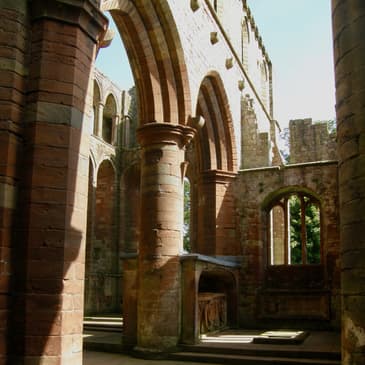
Cam:And what you'll find there, if you visit, are the remains of a priory originally built in the 12th century— built, significantly, from wall stone, plundered from Hadrian's Wall.
Emily:It started as a monastery founded by Robert De Vaux in honor of Henry II, and was dedicated, interestingly, to Mary Magdalene, who became particularly popular as an object of devotion in the 12th century, thanks mostly to a monastic order known as the Cistercians.
Cam:Now, this whole area has a bit of a turbulent history because it's pretty close to the Scottish border. That means that it's seen a lot of cross-border craziness in its long life, including a moment during which Robert the Bruce briefly made it his headquarters in northern England in 1311.
Emily:And as, of course, as one might expect if you know anything about religious history in Britain, the Catholic Priory was dissolved in 1538 by Henry VIII when he left the Catholic Church. And the buildings at Lanercost were all stripped of their roofs, except for the nave of the church itself, which basically continued to function as the parish church in the area. But all of the other monastery buildings were made unusable.
Cam:Now, at that point, the Priory essentially fell to the crown, and Henry granted ownership to a guy named Thomas Dacre. Dacre's family had a long history with Lanercost. Their family home was Naworth Castle, which is less than two-thirds of a mile away, just to the south. And the Dacres had long been patrons of the Priory, especially Thomas's father, Sir Thomas Dacre, the second baron of Gilsland, who married rich and therefore had a lot of money that he could use to bestow on places like Lanercost.
Emily:And so when Thomas acquires Lanercost from the crown, he actually transforms part of what had been the monastic cloisters into a grand hall with a fortified tower.
Cam:Yeah, the fortified tower is interesting. We touched briefly in our last episode on the bastle house at Birdoswald. This is basically a gorgeous fortified farmhouse. The reason it was fortified at Birdoswald in the 16th century, and the reason Dacre's new hall was fortified here, is because the Scottish border still remained really turbulent throughout the 14th, 15th, and 16th centuries.
Emily:This is going to be a running theme of today's episode, is just how unsettled this area is as it served as this frontier between England and Scotland.
Cam:Right. Every knight and nobleman along the frontier in this period from the 14th through the 16th century functioned on the side as a reiver.
Emily:R-E-I-V-E-R, reiver.
Cam:Basically, somebody who spent at least part of his time raiding his neighbors, whether they were English or Scottish. So lots of cross-border raids, lots of raids back and forth, lots of feuding. And as a result, a lot of them spent a good deal of time fortifying their properties just in case one of their neighbors came a calling. If you're interested in this, there's actually a pretty good book called The Steel Bonnets by George MacDonald Fraser, which covers this period in detail. And George MacDonald Fraser, as some of you may know, is better known as the author of the Flashman novels, which are a series of books about a classic antihero in the Victorian era. Good reads. Anyway, Lanercost remained with the Dacre family until it passed to another family, the Howard family, in about the 18th century. And the tombs of the Dacre family are all still there.
Emily:And then in 1929, Lanercost becomes public property and is now managed by English Heritage.
Cam:The nave of the original church is actually still used as a church. But when you go to the site, you'll find that the east end of the old Priory building and some of the monastic buildings are open for exploration. And when you go poking around, there's a lot of really cool things to see. First of all, that open east end of the Priory has some gorgeous arches, make for great shots.
Emily:Oh, it's so photogenic.
Cam:It really is. Especially if you catch it, you know—
Emily:In the right light, yeah.
Cam:Yeah. But, you know, a lot of the stones have Mason's marks and things like this in them. And there are even a couple of game boards etched into the windowsills in spots.
Emily:Although, I will say one of my favorite parts about Lanercost is the young man who was working there on the first trip. We didn't go on the second trip. You know, sort of taking money when people came in, if you were buying anything in the little gift shop. It was a guy named Max. And he was just delightful. He was local. And I remember him talking about riding his bike to work. But he also knew anything you could possibly want to know about the Abbey, about the Dacres, the Howards, the whole history of the place. And he was so excited to share it. And we probably could have sat there and talked to him for hours. But other people came in and we realized that we actually had to get back on our day. So yeah, just had this wonderful, interesting conversation with him. And he was the real highlight of that day.
Cam:He's exactly the sort of person you wanted working this kind of site, right? Because not only did he love talking to people, he also knew what he was talking about.
Emily:Yeah.
Cam:Which is important.
Emily:Yeah. So, love Max. This is not going to be Max's only appearance in today's episode, though. Which is even more exciting.
Cam:Right, a teaser of what's to come.
Emily:Yeah, I am not a stalker.
Cam:So, once you're done with Lanercost, take a walk back to the trail, and then you'll have a walk through gently rolling countryside from Haytongate to Carlisle over a distance of about 13 miles, or 21 kilometers, a lot of which passes through pasture land. As is true of most of the rest of Hadrian's Wall Path, you're going to encounter livestock all the way along, including a fair number of cows. And it was in this spot on our first trip that we actually had our one and only really unpleasant encounter with cows.
Emily:Yeah, it was scary a little bit.
Cam:It was not fun. We were just walking down the path. We had crossed a mud hole, essentially, which cows were clearly drinking from. And we were proceeding up the path and we ran into a cow and a calf coming the other way, clearly thirsty, clearly intending to get down to that mud hole.
Emily:Clearly not happy with us being there.
Cam:No. And they were not going to budge. They were occupying the width of the whole path. And there was a stare down.
Emily:There was definitely a stare down. That cow was not letting us come any closer.
Cam:But then it started to slowly advance.
Emily:We were like, what do we do?
Cam:Yeah. So we basically ended up getting chased off the path by a cow.
Emily:Yeah, there was like some brambles and bushes sort of to the other side of the path. So we tried to sort of move that direction, but it was really brambly. And that was not enough for the cow. And so we had to move even further. There was like a small tree there. And I was like, are we going to have to actually climb into the tree? But basically, we got far enough away from the path and enough behind the brambles that the mama cow decided that it was safe to continue on. I remember that it was like there was like briars or something there. Like it was not a place we wanted to be. But I also did not want to get run down.
Cam:No, it wasn't great. But I am—I'm comforted by the thought that that cow probably ended up as somebody's tasty dinner.
Emily:Oh, dude, not cool. But that is where we learned to maybe be more wary of cows than we thought we needed to be.
Cam:Yeah. And I don't know if I've dropped this statistic or not. The last time I looked, something like seven to eight hikers in the UK get killed by cows every year.
Emily:So yeah, don't underestimate them.
Cam:No, don't underestimate them.
Emily:Not long after we got treed by the cows, we actually ran into a couple of Dutch guys who were walking the wall path from the west to the east. And so we did warn them about the cows ahead. But they also complained to us, basically, we've been walking for three days and haven't seen any wall yet. And we were like, well, it's great. It's just a few miles down the road. You're going to see your first bit of wall. It's coming, I swear. But this actually does speak to one of the challenges when you start in the West, if you don't know this, is that it's going to be a lot of walking before you actually see wall proper.
Cam:Yeah. The only bit they had seen was the bit at Dovecote Bridge, which they had passed just before they ran into us. It sits just before Walton, a little town which grew up near the site of Mile Castle 56. So we're talking about a site about 66 miles from Segedunum along the trail.
Emily:Yeah. And what's unfortunate about the section of wall there is that it's not actually visible anymore. It's been reburied. So it was excavated, but they decided to rebury it because the wall in the west part is made of red sandstone. And it's just, it's soft, and it's a lot more susceptible to weathering. So they reburied that section to protect it.
Cam:Which is good for the wall, but not good for hikers coming from the West who are really, really hungry for their first glimpse of it.
Emily:Yeah.
Cam:Anyway, there's a lot more rambling countryside between Walton and Carlisle. Very pleasant walking country. Along the way, you'll pass through a little town called Crosby-on-Eden on the Eden River. And I remember that mostly because during our first trip, we stopped there at a place called the Wallfoot Inn, which unfortunately does no longer exist.
Emily:It also actually isn't in Crosby-on-Eden. It's like a couple miles past Crosby-on-Eden, which someone did not realize. And we couldn't find it and then realized we still had like two more miles of walking.
Cam:They advertised themselves as being in Crosby-on-Eden, so that's not entirely my fault. Anyway, what really stands out in my memory is this is the first place I ever had genuine, authentic haggis.
Emily:Yep, it was good.
Cam:It was delicious, yes.
Emily:And we also have some really good black pudding there too.
Cam:Yes. Black pudding is another dish that's really easy to find along the wall. Really tasty, although, as we discovered, it's an acquired taste.
Emily:So black pudding is grain that is then soaked in blood and cooked. And so it's very irony, as you might expect.
Cam:Umami.
Emily:Yes, it is tasty. I do like blood sausage better, if I'm going to be honest.
Cam:Another acquired taste.
Emily:Another acquired taste. But black pudding, when it's well done, is quite good.
Cam:So it took a little bit to get used to initially.
Emily:Yeah.
Cam:But now we're definitely fans.
Emily:I also will point out one other thing that at least was a difference between our two experiences of that walk between Crosby on Eden and the Wallfoot is that theoretically the wall path goes along the River Eden there. And on our first walk, that's what we did sort of through these like lovely flowers and various things along the river. But the second time, they'd actually set up a detour because that part of the wall path had suffered a lot of erosion damage and wasn't safe for people to walk on. And so instead of walking along the river, you had to walk along the highway, which was a less pleasant way to do it. But just be prepared that things like this happen there.
Cam:Yeah, that's actually a good point. The route of the wall path will shift here and there constantly, just because there's work being done on chunks of it and things like that. So make sure you have up-to-date maps.
Emily:Yeah. And this section of the trail ends at the Eden Bridge, which is just outside of Carlisle. So we're about 76.5 miles or 123 kilometers along the wall path from Segedunum. And in antiquity, the wall crossed the Eden River near this spot, and it was protected by both a mile castle, Mile Castle 66, and by a fort known as Uxelodunum, which lay just north of the modern town of Carlisle.
Cam:So that brings us to Carlisle. There's not much left of the fort at Uxelodunum. There's not much left of Mile Castle 66, which guarded the crossing at the River Eden. But Carlisle itself, which is sort of just off the path, is well worth the visit.
Emily:Oh yeah, totally.
Cam:And the first thing you can explore there, since it's right there, literally just off the path, is Carlisle Castle. It's a massive complex and the oldest surviving part is a brooding square keep.
Emily:Now, this keep was probably built in the 12th century, maybe by Henry I, who was the youngest son of William the Conqueror and became king after the death of his older brother, William II, in 1100. Or it might have been built by David I of Scotland, who took and held Carlisle for a time in the second quarter of the 12th century.
Cam:But like a lot of other structures in this part of England, the keep is definitely built of wall stone that was plundered from the wall and probably also from the nearby Roman fort, Luguvalium. And in fact, the castle is built over top of part of the fort of Luguvalium, where William II had built some kind of a structure probably as early as the 1090s. Although it's not entirely clear what that looked like, the thinking these days seems to be it was an earth and timber fort.
Emily:Yeah. So none of it survives. It's not part of the current castle structure.
Cam:Yeah.
Emily:Now, Luguvalium, the Roman fort, had been the westernmost in a line of forts that ran along the pre-Hadrianic Stanegate. And so we've talked about some of these other forts— Vindolanda, the fort at Corbridge—and these were just south of the later line of Hadrian's Wall. And of course, like all of these Roman forts, it eventually gave rise here to a fairly large civilian settlement that clustered around the fort.
Cam:Now, naturally, there have been various additions and restorations carried out in the castle over the centuries. There've been a bunch of builders there, not just Henry I, but also Henry II in the late 12th century, John in the early 13th century, Edward I Longshanks in 1296 or so, and then another major reconstruction under Henry VIII in the 16th century. But the keep is still there.
Emily:Random trivia. Do you know what "Longshanks" means?
Cam:Long legs.
Emily:Yes. Apparently he was a tall dude.
Cam:He was a tall rangy guy.
Emily:Yeah. Anyhow, back to the castle. And if you go into the keep in the interior, you're going to see a whole bunch of carved graffiti. So lots of it's carved into the stone, particularly in the 16th century, probably by bored guards who were there. And some of it's actually astonishingly high quality.
Cam:Yeah, it's a really neat place to explore.
Emily:Yeah.
Cam:And that keep and more properly, the entire castle complex really was a key power center along the English-Scottish border for a long time. And as a result, it has the distinction, I guess, of being one of the most besieged castles in England.
Emily:And those sieges include, but are not limited to, seven sieges by the Scots alone between 1174 and 1461.
Cam:Yeah, that's a lot of action.
Emily:Yeah. And there are a lot of famous names associated with the castle here. So first of all, there's Robert De Vaux, whom we mentioned when we were talking about Lanercost. He was appointed governor of Carlisle Castle at one point. The Dacre family from Lanercost also shows up among the list of governors, as does a man who was at the time known as Richard Duke of Gloucester, but whom you may know better as Richard III.
Cam:But I think the most famous guest of the castle...
Emily:Guest?
Cam:...was Mary Queen of Scots, who was housed there for a while in 1568, while she was under, I guess, house arrest—
Emily:Functionally, yeah.
Cam:—thanks to her cousin Elizabeth. And technically, this was the last time the castle was used as a royal residence, although it was a residence of a very particular kind at that moment.
Emily:I mean, it was housing royalty.
Cam:Fair enough.
Emily:Now, if we fast forward a little bit to the 18th century, during the Jacobite Rebellion, which was an effort to restore the Stuart family, who were Catholic, to the English throne, 1745 to 1746, the Jacobites actually captured Carlisle and Carlisle Castle in 1745. And for my outlander fans, this is the same rebellion that is the crux of the first book.
Cam:And that led directly to the last time the castle at Carlisle was subjected to siege. That was in December 1745, when the Duke of Cumberland attacked it and ultimately recaptured from the Jacobites. A bunch of the Jacobite soldiers captured during the siege were then held captive in the castle. And you can see where they were held if you go on a tour.
Emily:Yes. And they will actually point out on the tour something that gets called the licking stones, which are stones in the dungeon area where there's been like large grooves worn in the stone. And the myth around them, this is where the Jacobite prisoners, when they were being held there, were licking the water off the stones because they were not being fed. That's probably not the case. It's probably actually just due to water erosion wearing away at the rocks. But nonetheless, they were held there until they were then executed at Carlisle Castle. The execution process is pretty gruesome, so skip for the next 10 seconds if you don't want to hear it. But the execution process would have involved being hanged for a few minutes and then being cut down while still alive, being eviscerated, having your innards burned in front of you, and then decapitated.
Cam:Yeah, that's pretty grisly.
Emily:It's a pretty gruesome way to go. It's probably the last bit of unsavory history that Carlisle has, but it does continue on in a less gruesome way.
Cam:Right. So the castle is used basically as a military barracks until the 1950s. And in fact, parts of it are still used by military officers. And what you'll find if you poke around the grounds are a bunch of buildings named for famous battles and such.
Emily:And on our second trip, when we got to the castle, there was this huge, gorgeous poppy installation there that was set up for the commemoration of the 100th anniversary of World War I. And this was like a five-year commemoration all over England. And they had these poppy installations at different places. And actually, as a result, I mean, the Carlisle Castle was free to access so that you could see this gorgeous waterfall of poppies coming over the wall of the castle.
Cam:Yeah, all in all, that's a great site to visit.
Emily:Yeah.
Cam:But here too, part of the reason it sticks in my head is because we ran into our friend Max there, to everybody's surprise, since we had thought that he sort of went with Lanercost. We were not expecting to see him.
Emily:Yes. So we were at Lanercost one day. The next day we get to Carlisle Castle and we're poking around and we ran into Max and he proceeded to tell us about how the Dacres and Howards had a role here in addition to what they had done at Lanercost. It was like the conversation just picked up from the day before. And we did—on that trip, we did come back through Carlisle at the end. And he was working that day, but he was busy and we didn't see him.
Cam:But we did see him on our second trip.
Emily:We did see him on our second trip.
Cam:Eight years later. Yeah, he was still working there.
Emily:Eight years later, we're back on the wall. We stop at Carlisle. And we're like, what are the odds that Max would still be working here? And so we asked, does Max work here? And they were like, yes. It was almost like we turned around and saw him walking across the grounds. And we were like, Max! And he was like, who are you people?
Cam:He did not remember us, yeah.
Emily:I was like, we met you, like, blah, blah, blah. And how are you doing? And we were very excited. He was like, cool. And at that point, we learned that he was almost wrapping up his time there. He was actually leaving to go back to school to get a master's in modern Polish history.
Cam:Yeah.
Emily:And so, of course, we went home and Googled him. And we did again before this episode and to learn that yes, he did a PhD in modern Polish history and teaches at the college level, but still comes back and gives lots of talks about Carlisle and Lanercost and all of that stuff. So even though he's professionally gone in a different direction, he still seems to hold a pretty strong interest here. And it just makes me really happy to think he's still doing his thing.
Cam:Yeah. So if you're in this area, make sure to see if he's holding some kind of event that you can go to, because I guarantee you, you'll have a great time.
Emily:Honestly, if you Google Max Carlisle Castle, you'll find him. Like I said, not a stalker.
Cam:Nope, definitely not a stalker.
Emily:It's weird to think about, right, how you intersect even briefly with people and they have little impacts on your life like this. Anyhow. So the castle is the big landmark in Carlisle. But another cool landmark that's worth seeing is the cathedral at Carlisle. This cathedral is also built of red sandstone, much of it wallstone as well.
Cam:And this cathedral started life as a Norman priory, that is a monastic church, which was built in the 1120s by Henry I.
Emily:And then not long later, in 1133, it becomes a cathedral. And by a cathedral, that means it was the center of a diocese and it was the seat of a bishop.
Cam:These days, it has the distinction of being the second smallest surviving ancient cathedral in England. There's only one smaller than that, that's St. Asaph in northern Wales.
Emily:Now, today, some bits of that 12th century church are still there, in particular the south transept and two bays of the nave.
Cam:Most of the rest of the cathedral proper, though, was built in the mid-14th century in a different style. The older bits are Norman, the newer bits are Gothic. There are also a bunch of attached monastic buildings that were built in the 13th century and renovated a couple of centuries later.
Emily:Now, of course, after Henry VIII dissolves all the monasteries, those cloister spaces do fall into ruin, and you can see some of the ruins there around the church today. But the cathedral does continue on as a cathedral.
Cam:Right, not unscathed. Portions of that nave that survived from the 12th century stage were unfortunately demolished in 1646 during the English Civil War by members of the Scottish Presbyterian Army who wanted to reinforce Carlisle Castle.
Emily:And today, the cathedral serves both as a cathedral and as a parish church.
Cam:Right. It is a working church. So be aware of that when you go in. It doesn't stop you from going in. Just be respectful of your environment, as always. Now, the third really cool landmark in Carlisle also happens to be its third oldest building after the cathedral and the castle, and that is the Guildhall. The wood timbers for the roof date to about 1407, which gives you a good sense of how old that building is. And it shows. It feels like an old building. And those wood timbers are just fantastic. The roof is the coolest part of the building when you're standing inside and looking up at the beams.
Emily:Yeah. Now this building derives its name from the fact that it housed rooms and still does for local guilds. There are four guilds still in existence today in Carlisle, although they are now purely honorary.
Cam:Right. They're like, you know, the masons, right? Or something like that.
Emily:Yeah. But the guilds that survive are the Merchants' Guild, the Skinners' and Glovers' Guild, the Butchers' Guild, and the Shoemakers' Guild. And actually, the guild hall from the front has these little carved figures on it. So it's a really obviously old building.
Cam:The other thing that was really cool, though, was the trunk that you can find inside. It's on display if you go inside and poke around. It's got these four enormous padlocks on it. And I think we were told that it had survived something like 14 city sieges somehow.
Emily:Yeah.
Cam:So again, another cool sight to see.
Emily:Yeah.
Cam:Carlisle is full of them, it turns out.
Emily:Yeah. We had lovely times in Carlisle. We did have a funny incident at Carlisle. Our first trip, after we finished the wall, we came back to Carlisle to catch our train back to London. And we stopped for food at a tapas restaurant. Food was pretty good, but that was where we learned how behind the times the US was in credit card technology, because the US was still on swipe cards, and everything in Europe had moved to chip cards.
Cam:Chip and pin.
Emily:Chip and pin, yeah. And they had one swipe reader in the restaurant, and it was broken. And so we had to go find an ATM so we could pay our bill.
Cam:Digital wallets have, of course, totally changed the way we pay for things now. So this sort of thing happens way less often than it used to.
Emily:Yeah. This is also where I tried cheesecake again.
Cam:Yeah. And it didn't go well here either.
Emily:It was okay. I had a conversation with the waiter because I saw a cheesecake on the menu and I was like, you know, I had it. It's not great. He's like, he's like, no, he's like the cheesecake you'll get here is not like you are used to in America. But he's like, I think ours is pretty good. Like, all right, I'll try it.
Cam:Dear listener, it was not.
Emily:It was fine. It kind of reminded me of a Jell-O no-bake pie.
Cam:I don't know what that is. Okay.
Emily:So it was more pudding-y as I might describe it. It was not runny and yogurty like the last one, but it was still not what I would call cheesecake. But anyhow, it wasn't bad. It just wasn't cheesecake.
Cam:I'm still going to repeat the advice I gave last episode, which is stay with the sticky toffee pudding. You will not go wrong.
Emily:Yeah. No, and we did on our second trip have some really excellent dinners in Carlisle.
Cam:Yes. We don't want you coming away from this episode thinking that Carlisle is a food desert or anything.
Emily:No, no, it's definitely not.
Cam:Right. So that's Carlisle. Now, in antiquity, after the wall crossed the Eden, just north of where Carlisle now sits, it ran for only another 14 Roman miles along the south bank of the River Eden as it headed west toward the Solway Firth. That means from this point, the trail itself is only another 14.5 modern miles or so. That's 23 kilometers. It stays mostly to the line of the ancient wall, although it diverges a little bit to get around modern features of topography.
Emily:The first major landmark you're going to come to after you leave Carlisle is Burgh by Sands. Burgh, B-U-R-G-H. Burgh by Sands.
Cam:And if you want to know why that's significant, go back and listen to the last episode where we give you a really nerdy digression on the dialects of the north.
Emily:On the Cumbrian dialect, yeah. Now, Burgh by Sands is built near what would have been the Roman fort Aballava, which probably comes from the Celtic word for apple. And this fort sat somewhere between Mile Castle 71 and 72.
Cam:Now, this is an interesting fort because in the 3rd century, it was home to an auxilia unit called the Numerus Maurorum Aurelianorum, which was originally a unit recruited in North Africa. It was a Berber unit from probably Morocco or the western part of Algeria.
Emily:Yeah. Nowadays, you will see a fortified church dedicated to St. Michael that stands on the site of part of the fort. And there's actually some belief that the church now stands at the site of the headquarters, the commander's headquarters, the principia of the ancient fort.
Cam:The churchyard here has a neat little display with stones and things like this capturing important dates. And recently, they've installed a plaque commemorating the auxiliary unit that was housed there as the first recorded African community in Britain.
Emily:Yeah, it's pretty cool. Now, of course, this church, which was built in the 12th century, is built almost entirely of wallstones and is famous as the place where Edward I—
Cam:Longshanks.
Emily:—Edward Longshanks, Hammer of the Scots, all the things.
Cam:Et cetera, and so forth.
Emily:Yes, it's where he lay in state after dying of dysentery in the nearby marshes while campaigning to subjugate Scotland after Robert the Bruce had been crowned King of Scotland.
Cam:If you want to, you can take a side quest here and visit the site where Edward died. It's about one and a third miles north of the wall path. That's a little over two kilometers. I should say we didn't go.
Emily:No, we did not.
Cam:I was not particularly interested in seeing where Edward died of dysentery.
Emily:No, but there is a statue to him you will pass on the wall path.
Cam:Yeah, just in case this is the sort of thing that floats your boat.
Emily:Yeah. Now, in the early 14th century, this church actually acquired a new tower because of the unsettled nature of the border, as we've mentioned many times. And this tower was built after the death of Edward I, which made this whole area increasingly dangerous.
Cam:Yeah, and gave even more license to those border reivers who had been active already for a few decades.
Emily:Yeah.
Cam:Right. So from Burgh by Sands, if you head west about a mile and a half, you will enter the tidal flats of the Solway Firth. These tidal flats stretch for a distance of about six and a half miles, let's say 10 and a half kilometers, from a place called Dykesfield all the way to the end of the path at Bowness on Solway.
Emily:And this whole section of the path and the nearby road is actually prone to tidal flooding, especially in the spring. And they actually will post the tidal tables. And so it's actually really important that you check those tables when you're doing this part of the walk to make sure that you have time to get through before the tide comes in.
Cam:Yeah, you don't want to be stuck out there at high tide.
Emily:No.
Cam:They do post the tide tables online too. So you'll have plenty of opportunity to do the forward planning you need to avoid getting swept out to sea by an unexpected high tide.
Emily:But they do also post them on a board as you get to the part that is subject to the tidal flooding. And they'll tell you how long before and after the high tide you need to give yourself.
Cam:Yeah, there are plenty of signs warning you of what may come. So the danger that you'll be swept away is pretty low, as long as you have somewhat of a clue.
Emily:The tide does come in very fast there. And there are sort of horrible stories about people getting stuck out. Not necessarily people doing the wall path, but...
Cam:Just people in general.
Emily:Yeah, just people in general.
Cam:Now, the wall along these stretches is long gone. That's not just because of the tides. It's also because, you know, ever since Birdoswald, basically, in these lowland areas, it was really easy for people to plunder bits of the wall and use the stones to build other things like Carlisle Castle. That said, there are still signs of the wall everywhere you go. So on this stretch, you'll come across a little town called Drumburgh. And here, what you'll see are lots of buildings made of wall stone.
Emily:And this includes Drumburgh Castle, which was probably actually built from stones plundered Roman wall fort in this area, Congavata, which was built a Roman mile 76. And Drumburgh Castle also includes at least one ancient Roman votive altar that was built into it alongside with the wall stone.
Cam:Yeah, it's really, really clear when you walk past it.
Emily:Yeah.
Cam:Now, this structure was built originally as a fortified farmhouse early in the 14th century.
Emily:It then gets rebuilt as a spectacular bastle house in the early 16th century by Sir Thomas Dacre, father of the Thomas Dacre who acquired Lanercost from Henry VIII.
Cam:And again, this is just more evidence of how unsettled the whole English-Scottish frontier was for much of this period and how much of a concern these border reivers really were to people living along the frontier. So what you're looking at when you look at this building are really the remnants of that unsettled moment, although the house did get modified a bit more in the 17th century, just to make it a little bit more comfortable as a modern country house.
Emily:Now, finally, a few scant miles past Drumburgh is Bowness on Solway. In antiquity, a fort here called Fort Maia would have stood on a cliff. It was the second largest fort on the wall. Now, nothing really survives of Fort Maia. The north parts of the fort collapsed into the sea a long time ago due to erosion.
Cam:And it looks like the east and west gates probably sat where the modern road enters and exits the village, but of course there's not really a whole lot to see there either.
Emily:So when you finish the wall, it takes you away from the main road of the town down towards the coast where there is a small wooden pavilion that sits near the shore to greet hikers at the end of their journey or to send people on their way as they start.
Cam:And on each side of this little structure, you will find signs in both English and Latin. On the east side, for people who started in Segedunum and are now reaching the end of their incredibly long walk, the Latin motto says, Ave, Terminum Callis Hadriani Augusti Pervinisti, which translates loosely to, Hail, you have come to the end of the trail of Hadrian Augustus.
Emily:And on the west side, for people who are just starting their wall path here, It says, Segedunum Mille Passuum Cctaginta Quatuor, Fortuna Vobis Adsit. It's 84 miles to Segedunum. May fortune be with you.
Cam:Fortune, of course, in Roman thinking being both luck, but also a goddess.
Emily:Yes, yes.
Cam:It's very charming, little picturesque structure.
Emily:It's very peaceful.
Cam:It is. It's got a bunch of mosaics on the floor, naming the fort Maia and depicting local water birds and things like that.
Emily:And you could sit there and look out at the water and maybe see some birds.
Cam:Yeah.
Emily:It also sort of has this lovely little short poem that is inscribed on the pavilion. And each line represents one of the cultural influences on Bowness. And so each line is in basically a different language. So we have a line in Latin, a line in Scots Gaelic, a line in Cumbrian, and a line in English.
Cam:And that's it. That's the end of the trail. No real fanfare or anything.
Emily:No, it's kind of anticlimactic.
Cam:Yeah, there's not even a pub that is reliably open, depending on what time of day you get there. So when we got there on our first trip, we sat down and just sort of hung out in the structure there with another guy who had just finished the path, a guy we'd run into once or twice before over the past couple of days, and who jokingly called himself Billy No-Mates.
Emily:Yeah, he'd wanted to do the path. He couldn't get anyone to do it with him. He'd wild camped the night before. And so yeah, he said something like, oh, you can just call me Billy No-Mates. Now, I thought his name was Billy. And we definitely referred to him as Billy every time we talked about him after this, not knowing that "Billy No-Mates" is actually just British slang.
Cam:Specifically, British slang for somebody with no friends.
Emily:So yeah, we've called him Billy for years. That was probably not his name. Now, while we were sitting down there with, for lack of a better thing to call him, Billy, a local man from the community comes down. He's on like an electric scooter, older man. And he came down to, I think, just see who was there and hang out and talk to people. He was quite the character. And mostly Billy talked to him and we observed. And then eventually the old man went on his way and we had a chat with Billy about—I can't believe we're still calling him Billy, but I don't know what to call him—
Cam:But I mean, the old guy was funny, because he parked his scooter and sort of gazed out across the Firth to Scotland. And before he said anything else to us, he just muttered, "Cannibals."
Emily:I mean, he used the word cannibals a lot because he was a farmer. There was some animal he referred to as cannibals.
Cam:It was foxes.
Emily:Huh?
Cam:It was foxes. I mean, even though foxes are manifestly not cannibals and were eating his chickens or whatever.
Emily:Yeah, that's right. They were eating the chickens, right? Maybe the rabbits? Yes, but yes, foxes were cannibals. On the other side of the Firth were cannibals.
Cam:Yeah.
Emily:He talked about all the blood this land has seen. And, you know, and our friend Billy, after he left, said that this guy reminded him of a character from Dad's Army, which was a British TV show in the 60s and 70s about the Home Guard during World War II. It was a fairly well-known sitcom. The theme song was Who Do You Think You're Kidding, Mr. Hitler? If you've ever heard of that, that was the theme song. And I actually went and watched the first episode of Dad's Army, and I'm pretty sure I know which character he was being reminded of.
Cam:Yeah, the whole experience was just very interesting. You know, and his habit of talking about the Scots in particular as cannibals just struck me because it sort of really picks up on this theme of the frontier as an area of danger, which I'm sure the Romans thought similar things about the peoples living north of the wall. I'm sure the Reivers thought of each other on different sides of the border, or maybe even on the same side of the border (depending on who was fighting who) as cannibals.
Emily:The funny thing was, was that, gun to my head, I could not have told you the difference between his accent and a Scottish accent.
Cam:But I mean, that too, I think really catches the sentiment, especially of the English Scottish frontier. You know, a lot of these people would have been indistinguishable to one another.
Emily:Especially to outsiders.
Cam:Yeah, exactly. Yeah.
Emily:So we'll sort of end our discussion of the actual wall path here and talk a little bit more about logistics. And first, I just want to start with sort of our thoughts on starting in the West versus the East.
Cam:Right. Because as you may or may not know, depending on how much of our series you've listened to, we've walked this path twice now. The first time we started in Segedunum in the East, and the second time we started here at Bowness and walked the other way. I don't know. Which did you prefer?
Emily:I mean, I liked ending in Segedunum better just because there was more to do.
Cam:Yes.
Emily:And it feels more like an ending.
Cam:Yes.
Emily:But, you know, the first time you do a thing feels more special. And so the first time, I think it's still my favorite, but that's less to do with the direction and more to do with the first time we had this experience.
Cam:Yeah, I agree with all of that. And I would say, you know, if we were to do this again, I'd probably say, let's start in the West again, just because I really did appreciate ending in Newcastle, which is, you know, a big, interesting place—and among other things, gives you access to lots of pubs to go drink in, and you will need a drink when you're done with this.
Emily:Which is not to knock Carlisle, because what we had to do from Bowness is basically wait for the bus from Bowness to Carlisle so that we could go back and hang out in Carlisle until we caught the train back to London. But I would say if we did it again, east to west, I would plan on staying in Carlisle overnight. Because Carlisle was a nice town. It's just not as big and bustling as Newcastle.
Cam:Yeah. But you do raise a good point here, which is on some level, it's probably easier logistically to start at Bowness because what you can do is fly in, take the train up from London to Carlisle, overnight in Carlisle, which is what we did, and then take the early morning bus out to Bowness and then just start the walk. If you do it the other way, depending on the bus schedule, you might end up sitting at Bowness with nothing to do for a couple of hours.
Emily:Yeah. It was even hard to find a bathroom, I remember.
Cam:Yeah. No, nothing was open. Nothing at all.
Emily:And what we did actually on that second one was we stayed in Carlisle for two nights. We took the bus out to Bowness and then just walked back to Carlisle. And that meant all we needed that day were day packs.
Cam:Yeah, and did a second night in the same place.
Emily:Yeah, which was nice. And there was a lovely woman who ran that B&B that we stayed at.
Cam:Yeah.
Emily:So yeah, I would say think about what kind of ending you want to have. It's perfectly doable both ways. If you do start at Bowness, just keep in mind it's going to be a couple days before you see real wall.
Cam:Right.
Emily:Yeah.
Cam:So other logistical considerations. My first piece of advice is just make sure you plan ahead. And there are a bunch of resources that will help you here, including a couple of pretty good books that we used and that have been, I think, updated at least once since our first trip in 2010.
Emily:So the first book, and I think the book that we found the most helpful was Mark Richards' "Walking Hadrian's Wall Path" by—we're not sure how they say the press's name, it could be Cicerone, Cicerone, Cicerone—Press. And this literally almost has like step-by-step guidance. Every stile you have to cross, every gate, every step of the way, the guidebook will tell you what to expect. That was, I think, what we used the most on the days of walking themselves.
Cam:Yeah, it's a really great book.
Emily:Elevations, distances, sights to see.
Cam:And you can totally do the walk with just that book.
Emily:Yeah.
Cam:There is an official guidebook published by the National Trails itself. That one too is useful because it gives you detailed instructions for taking a few digressions along the way. For instance, we talked in some detail a couple of episodes ago about Corbridge. And the National Trails guidebook will give you a schematic of the walk that will take you from the wall path down to Corbridge itself and things like that. So that's really good to have as a supplement too.
Emily:Yeah. And then there's the Hadrian wall path map by Harvey Maps. It's very detailed and it gives you a segment by segment overview of the wall path.
Cam:And then of course, these days, there are also lots of travel agencies and adventure companies, for lack of a better term, who can handle much of the planning, but you don't have to use them. You can do it on your own, which is what we did both times.
Emily:Yeah. If you are going to do it on your own, more things you should think about. One is lodging. Figure out the route you're going to take and where you're going to stay long before you go. So think about how much distance you're going to cover that day and then where you can stay. And for us, in some cases, how much distance we covered kind of depending on where there was a place to stay.
Cam:Yeah, this is a point worth underscoring. You know, it's only 84 miles or so from end to end. So if you're an experienced hiker, you may think, oh, I can bash that out in four or five days. Don't do that. If you do that, you're just going to miss the opportunity to see lots of stuff along the way.
Emily:Yeah. And I will say, between our first two trips, you know, travel companies had really increasingly stepped into the planning space of booking lodging. Like at one point, we stopped a place we stayed in, Corbridge. We were the only people staying there that actually booked ourselves that hadn't had a travel company book for us.
Cam:Yeah. So that's become a reality these days. But you can still do it yourself. and what you'll find is that a lot of lodging along the way is mostly small B&Bs, which really does mean limited space. So in high season over the summer, that means you're really going to want a book in advance, but even more so now that you've got all of these adventure companies also competing for that space and trying to book it for their clients. So again, if you're doing this on your own, just make sure you get started early and use the various resources, the books, websites, etc. to identify good places and contact.
Emily:Yeah. And you should be prepared that you may need to little extra and or take a bus to get to the place where you're staying.
Cam:Yeah. And conveniently enough, there is a wall bus.
Emily:We've mentioned several times.
Cam:The AD-122, named after the year in which Hadrian probably started building the wall. And it connects most of the sites along Hadrian's Wall between Carlisle in the west and Corbridge in the east. So this is really useful if you end up with some distance between the endpoint of your hike for a particular day and where you're attempting to stay.
Emily:Yeah. We used it to get back to Chesters on our first trip, and we also used it to get between Housesteads and Twice Brewed, both of which are stops on the Wall Bus.
Cam:And to get back and forth between Twice Brewed and Vindolanda, which we did a couple of times.
Emily:And of course, you can also use the Wall Bus if you don't want to hike, but you want to hit highlights of the wall and don't have a car.
Cam:And it's a really convenient service, and of course, way cheaper than taxis and Uber, which also exist, but will cost you a lot more.
Emily:Yeah.
Cam:Now, while we're talking about moving around and so on, we might as well talk about luggage.
Emily:Yeah.
Cam:On both of our trips, we carried all of our stuff.
Emily:Yeah, we did.
Cam:We had, you know, 20 to 25 pounds, whatever, something like that, that we were humping all day, every day. These days, you can pay somebody to just transport it for you.
Emily:Well, you could back then too.
Cam:Right. It was kind of a novelty during our first trip. But during our second trip, I think we were the only people who were still carrying packs. And, you know, we'd run into people on the trail or we'd talk to B&B hosts and they were just sort of shocked that we were carrying our own stuff.
Emily:Yeah. Whereas on the first trip, almost everyone was carrying packs and there were even people we passed who were carrying camping gear. So we felt like the slackers next to them. And then, you know, eight years later, we're the only people wearing full packs.
Cam:Yeah. So you can do it with a pack on. You can even camp if you want to. There are a couple of campgrounds.
Emily:Yeah.
Cam:But of course, the more comfortable way to do this is just to contract with an adventure company to transport your stuff from B&B to B&B and just walk with day packs.
Emily:Well, the adventure companies are just contracting with this luggage transport service that exists there. So you could actually just go to the luggage transport service yourself if that's what you want to do.
Cam:Yeah.
Emily:We did it Roman style.
Cam:Yes.
Emily:Carry everything you need with you.
Cam:Yes. Now, if you are staying at B&B's, one of the things you will quickly discover is that most of them will offer you a full English breakfast in the morning. And we highly, highly recommend that you take advantage of that.
Emily:The Cumberland sausage.
Cam:Yeah, it's really interesting, actually, because you're going to get slightly different menus, for lack of a better word, at different points along the wall. On the western side, that English breakfast will feature a Cumberland sausage, which is a nice, well-seasoned and satisfyingly meaty sausage.
Emily:You can only get true Cumberland sausage in Cumbria.
Cam:Exactly. So it's a regional specialty. Take advantage of that. Further east, it's probably going to be bacon. You'll probably get black pudding all the way along.
Emily:If you have the option, fried bread.
Cam:Oh yeah, the fried bread is nice too.
Emily:Oh yeah.
Cam:But the point is, you know, you're going to be burning a lot of calories during the day. So that nice satisfying breakfast will help tide you over.
Emily:It really did. One of the other delightful things that we discovered about the B&Bs there is instead of having coffee in the room, they have tea. And of course, if you're going to have tea, you need some biscuits to go with it. So there'd be little packages of cookies with the tea in the room. And we usually took those with us in the morning to have a little sweet treat at some point during our day.
Cam:That was really good too, because it wasn't always easy to find lunch along the way.
Emily:Yeah.
Cam:So if you're staying in a place that does offer a packed lunch for an extra fee, it's not a bad idea to take advantage of that because it might be the best you'll be able to find on any given day.
Emily:And then when it comes to dinner, some of the lodgings are going to have a restaurant or a dinner on site option. The place we stayed in Gilsland, Twice Brewed, Greencarts. And of course, in Carlisle and in Newcastle, there was easy dinner to be had, but you may have to book ahead on that. So just be aware.
Cam:But every little village is probably going to have a pub or at least somewhere close that you can go if you're willing to take a cab for 10 minutes.
Emily:Or do a little walk.
Cam:And what that means is that all the way along, at least for dinner, you'll be able to grab decent food. And more importantly, from my perspective anyway, really good beer, real ale.
Emily:Yeah. We always had solid dinners. For sure.
Cam:And For me, that's important. I'm the kind of person who loves to do these hiking trips, but what I want at the end of the day is good food, good beer and a shower.
Emily:Not necessarily in that order.
Cam:Right. So camping is not for me.
Emily:Yeah. Now some more like sort of hiking logistics. If you're going to do this, definitely pack rain gear and layers so that you can adjust as the temperature changes. And of course, it's England. Our first walk, we had really good weather for the most part. We still got rained on pretty substantially.
Cam:And we had to contend with gale force winds that one day too.
Emily:Yeah, so just be prepared.
Cam:Sunscreen is good too.
Emily:Yep. You wouldn't think in a place like England you would need it. But I was wearing long sleeves that were theoretically UV-resistant shirts, and we had such sunny weather that I actually tanned through my shirts on that first walk. You could see the outline of my hiking pack straps on me.
Cam:Yeah, the sunniest week in England, I feel, is what we encountered that first trip.
Emily:You actually didn't believe me when I said, I'm tanning through my shirt. You were like, what? And it was like...
Cam:But also, you're at a high latitude when you're walking the wall, which means lots and lots of sun during the day. The days are long, the sun is coming in from a fairly high elevation, which means it's really hitting you hard. So you will burn if you're not careful.
Emily:The other thing you're going to do is you are going to blister. So bring blister supplies because a long stretch of this walk is through farmland. It's not like there's necessarily a pharmacy you can get to easily. So definitely have a kit with you to treat blisters. And actually on our first trip, we were even a little underprepared. And when we got to Carlisle, we asked Max for directions to a drugstore to get a sewing kit so we could get a straight pin to go in and pop some of the blisters that we had because they were under calluses and painful and we just needed to pop them to keep going.
Cam:Good times.
Emily:Yep. Some other things that you should be aware of while you're walking, and I would recommend long pants to help with this, is that there are lots of nettles, like stinging nettles, that grow along the path that you're going to encounter. And man, those things poke through clothing. They make you itchy. They're not fun. You're also going to encounter midges, which are little tiny gnats and they'll hang out in clusters and they're just unpleasant.
Cam:They bite sometimes.
Emily:They do bite sometimes too. So just be aware that that's going to happen.
Cam:And then of course, there are the animals. We've sort of talked about these from time to time already. Lots of sheep, lots of cows, some goats, the odd horse.
Emily:Yeah, and with farm animals and things like that, just be cool. Just leave them alone and, you know, it'll be fine.
Cam:You'll probably be okay unless they really want to force you off the path to get a drink or something like this. Although if you see a sign telling you to stay out of a field because there's a bull in it, you should probably listen to that.
Emily:Yeah. And of course, you will encounter lots of animal droppings, particularly sheep, occasionally cow. You know, do your best not to step in the cow patties, but there's not a lot you can do about the sheep stuff. Just, you know, be prepared that your shoes are going to get probably some animal scat on them as you walk.
Cam:Which may or may not be of interest to the customs people if you're flying back into the United States.
Emily:Yeah.
Cam:One last short piece of advice is that there aren't a lot of places to go to the bathroom along the way.
Emily:No, there really aren't.
Cam:And there's not a lot of tree cover either.
Emily:No, there isn't.
Cam:So that can lead to some tense moments. You're sort of waiting for the nearest place where you can, you know, take care of things.
Emily:Yes, but you should be prepared that you are probably going to have to pee outside.
Cam:Sometimes in some very exposed situations.
Emily:This is where it's helpful to have a friend who can kind of like keep watch for you.
Cam:Yes.
Emily:Yeah, that was something I definitely did not expect on the first trip and had to get over real fast. And of course, as we mentioned before, make sure you check the tide schedule for the bit in the west between Burgh by Sands and Bowness.
Cam:Yeah, you don't want to get caught by high tide.
Emily:Nope.
Cam:I think that's mostly it. So the last little bit of closing advice is that you may encounter some trouble understanding the local dialects. It might take you a couple of days to adjust. But once you have, it'll be worth it because you're going to meet a whole lot of kind, generous, interesting, sometimes weird people.
Emily:Yeah. It's one of the best parts of doing something like this.
Cam:Yeah.
Emily:And we'll say, you know, it will be tough. I kept journals on both trips, and going back and rereading them to do these episodes, I saw that I wrote repeatedly on both trips, things like, I don't know how we made it today, I don't know how we're going to keep going, this is really hard. In all fairness, I actually don't remember most of that. I mean, I do remember some of it. But you know what? If someone asked me, do I want to do this again? I would go again tomorrow. No questions asked. I probably would take advantage of the luggage transport service, though.
Cam:Right.
Emily:But yeah, I would do it again tomorrow. It was such an incredible experience both times. And we just, again, we met cool people. We saw cool things. We ate good food. And it was just an A+ trip all around.
Cam:So does this mean I should be looking at booking another trip? Anyway, I won't put you on the spot. Let's close out.
Emily:So this concludes our narrative of the Hadrian's Wall Path, its history and what it's like to do it. And as we mentioned, this is our final episode of our first season. We're going to take a short break. So like we said, no June 15th episode. We'll be back with a new episode July 1st. So until then, I'm Emily.
Cam:I'm Cam.
Emily:And this has been Have Toga, Will Travel.
Cam:If you like this episode and you want to help support us, please do tell a friend about us. It really helps when you pass along that sort of word of mouth recommendation. It's one of the best ways you can help us make the show grow.
Emily:And you can subscribe wherever you get your favorite podcasts and follow us at havetogawilltravel.com. Keep an eye out for our posts on Hadrian's Wall. And you can follow us on all the socials.
Cam:Thanks for listening, everybody. We'll be back on July 1st.