
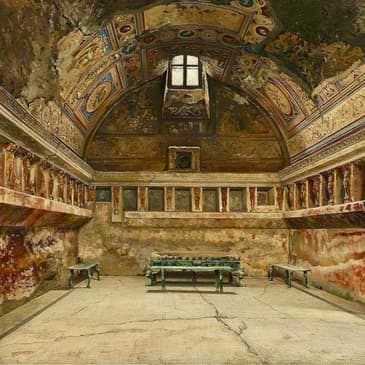
Have you ever wondered what a bath-house architect from ancient Rome would think if he found himself swept through a time warp into a modern Japanese Spa? Wonder no more! Emily and Cam discuss Thermae Romae, a 2012 Japanese Film that seeks to explore precisely this question by dramatizing the adventures of one Lucius Modestus, an engineer who becomes Emperor Hadrian’s personal bath-house designer.
Visit our homepage to subscribe, to find us on social media, and to contact us by email:
Useful Links:
- Watch Thermae Romae (with English Subtitles) on Dailymotion
- Watch the Thermae Romae Novae anime series on Netflix
Cover art adapted from Joseph Theodor Hansen, "Tepidarium at the Forum Baths in Pompeii"
----------
00:11 - Introduction
01:56 - Thermae Romae: the basics
- 02:28 - How to watch Thermae Romae
- 03:29 - A plot summary: Lucius Modestus travels through time, learns lots about Japanese bathing culture, and applies his knowledge to Roman bath-houses in the time of Hadrian
- 06:59 - The original Thermae Romae manga series
- 08:13 - The film’s success and the Thermae Romae Universe
10:17 - A Fish-out-of-Water Comedy
- 10:24 - The basic premise and some of the movie’s quirks
- 13:35 - Modern Japanese and Ancient Roman bathing cultures, compared
- 19:16 - Lucius bumbles his way through modern Japan and discovers the marvels of Japanese bathing
- 26:05 - Poking fun of Japanese onsen culture (and a digression on the challenges of translation)
29:46 - Thermae Romae and Roman Culture
- 29:56 - A quirky interpretation of real Roman history: the reign of Hadrian, the death of Antinous, and the question of succession (and deification!)
- 38:54 - Lucius’ (very Japanese) critique of Roman bathing culture
- 42:09 - Does Lucius’ critique hold water? Imperial bath-houses, neighborhood bath-houses, and bath-house sociability
- 47:04 - The old men from the onsen teach Lucius to care less about honor and more about community spirit
- 49:36 - Some final thoughts about the movie
51:25 - Wrap-up
- 51:31 - What’s up next: the Odyssey—both Homer’s Odyssey, and Nolan’s Odyssey
- 52:26 - A plug for “The Return” (and for our episode about it!)
[00:00:10] Hello, welcome to Have Toga, Will Travel, a podcast exploring the Mediterranean world, ancient and modern, through the eyes of two former classics professors. I'm Emily. I'm Cam. And we're your hosts. Well, first of all, we would like to welcome you all to the start of our second year of podcasting. Woohoo! How exciting is that? And as we said in our last episode, we are back from our vacation, both from the podcast and in real life. We took a trip to Japan, which we were visiting in the past.
[00:00:40] for the first time. And we had a really fabulous time there. Yeah, it was great. You say that with such enthusiasm. I meant it. It was great. Yeah. Now, interestingly enough, you wouldn't necessarily think that a trip to Japan has much connection to the Mediterranean world, but it actually does in some surprising ways. We'll probably get back to a lot of those surprising ways and a lot more detail in future episodes. But today, what we'll do is acknowledge our trip, as well as some of the intersections between modern Japan and the ancient Mediterranean world,
[00:01:10] by talking about a Japanese movie involving time travel between modern Japan and ancient Rome, a movie called Thermai Romai. Conveniently, this will also serve as a sort of interesting postscript of sorts to our recent episodes on Hadrian's Wall, since the movie is set primarily during the age of Hadrian, at least when we're in ancient Rome, and in fact features Hadrian as a character in the movie. Yes, how convenient for us. It was not intentional, but it worked out pretty well. Yeah.
[00:01:40] So we'll talk first a little bit about the movie itself, what the movie is about, how well it works, that kind of stuff. And then we'll shift focus a bit and talk a little bit about how the movie interprets Roman history and culture from the standpoint of a modern Japanese observer.
[00:01:55] So Thermai Romai is probably not a movie you've heard of unless you're into Japanese film or manga. Now we ourselves only know about it because like, I don't know, 13-ish years ago or so, we were on a trip back from Greece and it happened to be one of the film options on the flight. And I watched it because how could I not watch a movie called Thermai Romai in Japanese? Yeah, that was Emily written all over it for sure.
[00:02:23] Yeah, that was a rabbit hole I was all about going down. And I did. Now the unfortunate fact of the matter is that this is not a super easy movie to watch if you live in the United States. We watched it on daily motion with English subtitles, which worked, but you will get commercial interruptions if you do that. A lot of commercial interruptions every five minutes or something like that. Yeah. And they don't show up at any sort of natural break in the movie. No, so those can be kind of a frustrating experience.
[00:02:52] Cam was ready to throw the computer out the window. Yeah, it was not great. You got through it though. I did get through it, but commercials were frustrating. Now if you happen to be in Japan or South Korea or have a VPN that says you are in one of those places, you can actually stream this on Amazon, although you may not be able to get English subtitles that way. Yeah, I wasn't able to test that to see. So buyer beware. Yeah. Otherwise, DVD is really the only option and you can find it on DVD.
[00:03:21] Yeah, you can order it from Amazon. Although if you're in the United States, it comes from Japan, which means you have to deal with tariffs. So it jacks up the price a little bit. Yeah. Anyway, what is this film? Well, fundamentally, it's a 2012 Japanese film about a Roman bath architect, a guy named Lucius Modestus, who is going through a bit of a professional crisis and looking for new ideas about how to build bath complexes.
[00:03:43] And while he's sort of mulling over his problems, he discovers a portal in a Roman bathhouse that sucks him into this weird vortex and transports him into a modern Japanese bathhouse in Tokyo. What's called a sento, a public bath. In this case, a very specific public bath in Arroyu, which actually is a real bathhouse. Yeah, they show the exterior and you can Google it. It's in Tokyo. Right. Inspired by what he sees there and in other places that he'll visit later in the movie,
[00:04:12] he brings a bunch of new ideas back to ancient Rome and becomes the city's premier bath architect. Now, over the course of the movie, he travels multiple times between Rome and different locations in Japan. And each time he finds new ideas that he can bring back and improve his baths. He even manages to win the favor of the Emperor Hadrian by both designing a private bath for him
[00:04:36] and then designing a Nile-like habitat for the crocodile Hadrian has that he believes to be the reincarnation of his dead lover Antinous. If you're getting the sense that this is kind of a goofy movie, you're right. It's a fun movie. It's a fun movie, but goofy. Now, each time Lucius travels to modern Japan, he also happens to meet the same young woman, a woman named Mami Yamakoshi. He's tied to her apparently by the red thread of fate or whatever it is. Yes, the red thread of fate.
[00:05:06] And she is an aspiring manga artist who herself is trying to find new ideas and trying to make her way in Tokyo in the big city. Her mother runs a traditional onsen, that is a Japanese spa with water from natural hot springs, somewhere out in the countryside. So she's moved to Tokyo to try to make it as a manga artist. Yeah. Now she gradually becomes enamored with Lucius. Of course. Yes. He reminds her of a hero from a manga comic. Probably doesn't hurt that he constantly is showing up naked because he's been in a bath.
[00:05:38] That actor did a lot of nude scenes in that movie. And at some point in the film, she actually ends up traveling accidentally back to Rome with Lucius, as do a bunch of old men who hang out in her mother's onsen. And while she's in Rome, Hadrian asks Lucius to build a bath to elevate the profile of his intended heir, Caonius. Now, Lucius in this case refuses, partly because he doesn't like Caonius,
[00:06:07] and partly because he learns from Mami that Antoninus, and not Caonius, is supposed to be Hadrian's heir, because, of course, Mami has read her Roman history. Now, with the help of Mami and the old men from the onsen who also get sucked back in time, Lucius ends up building a medicinal bath based on a Japanese spa to help heal Roman soldiers on the Danube frontier, where Hadrian is trying to fight off an invasion. Lucius gives credit for this to Antoninus to elevate him in Hadrian's eyes
[00:06:35] and ensure that he, not Caonius, actually succeeds to Hadrian as ruler of the Roman Empire. And then Mami does return to her own time and uses her experiences to create a manga series that she is finally able to sell to a publisher. And everybody lives happily ever after. Yay. Although, of course, the movie hints at a sequel in its final season. Well, because will they find each other again? Well, all roads lead to Rome. Right. Now, the film itself is based, actually, on a manga series written by Mauro Yamazaki
[00:07:05] that ran from about 2008 to 2013. We have not read this. No. But it seems that much like the movie, in the manga series, every time Lucius encounters a new problem, he gets swept away to Japan somehow and finds inspiration to solve his problem. And of course, all of those problems revolve around baths and hygiene and that kind of thing. And in the manga series, he seems to visit all sorts of places, you know, bathhouses,
[00:07:32] baths in people's homes, water parks, zoos, fertility festivals, all sorts of things. And the movie does try to capture the same kind of range of locations, albeit it does it in a very condensed kind of way. Now, one main difference, we think, between the movie and the manga series is that the character of Mami does not seem to be in the manga. She gets added to the movie, it seems, to create a female lead. Although it seems pretty clear to me anyway that her character is based on
[00:07:59] several other characters that do pop up in the comic book series, including a geisha named Satsuki, who in the manga series happens also to be an expert in Roman history and who can speak Latin fluently. I mean, cool. Why not? Now, the film itself was fairly successful, and that's probably an understatement. The actor who plays Lucius, Hiroshi Abe, won an outstanding performance for actor in a lead role at the
[00:08:24] 36th Japan Academy Film Prizes, which is basically like the Japan Academy Awards. And it was the second highest grossing domestic film in Japan for all of 2012. Just out of curiosity, do you know what the first one was? No, I did not look that up. Bit of trivia we can hunt down later. Yeah. Anyway. Cam's like, I want to watch that one. Yes. I'm kind of curious now, yes. So this movie, Theromai Romai, is now actually part of a growing
[00:08:51] number of entries in what has become the Theromai Romai universe. Did anyone know that existed before they listed this episode? There's a Theromai Romai universe? There is. So actually, before the movie was made, early in 2012, there was a short-lived flash anime series on Japanese TV based on the manga series. The film also spawned a sequel, Theromai Romai 2, in 2014, and a second anime series on Netflix in 2022, Theromai Romai Novi.
[00:09:21] Now, technically, this is called a web anime or an original net animation, which basically just means it was only released online. Theromai Romai Novi is actually really easy to find on Netflix. It's available just on regular Netflix. So if you're looking for an entry point into the Theromai Romai universe that doesn't involve hunting down the DVD of the movie, this is a good place to start. And actually, one of the cool things about it is at the end of every episode, they have the author
[00:09:46] who created the original manga series actually come in and go to different Japanese baths and talk to people and you learn a bit about it. Yeah. It's a lot of fun. Yeah. And then finally- He did not watch most of that season one in like an afternoon. Yes. All right. And anyway, now there's a sequel manga series, Theromai Romai Redux, which began serialization on Shonen Jump Plus in Japan in early 2024 and is apparently still ongoing
[00:10:15] as the author creates new issues. So back to the movie. This movie is largely, you know, what you might call a fish out of water comedy. Although for the most part, this is a comedy that produces kind of chuckling rather than like outright laughing fits. That's a fair way to characterize it. And the humor is mostly based on Lucius's reaction to things he experiences whenever he finds himself transported to different locations in modern Japan.
[00:10:44] And that humor is amplified by the fact that obviously Lucius can't actually talk to anybody while he's in Japan. The movie tries to capture this in a couple of different ways. The film is in Japanese, except for those moments when Lucius is present in modern day Japan. Then he himself speaks Latin while everyone else around him speaks Japanese, of course, as one would do in Japan. Yeah. It's weird. If the premise is that everyone is speaking the same language, then they're speaking
[00:11:11] Japanese, whether they're in Rome or Japan. But when you actually have the mixing of the linguistic worlds, then they clarify it. Right. But that helps emphasize, as you said, the linguistic divide and it lets Hiroshi Abe act all indignant and confused and frustrated in various different ways as he's trying to communicate with people in modern day Japan. Although the film does eventually have mommy learn Latin. So there are two leads can talk to each other without all sorts of strange film contrivances.
[00:11:39] Yeah. But other than the like miscommunication jokes or inability to communicate jokes, most of the humor in the film focuses on Lucius's reactions to differences between Roman bathing culture and hygiene and Japanese bathing culture and hygiene. Right. The contrivance here is that the time travel mechanism in the movie, I guess space time travel, because he's jumping locations too. Even though it isn't fully explained, clearly revolves around water
[00:12:06] somehow. So how it works is Lucius has some kind of a problem that he's trying to deal with. He ends up submerged in a body of water somehow. And then he gets sucked through time into modern Japan, where he sort of hangs around until, as we learned later on, the minute he starts to cry, he is transported back to ancient Rome. Yeah. And then whenever he goes to Japan, he also ends up in some sort of body of water. That's what he comes out of. Right. Yes. Important detail. Yeah. Usually a bath, but not always.
[00:12:33] Not always. Now, for some reason, which we don't fully understand, these transitions where he time travels are always accompanied by these operatic interludes. So there's like this random opera singer and this kind of bucolic outdoor setting, singing Italian opera every time this time travel happens. As Lucius is sucked through some weird temporal vortex, yes. It's very meta. There's moments where like, oh, the singer's not ready as if the transition caught
[00:13:00] him by surprise. And to me, it was sort of reminiscent of the film Mighty Aphrodite, which has a literal Greek chorus that it cuts to at moments to comment on the action. This is one part of the movie I have not sussed out yet. Again, kind of reminds me of this Greek chorus thing, but I haven't quite figured out what it is and honestly have not taken the time yet to be like, oh, what's the piece of opera that's being sung? Is this some sort of comment on the action? It's a little weird,
[00:13:28] but it's quirky at the same time and part of the film's charm. Quirky is the best way to put it. It's a weird element. Yeah. Anyway, because the movie really focuses on Lucius's reactions to differences between Japanese and Roman Roman bathing cultures, it's probably worthwhile to talk a little bit about what those bathing cultures are like. And we can start by saying that public bathing culture was a big
[00:13:54] feature of life in ancient Rome and is still a big feature of life in modern Japan. And there are, in fact, similarities between the bathing cultures of both of these places. The first of those is that communal bathing is not only popular, it's also done in the nude, of course. And the other similarity is that both revolve to some degree, at least around bathing in hot water, whether that's water that's been heated or water that's coming out of a hot mineral spring when it's
[00:14:21] available. And in Japan, that kind of captures the difference between a sento and an onsen. A sento is a public bathhouse that you'll find in a whole bunch of different cities around Japan. An onsen is generally pretty specifically a bath fed by a hot mineral spring, and they tend to be more like spas or resorts. Also, in both cases, generally speaking, baths are going to be segregated by gender. In the Roman case,
[00:14:47] it was separate spaces and or separate times of day. Women went at these times, men went at these times. In Japan, generally speaking, baths are also segregated by gender, although in this case, location and not time. That said, there is still places where you can find mixed gender bathing at Japan in some of the onsen and particularly rural areas. Yeah. You know, in places where it's actually hard to divide users between two different places just
[00:15:15] because of the way that the hot springs are configured. Yeah. And then finally, and most importantly, in both cases, the bath is not for washing and cleaning yourself. The bathers clean themselves first, and then the bath is for soaking, whether for relaxation or for therapeutic purposes. There are, of course, some differences though, too, between Roman bath culture and Japanese bath cultures. And one of the main differences is the fact that Roman bath houses had multiple rooms.
[00:15:45] A lot of them tended to have an exercise area, a palaistra typically, sort of an area for wrestling. And then they had a bunch of rooms in the bathing complex itself that tended to be kept at different temperatures. There was, first of all, the frigidarium, that was the cold room with a water bath. There was the tepidarium, which had basically a warm bath. And then the caldarium,
[00:16:10] where the hot pool was kept. And in some cases, you'd also find what is usually called a laconicum, which was sort of like a sauna room. Yeah. Sometimes also called a sudatorium. And the presence of the palaistra in particular emphasizes that the bath in the Roman context was not just for bathing, but also for athletics. So you can think of these as, you know, health facilities more broadly, I suppose, on some level. Yeah. Along with that, the process for cleaning yourself before getting into the bath is different
[00:16:38] in both places. So in the Romans, you're going to oil up. You're going to put olive oil on you, and then you're going to use a strigil, S-T-R-I-G-I-L, to basically scrape the oil and dirt off of yourself. Or you're going to have a friend or one of your enslaved attendants do this for you. And they use the oil because the olive oil is going to bond with the oil in the skin,
[00:17:04] right? Because like dissolves like. And the dirt, which has bonded with the oil in the skin, is going to become caught up in that. And so as you scrape the oil off, it's taking all that dirt off with it. And you might actually do this cleaning practice again after you've bathed as well. Now, on the other hand, on the Japanese side, we're not using oil. We're using basically showers, small showers, and you kind of sit on a little stool and you wash yourself with soap and water,
[00:17:31] as you know, we might think of you normally do in a shower before you get into the pool. It's kind of funny, actually, because you don't use the shower. You fill up a little bucket. And yeah, you pour it on yourself. And dump the bucket over yourself. But that's because you don't want to spray your neighbors. Yeah, yeah, yeah. Right. Because these are not enclosed showers. No, they are not. This is just a big open room with these little, little dividers. So you sit down and you keep it tight so that, yeah, you don't get your water everywhere. Not only is the pre-bathing process different between Japanese and Roman bath practices,
[00:18:01] the actual bathing process is a little bit different too, as we've already sort of anticipated by talking about the way Roman bathhouses are laid out. In a Japanese bathhouse, after you clean yourself at the cleaning stalls, then you enter the bath where you basically soak. It's really hot. You sit there and let that hot water do its work. Cam did not like the hot water when we tried this. It really is too hot for my tastes. In the Roman context, though, you would typically progress
[00:18:29] through rooms of different temperatures after you exercised and got yourself striduled or stridulated or whatever we want to call that process. We don't exactly know how this worked. And honestly, it probably varied from place to place and from person to person. Yeah. But one potential sequence would be to start in the warm room, the tepidarium, and have yourself a little bit of a warm soak, then move into the caldarium and have a really hot
[00:18:52] soak, and then maybe a plunge into the frigidarium with some time in the sauna facility if that existed. So just a different style of bathing that involved progressive changes in temperature. Yeah. The key in the Roman context is you do the hot bath before the cold bath, and the cold plunge is often what you finish on, or it comes towards the end. A nice shock at the end.
[00:19:16] Yeah. Now, these sort of bathing differences are the background for the movie's efforts to explore what someone brought from ancient Rome into modern-day Japan might think. So, like, initially, Lucius is not aware that he has traveled through time. He thinks instead that, you know, he has somehow traveled to a different place in the Roman Empire, or maybe some sort of far-out province. He's not really sure where he is or who these people are. He just knows that everything is different.
[00:19:46] Yeah. At first, he thinks maybe he's been sucked through a hole into the bath complex used by enslaved people. Then he has a little bit of a rethink, and so he starts to think that he's, as you put it, maybe in a far-out province, the province of what he calls the flat-faced tribe. These are the terms used in the subtitles. Subtitles, you know, which he conceptualizes as a poor province that has somehow surpassed Rome itself in some kinds of bathing technology.
[00:20:13] Yeah. And that provokes a certain amount of anxiety for him. Yes. Yes, definitely. Some, I don't know, like an assault to his sense of cultural superiority or whatever. Yeah. And it is worth pointing out here that, like, to a certain extent, the movie somewhat underestimates Roman technological sophistication, but it does create a good pretext for these moments in which Lucius reacts to the different things he encounters. Yeah. At the same time, there's a real missed opportunity here, right? Because as we sort of
[00:20:42] mentioned, some Japanese characters later on get sucked back in time to ancient Rome, including Mami. And there were some choice moments here to have them react to things that they encounter in the Roman world. You know, you can think of a range of examples, and one might be just how awful it probably was to, like, go into the hypocaust structure, right? The crawl space under the elevated floors and clean out all that gunk created by the furnace. Yeah. This is the structure that would have heated the baths in the Roman era.
[00:21:09] I mean, that job would have been horrible. Not surprisingly, it's a job usually done by enslaved people. But the other thing that Mami could have encountered, my favorite thing, is a story we find in a medical text by a guy named Itius of Amida, a late Roman author who talks about going into bath houses and gathering up the gunk that people would stridil off of themselves so he could use them in various unguents and other things that he was creating for medical purposes. And that would have
[00:21:37] been a choice gross-out moment that the movie chooses not to get into, unfortunately. Yes. Cam was very excited about working this story somewhere into our description of the movie. It's a great story. No. That's it. There are funny moments in which Lucius gets to react to stuff. Yeah, yeah, yeah. It just, yes, we do miss the opportunity to see the reaction sort of in the other way. Now, when Lucius first finds himself in Japan in this public bath, the sento, in which he sort of emerges, there are lots of things that he marvels at.
[00:22:06] There's a wall-sized painting, very naturalistic painting. There's a huge mirror. There are posters, the plastic buckets that you would use to bathe with. And there's this cold-fruited milk drink. And he's just sort of impressed by all of these things. And this is another thing worth mentioning, is that drinking cold milk after soaking in the hot water is not uncommon in Japan. And this could be
[00:22:30] plain milk. This could be like a coffee-flavored milk or even a fruit-flavored milk, as is the case in the movie. And this is used as a way to cool down, to rehydrate and replace electrolytes and vitamins that you have lost through sweating and the heat. Yeah. So a lot of the humor here is sort of him reacting to this stuff and kind of bumbling around. Oh, wow. What's this? Oh my gosh. This is amazing. How did this remote tribe in the province come up with all these things? Yeah. And it's also funny because he's basically interrupted
[00:23:00] the bath time for a lot of old men, sort of also equally befuddled by what's going on and, you know, yelling at him to do things and all of that. And nobody understands anybody. They're trying to help. They're trying to help. Yeah. And this pattern continues. So in a later trip, for example, Lucius finds himself sucked into the display room of a company selling modern Japanese bathroom fittings, tubs, jacuzzis, toilets, things like that. And again, from his perspective,
[00:23:27] this is full of all sorts of amazing stuff ranging from, you know, things that we would consider pretty mundane, like printed toilet paper, to actually some pretty cool toys like flat screen TVs that could be mounted above jacuzzis and of course, modern toilets equipped with bidets. In this moment, he is given what's called a yukata to wear because of course, he is naked when he's come through. Yukata is a garment like a kimono. It's the same sort of shape of garment, but it's lighter. It's made of cotton. It's sort of a summer garment. It's
[00:23:56] not as formal as a kimono. And he's given it and he tries to sort of tie it like a toga. So he's tied it around himself like this sort of one-shouldered garment. Right. And part of the humor here revolves around his efforts to figure out how all of this stuff works, not just the yukata, but also some of the more technological stuff like the modern toilets. And here he sort of imagines in his head that there are people hidden somewhere operating at all. And naturally as somebody from a slave society, he's imagining that
[00:24:25] there are enslaved people pulling ropes and levers and things like that to make all of this work, blowing through tubes to create the jacuzzi effect and so on. Now, the sort of best moment in this scene though is when he tries to use the toilet and he turns on the bidet feature, which initially provokes shock. As it understandably would, I think. And then he has this vision of being in a field of flowers and this beautiful meadow.
[00:24:52] It's well done. That scene is probably worth the movie on its own. And then of course he has to then mentally contrast this with what they would have used in ancient Rome, which we have talked about before, which is the sponge on a stick. Yummy. And how much more hygienic and pleasant this is. And this sponge on a stick that you would just pass around in the public urinal. Right, yeah. It's a great scene. Or public toilet. It's a great scene. Yeah.
[00:25:17] And finally, there's an extended sequence later on in the movie in which he gets sucked into various onsen, these mineral spring baths. Part of the movie's conceit here is that Lucius discovers the miraculous healing properties of mineral springs during these visits, as though this is knowledge that he wouldn't have had. Yeah, because of course, in actual fact, hot springs and mineral springs like that were well known in the ancient Mediterranean world and, you know, known or reputed to be healing
[00:25:44] and therapeutic. And so they're all over the place, right? You have Siwa in Egypt, Thermopylae in Greece, and fairly famously what the Romans called Aquaisoulis, but you probably know as Bath in England, and so on and so forth, right? These were all over the place and well known and would have been familiar to a Roman of Lucius's era. The more entertaining bits here are definitely those in which Lucius's experiences highlight some
[00:26:11] interesting cultural differences. And here the movie takes the opportunity to poke fun a little bit at Japanese onsen culture itself. So for example, in one very brief scene, Lucius manages to pop up in the modern world in an onsen in the middle of what seems to be a fertility festival dedicated to the Shinto deity Konsei-sama. This is a weird scene in which participants are parading around a giant phallus in the onsen, and there's a woman riding it, right?
[00:26:38] Basically to conjure fertility, perhaps. And Lucius sort of pops up out of the bath naked, of course, as always. And he is promptly mistaken for an incarnation of the god and the women all mob him. Yeah. So it's a pretty funny scene. But, you know, the other interesting thing here is that I'm sure this would have been a context that a Roman would have understood immediately. At least the giant phalluses part. Yeah. That would have been the dead giveaway, because this is something that probably would have been relatively familiar to Romans.
[00:27:05] Later on in the movie, he shows up at a rural onsen, actually specifically the one that mommy's mother runs, where he experiences various delights, like soft-boiled eggs that have been cooked in the hot water of the onsen, and some home-brewed sake, which has spoiled. The film somewhat implausibly posits that he would have been more or less knocked out after one glass of sake. Probably not accurate for the Romans, but...
[00:27:34] But it gives them an opportunity to demonstrate the healing property of the mineral water, right? Yeah. Because they give him a bit to drink, and that revives him. Yeah. But there's also a running joke here about what life is like in a rural onsen. And, you know, part of the joke is that the people you find hanging out here are mostly regulars, mostly old men. And in the movie, anyway, they're presented as, I don't know, for lack of a better term, country types. And the subtitles try to capture this by presenting their dialogue
[00:28:02] in what the translators no doubt assumed was, I don't know, what would you call it? A rustic English dialect? Yeah. Yeah. Something like that. I mean, and this highlights one of the problems of translating, especially when trying to translate something like dialect that has particular cultural connotations in its own context, right? So I'm assuming that the Japanese that's being used here is somehow marked as different from how people speak in Tokyo. I don't speak Japanese to understand it. And the
[00:28:32] subtitles are trying to convey that. But is the connotations that we're pulling from the English the same as what is being pulled from the Japanese dialogue? It's really hard to say. You know, this is a problem you run into in translating in general. And in particular here, I'm thinking of the Lysistrata, because in the Lysistrata, the Spartan characters speak a different dialect of Greek
[00:28:57] from the Athenian characters. And I have seen that done a range of different ways, whether using like a country rustic dialect like they try in this film or like, the Athenian characters are, you know, English and the Spartan characters are Scottish. Yeah. Or the Spartan characters speak with a Russian accent. And you know, clearly from the Cold War, right? Like, so this is a problem. I know you found this very jarring.
[00:29:26] I found the way that they were presenting the dialogue and the subtitles here a little bit off-putting. Yeah. Because it's yee-haw kind of stuff, you know? Yeah. Yeah. It felt a little clumsy. But, you know, it actually does speak to a really challenging issue. Like, how do you convey this in translation and in subtitles? Yeah. No, it's definitely a challenge. Yeah. Anyway, so there's a lot of funny stuff in this movie, just from a narrative standpoint. But the other thing that interests us is the movie's interpretation of Roman culture. So
[00:29:54] that's probably where we're going to turn next. Yeah. Now, you know, it is worth saying that the movie does take a real historical framework that it sort of builds its story on, but then it gets very creative, maybe plays a little loose with details. That goes without saying. But there is actually a real historical framework that it does fit into. And that framework basically revolves around two big moments in Hadrian's life. Now,
[00:30:20] one is the death of his lover Antinous, and then the other is the question of his legacy. Who will become emperor after him? And how will Hadrian himself be remembered? Right. So Hadrian, as you may remember from our fairly recent episodes, was emperor of the Roman world from about 117 CE to 138. He was actually born outside of Rome, outside of Italy. In fact,
[00:30:43] he was born in Italica in southern Spain to a senatorial family. And as emperor, rather notoriously, he did not spend a whole lot of time in Rome itself. Instead, he spent a lot of time touring the provinces, pretty much the entirety of the Roman Empire, including Pannonia on the Danube frontier. This is an area roughly equivalent to the northeast part of the Adriatic Sea. That's where
[00:31:09] lots of action in the second half of the movie seems to be set as Hadrian has to deal with a barbarian invasion there, even though the movie places this visit much later in Hadrian's life than was actually the case. Now, Hadrian was known as an emperor, very interested in culture, especially Greek literature and culture. He was something of a Hellenophile. And the movie kind of spins this in an interesting way by imagining that Hadrian actually wants to unify the empire with a
[00:31:37] sort of soft power of culture rather than through military domination. And specifically, he imagines that he wants to use Roman bathing culture as a focal point to unite people, which of course is a goal that Lucius can really get behind. Yeah, there's a funny comment here on sort of the centrality of bathing to Japanese conceptions of, you know, what civilized life is like. But, you know, also a fairly good view here of what
[00:32:03] Roman views of civilized life are all about. And I'll ask your point about Roman bathing culture is adopted and adapted from Greek bathing culture in antiquity. Yes. Anyway, so Hadrian runs into a moment of crisis in the film, just as he ran into a moment of crisis in real life. And this was the death of Antinous, a young man from Claudiopolis in ancient Bithynia. That's basically the northwest part of modern day Turkey. Claudiopolis itself is about
[00:32:32] halfway between Istanbul and Ankara. Hadrian and Antinous began a relationship in 123. And they were together for several years until Antinous unfortunately drowned in the Nile River during Hadrian's tour through Egypt in 130. Yeah. Now, Hadrian is overwhelmed with grief after the death of Antinous. He has Antinous declared a god. He institutes the worship of Antinous throughout the empire. And the worship of Antinous will
[00:33:00] actually last until the prohibition of pagan religions by Theodosius in 391 CE. Yeah, there are at least a couple of dozen temples constructed to him, 28, I think. And sculptures of Antinous can be found all over the place. Whenever you go to a museum that has Roman sculpture, you're likely to run into one. There are at least 115 that survive today. So he seems to be the person from classical antiquity with the most number of surviving statues now in the modern world.
[00:33:27] Yeah. So sometimes you'll see him referred to as the best known face from antiquity. Right. Because we have all these statues. He's easy to spot once you know what you're looking for. You're like, oh, that's Antinous. And so the movie gets into this moment of crisis in Hadrian's life by having Lucius devise several innovations in the emperor's private bathing facility to kind of bring him out of his funk and to create an environment conducive for Hadrian's functionally pet crocodile,
[00:33:56] which Hadrian believes to be the incarnation of the deified Antinous, right? He drowns in the Nile, the crocodile comes out of the Nile. Clearly, this is Antinous. And so by creating a sort of tropical-ish environment through basically using radiator heating, as we would call it, cycling hot water, he creates an environment in which the crocodile can thrive and Hadrian, you know, can be assured that his Antinous crocodile is going to survive.
[00:34:23] This, as far as I can tell, is an invention of the movie. I don't think there's any source. Yeah, I don't. I've never come across that, no. But I think it probably is partly just an excuse to have Lucius manifest in modern Japan in a crocodile enclosure in that one scene. Oh, yeah. Yeah. He also brings the banana back to the crocodile to eat. Oh, right. He brings the banana back to grow, yeah, to grow food for Hadrian as well. Yeah, yeah. And the banana was not something that would have been known in ancient Rome.
[00:34:47] No. So the second moment of crisis that the movie gets into is sort of a succession crisis, right? It raises the question, who is going to become emperor after Hadrian? For much of the film, as was true in real life, the leading contender seemed to be a guy called Lucius Caonius Commodus, who, in real life, after being adopted by Hadrian in 136 CE, took the name Lucius Elias Caesar. Now, like a lot of Roman aristocrats, he had a turn serving in various government posts,
[00:35:17] and among other things, he was governor of the Pannonias in the 130s. However, when he got back to Rome in 138 or so, he died of a hemorrhage, and that obviously made him unavailable to succeed to Hadrian as emperor of the Roman world. Although, fun fact, his son, Lucius Verus, would later be a Roman emperor himself, co-emperor with Marcus Aurelius.
[00:35:40] Now, in the movie, Caonius is sort of this antagonist figure who, in contrast to Hadrian's eventual successor, the much more statesman-like Antoninus, is really interested in nothing but his own pleasure. In reality, the real Caonius is probably not as terrible a person as portrayed in the film, even if historians seem to agree that he was probably not really cut out to be emperor.
[00:36:05] But this sets the stage here for Lucius to save the day by importing Japanese onsen technology to help the Roman army recover through therapeutic bathing and be able to drive off an invasion, and then give credit to Antoninus in order to boost his chances of becoming Hadrian's successor in place of Caonius, so that Caonius is supplanted as heir by Antoninus. And that's what happens. Wow, the wonders of therapeutic bathing. Yes.
[00:36:35] Can solve anything, apparently. Apparently, yes. So the one last thing that's worth saying here about the actual history is that the movie really has an odd fixation on the question of whether or not Hadrian will be deified once he dies and is no longer emperor. Yes, and Caonius won't do this, but Antoninus wills. Yeah. Right, and that becomes the critical plot point, right? Historically, obviously, Hadrian was deified after his death by his real-life successor, Antoninus Pius. And you can actually still visit
[00:37:03] remains of the temple dedicated to Hadrian in Rome. It's got a nice big facade that's still preserved. Yep. It's otherwise like a lecture hall on the inside and a bank. Bank, yeah. And so, yeah, our characters, Mami and Lucius, become really concerned that this needs to happen. Hadrian needs to be deified, Antoninus needs to succeed him, and, you know, they seem to be worried that Hadrian's plan to unite the people of the empire using Roman bathing as
[00:37:29] a focal point won't happen otherwise. Caonius will ridicule it and abandon it, but Antoninus will preserve Hadrian's plan and keep going with it. And this is partly driven by Mami's knowledge of Roman history. So this is her driving concern, and she kind of pulls Lucius into it and convinces him that this is really important. Well, yeah, because Lucius has a natural impetus here, obviously, to help the guy who's all about bathing, not the guy who is it, right? Okay, fair enough.
[00:37:58] It's a weird plot point, though. And I mean, you know, I was trying to think through what's going on here. And I guess you could argue that the movie's interest in Hadrian's status, you know, as somebody who gets deified later, may reflect Japanese conceptions of what the modern imperial family in Japan does, which is to serve as sort of this symbolic focal point around which people can unify. The Japanese emperor does not have a divine status in the same
[00:38:25] way that Hadrian did after he died, but he's still an important component of the imaginary of Japanese culture. Yeah, like I have no doubt that the way Hadrian gets treated is intersecting with modern ideas in Japan about the imperial family, but I don't really know enough to analyze or articulate that. I wish I did. It's something I'd love to tease out in more detail. Yeah, yeah. But we don't have time to go down those rabbit holes right now. Like, we'll come back when we're experts on Japanese history.
[00:38:54] But what we can do is digress a little bit on how the movie treats Roman bathing culture. Yes, that we can do. So, you know, bathing culture is hugely important in this movie. And a big component of that is a critique that Lucius makes about Roman bathing culture early on in the film, which is basically that Roman baths are too focused on luxury and ostentation, and they have too much going on, right? So they're noisy, right? You've got this one room with the bath in it,
[00:39:22] and there's wrestling going on, and there's snack vendors running around, there's people having, you know, their hair removed by waxers and hair pluckers, and all of this is happening, and it's all crazy busy, loud. And what it's not is what a bath is supposed to be about, which is relaxing. Right. And that idea that the bath is supposed to be a place to relax is an idea later picked up by Hadrian in the movie, when Hadrian has a conversation with Lucius and says something like,
[00:39:47] you know, baths like Roman roads aren't supposed to be just about displaying Roman power and so on, but should actually bring people relief. It should actually do something good for people. Yeah. So a lot of what Lucius does with the knowledge he picks up in Japan is to try to make the bathing experience in Rome more pleasant, more calm, more relaxing, easier in response to this critique. Right. So one of the things he does to try to make Roman bathhouses more relaxing is,
[00:40:17] you know, introduce a big naturalistic painting into his new Roman bathhouse, a big painting of Mount Vesuvius, which, you know, sure, it looks pretty, but I don't know if anybody would look at that and think, oh, Vesuvius post-eruption. That's going to make me relax. But anyway, that's his attempt. You know, he also tries to make the bathhouse a little bit more community oriented, I guess, by posting notices about local events modeled on the ones he's seen in the Sento in Tokyo.
[00:40:44] He introduces baskets modeled on those he finds in Japan so that people can put their clothes in them and don't have to leave their clothes in little cubbies in the front room where they have to play an enslaved attendant to watch over them. That sort of thing. Right. They can take the baths with them. Yeah. He gets the cold milk drink going. The cold milk drink. Yeah, of course. Yeah. Right. And it's confined to a specific place in the bathhouse. So you have to go to it like a bar. So that eliminates the sort of wandering snack vendors who are in everybody's faces and shouting and making noise and so on.
[00:41:13] And of course, this is all related to a more implicit critique about the social functions of baths. As we mentioned, the bath he's hanging out in at the beginning of the movie is incredibly chaotic. It's full of tons of people, some of them acting like idiots. And there's not really a sense of community in the bath. And in contrast, right, the sento and the onsen that he visits in Japan is anchored around these small and fairly intimate communities where everybody knows everybody.
[00:41:41] You know, it's probably the same crowd every day. You know, you know the people you're going to see and it's much more community minded. Right. And, you know, my thought as I was watching this is that the baths in Japan and the movie are sort of functioning like the Greek caffeine, right? The place where all the old men hang out all day long and just sort of gab about stuff. Yeah. Yeah. And anyway, the movie strongly implies that this is an aspect of bathing that Roman culture in Lucius's day had lost or abandoned and obviously to its deficit.
[00:42:09] Now, this is an interpretation of Roman culture that probably breaks down a bit when you poke at it a little bit. First of all, it adopts a view of Roman bath culture that emphasizes, you know, these big bath complexes in Rome that were built by emperors, while probably ignoring how these actually work. So think here about like the Baths of Caracalla, right? The Baths of Agrippa, these massive, massive complexes.
[00:42:34] Now, these complexes did exist. They were huge. They were incredibly lavish, you know, lots of just amazing internal decorative elements and so on. And they did actually have facilities for all sorts of activities apart from just bathing. So in addition to the bathrooms we've talked about, Frigidaria, Tebidaria, Caldaria, they had wrestling grounds, they had outdoor swimming pools, they had gardens, they had libraries and so on. But the important thing here is that in these big
[00:43:02] bath complexes, that stuff didn't all happen right in one big room as the movie sort of implies at the beginning in the scene in which Lucius delivers his critique about Roman bathing. The wrestling was separated from the bathing usually. Yeah, he'd be outside. Right. As was the swimming perhaps and as was the library, that sort of stuff. Yeah. And of course, as we mentioned, the basic Roman bath would have had multiple rooms just
[00:43:28] like period, full stop. And so it seems that maybe part of what's going on here is the movie is sort of using the model of the Japanese bath, right? In which you're really only as one bathing room and sort of putting that on the sort of Roman model. Yeah, it's a little bit odd. Yeah. Because if you look at the new animated series in particular, the new animated series is a little bit better about understanding how a Roman bathhouse functioned. But anyway, the second problem with this aspect of the movie and its critique of Roman bathing
[00:43:55] culture is that it doesn't acknowledge that the big imperial bath complexes that we're talking about here were the exceptions rather than the rule. There were tons and tons and tons and tons of other bathing complexes in Rome. To say nothing about bathing complexes in the rest of the empire, they were much smaller and really were focused around the actual baths, the frigidarium, the tepidarium, the caldarium, and probably functioned much more like neighborhood baths in
[00:44:23] the way that the sento functions kind of like a neighborhood bath in Tokyo or someplace like that. Yeah. So like, for example, there are baths at Pompeii, often called the Stabian baths. And it's a nice bath complex, but it was probably the town's big bath complex. And you had, you know, a set of rooms for the men. So you had your typical bathing rooms, you had your changing room, you know, your caldarium, your tepidarium, your frigidarium.
[00:44:48] This did also have a laconicum, right, the sauna, and it had a palaistra, the outdoor athletic space, if you will. And then you had another smaller set of rooms for the women's side, which were closed off from the men's side. So they had separate entrances. And the women's rooms were a caldarium and a tepidarium, and then a combination changing room and cold plunge room. So the cold plunge pool was in the changing room, so much smaller facilities. And then you also had
[00:45:17] a few rooms in the complex that were basically service rooms where the workers would have been doing various things to make the baths run that would not have been open to the public. So that I think gives you a sense of what a nice neighborhood bath would have looked like in the Roman period. Yeah, it is a nice bath. It is a neighborhood bath, and it's one of several in Pompeii, which is another important point to make, right? That, you know, they do function as sort of these nodal activities for neighborhoods. And you have to imagine that the bather's experience
[00:45:45] in a facility like this would have been much different than the bather's experience in a big imperial bath complex, which was, after all, designed not just to wow people, but also to serve like literally hundreds of people at a time. Yeah. In that sort of situation, most of the people in there at any given moment probably didn't know one another. Yeah. And they're not interacting with most of the people who are in there with them. And these smaller baths probably drew like a crowd of regulars, as you see in the Japanese
[00:46:12] context in the movie. People who visited at more or less the same time every day. In the Roman context, popular times were the mid to late afternoon when the baths were the hottest. Right. And so even though Roman society still had lots of gradations and status that would have been obvious, these smaller baths arguably still offered scope for the kind of stable communities and relationships that we see in the Sento and Onsen scenes in the movie, we think. There are obviously
[00:46:37] still questions. So for example, wealthier people in Rome and Roman towns often moved around city with attendants, either enslaved attendants or their clients. Did these people come into the baths in a big group so that you'd be in your bath with your enslaved attendants and you're like, you know. Oh gosh, Claudius and his whole crowd is there. Yeah, exactly. You can imagine something like that happen, but nevertheless, you'd still probably get much more of a community feel than you would in those big imperial baths. Yeah, yeah, for sure. And then, you know, one final thing that we want to talk about
[00:47:07] is this movie seems to see Roman culture as one in which people are fully preoccupied with their own honor and glory. And this is in contrast to Japan, where people are presented as being much more willing to sacrifice their own interests for the interest of the group. And this point gets made something of a ham-handed way in which the old men who hang out at the onsen, who get sucked back in
[00:47:32] time with mommy, kind of eagerly help build an onsen for the soldiers to help them recover so that they can repel this invasion. And this is really driven home by a sort of internal monologue of Lucius that you hear where he's sort of marveling that these men are committing themselves to this task that they will get no honor for. And why would they do that? Just in case you missed the point. Yeah. Now, this contrast is probably overstated. It's true that Roman society really did emphasize
[00:48:01] dignitas, which we often translate as honor. That is the respect in which an individual was held by others. But of course, there were also plenty of ways in which various aspects of Roman life did emphasize community. So one example here for someone like the character Lucius is that as an artisan, he probably would have belonged to an association of other craftsmen called a collegium. And this is a group which
[00:48:26] would have built up collective norms and values that they would enforce, they would chip in money to pay for burials for members and things like that. So he would have had some awareness of this kind of community behavior. You know, and one of the sort of struggles we have, right, is that we don't have a lot of evidence in Rome from the non-elite or immediately sub-elite classes that might speak to ideas different from what the aristocracy is emphasizing.
[00:48:56] In the movie, though, this idea that Rome is a society in which people are fixated on honor and glory versus Japan, in which they are not, becomes central to development of Lucius as a character. Part of his arc, I guess, is his movement from a state in which he's obsessed with his own skill and talent as a bath engineer to a state in which he's willing to do what's best for the Roman Empire, i.e. help Antoninus become the successor by sponsoring a bath without receiving any personal
[00:49:24] credit for it. Although at the end, you know, you get a touching scene in which Hadrian sort of recognizes that it was his idea even as he tries to distance himself and say, we all accept your thanks. It was a group effort. Yes, but yeah, he doesn't want credit for it, but he does kind of get credit for it at the end too. So overall in the movie, we have some eccentric interpretations and creative uses of Roman history, but a sort of nonetheless real historical framework that we are working within on some level,
[00:49:53] albeit with time travel. But the sort of artistic license definitely does not stop the movie from being a fun experience overall. I enjoyed the movie the first time I watched it. I found it, yeah, a little weird, very quirky, but fascinating nonetheless, because I found it really interesting to see how Roman culture is being viewed from someone not from like a North American or European perspective, but from a Japanese perspective. And that's, you know, that's something I don't
[00:50:22] encounter a whole lot. And I enjoyed it for that reason, if nothing else. Yeah, no, I agree. It's worth watching for both of those reasons, both because it's fun movie. And because it does give you some insight into how people from a culture kind of unlike our own see the Roman world. Yeah. I don't, I mean... And you know, the actor's easy on the eyes too, and he spends a lot of time with no clothes on. With no shirt on, yeah. Yeah, yeah, yeah. I still honestly do not know what to think about the fact that this was the second highest grossing
[00:50:52] movie in Japan in 2012. And he won a Japanese Oscar for this. I'm not sure, I'm not sure what to think about. But anyway, it is what it is. And it's definitely worth a watch if you can put up with the commercials that you'll have to suffer through if you're streaming it from daily motion. Cam was a little skeptical when we first started watching it. Yeah, it grew on me though, as I watched it. Yeah, you watched it twice and then got into the anime series as well. Yes. And we've got the sequel on order. It should be coming sometime later in the week.
[00:51:21] Maybe that's another episode on down the line. Anyway, we should probably wrap this up and tease the next couple of episodes a little bit. So our next two episodes are going to focus on Homer's Odyssey. Assuming that you haven't been living in a bubble, you probably know that there's a big new Odyssey movie by Christopher Nolan and starring Matt Damon, among others, coming out on July the 17th. This movie has been generating
[00:51:48] a ton of excitement, a ton of interest, both positive and negative. Yep. And we're gonna be there. It's how many of you came to go see a movie in the theater. Right. So we are gonna sort of wade into all of this with a pair of episodes. So on our July 15th episode, we're gonna spend some time discussing the actual epic poem, The Odyssey, traditionally attributed to Homer. And you know what the poem is about. We've touched
[00:52:14] on this a little bit before, but we're gonna really focus on the text itself. And then in our August 1st episode, we are going to talk about our own reactions to the movie after we watch it when it comes out. Yeah, it'll be fun. And this is a good time for everyone to revisit the episode we released almost a year ago, actually, on August 1st, 2025, about The Return, another recent and really good cinematic adaptation of The Odyssey. We'll get you in the mood for this discussion, if nothing else. Yeah, you can find it on Amazon.
[00:52:42] Yeah, I think we downloaded it from Apple. Apple? Yeah, but yeah, you can find it in a couple of different places. My bad. They both start with A. They do. Anyhow, I'm Emily. I'm Cam. And this has been Have Toga Will Travel. Subscribe to our show wherever you get your favorite podcasts, and follow us at havetogowilltravel.com or on all the socials. And if you liked this episode, please do tell a friend about us. Spreading word of mouth like that is one of the easiest ways you can help our show grow, and we really appreciate that.
[00:53:12] Thanks for listening, everyone. See you soon.