Need a refresher on Homer’s Odyssey before you watch the upcoming movie by Christopher Nolan? Emily and Cam have got you covered! In this episode, they break down the poem’s plot and its major themes as they explore topics like Odysseus’ reliability as a narrator (spoiler alert: he has none whatsoever!) and Penelope’s own craftiness.
Visit our homepage to subscribe, to find us on social media, and to contact us by email:
Useful Links:
- Listen to our episode about the “The Return”, Uberto Passolini’s splendid 2024 adaptation of Homer’s Odyssey.
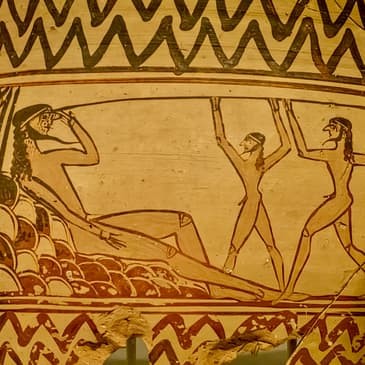
Cover image: “Archaic or late geometric period krater depicting Odysseus and a friend stabbing the giant Polyphemus in his only eye, clay, 670 BCE, Archaeological Museum of Argos.” Photo by Mary Harrsh, Wikimedia Commons.
----------
00:11 - Introduction
01:40 - What is the Odyssey?
- 01:46 - The Odyssey, the Iliad, and other epic poems
- 02:23 - The Homer problem. Do we know who wrote the Odyssey, and when?
- 06:54 - An overview of the Odyssey’s plot
- 10:14 - The poem and its 24 “books”
11:00 - The Telemachy: Narrative
- 11:23 - Athena visits Ithaka
- 12:08 - Athena’s plans for Odysseus’ son Telemachus
- 13:55 - Telemachus sets sail on an adventure to visit Nestor, Menelaus, and Helen
17:50 - The Telemachy: Themes
- 18:01 - The vulnerability of Telemachus’ position
- 19:39 - Hospitality: gracious hosts and happy guests
21:43 - Sailing to Ithaka: Narrative
- 22:06 - Odysseus escapes the Island of Calypso
- 23:18 - Shipwrecked again! Odysseus and the Phaeacians
- 29:28 - Odysseus tells the story of his adventures (the Cyclops, Circe, the underworld, the sirens, Scylla and Charybdis—and some other good bits)
- 41:29 - The Phaeacians send Odysseus home
42:11 - Sailing to Ithaka: Themes
- 42:18 - More on hospitality: bad hosts and dodgy guests
- 45:19 - Odysseus, the man of suffering
- 46:30 - Odysseus, the unreliable narrator
- 62:50 - A postscript on the poem’s mythical geography
55:37 - Ithaka at last!: Narrative
- 55:51 - Odysseus visits Eumaeus
- 56:41 - Telemachus returns to Ithaka—and Odysseus hatches a plan
- 58:42 - Odysseus among the suitors in disguise
- 59:57 - Penelope, Odysseus, and Eurycleia
- 62:23 - Penelope’s contest, Odysseus’ bow, and a massacre
- 64:48 - Reunions: Odysseus and Penelope, Odysseus and Laertes
- 65:53 - The final battle (and a deus ex machina)
66:39 - Ithaka at last!: Themes
79:41 - Final bits and bobs
81:45 - Wrap-up
Hello. Welcome to Have Toga Will Travel, a podcast exploring the Mediterranean world, ancient and modern, through the eyes of two former classics professors. I'm Emily.
Cam:I'm Cam.
Emily:And we're your hosts.
Cam:This is a big week because we are all eagerly anticipating Christopher Nolan's adaptation of The Odyssey, which hits theaters on Friday the 17th. So to get all of you ready, we're going to talk about Homer's Odyssey in a whole bunch of detail.
Emily:Now we have talked about The Odyssey before a bit when we discussed the movie The Return in our third episode, and The Return covers more or less the second half of The Odyssey.
Cam:Today though, we're going to go into the poem itself in a lot more detail than we did when we talked about The Return. We'll touch briefly on the basics. What is the Odyssey, when was it written, stuff like that. And then we're going to do a really deep dive into the plot of the poem and the poem's themes.
Emily:So before we get started, a couple of quick warnings here. One, this episode will feature plenty of spoilers for the poem, not for the movie, obviously, because we haven't seen it yet. So if you want to go into the movie without knowing much about the poem, maybe you should wait until after you've seen it to listen to this episode.
Cam:Second, this episode is going to be epic. And by that, we mean it's going to be really, really long, even by our standards.
Emily:Or maybe not. You never know.
Cam:We never know. We won't know until we've actually finished it and made the cut. But don't be surprised if that ends up being much longer than any of the other episodes we've produced so far.
Emily:So to start us off, we should talk about what the Odyssey is.
Cam:Great idea.
Emily:Imagine that. So the Odyssey is an epic poem, traditionally attributed to Homer, that tells the story of the return of Odysseus to his home on Ithaca after the end of the Trojan War.
Cam:It belongs to a collection of poems set in the Trojan War period, which told the story of the war itself and the voyage's home of most of the Greeks who fought at Troy. Loosely speaking, we call this the epic cycle. Most of those other poems are lost. Really, the Iliad and the Odyssey are the only surviving works left from the period that focused on the Trojan War and its aftermath.
Emily:Yeah. Now, like the Iliad, another Homeric epic, and the other related epics of the epic cycle, the Odyssey originates in the oral tradition, a very long oral tradition. And the key elements of this story had been told for a long time, more properly, sung to the music of a lyre before they were actually written down in some form.
Cam:Now, although both the Iliad and the Odyssey were attributed to Homer in antiquity, the two poems were in fact almost definitely not written down by the same person. Instead, it seems the Iliad probably predates the Odyssey by a substantial number of years. There are a couple of reasons to think that. One has to do with linguistics. I am not a linguist, so I'm not really going to touch on those arguments. But the other interesting detail is that the Odyssey seems to engage with the story we find in the Iliad and not the other way around.
Emily:Yeah, we get stories about the Trojan War that are told in the Odyssey. But what's interesting is that the stories that we get in the Odyssey are not stories that are covered in the Iliad. Now, this could mean one of two things, right? It could be a sign that the Odyssey was composed independently and wasn't aware of the Iliad. Or on the other hand, it's a sign that the Odyssey is functionally filling in the blanks of the Iliad without repeating it. And this gets referred to as Munro's Law after the scholar who kind of coined this argument. And basically the argument is there is an Iliad-shaped hole in your Odyssey. Right. So this actually absence of overlap is a sign that the poems are meant to be read complementary to one another.
Cam:There's a lot of debate about when precisely both of these poems, the Iliad and the Odyssey, were written down for the first time. Broadly speaking, I think a lot of people probably follow the argument of a guy named Martin West, who argued that the Iliad may have been written down sometime in the early to mid-7th century BCE, and the Odyssey perhaps a generation later.
Emily:Yeah, this is the sort of middle argument, if you will, because there are some scholars that take the composition of the Homeric poems back to the 8th century, so functionally not long after Greeks adopt the alphabet from the Phoenicians. And then there are scholars at the other extreme who argue that the Homeric poems as we know them didn't really come into existence until the 2nd century when scholars in Alexandria are gathering together the various Homeric stories that are out there and compile them and produce them in what you might call the definitive edition.
Cam:Now, those scholars in Alexandria in the late third or early second century BCE definitely did produce what became a definitive edition of Homer in the sense that most surviving manuscripts today can be traced right back to it.
Emily:Right. But the question is, to what extent were they working with a tradition that was already pretty strong, or were they creating something out of a lot of disparate parts? So it's a range there of several centuries. But for convention, we'll take the, like I said, that middle path of the seventh century.
Cam:Now, even if you adopt that view, there's still an open question about how far back in time the oral tradition on which the poems were based stretched. Did they go all the way back to the heroic or the bronze age, for instance? And that's the period in which conceptually, at least, the poems seem to be set.
Emily:However, the society that we see depicted in the Homeric texts, and especially in the Odyssey, really seems to reflect a political organization more akin to what you see in the early 7th century, you know, what we might call the Dark Ages in Greece, rather than the Bronze Age, which ended in the 12th century in Greece, which is when the Trojan War is nominally set, right at the end of the Bronze Age.
Cam:The Bronze Age is really a topic for its own episode, or, well, realistically speaking, its own episodes.
Emily:Yes.
Cam:But briefly, what we can say here is that based on the archaeology, we know that the Bronze Age in Greece was characterized by several big kingdoms with highly centralized palace structures and bureaucracies that exerted control over relatively well-defined territories. And that's not at all what we see in the Iliad and the Odyssey. We see a political structure with a much less complex level of sophistication. And that seems to fit best with what we know of the 7th century BCE, a point in time after the collapse of the Great Bronze Age societies, when the city-states that we know from the later classical period of Greek history were still in an early stage of development.
Emily:So now that we've gone over that bit of historical context of the poem, let's talk about the text itself, sort of a brief overview before we really get into the detail of the text. Now, the Odyssey is set in the 10th year after the end of the legendary Trojan War, which itself lasted for 10 years. So we are 20 years after the start of the war.
Cam:Most of the Greeks who survived the war and its immediate aftermath have returned home at the beginning of the poem. All but Odysseus, who, as we learn within the poem's first 80 lines or so, has been marooned on an island belonging to a nymph named Calypso for many years, mostly because the god Poseidon is angry with him and refuses to let him sail home to Ithaca.
Emily:The poem focuses primarily on how Odysseus returns to Ithaca with the help of the other gods, in particular Athena, and then reclaims both his household and his position as the island's chief political leader. And he does all of this against the opposition of other powerful men from Ithaca and other nearby islands who, believing him to be dead, have been trying to marry his wife Penelope and ultimately supplant him and his son Telemachus as Ithaca's primary ruler.
Cam:Now, when most people think about the Odyssey, what they think about are the fantastic adventures that Odysseus has after he leaves Troy. So if you read the Odyssey in school, for instance, you probably read an abridged version that really focused on this adventure chunk and makes it seem like a bigger part of the narrative than it actually is.
Emily:Now, we did touch on this a bit in our episode on The Return, you know, that these adventures don't take up that much space. And honestly, they only take up about 15% of the whole epic. And as we're going to talk about, these adventures are only told as a flashback by Odysseus. And Odysseus may not be the most trustworthy of narrators.
Cam:So if what you have in your head is a poem that focuses on those adventures, well, you might be in for a bit of a shock. The actual poem is quite a bit different. And I think the opening line of the poem gives us a much better summary of what the poem is ultimately about. That is a certain aspect of Odysseus' character.
Emily:The opening words are, "andra moi ennepe, mousa, polutropon," which means, tell me muse of the man of many ways. So the poem is first and foremost about a man who is polutropos, which is the word that I'm translating as "of many ways." And it's kind of an interesting word because tropos means path as in a physical path, but it also can describe more metaphorically someone's manner or habits or customs. And the polu, of course, meaning many. So Odysseus is a man of many paths, of many habits, of many manners, of many customs. And this speaks to both his journey. And of course, the poem takes its title, the Odyssey from Odysseus' name. This is the poem about Odysseus. And then eventually, because of his journeys, Odyssey comes to mean this sort of long, arduous journey. But it also speaks to his propensity to use disguises, to deceive, to adapt to the circumstances he's in. This is a poem primarily about a man, and a man who is complicated.
Cam:So now what we're going to do is dive into the poem and its themes in a lot more detail. Conventionally, the epic is divided into 24 books of about 500 to 600 lines of poetry each. Those books, roughly speaking, are about the length of the long scrolls that the scholars in Alexandria in the 3rd or 2nd century BC would have been using when they were producing their first definitive edition.
Emily:Now, from a plot perspective, we can divide those 24 books roughly into three sections, books 1 through 4, books 5 through 12, and books 13 through 24. And we're going to discuss each of these sections in turn.
Cam:We'll give you a little plot summary of each of those sections, and then we'll dive into some of the things that we think are interesting or important in each one of them.
Emily:Yes.
Cam:So let's get started. And let's get started by talking about the first of those three sections, the first four books of the Odyssey, a chunk that's often called the Telemachy, a name that references Odysseus' son, Telemachus. This section gives us a snapshot of life on Ithaca at a critical moment when Odysseus has been gone for almost 20 years, and his son Telemachus is right on the edge of adulthood.
Emily:In this section, the action begins with a conference between the gods, where Athena argues successfully that Zeus should let Odysseus finally return home. She asks Zeus to send Hermes with instructions that Calypso should let Odysseus go, while she herself goes down to Ithaca in the form of a traveler from a nearby island who is an old friend of Odysseus named Mentes.
Cam:When Athena gets there, we quickly see that the whole place is a mess, because Odysseus' great hall has been overwhelmed by the men who hope to marry Penelope, that is, the suitors, who have at this point spent three years crashing in Odysseus' house, eating all of his food and drinking all of his wine and so on as they try to force Penelope to choose one of them as her new husband.
Emily:And Athena has come down to Ithaca to rally the spirits of Odysseus' son Telemachus, who at this point is a young man of about 20, who's been watching the suitors sort of abuse his father's wealth and property for years, and who feels powerless to stop them.
Cam:Her goal here is to help Telemachus grow into a proper Greek hero by making a name for himself. And she does this by persuading him to assert himself in three ways. First, by exercising some authority within the household, which up to this point has seemingly mostly been run by Penelope as long as Odysseus has been away. So, for example, he asserts himself by speaking up a little bit against the suitors, apparently for the first time, but funnily enough, also by trying to restore proper gender roles inside the household. So in one very famous scene, Penelope comes down to try to tell the suitors off, and Telemachus basically tells her to go back upstairs and mind her weaving, which is the proper thing that women are supposed to do.
Emily:Yeah, it's kind of funny. And Penelope goes back upstairs and is so like, look at my son all grown up.
Cam:Right. My kid is bossing me around. He's finally becoming a man.
Emily:Yeah, it's I feel like not Penelope's finest moment. That's all right. She's still pretty awesome. So the second thing Athena does here is she persuades him to exercise some leadership on Ithaca. And in this case, by summoning an assembly for the first time in years. And he does so to try to make the abuses of the suitors a public issue and say, like, this is wrong. This shouldn't be happening. We need to do something about it.
Cam:And then the final thing she does is persuade Telemachus that he should go on an expedition. An expedition designed both to gather potential information about Odysseus, what happened to him, but also to establish for himself an identity in the wider world of heroes.
Emily:And this expedition quickly becomes the focal point of this section. So after Athena helps him, you know, fit out a ship and recruit a crew, he sails to Pylos to visit Nestor, who was one of the key leaders of Agamemnon's army and one of Odysseus's friends. You know, Nestor was sort of the old man advisor figure in the Iliad.
Cam:Right. If he was an old man during the Trojan War, how decrepit must he be here 20 years later?
Emily:Well, it's just like he's the old man of the Moria because he's like, he's only like 50.
Cam:Yes, yes, yes, yes.
Emily:You know. Anyway, so Telemachus learns from Nestor about the fates of several other men who fought at Troy, but not anything about the fate of Odysseus, because Nestor was separated from Odysseus during the trip home and doesn't know what happened.
Cam:So what Nestor decides to do is to send Telemachus overland from Pylos to Sparta, the home of Menelaus, in the hope that Menelaus might know more. Telemachus makes the journey, and Menelaus is able to tell him what he himself had learned from a god, a god called the Old Man of the Sea.
Emily:Proteus.
Cam:And what Menelaus says is that according to this god, Odysseus is trapped on Calypso's island with no ships and no crew to bring him home.
Emily:Now, a kind of funny note here when he's in the court of Menelaus, Telemachus also meets Helen, the famous or infamous Helen who is still queen of Sparta at Menelaus' side. And there's a sort of funny thing that happens here, which is that Helen drugs their wine at the banquet. And she does so with a drug that is designed to induce forgetfulness and dismiss sadness.
Cam:That's one way to smooth over the sort of marital discord that might be caused when one spouse starts a war on behalf of the other. You know, it's a strategy.
Emily:Cam thinks that Helen's just been drugging Menelaea since the war ended to keep the peace. But she also tells a story. She says that she met Odysseus when she was in Troy. He came in, disguised as a beggar, to do some reconnaissance work and revealed to her the Greeks' plans to take the city. And she claims that she was very excited to hear them because she was ready to go home. She was sort of tired of Paris.
Cam:Paris being the person.
Emily:Yes. Paris being the Trojan prince she had run away with. And what's interesting about this is that Menelaus had told a story about the Trojan horse, where Helen comes out and is trying to lure the Greeks out by doing impressions of their wives, calling to them to reveal themselves and that Odysseus has to hold them all back. So was Helen excited to go home? Was Helen legitimately trying to expose the Greek plot? We don't really know who or how to trust here with these stories. Maybe she was just doing bad impressions of their wives to convince the Trojans, like, is she a double agent? It's very complicated.
Cam:That story puts the whole Helen drugging everybody into perspective, though, right? Because what I have to imagine here is a drugged up Menelaus sort of saying, hey, dear, remember that time you tried to get us all killed and blow our plan as we were preparing to capture Troy? Wasn't that cool? But anyway, what's also interesting here is that this whole exchange of stories does foreshadow a bunch of stuff about Odysseus and what will come. One is, of course, that Odysseus will, as we shall see shortly, pose as a beggar again when he infiltrates his own home on Ithaca later in this poem. But the other thing this exchange sort of anticipates is a big problem that recurs throughout the poem, and that is, what stories do we trust? How do you know if someone is telling you the truth?
Emily:So, that little aside aside, Telemachus, now that he has this knowledge of his father's location, prepares to head back to Ithaca. Now, while he's been gone, when the suitors realize that he's left, they actually are plotting to kill him when he returns.
Cam:Right. So we're left on that note of uncertainty.
Emily:Yes. At the end of book four.
Cam:Right. So that's a summary of this first section, the Telemachy. And what we're going to do now talk a little bit about some of the themes that we think are important in this chunk of the narrative. And I'll start by pointing out that one of the big themes that emerges here is the vulnerability both of Telemachus himself and of Odysseus' household. As it emerges in these first four books, since Odysseus is not around, there's very little that his wife and his son and the enslaved members of his household can actually do to deal with these suitors who are hanging around, eating everything, drinking everything, and generally carrying on and abusing people.
Emily:And in part, this is because Telemachus doesn't have any real status or standing of his own, right? He doesn't necessarily inherit his father's power. And this point is made in the scene in which Telemachus tries to assert himself for the first time by arguing with the suitors in his household.
Cam:Right. There's a statement he makes, something like, there are many men with power on Ithaca, and any one of these men, perhaps including me, might become preeminent now that Odysseus is gone and rule the whole island.
Emily:Right, because birth only gets you so far in this world. So it's also critical that you establish yourself as someone who is skilled in war and politics to become the leader. And Telemachus is not skilled or experienced in these things. And this is precisely why Athena is trying to sort of push him to make a name for himself by going on this expedition and interacting with powerful allies abroad and making those connections and bringing him into that world.
Cam:Yeah, it's just worth emphasizing that for Homeric heroes like Telemachus and Odysseus, reputation and status are really important, the way in which peers view you in this world and assess your abilities.
Emily:Yeah. And your ability to have strong relationships with that, whatever you want to call it, transnational ruling class.
Cam:Right. Yes. So that's one theme that emerges here in the first section of the poem. The second one that's pretty important is a theme about, let's call it hospitality as a rough translation of a Greek word, xenia.
Emily:X-E-N-I-A.
Cam:This is essentially a relationship between a traveler and a host. And it's a theme that really gets emphasized by the contrast the poem makes between what Odysseus' household looks like in Odysseus' absence and what Telemachus experiences when visiting Nestor in Pylos and Menelaus in Sparta.
Emily:At the homes of both of those men, Telemachus encounters a well-run household in which he is welcomed as a guest, even though there's tons of other stuff going on. He's given food and drink before even being asked his identity. He's entertained by the conversation with men who regard him as a peer. And then he is sent on his way with gifts.
Cam:And for his part, he himself is a polite and considerate guest who accepts what is offered and responds with grace to a whole series of customary questions put to him by his hosts after he's been welcomed in and fed. Questions like, who are you? Where are you from? Why are you here? And part of the whole point of this episode is Telemachus learning the etiquette of this transnational elite.
Emily:Yes. And this is actually going to be an interesting contrast to how we might see his father behave in a future section. Yes. So in contrast to these well-run households, by comparison, Odysseus' household in his absence is a total mess. The suitors have almost literally invaded it. They take what they want, regardless of what Penelope and Telemachus think or are even willing to offer, and they refuse to leave.
Cam:And this, it should go without saying, is the precise opposite of how a good guest is supposed to behave. And in the world of the poem, that's actually a huge deal. It's not just that the suitors are clearly disrespecting Odysseus and other members of his household by carrying on the way they are. They're also actually disrespecting the gods, because in the world of the poems, the relationship between guests and hosts is actually something that Zeus takes very seriously in his aspect as the guardian of strangers.
Emily:Yes. So that's our rough overview of the first section. So now we're going to move on to the second section. The second section runs from book 5 through book 12, or really, you know, maybe the first couple hundred lines or so of book 13, depending on how you want to break it. And this section narrates Odysseus's journey from Calypso's island back to Ithaca.
Cam:So this section opens as the god Hermes arrives at the island of Calypso to tell Calypso that Zeus wants her to send Odysseus home. This is the second part of the two-part plan cooked up by Zeus and Athena at the very beginning of book one.
Emily:And it's finally at this point that we see Odysseus for the first time in the poem. And when we meet him, he is sitting on the beach of Calypso's island. He is weeping and wasting away from homesickness.
Cam:Calypso grudgingly agrees to obey Zeus's orders.
Emily:Not that she really has any choice.
Cam:No, she doesn't, but she complains about it.
Emily:Oh, she does. She definitely complains about it.
Cam:She has a great little speech in which she sort of complains about a sexual double standard here, right? It's okay for the male gods to take mortal lovers, but the minute she tries to do something like this, nobody's happy.
Emily:He has been there for eight years.
Cam:Yes, seven years at this point, yeah.
Emily:Seven years, yeah, okay.
Cam:So she grudgingly agrees to obey Zeus's orders, and she gives Odysseus an axe, points out where all the nice trees on the island grow, and says, hey, go build yourself a raft, and I'll outfit it, give you food, drink, all that stuff, and you can sail your way home.
Emily:So Odysseus builds his raft, and he sets out to sea on his raft, and he sails for 17 days. But he is unfortunately spotted by Poseidon, who of course has not been told by Zeus that Odysseus should be allowed to go home. And Poseidon, when he realizes what's happening, is enraged and summons a storm that wrecks Odysseus' raft and nearly drowns Odysseus himself.
Cam:But thankfully for Odysseus, Athena and another goddess work against Poseidon to save Odysseus. And instead of drowning, he finds himself spit up on another island, which we learn in a bit is an island inhabited by people called the Phaeacians.
Emily:So just as a note, Cam pronounced it Phaeacians, which is closer to how it would have been said in Greek. I tend to say Phaeacian, which is an anglicized pronunciation of it. So Phaeacian, Phaeacian, same people, different language pronunciations.
Cam:Yeah, I'll try to go with Phaeacian too, but I'm not going to promise that I'll be consistent about that.
Emily:Anyhow, here on this island, Odysseus first encounters a young woman named Nausicaa and her companions. Nausicaa happens to be the daughter of the most powerful Phaeacian lord, and she has been inspired by Athena that morning to go with her friends down to the beach for a day of doing laundry and picnicking and playing catch.
Cam:So this leads to a moment of comedy as a naked, bedraggled, and probably pretty haggard-looking Odysseus staggers out of the bushes, literally holding a branch.
Emily:And nothing else.
Cam:And nothing else over the important bits, and asks all of these aristocratic teenage girls for help.
Emily:Which, of course, brought most of them to run away in fear.
Cam:Scream and run away, yes.
Emily:Yeah. But more importantly, this actually does lead to Odysseus getting some help. Nausicaa does not run away from him, and eventually she decides that he is worth helping. She and her friends help get him cleaned up a bit. They get him some clothes, because of course they were doing laundry, and give him some food. And Nausicaa tells him that he needs to go talk to her parents, Alcinous and Arete, who are rulers and may be able to get him home. And what's sort of really interesting here is what she tells him to do is to go in and just ignore her father and go directly to her mother and supplicate her mother. Go to the queen first, for lack of a better word, and just ignore the king.
Cam:Yeah, I don't really want to speculate about what that says about their home life. But anyway, that's what Odysseus does. Following Nausicaa's advice and with Athena's help, Odysseus is able to sneak into the city of the Phaeacians, who we're told, tend to be a little bit suspicious of strangers and might react with hostility to him. And he throws himself on the mercy of Nausicaa's mother, who, along with her husband, is in the middle of hosting a banquet for other leading Phaeacians.
Emily:Now, in spite of their suspicion of strangers, Odysseus' supplication is successful after a tense couple moments where sort of nobody does anything. And then one of the elders in the court has to kind of speak up and invoke Zeus's protection of suppliants before Alcinous acts and accepts him as a guest.
Cam:Right. A very clear appeal to something we've mentioned already, Zeus's interest in protecting strangers. Yeah. And once moment of tension is resolved, the Phaeacians actually turn out to be fantastic hosts, the kind Zeus would approve of. They welcome Odysseus, they sit him down, they feed him, and most importantly of all, from his perspective, they promise that they'll deliberate about how they can get him home on the following day.
Emily:Now when the following day comes, they hold another feast and there's singing and dancing and athletic contests. Odysseus gets sort of goaded into participating in these contests, and he handily beats all the other competitors in the discus throw.
Cam:And in fact, he impresses everybody enough with his behavior that day that they're happy to offer him valuable gifts as they continue to prepare to send him home.
Emily:Now, Odysseus's behavior in all of this is actually pretty interesting, because it's clear that he's up to something, even as he's acting like a good guest.
Cam:Yeah, the first sign that he might be up to something is his response to the inevitable questions that come his way after he's been given his first meal at the Phaeacian court. Questions like, who are you? Where are you from? How did you get here? That kind of stuff.
Emily:Why are you here?
Cam:Why are you here? Yeah. And Odysseus answers these questions, but he does so very, very selectively. So conveniently, he forgets to tell them his name. Forgets.
Emily:Yeah.
Cam:In scare quotes.
Emily:Yeah.
Cam:And then he goes on to give a very, very detailed account of a very, very small slice of what has happened to him over the past few years. He tells the Phaeacians that a shipwreck left him marooned on the island of Calypso for seven years until she finally decided to let him go. And then a second shipwreck left him washed up on the island of the Phaeacians themselves, where he encountered Nausicaa and her friends.
Emily:A sliver of his experiences, or basically his whole experiences?
Cam:Well, this is something we'll get into in another couple of minutes, yes.
Emily:Now, the festivities continue actually on even to the next day. But then something happens. They've brought a local bard, Demodocus, into the court to sing and perform. And they notice that Odysseus starts getting a little weepy when the bard starts singing about the Trojan War, which at this point has already become kind of the stuff of legend.
Cam:In the world of the poem.
Emily:In the world of the poem.
Cam:And in fact, at one point, Odysseus himself requests a very specific song from Demodocus. Odysseus wants Demodocus to sing about how he himself, Odysseus, came up with the scheme to capture Troy by having the wooden horse built, the famous Trojan horse, and then how he fought a duel with Deophobos in order to rescue Helen after the Greeks had broken into the city.
Emily:And while he's listening to this song, Odysseus completely falls apart and just breaks down. And this is what gets the Phaeacians to finally say, all right, who are you exactly? Because they don't know yet. The dude's been in their court for two days and they don't know who he is. So who are you and why is this stuff making you cry so much?
Cam:And this gives Odysseus presumably exactly what he was looking for, right? A prime opening to make the big reveal. And he proudly announces his name to everybody in the hall. He is none other than Odysseus, son of the great Laertes, in the line of Zeus.
Emily:But Odysseus doesn't stop with his name. Instead, at this point, he launches into an account of everything that has happened to him since the fall of Troy. And it's a lengthy account that takes up almost four books of the poem's 24 books total. And this is the part that features most of the stories that people today associate with the Odyssey.
Cam:It's a long list. We're going to go through it. We'll probably be pretty brief when it comes to most of these events. But as you'll see there are a few episodes here that are really worth talking about in some detail.
Emily:Yeah.
Cam:So Odysseus' story starts with his description of his raid on the city of the Cicones, which after leaving Troy, he attacked and pillaged, killed all the men, and enslaved all of the women.
Emily:From there, they go to the island of the Lotus Eaters, people who, while intending no harm, feed his men the lotus, and this makes them lose their desire to go home.
Cam:Not something you want if you're trying to get your ships back home.
Emily:No.
Cam:Following the island of the Lotus Eaters, Odysseus and his men visit the island of the Cyclopes. This is one of the most famous stories in the whole of the Odyssey. Basically, Odysseus and his men wander into the cave of one of the Cyclopses, a guy named Polyphemus, and get trapped there by the Cyclops, who, it turns out, is intending to eat all of them. Although, luckily for them, he only manages to snack on a few of them before the episode ends.
Emily:Bashes their brains out on rocks like puppies.
Cam:Yes, yum yum. Odysseus and his men will escape from this sticky situation by getting the cyclops drunk, by blinding him while he's asleep, driving an enormous stake into his one eye, and by then hugging on to the bellies of the sheep that the cyclops keeps in his cave. So when the cyclops opens the door the next day to let the sheep out and very carefully feels what's moving around him to make sure none of Odysseus and his men are slipping out, Odysseus and his men are, in fact, ensconced safely underneath the animals and sort of ride out underneath them.
Emily:Now, there are a couple of famous moments in this scene, one in particular, when Polyphemus initially asks Odysseus to identify himself—right, the who are you question—Odysseus responds with the word "Outis" in Greek, which means no one. So when Polyphemus is blinded and is shouting for help from the other Cyclopes, he says, no one is hurting me. And the other Cyclopes are like—
Cam:Oh, well, then I guess there's not much we can do here, right?
Emily:Yeah, no one's hurting you. Now, when Odysseus and his men have managed to escape, and they're on the ship, and they're leaving, and Polyphemus is trying to, you know, throw boulders at them to sink the boats, etc.
Cam:Which, you know, is a bit of a challenge when you've just been blinded.
Emily:Yeah. Odysseus can't help but reveal his true identity. He tells Polyphemus that he is Odysseus, the sacker of cities and the son of Laertes. And now Polyphemus knows which name to put in the prayer.
Cam:Right.
Emily:Because Polyphemus' father is Poseidon. And so he praised Poseidon to keep this guy Odysseus from ever returning home. Or that if he is fated to go home, then may he come home late with no companions in someone else's ship and find trouble at home. And this is, of course, what stirs Poseidon against Odysseus and makes him an antagonist to Odysseus in the poem.
Cam:Yeah, it's an important moment, right? Because it's at this moment that Odysseus sort of succumbs to that love of the Homeric hero to glory and reputation. And he really needs to have it publicly made known that it's he, Odysseus, who has outwitted the Cyclops. Maybe he would have thought differently had he known that Poseidon was in fact Polyphemus' father, but alas, he did not. And now he's cursed to wander around for, you know, another 10 years and suffer all sorts of mishaps. Anyway, after leaving the island of the Cyclopes, Odysseus and his men then encounter Aeolus, the master of the winds. After hosting him in his palace, Aeolus gives Odysseus a gift, a bag in which Aeolus has trapped all of the winds except for Zephyr, the west wind.
Emily:Yes.
Cam:And the idea here is that with all of the other winds trapped, Zephyr will be able to carry Odysseus and his men home. Odysseus and his men actually get literally within sight of Ithaca when Odysseus' men, thinking that the bag is actually full of some kind of loot that Odysseus is hiding from them, get too curious and open it, releasing all of the winds. And of course, at that point, they immediately get blown all the way back into the middle of nowhere and end up back at Aeolus' island.
Emily:Yes. And when they get back to Aeolus' island and say, hey, could you help again, he's like, hard pass.
Cam:Yes, you guys are clearly cursed.
Emily:Yeah. He's like, nope. He just sends them away. And he says that they are basically cursed. And then it would go against all that is right to help a man so despised by the gods.
Cam:Right. So that's kind of a bummer for Odysseus to hear that.
Emily:Yeah.
Cam:And things get even worse because the next thing that happens is that Odysseus and his men land on the island of the Laestrygonians. Everything seems normal. A couple of men Odysseus sends out to scout the lay of the land run into a girl who agrees to lead them to her home and introduce them to her father. Great, they think, and they follow her and they get into the home of her father. And it turns out that her parents seem to be giants. Her father grabs one of them up and eats them. And this leads to a horrible scene in which the Laestrygonians chase them all down to the shore, start throwing boulders at the ships, wreck all ships except for Odysseus' own ship, and then fish the men out of the water and eat them up.
Emily:Yeah. Now, at this point, Odysseus has lost most of his group, right? He's down to one boat. And they end up at the island Aeaea, which is the home of Circe, who is the niece of the sun god. Now, here, the men are initially reluctant to go ashore.
Cam:Gee, I wonder why.
Emily:And one of them even says, look what happened before when we've gone ashore.
Cam:Yes. What's going to try to eat us here?
Emily:Yeah. Now, Odysseus, let's say, is dismissive of this concern, and they send a party ashore to investigate what's going on. Circe welcomes the men, and then when she's feeding them, includes a drug in the food that turns them all into pigs. Now, one man manages to escape and is able to go back to the ship and tell everyone what happened. Now they have to go rescue the men who've been turned into pigs and figure out how to turn them back.
Cam:So Odysseus is trapped in this sticky little situation. But happily for him, he manages to meet Hermes, who is wandering around on the island. And Hermes does two things. First of all, he gives Odysseus a protective herb that will shield him from whatever it was that Circe added to everybody else's food that turned them into pigs. Second, he gives Odysseus some practical advice for dealing with Circe . And what he says is, you know, when she tries to turn you into a pig, attack her with your sword. She'll back down and she'll actually invite you into bed. You can't turn her down because this is how you're going to end up getting your comrades turned back into people. But important safety tip: before you actually do get into bed with her, make her promise not to quote unquote unsex you while you're naked.
Emily:And so of course Odysseus follows this advice. His men are turned back into people and they actually end up staying there on Circe's island for a whole year until Odysseus' men get insistent that they really actually do need to go home now. And so they set out on their voyage, but Circe actually gives them some tips for what they actually need to do next rather than just going home.
Cam:Right. What she tells Odysseus is that he actually needs to sail not straight to Ithaca, but rather into the underworld for a very specific purpose, to go seek advice from the ghost of Tiresias, a famous seer, so that Odysseus can learn how he might someday make his peace with Poseidon. Odysseus goes, has that important conversation, is given a bizarre prophecy about what will happen many years in the future. And along the way, of course, he encounters a whole bunch of dead Greek heroes in the underworld, people like Agamemnon and Achilles, all of these men who fell at Troy or during the voyage home.
Emily:So after this consultation with the underworld, they return back to Circe's island for some more advice about the rest of their journey and what they're going to encounter and how best to deal with it. And Circe describes the obstacles, for lack of a better word, the obstacles—
Cam:The obstacles.
Emily:The obstacles.
Cam:That's a really inside joke.
Emily:That's for another episode.
Cam:Yes.
Emily:That they're going to encounter and how to get past them safely.
Cam:The first of these obstacles are the sirens. These are basically harpy creatures, bird-like creatures with the upper bodies and heads of women who have a tendency to enchant men with songs and lure them to their death on the rocks below their nesting spot.
Emily:Yes, the men jump ship and try to get to them and are dashed to pieces on the rocks.
Cam:And what Circe tells Odysseus is, okay, this is how you deal with them. You shove wax into the ears of all your men so they can't hear the siren's song and you'll be able to just roll past them. But knowing you, you'll probably want to hear it. So make sure you have your guys tie you up really, really tightly to the mast and tell them very specifically that when you start begging to be released, they should just tighten those ropes even more.
Emily:After the sirens, they're going to encounter two monsters who sit on either side of a strait called Scylla and Charybdis. Now, Charybdis is basically a whirlpool that will suck your ship into it. And Scylla is a monster living on the other side that has dog heads in her lower body, and she will chomp on your men. Now, the advice here is to sail closer to Scylla, because if Charybdis pulls you in, that's it. You're done. But what it does mean is when Odysseus gets there that, of course, Scylla gets to chomp on some of his men because they are close enough to her that she can grab men off the boat. And that's what happens, right? He doesn't tell his men this is what's going to happen.
Cam:He lets it be a surprise that there's one more thing that's going to eat them.
Emily:He doesn't tell them about Scylla. He just tells them, oh, we're avoiding this whirlpool and functionally sacrifices six men to get by.
Cam:And this leads us to Odysseus' last stop before getting marooned on Calypso's island, and that is the island of the god Helios. Odysseus has been warned very specifically to be careful here, because Helios keeps a herd of cattle there, which he really, really loves. He loves going up in the sky every day in the sun chariot and admiring the cows, I guess, as he soars past. Unfortunately for Odysseus, he and his men end up getting stuck there for a while because of the weather, and they run out of food. And at some point, his men decide to start eating some of the cattle of the sun.
Emily:Which are like mooing as their bodies are roasting, which is like never a good sign.
Cam:No, that's never a good sign. That's a sign right away that something is off. But they eat the cows up anyway. And of course, as you can imagine, this angers the god Helios, who complains to Zeus. And the upshot is that once Odysseus sets sail, Zeus promptly whacks his ship with a lightning bolt that completely obliterates it and kills everybody but Odysseus himself.
Emily:Now, Odysseus manages to survive by clinging to wreckage from the boat. However, they are close to Charybdis. And since we're now just dealing with wreckage, right, you can't avoid being swept into the whirlpool. And so all of the boat debris is sucked into Charybdis. Odysseus manages to survive, however, by holding on to like a fig tree that's nearby. He gets a hold of it, he holds on, and he basically waits until Charybdis spits the timbers back out. So imagine this, like, everything gets sucked down for a bit, and then it all gets spit back out. And then he manages to grab a hold of some of the ship's timbers and drifts until he lands at Calypso's Island.
Cam:And that's it. That's the end of his story, the story that he tells to the Phaeacians. And when he does reach the end of this very long story, which again takes up four whole books of the poem, the Phaeacians are completely blown away, both by what they've heard, the nature of Odysseus' experiences, but also by the skill with which Odysseus tells the story.
Emily:Yeah. And as a result, they give him even more gifts than they already had. And they place him on a magical ship, which whisks him away to Ithaca, where the Phaeacians who were sailing the ship deposit him on the shore while he sleeps, along with all of his gifts. And Odysseus has finally gotten home to Ithaca.
Cam:With no men.
Emily:With no men.
Cam:But with lots of loot.
Emily:Yes.
Cam:An acceptable trade-off? Who can say? All right, so let's talk for a little bit about some of the themes that are in play in this second section of the poem. And to begin with, it's worth pointing out that this whole second section further elaborates on the hospitality theme that we touched on in our discussion of the first section. Here, the Phaeacians in particular are clearly great hosts who take really great care of Odysseus, shower him with gifts and loot, and send him on his way.
Emily:But the section also offers some bad examples of hospitality, and this mostly comes in Odysseus' stories. Now, one really obvious one, right, is the Cyclops. It's not good to eat your guests. You're supposed to feed them, not feed on them.
Cam:The Cyclops is also kind of interesting because he seems to intentionally mock the custom of giving gifts to your guests by offering a very special gift to Odysseus. And that gift is that he'll eat Odysseus last after he's eaten up all of his friends first.
Emily:Yeah. And Odysseus links all of this in his narrative explicitly with the idea that, you know, the Cyclopses don't have cities or laws. They're literally uncivilized by some measure of that word. And in doing so, he identifies proper hospitality as a basic element of civilization, so to speak.
Cam:Right. And this obviously casts kind of a strong light on what the suitors are doing back in Ithaca.
Emily:Yeah.
Cam:They're acting in some sense uncivilized. The Laestrygonians are equally bad because they too have a habit of eating strangers who wash up in their lands.
Emily:We get to Circe, right? And Circe, you know, perverts the idea of hospitality by feeding guests, but feeding them something that turns them into animals.
Cam:Yeah, I guess we should establish some rules here. Don't eat your guests. Don't turn your guests into animals.
Emily:I mean, don't abuse your guests, you know, broadly speaking. Yeah.
Cam:But interestingly enough, Odysseus himself and his men are not completely blameless when we think about how hospitality is being discussed in this second section. So just by way of example, the very first adventure Odysseus describes to the Phaeacians is his decision to sack the city of the Cicones, to plunder their town, to kill all the men, to take all the women into slavery. Here, Odysseus and his men are really blurring the line clearly between stranger and pirate. And that raises a problem. How do you know if a stranger is going to be hostile or not?
Emily:Yeah. And when we get to the island of the Cyclops, Odysseus' men initially just want to ransack his cave and steal all the stuff and run off with it rather than waiting around for Polyphemus to show up. And Odysseus is totally okay with them treating Polyphemus' home as their own and eating all of his food without asking or being invited. But he also wants to stick around and sort of invoke this guest host relationship to try to get even more from Polyphemus. So he's being very manipulative of it there, right? He's perfectly happy to act as a bad guest and then try to convince Polyphemus to be a good host.
Cam:Yeah, I kind of feel for Polyphemus a little bit when Polyphemus saunters in and says, oh, hey, guys, clearly you're pirates.
Emily:Yes.
Cam:Roaming around causing no good to everybody.
Emily:Yeah.
Cam:Yes, that's exactly what they are at this moment in the narrative.
Emily:Yeah.
Cam:So that's one of the themes that gets developed in this long second section. But what this section also does as a whole is it really emphasizes Odysseus and certain aspects of his character. So first, and sort of on a basic level, it picks up on something that's been mentioned about Odysseus at the very beginning of the poem. That is, Odysseus is someone who has suffered a lot.
Emily:Yeah, he is the last of the veterans of the Trojan War who's still alive, who has not made it home. He's been stuck on this island for years, pining away for his home.
Cam:And most importantly, all of the friends and supporters who set out with him from Ithaca and the surrounding islands to fight the Trojan War in the first place, the crews of 12 ships, so that's maybe 600 people or so, all of these guys are dead. Odysseus is now alone and he's lost all of his friends.
Emily:Yeah, and this idea that Odysseus is someone who suffers was prevalent in antiquity because you get this kind of folk etymology that connects Odysseus' name for a verb, odussomai, which means to mourn or lament. And so people really saw this as sort of fundamental to who he was, right? This idea of Odysseus' suffering. Now, another characteristic that comes out in this section that is perhaps even more core to Odysseus' character than the idea that he suffers is the idea that Odysseus is someone who is full of metis, M-E-T-I-S, which means something like cleverness, wiliness, something like that. And this can mean, among other things, he is someone who has the ability to come up with clever or even tricksy plans or strategies.
Cam:Right. And that gets really emphasized in some of the stories that are told about Odysseus during this chunk of the poem, whether stories told by Demodocus or stories told by Odysseus himself. So Demodocus tells the story about the Trojan horse, which was an idea conceived by Odysseus. And then Odysseus himself tells us how he tricked Polyphemus.
Emily:At the same time, Metis can also be taken to mean someone who is really good at what we might call scheming or even outright deception.
Cam:Right. And this proves to be an even more elemental aspect of Odysseus' character later in the poem. But here, in this section, the poem actually leans into that idea of Metis as deception and scheming by playing with the idea that Odysseus is a masterful, but at the same time, totally unreliable narrator.
Emily:And it does this by giving him this incredibly detailed and compelling story about his adventures, all the while signaling in various ways that maybe we shouldn't trust him.
Cam:Yeah, the first signal that this is the case is simply the way that Odysseus sets up the whole conversation. He's clearly manipulating things in a way designed to ensure that the Phaeacians not only send him home, but send him home with piles and piles and piles of loot, way more than the typical gifts associated with hospitality.
Emily:And the way he's doing this is he's trying to wow them by beating Demodocus at storytelling, right? He sets Demodocus up to tell a story about himself that then prompts them to really interrogate who he is. And then that leads him like, and now I'm going to tell my story, and I'm going to like one up this bard.
Cam:In the same way that he one upped the other discus throwers.
Emily:Yes. Yes. And of course, this works. Not only do the Phaeacians praise him for his storytelling skill, but the queen Arete urges them not to be stingy with their gifts to Odysseus and to give him more.
Cam:But perhaps the clearest signal that we can't necessarily trust what Odysseus is saying in this long narrative is the fact that as he begins to tell the story, the poem describes him with a very specific word, the adjective polymetis. Poly plus metis. So it means something like really wily, really cunning.
Emily:Yeah, and this is a stock epithet that gets used to describe Odysseus in a lot of the Odyssey, but especially when he's in the middle of spinning a tall tale, or concealing who he is, or something like that, generally being deceptive, which he does a lot.
Cam:Yeah, and the poem uses that word right at the beginning of Odysseus's story. And what the poem says is, in response to Alcinous, wily Odysseus said this. And that should really prime the reader, I think, to expect a story which is not necessarily true.
Emily:Yes. And the poem is going to do this again at a sort of funny moment when Alcinous speaks up after Odysseus has told the story about his conversation with Tiresias in the underworld. So we have some back and forth between Phaeacians and Odysseus amidst the larger narrative that Odysseus is telling.
Cam:Alcinous breaks in and says something like, we'd never expect you for the sort of person who would make up a bunch of lies. You speak way too well for one thing. You tell this story like a really great bard. Go ahead, tell us more about your weird adventures in the underworld.
Emily:And of course, Odysseus is only too happy to do so. And once again, the poem kicks his narrative off by saying, "Wily Odysseus replied" and has him carry on with his story, starting with even more incredible details about his trip to the underworld.
Cam:And then finally, right at the end of this episode, immediately after the Phaeacians drop Odysseus off on Ithaca, The first person Odysseus encounters there is actually Athena, who, like Odysseus himself, has a penchant for disguise, and who appears to Odysseus in the form of a young shepherd. Odysseus, immediately hatching a new scheme, starts to spin a story to this person he thinks is a shepherd about how he is in fact in exile from Crete, and starts giving a complicated and totally fictional narration of what has brought him to Ithaca.
Emily:Now, it's Athena, right? So she knows that it's not true. And she basically laughs at him and reveals herself as a god. And then, you know, kind of pats Odysseus on the head and, you know, says something kind of like, you really just can't help yourself, can you? Like, you love telling these deceptive stories and being sneaky, even to a god who's going to see right through them.
Cam:Yes.
Emily:But she likes Odysseus, so this isn't a problem. She just finds it like...
Cam:She finds it adorable.
Emily:Yeah, yeah.
Cam:But all of this really does make it seem like we're supposed to see Odysseus' story here, the story about all his crazy adventures, not really as the truth, but rather as a cleverly told collection of maybe half-truths and outright fictions, which, among other things, absolve him of most, not all, but most of the blame for the fact that he's come home after 20 years and all of his other friends and supporters are dead.
Emily:Yeah. Now, you know, it is worth saying that the poem is, I guess, at best ambiguous.
Cam:Yeah, it doesn't really take a strong stance.
Emily:No, because we have all these clues that maybe Odysseus isn't being totally truthful. At the same time, at other points, the poem's narrator really does presume the truth of some, if not most, of these stories that Odysseus has shared. So it's hard to say where the poem falls, right?
Cam:But to emphasize a point we've already made, the characterization here of Odysseus as somebody who can spin these yarns really does establish him firmly in the minds of the audience as a schemer, somebody who has a penchant for telling fictions and lies and making stories up. And of course, along the way, it must have been great fun for the performer who was singing this composition, being really persuasive, channeling the words of Odysseus.
Emily:Yes. And now one of the sort of interesting parallels to the fantastical nature of Odysseus' stories is that the stories really engage in what we might call mythical geography, a geography that doesn't actually map to the real world. Much of Odysseus' journey can't really be mapped onto real places. But what's kind of funny is that people have been trying to do this since antiquity. Like they've been trying to figure out where all of these things really happened, which is kind of missing the point of the story. But these attempts go back to antiquity, at least as far back as Herodotus in the 5th century BCE, and probably earlier. And then this becomes really prominent in the Hellenistic period, where the Alexandrian scholars are really intensely focused on like, plotting where each of these things happened and trying to find evidence for it. So for example, you know, in the first century, we get Strabo, who sort of inherited this Alexandrian tradition, who very much wants to believe that all of these things can be placed. And quotes sort of negatively, this guy Eratosthenes, who said, and the quote's pretty good, Eratosthenes had said, you will find the scene of the wanderings of Odysseus when you find the cobbler who sewed up the bag of the winds, which is basically like, it's not going to happen.
Cam:That's a great quote.
Emily:Yeah.
Cam:To me, what's funny here— so Eratosthenes is known as a bit of a polymath who worked in a whole bunch of different academic disciplines. He was the chief librarian of the famous Library of Alexandria in the late third century BCE. He calculated the circumference of the earth. I think he came up with the term geography.
Emily:Yes, he coined the term geography.
Cam:He produced an estimate for the date of the sack of Troy. And in this quote about the wanderings of Odysseus, I mean, it's clear that he's thinking from the perspective of a scientific geographer and sort of dismissing the value of the Odyssey, the text, as a reliable guide to real world geography. But in that quote, I also see maybe recognition that even within the world of the poem, Odysseus's story is just totally false.
Emily:Possibly.
Cam:If that's true, you know, there are definitely ancient readers who did respond to Odysseus's story in the way that we've just been responding to it.
Emily:Which is funny because, of course, Eratosthenes takes as true the Trojan War itself. So he's not like a full-on skeptic, but he's pointing out that like, you can't map this. This isn't real on some level. So that's all to say that this tension of how real were Odysseus's journeys, this is a discussion that goes back to antiquity. I mean, we could talk at much more length about this stuff, but we should probably transition to the third section.
Cam:Right. Fascinating though it is to talk about Odysseus' unreliable narrator. We should move on.
Emily:So the third and final section, which is basically the second half of the Odyssey, focuses on Odysseus' efforts, now that he's back in Ithaca, to reclaim his place and his household and to punish the suitors.
Cam:Following Athena's advice, Odysseus heads to the home of his old enslaved swineherd, a guy called Eumaeus, who happens to be fiercely loyal to Penelope, to Telemachus and to the memory of Odysseus himself.
Emily:Now, Odysseus has been magically disguised by Athena so that he looks like a haggard old man, and he pretends to be a broken-down old adventurer who has fallen on hard times and is now a beggar.
Cam:Eumaeus welcomes this bedraggled old beggar into his hut, and the disguised Odysseus spends time as Eumaeus' guest while the two men bond over the campfire, essentially, by telling stories about the past. And of course, Odysseus manages during these conversations to turn them to his own devices by gathering a great deal of intelligence about how things actually stand in Ithaca and his household 20 years now after he set out.
Emily:Meanwhile, we actually return to Telemachus, who he'd left at the end of Book 4 out on his journey, but was going to face a threat from the suitors on his return. So Athena goes to Telemachus, who is still in Sparta, and prompts him to return home. She, of course, is aware of the plot against him and helps him avoid the ambush that the suitors have set for him at sea. And then she inspires, let's say, him to land on Ithaca near Eumaeus' hut, which, of course, he visits for information about what's happened while he's been gone.
Cam:There, Telemachus encounters Odysseus, who once again is in disguise. So Telemachus does not recognize his father at first. And I mean, why would he? He's never seen his father, for one thing.
Emily:Yeah, I mean, well, he might have seen him, but not in an age at which he would remember.
Cam:Right.
Emily:Anyway, while Telemachus is there, Eumaeus is sent out on an errand, and Odysseus takes the opportunity of his absence to reveal himself to his son and reveal his true identity. And he manages to convince Telemachus that he is, in fact, his father Odysseus. And Athena kind of helps by giving him kind of a like Athena glam up makeover.
Cam:Yes. The Athena makeover.
Emily:The Athena makeover. Yeah.
Cam:This happens previously in the poem too, when he meets Nausicaa for the first time, I think, right?
Emily:Yeah. It's going to happen a few times where she makes him look, you know, stronger and bigger and shinier and, you know.
Cam:Just to impress everybody that he meets.
Emily:And so Telemachus accepts him as his father and Odysseus then sort of briefs his son on what he thinks the two of them need to do regarding the suitors.
Cam:Odysseus' plan, it turns out, is to enter his own household as a beggar to scope things out a little bit more and to lay the groundwork for his revenge. That is to lay the groundwork for eliminating the suitors. Telemachus' job is to go home, wait things out, and to help by getting all of the weapons on display in the Great Hall moved into storage so that the suitors won't have them to hand when the critical moment comes.
Emily:So they put this plan into motion. Odysseus is led to his old home by Eumaeus, who still thinks that Odysseus is nothing but this burnt out adventurer beggar, but that this Odysseus in disguise character has news to give to Penelope about her husband.
Cam:So once he's brought into his old home, Odysseus spends some time moving around amongst the suitors, disguised as this beggar, under the pretense that he's there essentially to do what beggars do, right? To ask for food, to ask for handouts, that sort of thing.
Emily:Now, in addition to, of course, giving Odysseus the chance to basically do some recon work, this is also an opportunity for the poem to show just how terrible the suitors are. Most of them insult or abuse Odysseus, especially the two ringleaders, Antinous and Eurymachus. They also goad Odysseus into a bare-knuckle boxing match with the local town beggar. There's a contest set up of like, well, if you can beat him up, you can supplant him as like the official beggar of the palace.
Cam:Yeah, or a mascot or whatever.
Emily:Yeah. And it's a pretty gruesome fight. Odysseus does win. In addition to this, right, the suitors become wildly drunk and disruptive and just generally being awful nuisances.
Cam:Now, eventually, in the evening, once things have settled down a little bit, Penelope is able to arrange a quiet conversation with this beggar who has showed up at her house, apparently bearing news of Odysseus. And her goal here, of course, is to figure out whether he does actually have any real news about her missing husband.
Emily:Now, Odysseus, of course, does not disappoint. He spins out a sort of complicated and deceptive cover story about who he is and how he came to Ithaca. And then he swears that Odysseus is near and will be home before the end of the month.
Cam:At this point, in a moment of very high tension, Odysseus' cover is actually almost blown by the household nurse, Eurycleia, who's ordered to wash his feet during a lull in the conversation. Eurycleia sits Odysseus down and starts to wash his feet, and she notices a very distinctive scar on Odysseus's thigh, a scar that was created when Odysseus was gored by a boar during a boar hunt as a teenager. And once she sees that scar, she knows instantly who Odysseus is.
Emily:Now, she is not the first being, let's say, to recognize Odysseus. Because as he initially approached the palace with Eumaeus, his old hunting dog, Argus, who is old, he's been mistreated by the suitors, he's basically lying on a dung heap, recognizes Odysseus as soon as he comes back. Like, he lifts his head, he smiles, he wags his tail, and then he dies.
Cam:Yeah, it's a pretty heartbreaking little scene.
Emily:Yeah, yeah, the scene gets me every time. And, you know, Odysseus can't do anything to comfort the dog or to give him the affection that he wants to and that the dog has been missing. But it's like all the dog needs is to know that he's back. It's just such a it's such a heartbreaking scene. And it's so recognizable, right? It cuts across time and culture in a really poignant and profound way.
Cam:Of these two recognition scenes, the one featuring Eurycleia poses a much bigger threat to Odysseus because the instant Eurycleia figures out who he is, her immediate reaction is to run and tell Penelope. And Odysseus has to basically physically restrain her and threaten to kill her, essentially, if she lets anyone know who he actually is. Once that crisis has been averted, Odysseus then resumes his conversation with Penelope, who's been, I don't know, off looking at the wall or something during this whole little exchange with Eurycleia. And here, Penelope decides to make a profoundly important statement. What she says is that she has decided to choose a new husband by staging a contest. That contest will revolve around the bow of Odysseus, which is laid up in the storeroom. Her idea is that each suitor will have one chance to string Odysseus's old bow and loose an arrow straight through the rings of a dozen axe heads that will be placed in a line. Whoever can do this, she says, will prove himself worthy to be her new husband.
Emily:Because this was something that Odysseus could do, so this is how—
Cam:This is a trick he would pull at parties, apparently.
Emily:You could step into his footsteps. So the next day, Penelope has Odysseus' bow and arrows retrieved from the storeroom, enters the hall, and announces the terms of her contest to the suitors.
Cam:Now the suitors are all in, especially the ringleader Antinous, who's sure that he's going to be the one to win. As you can probably guess, though, things don't go completely according to plan. And as the suitors take the bow, it turns out that none of them can even string the thing, let alone draw it and loose an arrow.
Emily:So after all of the suitors have tried and failed, the disguised Odysseus asks for his chance.
Cam:The suitors, of course, think that this is a ridiculous idea and that it's preposterous that the beggar would even ask. But Telemachus steps in and insists that if anybody can decide what to do with the bow, it's him. And he insists that the beggar can have a turn too, even if there's no realistic hope that a beggar could marry Penelope.
Emily:So Odysseus takes the bow, and surprise, surprise, he is not only able to string it, but also to send an arrow straight through the holes in the axe heads. And at this point, he then promptly starts shooting at the suitors. They're just sort of realizing, oh crap, what happened? And Odysseus is setting off this bloody battle in his hall. Now, while the suitors had been trying to string the bow, Odysseus had sort of subtly revealed himself and his true identity to Eumaeus and to the loyal cowherd, Philoetius. So when this battle erupts, Odysseus, Telemachus, Eumaeus, and Philoetius attack the suitors and kill all of them, along with the enslaved members of the household who had cooperated with the suitors over the past few years. It's a pretty gruesome bloody scene.
Cam:Yeah, Homer does not hold back.
Emily:No, it's not romanticized at all.
Cam:No. At the end of that scene, though, Penelope and Odysseus are finally reunited. But Penelope gives Odysseus a test. She refuses to acknowledge his identity at first. After he gets frustrated trying to convince her that he really is Odysseus, he sort of gives up for the moment and says, I'd really like to sleep now. And Penelope says, okay, fine. We'll have Odysseus' old bed brought out for you. And Odysseus loses it at this point because he knows that his bed is actually built into the structure of the house around a tree that grows through the bedroom. And he's like, what has happened to my bed? Significantly, nobody else knows about the bed other than Odysseus and Penelope. So this becomes Penelope's way of getting the evidence that this is, in fact, Odysseus.
Emily:Now, the next day after the slaughter and their reunion, Odysseus goes to visit his father, who has more or less become a recluse on the island. And this is kind of a weird scene because he gets there and he initially lies about who he is to his father before he then eventually reveals who he is.
Cam:He really just can't help himself.
Emily:He really can't.
Cam:And then finally, this section, and in fact, the poem, concludes with one more battle. The families of the suitors, who have just been slaughtered, come after Odysseus and his supporters, looking for revenge. Odysseus and his friends and his father go out to confront them, and Odysseus' father, Laertes, kills their leader with a well-thrown spear. Our heroes are about to massacre everybody, but then Athena and Zeus intervene to stop the fight. And the expectation here that Zeus is somehow going to magic away the suitors' memories of the deaths of their family members so that there can be peace in Ithaca. And there ends the poem.
Emily:There ends the poem. It's not the ending you would expect.
Cam:No.
Emily:There's a bit of a deus ex machina there at the end.
Cam:A huge problem that is dodged by the intervention of Zeus.
Emily:Yes. Now to talk about the themes of this section, one of the big questions that comes out is how much revenge is acceptable. And when we were talking about this, we initially thought about phrasing this as a question of the line between justice and revenge. But the poem doesn't seem as concerned about the question of justice and what is justice. And it seems to be more kind of posing the question of, is Odysseus's revenge proportional?
Cam:Yeah, and the poem's answer to that question is a little mixed. So first of all, it's important to acknowledge here that the poem doesn't seem to worry at all with one aspect of Odysseus's revenge that tends to really bother modern readers. And that's the execution by torture of the enslaved members of Odysseus' household who had cooperated in some way with the suitors. These include the goatherd Melanthius and 12 enslaved women of the household, only one of whom is actually given a name in the poem, and that's Melantho, the sister of Melanthius.
Emily:And both Melanthius and Melantho are characterized in the poem as disloyal to Odysseus and his family, and just generally mean people. Among other things, both verbally abuse Odysseus at various points when he's in disguise as a beggar.
Cam:Even though they're depicted as bad characters, their deaths still seem really cruel to modern readers. Unfortunately, the punishment they receive here is not at all out of line with how slaveholders in antiquity actually would have behave towards people in their power who refused to submit to their authority. Slavery was fundamentally a relationship of power, and slaveholders got really, really, really upset with slaves who refused to acknowledge that they were on the bottom of that dynamic. So I'm not entirely sure, actually, that an ancient audience would have had any problem whatsoever with the way the poem depicts Odysseus and his supporters punishing these members of the household.
Emily:Yeah. I mean, what's sort of interesting here is that Margaret Atwood picks up on particularly the death of the 12 women for her take on the Odyssey and her book, The Penelopead. And there's a lot that we could unpack there and we don't have time to right now.
Cam:Well, we did warn them that this is going to be epically long.
Emily:Yeah. But, you know, these women who have been having relationships with the suitors are forced to clean up the hall after the battles. They're forced to clean up all the blood. And then they are...
Cam:They're hanged by Telemachus.
Emily:Hanged by Telemachus outside. And it's pretty gruesome. And there's a lot of weird assumptions, like they've betrayed Odysseus because they were sleeping with the suitors. They're also enslaved women. There's no idea of like whether those relationships were consensual or not. Did they have any choice in the matter? That's not even an issue in the poem. And Margaret Atwood's take is that they're actually Penelope's spies.
Cam:Yeah, that's a great story.
Emily:Penelope's spies. But Eurycleia hates Penelope. And so makes sure that these women are killed to get back at Penelope before Penelope can tell Odysseus that this was actually her spy network. We should talk about the Atwood book at some point.
Cam:At some point, yeah.
Emily:But that's the take that's offered there.
Cam:Not a take in the poem at all.
Emily:No, no, no, no. Now, the second element of the poem's reaction to this revenge question becomes a little more uncertain when it comes to the deaths of the suitors themselves. Now, for one thing, after Odysseus kills Antinous, who is the first person he kills right at the massacre, the other ringleader, Eurymachus, tries to negotiate with Odysseus by promising that he and the other suitors will pay restitution for everything they've consumed and sort of try to make things right that way. And Odysseus rejects this and says that at this point, there's nothing they can do other than die.
Cam:Yeah, it's a strong moment, even though the poem has sort of prepared us for that by dropping all sorts of hints that all of the suitors are going to get killed. And Athena has said repeatedly, hey, I'm going to help you kill them all. It's still a pretty hard moment when Odysseus rejects any possibility of a nonviolent solution here.
Emily:Yeah.
Cam:And the next thing that happens that's kind of troubling or throws into relief this question of revenge is the fact that Odysseus kills a suitor named Leodes, who not only actually begs for mercy, but who is also described in the poem as the only one of the suitors who, quote, hated the way the others behaved. And in fact, Leodes makes exactly that point to Odysseus as he's begging for his life. You know, I'm not like those other guys. Please spare me. But Odysseus doesn't care and just kills him anyway as Leodes is in the act of begging for his life.
Emily:And of course, that act of begging for his life is invoking Zeus and divine protection of suppliants, which Odysseus himself has benefited from in this story. And then finally, we have the reaction of the families of the suitors after the massacre. They don't feel like what's happened is proportional. And this is emphasized by the fact that basically Zeus has to intervene to make the families forget what's happened to end things and bring things back into order.
Cam:Right. Otherwise, you're just going to get an endless cycle of vendetta killings, essentially.
Emily:Yeah.
Cam:And as a result, the poem ends on this weird that makes it difficult to really take a stand on whether or not what Odysseus has done is reasonable.
Emily:And of course, the way that this sort of casts Odysseus' actions into a problematic light, it has led to other interpretations that try to understand his reasons for perhaps being disproportionate in his response. And, you know, we discussed this a bit when we talked about the Return, because that sort of cast Odysseus as a man who has been traumatized by his experiences, by the loss he's been through, the violence he suffered, and that this is almost like a form of PTSD.
Cam:Yeah, that's a really interesting take. And that's one of the things that makes The Return such a great movie.
Emily:Yeah.
Cam:The second major and really interesting theme in this section is the cleverness of Penelope. We already know that she's pretty clever, because even though she hasn't had all that much to do in the poem to this point, way back in book two, Antinous had complained about her by telling a story that showed just how sneaky and clever she could be.
Emily:Yeah, this is, of course, a very well-known story about Penelope and the funeral shroud she claims to be weaving. Now, according to Antinous, Penelope had tried to buy time against the suitors by claiming that she couldn't make any decision about a new marriage before she finished weaving what would be the funeral shroud for her father-in-law, Laertes, to ensure that he would have one ready for him when he died—that this was her responsibility as his daughter-in-law to do, and she had to complete that.
Cam:Now, Antinous, in the story that he tells in book two, claims that the suitors respected this request and left her alone to weave the shroud, not knowing that every night she'd unravel most of what she had produced during that day. And this carried on for three full years before one of Penelope's enslaved servants betrayed her and told the suitors what was going on, at which point they, of course, forced her to finish the thing so that she would have to pick one of them as her husband.
Emily:Now, the final books of this poem build out this theme a bit more in a couple of ways. First, there's this scene basically in which Penelope shames the suitors into giving her more gifts, which very much sort of echoes behavior that we saw Odysseus doing. She gets an Athena glam-up makeover in her sleep. And she comes down in the morning, and the suitors are all, you know, wowed by her beauty. And she then makes a speech in which she acknowledges that maybe it's time for her to marry again, now that Telemachus is almost a man, but points out that the suitors are not behaving like suitors. Suitors are supposed to woo women by giving them gifts, and by entertaining and feasting the women's friends and all of this stuff, and not by doing what they're doing, which is eating someone else's property. And so, in an effort to impress her, the suitors then compete to give her gifts. And this is going on all while Odysseus, in disguise as a beggar, is in the hall kind of watching all this happens and is like very proud of Penelope.
Cam:Yes, that's my wife, everybody. He wants to say, but can't. The second thing that happens in this section of the poem, though, is that the poem arguably implies that Penelope is sharp enough to recognize Odysseus when she speaks to him in the palace, and in a sense ends up beating him at his own game of being sneaky and clever.
Emily:So one of the things here is this conversation between Penelope and Odysseus in disguise as a beggar. And this conversation feels very personal. It feels intimate in a way that one would not necessarily expect a queen to engage with a beggar who's coming with news of her husband. It's not that, okay, tell me what you know, thank you for the information, go on your way. It reads as a private moment, not a public moment. And there's something about that that just makes you wonder, why would Penelope, if she legitimately thinks this is a beggar, have this kind of quiet personal
Cam:moment with a stranger? The key moment, though, is when Penelope has declared that she's going to have one of her attendants wash Odysseus's feet.
Emily:Which happens after the conversation.
Cam:Which happens after this long intimate conversation, yes. She turns to speak to Eurycleia, the nurse, and she says, Wise Eurycleia! Stand up, come here and wash your master's, dot, dot, dot. And given the way the conversation has unfolded, everybody is surely expecting "feet" to be the word that completes that sentence, in which case the line really implies that Penelope knows exactly who this is. But the poem is very sneaky here and it frustrates us because instead of feet, it uses a weird word, which means something like age mate or contemporary. So what you get is a sentence that goes, Wise Eurycleia, stand up and come here and wash your master's contemporary.
Emily:Yeah, it's weird. But I can't help but think that part of the reason she even has this happen, because there's no obligation to have Eurycleia wash this beggar's feet, is—
Cam:To set up the recognition.
Emily:To set up the recognition, right? Because she knows if that's really Odysseus, there's going to be the scar. Eurycleia is going to recognize it.
Cam:Yeah.
Emily:And to see how Odysseus reacts to that.
Cam:Yeah.
Emily:Right? It's a test.
Cam:No, I agree with that 100%.
Emily:Totally setting him up.
Cam:Yeah.
Emily:And so the poem is just playing with the audience's expectations here and doing it in a way that makes it possible to believe that Penelope knows what's going on. You know, at the same time, she seems on the surface ignorant of what's going on, that she doesn't recognize him. And so you can read it both ways. I definitely think she recognizes him.
Cam:Well, especially since the very next thing that happens is that Penelope almost immediately tells Odysseus, oh, I've got this idea. I'm going to stage this competition with Odysseus' bow, right, to see who will be my next husband. So yeah, you can totally read that as her being completely aware of what's going on and helping with the plot, even though she's not telling anybody what she's doing.
Emily:But it's also like, okay, if you're not going to reveal yourself now, okay, I'll give you this chance to do it, right?
Cam:Yes, yes.
Emily:And then at the end, you know, then the question is, well, why, if she's recognized him, does she not accept him? Why does she put him through the test of the bed? And I think it's actually basically her just messing with him, right? Like, you know, I'm just as clever as you are. Right. And I'm not going to let you get away with thinking you're the cleverest one in this household. And like, just remember who I am, dude. And sort of forces him to a point of frustration that now he can't convince her who he is.
Cam:Right.
Emily:Like, his tricks don't work on her.
Cam:Yeah. It's worth pointing out here a comment that you made earlier, which is that Penelope is Helen's cousin.
Emily:Yes.
Cam:And we've already been told at an earlier point in the narrative that Helen was able to see through one of Odysseus's disguises. Yeah. So there's some groundwork there for thinking that, yeah, Penelope ought to be able to do this too.
Emily:Well, it's interesting, right? All the people who see through Odysseus's disguises quickly—
Cam:Are women?
Emily:Are all women.
Cam:Or a dog, yeah.
Emily:Or a dog, yes. But it's the men that believe him readily and it's the women who tend to see through him, which is just kind of funny. And this is, of course, one of the really brilliant moments in The Return—is they definitely go with Penelope recognizes him right away. And it's very much this like, I know it's you. And in that, Odysseus also recognizes that Penelope has recognized who he is.
Cam:Yes.
Emily:But they play this game where she's like, fine, if you want to play this game, I'll play this game and pretend you're not you. And he's like, yes, I would like you to continue pretending that you haven't recognized me, even though I know that you have, which is just brilliant subtext in that scene. Like it's just, and of course, so well done.
Cam:Yes. The Return, of course, is a movie that everybody should watch if you haven't done so already.
Emily:Yes. And it was our third episode, if you want to go back and listen to that.
Cam:Anyway, now that we've consumed a truly epic amount of time, we've reached the end of our definitely not very quick and dirty overview of the Odyssey.
Emily:Now, the Odyssey is arguably one of the most popular and perhaps well-known ancient Greek texts. So it's not surprising that it continues to have resonance today. Point of trivia, the beginning of Latin literature, as we might call it, is usually marked when a man, Livius Andronicus, who is living in the mid to late third century BCE, actually translates the Odyssey into Latin.
Cam:Right. And of course, it becomes a text that is translated many, many, many times over the centuries and makes its first appearance in English in the 17th century.
Emily:And there, of course, have been countless, countless literary adaptations of the Odyssey. There have been five operas about the Odyssey, and there have been a dozen film and TV adaptations going back over a century.
Cam:All of which is to say that Christopher Nolan's film is just the most recent in a long line of efforts to interpret and retell this story. So we're really excited to see it. Hopefully it's going to be good. What I really want to see is a movie that does something interesting with the basic story, while nevertheless showing that it understands the themes and issues at work in the original text.
Emily:Yeah.
Cam:And if Nolan can do that, I think it'll be really, really good, in spite of all of the various things that people have complained about in some of the pre-release material.
Emily:Yeah, like I'm not interested in like some sort of strict fidelity to the text. What I want to see is that they understand the deeper parts of the story and how they tell that, how they interpret that. And yeah, do something interesting with it. Because I would actually say like deep literal fidelity is just actually not all that interesting.
Cam:No, it's not.
Emily:And part of the point of retelling these stories is that each person who tells it puts their own spin on the story.
Cam:Yes.
Emily:Looks at it maybe from a new angle.
Cam:Very much the case with the Return. Hopefully will be the case here.
Emily:Yeah. So that's all for today. I've been Emily.
Cam:I'm Cam.
Emily:And this has been Have Toga Will Travel. Subscribe to our show wherever you get your favorite podcasts, and you can follow us at havetogawilltravel.com or on all the socials.
Cam:And if you liked this episode, even though it was epically long, please do tell a friend about us. It really helps the show grow when people who like the show spread the news. We really appreciate it.
Emily:Yeah. Thank you for listening.
Cam:And we'll talk to you again in our next episode in which we'll give you our reaction to Christopher Nolan's film.
Emily:Yes.
Cam:Two weeks from now. That's our August 1st episode.
Emily:Yes.
Cam:All right. See you soon, everybody.
Emily:Thank you.
Cam:Thank you.