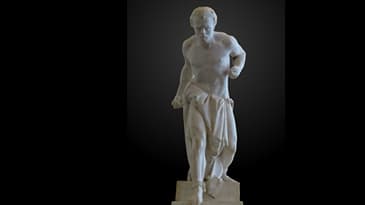
• Cover image: Vincenzo Vela, Spartacus (1848); photograph by Rama (Wikimedia commons)
Links:
• “I am Spartacus” (https://www.youtube.com/watch?v=FKCmyiljKo0) : an iconic scene from Kirk Douglas’ 1960 film
• Pepsi’s “Spartacus” commercial (https://www.youtube.com/watch?v=2T481yh1KiY)
• “The Son of Spartacus” (https://www.youtube.com/watch?v=K4nPW69A8vo) : an unofficial 1962 sequel to the Kirk Douglas movie, starring Steve Reeves
Visit our homepage to subscribe and to find us on social media:
• https://havetogawilltravel.com (https://havetogawilltravel.com/)
If you liked this episode, buy us a coffee:
• Our Ko-Fi page (https://ko-fi.com/havetogawilltravel)
----------
00:10 - Introduction
01:11 - The sources: what can we know about Spartacus?
• 01:27 - Plutarch, Appian, and their interest in Spartacus
• 02:17 - Sallust: the original source
02:58 - Spartacus: a basic biography
• 03:05 - Spartacus' origin in Thrace, among the Maidi
• 03:16 - Spartacus' brief career as a Roman auxiliary and as a latro
• 03:49 - Spartacus enslaved and sold to the ludus of Lentulus Batiatus
• 04:44 - The gladiators escape from Batiatus’ ludus, seek refuge on Mount Vesuvius, and defeat several forces sent to suppress them
• 07:07 - As the rebellion gathers steam, Spartacus and his supporters drive north, and defeat three Roman armies along the way
• 10:04 - After Spartacus’ army turns south again, winning yet another major battle, the Romans entrust Crassus with the responsibility of ending the rebellion
• 11:49 - The Romans outmaneuver Spartacus and defeat the rebels
15:31 - Why did Spartacus and his supporters rebel?
• 15:51 - Enslaved people and small-scale resistance
• 17:28 - What made large-scale rebellions so difficult
• 18:40 - Poor living conditions as a motivation for rebellion: gladiators, enslaved herdsmen, enslaved agricultural workers
• 21:16 - Poor prospects for winning manumission as a further motivation for rebellion
• 23:03 - Many of the rebels had been enslaved only recently and longed to reclaim their freedom
24:52 - What were Spartacus and his supporters attempting to accomplish?
• 25:15 - To escape from Italy, or not? The sources and the problem of reconstructing Spartacus’ plans
• 27:01 - Modern approaches: (1) The sources had it right; (2) Spartacus had a larger agenda—whether to destroy the hegemony of Rome in Italy, or to end slavery
• 28:15 - A critique of these approaches, and an alternative: staying together was the best guarantee of freedom
31:16 - The ongoing resonance of Spartacus in modern literature, film, and television
• 32:29 - The discovery of Spartacus by French and Italian thinkers in the 18th and 19th centuries
• 33:35 - The Marxist and communist take on Spartacus
• 35:40 - 20th century novels: Koestler’s “The Gladiators” and Fast’s “Spartacus”
• 38:20 - Spartacus goes to Hollywood: Kirk Douglas’ 1960 film and Spartacus as social revolutionary
• 49:08 - A Spartacus for the 20th century: Andy Whitfield as Spartacus
51:05 - Wrap-up