
Visit our homepage to subscribe, to find us on social media, and to contact us by email:
• https://havetogawilltravel.com (https://havetogawilltravel.com/)
If you liked this episode, buy us a coffee:
• Our Ko-Fi page (https://ko-fi.com/havetogawilltravel)
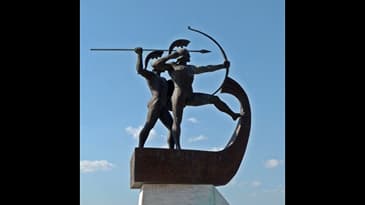
Cover photo adapted from an image of the Salamis Soldiers' monument, by Ziegler175:
• https://commons.wikimedia.org/wiki/File:SalamisPaloukiaSchlacht2.jpg
----------
00:10 - Introduction
01:43 - Aeschylus and his historical context
• 01:56 - The subject of the play (and its peculiarity)
• 03:06 - The Battle of Salamis and the Persian Wars
• 05:10 - Aeschylus’ Career
06:22 - The Persians in performance
• 06:30 - The Dionysia of 472 BCE and Aeschylus’ tetralogy
• 08:35 - Pericles as producer (choregos)
• 09:09 - A synopsis of the play
• 11:12 - The structure of Greek Tragedies (or, how do we know that the Persians only needs two actors apart from the chorus?)
14:03 - Interpreting the play: sympathy for the Persians?
• 15:06 - The survival of the play: evidence of its popularity?
• 16:04 - Triumphalism vs. a recognition of common experience
• 17:06 - Differences between Greek and Persians in the play: archers vs. spearmen, autocracy vs. autonomy, proskynesis and lamentation
• 20:36 - Aeschylus argues for common experiences: the Persians as Homeric heroes, the horrors and the costs of battle, and Aeschylus’ rejection of the “effeminate Persians” trope
26:37 - The play’s main theme: empire and hubris
• 27:00 - Xerxes and his bad decisions
• 27:56 - The gods’ desire to punish Xerxes
• 28:53 - The hubris of Xerxes, or the hubris of the Empire? (Featuring Emily’s rant about hubris in ancient and modern thought)
• 34:27 - Aeschylus, the gods, and Athenian imperialism
• 36:55 - The social function of tragedy: thinking through big problems
• 37:28 - What staging the Persians can tell us about the play
39:12 - Wrap-up