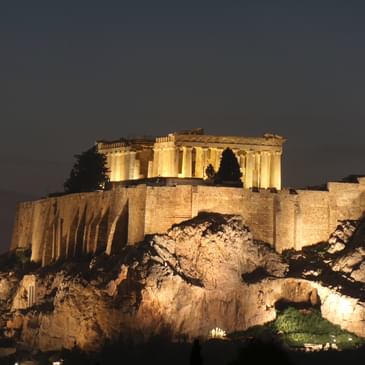
In this episode, Emily and Cam talk about what it’s like to visit the Athenian Acropolis today; how that experience compares to what visitors would have seen in the fifth century BCE; when and why the remains of the structures there today were created (especially the Parthenon and the Erechtheion); and what those structures meant to ancient Athenians.
Visit our homepage to subscribe and to find us on social media:
Episode Links:
- Our short blog post featuring pictures of Nashville’s replica of the Athena Parthenos statue.
----------
00:11 - Introduction
02:05 - Visiting the Acropolis: the modern experience
- 02:32 - The geography of Attica
- 03:41 - Our first impressions of the Acropolis (and how Goethe did it better)
- 05:45 - What visiting the Acropolis is like: sacred and profane space; the temple of Athena Nikē (and aspects of the gods); the Propylaia; the Parthenon; the Erectheion; the Dörpfeld Foundations
14:23 - What visiting the Acropolis was like in the fifth century BCE
- 14:30 - The ramp
- 16:28 - Athena Promachos
- 17:01 - Colorful temples
- 17:38 - Dedications everywhere (and why dedications mattered)
20:20 - How and when the structures on the Acropolis came to be
- 20:25 - The basic context: Darius, Xerxes, and the Persian invasions of Greece
- 22:20 - The Oath of Plataia: the Greeks swear not to rebuild their temples
- 23:59 - What changed? War in the Aegean, the Peace of Kallias, and the Athenian Empire
29:01 - The Parthenon
- 29:26 - The basics of the Parthenon and Greek architectural orders
- 32:38 - The Parthenon’s pediment sculptures: the west pediment group and the east pediment group
- 37:31 - The metopes: the Amazonomachy (west), the Trojan War (north), the Gigantomachy (east), Lapiths vs. Centaurs (south)
- 40:37 - The Ionic frieze and various interpretations of its imagery
- 43:53 - Pheidias’ statue of Athena and its decoration
- 46:04 - The meaning of the Parthenon’s sculpture: the Athenians, their empire, and their imperial mission
49:41 - The Erechtheion
- 49:49 - The fundamental weirdness of the Erechtheion
- 52:08 - Why is it so strange? The persistence of ancient ritual.
- 52:54 - The most sacred image of Athena: the Xoanon
- 54:08 - Is the building we call the Erechtheion the building the ancient Athenians (and Pausanias) called the Erechtheion? Or is it the temple of Athena Polias?
- 56:48 - Emily delivers a fine rant about the perils of “received wisdom” in Classics
- 1:01:08 - Cam footnotes Emily’s rant with a digression on horror vacui
1:02:02 - Wrap-up
Hello. Welcome to Have Toga Will Travel, a podcast exploring the Mediterranean world, ancient and modern, through the eyes of two former classics professors. I'm Emily.
Cam:I'm Cam.
Emily:And we're your hosts.
Cam:And today we're going to lean back towards the Greek world after three episodes on Roman gladiators and related things. And we're going to talk about the Athenian Acropolis. This will be the first of at least two episodes, depending on how much we decide we have to say. Most people will know what the Acropolis is already. It's one of the most famous sites in the Greek world, in the ancient world in general. And it has one of the most famous buildings from the ancient world on top of it, the Parthenon.
Emily:Now, the Acropolis is actually a really complicated site because it's more than just the Parthenon. And the Acropolis has a whole complex history, most of which is not obvious to a visitor today, or even explained well when you visit the site. And there are some actually really weird, cool things that you can walk by on the Acropolis and never know what they are, or even that they're anything important at all.
Cam:No, and we'll try to talk a little bit about some of those as we go along. Mostly what we want to talk about today is the visitor experience, and how the experience of modern visitors differs from the experience of people who visited the site in the mid to late 5th century, which is the period when most of the structures you'll find up there now were first built. We'll then move on to talk about the context in which those structures were created in the mid to late 5th century. And finally, we'll touch on the two most significant ones, the temples called the Parthenon and the Erechtheon, and say a little bit about what they meant to the Athenians who viewed them and to other people who came from the Greek world to look at those temples.
Emily:That was slickly done.
Cam:You like how I just said the Parthenon and the Erechtheon without wading into any of the controversy? They'll get enough of that in a few minutes.
Emily:They will, but well done. So before we actually dive into the buildings, we want to talk a little bit about what it's like to approach the Acropolis and what it looks like from a distance. So if you remember back in episode one, we were talking briefly about the geography of Athens and Attica and the Attic Plain in which Athens sits. We'd mentioned to come from Marathon to Athens, you had to cross these mountains. And that's because Athens, which sits in the Attic Plain, is ringed by a series of mountains. And from north to south, these mountains are today called Egaleo, Parnitha, Penteli, and Imettos. Now within the Attic Plain, there is a line of hills that come down the center that stretch roughly from Penteli south to the sea, So they roughly parallel Imettos. And the Acropolis is one of these hills. It is not the tallest of these hills, but it's still visually quite striking. It towers over what is now downtown Athens. It looks very steep and table-like on the top and very wide, broad hill. Now, the table-like top isn't natural. It is a product of terracing and human construction over millennia.
Cam:Yeah. And you'll notice when you go there, it's got some pretty massive retaining walls, obviously not natural. The ones you see today were built mostly during the fifth century BC.
Emily:So Cam, what was your first impression of the Acropolis?
Cam:Well, on our first visit together to Greece, which was also my first visit to Athens altogether, we took the metro in from the airport. So we took it into Monastiraki, and we got out of Monastiraki on the Athinas Street stop, which is on Athinas Street north of Monastiraki Square itself. And you're sort of coming out late afternoon, early evening onto Athinas Street, which is a really busy street. So there's a lot of disorientation and confusion anyway, just because you're stepping out of the metro. And I glanced to the right, and there was the Acropolis. From the north, I mean, it looks really high, in part because of those retaining walls that we talked about. And I could see the top edge of the Erechtheon poking out. And it was just kind of like, wow, there it is.
Emily:Yeah. It's like just there. Yeah. I mean, my first impression was similar. I don't remember it as well as you did. Mine was a little earlier. But taking a cab from the airport to the Kalimarmaro Stadium and getting dropped off. And just like, you know, there's Athenian traffic, there's cars going by, and there's the Acropolis.
Cam:Yeah, just sort of looming in the background.
Emily:Yeah, it's just, it's like there and it's real and it is existing in this whole modern city now.
Cam:We're not the only people who have just had, I guess, overawing first impressions of the Acropolis. So there's a great story about the German author Goethe, who famously, I mean, who knows if this story is actually true?
Emily:I mean, I heard this story from my professor in Athens, Professor Diamond. He found it kind of ridiculous, Goethe's vibe here, but...
Cam:Well, it is ridiculous because according to this story, Goethe really wanted his first view of the Acropolis to come with the light of the full moon. So if we're to believe the story, he spent literally days wandering around Athens, covering his eyes to avoid looking up.
Emily:Yeah.
Cam:Because there's nowhere you can go and not see the Acropolis if you're not looking right down at the street.
Emily:Yeah. It's one of those things you can't miss when you go to Athens for the first time. Like it's just...
Cam:No, it's visible from much of the city.
Emily:Yeah.
Cam:At least much of the city of Athens itself. Yeah.
Emily:Yeah.
Cam:Right. So what is going there like? There's only one way up onto the top of the Acropolis, and that is through the ancient ceremonial entranceway, a structure called the Propylaia. This is a monumental, colonnaded entryway with a couple of wings, and we'll talk about how it looks in a bit more detail in a bit. But right now, the important point we want to make is that this is the structure that really marks the boundary between profane and sacred space. That is the space inhabited by people and the space dedicated to the gods.
Emily:And it's worth noting that this sacred boundary is actually really important. And it is one of the two main elements, the two things you have to have to have a sanctuary in Greece, right? You have to have the sacred boundary that defines the sacred space versus the profane or the everyday space and the altar. And that's it. That's all you need for a sanctuary. I'll note a temple is not a required part of that.
Cam:No, temples are definitely extras.
Emily:Yes. Temple is where you house the cult statue of the god, but it is not a requirement to have a sacred space.
Cam:So most visitors will approach the Acropolis by entering through the main gate near the western side of the monument. And what you'll find there are a bunch of paths that lead you up around the shoulder of the rock. The modern path basically walks you up around the southwest corner of the monument, underneath the bastion of Athena Nikē, and spits you out right in front of the Propylaia, the ceremonial entranceway. This was not the way visitors would have approached in antiquity, and we'll get to that in a bit more later. But the modern visitor standing in front of the Propylaia will see a couple of interesting things. The Propylaia itself, obviously, but also immediately to the right, that temple of Athena Nikē that I've mentioned. It's a small but very pretty little temple that sits high up on a bastion that sort of towers over the modern approach to the Acropolis itself.
Emily:And it's worth mentioning here, and we say Athena Nikē, what this means is Athena of the victory, if you will, is because gods were usually worshipped in different aspects. So temples were usually dedicated to a god in this area of influence. So Athena Nikē, right, is dedicated to Athena, who's associated with victory. Also on the Acropolis, we're going to talk about a temple to Athena Polias. And that is Athena in her guise protecting the city, Athena of the city. Athena Parthenos, Athena the maiden. And so these aren't different deities. They're all just different aspects of a particular deity, right? Because each deity has a lot of elements over which they have control or influence or sway. And generally speaking, in religious practice, you're appealing to one of those particular aspects of that god.
Cam:Right. So the temple of Athena Nikē, was basically there to honor Athena in her guise as the goddess who brought victory to the Athenian state.
Emily:Now, it's also worth pointing out that this bastion has kind of a cool little thing you can see as you're walking around it, is there's a little polygonal cutout in the bastion itself. And this was actually done in antiquity by the ancient Athenians. And through that little cutout, you can see remains of the constructions that were there on the Bronze Age. And it's clear that the Athenians thought those old remains were important and so intentionally cut this out so that it could be seen into and perhaps there was ritual practice associated with it.
Cam:Yeah, I don't think we know what they thought that particular little bit of the Acropolis was way back in the dawn of time, but they clearly associated it with some kind of mythological importance.
Emily:Yeah, and it was clearly important enough to leave it exposed, as opposed to other Bronze Age remains that were there that weren't left visible.
Cam:The other thing you'll see as you're facing the Propylaia before you enter the Acropolis itself, to your left is an extremely tall statue base. This is a statue base that was originally constructed probably in the second century BCE by the rulers of Pergamon. That was a kingdom in the western coast of what is now Turkey. And the rulers of that kingdom were, at that point in time, important patrons of the city of Athens who were donating a lot of money to build buildings and things like this. And they constructed a statue, probably a bronze statue of a quadriga. That's a four-horsed chariot. Later on, that whole monument gets rededicated to a guy named Agrippa. Augustus's right-hand man.
Emily:And son-in-law.
Cam:And son-in-law eventually, yes. And what's interesting here is that it just sort of gives you a sense of how lengthy the life of the Acropolis itself was and how often things were built, rebuilt, repurposed. And we'll touch more on that
Emily:next episode. Yeah. So as you go through the Propylaia, you'll see that it has a Doric façade. So this is one of the architectural styles, and we'll talk a little bit more about what that means shortly. But within, you have ionic columns, which is a different architectural style. So we're mixing architectural styles in this building. There are also two anterooms within the Propylaia. So monumental gate, it's not just a gateway, like it's a full building functionally. And the anteroom on the north side functioned as a picture gallery. And the one on the south side gave access to the precinct of Athena Nikē, that little temple we just talked about.
Cam:Yeah, it's worth pointing out that this whole structure is designed to impress. And one of the things that really impresses in that way, not to be totally redundant, is the change in elevation you experience as you ascend the monument.
Emily:Yeah.
Cam:Right. Even the Propylaia itself is built on a couple of different levels because you're still climbing to the top of the Acropolis itself. And it's all designed to awe the visitor. And it does that pretty well. Anyway, once you're through the Propylia, you have a nice view of the top of the Acropolis itself. And the first thing you're going to notice are the remains of the two temples that still stand there. The one on the left, from the visitor's perspective, is the temple we know as the Erechtheion. The one on the right is the Parthenon. The Parthenon is the one that probably immediately catches people's eye. It's a spectacular Doric-style temple, and again, we'll talk about styles in a second. And it is impressive, even in its very ruined state.
Emily:Yeah. You come through the Propolaia and it's still relatively high above you.
Cam:Yes.
Emily:And I can remember— so if my impression of the Acropolis for the first time was, "Oh, look, it's there," actually going up onto the Acropolis for the first time, I was overwhelmed. I remember just feeling awe, like the feeling that you just want to fall on your knees in front of this building, which is a ruin now. And even so, it contains such overwhelming beauty and power. And, you know, that's a feeling I will never forget.
Cam:Yeah, it's a funny thing. It's a building that everybody knows, because we've seen pictures of it here, there, everywhere, you know, it's been featured in countless shows on the Discovery Channel and things like that. But it's still a very different experience to actually stand in front of it. And I think, above all, what you get when you're standing there that you don't really get when you're seeing a picture or seeing a film is just a sense of scale.
Emily:Yeah.
Cam:Like it really is a big temple.
Emily:Yeah. The only thing that I could even compare it to is the Grand Canyon. The difference between seeing the Grand Canyon in a picture and experiencing what that feels like in real life. Those two things I would put in the same category.
Cam:Yeah. The other temple up there, the one we know is the Erechtheon. I think most people think it's a little less impressive at first glance than the Parthenon.
Emily:I mean, it is, but that's like, you know, a not fair comparison to even make.
Cam:It's not a fair comparison, no. It is, however, as we'll see, probably far more important from the standpoint of Athenian religious life. This, as we'll see, was the center of some important cultic practice in classical Athens. And then between those two temples, if you look carefully, you'll see a bunch of ruins, tumbled stones, which mark the foundations of a much older temple that existed before the two we're talking about, and one that we'll have to come back to and argue about a little bit in our next episode.
Emily:Yep. These are called the Dörpfeld Foundations, named for the archaeologist who excavated there. But you can totally miss them. You'll just think they're like a pile of rocks as you're walking around.
Cam:Right. If you haven't been told what they are, you'll just walk right by them. But actually, they're pretty cool.
Emily:Yeah. So that's the approach in the modern era. In the ancient era, in the 5th century, it would have been a different experience for the ancient visitor. First of all, the approach would not have been up through paths and stairways up the hill of the Acropolis. It actually would have been up a giant ramp that would have led up to the Propylaia, through the Propylaia, up into the sanctuary. Now, why a ramp? Well, a ramp because you've got to get things up the Acropolis that aren't going to do stairs well, and in particular livestock, as well as probably carts and wagons and other things.
Cam:Chariots, yes.
Emily:Chariots. But the livestock that you need for the sacrifices are much easier to get up there when it's a ramp. So that's the first thing, right? The approach would have been totally different. It would have been a straight up approach. You would have had your eye on the Propylaia and the buildings up there the whole time. And the other thing that would have been, or one of the other things that would have been really different is that when you go up there today, you see a lot of exposed bedrock on the Acropolis. They've put in some concrete paths for visitors to walk on, which are fairly recent. But the bedrock is really a feature of the excavations that happen in the 19th and 20th centuries that stripped away all of the upper layers that had been built up. So all of the layers of human occupation and use, they excavated down to bedrock. And that's what got exposed. And there was a period there where when you went up there, you were walking around on the bedrock, which led to a really funny moment we got to witness of a woman trying to negotiate the Acropolis in stiletto heels.
Cam:Yeah, I don't know how she did that.
Emily:She leaned on the guy she was with the entire time. He was supporting her because she could not keep her balance on the surface.
Cam:Yeah, the problem with the bedrock— it's mostly a limestone of some sort, and it's been literally polished smooth by thousands and thousands and thousands of people walking all over it. So it's really slick. Anyway, there are other things that ancient visitors would have noticed that are not there for the modern visitor to see today. And probably the most prominent thing an ancient visitor would have noticed was the statue of Athena Promachos. That means Athena who fights in front, Athena the champion, something like this. That was an enormous bronze statue. It measured about nine meters in height, that's 29 feet. It was Athena carrying a spear. And we're told in some of the sources that the glint from the top of her spear could be seen at sea by ships rounding the Cape of Sounion, about 25 miles, 40 kilometers, to the south by southeast. The other thing that would have really struck an ancient visitor is the color all over everything. We're presented today with the remains of ancient temples that have had the color worn away just by centuries of exposure. But in antiquity, most of the carved surfaces of the temples would have been really bright, in blues and reds and in other colors. And that would have made a strikingly different visual impact than the bare stone does today. And it's worth pointing out that there were several other shrines and buildings up there, which now no longer exist just because of the long history of occupation after classical antiquity.
Emily:And then the final really significant difference is that in antiquity, there would have been dedications everywhere, all over the Acropolis, dedicated to the goddess. And these would have ranged from very humble dedications to, like, grand statues, right? And these were all gifts to the gods offered both by individuals and by the Athenian polity as an entity.
Cam:Yeah, I guess we should probably just point out that this is a fundamental aspect of Greek religious life. You offer things to the gods either in the hope that they'll do something that you want or to thank them, more importantly, for things that they've already done.
Emily:So the statue of Athena Promachos that Cam just mentioned is actually an example of a dedication to the goddess from the Athenian polity. Also up there was a really famous bronze four-horse chariot, also dedicated by the Athenians to Athena to celebrate the first major military victory of the democracy in a battle that happens in 506 against the Boeotians and Chalcidians.
Cam:But there was a ton of other stuff up there too, because it wasn't just the Athenian state that dedicated stuff on the Acropolis. It was people from all over the social spectrum and from basically big chunks of the Mediterranean world. And these people would come up there to make gifts to the gods.
Emily:For the reasons you do that.
Cam:Sometimes they dedicated little trinkets, you know, a tiny little bronze horse that you could put in the temple. But sometimes they'd commission statues or stele, which are basically big plaques carved in relief. And the new Acropolis Museum gives a really good impression of what this would have looked like. The new museum is down below on the southern side of the Acropolis, a big fancy new building. And the main gallery, which you meet after climbing up a ramp that is meant to evoke the approach to ancient Acropolis, is full of archaic sculpture—that is, sculpture from mostly the 6th century BC. And it's all arranged in a literal forest of statuary that gives you, I think, a pretty good sense of what it would have been like to wander around on the Acropolis.
Emily:And most of those statues were dedications to the goddess. They're being situated in the museum exactly the way that that sort of thing would have been seen in a sanctuary. It's one of my favorite museums in the world. So I find it really cool the way that they've set that up. But yeah, that gives you a real sense of how the Acropolis would have felt. It wasn't just buildings, right, it was all these statues everywhere. It might have even felt a little crowded.
Cam:A little crowded, yeah. And again, what's really striking is that a lot of these statues are being put up just by people. I mean, people with money, obviously, because these are not cheap, but these are not state dedications.
Emily:So that's what you see when you go up there, what the ancient visitor would have seen when they would have gone up. But let's talk a little bit about how these buildings come to be in the fifth century. And they're part of a program to replace earlier structures that were there and had been damaged by the Persians when they occupied Athens in the summer of 480 and then again in 479 BCE.
Cam:Yeah, there's a long complicated history here. Basically, we touched on the conflict between the Athenians and the Persians in our first episode, in which we talked about the Battle of Marathon. Battle of Marathon happened in 490 BCE. And, as we explored in that episode, the Athenians defeated a Persian effort to topple their democracy and install a tyrant, this guy named Hippias, who'd been exiled a few years earlier.
Emily:Yeah, now that's not the end of things. Ten years after the invasion in 490, in 480 BCE, Xerxes, who's the son of Darius, who'd been the king of Persia during the marathon campaign— Xerxes picks up where his father left off, and on a much bigger scale, and he actually sets out to conquer all of Greece and invades the Greek mainland with a massive army. During that conflict, the Persians sack Athens not once, but twice. Extensive damage is done to the Acropolis in that process, obviously. But there is actually a weird side benefit, if you will, which is that when the Athenians get back. All of these statues that have been damaged, etc., are all ritually buried on the Acropolis. They're not really fit to be on display anymore, but you can't throw them out because they belong to the goddess. And so they're all ritually buried. These are the statues that you now see in the new Acropolis Museum. And it is actually one of the best preserved sets of archaic statuary that's been found from Greek antiquity.
Cam:Now, the Greeks drove the Persians out of the Greek mainland proper in 479. And the temples that we're going to talk about, the Parthenon and the Erechtheion, were set up from the 450s onwards. The Parthenon was basically constructed in the 440s. The Erechtheion was begun in the 420s. You may wonder why it took so long, 30 years or so, between the moment at which the Persians were expelled from the Greek mainland and the moment at which the Athenians started rebuilding some of the temples up on the Acropolis. You're not alone. Some ancient sources found this a little puzzling too, and they tried to explain it by talking about something called the Oath of Plataea. This, we're told, is an oath that the allied Greek states who fought the Persians in 480 and 479 took right before a decisive battle at Plataea in 479. One of the clauses of this oath, we're told, asked parties not to rebuild the temples destroyed by the Persians, but to leave them as memorials to the impiety of the barbarian, right? "Look what the Persians did. They had so little respect for the gods that they destroyed our temples." And in fact, there's very little evidence of major building activity in the decades after the Battle of Plataea in Athens or in Attica proper. And again, that might seem a little odd, but it's probably less odd if we remember that temples were not critical elements in Greek religious practice, they were extra. What was really important was the sanctuary in which you made offerings to the gods and the altar on which you could offer sacrifice.
Emily:So if they took this oath—and I know you are skeptical of the oath of Plataea— but if they took this oath, right, that might explain why there wasn't any building for all of these decades. But then something clearly changes, right? Because there is building that happens again after 450. So what changed? I mean, the short answer is we don't know for sure. We can say that, one, of the 31 city-states that swore the oath, assuming it happened, only five of them actually had temples destroyed. So a lot of them made a promise that they didn't actually have to keep. Two, we also hear about (and some people are skeptical of this as well) what's called the Peace of Callias, in roughly 449. The fighting with the Persians didn't end in 479, when the Greeks repelled this invasion of Greece that Xerxes had staged. And the Athenians, in particular, continued fighting the Persians in the Aegean, much of which was still under Persian control, for another 10 to 15 years alongside Athenian allies.
Cam:And then, even when they'd seized a bunch of the Aegean from Persian control, they spent several years fighting the Persians further abroad. And weirdly enough, we end up with Athenians and their allies fighting in places like Cyprus and in Egypt in the 460s and in the 450s. The Egyptian expedition in particular was pretty rough for the Athenians, and they suffered a bit of a disaster. And it seems that in the late 450s, partly because the Athenians were a little bit exhausted, but also because the Persians were getting a little bit exhausted about all of this too, there was a formal peace treaty, again, the Peace of Callias. And one of the clauses in that peace treaty, we're told, is that the Persians agreed not to sail warships into the Aegean. And that, we think, could have been portrayed by the Athenians as a really significant victory, because they could hold it up as evidence of the fact that they, the Athenians, had basically saved Greek states in the Aegean from further Persian intervention.
Emily:Then the other really important element that has changed in the intervening years is that Athens has emerged as an imperial power. So there is this alliance with which the Athenians had been fighting the Persians. And this begins as a voluntary alliance, and the allies would send ships and men to join the Athenian navy to go off and fight the Persians. But as this alliance grows, It transforms slowly into a structure in which, rather than sending ships and men, so contributing forces, the allies just pay tribute to Athens in silver instead, and they do what Athens tells them to do. They took Athenian orders.
Cam:Yeah, what causes this is pretty complicated. In part, it's because early on when a couple of allies got tired of fighting and tried to leave, the Athenians said, "Well, we appreciate your position, but no," and forced them to stay in, going to war, in fact, with a couple of their allies. And those former allies, once they had been defeated and forced to rejoin the structure, were not brought back into the structure on the same terms. They were made subjects, essentially, and basically compelled to give tribute and to do what the Athenians said. But the other thing that's happening, and I've already sort of mentioned this in passing, is that as the Athenians and their allies are fighting the Persians in the Aegean, They're taking cities that had been held by Persian commanders, Persian garrisons. And sometimes those cities, even though they were Greek cities, were not necessarily all that excited about switching sides because they felt vulnerable to Persian counterattacks, and they were looking for a middle way to coexist basically with both powers. Those states too probably were incorporated into this growing structure as tribute paying subjects rather than as allies. And so we modern historians, and to some degree ancient historians as well, talk about a transformation from the Delian League, the name of this voluntary structure, to the Athenian Empire.
Emily:So by 449, the Athenians have become incredibly wealthy because of their empire. They've become very powerful. They can argue that they have finally defeated the Persians, and they want the trappings that go with that newfound status of wealth, of power, and of lording it over the other Greeks, "Look what we did to the Persians."
Cam:Yes. And in some sources, that gets twisted around. And the person basically who is most associated with this building program, Pericles, an important Greek general, is accused of wanting to dress Athens up like a prostitute.
Emily:Yeah, good times.
Cam:Yeah. Anyway, so the Athenians decide to embark on a new building program, probably just after 449. What we're going to do next is talk about two of the buildings in particular that get constructed on the Acropolis in the next few decades. First, the Parthenon, which is built mostly between about 447 and 433 or so. And then the Erechtheon, which is begun a little bit later in the 420s and probably completed around 407 or 406 or something like that. So let's start with the Parthenon. And the basics that you need to know are that the Parthenon is a peripteral Doric temple with ionic elements. What does that mean? Well, when we say it's a peripteral temple, what we mean is that it has a freestanding colonnade that goes all around the inner structure, the cella, as it's sometimes called, which was the building in which the cult statue housed. And that freestanding colonnade all around the building creates porticoes, creates an impression that the temple can be approached from any side, even though as we'll see, it does have a distinctive front and back.
Emily:Yeah. Now Doric is an architectural order. And we mentioned this earlier. So if you've heard of Doric, you've probably heard of a Doric column, right? That has the plain kind of unadorned column capital. And that was part of it, but the order actually had much more elements to it than that. So you had the column with this unadorned capital, a Doric column would be fluted, it would not have a base to the column, it would just the column would rest flat on the surface, the stylo bate. And its proportions made it kind of...
Cam:Stout.
Emily:Stout, yes. I believe the proportions were six to one, height to width. And then the columns would have supported these two structural elements, which were kind of horizontal bands. They ran across them that the roof was supported on. And the lower of these two horizontal elements was called the architrave. And then above that was the frieze. And then on top of the frieze in the space created by the roof was a triangular open space called the pediment. And all of these elements go into the architectural order and would have been handled differently based on the architectural order. So in the Doric order, in addition to the column, in the frieze portion, you would have had a set of decorations that are referred to as triglyph and metope. And so the triglyph looks like almost like a mini column. It's got three lines on it running vertically, and those would have been alternated with sort of flat spaces called metopes. Metopes could be left plain, or they could be sculpted. In the ionic order, just real quick, your columns are thinner. The proportion is more like nine to one. The column capital has the scroll work. And then in the ionic order, the frieze does not have the triglyph and metope pattern. It is open. And often on ionic columns, that open area, the whole frieze could be sculpted in a much longer narrative, if you will. Or it could have inscriptions in it or lots of other things, but it was one continuous unbroken piece. And on the Parthenon, our outer colonnade is Doric. Our inner colonnade that helped define the porches on either end of the building had one of these ionic friezes all the way around the inner structure that would have housed the statue. And that whole ionic frieze is sculpted in one continuous narrative.
Cam:And it's the sculptural decorations of the Parthenon that were one of the most impressive aspects of the building in antiquity. Most of the sculpture is not present in situ anymore because of a variety of different reasons, and we'll explore some of those in our next episode when we talk about the afterlife of the Acropolis and the Parthenon. You'll find much of that sculpture now in the British Museum in London.
Emily:Yeah, you will.
Cam:Some of it dispersed through other European museums.
Emily:I wonder how it got there.
Cam:And a few pieces in the new Acropolis Museum. Although by far, the lion's share is in London. You can guess that this is a sensitive subject.
Emily:You do see some of the sculptural elements still on the building today. Those are reconstructions. The originals have been moved into the museum.
Cam:Yeah, there are only a few pieces of actual ancient sculpture still on the building itself. Broadly speaking, there are four different kinds of sculptures that are important here that we'll talk about. First, there are the pediment sculptures. We've already talked a little bit about what the pediment of a temple is. It's the large triangular area that rests above the architrave and the frieze. Pediments did not have to be full of sculpture, but on the Parthenon and on a number of other important Doric temples in the Greek world, they were.
Emily:So the Parthenon really, if they could sculpt it, they did.
Cam:Yes. There were two pediment groups because the building had two pediments, one on the west side, one on the east side. Those are the two short sides of the temple. Visitors who were approaching the building up the ramp through the Propylaia would have seen the west pediment group first. Now, even though this is the first one they would have seen when they laid their eyes on the Parthenon for the first time, this is actually the back half of the building. The Parthenon, like a lot of other Greek temples, had a main internal cella that opened to the east. On the west side in the Parthenon, you had a secondary room, the Opisthodomos. The pediment over the Opisthodomos on the Parthenon was a complicated sculpture group that depicted a legendary contest between the gods Athena and Poseidon to determine who would become the patron deity of Athens and of Attica. And the myth as we have it basically presents Athena and Poseidon both offering a gift to the city. Athena offers the olive tree, Poseidon offers a salt spring, and Athena is deemed a winner. The sculpture group is a little bit more complicated because there are chariots very clearly depicted behind each god, and it may be that there's an allusion to a chariot race as well, part of the myth that we don't know anymore.
Emily:Yeah, the version that I had a professor sort of speculate could be the story here, right, is that there's a chariot race and whoever wins, wins the patronage. And when they reach the finish line, each sort of puts down their marker, the olive tree or the spring of salt water to mark their completion. And so it's not that the olive tree and the fountain aren't involved, but that they are actually indicative of a larger thing. And it's perhaps this pediment group actually hints at this story of a chariot race, but we don't know.
Cam:And that's going to be something that we're going to have to revisit, the fact that there may be myths and legends that we simply don't know. Because the fact of the matter is that it's not clear that we fully understand the stories being told by a lot of the sculpture on the Parthenon. But anyway, apart from Poseidon, Athena, and their chariots, there are several other gods serving as charioteers and messengers depicted on the pediment decorations on the west face, along with a bunch of heroes of Athens and Attica, and a few figures who seem to represent river gods. So the central idea here is that all of ancient Attica is watching this contest unfold as Athena and Poseidon vie with one another to determine who will become the main patron of the city of Athens.
Emily:Now, if you go over to the east side of the Parthenon, which is the front of the building, in the pediment group there, what you're going to see, right, and this is the entrance to the main cella where the statue of the goddess would have been, you're going to see a depiction of the birth of Athena, right, who springs, you know, fully armed from the head of Zeus. So you have Athena and Zeus in the center of this pediment, and then all of the Olympians and gods watching. You have Hephaestus with his axe, right? He's just like cracked open the skull of Zeus.
Cam:It's one way to relieve a headache.
Emily:I mean, I've contemplated it. And then in the corners, you have the chariots of the sun and the moon, the moon is setting, the sun is rising. So the birth of Athena is happening at dawn. And of course, this pediment is facing the east and it would have taken the sunlight at sunrise. So it would have been quite striking in that moment.
Cam:The next batch of sculpture it's important to talk about are the metopes. Again, these were panels situated on the frieze level of the temple, which ran around the building. On the Parthenon, every single metope was sculpted in relief. There were 14 on each of the two short sides and 32 on the long sides. Now, it's really unusual for all of the metopes on a temple like this to be sculpted. So the Athenians are making a statement by doing this.
Emily:Yeah. By comparison, the Temple of Zeus at Olympia, which contained a statue that It was one of the wonders of the ancient world— and this is, so this temple is no slouch— it only had 12 sculpted metopes, six on each of the two short sides.
Cam:Right. And the Parthenon has 92.
Emily:92. So, wow, what a difference.
Cam:Now, the metopes themselves break down into four groups, one per side that seem to depict a coherent set of images and evoke stories, if you will. The west side, and again, these would be the first metopes that a visitor noticed when climbing the Acropolis and approaching the temple, featured an Amazonomachia, basically a battle between Greek soldiers and Amazons. There's an allusion here to a moment in Athenian myth and history when the city was basically besieged by Amazons.
Emily:More myth than history.
Cam:I'm sure it's more myth than history, but that's the story that is being evoked. And one of those metopes may, in fact, depict the Athenian mythical ruler Theseus, who is here playing a role in driving the Amazons. As an ancient visitor continued walking along the temple along the north side to get around to the front of the building, he or she would have looked up to see the 32 metopes on the north side of the building, which represented scenes from the Trojan War. So Greeks versus Trojans. On the east side of the building, over the main entrance to the building, a visitor would have seen 14 metopes depicting a gigantomachy—that is a battle between Greek gods and giants. Giants are essentially the children of the earth, Gaia, you know, depicted as sort of, well, giant. Giants and somewhat monstrous. And finally, on the south, if a visitor wandered around to that side, he or she would have encountered 32 metopes depicting the myth of the Lapiths fighting the centaurs. Again, there's a story behind this. The story essentially is that a bunch of centaurs, half man, half horse creatures, were invited to the wedding of Pirithous and Hippodomia. And because centaurs, you know, are sort of half wild, I guess, and can't hold their liquor, they don't know how to drink wine properly. They get raging drunk at the wedding, start a riot and try to carry off all of the women. Battle ensues.
Emily:So that's all the sculpture you would have seen outside. Now, if you walked up onto the porch, the portico created by this exterior colonnade, you would then see on the west and east sides an interior colonnade. And above that was this ionic frieze I mentioned earlier that runs over those colonnades and along the sides of the inner room structure all the way around the building. Now, this frieze is one of the oddest things about this building. I mean, one, its location would have made it kind of hard to see, and you would have had to have come through that first row of columns to see it anyway. And we also don't have a good understanding of what the story is that's being shown here. It's clearly some sort of procession. The figures sort of move around the building and meet in the center over the east door to the cella. And the traditional understanding is that this story depicts the Panathenaic procession, which would have been the parade that happened in conjunction with the most important religious celebration in Athens celebrating Athena.
Cam:But the reason for thinking that basically is because you've got, you know, a bunch of people who look clearly like they're officiants sort of up at the far end, and you've got animals being led up for sacrifice, and then you've got people parading on horses and just normal citizens. And it really does look like sort of the population out there for an important event like this.
Emily:Yeah. But there are other elements of it that don't fit with that interpretation. So for example, One of the really significant elements of the Panathenaic procession was this boat that was wheeled in it. And the sail of the boat would have been the garment that had just been woven for Athena, and that was the big dedication to her at this ceremony. And that boat is nowhere depicted in this procession. So there have been other theories as to what this is about. One that's been proposed is that this is telling the story of the sacrifice of the daughter of Erechtheus, who's one of the legendary kings of Athens. And that's partly because the center panel, the thing that this all leads to, is this panel of what feels like a family scene, women carrying some cloth. There's a small child who's featured very prominently in this scene. And it's weird because this scene is separated from the procession that's happening by an assemblage of the gods. But the gods are looking away from the center scene. They're not looking towards it. It's very weird. Now, the child in this scene is receiving some sort of garment or piece of cloth or is giving it. There's clearly some symbolism there. We don't quite know what it is. There's also been a recent theory that maybe this is depicting the birth of Ion, who's another kind of legendary Athenian forefather. And it's possible it's depicting a myth that we just don't know.
Cam:Right. I mean, it's pretty clear that we don't actually understand what is being communicated. It could be something we sort of know about, could be something we don't know about at all. One of the joys of this kind of interpretation is that you don't always come up with concrete answers.
Emily:No, you don't.
Cam:And finally, the last bit of sculpture that we'll talk about in connection with the Parthenon is the cult statue that stood inside the main chamber that you would access from the east side of the building. To some extent, I'm tempted to just say, "Go Google the Nashville Athena," because that'll give you a much better sense of what this thing looked like than I can convey in words. The backstory here is that there is a replica of the Parthenon in Nashville, Tennessee, which contains within it a replica of the Athena statue.
Emily:Or you can visit our show notes for pictures that we will share that we took when we were in Nashville.
Cam:Yes, we'll link some pictures. This statue was colossal. It was the work of Pheidias, a famous sculptor who was responsible for, among other things, the Athena Promachos that we mentioned a little bit earlier in the show, as well as the statue of Zeus at Olympia in the magnificent temple that we mentioned a couple of minutes ago. It was a chryselephantine statue. It's a fancy way of saying it was gold and ivory. Basically, it had an ivory skin draped over an internal wood frame and was lovingly decorated with lots and lots and lots of gold. It was colossal. It was about 12 meters tall. That's about 42 feet.
Emily:Now, Athena in this statue was depicted as fully armed and armored. She was wearing the aegis, which was the breastplate with the gorgon head. In her right hand, which is extended, she held a statue of Nikē, victory. The statue in her hand was six feet tall. And then in her left, she has her hand on her shield, which is sheltering a snake. And she has a spear leaning against her left shoulder. And the shield was decorated on its face with another Amazonomachy, this battle between Greeks and Amazons that would have been done in gold. And on the reverse, on the inside would have been painted a Gigantomachy, the fight between the gods and the giants. And then the podium that the statue stood on was decorated with the myth of Pandora.
Cam:Now, we've talked a lot about the sculpture, and we've emphasized a couple of times that the detailing on some of the sculpture, the amount of the sculpture, all of this was sort of exceptional and really made the Parthenon stand out. And just because there was such a clear emphasis on the sculpture here, it's worth stepping back a second to talk about what it may have meant to a visitor from Athens in the fifth century or a visitor from elsewhere in the Greek world. And I think there are two points that we can probably make. First, very obviously, all of this sculpture and the quality of it and its detailing was meant to glorify Athens and to really stress the fact that Athena was the patron god of Athens and that Athens owed a lot to Athena's favor. But second, and more interestingly, I think you could also make an argument that there is a theme here that has to do with order against chaos. And that's an argument I think that gets made most clearly by the metopes and the decorations on the shield of the Athena statue inside the temple. So if you think about the metopes for a second in particular, what you have there are a bunch of scenes of Greeks or Greek gods defeating enemies who can be depicted in some sense as "barbarians," as non-Greeks, or even as, you know, monstrous in some sense, agents of chaos. So, you know, Greeks versus Amazons, that's, you know, manly Greeks fighting women who are sort of subverting the natural order of things. Same with the battle between the gods and the giants on the other side. It's pretty clearly there in the story of the centaurs fighting the Lapiths. But even the Trojan War, you can sort of cast that if you want as a battle of the Greeks against quote unquote "barbarians" from the east,
Emily:which is sort of how Persians were being increasingly constructed in the 5th century BC. Particularly if you're coding Trojan as Persian in that way.
Cam:And if that's what's going on here, then arguably what this sculpture is doing is making a point about empire. It is trying to construct an argument for why the Athenians deserve their imperial power in the mid to late 5th century BCE. It's an argument that I like and that I find persuasive, if for no other reason than simply the fact that cross-culturally, this is what empires do. They construct arguments about their mission, why it's good to be an empire, and why it's good that they wield power over other states.
Emily:What did the Romans ever do for us? And of course, the Athenians had an example of how you build this ideology of empire close at hand, and that is the Persians. So in inscriptions, Persian kings present themselves as people chosen by the Persian god Ahura Mazda to bring order and peace to a chaotic world. And Athenians seem to be making that same claim, right, that they too are bringing order, in this case as Greeks, bringing order to a chaotic world. And if they're not doing so at Athena's express command, as the Persians claim to be doing, I mean, they're certainly doing it with her approval as evidenced by their success.
Cam:So yeah, I think the Parthenon can be read on some level as a monument to empire. The other temple up there, the Erechtheion, is a little bit different. And as we've already suggested at the top of the episode, this was probably the temple on the Acropolis that was most significant from a religious standpoint. It is the youngest of the 5th century structures. It was started at the very end of the 420s and completed probably around 406. It's also the strangest of the structures completed during the 5th century, mostly because it's completely irregular. It is in the Ionic style, so it features those fairly slender columns with a column base and with scroll work capitals, and the building features a continuous frieze rather than metaphys and triglyphs. But it's weird. It's not peripteral like the Parthenon, So it has columns on its front, its east-facing side, which would have looked out onto the great altar of Athena, which occupied the eastern part of the Acropolis.
Emily:But it gets weirder than that. That doesn't seem too bad, right? This is a temple that's actually built on two levels. So the East Room was on a higher level than the West Room. And the West Room has two porches on either side, on the north and the south.
Cam:One of which is higher than the other.
Emily:One of which is higher than the other. Now, the north porch is built on the lower ground level. It's fairly tall. It is accessible from the outside. It features ionic columns. And the porch itself once housed an altar, which is weird. Altars usually go outside buildings. But clearly, when this building was built, that location was really key for the altar, and it had to stay there. And we know that there was an altar there because the roof that is over this porch actually has a hole in it. It has an open panel through which smoke could vent. The south porch, which is arguably the most famous part of this building, is what's known as the karyatid porch. And it is named for the columns that supported this porch roof. These columns were in the shape of sculpted women. The term for them is karyatids, and they stand there holding up the roof of this porch. Now, what's weird about this porch is that it is not accessible from the outside. It actually looks really unattainable. And as you look at the building, it almost looks like a balcony. So yes, we have the front to the east, we have these two levels, and then we have these two not-at-all-parallel porches on either side of the building.
Cam:this brings up a key question, which is why is this building so strange and irregular? And I guess the easy answer is, we don't know.
Emily:That's usually the answer.
Cam:It's often the answer. I think what we can say is that it probably incorporated several truly ancient religious sites where worship had been conducted since the early archaic period before the temple as it exists now was built and before temple architecture was standardized. And those shrines themselves may have been located near or over the remains of a Bronze Age palace, which seems to have existed pretty close to that site. Other than that, the one thing I think we can be confident about is that this temple was built primarily, if not exclusively maybe, to house the Xoanon. The Xoanon was the most ancient and important representation of the goddess Athena at Athens, specifically Athena in her aspect as Athena Polias, Athena of the city. This was so old that it was reputed to have fallen from the sky. And as far as we know, it didn't even really look like much. It was probably just a very worn, vaguely human-shaped piece of wood. It was, however, the focus of the most important religious celebration in Athens, the Panathenaia, and especially the greater Panathenaia, which happened on a four-year cycle. At that greater Panathenaia, this representation of Athena Polias was presented with a new robe, which was wheeled up to the Acropolis in the boat we talked about a little while earlier. This image probably stood in the lower west chamber adjacent to that north porch, which housed an altar and had an open panel to vent smoke. And we can guess that there were probably key sacrifices performed at that altar during key stages of the Panathenaia, whether we're talking about the once a year Panathenaia or the great one that happened on four-year cycles.
Emily:Now, beyond that, we don't really know what else was going on in that building or what other shrines might have been included there. Even the name we call this building is perhaps up for debate. The name the Erechtheion comes from Pausanias, who was basically a travel writer in antiquity.
Cam:Much later though than the building itself. He was writing during the second century CE.
Emily:Yes. And he describes a two-chambered building called the Erechtheion that housed a lot of cults. So a lot of shrines to different figures that received religious worship. And so what he describes is a building that has shrines to Erechtheus, Kekrops, Boutes, Hephaistos, and Poseidon. Pausanias then goes on to talk about the temples of Athena Polias and of Pandrosus. So two different temples there, Athena Polias and Pandrosus. Now the general view is that all of these things were in the same building, that is, all of the shrines to the various people and the temple of Athena Polias and the temple of Pandrosus, that these are all part of the same complex. But it does also kind of seem weird that the place that housed the most sacred statue of Athena is named after an Athenian hero who also receives worship in the same building, than after the goddess. And in Pausanias, there's also kind of a clear break between the passages in which Pausanias describes the Erechtheion and when he describes the Temple of Athena Polias.
Cam:What this means is that it's possible that we've misnamed the structure that we now call the Erechtheion because of a misreading of Pausanias that tries to mash all of these cults into one building. On this view, the building that Pausanias called the Erechtheion would have been further to the east, probably near where you'll now find a modern viewing platform. It would have functioned as a hero cult, hosting the cult of Erechtheus, along with altars to other gods and heroes who are named in Pausanias' text. What this means is that the building we now know as the Erechtheion is perhaps more properly the temple of Athena Polias, the temple that sometimes gets named in sources as the old temple or the temple with the image. I want to be straightforward though and say that this is a minority view. We're basically heretics here. This is an argument made most recently and most formally by a guy named Noel Robertson in a very interesting article about Athena's shrines and festivals.
Emily:I'm used to being a heretic in Classics. It's fine.
Cam:Well, fair enough.
Emily:I'd like to do a bit here. We're too long, but I'm wondering, I kind of want to get into this a bit.
Cam:Well, rant away and we'll see where we get.
Emily:Okay. So how does something like this happen in classics? So unfortunately, this is like a really common thing where there'll be this bit of, functionally, received wisdom that comes down, everyone accepts as true, but if you start scratching at the surface, it actually doesn't hold up well to scrutiny. And the evidence for it is not great and/or relies on a bunch of weird assumptions or like selective readings of texts or a whole bunch of things. Now, classicists don't always like it when you point this stuff out. But with this problem with the Erechtheon and which building this is, there are things that just aren't explained by the standard reading. And if you go back and look at Pausanias, and we did this, and we went back and looked at the Greek and the terminology that he uses. So this is really interesting here, right? When he's talking about the Erechtheion, he calls it an oikēma. Now, oikēma is a really generic word that basically means like habitation or dwelling place. It can describe like a house or a building, but it can also describe a stall that you keep animals in, like a pen even, an enclosure, right? So it doesn't actually have to be a physical structure. And then when Pausanias is talking about the temple of Athena Polias and the temple of Pandrosus, for those two things, he uses the term naos, which is the Greek word for temple. Not sanctuary, like a naus is specifically a building with a roof. So it seems that from the terminology, what's going on with Athena and Pendrosus' buildings, we have real buildings. But what's being described as the Erechtheion doesn't necessarily have to be a building with a roof. It could just be some sort of demarcated enclosure that has altars in it. And what's also weird is that he says the oikēma, that is the Erechtheion, has altars in it. You don't put altars in temples in antiquity. Altars go outside the temples. Like, it's really unusual, as we pointed out, to have that altar on the north porch of the Erechtheion, right? That is atypical. So why would they have another building with more altars inside it? We need a reason for that. And it surprises me that Pausanias doesn't comment on the weirdness of that. Now, what's really interesting is if you look at the translations of Pausanias, they are actually having to adjust their translation of the words that have pretty clear meanings in Greek to make it fit the interpretation that this is all one building. So the translation we were looking at—in talking about the Erechtheion and translating the word oikēma translates it as temple. Now, that is not an impossible translation of that word, but reading more into it than is necessarily there in the word itself. And then when it gets to the naos of Athena, it translates it as shrine, right? Which doesn't make it sound like a building. Naos is shrine in the sense that it means a temple. So they've actually had to mess with how they're translating the Greek, which is pretty clear there on the word naos, so that it fits this interpretation that everything's in the same building, which is the kind of like weird roundabout circular logic that you sometimes get with these traditional interpretations, where somewhere, someone along the way has decided that this was how it was going to be, probably someone in like the 19th century. And because they're like an old eminent respected scholar, everyone just took it at face value and moved on. And then when evidence contradicts that, well, then we just have to reinterpret the evidence so that it fits the interpretation that we've decided is received wisdom. And we never actually question the foundation of the idea to begin with. And this happens more than you would think in classics. And this is just one of those things as we poked into this more to get more refined and like really what is going on here in Pausanias—it just, I think that reading that this is all the same building just gets harder and harder to maintain. That is me. That is my rant. Do you have anything to say, Cam?
Cam:Excellent rant. So when people talk about geometric pottery, pottery from a specific period in Greek history, which has a lot of geometric decoration on it, they talk about the horror vacui, by which they mean the horror of empty spaces. So you'll sometimes find people say Greek painters of the period covered their vase all over the place because they couldn't abide those empty spaces. People who study the past are the same way. we don't like not having answers and we'll create those answers. And then if people who use your work aren't careful, they sometimes forget that those answers are far less concrete than they actually are. And that kind of contributes to this problem, right? Our own horror of empty spaces in our knowledge. But we've babbled on for a long time about that. So we should probably end this episode because it's probably really long already.
Emily:I'm assuming we're going to excise that bit.
Cam:We may. We may excise that all in post. But this argument about the name of the Erechtheon is pretty interesting, mostly because it highlights that when we construct stories about the past, there are a whole bunch of challenges that we have to overcome. And in doing so, you know, we have to constantly confront all sorts of problems of evidence and interpretation that don't necessarily yield straightforward solutions.
Emily:Yeah. And the other thing that this sort of issue around, what is the Erechtheon highlights. And then I think we've also touched on in other elements of thinking about the differences between the 5th century and today, but also some of the things that were happening on the Acropolis prior to the 5th century, really highlight the fact that the Acropolis has had an incredibly long life. And it had an incredibly long life before these buildings went up in the 5th century. And that incredibly long life also continued well after the 5th century. And that's what we're going to explore in the next episode.
Cam:Yeah, hopefully we can do that in a fairly contained episode that won't take three hours.
Emily:This didn't take three hours. But that's all for today. I've been Emily.
Cam:I'm Cam.
Emily:And this has been Have Toga Will Travel. Follow us wherever you find your favorite podcasts. If you like a friend, tell about us.
Cam:I think you mean if you like us, tell a friend.
Emily:And you can follow us at havetogawilltravel.com or on all the socials. And if you've got questions or topics you'd like to see us cover, please reach out and let us know.
Cam:Thanks for listening, everybody.