Emily and Cam talk about their recent trip to Athens and Rome in an episode that features some talk about marathons, tsipouro, and cats.
Visit our homepage to subscribe, to find us on social media, and to contact us by email:
For images of the Museum of the Forma Urbis, visit our blog post:
Links to some of the places we mention in this episode:
- Athena’s Cook
- Paradosiako Serron
- Noctua Brewing
- Esthio
- Βαυβώ (Vafvo)
- Hotel Santa Maria
- San Clemente Archaeological Zone
- Museum of the Forma Urbis
----------
00:10 - Introduction
01:25 - Our second walk through the Athens Marathon
- 01:38 - Faliro: tourist sites, getting there, and the Marathon Expo
- 05:06 - Carb loading before the Marathon
- 06:32 - The trip to Marathon and the wait in the Stadium
- 09:27 - The race itself (drinking tsipouro in the footsteps of Spiridon Louis!)
15:19 - Our stay in Athens
- 15:41 - How we travel
- 17:11 - Old neighborhoods (Plaka and Monastiraki) and ancient sites (the Acropolis and the Theatre of Dionysus)
- 19:01 - A field trip to Ilion (the Athens suburb, not Troy!) to eat at Paradosiako Serron
- 21:06 - Modern Athens: Pangrati
- 23:23 - Modern Athens: Koukaki and its restaurants (including Esthio) and our view of the Acropolis
- 29:36 - Modern Athens: Neos Kosmos and Βαυβώ
33:41 - Our Stay in Rome
- 33:53 - Rome’s “feel” compared to Athens: geography and tourism
- 35:39 - Trastevere and the Hotel Santa Maria
- 37:12 - Culture shock: coffee and language issues
- 40:01 - The Archaeological Zone at San Clemente
- 43:45 - Castel Sant’Angelo
- 44:42 - The Museum of the Forma Urbis
- 46:34 - Wandering the city (and the Temple of Vibia Sabina and Hadrian)
- 49:30 - Hangin’ on the Janiculum
50:26 - Wrap-up
Hello. Welcome to Have Toga Will Travel, a podcast exploring the Mediterranean world, ancient and modern, through the eyes of two former classics professors. I'm Emily.
Cam:I'm Cam.
Emily:And we're your hosts.
Cam:I guess this is our Christmas episode, technically. Or at least, this is the last episode we're doing before Christmas.
Emily:Well, this is the last episode that people will get before Christmas.
Cam:Oh, well, that's a good point. This is the last episode that, yes, people will listen to before Christmas. So we're going to do this a little bit differently. This will be a fairly relaxed episode in which we mostly talk about our recent trip. We took a trip to Athens to do the marathon, and after that, we spent a couple of days in Rome. As far as the marathon goes, since we covered the history and the course in a lot of detail in episodes one and two, what we'll do this time around is talk a little bit more about some of the more personal experiences we had.
Emily:Yeah. And we're also going to take some time to talk about our travels in Athens and in Rome. It's been over 10 years since we went to Rome and we decided before this trip that the gods, the signs were telling us we should go back. So we're going to talk a little bit about that and then just try to give you all a sense of how we engage with these places when we visit them. But first, we'll talk about the marathon and what that experience is like. So before the race even starts, you have the like pre-marathon rituals, if you will. So ritual one, right? Picking up your gear, your stuff, your bib and all of that. So this involves a trip out to the Taekwondo Stadium at Faliro. This was a stadium built to host Taekwondo and handball competitions during the 2004 Olympics. And it is located in Faliro, which is about four miles from the city center of Athens. And it's where ancient Phaleron was located, which was one of the two ports of classical Athens. And it's the older of the two ports.
Cam:Now, we don't want to sell Faliro short, because there's actually a lot of cool stuff out there. The stadium is literally almost right across the street from the Stavros Nearchos Cultural Center and its grounds, which among other things are home to the Greek National Opera. And not too far away, you can also find a weird little naval museum—
Emily:One of Cam's favorite places.
Cam:Organized around the battleship Averoff, a battleship launched in the 1910s. But that museum is also home to a replica of an ancient Greek oared warship, the Olympias.
Emily:Yeah, a trireme.
Cam:A trireme, yes.
Emily:It's pretty cool.
Cam:It is pretty cool. My one regret is that I've never actually been able to row in the thing.
Emily:You're too tall to row in the thing.
Cam:I know, that's my fear.
Emily:But getting to the stadium is not the most fun ever. There's a really convenient bus from downtown, which a lot of people take. It runs down this fairly major boulevard, Leoforos Andrea Syngrou. The road itself is named for a 19th century banker who was born in what was then Constantinople, what is now Istanbul. It's an easy straight shot, but it's maybe not the most scenic route you could take.
Cam:No, if you take the bus, inevitably the bus will be crowded. But the bigger issue is that Syngrou Street is pretty uninspiring, especially the stretch right near downtown Athens. Got a lot of generic business hotels and inevitably all of the support infrastructure that develops around those kinds of business hotels. So in this case, lots of gentlemen's clubs.
Emily:Yeah. Really, business travelers? But the Taekwondo Stadium itself hosts the annual Marathon Expo, which is sponsored by OPAP, a lottery company in Greece. But the expo has hundreds of booths set up by sportswear companies, nutrition companies, other races that are advertising, just tons of stuff throughout the whole facility. So, you know, you go in, you go to the registration, you get your like, basically just your bib. And then to get the rest of your stuff that you've gotten as part of the package, like your shirt and all of that, you've basically got to go through the whole like gauntlet of the expo. And there's not necessarily a lot of space. And so it's this game of like, how quickly can we get through this because we are not interested in shopping?
Cam:And you really do have to go through the entire stadium, through all two or three levels, whatever there are in there, to get from the registration desk to where you pick up your marathon swag and can actually leave.
Emily:Yeah. I did appreciate they were passing out PowerAid somewhere near the start. I just remember being really thirsty because it'd been a hot bus ride because we'd been sitting in the sun and then...
Cam:Yeah, well, they don't want people passing out in the hour it will take to wend your way through the entire expo.
Emily:Yeah. And so then after all of this, right, then you've got to go walk back to the bus stop and catch the bus back to Athens or back to the city center through the less than scenic drive.
Cam:It's not the prettiest part of Athens.
Emily:No, it's not.
Cam:So the second ritual, of course, is carb loading, especially on the day before the marathon itself. And basically what this means is that you, along with 20,000 to 30,000 other people, are wandering your way through central Athens looking for a place to get something starchy.
Emily:Well, at the same time, actually, that you're doing that, this city center as well is setting up for the 5K races that happened that evening before the marathon that happened in the city center, which is actually kind of fun to be around.
Cam:But it makes everything a bit of a mess.
Emily:Yeah. And we did stop by one of our regular go-to places. And I'm pretty sure it's the place we ate last year the day before the marathon.
Cam:One of our favorite places in Athens, actually. It's called Athena's Cook.
Emily:Yeah. Like, oh, we'll just hit up this place. And sometimes it'll be busy, but not so busy that you can't just walk in. Oh, yeah, no. It was packed. There was a line. We were like, oh, we're going to go find somewhere else.
Cam:Yeah, I was a little bit unprepared for just how busy things were going to be in the center. I think the problem this year is that we tried to do things well and eat relatively early, sort of mid-afternoon-ish instead of, you know, at normal tourist hours or, you know, even Greek dinner hours. And just everybody else was there at the same time as we were. Did not go well.
Emily:Yeah, no. We did find a place eventually. We had some really good pasta at a place that we do like. It's called La Pasteria. It's now a chain in Athens. I remember going to the original location many, many years ago. And so it was good. It was, you know, it all worked out.
Cam:It worked out. So having carb loaded, most people then just go to bed because the next challenge is to get out to Marathon. And that involves getting up pretty early on a Sunday morning to get on one of the buses chartered by the organizing commission and get yourself out to Marathon before 8am in the morning.
Emily:Yeah, the drive takes, you know, about an hour. And it feels like a really cruel game of like, here, we're gonna bus you out all the way out. Now, get yourself back.
Cam:Yeah, it gives you a really good look at the course that you have to walk or run over the next however many hours is going to take you to finish the race.
Emily:Yeah.
Cam:This year was particularly scary, because Zeus decided to throw his weight around a little bit and rain on us the whole way there.
Emily:Yeah. Now, the funny part of this is that the forecast was not calling for rain.
Cam:No, it wasn't. This was totally unexpected.
Emily:So yeah, because the forecast said it was going to be dry—and we were checking obsessively because we knew there was rain, generally speaking, in the forecast—because the forecast said it was going to be dry, so we're like, okay, we don't have to pack our ponchos. And then we get on the bus and we see the rain and we're like, oh no. Couldn't help but think about a former student of ours Giles, who definitely tempted Zeus in his own way.
Cam:Yeah, he didn't pack a jacket. And then when we told him that it might actually get cold, he sort of scoffed at us and said, oh, I'm not going to need one.
Emily:And then we got snow that trip. So Giles, we were thinking about you that morning, that maybe we had also tempted Zeus by not bringing our ponchos.
Cam:We definitely did.
Emily:But luckily, by the time we actually got to Marathon itself, the rain had kind of tapered. It was just sprinkling. And so while the sky looked kind of ominous and threatening for a bit, it really wasn't that bad.
Cam:Which is good because once you're at Marathon, you have a wait of anywhere between two and three hours before your starting block actually gets to cross the start line.
Emily:Yeah. And there's no shelter to speak of. You're hanging out in the Marathon soccer stadium, just waiting.
Cam:Not a pleasant place to be if it's pouring rain.
Emily:No.
Cam:At the very least, the organizers do their best to keep everybody's spirits up. They play plenty of good music. They chat to the audience in multiple languages.
Emily:Yeah, I think I was at like eight languages or something that they do greetings in. Yeah, it was cool.
Cam:And as the actual start time draws near, they start to tell some pretty interesting stories about other people competing in the race.
Emily:Yeah.
Cam:So this time we had a former Olympic gold medalist, Thomas Kroll, a Dutch guy who was a speed skater.
Emily:And he's now a pilot for KLM. That's what he became after he retired from speed skating.
Cam:His second dream job, apparently.
Emily:Yes.
Cam:Apparently he only joined the race six weeks before?
Emily:Yeah, six weeks before. He had a i think a friend who was doing it—a friend had to drop out and was like hey do you want to do the Athens marathon, he was like okay!
Cam:Yeah, I mean you know, who doesn't just go on a marathon with no training and—
Emily:I don't think it was no training, I think he does run.
Cam:And apparently we were also running behind a former italian prime minister Matteo Renzi who was given the honorific bib Number One.
Emily:Yes he was! So we're not going to talk too much about the race itself because we did go over this in a lot of detail in Episode Two. But we wanted to point out just a couple highlights, particularly from this year, from our experience. So one, we noticed a couple of racers from last year that we saw again this year that we recognize. So one was someone we dubbed the orange lady because last year she was in our block and she was carrying a plastic bag with her that had a bunch of oranges in it and a loaf of bread, which was like clearly her snack.
Cam:It is important to snack during one of these races, but I don't know if a bag of oranges is what I would want to bring.
Emily:It was just very distinctive. And then we also saw Idomeneas Avramakis, the man who races barefoot in costume armor.
Cam:I think you missed the really important point though, which is he's in his mid seventies.
Emily:Oh yeah. And this is his 19th marathon.
Cam:Yeah, and he's famous. Everybody knows who he is.
Emily:I got a really good picture of him. And as we were passing him, there was a woman who had come over to like talk to him and ask him questions and was recording their conversation on her phone. Anyhow, it was it was actually really nice to see him again, knowing that this is now his 19th race. He's in his mid 70s. And he was incredibly gracious to the other racer who was interviewing him on the race.
Cam:Yeah, I don't know if I'd have the patience for that.
Emily:I mean, you put up with me. Isn't that enough?
Cam:But the highlight of this particular run through the Athens course occurred just past the halfway point at the 22.5-kilometer aid station. On the Athens Marathon, you'll find aid stations roughly every two and a half kilometers, staffed by an amazing group of volunteers who are there to hand out drinks and snacks. This particular aid station was manned by a Boy Scout troop. So there are a bunch of kids there, in their boysccout uniforms, handing out water.
Emily:So as we're approaching this aid station, sort of towards the back of the aid station, we see a couple men, and I think I hear them say, "Tsipouro." And then I watch another racer go over and it looked like he did a shot. So we make a beeline over to these guys. And they were like, "Tsipouro." And I was like, "Nai, Tsipouro!" And so they have like little plastic shot glasses. And, you know, he looks at my bib, he's like, "Okay, Emily, like, go slow, go slow," you know, like, I've never had Tsipouro before.
Cam:Tsipouro, for those of you who don't know what it is, is a strong spirit distilled from the mush that is left behind after you crush grapes for wine.
Emily:Yeah, it's like Italian grappa. So I just like throw it back. And it was amazing. It burned all the way down, which felt so good in that moment. And these men were very clearly impressed. And like, I got big hugs from them. And then they got some for Cam. And you were under pressure then to do it all at once like I did. Like, there was clearly a like...
Cam:Well, they didn't know they were dealing with veteran Tsipouro drinkers.
Emily:Yeah, that's true.
Cam:They thought we were just, you know...
Emily:Yeah. So then you got big hugs and, you know, it was all very delightful. It was a real invigorating moment. But for me, I think one of the funniest parts was that they were pouring this Tsipouro out of plastic water bottles.
Cam:Yeah, it was clearly moonshine that they had smuggled into the aid station. And I appreciate that. I love them for it.
Emily:Oh, no, it was fabulous. I wish I knew who they were so I could thank them. And we decided they were Boy Scout dads.
Cam:They had that look to them.
Emily:Well, most of the troop leaders had like the neckerchiefs on. They didn't have anything on. And it just felt like a dad vibe. We're not here officially.
Cam:Right. We're not here officially with our moonshine Tsiporo.
Emily:Yeah. It was great. And one funny historical irony about the Tsipouro is that it happened near Pekermi.
Cam:Right. We drank it pretty close to the spot where Spiridon Louis, the winner of the first marathon race in 1896, infamously stopped to slug back a glass of wine halfway through his race.
Emily:Yeah.
Cam:Before then proceeding to catch up the people ahead of him and pass them and win the race.
Emily:Yes. So it felt like a nice nod there to history.
Cam:Yes.
Emily:I will say, I had another fun moment. It was not, I guess, a highlight for you, but I made myself a playlist this year because I learned last year that I need music. Music makes a big difference for me, but it's got to be stuff that gets me going and also gets me dancing. So there was definitely me playing music and dancing while we were walking the marathon this year. And I'm just playing it on my phone. So it's just coming out of the phone speaker. I probably annoyed a bunch of people. I kind of don't care. But one of the songs on my playlist was Bonnie Tyler's "Holding Out for a Hero" from Footloose, which is, I think you have to be a very particular age to appreciate that song or to even know it. And so the song is on, we're going down the chorus, and I hear someone shout from behind me, "Holding out for a hero!" And I turn around, and there's a woman on the sidelines, arms up in the air, cheering, excited, and like she and I had the whole moment. And it was really cool. And that kind of made my day. I did not expect that, especially not for that song of all the songs on that list.
Cam:Well, it did its job, which was to get you through the race.
Emily:Yes. Yes. And we did well.
Cam:Well, we finished more quickly than last year.
Emily:Yeah.
Cam:We still walked it, so it took us a while.
Emily:Yeah. No, we had a goal of 10 minutes per kilometer, and we came in at an average pace of 9.59 per kilometer. Woo-hoo. Go us. Even better, it was still daylight when we finished this year.
Cam:Right. So we hobbled home and promptly treated ourselves to some beer and more pasta from a little takeout strip around the corner.
Emily:Yeah, we learned last year, have your post-race meal planned in advance.
Cam:It's a lot easier when you don't have to work hard to get your food after the race.
Emily:Yes.
Cam:Right, so that was the race this year. But of course, this trip was also an opportunity for us to spend some time engaging with both Athens and with Rome. And we're going to spend the rest of the episode talking a little bit about that experience. Now, before we really get going, we did want to preface this with a little bit of information about how we engage with places when we travel.
Emily:So first of all, we do lots of walking.
Cam:Which is not always the best plan if you've just finished a marathon, but it is what it is.
Emily:It's what we do. And we actually just spend a lot of time immersing ourselves in the environment, the vibes, the people, and just being on foot and out in the place. And I know not everyone can do that, but we can, and that's what we like to do. And if we're not walking, then we will tend to use public transportation as opposed to like cabs and Ubers and stuff like that. Because again, it's just part of getting into like the vibe of the place where we are.
Cam:An important component of that is learning a little bit of the language. We're learning modern Greek.
Emily:Yeah.
Cam:And I won't say we're good at it. We know enough now to ask questions and then totally fail to understand the answers—
Emily:That's not true. We can get through basic conversations, like really basic conversations.
Cam:Our Italian is less good, but even in Italy, you know, we know enough to say hello, please, thank you, that kind of thing. And that means that you can engage with people in a slightly different way than you can if you don't know basic words like hello, goodbye, and so on.
Emily:Yeah. And then we also like to generally just engage with, let's say, receptive locals. Not everyone wants to have a conversation with a tourist. But, you know, when someone's willing to chat, we will chat, we will ask questions, we will get to know people and let people talk to us and share and share back. And that's how we've made friends functionally on our trips. And it makes the experience a lot richer as well.
Cam:So because we like to walk, we spent a bunch of time wandering around, in Athens in particular, both in the ancient or historical parts of the city and in some modern neighborhoods. It's really easy to spend a lot of time wandering through the historical core neighborhoods of Athens, and Plaka and Monastiraki are the best neighborhoods for that kind of thing. These are the older neighborhoods of Athens. They predate the birth of Greece as a modern country. They're full of nice, twisty little lanes, plenty of places to get lost, plenty of things to do and see.
Emily:And then this trip, as we often do, we revisited the Acropolis and the ancient sites on the slopes of the Acropolis, and particularly the sanctuary and Theater of Dionysus. And, you know, how many times can you go to the Acropolis? The answer is a lot. I mean, there's just so few places in the world like it. And so the opportunity to just go there and be there is always special. We missed the few days where there was no scaffolding on the Parthenon.
Cam:We missed it by just a couple of weeks.
Emily:And, you know, for me, with my background in theater, going to the sanctuary in Theater of Dionysus is always a special moment, you know, to be in the place where theater as we know it started. You know, I've just had some experiences there where it just feels like antiquity is so close. I can almost touch it. Like if I could just kind of reach through this curtain, this invisible curtain, I could grab a hold of something. But I've never quite been able to do that. But it's always really emotional for me, at least, to be there. I like the theater too. Sorry, folks. Cam has trouble talking about anything personal or emotional.
Cam:I'm only really good in a support role.
Emily:So we do spend a fair amount of time in the older historical parts of the city.
Cam:But one of the other things we like to do, particularly as we spend more time in Athens, is to get away from the big tourist neighborhoods and go out and explore other parts of the city. And we did a fair amount of that this trip. One of the things we did is make a fairly long trek out to a suburb of Athens called Ilion. This is a part of Athens where you will not see a single tourist.
Emily:No, you won't.
Cam:Technically, it's not even in Athens. It's one of the many municipalities around Athens that sort of makes up the big metro area.
Emily:Yeah, Athens itself is pretty small. Its metro area is huge. It's kind of like the city of Atlanta. The city of Atlanta itself is really small, but the Atlanta metro area is really big.
Cam:That's a pretty good analogy, although Athens is a lot more dense than Atlanta is as a metro area. Anyway, we've been out to Ilion a couple of times now, and the reason we go out there is that we have a friend who runs a restaurant out in that neighborhood. It's called Paradosiako Serron. It's a fantastic little souvlaki place. So heading out there gives us a chance to get away from some of the tourists while also having a friend that we can go visit.
Emily:Yeah, although getting there is a bit of a project because you have to take the red line on the metro all the way to the end and then either walk about half an hour or take a bus. And because we had just done the marathon this year, we opted to do the bus rather than the 30-minute walk. It was interesting. It was near rush hour and the bus was sardines in a can. It was just people on people. It was so tightly packed.
Cam:Yeah, it's an experience much like riding the subway in New York during rush hour.
Emily:And it also didn't help that there was a lot of traffic, so it was a slow bus ride at that. But all worth it to see our friends and get to hang out with them and also eat the incredible food that they make there. I feel incredibly grateful that we've managed to make friends in Athens and have people that we get to go see like that.
Cam:You keep launching into feelings talk, and I'm like, ah!
Emily:Cam is like, I can't script my feelings. I don't even know how to talk about them.
Cam:I'm not equipped for this. Yeah. Anyway, getting out to Ilion is a bit of a project. But for people who want to explore Athens off the beaten track in a slightly easier way, you can do it by staying in one of a couple of neighborhoods that are actually pretty close into the historical center, but still feel like real neighborhoods. One of those is Pangrati, the neighborhood where we normally stay when we go to Athens. It's the neighborhood in and around the stadium.
Emily:Where the marathon ends.
Cam:Right, the old Panathenaic Stadium. Now, even though the neighborhood is only about a 15-minute walk away from the center, and even though the stadium is there, along with another big tourist draw, the Goulandris Museum, surprisingly few tourists actually wander around in the neighborhood itself.
Emily:Yeah, there are some study abroad programs that are based in the neighborhood. So you will see like American college students in particular around, but not tourist groups and things like that.
Cam:And when we started staying there 20 years ago, maybe, it still felt like sort of a working class, middle class neighborhood. That's changed a little bit. It's bougieing up a bit, you know, a lot of new restaurants are opening things like that. But it still is a neighborhood in which Greek people live. It's also a neighborhood that will feel a lot different from the central neighborhoods in which most tourists spend their time. Because the architecture is different, for one thing. There are some old 19th century buildings, and the ones that are there are absolutely lovely. But there are also a lot of, you know, more modern apartment blocks that are much more typical of Athens outside of the historic core.
Emily:Yeah. Now this time we did not end up staying in Pangrati, partly because we booked our accommodations later than we did last year. And because that is the neighborhood right by the stadium, the accommodations that are there do tend to fill up for the marathon pretty quickly.
Cam:There aren't a lot of hotels there. That's the thing. There are only a couple. Lots of Airbnbs, but we're both a little bit reluctant to use Airbnbs, especially in cities like Athens that are big tourist draws, because for a lot of reasons, Airbnbs-
Emily:Are basically pushing people out of housing.
Cam:Yes.
Emily:So we try to stay in actual hotels. This time, however, we stayed in a new neighborhood for us, a neighborhood called Koukaki, which starts a couple blocks south of the Acropoli metro station. So if you're in Athens, there's a pedestrianized street called Makriyanni, got a bunch of restaurants in it, and you sort of walk down to the end of the restaurants and tourist shops is roughly where this neighborhood begins.
Cam:So Koukaki, like Pangrati, is close enough to the historic center to host a bunch of hotels and tourists. But it's far enough away that it's actually home, like Pangrati, to a lot of Athenians and/or other Greeks. Here too, you'll find a few neoclassical buildings, but most of the architecture is relentlessly 20th century. So this part of Athens feels a lot different than the areas around the Acropolis where most tourists spend their time.
Emily:Yeah. You know, it was a lot of fun to wander around in a new neighborhood just to explore and like the different businesses that are there. And this is a neighborhood that definitely caters both to locals and tourists. I think one of Cam's favorite parts of the neighborhood is that it's the home of the tasting room of Strange Brew Brewing Company. And so this gave us a chance to go out to their tasting room, which we hadn't been to before. And their beers were quite good.
Cam:It's a fun experience because it really is a tiny little hole in the wall place. I think they had one table inside and a few seats at a bar that sort of rings the exterior wall.
Emily:Everyone else was hanging out outside.
Cam:But there are a lot of other really great bars and restaurants in this neighborhood. And part of the fun of being in Athens is just sometimes wandering into a little place that you just happen across and hanging out, having something to eat, having a drink. One of the places we encountered was a little bar called the Fran Restobar. The main selling point when you're walking past it on the sidewalk is its layout. It's a sidewalk cafe, basically on a corner of the sidewalk with a ton of outdoor seating. It looked like a fun place to hang out. So we stopped, sat at the bar, had a couple of great little Greek beers. And as we were chatting with the bartender, he pulled out a jug full of homemade ouzo and poured us a couple of generous shots. This is a recurring theme this trip, the homemade liquor.
Emily:Yeah. You know, we also tried some good restaurants in the neighborhood. There was some interesting what you might call like nouveau Greek restaurants that we tried, Seawolf and Esthio. And these are places that definitely both seem to draw both locals and tourists. We saw a lot of, clearly a lot of people who were there for the marathon when we were at Esthio. We saw fewer Greeks, but that I think is partly because we were eating dinner at what are like tourist hours in Greece. So if you're going to dinner before like 8pm, those are tourist hours. But we didn't want to be staying up too late because we had the marathon. And so we tended to keep our evenings early.
Cam:Even 8pm is still early for dinner in Greece.
Emily:Especially in the summer.
Cam:At most restaurants in Greece at 8 p.m., it's still tourists or old people.
Emily:Yeah, okay.
Cam:And we're both now, so, you know, it's not a knock on anybody.
Emily:Yeah, no.
Cam:But restaurants really don't get busy until about 10.
Emily:Yeah.
Cam:Anyway, in a neighborhood like Koukaki that's relatively close into the center, people who run restaurants are used to dealing with tourists, and they'll often default to English. At Esthio, though, the owner was really kind to us when we tried to speak to him in our admittedly not-so-great Greek. There was a point late in the meal when Emily signaled to the owner who was out working a table nearby, addressed him in Greek, and he started to speak to us in English, but caught himself and very kindly switched into Greek and spoke to us very slowly and patiently.
Emily:Yeah, no, I appreciated that because that's how we're going to get better. There was also a fun moment towards the end of the meal where we ordered some tsipouro, And Cam really impressed the waiter because the waiter came over and Cam was like, is this Idoniko? He named the exact tsipouro. I think he was like, yes, how did you know it's my favorite?
Cam:Again, little did he know that he was dealing with veteran tsipouro drinkers.
Emily:Yes, but I would not have been able to identify—like, that was just, I was impressed.
Cam:I have a refined palate, what can I say?
Emily:The look on his face was like, oh my God.
Cam:I'm also pretty sure he was shocked when we said we didn't want ice in our tsipouro.
Emily:We're professionals. And one of the other cool things about staying in that neighborhood was that because we were closer towards the Acropolis side of the neighborhood, it just so happened that our room, which was on the fifth floor of the building, had a balcony. And from that balcony, we had a view of not only the Acropolis and the Parthenon, but also the Acropolis Museum below it as well. And this was really cool. If you've never been to the Acropolis Museum, and we should do an episode on the Acropolis Museum, it's got a couple galleries, but on the top floor is a gallery that was built to house the sculpture from the Parthenon, most of which is not there. So they have plaster casts of the pieces that are missing, but exist somewhere in the world.
Cam:You say somewhere in the world as though there's any doubt about where most of it is.
Emily:We've covered that. And so the gallery is set up so that the sculpture is displayed as it would have been on the Parthenon itself so that you see it from the...
Cam:For the most part, the surviving sculptural elements are placed in their proper relative position.
Emily:Yeah.
Cam:So you can walk around and get a sense of the scale.
Emily:And that gallery is lit up all night long.
Cam:Floor to ceiling windows.
Emily:Yes. Floor to ceiling windows lit up all night long. So we could sit there on our balcony, look at the Acropolis, and look down into the museum and see the sculpture from the Parthenon lit up. And it was just an incredible view. That's how we spent our last morning there. We had to get up really early to get our flight. We had two bottles left of our favorite Greek beer, Night Vision by Noctua. And we sat out on our terrace and looked up at the Parthenon and the museum and drank our beer and just took it in.
Cam:A breakfast of champion by moonlight.
Emily:Yeah. Communed with the spirits in all the best ways.
Cam:Staying in Koukaki also gave us a chance to poke around in Neos Kosmos, a neighborhood right across the street on the other side of Leophoros Syngrou. This, too, is a neighborhood that is very Athens. A lot of the architecture is 20th century, punctured here and there by surviving neoclassical buildings from the 19th century. It too, until fairly recently, was a very working class, middle class neighborhood, but it's been experiencing a bit of a renaissance. And it's now home to a whole bunch of little coffee shops and restaurants and boutiques and things like that.
Emily:So one of the places we found there was a little bottle shop and grocery store called Βαυβώ, which is just a nice example of these kinds of places. It's a very small, well-curated selection of Greek beers, as well as wines and snacks and other products. When we went, it was stacked by two friendly young women— they might have been the owners—and the resident stray cat that likes to hang out on their couple sidewalk chairs they've got. And what was funny was when we walked in, we were looking for this beer that we like, Night Vision, which can be hard to find sometimes. So we were on the lookout for it. And we walked in and, you know, she asked if she could help us. And we said that we were looking for Night Vision. And she was shocked that we knew it. She's like, "You know Night Vision?" We're like, yeah, it's like our favorite beer. And she agreed that it was an excellent beer and they had some. And so we picked up a few bottles to take home. And then we tried some other beer that they had sat there and had a drink. But we ended up having a really long conversation with her about beer and politics.
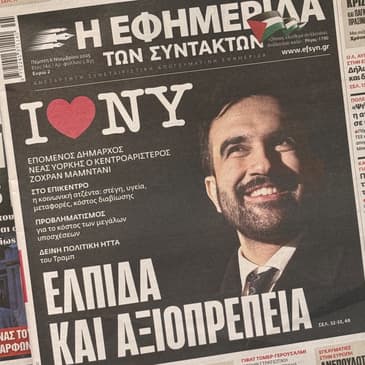
Cam:Yeah. The day before we had been wandering through Koukaki was the day after the election in New York City. And the front page of one of the newspapers had a big photo of Mamdani with the headline, "Elpida kai Axioprepia."
Emily:Hope and dignity. It also said, I love New York too.
Cam:Yes. Anyway, it was something we had not expected to see while wandering around a neighborhood in Athens. So we'd taken a photo of it, and we showed it to the people at Βαυβώ. And that led to an interesting conversation about politics, American and Greek.
Emily:Yeah, one of their friends also writes for that newspaper.
Cam:Yes, it's a left-wing newspaper. Politics in Athens skews much more heavily to the left than typically is the case in most American cities, especially among anybody under the age of about 50, I would say.
Emily:I mean, I think it varies, but yeah. But it also kind of made the name of this little bottle shop a lot more interesting because the name Βαυβώ is a name from Greek mythology. It would have been Baubo in ancient Greek. And as the stories go, when Demeter was mourning the loss of her daughter Persephone, this was the name of a older woman, probably lower class older woman, who managed to make Demeter laugh while she was mourning her daughter by lifting up her skirts and flashing her.
Cam:Yeah, there's a lot to unpack there. A lot we could say about gender and class, especially since-
Emily:And boundary crossing and-
Cam:Yeah, especially since-
Emily:Humor.
Cam:Especially since this is a little bottle shop being run by women who really care a lot about beer. And beer in Greece— it's a burgeoning micro-brewing scene there, but the vibe is very retro 80s heavy metal for some reason. And very male heavy in a lot of ways. So there's something very intentional, I think, about the choice of Βαυβώ as the namesake for this particular restaurant.
Emily:Being like intentionally transgressive.
Cam:Yeah.
Emily:But we have every intention of going back to that bottle shop next time we're in Athens.
Cam:Yeah. If you're looking for a great little selection of Greek beers, that's one place to go.
Emily:Yeah.
Cam:The other place we might as well plug is BeerTime in Psiri, which has for a long time been our favorite beer bar in Athens because they too have a really well curated selection of Greek beers.
Emily:It is our favorite beer bar in Athens. But we should transition to our time in Rome. In many ways, our time in Rome was similar to Athens because we tend to travel the same wherever we are. But Rome is a very different city.
Cam:It is a very different city in a lot of ways. And one of the things you'll notice just off the bat is the fact that the architecture is totally different. Athens is mostly a modern city with a pretty small 19th century core. Rome is a very medieval city and a Baroque city.
Emily:It's not Baroque, don't fix it.
Cam:And that alone makes it feel completely different than Athens.
Emily:Yeah, I mean, one of the things I find kind of funny is that both cities develop because of the rivers that flow through them. But like, you know, in Rome, the Tiber is a very substantial river. There are bridges, you've got to get across it. And in Athens, the rivers have all basically been channeled underground. And they're the kind of thing where you could probably stand a foot on either side of it most of the time, which is funny, but also speaks to just the differences in terrain and geography and all of those things that underlie a lot of the other differences that you see in the cities in some ways.
Cam:Emily just made a river god somewhere cry.
Emily:I didn't say they were any less important.
Cam:The other thing that's really different about Rome is the nature of tourism there. Partly this is an issue of volume. Rome feels a lot more crowded than Athens does in the central tourist areas.
Emily:Oh my god, there's so many more tourists in Rome.
Cam:And one of the sort of side effects of that is that it feels a lot less like a city that people actually live in.
Emily:Yeah.
Cam:In Athens, it doesn't take that much work to wander away from the center and find a neighborhood where there are Athenians. In Rome, that's actually not as easy as you would think. And what you really probably have to do is get on the subway and ride it out a few minutes past the old Roman walls before you get into a neighborhood where the majority of the people you're going to run into are actually Italian.
Emily:Yeah. And like we said at the top, it's been a long time since we've been in Rome. So I'd almost kind of forgotten how the city feels in some ways. And also, like Athens this time, we were staying in a neighborhood that was fairly new for us. Usually when we've been in Rome, we've stayed near the train station, near Termini. And this time we were staying over in Trastevere, which is on the other side of the Tiber River from the ancient city of Rome and the medieval city. And it was actually really nice. We managed to find like a fairly quiet hotel, despite being in the middle of a pretty busy neighborhood. And it was a just wonderful people who worked there.
Cam:Shout out to all the great people at the Hotel Santa Maria.
Emily:Yeah. The hotel also had a very friendly, if somewhat spoiled resident cat who liked to come in at breakfast and the happy hour the hotel had and act like it hadn't been fed in ages, when I know very well that that cat was well-fed and not hurting for food at all.
Cam:That cat dined on prosciutto three meals a day.
Emily:Yeah, that cat was fine.
Cam:The hotel was great, but our experience highlights what we were just saying about the people who live in Rome these days. None of the staff working there that we talked to live anywhere near Trastevere. They're all commuting in from a few kilometers away. And that just underscores the fact that these neighborhoods, even in Trastevere—I won't say been taken over by tourists—
Emily:But kind of.
Cam:But they've become tourist neighborhoods.
Emily:Yeah. And this trip did make me want to, next time we go to Rome, to get out of the touristy areas and spend some time in the parts of Rome where real people live.
Cam:Yeah. So it had been long enough since we were last in Italy that there were some kind of embarrassing culture shock moments. The one that stands out to me is the moment when I tried to order coffee at an Illy bar. We'd been eating breakfast every day in our hotel where they had some perfectly good espresso. So we hadn't really gone into an Italian espresso place for our entire trip until the day we were leaving, literally. And I had forgotten that there's a very distinctive way in which you order coffee in an Italian coffee bar. Basically, you pay for your drink, they give you your receipt, you walk up to the bar, plonk your receipt down, the barista looks at it, serves you your coffee, and you knock it back as quickly as you can and go. And I'd forgotten that crucial step of actually going and putting the ticket on the bar. So we were standing around wondering what was going on, "Where is our coffee?" And I would say it took me a good three or four minutes before I remembered, oh, wait a minute. We're in Rome.
Emily:Yeah, that was kind of funny. I, you know, didn't drink enough espresso.
Cam:It was not one of my prouder moments.
Emily:No. We also had a couple embarrassing moments where instead of Italian coming out of our mouths when we would try to speak to people, Greek would come out. Although I think did kind of win some of the people over that we were interacting with because then we explained like, oh, sorry. like, we were just in Greece, that was Greek. And I think they were just kind of impressed that as Americans, we were using any other language.
Cam:Americans do have a pretty bad reputation for being aggressively monolingual. A lot of my fellow Canadians have the same problem too, to be honest.
Emily:Yeah. We straightened ourselves out eventually. And we had our last night there, we had a waiter at a really good restaurant, but he was a little grumpy when we got there. But we can sort of fake our way through Italian enough. Like if it's a restaurant and the conversation is basic enough and there's no unexpected questions, if you can anticipate what the questions are going to be, so in case you don't understand what they actually say, but you know...
Cam:You just nod wisely and say, "Vino!"
Emily:You know, you kind of know how to respond that you can kind of get away. And I think we managed to reasonably fake it well enough that this waiter thought we were tourists who had enough Italian to communicate. And he got decidedly less grumpy as the night went on when he didn't have to speak to us in English.
Cam:Yeah, he really did not want to speak English to us.
Emily:And it was fine. I don't understand most of what he said, but enough to respond.
Cam:Well, you understood the food words, which were the most important words in that conversation.
Emily:Yeah. And I felt pretty proud of ourselves that we went over the grumpy waiter.
Cam:Yeah, that was a fun experience. As we did in Athens, we visited a range of both familiar and new places. So we do have a bunch of favorite places that we like to visit, but we do always try to find something new or different to do whenever we're on a trip. This time, one of the old favorites we visited was the Church of San Clemente in the Celimontana area, just south of the Colosseum. This is an old church with an active archaeological zone underneath it. The current church, much of which dates originally to the 12th century, sits on top of a much older church from the 4th century, big chunks of which still exist in the basement. So if you pay your entry fee, you can wander down into the subterranean part of the church and poke around in the old 4th century church beneath.
Emily:Yeah, and one of the cool things in the 4th century church is there's almost what amounts to a comic strip on the wall. It's a series of panels or illustrations telling a story. And there are captions or like speech bubbles.
Cam:Basically a fresco with dialogue.
Emily:Yeah. And these speech bubbles capture what people have argued is basically the oldest version of Italian that there is. And as sort of the spoken Latin changes over the centuries, this is something they can point you and say, okay, this is now Italian. It's not Latin anymore as we look back. It also has a naughty word in it too.
Cam:Well, now you have to tell them what it says.
Emily:Since this is a non-explicit podcast, we probably shouldn't use that kind of language. It's not really that bad.
Cam:Yeah, the scene shows a bunch of people trying to haul San Clemente off. But because they've somehow been beguiled into thinking that a great big rock is actually the saint, they're not doing very well. And their leader is screaming, "Pull, you jerks!" Only he uses a slightly more colorful word than jerks.
Emily:We did overhear a tour guide say how much the schoolchildren, when they come to tour, get a kick out of the naughty word in the illustration depicting a scene from the saint's life. And then...
Cam:And then there's something even more cool to see. Underneath the church that's underneath the church, there's an ancient Roman Mithraeum.
Emily:A Mithraeum is where Mithras was worshipped, who was a Persian deity that becomes popular in the Roman Empire, particularly with the military. And the sanctuaries for Mithras tended to be underground. And it was one of these mystery religions, if you will, meaning that followers or adherents had to be initiated to learn about the rites and stuff. So it was secretive in that outsiders couldn't know about the rituals and stuff.
Cam:So what you see basically is a large banqueting room with a really fantastic altar still in situ beneath. And that alone is pretty much worth the price of admission.
Emily:Yeah. And because Rome, you know, is such an old city and has such history, what you see at San Clemente of these like layers of construction and habitation happen all over the place. Like there's all sorts of underground sites and tours that you can do. Not far from San Clemente, there's a church of Santi Giovanni e Paolo, where you can get a tour underneath, where there's a Roman apartment building, like ancient Roman apartment building and street. These things are kind of everywhere, and we've gotten lucky enough to do them in a few places. And they're really cool to see these underground sites and see the layers, literal layers of history. But the Mithraeum is still a favorite, for sure.
Cam:Although I have to say that the archaic Italian scrawled on the wall in the church under the church is pretty cool, too.
Emily:Yeah, it's a neat place to go. And that's one of the reasons we went back to it.
Cam:Yes.
Emily:We also got to go to some new places. One of the big ones here is the Castel Sant'Angelo, which I know is not like a new site or anything, but neither one of us had ever been before. And wow, we did not appreciate how huge that site is.
Cam:Yeah, for those of you who don't know what Castle Sant'Angelo is, it is an ancient Roman tomb, the tomb of the Emperor Hadrian. And it was reworked by the popes into a fortress with a palace on it.
Emily:It was so much larger than we expected. We spent a ton of time there. And we're probably actually going to do an episode on it because it's just incredibly rich in terms of the history. And it was really cool.
Cam:Yeah, our mistake for thinking that a papal palace could be anything other than big and luxurious.
Emily:See, I knew the fortress part, not the palace part. Anyway, that was cool.
Cam:The other thing we visited, new to us, also new to the city of Rome, was the Museum of the Forma Urbis. This is one of the most interesting artifacts to survive from the ancient Roman world. It was a huge marble plan depicting the footprint of the city of Rome as it existed in the early 3rd century CE. It was originally mounted on the wall of the Temple of Peace, and it was huge. It was about 18 meters wide by 13 meters tall. There's not much of it left, but there are a bunch of substantial fragments, and they're now displayed in the Museum of the Forma Urbis underneath a glass floor so that visitors can wander around and inspect the surviving fragments, which have been sort of laid out in relative position. The bits that are missing, and there are a lot of those bits that are missing, are filled in with illustrations based on a mid-18th century map of Rome by a guy called Giovanni Battista Noli. So what you end up with is a really, really interesting composite effect where you kind of get a sense of what Rome looked like at two very, very different points in its history.
Emily:And it's cool the moments where you can see how the ancient city affected what came after it, even if it went from urban buildings to gardens. You could still see in places where the later was dependent on the former.
Cam:Yeah, that happens all the time in Rome. The most famous example is the Piazza Navona, a mostly Renaissance period piazza in Rome, which grew up on the old Stadium of Domitian and still echoes the shape of the stadium. Anyway, because the Forma Urbis is so cool, and because it's so hard to describe in a way that does justice to it, I think we'll probably go and post a few pictures of it on our blog. So that will be there for you to visit later.
Emily:Now, while we were in Rome, we didn't do sites like the Forum and the Colosseum and things like that, partly because we didn't have a lot of time, and partly because there were a lot of crowds, and we were tired from the marathon, and so we limited ourselves a little bit. And we did walk around them, but we didn't go in. We did see that on the Colosseum, they are sort of attempting to recreate what statues on the Colosseum would have looked like and all the niches that we talked about in that episode. So they're not real statues. They're two-dimensional panels with sort of statues on them. But the effect is that there are now statues in those niches, especially at a distance, which was kind of cool.
Cam:What we did do is what we do best. We wandered a big chunk of the old city. As we've mentioned, old Rome is quite a bit larger than old Athens, but it's still compact enough that you can get across it if you want to in, let's say, half an hour, depending on where you're starting and where you're ending. And as you wander through Rome, what you will quickly discover is that there's plenty of stuff to see just wandering around. And part of the reason for that is because parts of Rome are so old and have been inhabited for so long, you end up with a living landscape in which buildings from a whole range of different periods coexist happily alongside one another. So one great example is the old temple of Vibia Sabina and Hadrian. There's not much left of the temple now except for the facade of one wall, which consists of about a dozen Corinthian columns. In the 19th century, that wall was integrated into a 19th century aristocratic home, a palazzo. That palazzo is still there. It's now basically the Roman Stock Exchange. So you end up with a crazy composite building with one wall that is ancient facing onto a piazza. What we discovered is that the staff at the Stock Exchange is perfectly happy to let you wander in and wander around, at least on the ground floor, so you can inspect that ancient wall from the inside.
Emily:Yeah. And it was kind of funny when we walked inside because, right, you've got the sort of ancient wall and then you had like a very modern space otherwise in the middle as you're like walking around where the little displays are. And it was set up, looked like it was set up for like a lecture or a talk or something.
Cam:It has the feel of a very modern bank, which is hardly surprising since it's the stock exchange.
Emily:Yeah. Yeah. So it was just, there was a lot of interesting juxtaposition going on.
Cam:But that's not the only place like that in Rome. And everywhere you go in the city, It's really easy to stumble across ancient fragments that were repurposed and built into 14th, 15th, 16th century buildings and modern structures alongside them. But we are definitely running long. So why don't you end by telling people about the experience we had on the Janiculum?
Emily:So I have a former student who is there in Rome studying for the priesthood. And we were able to meet up with him. And the North American Pontifical College is on top of the Janiculum Hill. So we were able to meet up with him there and hang out for a bit. And I mean, had a lovely conversation, learned a lot about what it's like studying to become a priest and doing that in Rome, but also got one of the best views of Rome I've ever had from the rooftop on top of the Janiculum Hill.
Cam:Yeah, the Janiculum is the tallest of the hills immediately around Rome. And we were on top of a fairly tall building on top of that. So the view was pretty good.
Emily:Yeah.
Cam:I'll have to admit.
Emily:That was like a really, it was a really delightful moment that we didn't necessarily plan for.
Cam:It was cool.
Emily:Yeah. So I would like to thank Charlie for giving us that chance and for the lovely conversation. So I think that's where we'll wrap it up. Hopefully you enjoyed hearing a little bit about our travels and how we like to travel and just some of the experiences that we had on this trip. And if you found this episode kind of boring and tedious, don't worry, we'll be going back to our more normal style next time.
Cam:Dense facts, lots of detail.
Emily:Cam is like, "I'm so uncomfortable with talking about personal experiences."
Cam:Guilty as charged.
Emily:Cam is like, “Please end this. Please make my suffering stop.” So until our next episode, I'm Emily.
Cam:I'm Cam.
Emily:And this has been Have Toga, Will Travel. Subscribe to our show wherever you get your favorite podcasts. And follow us at havetogawilltravel.com or on all the socials. And if you have any questions or any other topics you'd like to see us cover, please feel free to reach out and let us know. And if you like this episode, tell a friend about us.
Cam:Thanks for listening, everybody. Have a great holiday, and we'll see you in January.
Emily:2026, baby!