Nafplio (ancient Nauplia) is a Greek town with a long, long past. Nestled on a spit of land at the north end of the Argolic Gulf, it overlooks a harbor that has been one of the most important in the Peloponnese since at least the 7th century BCE, when ancient Nauplia was conquered and annexed by nearby Argos to serve as that city-state’s primary port.
Given its strategic importance, it should hardly be surprising that Nafplio has been the target of ambitious warlords and imperial powers since antiquity. Long part of the Roman and then Byzantine Empires, it served briefly as the seat of a Byzantine warlord after the ill-starred Fourth Crusade of 1204 threw the Balkans into chaos, before passing a few years later into the hands of a Burgundian master—one of the many “Franks” who occupied much of Greece in the wake of the Crusade. It was ceded to the Republic of Venice in 1388; conquered by the Ottoman Empire in 1540; reconquered by Venice 1686 (by none other than Morosini, whose forces would blow up the Parthenon the next year); and taken again by the Ottomans in 1715. It was finally liberated in 1822, during the Greek War of Independence, by Greek freedom fighters operating under the overall command of Theodoros Kolokotronis—a former highwayman and soldier of fortune who, because he was just over 50 at the time the war began, was deemed ancient enough to be given the nickname “The Old Man of the Morea.”
With the advent of gunpowder and artillery of growing sophistication, Nafplio became increasingly difficult to defend, because it sat in the shadow of the massive Palamidi Hill. Just to the south of Nafplio itself, the Palamidi Hill—with a summit of 220m / 656 ft—offered a prime spot for lobbing cannonballs and shells into the town below. In the early eighteenth century, the Republic of Venice (in control of Nafplio at the time) attempted to cope with this danger and control the heights by constructing a massive series of fortifications on the hill, the Palamidi Fotress. Today, it’s one of Nafplio’s premier tourist spots, and a very interesting place to spend the afternoon!
The Palamidi Towers over Nafplio
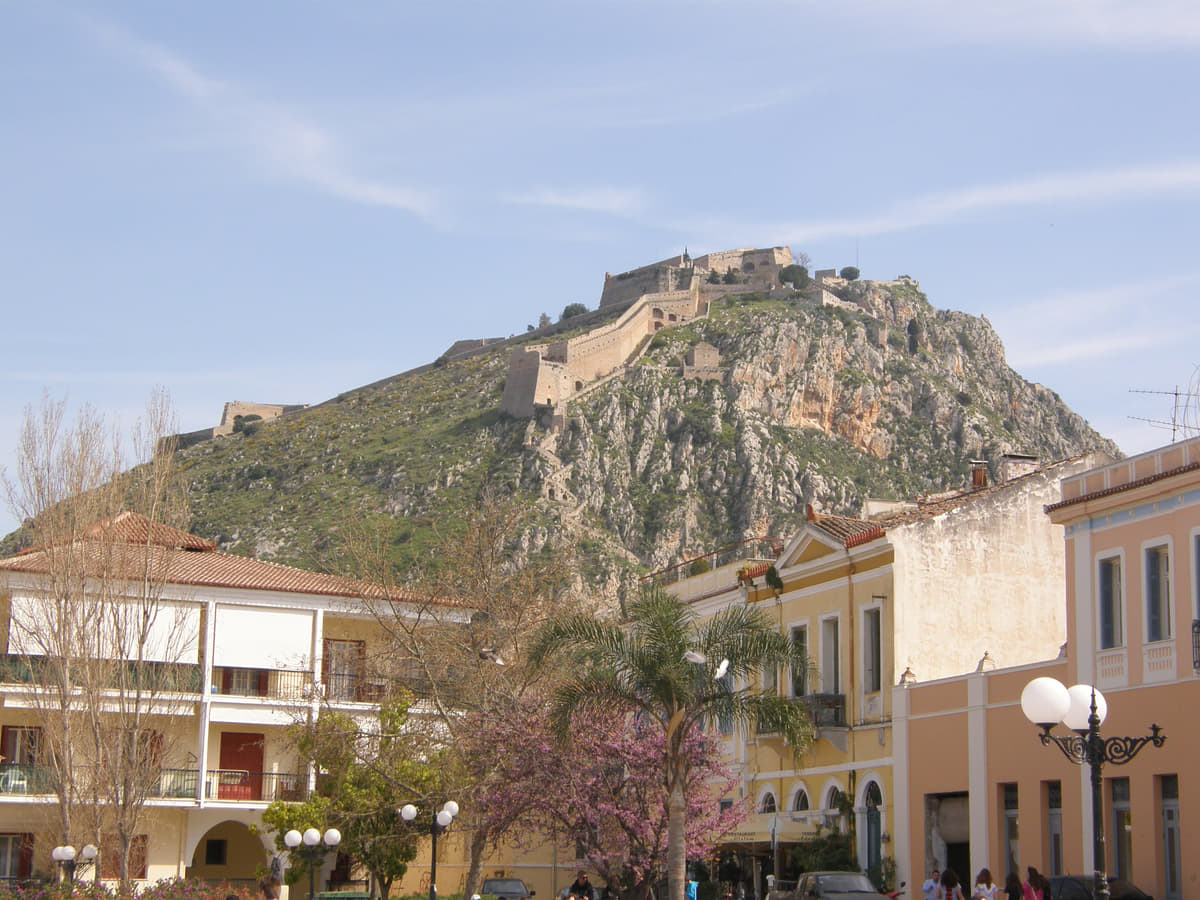
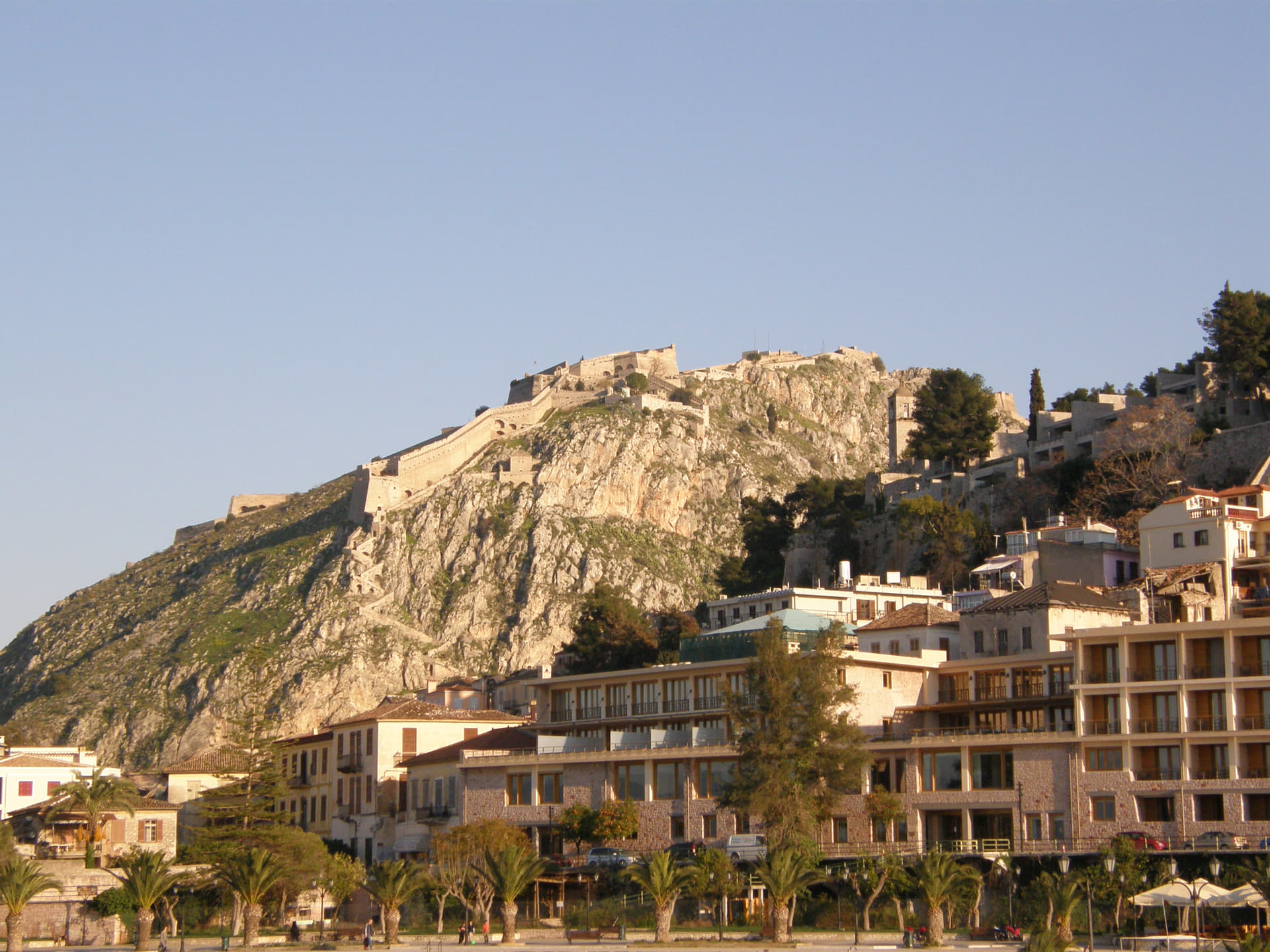
The westernmost point of Nafplio is the best place from which to view the fortress in its context. From here, near a narrow pier that leads to Nafplio’s lighthouse, the fortress looms over the town. In immediate the foreground is the Amphitryon Hotel, with other buildings visible behind it on the rising ground of Nafplio’s ancient acropolis. In the background, of course, the massive bulk of Palamidi Hill towers over the scene, crowned by the fortress itself.
What we see of the fortress from this angle is its back (western) side. As you can see, the western slopes of the Palamidi Hill are steep, rocky, and not particularly accessible. The fortress’ engineers were less concerned about protecting this side of the hill than they were about guarding its eastern slopes, which are comparatively gentle. Their priority on this side was to protect the communications route between town and fortress from attackers who managed to capture the outlying fortifications on the ridge descending to the east (to the left in this shot). If you look carefully, you can see the staircase that begins at the bastion near the hill’s summit and makes its way down the hill under the lee of a protective wall, which ends at the lowest of the fortress’ eight bastions (the Robert Bastion). The staircase then continues to the town, zigzagging down a particular steep stretch of the hill. (What you can’t see from this angle is the impressive, covered cauponier that connected the base of the staircase with Venetian fortifications on the ancient acropolis.)
Nauplia's Ancient Acropolis
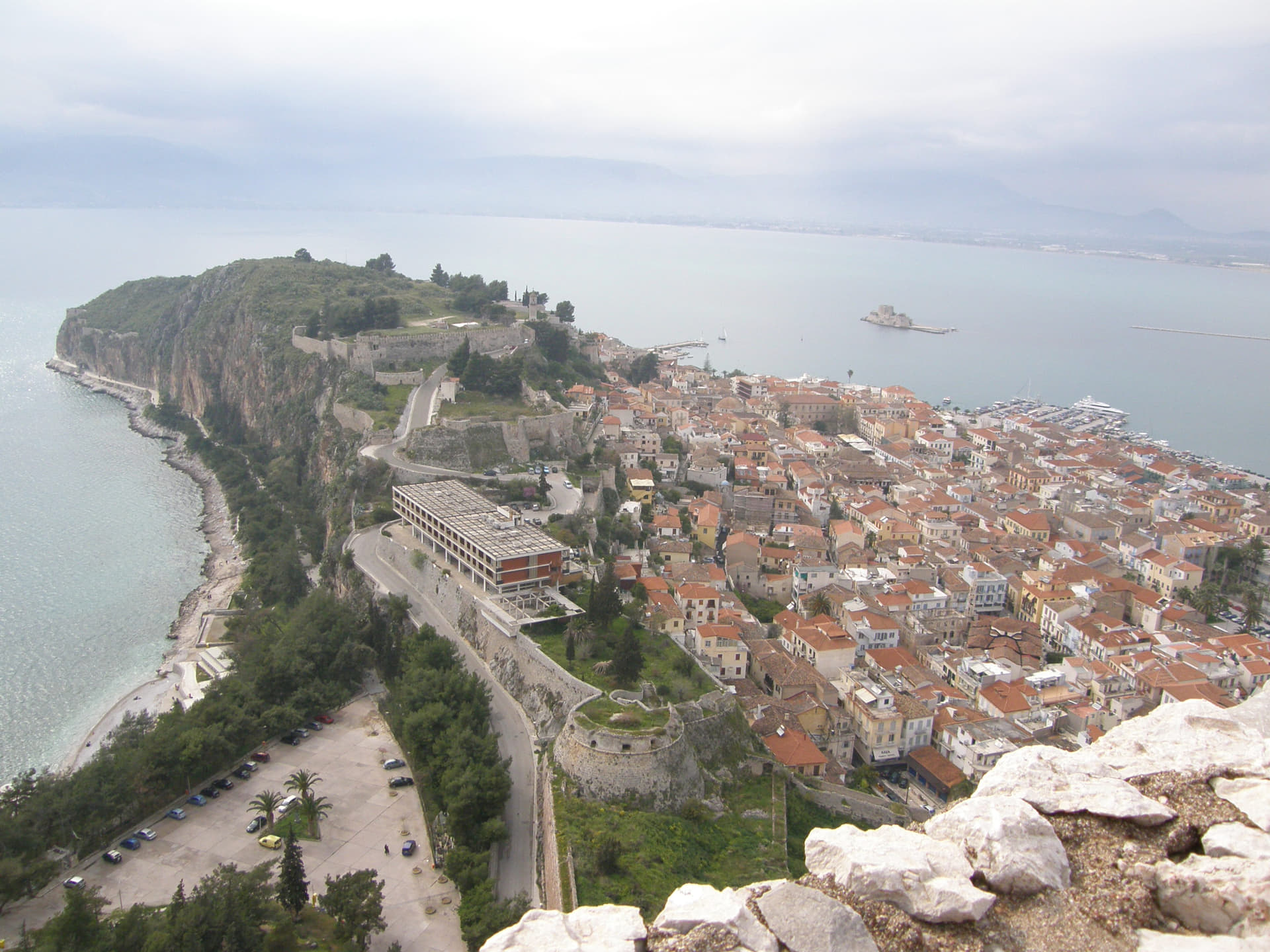
When visitors make the climb up the zigzag staircase (yes, we’re THAT kind of people) and have the stomach to look behind themselves as they ascend, they are treated to views of the northern end of the Argolic Gulf, of Nafplio town, and of the headland that served as the acropolis of ancient Nauplia.
This photo is unfortunately dominated by an ugly and abandoned brutalist hotel that now glowers over the parking lot in the bottom lefthand corner of the shot. If, however, you ignore it, you can see several different layers of old fortifications that guard the ascent up the ancient acropolis from its eastern end (“down” in the photo).
The oldest visible remains in this shot are the medieval fortifications just up the road from the abandoned hotel. In the 1470s, the Venetians reinforced these by adding a talus (a sloping protective wall) in front of them. In the photo, the remains of the talus can be seen if you look just above the top corner of the abandoned hotel; it has fallen away further to the right, where the old medieval wall itself is now visible.
The other visible fortifications were built by the Venetians at roughly the same time as the talus. Up the hill from the medieval wall and the talus is the so-called Gambello Traverse—an additional wall built on the ruins of the acropolis’ ancient fortifications to provide a secondary line of defense against artillery. The abandoned hotel itself sits on top of another late 15th-century Venetian fortification, the Castello di Toron; Venetian engineers modified this in the 18th century by adding the round artillery battery, as well as an outer bastion (the walls of which you can still make out below the battery). Finally, in the harbor to the north (to the right in this shot), you can see a 15th-century island fortlet known as the Bourtzi.
To the north of the ancient acropolis, the old districts of Nafplio itself spread out in all their glory. The town features a lot of nice neoclassical buildings as well as handful of surviving Ottoman features (fountains, mostly). And, in the distance at the top right of the frame, you just make out the acropolis of Argos (the bump at the end of the longer ridge on the far side of the gulf), crowned by a medieval castle known as the Larissa. Argos itself is the whitish smudge at the base of that acropolis.
The Gate of the Agios Andreas Bastion
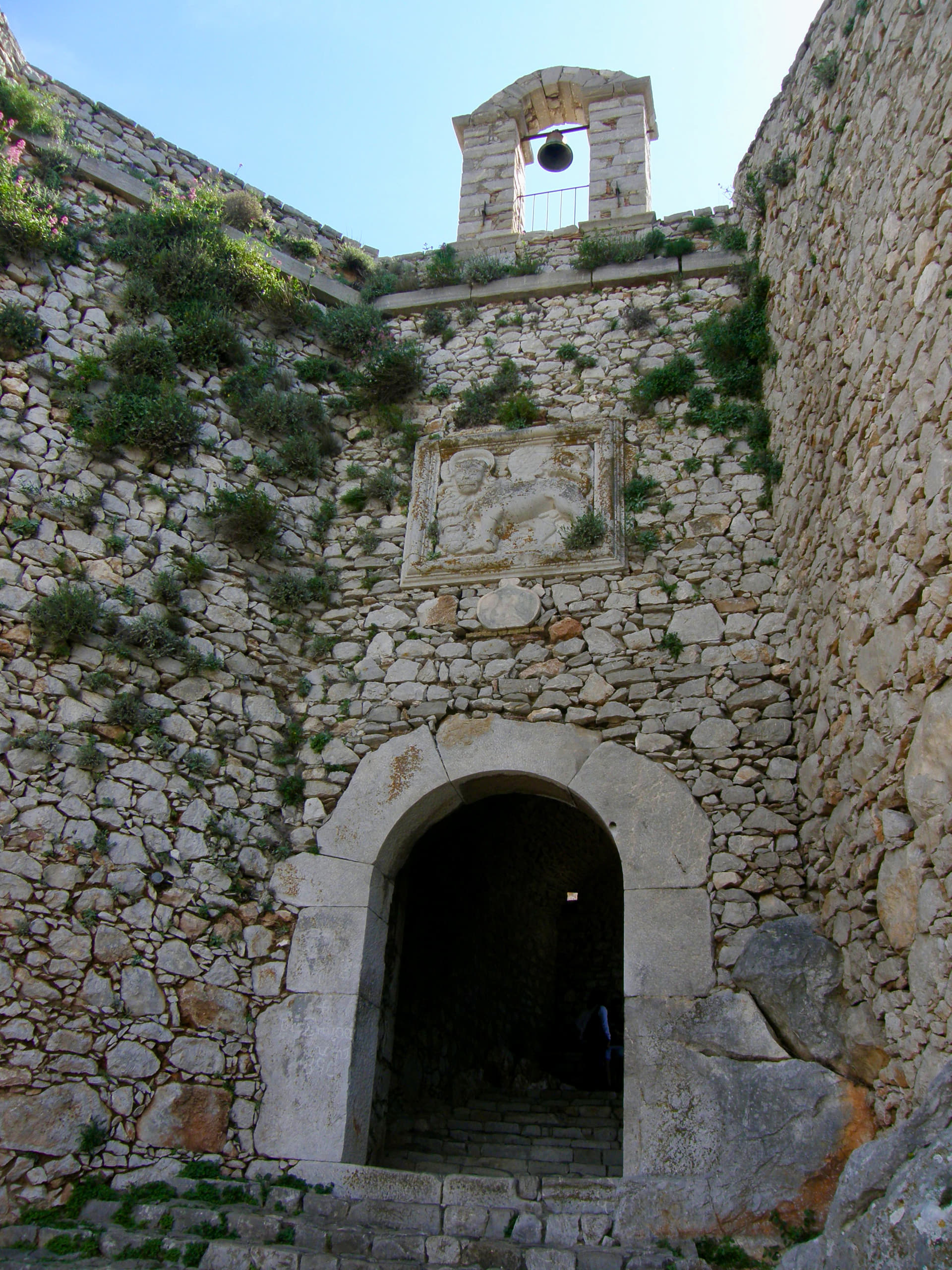
At the end of the long climb up both the zigzag staircase and the straighter segment that begins at Robert Bastion, visitors finally come to the most important complex of the fortress: The Bastion of Agios Andreas (the name is the Greek form of Saint Andrew), which anchors the northwest corner of the upper fortifications. Among other things, this bastion housed a chapel, along with rooms used by the fortress’ commander. Infamously, it also contained a room in which one of the heroes of 1822—the Old Man of the Morea himself, Kolokotronis—was imprisoned for several months in 1834 and 1835, after being accused of plotting against the government of Otto I (the Bavarian prince who was appointed King of Greece in 1832).
Agios Andreas is actually the third name borne by this bastion. Like the seven other bastions (all of which were renamed by the Greeks when they took possession of the fortress), it had had two other names: the Ottomans called it Disdar Tabya, and the Venetians San Girardo. In spite of the various changes in name, however, the gate of the bastion still proudly proclaims its Venetian heritage: the plaque above the doorway is emblazoned with the winged lion of Saint Mark, the ancient emblem of the Republic of Venice.
The Phokion Bastion
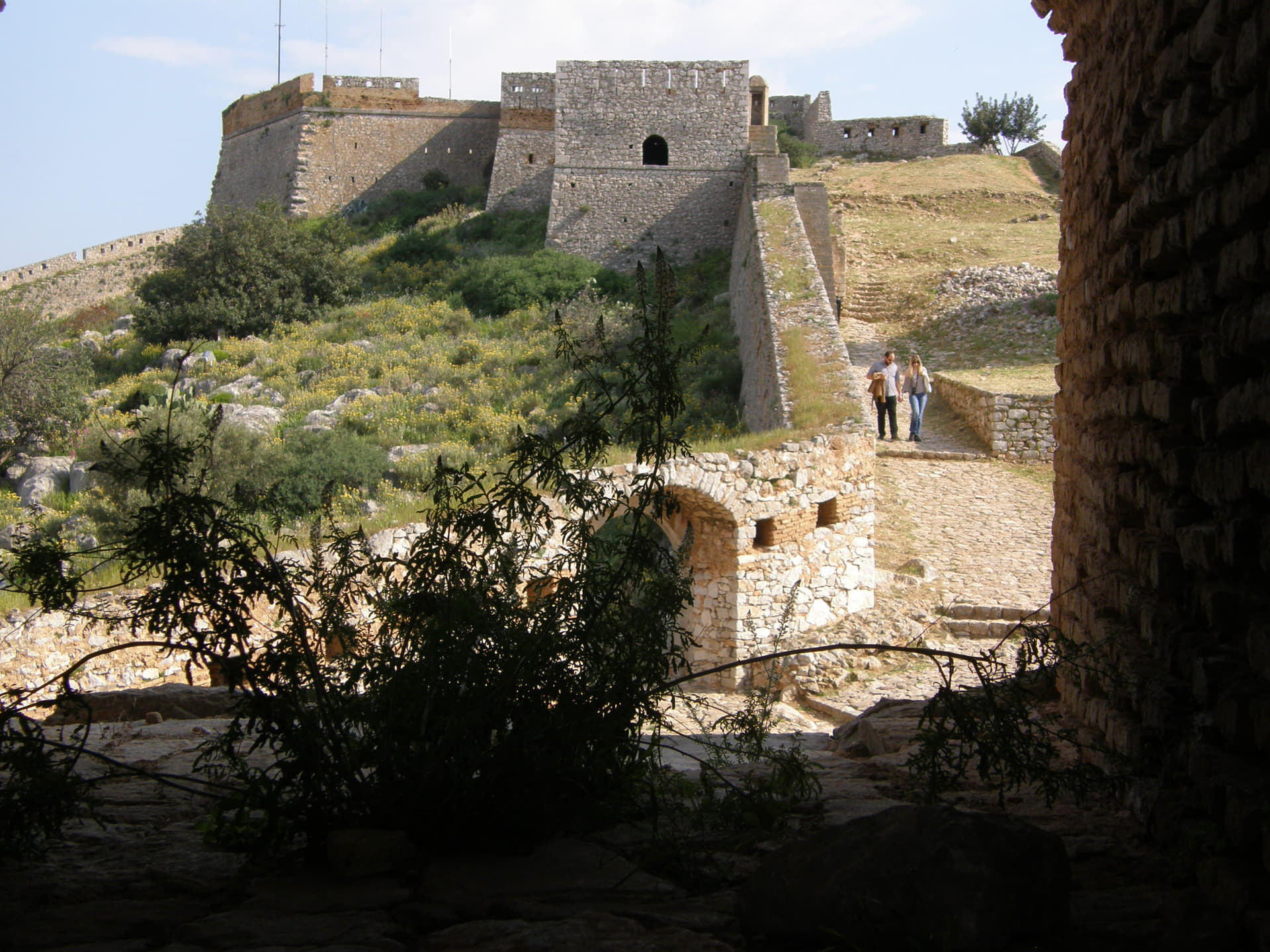
The defensive logic of the fortress begins to reveal itself as visitors pass through the Bastion of Agios Andreas and move deeper into the complex. Composed of multiple bastions that radiate outward from Agios Andreas like points on a fan, the fortress was designed to be defended by a relatively small garrison that could, if necessary, fall back in stages—forcing an enemy attacking up the eastern slope to tackle multiple defensive points under fire from overlapping batteries. Agios Andreas itself was the last point of defense in this network.
Immediately to the south of Agios Andreas is the Phokion Bastion (seen here through one of Agios Andreas’ cannon embrasures). What you can’t see in this shot of the Phokion Bastion are the embrasures that housed its own artillery battery. That battery was situated at the southeastern end of the bastion. From there, its cannon could either fire over the fortress’ external wall (visible on the left edge of the shot) or toward other bastions situated further south, but could not easily be turned against Agios Andreas if the garrison were to abandon Phokion and fall back.
Agios Andreas from the South
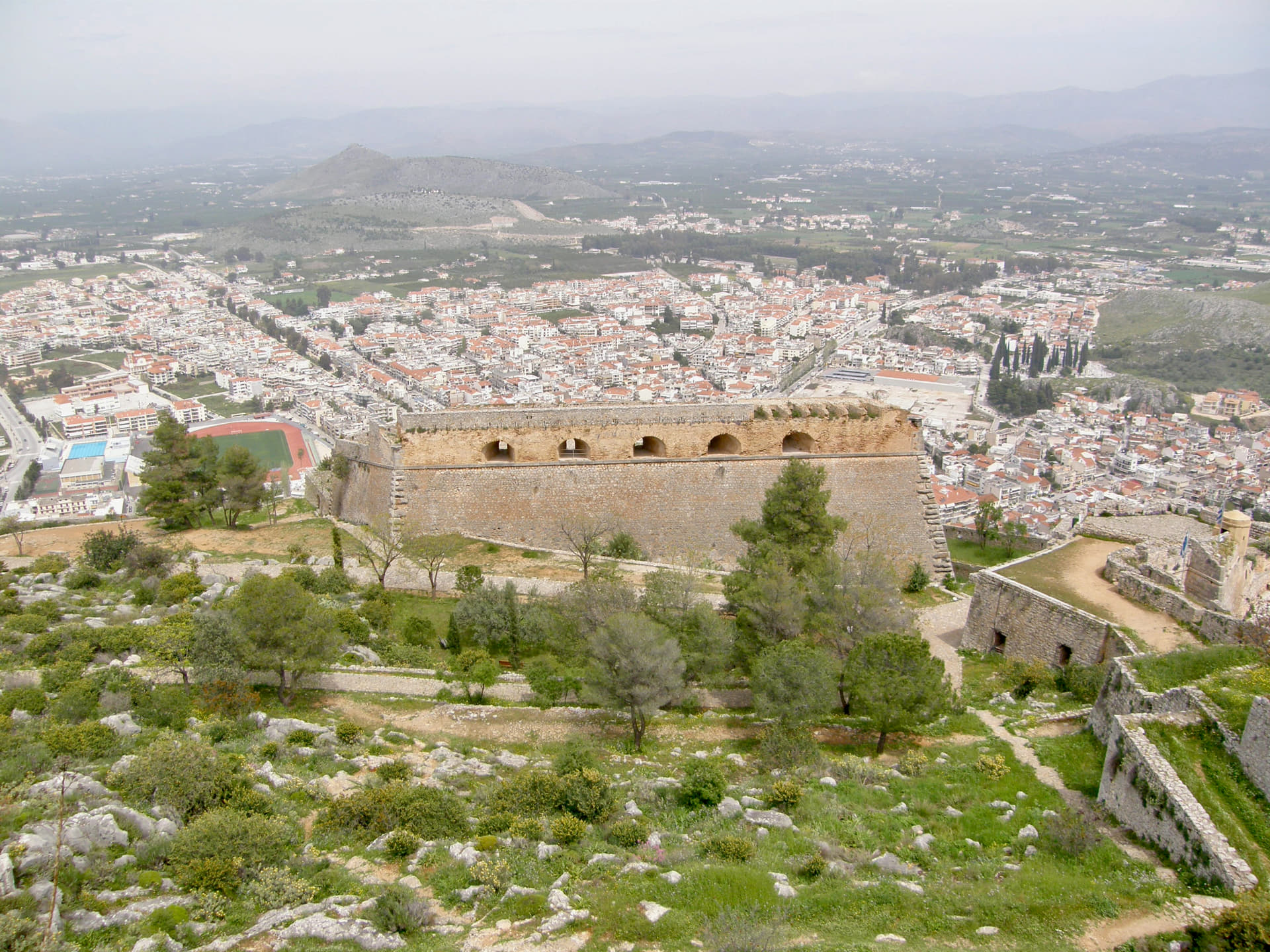
The defensive logic of the complex becomes even more clear when a visitor climbs up the Phokion Bastion and turns around to look back at Agios Andreas. A line of dour cannon embrasures glower at the Phokion Bastion itself and at the inner yard between Agios Andreas and the bastions to the east. Soldiers would fight from the outer bastions as long as possible, fall back to the next point of defense, and open fire on advancing attackers who had surmounted one bastion—only to run headlong into an unwelcome cannonade from the next bastion in line.
The acropolis of Argos is once again visible in this photo: it’s the bump on the far side of the gulf, near the left edge of the shot. The hill in the middle distance near the right edge of the shot is Profitis Ilias; just to the left of it is the Bronze Age citadel of Tiryns, which unfortunately can’t be seen from this distance.
The Miltiades and Epameinondas Bastions
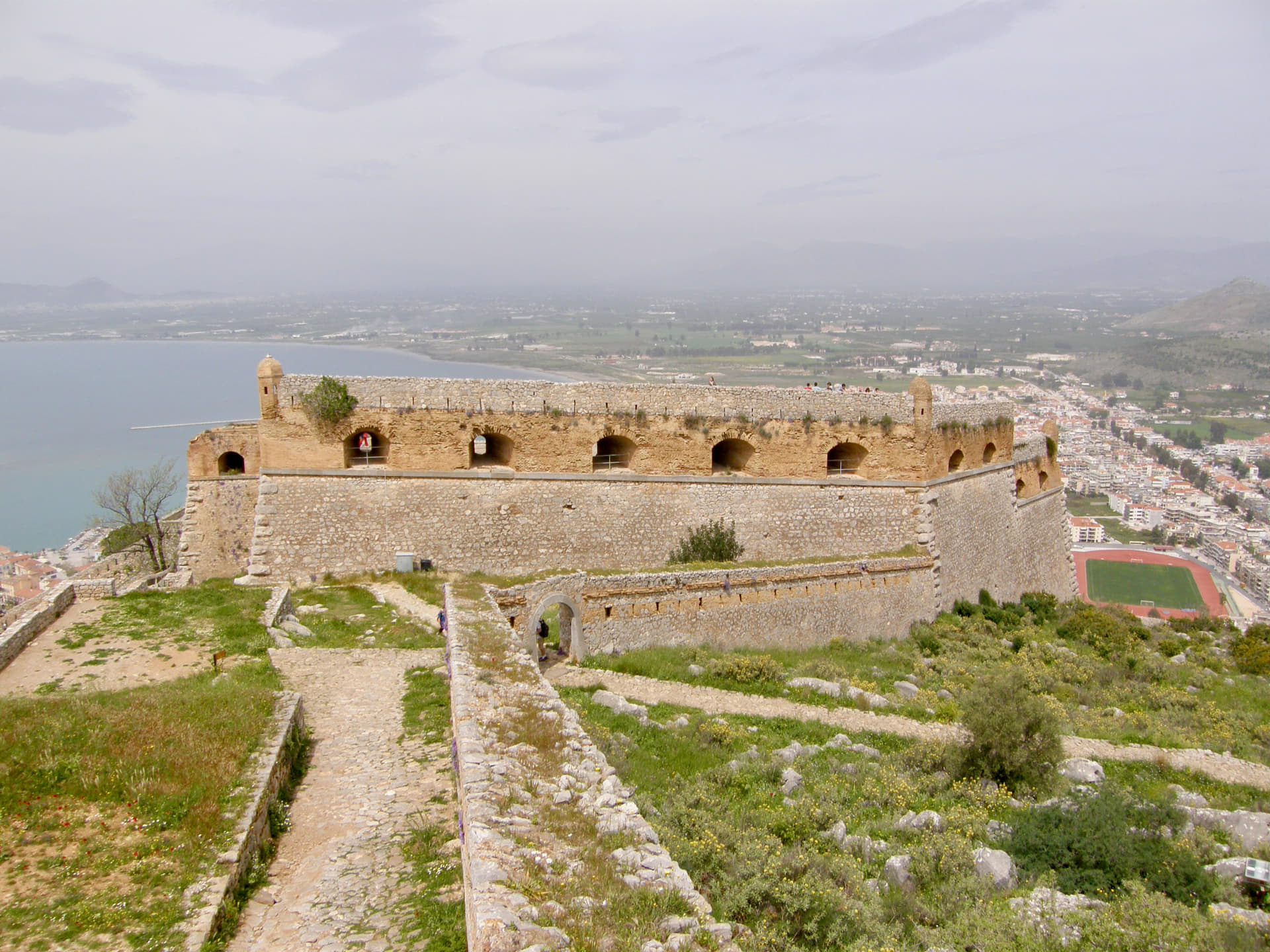
To the east of Agios Andreas are the free-standing Miltiades Bastion (in the center of the shot), and the Epameinondas Bastion, which houses the main eastern gate of the complex (on the right). Both are seen here from the southeastern end of the Phokion Bastion (our camera is pointed to the north). The Miltiades Bastion is particularly nasty: on its eastern face is a battery designed to fire over Epameinondas and sweep the approach to the complex’s gate; on its northern face is a battery designed both to support outlying bastions to the south, and to rake any attackers that succeeded in breaking through the gate and attempted to advance against the Agios Andreas Bastion.
The Epameinondas Bastion and the Gate
From the Miltiades Bastion, visitors have a nice view of the Epameinondas Bastion, its gatehouse, and the countryside beyond. The fortifications stretching away to the southeast (left) near the top of the shot are two outlying bastions situated to the south of the Phokion Bastion, there to guard the long ridge at the top of the cliffs that plunge down into the Argolic Gulf.
The camera here is overtop of the northern battery of Miltiades, and gives a good sense of what defenders would have seen if posted to the bastion. You’ll note that they have a clear field of fire both to the fortress’ inner courtyard—which enabled them to enfilade anyone who broke through the gate—and to the ground outside of the outlying bastions to the south.
Today, the gate opens onto a parking lot. (Yes, this means that visitors who don’t want to brave the staircase from town can drive up!) If you look carefully to the left of the gatehouse’s turret, you should be able to see three tour buses lined up on the road.
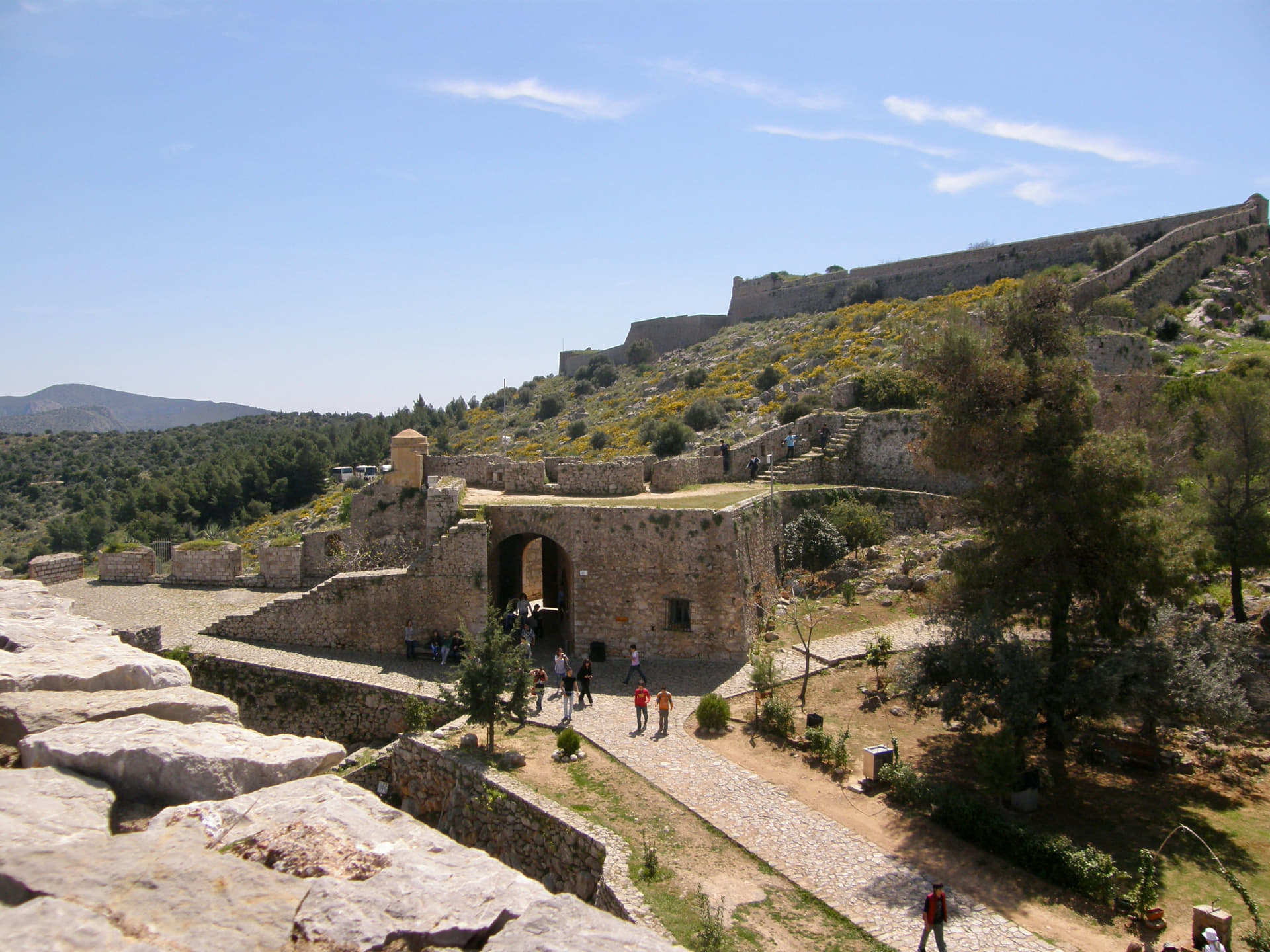
The Phokion Bastion's Cliffside Gate
The two outlying bastions visible in the previous photo are the Themistokles and Achilles Bastions. They communicated with the Phokion Bastion via a path that passed through a gate in Phokion’s southwest wall. This photo, captured from a point outside of the gate, hints at both the roughness of the hillside here and at the color of the wildflowers that bloom in the spring.
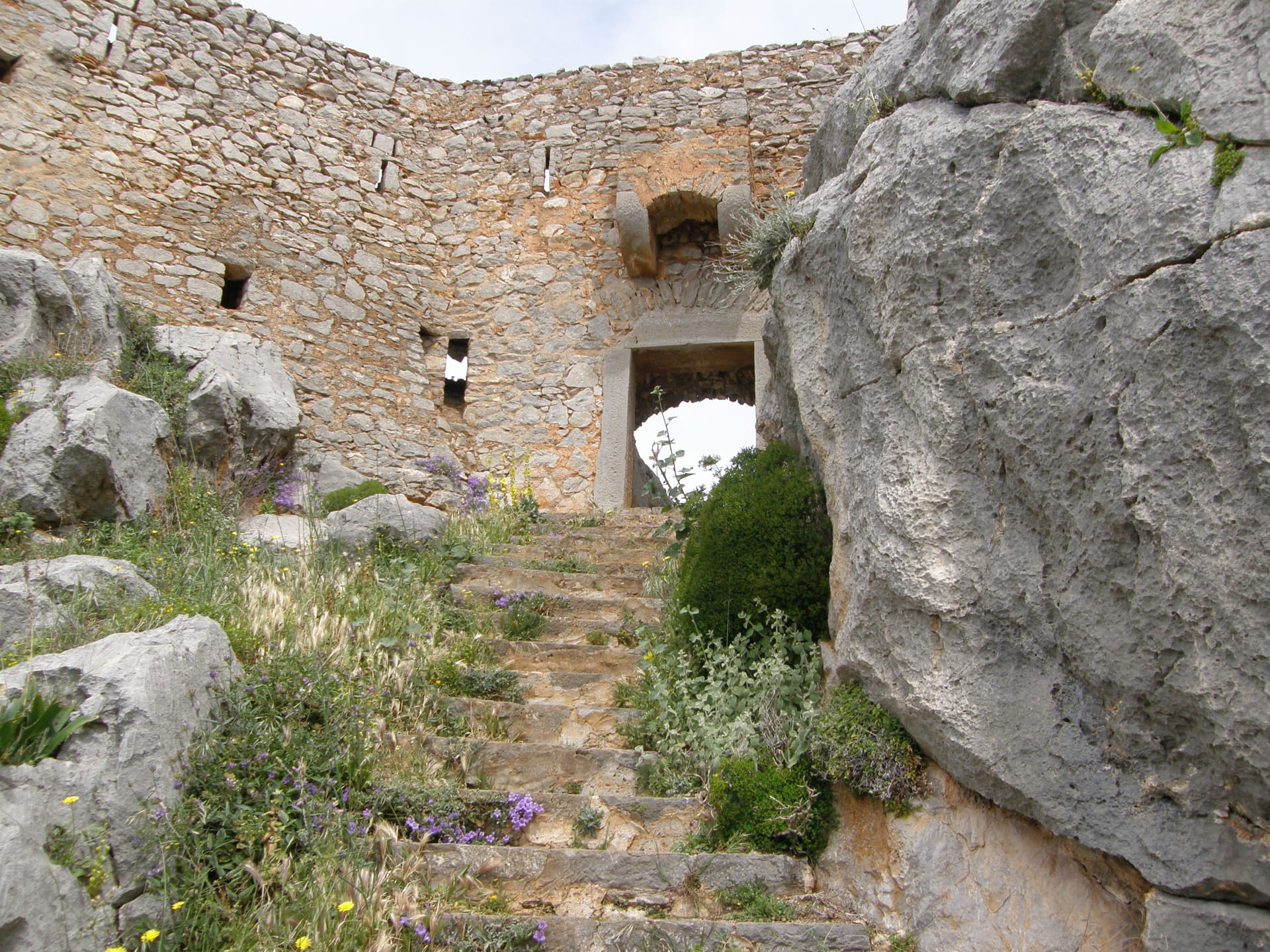
The Cliffside Path
The path itself offers dramatic views of the cliffs and the Argolic Gulf below. This shot captures the essence of the Aegean: sea, sky—and cacti!
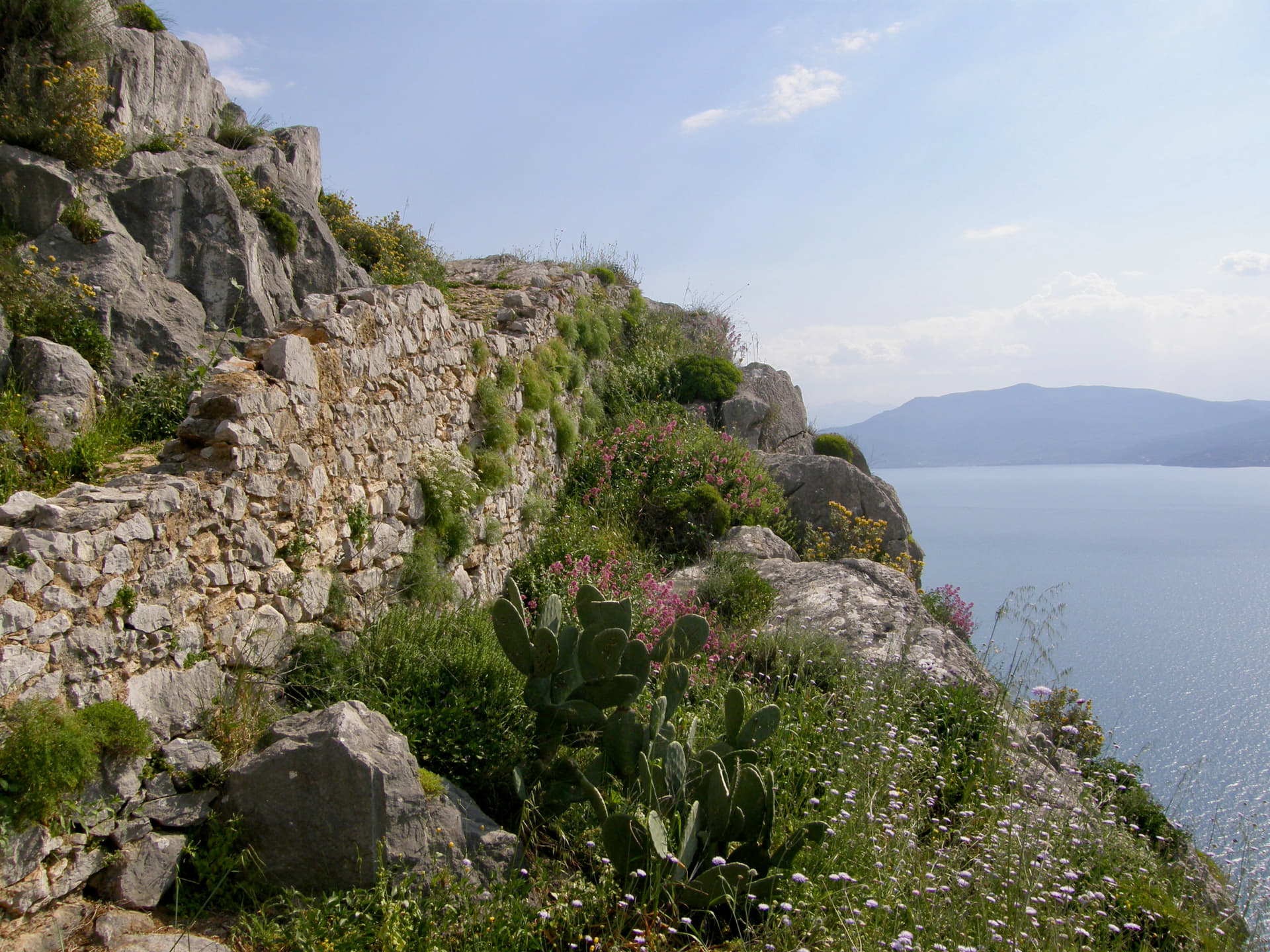
The Walls of the Themistokles Bastion
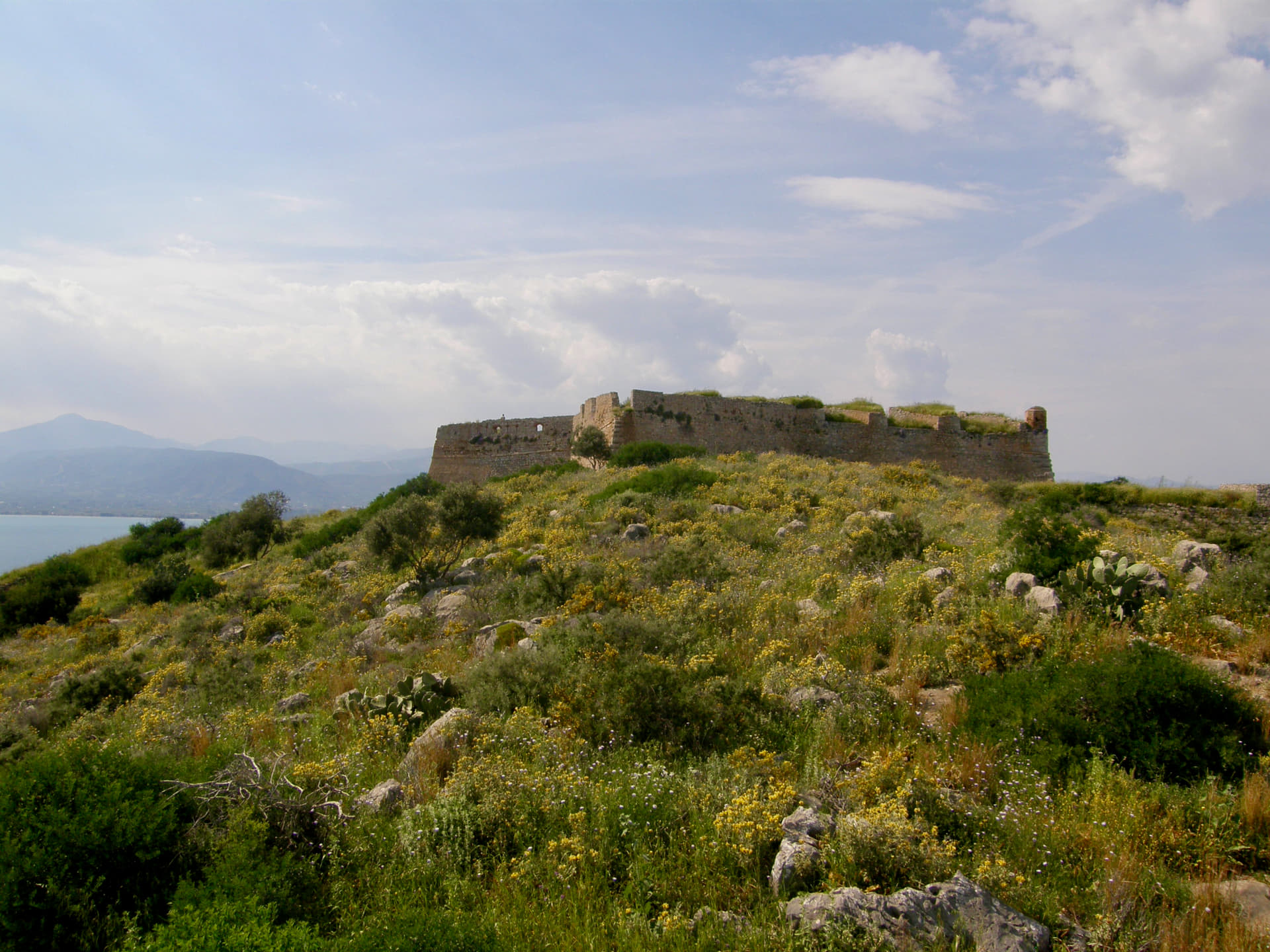
Comparatively few visitors wander as far as the outlying Themistokles and Achilles bastions. As a result, both of these feel (and are!) wild and overgrown, and the lines of the fortifications and traces of old internal roads can both be difficult to trace. This shot was taken from within the Achilles Bastion, looking northward back to the Themistokles Bastion. The cannon embrasures you can make out at the top of Themistokles are designed to cover the fortress’ extreme southeast corner.
It was in this sector of the fortress that Ottoman attackers first broke through the lines in 1715, after besieging a force of mercenaries and conscripts levied by the Republic of Venice. It seems that the Ottoman forces managed to penetrate the Achilles Bastion at the fortress’ extreme southern end. The defenders panicked, and instead of continuing to fight in the way the fortress and its bastions were designed to support (i.e. by falling back first to Themistokles, then to Phokion, then to Agias Andreas), they simply ran—all the way back down the hill to Nafplio, which the Ottomans promptly captured.
History, as they say, often rhymes, and in 1822 the Ottomans lost control of the fortress in the same way they had won it. On November 29th, after a lengthy siege, a small force of only 350 Greek freedom fighters burst into the fortress under the leadership of Staiko Staikopoulos. Ottoman resistance quickly crumbled, the fortress fell, and shortly afterward Kolokotronis and his forces liberated Nafplio—which became the capital of independent Greece for the remainder of the war.
Epilogue, Part I: The Old Man of the Morea Taverna in Athens
Although Kolokotronis was imprisoned in the Palamidi after falling afoul of Otto I (the Bavarian prince appointed King of Greece by the Great Powers of the time, who had no interest in a Greece governed as a republic), he was eventually pardoned and released. Today, he is widely revered as one of the heroes of the Greek War of Independence, and both Athens and Nafplio in particular are littered with official monuments erected in his honor.
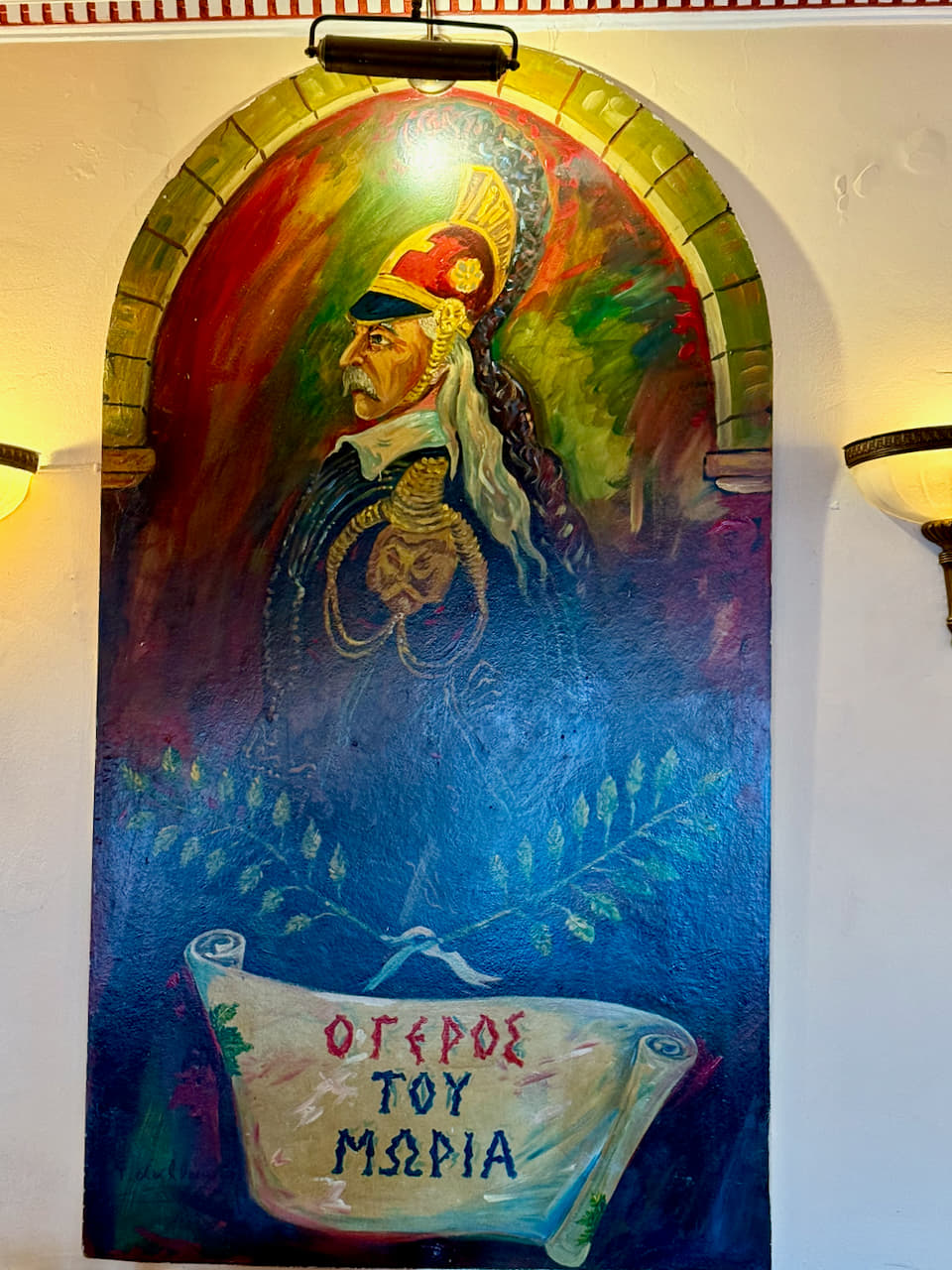
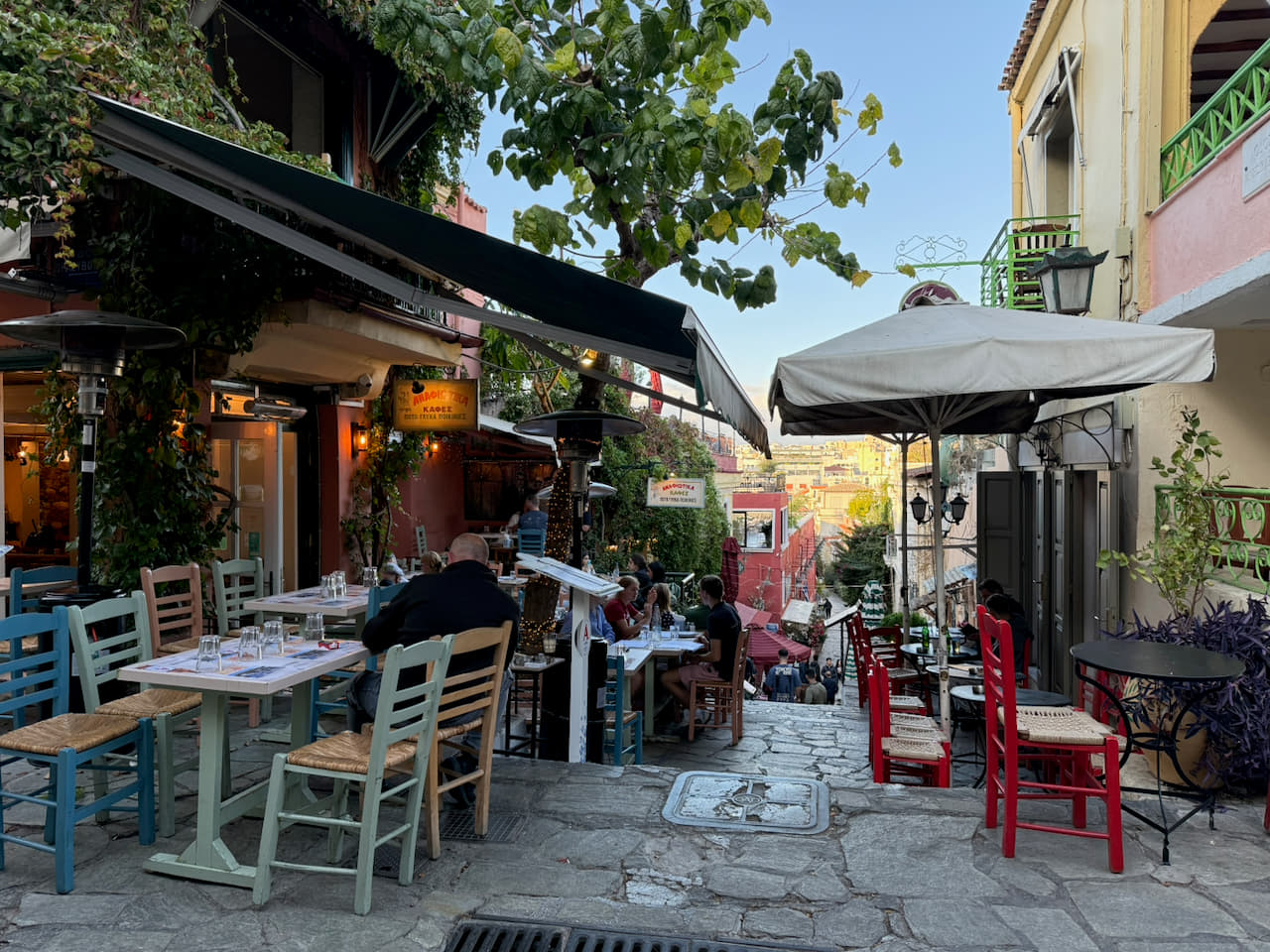
There are also unofficial monuments to Kolokotronis, and one that’s well worth the visit is the aptly named “Old Man of the Morea” (ο Γέρος του Μωριά)—a taverna in Athens that sits on the northern slopes of the Acropolis, at the intersection of Mnisikleos and Thrasivoulou. As you can see from the photo, it’s in a scenic part of town featuring narrow, steep streets lined with cafes and restaurants (the taverna itself is slightly down the hill from where this photo was taken).
Epilogue, Part II: The Old Man Himself
The food at The Old Man is pretty good, and the terrace is a nice place to stop for a drink and a snack, but the highlight of the place is definitely its portrait of the Old Man of the Morea himself. Based on a famous nineteenth-century portrait by Dionysios Tsokos, it shows Kolokotronis in full military regalia, wearing the distinctive helmet that he apparently acquired while serving with the British army in the First Regiment Greek Light Infantry. If you happen to be in the neighborhood, stop by, raise a glass of tsipouro, and give him your best.