
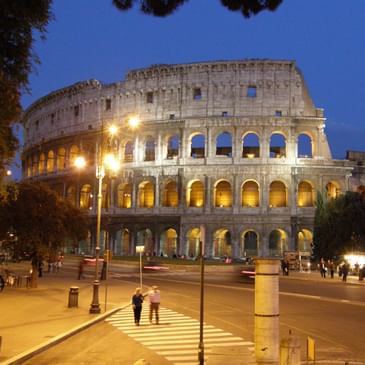
In the first of three episodes about gladiators in ancient Rome, Emily and Cam explore the world’s most iconic remnant of ancient gladiator games: the Roman Colosseum. They talk about the appearance of the building, then and now; the origins of the building as part of the emperor Vespasian’s effort to legitimize his power; and the cycles of destruction and renewal that produced the ruin that survives in Rome today.
Visit our homepage to subscribe and to find us on social media:
If you liked this episode, buy us a coffee:
----------
00:10 - Introduction
- 00:23 - The Colosseum: an iconic remnant of ancient Rome and its gladiator games
- 00:57 - First impressions of the Colosseum in Rome from the exterior
- 03:31 - The Colosseum’s interior: the exhibit spaces in the upper ambulatory and the arena
05:38 - The Colosseum as it was in ancient Rome
- 05:59 - The Colosseum, or the Flavian Amphitheatre?
- 06:58 - What’s an amphitheatre? A southern Italian innovation, influenced by Greek theaters
- 09:04 - The spread of amphitheatres in ancient Italy and elsewhere
- 10:05 - The Roman Colosseum in its heyday: its appearance, its structure, and its amenities
16:08 – Why was the Colosseum built? Vespasian and the legitimacy of the Flavian dynasty
- 16:39 - Augustus and the legitimacy of imperial power
- 19:05 - The fall of Augustus’ dynasty and the rise of Vespasian
- 20:39 - Vespasian and the ideological importance of the Flavian Amphitheatre
- 22:47 - A digression on Nero and his murder of his mother, Agrippina
26:06 - The survival of the Colosseum after antiquity: cycles of destruction and renewal
- 26:46 - Fires and earthquakes and flooding, oh my!
- 27:35 Fit for plunder: the Colosseum as a source of building materials
- 28:37 - Social, political, and economic transformations: the collapse of the Western Roman Empire and the decline of the Colosseum
- 30:17 - New Life in the 11th century: the palaces of the Frangipani and Annibaldi
- 31:15 - A loss of memory: did anyone remember what the Colosseum was for?
- 32:28 - Flavio Biondo and the “rediscovery” of the Colosseum
- 33:05 - The Catholic Church, the Italian government, and restoration
33:54 - Final Thoughts and a meditation by the Venerable Bede
Hello. Welcome to "Have Toga, Will Travel", a podcast exploring the Mediterranean world, ancient and modern, through the eyes of two former classics professors. I'm Emily.
Cam:I'm Cam.
Emily:And we're your hosts.
Cam:Today we're going to bring you the first of three episodes in which we'll talk about gladiators in ancient Rome. We're going to kick things off by talking about the Colosseum, one of the most iconic remnants of both the Roman world and the gladiatorial games that it produced.
Emily:It's also one of Europe's most popular and most crowded tourist attractions. So if you go to Rome, you'll visit it, no doubt. But you may not actually come away really understanding much more about what it is that you're looking at or its context.
Cam:Yeah, it can be a particularly challenging site to experience the first time you visit it.
Emily:And your first impression of the site really is shaped by the angle you approach it from, which direction you approach it from. Because if you approach it from the north, that's where you get the really nice, well-preserved exterior, and you get the sort of classic look of the Colosseum.
Cam:Yeah, if you're coming at it down the Via dei Fori Imperiali, or whatever they call it, or if you're coming out of the subway station right across the street from it, you get a glimpse of the really nice facade.
Emily:Yeah. If you're coming at it from, say, the side of the ancient forum, you don't get quite as good a view. And that was my first impression many, many years ago when I first saw the Colosseum in 1994. It was kind of sad.
Cam:Yeah. Half the outer wall is gone. That's the thing you'll notice if you actually walk around the whole structure. On the north side, it looks really great. On the south side it looks considerably rougher.
Emily:And of course, for both of us, when we first saw it, there was still traffic driving around the Colosseum. So that also created a weird impression. But it's been about 12 years now that they've closed those roads to cars and made it pedestrianized. And it's much nicer now.
Cam:Right, now you don't have to contend with vehicle traffic anymore. It's just mobs and mobs of people, including people dressed up like gladiators trying to get you to pay money to take pictures with them and so on.
Emily:Yeah. That's a fun thing to contend with. And of course, street vendors, like all of that stuff, and hordes of tourists. And the people in the gladiator costumes are going to make you pay for the pictures, even if they don't tell you that up front. Just pro tip there. So, you know, I remember my, like my first approach coming from the forum. And one of the things that surprised me was that there wasn't a lot of signage up on the outside about what you were looking at or anything. But there was like a big plaque put up by one of the popes about this being dedicated to Christian martyrs and some of the restoration work that had been done by the Catholic Church.
Cam:And some of that restoration work is really obvious once you know to look for it. In the early 19th century, the Vatican shored up the outer wall with some fairly elaborate brickwork where the remnants of the northern external wall ended.
Emily:Yeah. Why don't you say a little bit about what your first impression was the first time you saw it from the outside?
Cam:Well, I came at it from the good side. So when I came at it, you know, my view was dominated by the northern wall, which is still pretty much intact. And you don't get a sense of just how broken and fragmentary it is until you move around to the far side of the Colosseum.
Emily:Yeah. And when you go inside, it's a bit of a mixed bag. Like when I first saw it, (A) the Colosseum was an open site. So you could walk in on the ground level. It was free. You like walked in, you looked around, there were no signs, a nd then you left.
Cam:That hasn't been true for years.
Emily:Hasn't been true for years. And it's much better now. There've been a lot of improvements.
Cam:Yeah. The one thing that they've done that is really, really nice is they've turned parts of the upper ambulatory into exhibit space.
Emily:So the upper ambulatory, that would be like the second floor.
Cam:Second floor for North Americans. First floor for Europeans.
Emily:What we might think of as the corridors that got you around the building.
Cam:Right.
Emily:And you can go upstairs now, too. And those stairways are the ancient stairs that ancient Romans would have taken to get up to the floors.
Cam:And that gives you a pretty interesting sense of what the stairways that led you up to the higher tiers of seating were like, a lot of which are no longer accessible.
Emily:Yeah. When you get into the interior, the performance space, it's not in great shape. Most of the seating is gone. Okay, all of the seating is gone.
Cam:Yeah, that seating has long been plundered and taken away and recycled for other purposes. So when you're standing inside the seating area, what's called the cavea, basically you can see the stone piers and to a certain extent the concrete arches over the piers that once supported the seating. But it takes a real clever use of the imagination to construct a picture of what that seating area once looked like.
Emily:Yeah. And the floor that would have been in the center in the arena is missing. That's long since gone. And what you see then is all of the stone substructure. Although the Colosseum does get used now from time to time. And so there actually is a new floor that's been put in at the east end of the arena. But that is new. That is modern. That is not ancient.
Cam:So all of this is to say that the Colosseum is a pretty challenging and complex site when you're visiting it for the first time. and it can be really hard to interpret if you don't know much about it.
Emily:Yeah, and we hope to fix that today. So we're going to be talking about the building itself, when it was created, why it was created, and the cycles of destruction and renewal that are responsible for how the building looks today, so that maybe you can appreciate it a bit more when you go to visit it in Rome.
Cam:So let's start with the basics. What we call the Colosseum today was originally probably just called the Amphitheater, or perhaps the Flavian Amphitheater, if the speaker wanted to be a little bit more precise. It's a little bit hard to say when it came to be called the Colosseum. The name is certainly attested by the Middle Ages when it's referred to as the Colosseum in documents. How we got that name, we just don't know. There are two possible answers. One, because the thing was so huge, Colosseum became a natural name for it. Two, it adopted the name because for a long time, right beside it, there was a colossal of Nero.
Emily:Colossus being the term used for these massive statues in antiquity.
Cam:Yes, a colossal statue of Nero that had been retooled to look like the sun god. Its original name, the Flavian Amphitheater, is a name which describes both the person who commissioned it, the emperor Titus Flavius Vespasianus, to whom we'll return a little bit later, but also its function.
Emily:Yes. So what is an amphitheater? So an amphitheater is a building that is built for the purpose of watching gladiator contests, which originally happened in the context of funeral games as gifts to the dead, beast show games, and so this could be both watching animals fight each other, but also kind of staged hunting matches where people hunt the animals, and then finally public executions.
Cam:And we're going to come back to these and talk about them in a lot mor detail next episode.
Emily:Yes. But as for the building itself, the name amphitheater was actually a Greek name in origin, and it literally means a theater on both sides. So a Greek theater is a semicircular construction that has a performance area and then raised seating in the semicircular configuration. So you put two of those together, a theater on both sides, and then you get an amphitheater where you have a raised seating area all the way around central performance space. Now, even though this is a building influenced by Greek styles, as we can tell by the name, it seems to be an innovation of Southern Italian culture in antiquity. This is where our first amphitheaters seemed to arise. And different from the Greek theaters is that the amphitheater has a distinctly oval shape to it. So it's not a true circle. And it's possible that this oval shape is echoing the shape of more impromptu spaces that had been used for gladiator contests and the like, particularly in the Roman Forum. So the Colosseum is part of this genre of building. And just as a little side note, the central performance area of the amphitheater, what would have been the orchestra in a Greek theater in the Roman amphitheater starts to be called the arena, the arena, which comes from the Latin word for sand, harena, because that performance space would have been covered in sand in the amphitheater, partly because sand absorbs blood well and is easy to clean up.
Cam:Yum, yum. As best as we can tell, amphitheaters started appearing in southern Italy in the late second century BC. The oldest one that we can date is the amphitheater at Pompeii, which dates to about the 70s BC. That makes it about 140 years younger than the Colosseum, which was commissioned in 70 AD. But from their origins, amphitheaters started to spread pretty quickly throughout other parts of the Roman world. In Rome, the first permanent stone amphitheater that we know of was built in about 29 BCE by one of Augustus' supporters, a guy named Titus Statilius Taurus. But they also started popping up quickly in North Africa, and in particular in the Western European provinces. There were even a few built in the Greek-speaking part of the empire, the provinces in the east, though they didn't catch on there to the same degree. That doesn't mean gladiatorial shows weren't performed in Greece. They tended, however, to be performed in pre-existing structures like theaters.
Emily:So the Colosseum, even when it was built, was pretty remarkable in its scale and in its grandeur. And when you see it today, it can be actually hard to imagine what it would have looked like in its heyday in antiquity. And so we want to try to help create that picture for you. Now, first of all, the Colosseum is the largest amphitheater in the ancient Roman world. The seating capacity, we estimate to be somewhere between 50,000 and 80,000 people. It's hard to say because the seating doesn't survive. And so we have to make best estimates. But just to give you some comparison, at 80,000 seat capacity, you're looking at a building that is on par with the largest professional football stadiums in the US. In the Colosseum itself, the seating would have been tiered, as we might be used to in a modern stadium. But where you sat would have been dependent on your class and your rank. On the outside, it's really designed to impress the viewer. So you have four stories. The first three stories all have archways that are flanked by columns. And each level uses a different style column. So we get Doric on the first, Ionic on the second, Corinthian on the third. On the top story, the fourth story, we don't have freestanding columns. We have columns that are embedded in the wall that are squared. They're called pilasters. And there are no archways on the top level because the seating at that point was basically flush up against the wall. Now, on the lower levels, these archways served as entrances and exits. On the second and third levels, well, nobody's going in and out of them there. So they filled them with statues. Every single archway had a statue in it. There were 156 of these statues decorating the exterior of the Colosseum. So it was quite the site to look up at when you approached it in antiquity.
Cam:Yeah, there's a very famous scene. It's a sculptural scene, a relief on the funerary monument of the Haterii, which shows the Colosseum and the archways and the statues standing in the archways, which gives you a pretty interesting sense of what it looked like when it was complete. The exterior of the building was made of travertine, a type of limestone that was used frequently in Roman monumental buildings. In the interior, the Roman builders used a lot of tuff, which is a volcanic stone, along with concrete and brick. Most of the structure is supported by concrete vaults and arches that rest on travertine load-bearing piers, and a lot of the surfaces would have been covered in stucco and painted.
Emily:It's worth noting that the columns on the outside that we talked about are purely decorative. It's really the arches and vaults that are holding the building up. So it had columns, but they weren't structural in their purpose. They were more decorative.
Cam:Right. A lot of the weight is being carried by those travertine piers inside, and more importantly, the concrete vault. Yeah. Concrete was one of the major innovations in Rome, and it facilitated the creation of some really big, spectacular, colossal structures. Like the Colosseum. To give you a sense of just how colossal this structure was, we've already mentioned that it was four stories tall, about 50 meters. But the foundations themselves extended for another 12 meters or so under the building.
Emily:That'd be about 39 feet.
Cam:Right. So it's a very, very deep structure built to support a very heavy building.
Emily:Yeah. And those foundations are not just under the building. They actually extend out from the building six meters or 20 feet beyond it.
Cam:The building also had a really interesting substructure, especially underneath the arena itself, and you get a good view of that today when you go inside the Colosseum, simply because the wooden floor of the arena that supported the sand has long been lost. What you're looking at when you see the substructure are a series of corridors and rooms in which gladiators and animal handlers moved about as they were getting ready for different elements of a show. There are also a series of vertical shafts, which could be used to winch gladiators and animals up to just below the level of the arena surface itself, at which point they could emerge into the arena through trap doors.
Emily:Yeah. Yeah, this actually leads to a kind of funny story. Many years ago, when the Gladiator movie came out, like the original, and I was talking to a friend, and I mentioned that there was a lot of inaccuracies in the movie. And she said, yeah, when they had the animals come out of the floor of the arena, that's when I knew that they were making stuff up. And I was like, oh, no, that part, that part actually happened. And that was totally a thing they could do. They had manual elevators and they had trap doors and they could have animals or gladiators come up out of the floor.
Cam:Yeah. And there are some good surviving examples of similar shafts at other amphitheaters in the Roman world as well.
Emily:Yeah.
Cam:Right. The substructure was connected by a series of tunnels to a bunch of support buildings nearby. The most important of which was called the Ludus Magnus. And that is essentially the facility where gladiators lived and trained. And finally, one of the most interesting features of the building is the series of awnings that the Romans devised to cast shade over the people inside the amphitheater. These were the velaria, basically sail-like things.
Emily:They were sail-like things.
Cam:Yeah. And they were extended out over the amphitheater on a series of masts and booms by basically a bunch of Roman naval personnel who were stationed at the Colosseum in order to perform this one job.
Emily:Weirdest job in the Navy?
Cam:Probably, but also probably not the worst job in the Navy by far.
Emily:Oh yeah, no, no, not by far. So that's what the Coliseum would have looked like. It would have been a really impressive structure to look at. It's also an impressive structure from an engineering standpoint. Now, the next question is, how and why did this building come to be? So the Colosseum is commissioned by the Roman Emperor Vespasian. Vespasian is a really pivotal figure in Roman history. He's the first Roman emperor to successfully consolidate power, who was not a member of the extended family of Augustus, who was the first emperor of Rome. And this new amphitheater was a crucial element in his effort to assert his legitimacy as emperor.
Cam:Right. The fact that Vespasian is the first Roman emperor to consolidate power who is not from Augustus's family, that's actually a really big deal. So it's worth digressing a little bit on Augustus. Augustus is the guy who decisively transformed the government of Rome from a Republican one into an autocracy after a series of civil wars in the late first century BCE. His big challenge was to create a role for himself that would allow him to hang on to power and, just as importantly, transmit it to his descendants in a society that was fundamentally allergic to monarchy. This is a big topic, but one of the things that was really fundamental to his success was his self-presentation as pater patriae, the father of his country. And one aspect of this was his use of his phenomenal wealth to give gifts to the Roman people. Augustus was phenomenally filthy rich. He had inherited the estate of his adoptive father, Julius Caesar, which was already immense, largely because Caesar spent a good chunk of his life rampaging around Gaul plundering. And he had added to that himself over the course of the civil wars. And that fortune allowed him to give out cash gifts to Roman citizens in Rome, but it also allowed him to endow a whole lot of public buildings: forums, temples, all sorts of public space. In doing this, Augustus was basically appropriating a very old form of Roman aristocratic competition. Competing Roman aristocrats throughout the Republican period had impressed people with their power, their wealth, their status by spending a lot of their wealth on the people of Rome itself. Augustus took that to an extreme and gradually monopolized that role for himself within the city of Rome. In doing this, he created the expectation that, of course, this is what the leading citizen of Rome should do. And it therefore became a critical element of imperial legitimacy in Rome, one that was eagerly exploited by the other members of Augustus's family who inherited his position. So much so that by the middle of the first century AD, people living in Rome believed that of course a member of Augustus's family should be in charge and should use the wealth of the house of Caesar to benefit the people.
Emily:Now, Augustus's dynasty comes to an end in 68 AD with the suicide of Nero. Yes, that Nero. What this basically triggers is a series of civil wars in the year 69, it's sometimes called the year of four emperors, because you end up having four different people vying for control of Rome, all of whom get themselves declared emperor at some point, but only one of whom is able to consolidate power, and that is Vespasian. Now, Vespasian had been a military leader, commander, in the Eastern Empire. Not long before his death, Nero had appointed Vespasian to command in Judaea to suppress the Jewish rebellion. And Vespasian is successful in doing so, and then emerges victorious after these civil wars for power. Now, Vespasian's big struggle here is how does he assert that he has legitimate claim to succeed the powers of Augustus when he is not of Augustus's family? And so to a certain extent, he wants to take on this pater patriae, father of his country, mantle. And so part of his solution is to assert that Nero had betrayed the legacy of Augustus. So Nero might have been a blood relative, but he wasn't living up to that. And at the same time, Vespasian is going to claim that he was a person fit to live up to that legacy. And part of the way he's going to do that is to do what Augustus had done and shower the people with gifts, including public buildings and things like the Colosseum.
Cam:Exactly. And the amphitheater he commissioned in 70 AD proved to be the perfect project for achieving both of these goals. First, it was a massive, expensive, ostentatious piece of public infrastructure, funded primarily by Vespasian's spoils, the spoils that he had gathered during his suppression of the rebellion in Judea.
Emily:Yeah. And there's even an inscription that says that, right, that Vespasian gives this from his spoils from the war. So it's not public funds, it's his own private funds.
Cam:Yeah. That inscription was discovered in the 1990s. So it's actually a fairly new piece of evidence, all things considered, even though it's now 30 some odd years old. We take what we can get. New evidence doesn't come along very often.
Emily:No, they really don't.
Cam:Secondly, Vespasian also built his new amphitheater over top of a pleasure estate that Nero had created for himself in the heart of Rome. People have often heard that Nero fiddled while Rome burned. We'll set aside the fact that fiddles hadn't been invented yet. What that story is a reference to is a great fire in Rome in 64 AD that burned down a lot of the city, displaced a lot of people, destroyed a lot of buildings. Nero had already been expanding the imperial properties in the heart of Rome, and he took advantage of the fire to gather up a whole bunch of other property and make a great big palace and its associated grounds in a part of the city where before there had been a lot of buildings, a lot of shops, that sort of thing. It even featured a big artificial lake where the Colosseum would later stand. For Vespasian, this was all very useful because it allowed him to present the Colosseum as a project that established a clear contrast between Nero and himself. He was able to argue that Nero had been primarily interested in his own glory when he engaged in his building projects, and that he himself, Vespasian, was more interested in the welfare of the Roman people and was bestowing infrastructure on the city as a whole.
Emily:So we should take a second here before we move on, because I know you have a story about Nero that you find very entertaining and would like to share with people.
Cam:It's true. I do have a favorite Nero story. It's a story with some pretty dark content because it's a story about Nero trying to murder his mother. But the details are just so ridiculous that it's a story worth telling. It's a story that comes from Tacitus. And basically the story is that Nero had a very rough relationship with his mother, Agrippina.
Emily:I mean, he was a bit of a mama's boy for a while.
Cam:Well, as Tacitus presents it, yes.
Emily:Okay, fair enough. It's how Tacitus presents it. Tacitus doesn't like Nero anyway.
Cam:No, he does not. Agrippina, we should note, was Augustus's great-great-granddaughter. And she, from all accounts, was a very strong-willed woman.
Emily:Yes.
Cam:And in Tacitus's story, Nero found Agrippina overbearing, domineering, he didn't like the way she meddled in his business, and he decided at a certain point to get rid of her. But he faced a fundamental problem. He was having trouble convincing somebody to actually kill her because she was the great-great-granddaughter of Augustus, and because people had become attached to the idea that the family of Augustus ought to be in charge. So according to Tacitus, he cooked up an elaborate plot to kill her, which involved a collapsible boat. The idea was to send Agrippina out on a pleasure cruise in this collapsible boat, and at a certain point, Nero's henchmen would trigger whatever device was on board to make the ship fall apart, and Agrippina would hopefully be crushed and or drowned.
Emily:Anyone else getting like Wile E. Coyote Roadrunner vibes already?
Cam:Yeah, it has that feel. So anyway, Agrippina and her enslaved attendants are out on the pleasure boat, and they're enjoying a fine evening off the coast of Baiae in southern Italy. And at the appointed time, Nero's henchmen trigger the device that is supposed to break the boat apart. So what happens is a weighted ceiling in the cabin in which Agrippina is hanging out comes crashing down. Miraculously, Agrippina does not die. She happens to be lying down on a couch, and the back of the couch protects her from being crushed. The boat, however, is in bad shape, and it's starting to founder a little bit, and there are people running around on deck, and Agrippina isn't sure what's going on, so she and her people make the decision to abandon ship, so they jump overboard. There is an escort vessel following along, stuffed with Nero's conspirators. One of Agrippina's attendants calls out to get their attention, not realizing that they're in on it, and she is promptly bludgeoned to death with an oar. Again, however, Agrippina does not die. She manages to keep her mouth shut, and she paddles away from the escort vessel. That leaves her sort of adrift out at sea, but she escapes death a third time and manages to swim to shore. And that puts everybody in sort of an awkward position, because Agrippina is pretty sure that Nero has just tried to kill her, Nero is pretty sure that Agrippina knows he's just tried to kill her. So you can imagine what family life might have been like for the next couple of days. And the tension only finally gets resolved when Nero coerces one of his henchmen into going over and murdering her the old fashioned way with a sword, which is probably what he should have done from the beginning.
Emily:Should have.
Cam:Right. The moral of the story is don't muder your mother. If you are going to murder your mother...
Emily:No, no murdering of mothers.
Cam:Right. But if you are going to murder your mother, don't devise some weird, crazy, elaborate scheme. Anyway, back to the Colosseum.
Emily:Yeah. So back to the Colosseum. So much like Agrippina, the Colosseum actually is a bit of a survivor as well. And in many ways, we're actually lucky that the Colosseum survives at all. Like many ancient buildings, it went through cycles of destruction. But the Colosseum also benefited from periods of renovation for varying purposes. So let's talk a little bit about why it looks like the way it does when we see it today. Because what we see today is really a shadow of what the Colosseum once was. It's sort of an intriguing hint at its former grandeur. Now, like all ancient buildings, the Colosseum was vulnerable to damage from natural causes, things like fires and earthquakes and in other contexts flooding and things like that. For the Colosseum, we have evidence of several fires and earthquakes, including a major fire in 217 that was caused by a lightning strike and several earthquakes in the 5th and early 6th centuries.
Cam:Yeah, that fire in particular in 217 created enough damage that substantial portions of the north side of the Colosseum needed to be rebuilt.
Emily:And some parts were, I think, never actually rebuilt after that fire. There were other fires too, but that's the big one. Now, when the building is damaged like that, it does fall into periods of disuse before there are renovations or restorations to allow it to reopen. And during those periods of disuse, people take advantage of that to plunder building materials from it, whether that is stone to be used in other constructions or stone that can be burned to make mortar—big chunks of the Colosseum were made of a limestone, and limestone can be burned to make mortar—and then finally, the metal that was used for the clamps to hold stones together, and in various parts would be taken and melted down and reused. Now, over the course of antiquity, there's at least three major restorations to make the building functional again after some of these natural disasters. Now, that said, the building is never fully restored to its initial grandeur or capacity in these restorations. And sometimes they're really long periods between the initial damage and when the building is repaired. Now, natural disasters aren't the only thing that affected the physical state of the Colosseum.
Cam:No, there were major social, political, and economic changes in late antiquity, especially during the 5th and 6th centuries, that really spelled a rough period ahead for the Colosseum. First, gladiator shows seem to have been abolished at some point during the early 5th century. There are a lot of complex reasons for this, but they seem tied heavily to the Christian elaboration of Stoic arguments that had already been made about gladiatorial games and how they sort of damage the souls of people who watch them. More important, though, was the fact that the Western Roman Empire collapsed in the late 5th century AD. This was a seismic event in the history of the Roman Empire. For much of its history, Rome had been a truly massive city, and in the imperial period it had a population of hundreds of thousands of people. Rome could support a population like that because it was at the center of a bunch of trade and tax networks that brought food into the city to sustain that population. Once the Western Roman Empire collapsed in the late 5th century, that was no longer the case, and the population of Rome quickly collapsed. And with that collapse in population went the collapse of a lot of the infrastructure that had made Rome such a grand city. And the last real recorded event in the Colosseum took place in 523. It was a beast show, what the Romans called a Venatio. And of course, we'll return to those in much more detail next episode.
Emily:Now, after the collapse of the population, there really is no role for the Colosseum, and it is abandoned functionally for several centuries.
Cam:And harvested for materials, for reasons that we've already mentioned.
Emily:And harvested for materials, yes. That always goes into those periods of disuse. Now, weirdly, the Colosseum gets some new life in the 11th century. In the late 11th century, the Normans show up and sack Rome.
Cam:Normans were pretty good at running around sacking places.
Emily:Yeah, they were. And as a result of this, some Roman aristocrats think like, hmm, we should find stronger places to live. And so they begin transforming ancient monuments that are still there in ruins into fortified palaces. And so a couple of these families end up building these fortified palaces into parts of the Colosseum. Now, they're not using the whole Colosseum. They're only using parts of the Colosseum. So the big names here are the Frangipani family and the Annibaldi family, who have built these fortified palaces in parts of the Colosseum. Now, in the 14th century, there's going to be another major earthquake and the Colosseum is abandoned again. Now, one of the weird things that has happened during these major periods of abandonment, starting from late antiquity through the Middle Ages, is that people forget what the Colosseum was. And so you end up getting these rumors developing around what the Colosseum might have been. And you have to imagine, right, there's no written records and living memory doesn't last very long. And so rumors start to develop. And for the Colosseum, it sort of starts off as, this was a place of pagan worship, and then it kind of becomes a place of demons, which then leads to this idea that this was a place of Christian martyrdom. Now that said, we have no clear attestation anywhere that Christians were killed in the Colosseum. But nonetheless, this is the sort of story that develops. And again, you have to think about depopulated city, huge ruins, no records. You've got a general demonization of pagan Rome, and you have a contemporary society where monumental buildings are either palaces or churches. And it's clear that it's not a palace, what medieval Italian families do aside, that the original building is not a palace, right? So it must have been some sort of place of worship, and then the ideas go from there.
Cam:Starting in the 15th century, there's another burst of interest in the Colosseum that helps prevent it from further degradation. First, humanists became interested in the structure, especially a guy named Flavio Biondo, who was interested in reconstructing the topography of ancient Rome. He's often credited as the guy who first identified the Colosseum for what it actually was, the Flavian Amphitheater, which had hosted gladiator games in antiquity.
Emily:Shout out to my cousins, Biondo. I do. I have cousins. Their last name is Biondo. It's really cool.
Cam:Maybe he's descended from our boy Flavio here.
Emily:They might be. I mean, there are worse people to be descended from.
Cam:Right. The other thing that happens, though, is the Catholic Church gets interested in the Colosseum, primarily because they believed it was a site of Christian martyrdom. And in 1675, Pope Clement X actually dedicated the Colosseum to the martyrs. And the Colosseum became an important site of Catholic observance over the next couple of centuries. In the late 18th century, some actual attempts to restore the structure began, as well as some early archaeological excavations. And then finally, in the late 19th and early to mid-20th centuries, after the unification of Italy, various Italian governments became interested in promoting excavations and extensive restorations for their own political reasons. That all culminated in 1980 when the Colosseum finally became a UNESCO World Heritage Site.
Emily:So when you go to the Colosseum today, you're looking at a building that has survived fires, earthquakes, dismantlement, repurposement, and neglect. And while it may not be what it once was, it is impressive nonetheless, and serves as a testament to its designers and builders who made it so. And if we can, we'd like to quote the Venerable Bede, a 8th century British monk who probably never went to Rome, who recorded this proverb that is either in reference to the Colosseum or to the statue that stood next to it. Quamdiu stat Colossaeus, stat et Roma. Quando cadet Colossaeus, cadet et Roma. Quando cadet Roma, cadet et mundus. As long as the Colosseum stands, Rome also stands. When the Colosseum falls, Rome also falls. When Rome falls, the world falls too. So the Colosseum is a survivor and the metaphorical heart in Rome that holds itself before us as an image of Rome's power, both in the world and in our imaginations.
Cam:And next time, we're going to talk about what actually happened inside the Colosseum. And more importantly, the people whose lives were offered up for entertainment in a society that did not always live up to the grandeur that the structure itself promised.
Emily:So that's all for today. I'm Emily.
Cam:I'm Cam.
Emily:And this has been Have Toga, Will Travel. Subscribe to our show wherever you get your favorite podcasts and follow us at havetogawilltravel.com or on all the socials. And if you liked this episode, tell a friend about us.
Cam:Thanks for listening, everybody.
Emily:See you next time.