
In this episode—the second of three on gladiators and related topics—Emily and Cam talk about what happened in the Colosseum and in other Roman arenas. First, they discuss the kinds of things that people would expect to see when they went to the games, including beast shows, public executions, and gladiator matches. Then, they focus on the gladiators themselves: who were they, and what were their lives like?
Links:
- The Zliten mosaic (with pictures)
- Gladiator Graffiti near the Porta Nocera in Pompeii (scroll down toward bottom, to the section on tomb 14EN)
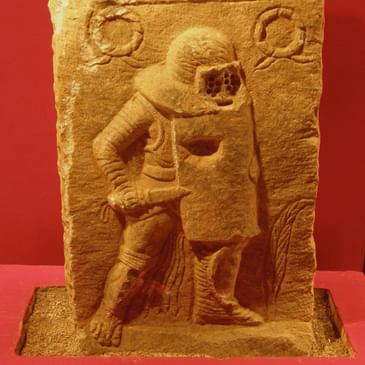
- Image of the tombstone of Urbicus the Secutor
Visit our homepage to subscribe and to find us on social media:
If you liked this episode, buy us a coffee:
----------
00:10 - Introduction
01:57 - The Games
- 02:14 - Funeral games and the origins and development of gladiator combat
- 06:17 - The games in the age of the Colosseum
- 08:44 - Beast shows and hunters (venatores)
- 11:22 - Public punishments and spectacular executions
- 15:00 - Gladiator combat: gladiator graffiti from Pompeii and the excitement of the matched pair
- 19:52 - Mock battles, naval and otherwise, with a digression on Certamen players and the phrase “we who are about to die salute you”
- 23:13 - Keeping score: gladiator win-loss records, referees, and the possibility of survival
- 26:22 - An underdog story: the victories of Marcus Attilius at Nola
- 28:37 - Gladiators as celebrities (and sex symbols)
31:48 - The Gladiators: who were they, and what were their lives like?
- 32:14 - Who fought as gladiators?
- 33:14 - Gladiator “schools” (ludi) and managers (lanistae)
- 37:02 - Gladiator cemeteries and what they tell us about living conditions (diet, injuries, life expectancy)
- 43:22 - Evidence from tombstones: why did free people fight as gladiators?
- 50:08 - Evidence from tombstones: the lives of enslaved gladiators
56:01 - Final Thoughts
Hello, welcome to Have Toga Will Travel, a podcast exploring the Mediterranean world, ancient and modern, through the eyes of two former classics professors. I'm Emily.
Cam:I'm Cam.
Emily:And we're your hosts. Now last time we talked about the Colosseum, particularly as a building. And today, we're going to talk about what happened at the Colosseum. That is, the games, or the gladiatorial games, if you want to call it that. Now, most people's conceptions of these games are really shaped by Hollywood. In the contemporary moment, at least the touchstone movie here is Gladiator.
Cam:One and two.
Emily:One and two. Well, I don't know how much two is really factoring into anyone's conception. But of course, the Gladiator movies are not the only ones over the last century or so that have attempted to depict what happened in these games. Now, Hollywood, of course, gets some things right; it gets some things wrong. And then in some cases, it gets like a weird mashup of facts that individually are correct, but when you put them together, leads to a false understanding of what happened. So one example of this is we see a conflation between public executions and gladiator fights. And both would have happened, but they're not the same thing. And we'll talk more about that in today's episode.
Cam:So we've structured this episode into two main parts. First, we're going to talk a little bit about what people may have expected to see when they went to gladiator games at the Colosseum or at similar venues, especially in the imperial period once things had adopted sort of a standard pattern. And then we'll spend the remainder of the episode talking in some detail about the people who participated in these shows willingly and in most cases unwillingly.
Emily:So as we get into it, the first thing we want to talk about is where do these games come from? And again, we're using games as sort of an all-encompassing term for the events that happened in venues like the Colosseum. We're going to see today that it's a fairly expansive term. But it seems that these games get started, we think, as funeral offerings for the dead. And the name for these games in Latin is munera, which means gifts. So the idea is that these performances are offerings to the dead. They are gifts to the dead that would have been performed at a funeral in honor of the dead person. And it seems that they originated in Campania, which is the region of Italy around Naples. And at the point in time when these games would have originated, that area would have been primarily inhabited by Greeks who had settled there, Etruscans, and Oscan-speaking peoples. Oscan is an Italic language. It's like a first cousin of Latin. And the best known group of Oscan speaking peoples in Campania were the Samnites. We have some tomb frescoes from Paestum, which is a city in Campania, from the fourth century BCE that shows paired fighters fighting each other, which most people interpret to be an early form of gladiatorial combat. And it's also telling that within Rome itself, one of the popular types of gladiators, because there are different kinds of gladiators who fought with different weapons and in different styles, was the Samnite type of gladiator, who was meant to mimic a Samnite warrior. The Samnites were early in Rome's history, a key enemy of Rome as it was expanding power in the Italian peninsula. And Rome fought a series of wars against the Samnites in the fourth century BCE. And when Rome gets into a fight with Carthage, the Samnites fight on the side of the Carthaginians. So these things all lead us to believe that the Romans adopt this particular form of entertainment, if you will, from Campania. Now, the earliest documented gladiatorial fight in Rome is in 264 BCE. A man by the name of Decimus Junius Brutus Scaeva offers some gladiatorial comments in honor of his dead father. And these happened in the Forum Boarium. Now, this is not the main Roman forum. Rome had multiple fora, which were basically just spaces for conducting public business. That could be judicial, political, or commercial, like a marketplace. And so the Forum Boarium is the oldest forum in Rome, and would have been used for primarily commercial purposes.
Cam:Right. It's called the cattle market.
Emily:The cattle market.
Cam:Translated into English.
Emily:Yes. And of course, a forum makes a good space for holding these things because you've got a space where you can gather lots of people. You've probably got some open space that you can use. And so it's a great place for putting on a show. And so even though, yes, these are being offered for his dead father at a funeral, it's also being done as a public spectacle.
Cam:Now, over time, these games gradually became detached from the funerary context in which they originated. By the time we get to the end of the second century BCE, these games were often staged as public spectacles by public officials or magistrates in Italian cities, especially in Campania. When a public magistrate staged these games, he was taking on the role of a munerarius, that is, somebody who offered the gifts that constituted the munera, the games. This is a big job. To a certain extent, there was some public funding. But in many cases, the munerarius, or the editor as he was sometimes called, was expected to spend a bunch of his own money to stage some really spectacular games. And increasingly over time, these things became opportunities for conspicuous display on the part of these magistrates, so much so that the events themselves are often referred to as spectacula.
Emily:Yeah, and spectacula, of course, meaning spectacles.
Cam:Spectacles, right. Which captures some essence of the public appeal they exercised.
Emily:So what were these games like? Now, as we've already said, right, the nature of these games does change over time. And so we're really going to look at what the games were like, sort of in the height of the empire, so the first century CE onwards, when, you know, as Cam mentioned, we really have kind of a more of a program, and they're less impromptu. So as we mentioned, right, the venues for these games originally had been fora and things like that. And eventually, as we discussed last episode, amphitheaters develop specifically for watching the games, which really does speak to their popularity, right? These games are so popular that we're going to build a building primarily for holding these games.
Cam:A lot of the times in the case of theaters and amphitheaters and so on, all these bits of what we consider to be public infrastructure, a lot of times those are actually funded by individuals.
Emily:Yeah, that's a large investment of wealth, broadly speaking, of land, of time and money building the building, of materials used for the building for this one specific thing. And of course, the building isn't being used if it's not being used for these games primarily in the ancient period. So that we're willing to invest that kind of time and money into this infrastructure speaks to how popular they were. Now at the games, we're really going to have actually three different kinds of events. One is beast shows, two is public executions, and three is gladiator fights. And there's a mosaic that actually illustrates this really nicely. Forgive my pronunciation here. It's called the Zliten mosaic, Z-L-I-T-E-N. We'll put a link to it in the show notes. And this is a mosaic from the second century CE from Libya. And it gives us a kind of ideal or a schematic structure for what these games look like. In this mosaic, we see a depiction of a procession that would have happened in the morning, and then beast show, which would have also happened in the morning, and then public punishments and executions usually would have happened at the midday break, and then gladiator shows in the afternoons. Now, this is, of course, a sort of idealized schematic structure. So there are obviously variations in timing and structure, but that's the basic elements of procession, beast show, punishments, gladiators.
Cam:So let's start by talking a little bit about the beast shows. These had a long history. By the third century BCE, the Romans were already displaying animals, in particular war elephants that they had captured in the wars against Carthage in triumphal processions in Rome, and it seems killing them. But as these beast shows evolved, they became a really interesting way for the organizers of games to wow the crowd and to impress them with either their own power or, depending on who's staging these games, the power of the Roman state. We can get a good sense of what these looked like from some poems composed by the Roman poet Martial in 80 CE to commemorate the inauguration of the Colosseum in Rome. In one series of epigrams in particular, Martial talks about a rhinoceros running around in the Colosseum, which, I mean, must have been pretty cool to see if you are a Roman living in Rome in 80 BCE. That's not something you see every day.
Emily:Or any day.
Cam:Or any day, really. But then Martial goes on to elaborate. There wasn't just a rhinoceros running around in the Colosseum. That rhinoceros was then goaded to fight some other critters, including a bear, some bulls, and finally a lion. And again, that must have been really impressive to a crowd in 80CE. You're seeing not just one exotic animal, but a whole collection of them, right? It's a spectacle that you just won't witness every day. For the organizers, of course, this kind of beast show was a great way to demonstrate their own power, their ability to get the animals in the first place, their ability to choreograph the whole event. And at the same time, depending on what kind of beast show we're talking about, it was also an opportunity for the organizers to display some other kinds of human skill as well. Some of these beast shows were what we would properly call controlled hunts, I guess, when you had individuals known as venatores, hunters, whose job it was to confront these animals in the Colosseum and demonstrate their skill with weapons as they tried to kill some of these large aggressive animals that Romans didn't necessarily see all the time.
Emily:Yeah, in which case, part of the point there then becomes seeing the sort of skilled hunter in action, as well as a sort of exotic animal, or maybe not so exotic animal.
Cam:Yeah, there's definitely, you know, an element there of suspense, right? Is the hunter going to prevail? Or is the lion going to get to him before he's able to kill it?
Emily:Or even like the bull, right? Bull's not an exotic animal for the Romans, but—
Cam:Not an animal you want to tangle with.
Emily:No, I don't want to get... No, definitely not. Now, the second type of event that we mentioned, right, is these public punishments or public executions. So here you've got convicted criminals who are being typically executed publicly, and in the literature they are depicted as basically the enemies of order. And we get this idea from some of Martial's epigrams that really the punishment for these criminals, this public punishment, is deemed as fair and just. And what Martial says in one of his epigrams talking about one of these public executions, and this is my rough translation of what he says, it's, "that guilty one defiled the neck of his parent or master with a sword, or he out of his mind robbed a temple of its private gold, or he applied savage fires to you, Rome." So in other words, Martial doesn't know what this person did to merit public execution. But the idea being expressed is that, well, whatever he did, it had to be pretty horrible to get this kind of punishment. And there is some kind of disturbing logic to that: not a, this is what this person did, and therefore this is why this punishment is merited, but rather, well, this is the punishment they're getting. So obviously their crime has to be something really serious.
Cam:Right. It's a manifestation of the power of the state, basically.
Emily:Yeah. Now these public punishments, I mean, part of the goal of them, right, is to humiliate the convict. Even if they're not being executed, they're still receiving some sort of form of corporal punishment. And it seems that the spectators are happy to view it, right? This is a regular feature of these games. And, you know, it's worth saying that in societies with slavery, violent punishment is fairly commonplace, as is the dehumanization of people. And this is a real demonstration of power. And so when you're portraying criminals as these enemies of order, and you're giving them these kinds of punishments, right, you're reinforcing that idea that this kind of violent punishment is necessary and part of maintaining good order. Now, this dehumanization is furthered in these public punishments because it's often being done by animals. It's usually not a person who's executing these people. It's usually some sort of animal that's sent out to kill them. And this is where we see, say in the movie, Gladiator, gladiator fights and public executions being treated as the same thing. But sending people out with no weapons to face animals is a feature of public execution and not, say, the wild beast hunts, where you have a skilled hunter and you have a more evenly matched situation. The whole point here is that they're not evenly matched. And some of these executions could be pretty spectacular. The crowd appreciates a good show, and we get stories from Martial, in particular, talking about how the punishment is set up to reenact various mythological narratives, which, you know, some of them are pretty gruesome, such as Orpheus being torn apart. Now, granted, in the myth, it's by maenads. And when Martial talks about it, it's being done by wild animals. Think of any gruesome myth, and they found a way to use it to kill someone. And again, this stresses the power of the emperor or the state, right, to make this fantastic myth come alive and to assert power over this enemy of the state. And it sets an example of what happens when you go against the system.
Cam:Finally, this brings us to the third thing that the crowd was anticipating at one of these shows, and that's the gladiatorial combats themselves. The nature of what the crowd saw in this portion of a show is best captured by a really interesting series of graffiti from Pompeii that was painted onto the side of a tomb outside of one of Pompeii's city gates in the mid-first century CE. Streets outside a lot of Roman cities were lined with tombs in antiquity. So, if you were approaching a city on the street, you'd pass through a lot of them. So, these became great places to do little doodles, paintings, slogans, if you wanted somebody to see them.
Emily:A lot of things happened in those.
Cam:A lot of things happened in those tombs. Anyway, in this particular collection of graffiti, you'll find a link to it in our show notes, the artist depicts three fights that had taken place in a recent series of games at Nola, which was a town about 10 or 12 miles north of Pompeii. And they're useful little illustrations because the artist also included captions identifying the people that he was depicting in his art.
Emily:Yeah, it's almost like a little comic strip.
Cam:It really is. And, you know, if you go visit the link in the show notes, you'll see exactly what I mean. What's interesting about this series of illustrations is they capture, I think, the excitement of gladiator combat as almost a sport that people followed closely and got really invested in. Much like people follow heavyweight boxing these days and get invested in those competitions.
Emily:Or MMA or, yeah.
Cam:Right, these other kinds of combat sports that we have in modern culture. There are three aspects of the series of graffiti that I think drive that point home. So first of all, all three of the fights depicted in these graffiti were one-on-one fights between what we often call matched pairs of gladiators. And by that, what we mean are gladiators armed in very specific and complementary styles that were meant to provide a strategic level to the fight. The very classic example that people are probably familiar with from various kinds of media is the match between a retiarius and a murmillo. The retiarius is a gladiator who fought with a trident and a net, and his opponent was typically a murmillo, a more heavily armed gladiator with a large shield and a short sword. The murmillo in these kinds of contests wanted to get in close so he could use his sword. The retiarius wanted to keep him as a distance, tangle him up with the net and jab at him with the trident.
Emily:Which is a much longer weapon.
Cam:So you can see how that would set up fights in which each contestant had to use a particular set of skills and they had to find a way to outwit or outfox their opponents.
Emily:It also makes the fights last longer.
Cam:Yes, it makes the fights last longer. One of the problems with a sword fight is that it can be over really, really quickly.
Emily:Yeah, yeah, yeah.
Cam:That's not what you want.
Emily:No, you want to draw it out.
Cam:Yes, you want the audience to get into it and to, you know, sit there in a state of suspense waiting to see the outcome.
Emily:Yeah.
Cam:So anyway, in the series of graffiti from Pompeii, what you see are three sets of gladiators armed in very specific ways. You know, so for instance, in the first one, what we see is a fight between a murmillo and a hoplomachus. These were both heavily armed gladiators. Again, the murmillo had a large shield and a short sword. The hoplomachus had a small shield, a spear, and a sword as a backup. And we don't know exactly what those kinds of fights looked like, but you can imagine that each particular gladiator was trained in a certain style. And again, the goal was probably to use his own tricks of the trade to outwit his opponent and deliver a blow that would hopefully end the fight. As far as we can tell, fans of gladiator combats were invested enough in these kinds of shows that sometimes they would learn a lot about the styles employed by particular gladiator types. And we know, for instance, that the Emperor Titus, the son of Vespasian---Vespasian being the guy who commissioned the Colosseum---presented himself as a connoisseur of Thracians--- Thracian being a particular type of gladiator who used a curved sword known as a sica.
Emily:So this paired one-on-one style of fighting seems to be the norm for gladiator fights. Now, movies like Gladiator and Gladiator 2 like to show these sort of simulated battles, right, where you've got teams of people against each other. Now, that might have happened, but if it happened, it was probably in the context of public executions and was probably not the norm.
Cam:Right. Gladiators tended to be highly skilled in their particular set of weapons, and they're not the sort of people that you're going to throw into one of these mass combats, where the point really is to ensure that a whole bunch of people you've pegged as undesirable get themselves killed.
Emily:The other thing worth mentioning here is these mock naval battles. Now, if you did see Gladiator 2, they had a mock naval battle happening. And yes, those did happen. We do have evidence that mock naval fights would be staged. It probably didn't happen in the Colosseum. Usually they were using another body of water. You know, we do have some evidence that other amphitheaters might have been used, but we don't... it doesn't seem likely that the Colosseum was ever used for these mock naval battles. Now, these mock naval battles, again, would have been used as a way to punish convicted criminals, not for gladiator fights. And interesting little, little diversion here, a little digression here. We get a story from the Roman historian Suetonius in his life of Claudius about a naval battle that Claudius has staged for entertainment purposes. It seems clear from the Suetonius that the participants, if you will, are convicted criminals. The interesting bit about this story is it's this story that gives us the famous quote, morituri te salutant. Now, if you've watched Gladiator, if you've read anything about Gladiators, you've heard this thing, right? Gladiators walk in and they say to the emperor, whoever's hosting the games, right, "We who are about to die salute you." Morituri te salutamus. Yeah, that's not what happens. So we get in the story in Suetonius that these naumachiarii, as they call them, right, the people fighting in the mock naval battle, come in and say to the emperor, "Ave imperator! Morituri te salutant." ("Greetings, emperor. Those about to die salute you.") And Claudius responds, "Aut non," which in Latin means "or not." Now, the point of telling this story is to show that Claudius is kind of inept, because the combatants take his response to mean that they have been pardoned for their crimes, which is how we know that they were criminals, and they refuse to fight. Because now they're no longer convicted. They are free. They don't have to do this. And then he goes on to describe sort of Claudius, you know, bumbling around and trying to get the naumachia to happen, that that wasn't his intention to pardon them, etc., etc. Now, somehow, tradition has taken this story and adopted it to say that this is what gladiators said every time they walked into the arena. And we just have no evidence for that. In fact, this line from Suetonius is the only time this phrase is ever used in Latin literature. But yeah, so this is a completely made up idea that yes, we can dispel today. No, this was not said by gladiators. And the one context in which it is said, it's there to show that Claudius is inept. And B, it was said by convicted criminals. So certamen people, stop putting it in your questions.
Cam:That's a bit of inside baseball for the 95% of our audience who has no idea what certamen is. It's a trivia-based game that people play in high school at Latin conventions.
Emily:Yes. So after my little digression, back to the graffiti from Pompeii.
Cam:Right. So the second way that these graffiti really capture the excitement of gladiator combat as a sport is in the way that they suggest that viewers paid attention to the win-loss records of the combatants. I've mentioned that the illustrations are captioned, and one of the details in those captions is the amount of fights each participant had survived and the number of fights that participant had won. Again, this invites a comparison with modern sports like boxing, and it also really emphasizes that gladiatorial fights were not necessarily fights to the death, although death was always definitely a real possibility. Instead, these fights appear to have been structured and they were in fact governed by some kind of rules and by referees who are depicted in reliefs and in mosaics and things like that and who might actually step in to interrupt a fight, especially if one fighter signaled that he was done and he was unable or unwilling to continue, which he would do by releasing his weapons and holding up a finger in a gesture that we also see represented in some of the visual evidence. At that point, it would then be up to the munerarius to decide if the losing fighter, the fighter who was submitting, lived or died.
Emily:Now, how the munerarius indicated this would have been with a gesture. But of course, the gesture, we don't know really what they were. Now, if you've, again, watched movies, you've probably seen, oh, thumbs up, thumbs down. No, this is a modern idea. We get in Juvenal, so a first century writer, in his Satires, he uses the term pollice verso, which means literally "with the thumb having been turned," to indicate that a gladiator should be killed. And the line where this specifically is mentioned is he's talking about people putting on games and, quote, "when the crowd orders with its thumb turned, they [that is, the people holding the games] kill to please the people." But what that gesture actually looks like, what does it mean to turn the thumb, we have no idea. The idea that this gesture was a thumbs down actually comes from a painting from 1872 by the French artist Jean Léon Gerome, depicting a gladiator looking up to the stands, and the people will all have their thumbs down. Now, this choice to portray it this way was actually controversial in the moment. People argued against it, but it entered sort of the public consciousness, and that's where we get that from. The gesture to live, we're not certain about. It seems it was either like two fingers up, or possibly a gesture where the thumb is tucked into the fist. We get depictions of both in art. So maybe both were used. It's not clear.
Cam:Or maybe we're misinterpreting one of those gestures.
Emily:Or maybe we're misinterpreting. Yeah, but it's hard to say. So with some sort of gesture, we have some indications as to what these gestures might have been, but not enough to have clarity as to what it was.
Cam:And finally, the third way the Pompeii graffiti captures some of the drama of the gladiator games that really invites the comparison with sport is by depicting the three fights that they illustrate as a narrative sequence. So in the first illustration, what you see is a fight between two people, Hilarus and Creunus. Hilaris is an enslaved gladiator who belonged to the emperor, and the caption tells us that he was a veteran of 14 fights who had won 13 of them. So this is a guy who's been very successful as a gladiator. His opponent, Creunus, also an enslaved gladiator, had a record of seven fights, five victories, nothing to sneeze at. Hilarus won this particular fight, although his opponent, Creunus, survived. The second illustration shows Hilarus fighting again, maybe the next day. This was a four-day long set of games, according to the text accompanying the illustrations. In his second fight, Hilaris took on a challenger named Marcus Attilius. Marcus Attilius was a tiro, that is, a fighter with no previous experience. He also happened to be free rather than enslaved. So this would have been a really dramatic contest that pitched the veteran enslaved gladiator against a nobody, a newcomer, who happened to be free, which was a little unusual. And astonishingly enough, Marcus Attilius won this particular fight, although Hilarus did survive, we think, to fight another day. At least he didn't die then and there. But then the third fight shows Marcus Attilius himself going a second round, this time with another free gladiator, Lucius Raecius Felix, also a veteran who had fought and won 12 fights. And here, surprisingly, once again, the newcomer, Marcus Attilius, won.
Emily:So it's easy to imagine how exciting this must have been to watch, right? You have this classic underdog story, and he's become successful. And like, this person was into it enough, enjoyed it enough that he then went and did a whole, basically a comic strip of this story of Marcus Attilius. And so it clearly had an impact on the audience.
Cam:Right, on at least one viewer. I mean, you know, unfortunately, we don't know who doodled these little sketches.
Emily:I mean, you say doodle, they're actually pretty elaborate drawings, not like stick figures. But yeah, so presumably he wasn't this—our artist could have been a woman—our artist was not the only person attached to the story and invested in the story. And it is true that, like, really successful gladiators, I mean, they become celebrities in their own right in the Roman world. And so we get stories of, say, the gladiator Hermes, who was trained in multiple gladiator styles, you know, and was very successful. And people will talk about this. Right. So it'd be like being able to go, not only are you a good boxer, you can also wrestle, you know.
Cam:Also, according to the poem that talks about him, darling of all the girls.
Emily:Darling of all the girls. Yes, that's another theme that comes up a lot. We also get gladiator figurines from all over the Roman Empire, little gladiator figurines like dolls or action figures. Right, you can imagine like little kids playing with their gladiators and, you know, you have a statue of your favorite gladiator in your house and, you know, all those sorts of things. But, yes, on the topic of girls we also have some really fun graffiti from the gladiator barracks at Pompeii, which are basically the gladiators boasting about who's most popular with the ladies. So we have one that says, Celadus the Thrax makes all the girls sigh. We have another, a couple pieces of graffiti about a gladiator named Crescens. One, he refers to himself as the "dominus puparum," which is like, "lord of the ladies."
Cam:Master of the girls.
Emily:Master of the girls. Yeah, no, pupa is a slang for young woman, let's say. I don't know, like chick in English. So he's the master of the chicks, dominus puparum. But my favorite little one is he refers to himself as the "retiarius puparum." Now, clearly he himself is a retiarius--- this is the gladiator that fights with a net and a trident. So he is the one who nets the girls, in this case, puparum nocturnarum. So he's the netter of the girls of the night, which, I mean, there's probably more slang happening there that we're unaware of, but it's pretty funny. What's even funnier is that the book where this inscription is published that we're looking at has a footnote on this piece of graffiti that says, "The sense of these words is not known."
Cam:Right. The editor didn't want to grapple with what exactly is going on there.
Emily:Yes. I think we can hazard... I don't think it's that it's unknown. Yeah. I don't think the editor wanted to talk about it. But yeah, he catches all the girls of the night.
Cam:He catches all the girls, yeah.
Emily:But the girls of the night.
Cam:The girls of the night.
Emily:Yeah. But the larger point here is, right, that there's a competition among the gladiators for who is most popular with the ladies. And this is a thing that they boast about.
Cam:Gotta fill those long nights in the barracks somehow.
Emily:I have no witty comeback to that.
Cam:It's okay. And with that, let's move on to the second section of today's episode. And that's a section in which we're going to talk about the people who actually fought as gladiators in the arena. All types of people could find themselves trained as gladiators fighting in the arena. Men and women, although women seem to have been rare.
Emily:Yeah. We do have depictions of women as gladiators for sure.
Cam:Yes, yes.
Emily:And evidence that they were.
Cam:Some people who fought as gladiators were free, either freeborn or former slaves who had been released from bondage. Some were enslaved and probably most were enslaved, it seems, just based on the number of slaves who pop up in the inscriptions. We can tell the difference in inscriptions and graffiti because of the names that are attached to specific gladiators. When we're dealing with an enslaved gladiator, we usually see somebody who uses only one name, like our buddy Crescens, the netter of the girls. Freeborn or freed gladiators will use the more common tria nomina, as it's called in Latin. That is, they'll have three names, sometimes two, like our friends Marcus Attilius and Lucius Raecius Felix. In our inscriptions, you'll find people who are both carrying the names associated with enslaved people and people carrying the names associated with free people. But again, it seems that enslaved people outnumbered the free and the freed by a substantial margin.
Emily:Now, how were gladiators organized? During the Roman Republic, I mean, what develops is basically privately-owned schools, and gladiators would have been part of these privately-owned schools, which would refer to in Latin as ludi or ludus in the singular. And these schools would have been managed by lanistae. A lanista is both a trainer and manager of gladiators. The lanista will purchase enslaved people, train them, sets their regimen, will also negotiate fees with the munerarius, the host of the games, makes the performance arrangements, so is both trainer and manager. And the lanista would charge a fee for the use of gladiators in events. And there would have been a conditional clause in these contracts, basically demanding that the munerarius purchase any gladiator who was killed or disabled in the fights. And we have evidence from a Roman lawyer in the imperial period named Gaius, who assumed that a gladiator who was dead or disabled would cost the munerarius about 50 times more than a gladiator who didn't. Now, lanistae don't have a great reputation culturally speaking. They really are seen by the larger society as almost on par with a pimp as someone who profits from the trafficking of human flesh.
Cam:Slave-traders fall into that same category too. So, the lanista is probably being assimilated with a slave trader just based on the nature of the work involved on some level.
Emily:Now, sometimes the lanista was not just the trainer and the manager. Sometimes the lanista actually owned the school and owned the gladiators within it. Sometimes he was acting as an agent for a wealthy aristocrat who actually owned the school, but of course would never have gotten their hands dirty actually doing that kind of work.
Cam:Yeah, there's a real debate about how often wealthy Roman aristocrats owned stuff like gladiator schools. It wouldn't surprise me if a lot of them did and just had them managed through lanistae. And quite clearly, once we got into the imperial period, the emperors themselves became owners of gladiatorial schools and the enslaved gladiators associated with them on a truly massive scale. So even in the graffiti from Pompeii, Hilarus, for instance, is identified actually as Hilarus, the slave of Nero, in the graffiti. So, he's clearly a member of a school owned by the emperors. There were several of these. We know of the Neronian school. We know of the Julian school by the middle of the first century AD. Those were both schools owned by the emperor himself, probably Nero in this particular context. And these would have been managed by lanistae who worked directly for the emperor. Probably either enslaved lanistae, who represented the emperor's interests directly as his enslaved agent, or perhaps by former slaves of the emperor who had been set free and continued working in the same capacity after earning their freedom. Now, one of the big mysteries is how gladiators who were free fit into this system. They don't seem to fit naturally into a system of gladiatorial schools that are crewed mostly by enslaved gladiators belonging to an owner. What we think is that free people who decided to fight as gladiators probably had to enter into contracts with a lanista. And what little pieces of evidence we have suggest that those contracts were pretty severe in the sense that these free gladiators pledged to subject themselves to the sort of discipline that was usually associated with enslaved people, not with free people.
Emily:Yeah. So what were the day-to-day lives of these gladiators like? And here we get a lot of interesting evidence from gladiator cemeteries and the analysis of the human remains that have been excavated there. Now, this is actually really cool stuff. In the last 35 years, there have been four different gladiator graveyards found. So two of them have been found in Turkey, Ephesus and Anavarza, and then another one in York in England, and Nîmes in France. And the skeletons can tell us a lot about their injuries, their diet, their training. I'm going to talk a little bit more about the gladiator excavations in Ephesus, partly because of those four graveyards, that's the one that was found longest ago. And so the most work has been done on there. But also when we were in Ephesus, we actually got the opportunity to go to the museum, which had an exhibit there just on the finds in this gladiator graveyard. It was a really fascinating, cool exhibit. So I recommend if you're ever in Ephesus and that exhibit is still there, I highly recommend seeing it. Now, what they found at the cemetery in Ephesus was they found 68 individuals buried there. Now, of those 68 individuals, 66 were men aged roughly in their 20s, 19 to 35 at, sort of, the outside. And then there was one man aged 50, so a much older gentleman there, and one woman. So it seems that we do have an example of a female gladiator being buried here. And what was really kind of cool about the exhibit was that it highlighted some of the individuals who were found there and what the skeletons told us about that particular individual, injuries that they had sustained that left marks on their skeleton, whether that injury was fatal or not, what weapon might have made it, and any other details that the skeleton could tell us about this person's life.
Cam:Yeah, some of the individual exhibits showed a lot about specific people who had been buried in that cemetery. But what these gladiator graveyards also do is give us a database, if you will, that allows us to generalize a little bit about what gladiators experienced as a whole. So one of the things archaeologists have been able to do is draw some conclusions about what gladiators ate. And what's interesting, I think, is that they did not eat a lot of meat. In fact, they didn't eat any meat at all, according to some of these studies. Instead, their diets consisted mostly of barley, beans, some other greens and legumes supplemented by vegetables, dried fruit, and stuff like that. And that's just a really interesting observation to make of a population that we associate mostly with very well-muscled individuals. And on the subject of muscle development, what you can see sometimes in the skeletons are indication of overdevelopment, right? So extra bone growth where tendons and ligaments affixed, the sort of development that you'd expect to see if people are using really heavy implements, like training swords and training shields that were probably heavier than the real use versions they would employ in the actual arena.
Emily:And also, like, a lot of use of it, too, right, to the point that it's actually affecting the skeletal development.
Cam:Basically, yeah. An overuse injury. But finally, the other thing that you get a feel for are the kinds of injuries that gladiators could sustain. Now, interestingly enough, a lot of the skeletons bore traces of injuries that had healed. So these are fighters that had clearly survived a couple of rough encounters, which again is not that surprising given that we've already seen in the records of individual gladiators' fights that they do actually survive sometimes even when they lose.
Emily:They survive a lot of the times even when they lose.
Cam:But of course, there are moments when they don't, and they sustain fatal injuries, which also leave marks on the skeletons. So the one that I remember most vividly is a skeleton that bore traces of a fatal stab wound on the femur delivered by basically a four-pronged dagger that presumably nicked an artery or something like that because it proved to be a fatal injury.
Emily:They even had an example of the weapons that made the injury in the exhibit. Yes. But the fact that the injuries healed also shows that they're getting medical care, good quality medical care as well.
Cam:Right, by the first century CE the Romans knew how to deal with the kinds of injuries that were caused by weapons. But of course, if you're injured by one of those weapons in a pre-industrial context with no real understanding of germ theory, there's always a pretty hefty chance that you're going to die, if not from the injury itself, then from complications. And the rate at which gladiators died is a matter of some dispute. It's hard to get a full sense of this. But sometimes in inscriptions, you can count up the number of gladiators who were present fighting at a certain show and count up the number who clearly died during that show. Because to the extent that people were keeping score, they could mark whether a losing fighter had been spared with a little M usually, which stands for missus, right, "he was released." Or they would scribble a little theta character for thanatos.
Emily:For the Greek word for death.
Cam:For the Greek word for death. And when you go through some of this evidence, you can do the math and you can work out that maybe something like 20% of gladiator fights in the early imperial period ended in the death of one of the combatants. That means that any individual gladiator's odds of dying in a particular fight were about 1 in 10. That doesn't seem so bad, I guess, at first glance. But what that means is that by the time you are on fight number five or six, you're probably pushing things and you have exceeded the life expectancy of gladiators by some considerable margin already. So when we run into gladiators in inscriptions or graffiti that have survived 12 or 13 fights
Emily:Like our friend Hilarus.
Cam:Like our friend Hilarus. Those are gladiators who were both incredibly good and incredibly lucky. Most gladiators probably died well before that. And that's a point driven home by the fact that most of the skeletons in, say, the cemetery at Ephesus are of young men who died before the age of 30.
Emily:Yeah. Yeah, I think the average age there is 27. Now, these cemeteries, of course, the skeletons there can tell us a lot about the physical conditions for these gladiators. But tombstones can actually tell us a lot about gladiators' identity and social worlds. And if we want to sort of understand gladiators as people, you know, the tombstones are really our best way to do this. Now, we mentioned earlier that free gladiators were not the norm. So they definitely existed, but they were a minority within the larger group of gladiators. Free people who were gladiators were faced with some social consequences for being gladiators. One is infamia. And this is a Latin term that means something like disgrace or dishonor, and it has both a social valence, right, that you would be seen as disgraceful, dishonorable by the larger people.
Cam:Disreputable.
Emily:Disreputable, yes. I just see the bit from Mission Impossible, like, "kind of enjoyed being disreputable."
Cam:Well, maybe they did too.
Emily:Yeah, maybe they did too. That is one of the best lines in that movie. But infamia also had legal implications as well. This was, like, a legal status. If you had infamia, there were things, like you couldn't bring a lawsuit if you were someone who suffered infamia. And so gladiators, of course, were highly likely to incur infamia. Also, the skilled hunters, the venatores who participate in the beast hunts could incur infamia, particularly if they were paid money.
Cam:Yeah, the Roman jurists get into this a little bit, and they argue about the conditions that should result in infamia. And they're pretty clear that if you decide to sign up and fight in gladiator shows or in beast shows because you want to show how manly you are, that's perfectly okay. But if you take prize money, that's what makes you disreputable.
Emily:Yeah, it's fine if you volunteer.
Cam:Right.
Emily:The other problem that free gladiators encounter is that being a gladiator and the sort of world around it, as we've discussed, is seen as not being fit for free people. Because you are submitting to the discipline and punishment of the lanista. So you are basically turning your body over to someone else. And that is seen as not being fitting behavior for a free person.
Cam:No, it's hugely problematic in a context in which there's a really sharp line between free person and slave.
Emily:Yeah, yeah. And, you know, we also get things like Cicero, who criticize gladiators for basically being socialized to care for nothing but, you know, pleasing their lanista or the owner of their school. And so this is seen as, again, behavior that's not fitting of a free person.
Cam:All this raises a really good question, which is why would a free person do this if it came with all of these negative social consequences? And you can imagine a variety of different answers to that. One option is that free people who signed up as gladiators had no better options financially. Victory in the arena as a hunter or as a gladiator could come with monetary reward, with prize money. You can easily imagine that people with very few prospects saw that as appealing. You can also imagine that maybe there was just a thrill-seeking element. As we've mentioned already, gladiators could become almost like celebrities. Maybe some people wanted that.
Emily:They wanted the ladies. They wanted the ladies, right.
Cam:They wanted to be netters of the girls. But another thing that's worth emphasizing here is that Roman culture was a culture that really appreciated a certain kind of masculinity, one which focused on virtus, right? That's a Roman word that literally means manliness. And what it often meant in Roman literature of the late Republic and early imperial period was the sort of courage and skill you displayed on the battlefield. Now in the late Roman Republic, Roman culture was still one in which the army was a militia army and in which most male Roman citizens ended up fighting. And in that kind of context, you can easily see why virtus became a virtue that people really focused on. In the imperial period, that was no longer quite true. In the imperial period, we're looking at a context in which there's now a professional army. So the world in which every male Roman citizen had served as a soldier was long gone. But the persistence of virtus in Roman thought remained. And so fighting in the arena became one way that a free Roman citizen interested in displaying his virtus could do so without joining up for a 16 to 20 year hitch in the army.
Emily:And being sent to who knows where in the Roman Empire.
Cam:Who knows where---up along Hadrian's Wall or something like that, where it snows and rains all the time, the sun never shines, etc.
Emily:It's not true. We've been up there when the sun is shining.
Cam:Yeah, the three days of the year when the sun shines.
Emily:It was lovely.
Cam:Anyway, we can see evidence of this sort of behavior again in some of the tombstones. So there's a fairly famous tombstone commemorating a guy named Marcus Antonius Exochus. Note the three names there, which denote that this is somebody who is free. He had a tombstone set up for him, which depicted him in the weapons of a Thracian-style gladiator with the armor of a Thracian and the distinctive curved sword. And the inscription on this tombstone tells a story much like the story of our friend Marcus Attilius. What it tells us is that Marcus Antonius Exochus showed up as a rookie gladiator to fight in a series of games organized by the Emperor Trajan in 117 AD. He fought his first match. He didn't win, but he fought a much more experienced opponent to a draw. Then a few days later, he fought a second match. This time he won. Then he fought a third match. Unfortunately, the tombstone is damaged, so it breaks off before we learn the results of that third match. But you can clearly see that this is somebody who thought he had accomplished something fairly spectacular by entering these games, staged for and by the Emperor Trajan as a rookie, right, and had then won a series of fights. So virtus really did mean something, and that may have been one of the factors that motivated free people to undertake this kind of work
Emily:Maybe some of them just enjoyed being disreputable.
Cam:Maybe some of them just enjoyed being disreputable.
Emily:Now, in the case of enslaved gladiators, things are a little more complicated, right, because, of course, enslaved gladiators don't really have a choice to become a gladiator. And yet we can see some of the same potential concerns in the tombstones of enslaved gladiators, that they are also interested in virtus and in the rewards that come from being a gladiator. So the tombstone that we want to highlight here is a tombstone of a gladiator from Milan named Urbicus, who was a secutor, which is another one of these heavily armed gladiators like a murmillo. It helps illustrate how complex the ideas were going on even for enslaved gladiators. So the tombstone reads, "To the spirits of the dead, to Urbicus the Secutor of the first rank, a Florentine by birth, who fought 13 times and lived for 22 years. This monument was dedicated by Olympias, whom Urbicus left at five months old, and Fortunensis, his daughters, and Lauricia, his wife, to a well-deserving husband, with whom Lauricia had lived seven years. I advise you that each man kill whom he defeats, and may those who love this man worship his departed shades." Now, one thing we see here, right, is even though Urbicus is someone whom the larger society would have seen as dishonored, both because he was enslaved and because he was a gladiator, that honor and reputation for him and his family who put this monument up for him was clearly important, right. We get his fight record. We get that he was of the first rank, which means he was basically captain of his school. And we also get his origins as well. And so we can see that, right, that they take pride in this. And we also see the importance of his family and his family life, right. We get mentions of his two daughters, and we get specified that the younger one was an infant. His wife is mentioned. And on the tombstone itself, there's a relief of Urbicus in full gladiator costume. And it's got a pet dog on it. And clearly a pet dog. It's sitting there and like, looks like it's, I don't know, happy. And so we see that both, like, being proud of who he is and also that sort of family life, right. And then finally, the money. These tombstones cost money. And this one is a fairly large, elaborate one. So he was someone who was financially successful. And that money, which his family inherited when he died, right, was able to put up this tombstone. And no doubt that the wife would not have done that if money was tight, if she was worried about how she was going to support her family with the loss of her spouse. And I'll also just point out that he was 22. He and his wife had been together for seven years. So they'd gotten together as teenagers, and he was probably already a gladiator at that time. And so we get a really full picture of who this person was from a fairly short inscription.
Cam:At the same time, tombstones like this point to a very dark side of Roman culture. The kinds of things that Urbicus and his family members really emphasize in this stone, the fact that they had a family life, the fact that they possibly had some money, these were things that someone in Urbicus's position could simply not take for granted because Urbicus was an enslaved gladiator. In the Roman world, slavery was ultimately a relationship of power in which the slaveholder had a whole lot and the enslaved person, in this case, Urbacus, had almost none. And what that meant in practice was that Urbacus had no basic right to have a family life, no basic right to have any money of his own. Now, in practice, of course, everybody wants those things, right? Enslaved people in these kinds of relationships want the things that the system tries to deny. They want honor; they want status; they want a stable life; they want property. And slaveholders manipulate this by allowing enslaved people to enjoy those things at their own discretion. And what that means is that slaveholders have a lot of power to manipulate their slaves by offering rewards for the kinds of behavior that they want. You could say something like, "Hey, Urbicus, if you fight well, I'll recognize the fact that you have a relationship with Lauricia. I'll recognize the fact that you've had children, and I'll allow you to treat those children as your own children instead of selling them away." At the same time, those rewards that you're offering to somebody like Urbicus also become points of leverage, because something you've given is something you can take away. You can remove all those privileges. You can sell Urbicus's wife. You can sell Urbicus's children. And what that meant in practice is that enslaved gladiators like Urbicus had a whole lot of powerful motivations to fight well. It wasn't just their physical safety that depended on it. It was all of these other things that we tend to take for granted. And one of the big questions about what life was like as an enslaved person in the Roman world is the extent to which you decided to do the best you could within that system versus whether or not you decided to try to resist. That's a big question, a really big question. And we'll try to talk about it in a little bit more detail in our next episode when we turn to one of the most famous gladiators in the ancient world, Spartacus, who along with a bunch of his friends opted for resistance.
Emily:Yeah.
Cam:With some spectacular, arguably spectacularly bad consequences.
Emily:Yes. So that's our overview of the games of the Colloseum. And hopefully you walk away from this episode with a better understanding of what happened in these games, but also who the people were who participated in these games, either willingly or not. It is both more and less complicated than what you see in the movies.
Cam:Yeah, and until next time, that's all for today.
Emily:I'm Emily.
Cam:I'm Cam.
Emily:And this has been Have Toga, Will Travel. Subscribe to our show wherever you get your favorite podcasts and follow us at havetogawilltravel.com or on all the socials. And if you have questions for us or other topics you'd like to see us cover, please feel free to reach out and let us know. And if you liked this episode, tell a friend about us.
Cam:Thanks for listening, everybody.