What’s a “hero”, and what kinds of stories do we tell about them? Emily and Cam explore how heroes were imagined in ancient Greece as they lay the groundwork for next episode’s discussion of Eleven’s heroic journey in Stranger Things.
Visit our homepage to subscribe, to find us on social media, and to contact us by email:
Links:
Cover Image:
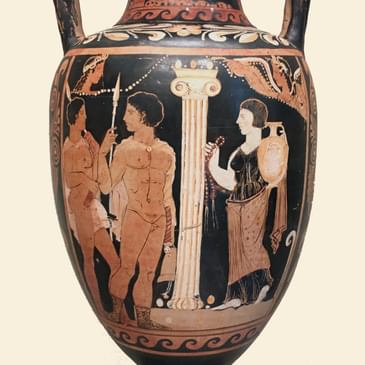
Pylades, Orestes, and Elektra perform rites at the tomb of Agamemnon. Painted in the late fourth century BCE on an amphora made in one of the Greek cities of southern Italy (which is now held at the MFA in Boston). Photo by Emily.
----------
00:11 - Introduction
01:15 - What is a hero?
- 01:33 - Some modern definitions of hero
- 02:52 - The roots of the word “hero” in ancient Greek (and maybe earlier)
- 04:12 - The various meanings of “hero” in ancient Greece: leaders, godlike heroes, and mortals given divine honors
- 13:09 – The flexibility of the hero concept in ancient Greece, and some examples: Achilles, Sarpedon, Theagenes of Thasos, and Kleomedes of Astypalaia
- 20:15 – Death and the hero in ancient Greece, and some strange cases: Asklepios and Herakles
26:51 - The stories we tell about heroes
- 27:39 – Two models of the “hero’s journey”: Joseph Campbell, “The Hero with a Thousand Faces”, and David Adams Leeming, “Mythology”
- 30:57 - A digression on problematic treatments of gender in hero studies
- 33:40 - Odysseus as the Cambell-style “everyman” hero
- 36:00 - Herakles as the Leeming-style “Chosen One”
- 42:26 – Coda: Alexander the Great and Herakles
44:17 - Wrap-up and teaser for our next episode on Stranger Things’ “Eleven”
Hello. Welcome to Have Toga, Will Travel, a podcast exploring the Mediterranean world, ancient and modern, through the eyes of two former classics professors. I'm Emily.
Cam:I'm Cam.
Emily:And we're your hosts.
Cam:So at the end of the last episode, we teased that we were going to do something a little bit different for the next couple of episodes. Basically, today will be the first of two episodes dealing with resonances between ancient myth and Stranger Things, a Netflix show that you may or may not know, the fifth season of which premieres...
Emily:End of November.
Cam:End of November. So a couple of weeks after this episode will come out.
Emily:Yeah.
Cam:Our ultimate goal here is to think through the story arc of one of the characters in the show, Eleven, also known as El.
Emily:Yeah.
Cam:And how it relates to ancient narrative patterns featuring heroes.
Emily:So, her story is going to be the focus of the second episode in this series. But today, we're going to set the stage by talking a little bit about heroes, generally speaking, in the ancient Greek world, and about the kinds of stories that are told both about ancient Greek heroes and heroes more broadly.
Cam:So, I guess we'll start by talking a little bit about what it is that pops into our head when we hear the word hero. And I suppose one really boring way to do this is to look at the dictionary definition of what a hero is.
Emily:Not the Bonnie Tyler song from Footloose?
Cam:No. Well, it could be.
Emily:I mean, that's what goes through my head, but that's just me.
Cam:So if you do approach this the boring way and open up a dictionary, let's say the OED, the Oxford English Dictionary, what you'll see is a series of definitions. The first is a man, and then in parentheses, or occasionally a woman, of superhuman strength, courage or ability favored by the gods, especially one regarded as semi-divine or immortal. The second is a man, and again, in parentheses, or occasionally a woman, distinguished by the performance of courageous or noble actions, especially in battle. The third, can we all guess how this is going to start? A man,
Emily:or occasionally a woman
Cam:or occasionally a woman, generally admired or acclaimed for great qualities or achievements in any field. So, a series of definitions there revolving around attributes that are inherent to a person. And then finally, the dictionary notes, a hero is also sometimes the central character or protagonist in a story, play, or a film, or so on, especially one whom the reader or audience is intended to support or admire.
Emily:Yeah. So, we can already see that there's overlap in those definitions, and there's distinctions in those definitions, and there's some gender problems in those definitions. All of which are going to, I think, continue to resonate as we talk today. But let's think about where the word hero comes from. So, the word hero does actually come to us from ancient Greek. Now what's really interesting is that while it's a word that we find in ancient Greek, it is not an Indo-European word. So, Indo-European is the largest language family in the world. It has its roots in Central Asia, and Indo-European speakers spread out throughout most of Europe and parts of Asia, including India, the Iranian plateau and Western Asia. Greek is an Indo-European language, but hero seems to come into Greek from whatever language was being spoken in the Balkan Peninsula prior to the arrival of Indo-European speakers. Now, there is some debate here because some people have posited that maybe it is Indo-European, maybe it's related to this Latin verb servo, which means to save or preserve. And so it means something like "protector" in its sort of root. But there's some linguistic reasons why that seems unlikely. If you want to get technical, it's that there is no digamma, which is the w, w-sound. In the earliest forms of hero, that sound isn't there, and that points away from it having a connection with servo. That w-sound is pretty key there.
Cam:Right. So, what does the word hero actually mean in Greek? Like modern definitions, it's pretty complicated because it can mean a number of different things depending on the context. So first of all, in some of our earliest literature, it seems to mean something like lord or leader. And here we're thinking of how the word is used in the Homeric epics, the Iliad, and the Odyssey, which we think, although this is not a universally agreed upon position, probably date to the early or mid-7th century BC. In these texts, hero gets used of male aristocratic figures, people like Agamemnon, Achilles, and so on, but also people who are not warriors in that sense. So it gets used of the healer Machaon, the bard Demodocus, and Odysseus' own son Telemachus, who at the start of the Odyssey anyway is a young man who hasn't accomplished anything yet, heroic or otherwise. So we can talk about Homeric heroes, and that's a definition that actually has some sense, but still a pretty broad category that is somewhat different from what we might think when we have hero in our mind. It's something more like leader than anything else.
Emily:The second definition we get is something like demigods. And even this definition is going to get a little tricky. So, Hesiod, who's writing in the mid to late 7th century, talks about the Ages of the world. And one of the things he talks about is the quote unquote, Age of Heroes, which he situates between the Age of Bronze and the Age of Iron, which is our current age. And when he describes the Age of Heroes, he says that this Age is also called the Age of Hemitheoi, which literally means half-god, what we might call a demigod. Now, the problem is that when we think demigod, we think someone who has like a divine parent and a human parent. But that's not quite what Hesiod seems to mean here. Because he goes on to then say that this race of heroes, the Age of Heroes, is killed entirely at Troy during the Trojan War, and at Thebes during the battle of Seven against Thebes. By doing so, he's including lots of people who don't have divine parentage. So for example, none of the people fighting at Thebes had divine parents. Or, you know, some of them, maybe there's a couple arguments, but most of them did not. People like Theseus, Jason of Jason and the Argonauts, and as well, most of the Argonauts don't have divine parentage. They all get included here. But then also there's fighters at Troy as well---most of them don't have divine parents: Agamemnon, Menelaus, Diomedes, Odysseus, all of that. So in some ways, what Hesiod means here by hemitheos might actually be closer to the term isotheos, which means something like "equal to the gods" rather than demigod. Or at the very least, hemitheos is ambiguous. It could mean demigod. It could just mean someone who is like the gods. And it's just gonna be fuzzy.
Cam:Yeah. Isotheos is an adjective that pops up all the time in Homer.
Emily:Yeah.
Cam:So when you're reading a translation of the Iliad and you run across the word godlike, you know, godlike Odysseus, godlike Achilles, whatever, that's isotheos being translated there.
Emily:Yeah.
Cam:So it's really meant to capture the sense that this is an age in which people were extraordinary in ways that are no longer true in the time of the author.
Emily:Yeah, yeah, yeah.
Cam:Finally, the other way hero gets used in ancient Greek is to describe dead human beings to whom some kind of divine honor or cult were paid. This is basically an amped up version of ancestor cults. It's different in that it's not concerned primarily with tracing blood relationships through generations from dead people, but rather it's concerned with identifying dead people who still have some kind of effective presence or the ability to influence the world, particularly as far as the fortunes of a given political community are concerned.
Emily:Yeah. And the real difference between hero-cult and ancestor cult is that hero-cult is a civic action and not a familial action. And when we say cult, we don't mean like, "oh, it's a cult." We just mean the means of offering worship to some sort of entity, right? It's a very broad term, so don't read too much into the use of the word cult here. And hero-cults as a phenomenon are fairly widespread and common in the Greek world. And if we're speaking in broad generalizations, which we are, they have their own set of worship rites that are different from what you would do for the gods, particularly the Olympian gods. It will have some points of commonalities with worship of chthonic gods. And this is a little weird here. Olympian gods are conceptualized as being up in the sky, you know, on Olympus, etc. Chthonic gods are gods that are conceptualized as living under the ground. So people like Hades and Persephone and Hecate, who are all associated with the Underworld, which is, of course, where also all the dead people are, in the Underworld. And so the way you talk to people below the earth is different from the way you talk to people who are up in the sky, or entities, I should say, not people. So some of the things that get associated with hero-cult are lamentation. You might have an altar that's sort of at ground level or a pit rather than raised up. Rites might tend to happen in the evening as opposed to dawn. You're going to pour libations, but you call the libations by a different term, called choai, as opposed to offerings to the Olympians, which are called spondai. And the very particular items about heroes that are unique is that usually the hero worship is centered around either a tomb or a cenotaph, so where the person is buried or something that stands in for a burial place. And the other key thing is that hero-cults are highly localized. So the worship tends to only happen in that place where that grave or cenotaph is, and it's going to be really particular to that locality. So, you know, heroes that get worshipped in this town may not get worshipped in the next town over. Like, there's not that kind of dispersion of worship.
Cam:Anyway, if you were to visit a major sanctuary in the ancient Greek world, the sanctuary dedicated to some god, what you would also find is a lot of these sanctuaries also had hero shrines incorporated within somehow. It might be a heroon, as we mentioned, a grave or a cenotaph set in the sacred precinct. It might take other forms. So if you think back to our fairly recent episode on the Acropolis, we talked a little bit about the Erechtheion, a multi-room structure up on the Acropolis that housed several cults. What we're told by Pausanias, a second century AD traveler, is that the Erechtheion had two rooms, one of which had three altars in it. One was an altar dedicated to the god Poseidon. But, says Pausanias, that altar was also used to offer sacrifices to Erechtheus, a very local Athenian hero.
Emily:Which, of course, already gets into the weird used for both a hero and an Olympian god, just to show that that breakdown I just gave is not always going to be true. It's a very simplified structure.
Cam:Lots of exceptions. The Erechtheion also contained an altar to the god Hephaestus, and finally an altar dedicated to another very local Athenian hero, Boutes. And in lots of other Greek cities and lots of other Greek sanctuaries, you would likewise find hero shrines often incorporated into a sanctuary, sometimes freestanding. So for example, at Sparta, there was a famous structure, the Menelaion, dedicated to Menelaus and his wife Helen. In Argos, there was a hero shrine dedicated to Agamemnon.
Emily:Yeah, at Olympia, there's a hero shrine to Pelops. At the sanctuary of Artemis, near ancient Aulis, modern Avlida, there's also a hero shrine to Iphigenia, so on and so forth.
Cam:And sometimes, you know, we can identify hero shrines on the ground and we just have no idea who was honored there.
Emily:Yeah, that's where the term heroon, which basically just means of the heroes, gets thrown in, right? We have a shrine. We can tell it's a hero shrine. We don't know who the hero is, but we know what it is by looking at the structure.
Cam:Right. Or you'll find an ancient Mycenaean tomb that was recognized in antiquity as an ancient tomb and people in later centuries would go there and make offerings. And we just have no idea
Emily:who they think they're making the offerings to.
Cam:Exactly. Yeah.
Emily:Now, despite some of the seeming differences between these three terms, right? Homeric hero, demigod, for lack of a better word, and hero-cult, these are not mutually exclusive definitions, and they do crosscut each other. So, for example, you can be all three of these things. And the prime example here is Achilles, right, who is the Homeric hero. He also fought at Troy. He is a demigod in that he does have a divine parent, and he also does receive hero-cult in a couple places. You can be, let's say, a Homeric hero and not the child of a god, as we've already mentioned, but then also receive hero-cult. So as we mentioned, Agamemnon, Menelaus, Odysseus, Orestes, Ajax, Diomedes, all Homeric heroes, not semi-divine, but do definitely receive hero-cult. You can also be, say, the child of a god and/or a Homeric hero and not receive hero cult that we know of. As we mentioned, there's a lot we don't know because it is so localized. And so one of the examples here would be Sarpedon, who is a Homeric hero. He is the son of Zeus. But I don't think we have any evidence of him receiving hero cult.
Cam:Not that I know of.
Emily:We could be wrong, though.
Cam:Yes, we can always be wrong. And finally, there are heroes who are neither the child of a god nor Homeric heroes, but are heroes because they receive hero-cult. And often these are real people who lived and died and who are given hero-cult because they are thought to have accomplished great things. So, for instance, people who found cities, new colonies, if you will, are often given heroic honors after they die. So, too, in some cases, were athletes. And we happen to know a few of these cases, mostly because this travel writer we keep mentioning, Pausanias, was interested in such things. And he's given us a couple of stories that he encountered while wandering around in the second century CE. One of those stories features a character named Theagenes of Thasos, who, it seems, lived during the early fifth century. He was known as a champion wrestler and champion pankratist. The pankration, if you don't know what it is, was basically the ancient equivalent of mixed martial arts. It was sort of a very violent, no-holds-barred combative sport.
Emily:No eye-gouging.
Cam:Pretty much one of the only rules. Yes. He was famous for a very distinguished career in which he won apparently dozens, if not hundreds, of bouts in both wrestling and pankration at all of the major big Greek festivals, the Olympic Games, the Isthmian Games, the Nemean Games, to say nothing of---
Emily:the Pythian Games
Cam:the Pythian Games---to say nothing of a whole bunch of more local games. In his later career, he even became a runner at which he also apparently excelled. So he's one of these fantastically successful, multi-talented people. Now, what's funny here is that after he died, there was a statue to him in his home state of Thasos, which is not at all unusual. Victorious athletes often did have statues put up to them in their local communities. The story Pausanias tells, though, is he had a local enemy who, after he was dead, would come and abuse his statue, including by whipping it. And this carried on for a little while until finally the statue fell over and crushed him to death. And so the story goes, the Thasians, you know, decided to punish the statue, as it were, by just dumping it into the sea. Well and good. Well, not long after this, Thasos starts to suffer from a famine. And no matter what the Thasians do, they can't figure out what's going on. So they send envoys off to Delphi to ask the oracle of Apollo there what's going on. And the answer they get is this will all work itself out if you bring your exiles back home. The Thasians interpret this to mean, okay, we have to recall people who have been exiled for various crimes, which they do. Famine doesn't let up. So they send Delphi again and they say, you know, we did what you told us, what's going on? And the oracle says, well, you forgot Theagenes. So that leads to some hilarity as they try to find the statue, which is now at the bottom of the ocean. They find it; they dredge it; they put it back up. Famine lifts. And from then on, according to Pausanias, Theagenes is worshipped as a hero. It's clearly, you know, his achievements were such that he continues to exercise power locally after he's gone.
Emily:Yeah, so this is what we mean by people who still have effective presence in the world after they're dead, right? Like that they are attributing now the lifting of this famine to the help or influence of Theagenes who's now been appeased or satisfied. And presumably part of the reason the famine started was because he was unhappy with them. And so you have to keep the dead happy for you, as the living, to succeed when they have that kind power.
Cam:Yeah, there's another interesting example, again, features an athlete. But this is an example that sort of, I guess, points to some of the ambiguities of the word hero. Like hero for the Greeks was often, but not necessarily somebody to be emulated or admired. It could just be somebody who clearly accomplished great things, terrible things, but great, to borrow the line from Harry Potter about Voldemort. Yes. So the example I'm thinking of is an example of another guy, Cleomedes of Astypalaia, a little island off in the Dodecanese, who was probably a contemporary of our friend Theagenes. Like Theagenes, Cleomedes was a pankratist, right? He fought in the pankration. And we're told he went to compete at Olympia and accidentally killed his opponent. This was a no-no in the pankration.
Emily:Yeah, you lose if you kill your opponent.
Cam:Yes, automatic disqualification. And this is what happened to Cleomedes. And according to the story, he was so angry about what had happened that he kind of went a little crazy. He went back home to Astypalaia, where he took out his anger on a school building and sort of toppled it, which I suppose would have been fine, except that it was full of school children at the time, a bunch of whom were crushed. So, the locals immediately kind of get together a posse and go after Cleomedes, who sensibly runs away, hides himself in a temple of Athena, and climbs into a chest and pulls the lid shut. You know, the sort of mob after him breaks into the temple, searches everywhere, figures he must be in the chest. So they fight with it for a while, finally pop the lid open, and there's no Cleomedes anywhere to be found. This, to put it lightly, is a weird situation. So they send the oracle at Delphi to sort of figure out, you know, what is going on here? What does all this mean? And the answer they get back is that clearly Cleomedes is something more than, strictly speaking, mortal. He should be appeased as a hero. And so this is an example of somebody receiving hero-cult, because as you said, he has a lot of power, even if he's not necessarily somebody whom anyone would want to emulate.
Emily:Yeah. And so one of the, I think, underlying threads we can pull out from these definitions of heroes is a connection between the hero and death, right? You have the association of warfare, the sort of straddling the mortal-immortal boundaries somehow, or literally worship after death. It is even easy to see how this term hemitheoi could slip between humans who are born half-divine and then humans who get treated with divine honors of a sort after they're dead, right? That's a sort of form of like half-divinity. And so it's a little messy. But this connection with death, I think, actually becomes really key to understanding heroes. And one of the sort of ironies of a hero, whichever meaning we're looking at, is despite, you know, whatever strength they might have, whatever power they might have, whatever their heritage, in the end, they are still mortal. And death for them is inevitable and irreversible as it is for anyone else. And this idea really does come through in some of the epic poems from antiquity: of course, Achilles' struggle with his mortality in the Iliad, and, if we want to reach even further back and into a slightly different culture, Gilgamesh and his struggle with his mortality in the Epic of Gilgamesh. And for both of these characters...
Cam:Both of whom are semi-divine.
Emily:Both of whom are semi-divine. For both of these characters, a big chunk of the text, one way or another, is about them coming to terms with their own inevitable death.
Cam:Now, there are two big exceptions in Greek myth, and those exceptions are Heracles and Asclepius. And they, although conceptually on some level heroes, straddle that gulf between hero and god in kind of a weird way.
Emily:Yeah.
Cam:They're both humans who do die, but somehow are able to transcend death. And they do so by becoming immortal. And this is weird, right? Because otherwise, generally speaking, in Greek thinking, the wall between hero and God is impermeable. Heroes do not normally become gods.
Emily:Heroes don't become gods.
Cam:Except for these two.
Emily:Except for these two.
Cam:And gods are not heroes. There's a distinct difference here. But both Heracles and Asclepius, mortals with divine fathers, die and then manage to do exactly this, to transcend death and to become divine in some way. Asclepius is the harder one for us to wrap our brains around. Well, maybe he's not. He's murkier.
Emily:He's murkier, for sure.
Cam:Right. The sources have plenty to say about what he accomplished in life. He was an amazingly talented physician.
Emily:Yeah, he manages to actually bring people back from the dead as a physician.
Cam:Yes. He is Apollo's son, right?
Emily:Yes, Apollo's.
Cam:So that skill with medicine is, I guess, somewhat hereditary. But he's so good at medicine. He's so good at bringing people back from the dead that this invites some divine wrath.
Emily:Yeah, he has violated the natural order.
Cam:Yeah, so Zeus strikes him down with a thunderbolt, basically. He then goes on to become a god in some way, although precisely how and why this happens is not...
Emily:Yeah, the sources don't really say anything about that.
Cam:So we're left to sort of flail around and say, oh, what's going on? What makes it even more weird is that as a god, he is often conceptualized as living on earth in the form of a snake, or several snakes, I guess, that reside in temples dedicated to Asclepius around the Greek world, even though in other senses, his temples look a lot like regular temples that house cult statues and so on.
Emily:Yeah. Now, Heracles, on the other hand, is The Figure here. He really is the hero-turned-god par excellence. He is the human who suffers intensely in his life, but then gains immortality as a reward after death. And he really becomes a figure that humans latch onto for this ability to gain immortality. Now, what's weird about Heracles is that there's a tension very early on. Is he a god? Is he mortal? What exactly is he? And we can see that this is actually being worked out pretty early on in the Odyssey. In the Odyssey, Odysseus sort of journeys to the Underworld, and he sees Heracles in the Underworld, you know, using his bow, being a hunter. But at the same time, as he's talking about seeing Heracles, he then goes on to say that the Heracles he's seeing is actually a phantom or like a---what's a good word there? A ghost?
Cam:It's... I wanted to use the word shade but we're already dealing with Underworld figures anyway.
Emily:So, it's like a phantom or like a ghost
Cam:a phantom of a shade
Emily:a phantom of a shade because you know Heracles himself is actually up with the gods on Olympus. So we could already see in the Odyssey there's a tension of, like, he is both a dead mortal and a divine immortal with the gods. So yeah, working out this--- is he mortal? is he divine? he's sort of doing both. what's going on?--- is there from some of our earliest literature. You know, Hesiod, who's writing, you know, let's say a generation or two later, you know, Heracles is both the son of the mortal son of Zeus who goes around and kills all the monsters, but then is rewarded in the afterlife with being brought up to Olympus. And then we also get stories from later sources like Herodotus, where basically he posits that there are, like, two different beings called Heracles, and one is a god, and one is a mortal. So, one is worshipped as a god; one is worshipped as a hero, but they're not actually even the same person. So, he's really trying to himself wrap his head around this kind of dual nature and find a way to explain it.
Cam:Yeah, it's really interesting that he could be worshipped in some places as a hero.
Emily:Yeah.
Cam:And in other places as a god.
Emily:Yeah.
Cam:Even in the 5th century, the precise nature of Heracles still hadn't been fully worked out.
Emily:Yeah, yeah, yeah. Really, I think a lot of what's going on is that Heracles is just kind of a messy figure because he gets conceptualized as both a mortal who dies as a hero, but then a mortal who also becomes a god.
Cam:So broadly speaking, despite all of the oddities we've discussed, we can see two main types of heroes in the ancient Greek world. First, you've got sort of the isotheos or hemitheos or chosen one hero, right? A person born with extraordinary qualities, usually people who are conceptualized as living way back in the heroic past. Two, you've got somebody who's thrust into extraordinary circumstances or who accomplishes something great and is given some kind of heroic status or worship in recognition of that fact. And what's interesting here is that these categories, these ways of thinking about what a hero was in antiquity, overlap with the ways people tell stories about heroes in a more general sense, ways that are captured often under the label the hero's journey.
Emily:So what is the hero's journey? You might have heard this term before. This is really something that gets coined in modern scholarship. And the real touchstone name here is Joseph Campbell. And Campbell's goal in describing the hero's journey is to articulate what he calls the monomyth, which is what he sees as the common template underlying all stories that are told across cultures, period, full stop. And he centers them around this sort of figure called the hero. And beyond just Campbell, right, the scholarship around heroes and hero's journeys, etc, that has developed grows out of both folklore studies and psychology, and in particular here, the psychologist Carl Jung on archetypes. And part of what they're trying to do is to understand why we tell stories in the way that we do. Now the hero's journey has, like, three basic elements or phases to it: the departure, the initiation, and the return. So the departure is the hero leaving the ordinary world. Then the initiation is the trials and tasks and the gaining of the reward that are part of the hero's struggles. And then finally, the return is coming back to the ordinary world with the reward, having been transformed by this journey.
Cam:Now, as you might guess, this idea that there may be a common archetype to stories about heroes has animated a lot of discussion, a lot of scholarship, and as a result, there are a bunch of different takes, a bunch of different models, a lot of variety here. There are two, though, that are particularly worth singling out. We've already named Joseph Campbell, who really has popularized the idea of the hero's journey. In the book he wrote, in which he explored this, The Hero with a Thousand Faces, was famously used as a reference by George Lucas when he was writing the script for Star Wars. And it is loosely an everyman's version of the hero's journey. It involves a protagonist, a hero who goes off and has these grand adventures, but has to reintegrate into society in some new way at the end of the journey. Other scholars have emphasized slightly different kinds of models. And here the name worth mentioning most is David Adams Leeming, who in a work called Mythology, lays out a version of this model that emphasizes the chosen one variation. This is a style of story that focuses on heroes who aren't normal people. They have some kind of a miraculous conception. And the point of these kinds of stories is to emphasize people's search for a savior, for a hero or a leader who is somehow unsullied, untarnished by all that squidgy human stuff. And it ends with the hero not reintegrating into society in a new way, but sort of leaving altogether by being taken out of the cycle of life and death, awarded recognition for what Leeming calls his inherent divinity.
Emily:Side note about David Leeming is that he spent a few years as the secretary and assistant to James Baldwin. Now, we're going to take a little digression here. There are some gender problems, particularly in-
Cam:I'm shocked.
Emily:I know. Particularly in Campbell's scholarship. Leeming seems to have a broader view of who could be a hero, but Campbell in particular was pretty explicit about the strong gender divisions in his work. And if you look at his full schema of his stages of the journey, you can see where women figure in as basically steps along the hero's path. And when people brought this up to Campbell, and sort of asked about women having hero's journeys, and what was going on there, he basically just said that heroes are men, and that women don't need a journey because they're just there. And quote, "all she has to do is realize that she's the place that people are trying to get to."
Cam:I mean,
Emily:Women aren't people. Didn't you know that? So as a response to this, like, scholars have attempted to articulate a heroine's journey. Now, a lot of these actually come out of psychology rather than folklore studies. So they have a slightly different tone and shape to them. What comes up in heroine's journeys in particular, and we'll talk more about this in the next episode, is about finding strategies to cope with patriarchy, to come to terms with femininity. And one of the key themes that comes out in these stories often is the restoration of the family.
Cam:These models, as Emily's already mentioned, are going to become a lot more important in the next episode when we switch our focus to Stranger Things's Eleven.
Emily:Who is a female hero.
Cam:Who is, of course, yes, a young woman. But here we can point to women heroes, especially everyday hero types in modern literature and even in fairy tales. So Dorothy from The Wizard of Oz, a big example. Katniss from The Hunger Games. Women protagonists in a number of different fairy tales. Donkeyskin, Cinderella, Thumbelina.
Emily:Little Red Riding Hood.
Cam:And from ancient stories, Psyche, from the Cupid and Psyche story. And Hua Mulan, who is the subject of now two famous Disney movies. One more famous than the other, I think.
Emily:The Chinese story, yeah.
Cam:But if you're interested, we can link you in our show notes to the New York Public Library's list of books for young readers, which feature a lot.
Emily:Yeah, it's a list of books that have female heroes as the centerpiece. And it's a really nice cross-cultural list as well that goes, of course, well outside of our own sets of expertise. And that's why we're going to direct you there because they have done more research on that than we have. Anyhow, to get back to Campbell and Leeming and the hero's journey, if we look at their schema of the hero's journey, we can find parallels between both models and various stories in Greek myth and literature. So for the Campbell-style story pattern, the sort of everyman story pattern, there are many examples we could look to. The one we're going to talk about is Odysseus in the Odyssey. Now, granted that the structure of the Odyssey is not linear in that big chunks of Odysseus's story are narrated by him in a flashback, We can see the departure, right, the leaving on the ship and the initiation, which consists of all of his travels and adventures and trials, including this descent of sorts to the Underworld, and then his return home and reintegration at the end.
Cam:Now, in Campbell's presentation, the initiation phase is a phase when the hero undergoes all these trials and comes back with some kind of reward. In the case of Odysseus, what he comes back with is first, and probably most importantly, a new relationship with Athena, who will support him actively in his efforts to reintegrate himself into life on Ithaca. He also comes back with a bunch of knowledge of what's exactly going on in Ithaca, which he picks up by talking to various people's shades in the Underworld. And then finally, of course, he comes back with really tangible rewards in the form of fabulous wealth, which he picks up as guest gifts from the Phaeacians to whom he narrates the stories of his adventure. The return portion is a very literal chunk of the Odyssey, basically the second half of the poem. Most of the poem even. Yes, the part we talked about in great detail when we gave our own take on the Pasolini film starring Ralph Fiennes and Juliette Binoche-
Emily:The ironically named The Return
Cam:ironically named The Return, which we reviewed in a little bit of detail a few episodes ago.
Emily:Yeah, third episode.
Cam:And in this portion of the poem, Odysseus really is concerned with reclaiming his place in Ithaca after a fairly lengthy series of adventures that have kept him away from home for many, many years.
Emily:On the other hand, if we're thinking about the sort of Leeming model of the miraculous child, the extraordinary person, the chosen one, if we will, Heracles is a really strong example of this chosen one model.
Cam:In spite of the fact that there's all this conceptual confusion about...
Emily:Yeah, but I think this is part of the reason why, because he's a different kind of hero on some level. So first of all, Heracles has a miraculous conception birth story. How could I do this concisely? So the rough story is Heracles' mother, Alcmene, is awaiting the return of her husband Amphitryon, who's been away at war. He is supposed to come back the next day. He comes back a little early, but it's not actually Amphitryon. It's Zeus in disguise as her husband, and he spends the night with her, which he makes last three times as long as a normal night so he can spend more time with her. And then he leaves. She doesn't realize that he was a god. Her husband comes home. She gets pregnant with this child. And then in the Leeming Model, right, the hero is tested at a young age, which demonstrates their divinity. In the case of Heracles, Hera, who is jealous, sends snakes to try to kill him in the crib. And Heracles, baby Heracles, manages to strangle them with his bare hands and kill them, which leaves some really cute artwork of chubby baby, like, killing two snakes joyously. As a young man, he also demonstrates having superhuman strength. For example, he kills his music teacher, Linus, because he gets upset with him and hits him over the head with a lyre and hits him so hard it kills him. And then, of course, as an adult, he's going to go on to complete a series of labors that demand superhuman skill, right? This is when he's at the peak of his powers. So things like killing the Hydra, capturing the man-eating horses of Diomedes.
Cam:There are many. There are 12 canonically, but that's-
Emily:12 canonically, but really more than 12. How that canonical 12 happens is a whole different story. But nonetheless, they are tasks that are set for him because they are conceptualized as things that a person couldn't do.
Cam:Yeah. And one of those involves a literal descent into the Underworld, a katabasis, which will become an important concept, I think, when we're talking about Eleven in the next episode. Right. In this particular story, Heracles is tasked to go down into the Underworld and to basically abduct Cerberus, the three-headed dog who basically guards the underworld and bring him back. And this is a story which, among other things, can be read as a metaphorical conquering of death since Heracles descends to the Underworld and comes back alive.
Emily:Yeah. And of course, lots of heroes have a katabasis, right? And it is this metaphorical overcoming of death, even if in the end they still die like everyone else does.
Cam:Like Odysseus does
Emily:Like Odysseus
Cam:after his descent into the Underworld. Yeah.
Emily:And this is where Heracles ends up being different, right, is that his overcoming of death in the end is not just metaphorical.
Cam:Right. And I guess we need to talk about that now, because that's where this is building. Yeah, Heracles is somewhat unique in that although he dies, he becomes a god in a very literal sense some way.
Emily:Yeah, and this is a key part of Leeming's schema is that attaining of the inherent divinity.
Cam:Right. So this is not a hero who is reintegrated into society. This is the hero who leaves it by transcending the cycle of life and death altogether.
Emily:Yeah.
Cam:The trouble is we don't really know how this happened in Greek mythology because we don't have a detailed surviving written account of it.
Emily:Yeah.
Cam:All we can say is that this is an idea that was probably present sometime in the 7th century, definitely by the 6th century, when it starts showing up in artwork. You get vase paintings and things like this of Heracles and the company of the Olympian gods.
Emily:I mean, you can make the argument that Heracles is never really integrated into society.
Cam:Right. Yeah. But that's also Leeming's model.
Emily:Yeah, yeah, yeah.
Cam:These people are...
Emily:They never belonged here to begin with.
Cam:Right. And so their heroic journey becomes sort of, you know, figuring out where their place is. And it turns out that their place is not with the rest of us because they're something more than human.
Emily:Yeah.
Cam:Anyway, our written accounts of Heracles' death are really limited, mostly, I think, to Sophocles' play, The Trachiniai. And the plot essentially revolves around the fear of Heracles' wife, Deianeira, that she is about to be supplanted by a new woman, Iole, whom Heracles has just captured after sacking a city.
Emily:To get her.
Cam:To get her. And in order to deal with this, Deianeira uses a potion, which she believes to be a love charm, but which is in fact a poison. And she soaks a cloak for Heracles in it, thinking that when he puts it on, he'll basically fall madly in love with her and forget all about Iole. But what actually happens is he puts it on and it basically starts eating away at him. Doesn't quite kill him, but it drives him into such a frenzy of pain that he asks to be burned to death. And there Sophocles' play ends. So we don't really know what happens after that.
Emily:Yeah. And scholars have argued, should we see his apotheosis as happening after the end of the play? Should we not? Because Sophocles makes no reference to it one way or the other. And this is things that scholars argue about. And of course, there's no answer.
Cam:Right. And it's clear that people remained puzzled by what exactly happened, like Herodotus.
Emily:Yeah. But part of what makes Heracles popular around the Mediterranean, not just in the Greek world is the fact that he is a human that not just has this metaphorical overcoming of death, but actually somehow manages to gain immortality. Part of that is that he's a culture hero, right? He fights the monsters who seek to destroy humanity, society, and he on some level restores order to the world. And then at the same time, because he does these great things, he is somehow now then also able to overcome death, not just in a metaphorical way, but in a literal way.
Cam:And that is just incredibly unique. Yeah. And as a coda to that, it's worth pointing out that because of his popularity and his versatility as a figure to think with, he becomes a model for other human beings who want to be seen as great and aspire to some kind of immortality. So you can argue that athletes in particular often patterned themselves after Heracles in the way they dressed, you know, that sort of thing. But the most famous example is undoubtedly Alexander the Great, who had an incredibly complicated relationship with Heracles. Alexander at some point started to see himself increasingly as a hero in the model of Heracles. There was a famous oracle Alexander received in Egypt at the temple of Ammon, a god whom the Greeks associated with Zeus. And what we're told is that the priests greeted Alexander as the son of the god when he entered the temple. So Alexander gets it into his head that he, like Heracles, is the son of Zeus. And, you know, what's interesting here is that he's accomplishing really great things, right? He's in the process of toppling the greatest empire that had yet existed in the world. And as a result, Alexander really did make the case that he, like Heracles, could perhaps anticipate some kind of, at the very least, heroization, but more likely deification at the end of his life.
Emily:He, too, was going to have an apotheosis.
Cam:He too.
Emily:And you also get stories about he had some sort of miraculous conception.
Cam:Yes.
Emily:Things like that start coming up, right?
Cam:Yeah, it's implied in the stories about his birth. Yeah.
Emily:Yeah, he really does glom on to that model, right? That I'm the chosen one.
Cam:Yeah, and he becomes somebody living out sort of the Leeming model of the hero's journey.
Emily:So that's all we're going to really talk about today. But in the next episode, as we mentioned, we're going to think through the story of Eleven from Stranger Things against the background of these different ways of thinking about heroes and what it means to be a hero. and in particular we're going to make the case that Eleven's story fits with this sort of Heracles/ Leeming/chosen one model and we're going to talk a little bit about how that's played out in the story so far and what that might mean for the upcoming fifth season.
Cam:So if you haven't seen Stranger Things yet you've got two weeks before our next episode comes out to get up to speed.
Emily:Yeah. And before we wrap up today, we are about to leave to go do our second attempt at the Athens Marathon in a few days. So keep an eye out on our Instagram feed. We're going to try to maybe do some Instagram live videos on the marathon day, which is November 9th, or maybe some of the places around Athens we might see or Rome. We're going to take a little stop in Rome. So just keep an eye out. We might try to do a couple little videos while we're out and about and traveling.
Cam:I don't know if I want to commit myself to live video, but we'll definitely post some pictures.
Emily:Yeah. We'll see. We'll see how it goes. So that's all for today. I've been Emily.
Cam:I'm Cam.
Emily:And this has been Have Toga, Will Travel. Like and subscribe wherever you get your favorite podcasts. And you can follow us at havetogowilltravel.com or on all the socials. And if you have any questions or topics for us to cover, please reach out to us and let us know.
Cam:And if you liked this episode, tell a friend about us. Thanks for listening, everybody.