
The Theater of Dionysus is quite possibly Emily's favorite site in Athens, and the adjacent Sanctuary of Dionysus is one of the most tranquil spots in the larger Acropolis archaeological park. These two sites are intimately connected: in antiquity, the various incarnations of the Theater were built to host dramatic and dithyrambic (choral) competitions at Athens in honor of the god Dionysus (whose Sanctuary and temples sat right next door), especially during the god’s major annual festival, the City Dionysia.
We discuss the Sanctuary, the Theater, and Greek drama in Episode 13 ("At Play in the Theater of Dionysus"). This post is meant to provide some pictures that will give our listeners a sense of what the Theater and the Sanctuary look like today, along with an overview of their development.
The Location of the Sanctuary and Theater
The Theater and Sanctuary of Dionysus sit below the south walls of the Athenian Acropolis, near its eastern end. The sanctuary was in place by the middle of the sixth century BCE at the latest, and the first version of the Theater (one with a wooden seating area, shaped like the capital Greek letter Pi) was probably built early in the fifth century.
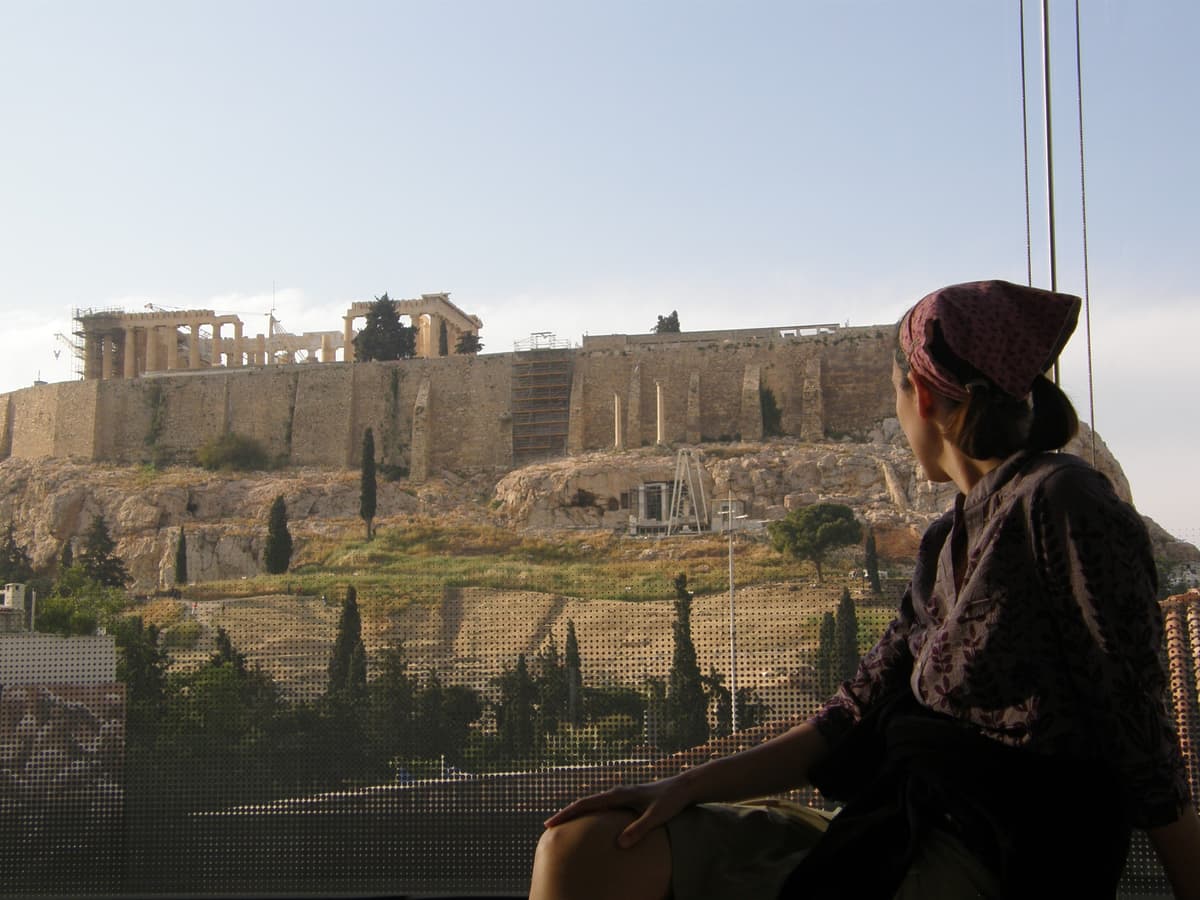
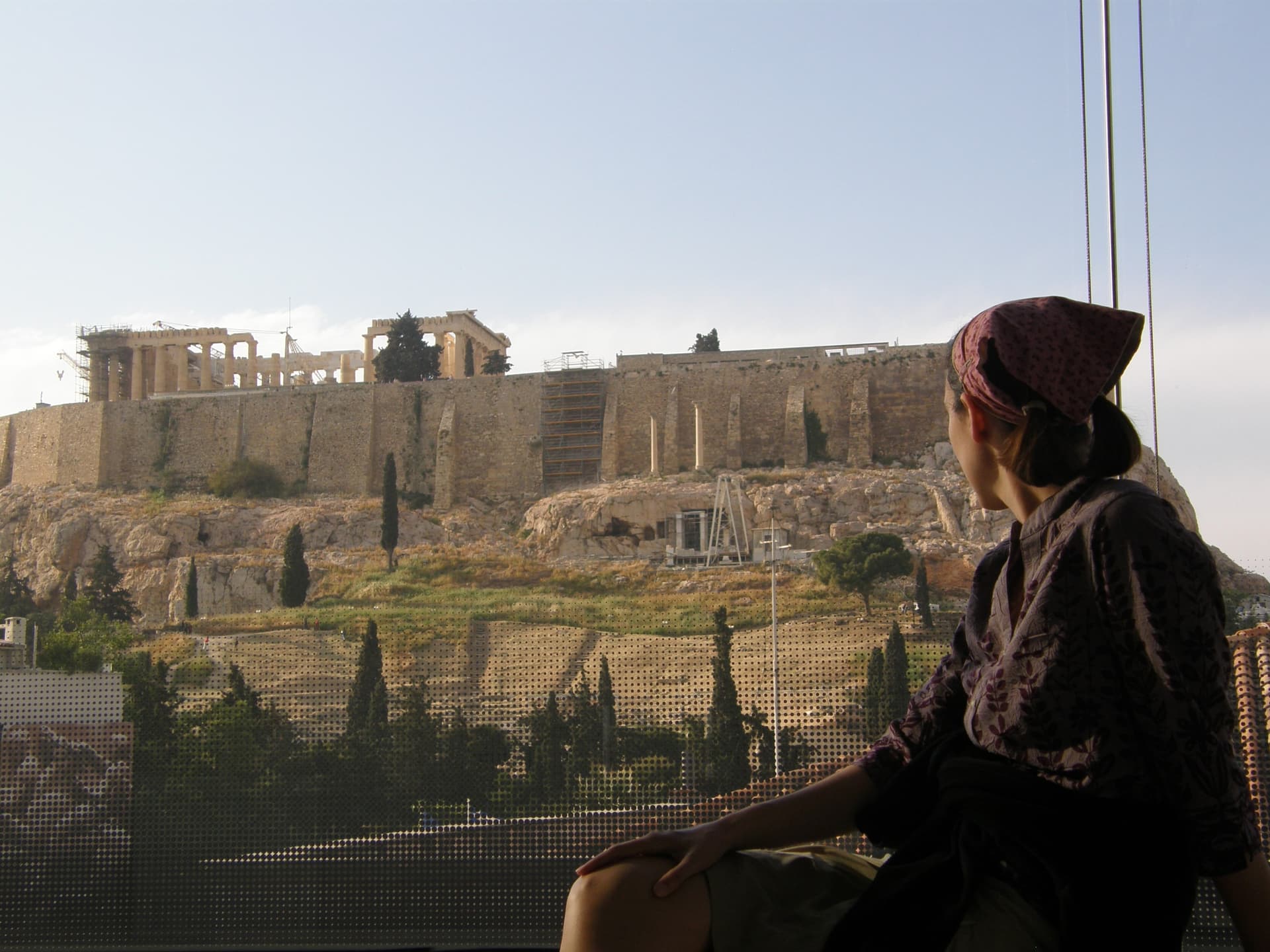
In the photo above, Emily is admiring the view of the Acropolis and the Theater from the upper gallery of the new Acropolis Museum. The glass unfortunately has little black dots in its lower reaches that somewhat obscure the view, but the slope on which the Theater sat can still be made out clearly here—it's the sandy-looking region just above the lower belt of trees. What's left of the stone seating (originally laid in the fourth century BCE) is concealed behind the treeline in this picture; it probably extended up beneath the present-day grass to the rocky shoulder of the Acropolis.
A couple of late-classical choregic monuments honoring victorious choregoi can be seen in the shot as well, both in the face of the rock just above the grass (obscured somewhat behind some modern restoration equipment), and perched on the shoulder of the rock. Choregoi were wealthy Athenians charged with financing plays and choruses during the dramatic competitions in honor of Dionysus; those who funded winning productions were awarded a tripod, which many displayed on permanent monuments (which grew increasingly elaborate in the late classical and Hellenistic periods).
The massive temple on the left edge of the photo is, of course, the Parthenon!
The Theater from Above
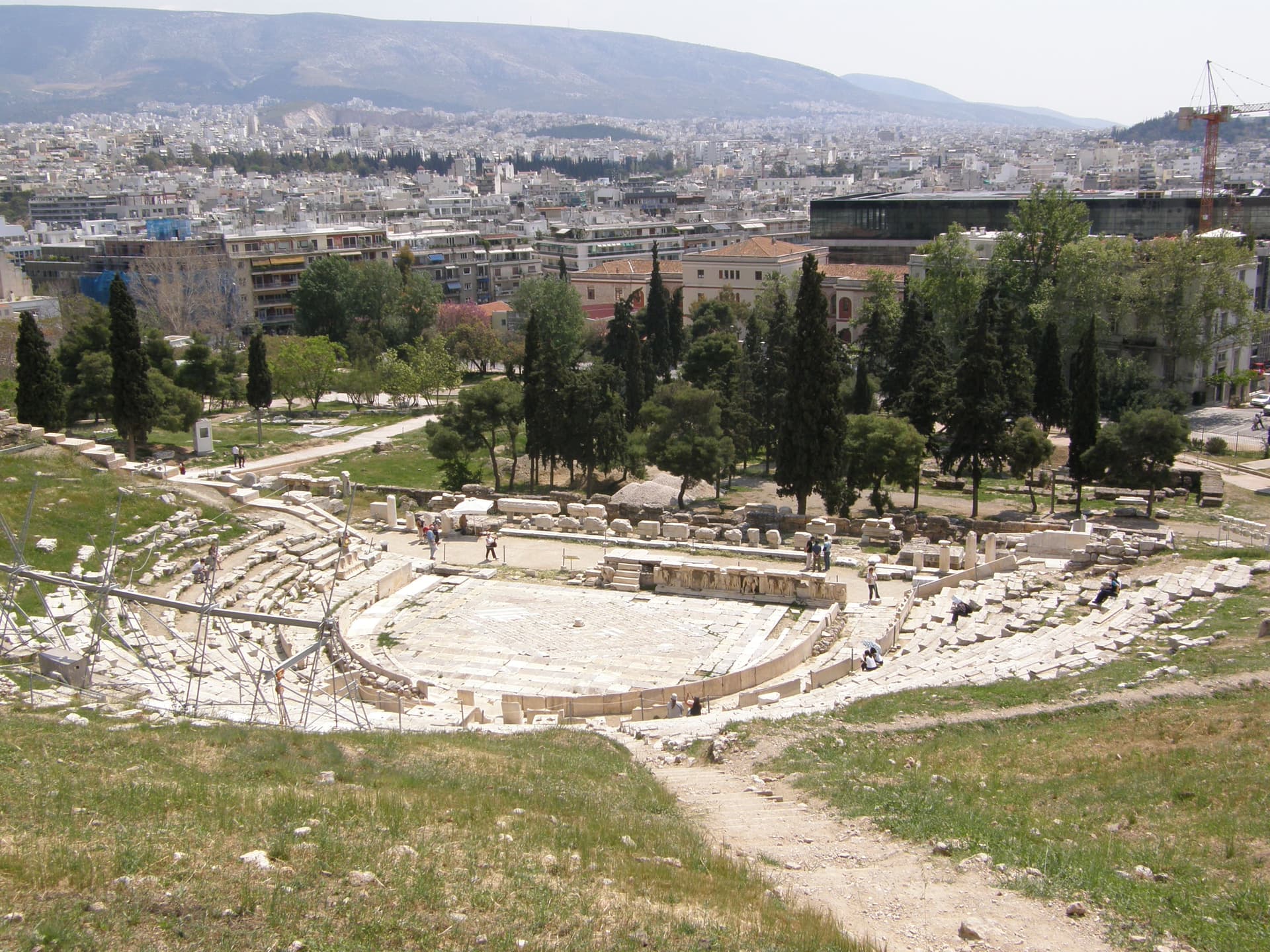
An ancient street known as the Peripatos ringed the shoulder of the Acropolis and divided the main seating bowl of the Theater from its upper courses. When the Peripatos is open, it gives visitors a good view of the Theater from above.
Although the seating in the Theater was made of wood during the high point of classical Athenian drama (the fifth and early fourth centuries), the structure was remodeled in stone in the mid fourth century BCE, and reworked several times after that in the Hellenistic and Roman periods. The remains of the Theater today reflect this long history.
The paved floor in the shot is the orchestra (the dancing floor used by the chorus), as it looked in the Roman period. It was backed by a raised stage (a feature of Roman and Hellenistic theaters, but not of the original fifth-century theater), part of which is displayed in situ (the stairs leading from orchestra to stage are visible in the middle of the shot). To either side of the stage are the side entrances (the paradoi), and just in front of the treeline are the foundations of a monumental stone skēnē (scene building) of the Roman period. At one point, the stone seating extended all the way up the hill to the Peripatos and beyond, but only a few tiers remain today.
The Sanctuary of Dionysus—the god to whom drama in Athens was primarily dedicated—lay in what is now the tree-covered area beyond the skēnē. The stone foundations of his "new" temple, built in the fourth century BCE, can be seen on the right edge of the shot, about midway between its top and bottom.
The Theater from the Orchestra
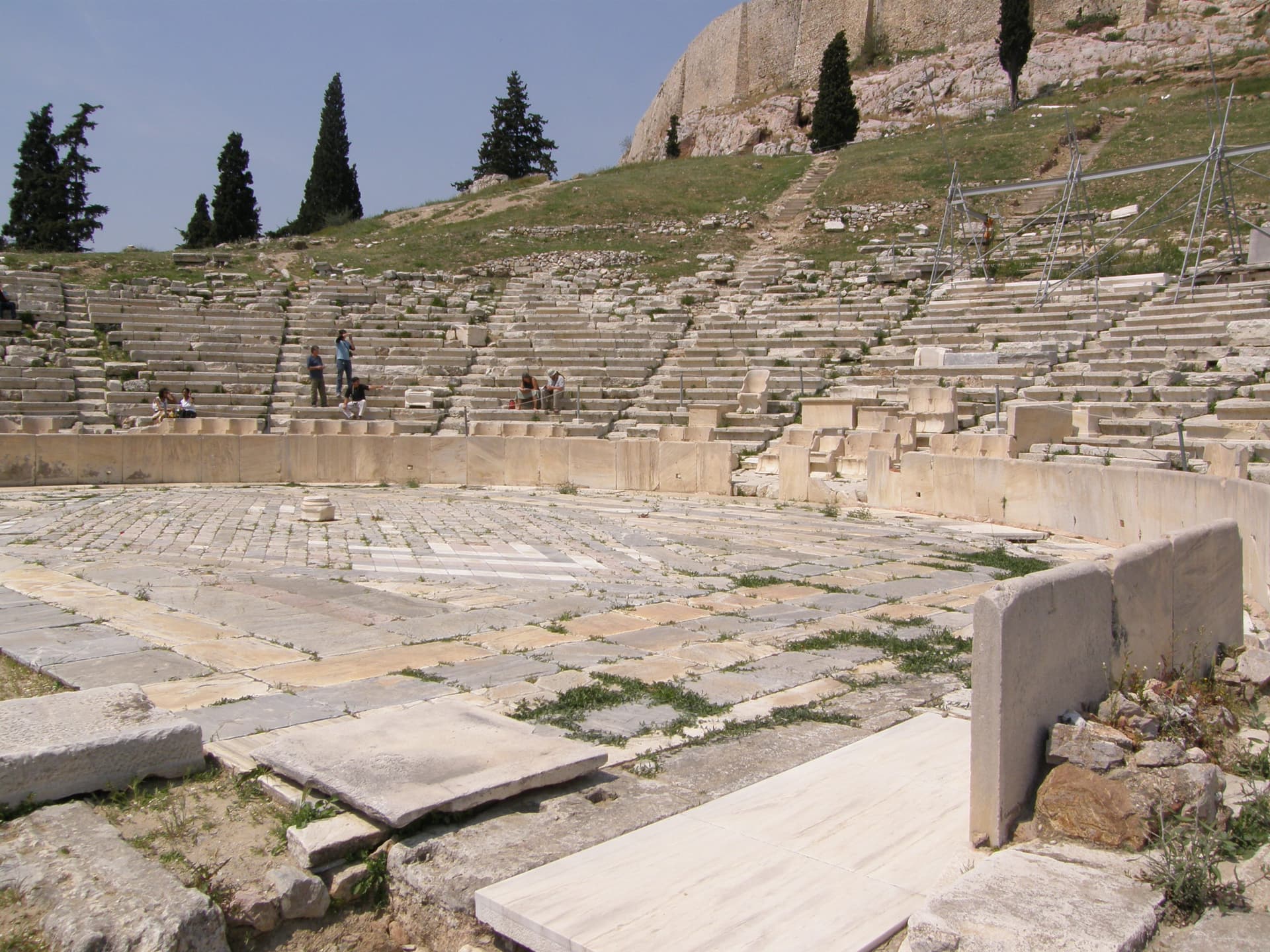
This photo, taken from the Southeast corner of the orchestra, offers a good view of both the paved orchestra itself and the seating area. Note the excavated stairways, which lead up past the surviving stone seating to the level of the Peripatos. When the seating was intact, it could probably accommodate somewhere on the order of 17,000 spectators (especially if it did in fact extend above the Peripatos).
The Fancy Seats
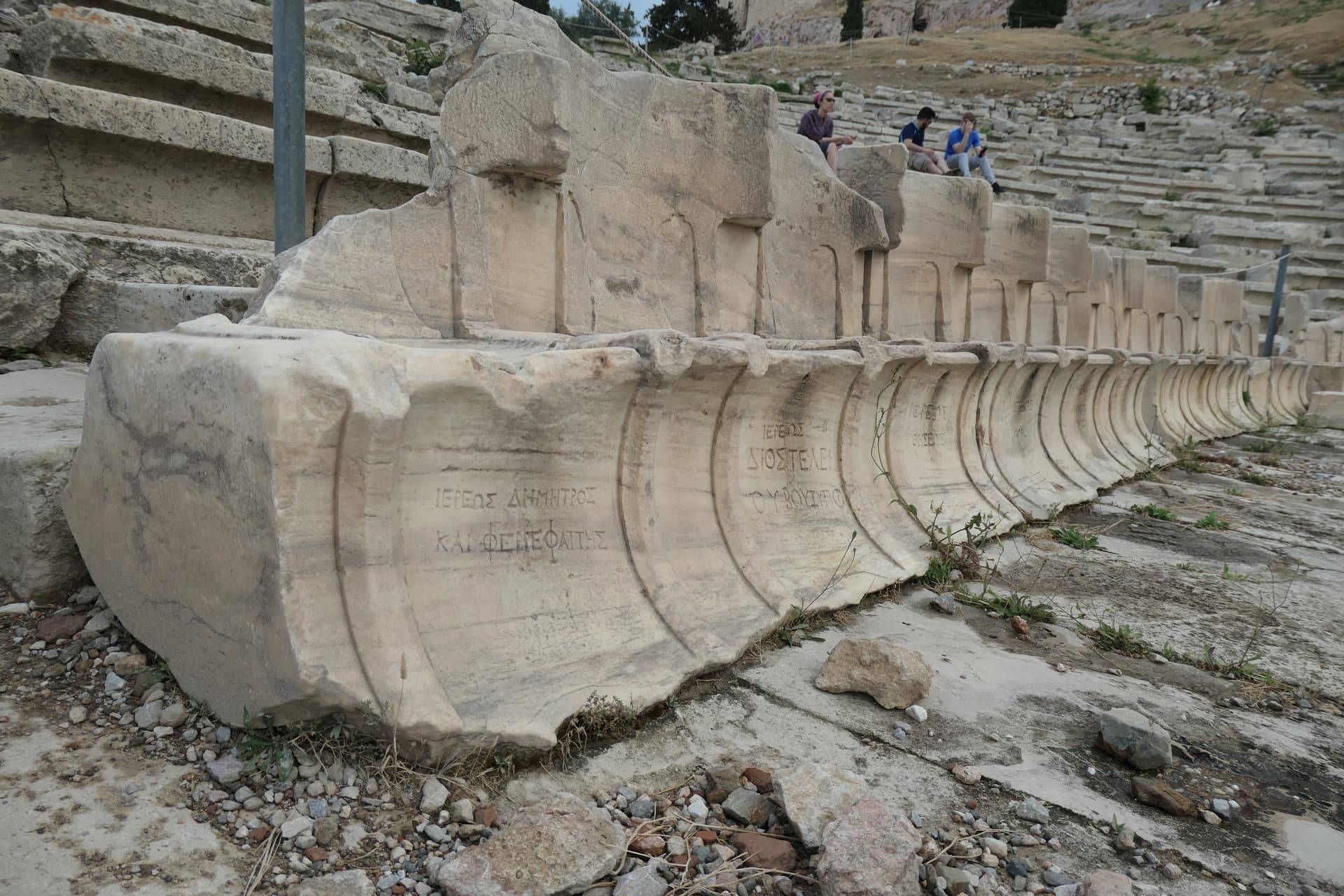
During the fifth century, when the seating area was constructed of wood, dignitaries who attended performances at the Theater (including the priest of Dionysus) had special stone benches. In the Hellenistic and Roman periods, dignitaries sat instead in thrones inscribed with their names. In all periods, the best seat in the house (center front) probably belonged to Dionysus himself, who was present for performances in the form of his statue, which the Athenians carried out from his temple.
Relaxing in the Theater
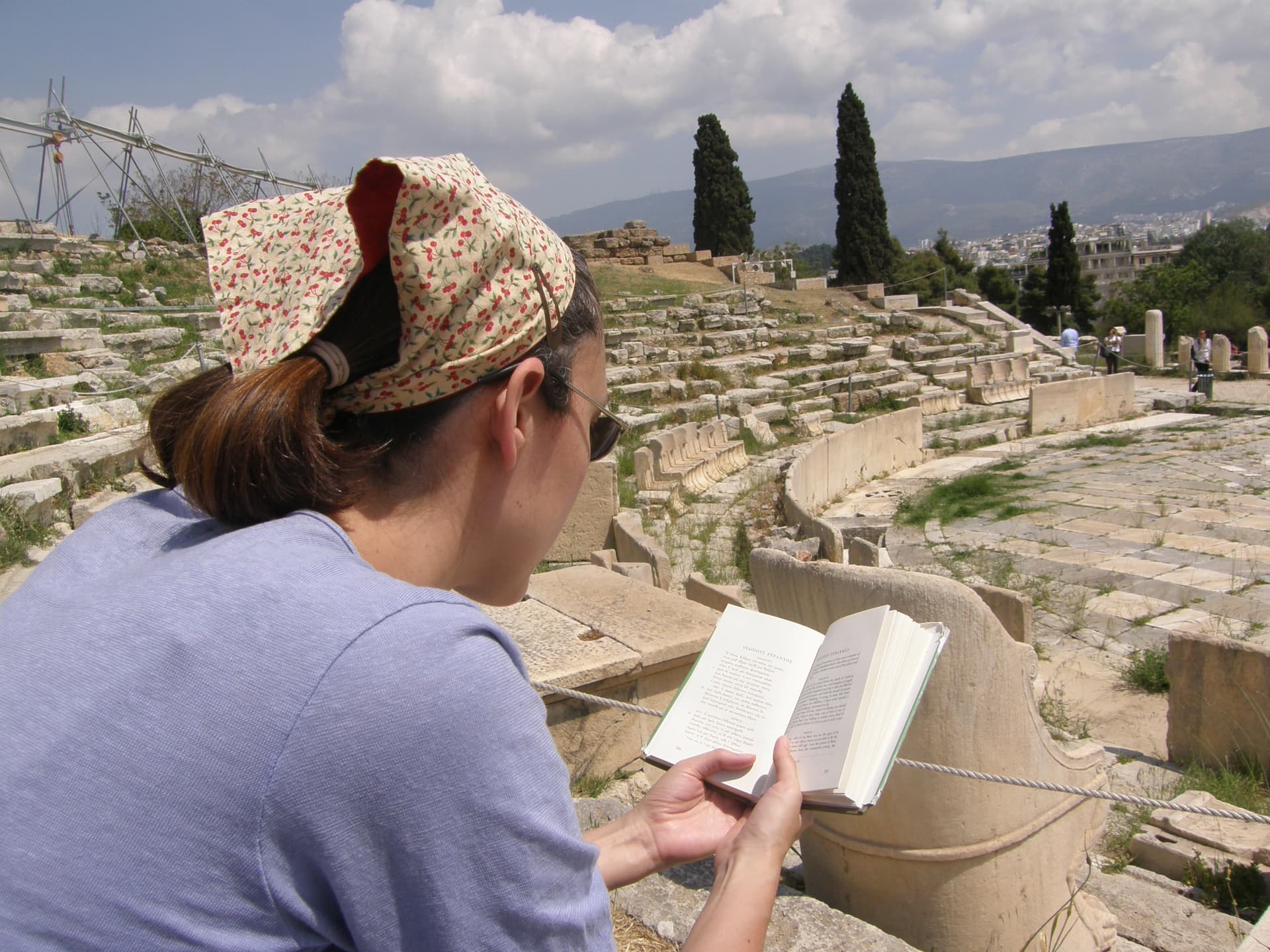
Until relatively recently, it was possible to enter the seating area and while away the time in contemplation with a good book. Here, Emily is reciting lines—in Ancient Greek, no less—from Sophocles' Oedipus Tyrannus, which was probably performed for the first time in 425 BCE.
Alas, the seating area has been roped off completely during our last few visits (this photo was taken in 2015).
The New Temple of Dionysus
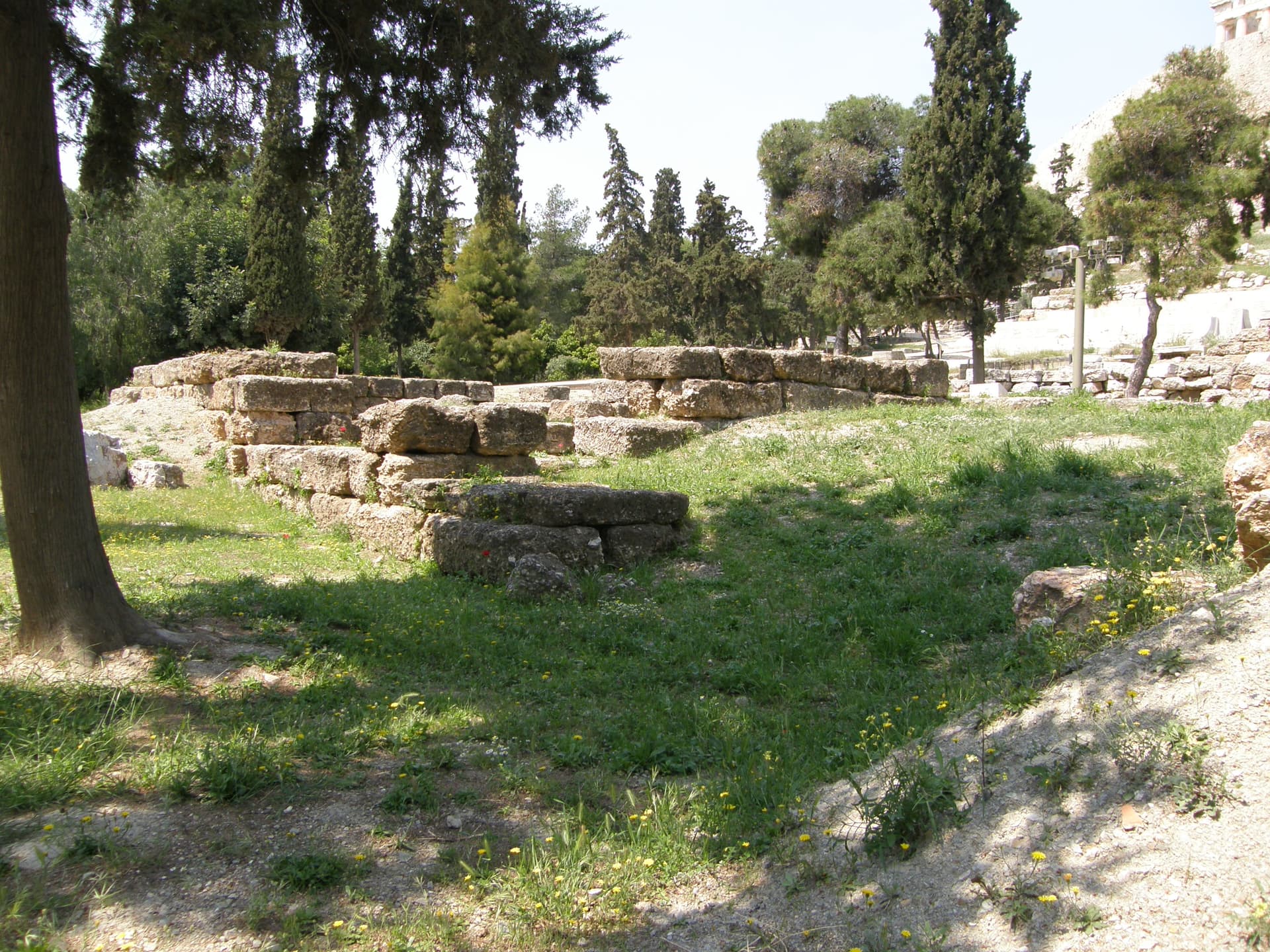
Although the Theater of Dionysus housed dramatic competitions dedicated to the god, it lay outside of his Sanctuary proper, from which it was separated by a peribolos (a low enclosure wall). The peribolos marked the area that was sacred to the god, where worshippers would find his altar and his temple (which housed his statue), and where they could dedicate gifts to him. Not much remains in the Sanctuary itself, but modern visitors can still see foundation blocks that belonged to the Old Temple (built in the late sixth or early fifth century BCE), as well as the blocks pictured here, which belonged to the foundations of the New Temple (built in the fourth century BCE, around the time that Theater itself was rebuilt completely in stone).
The Odeion of Herodes Atticus
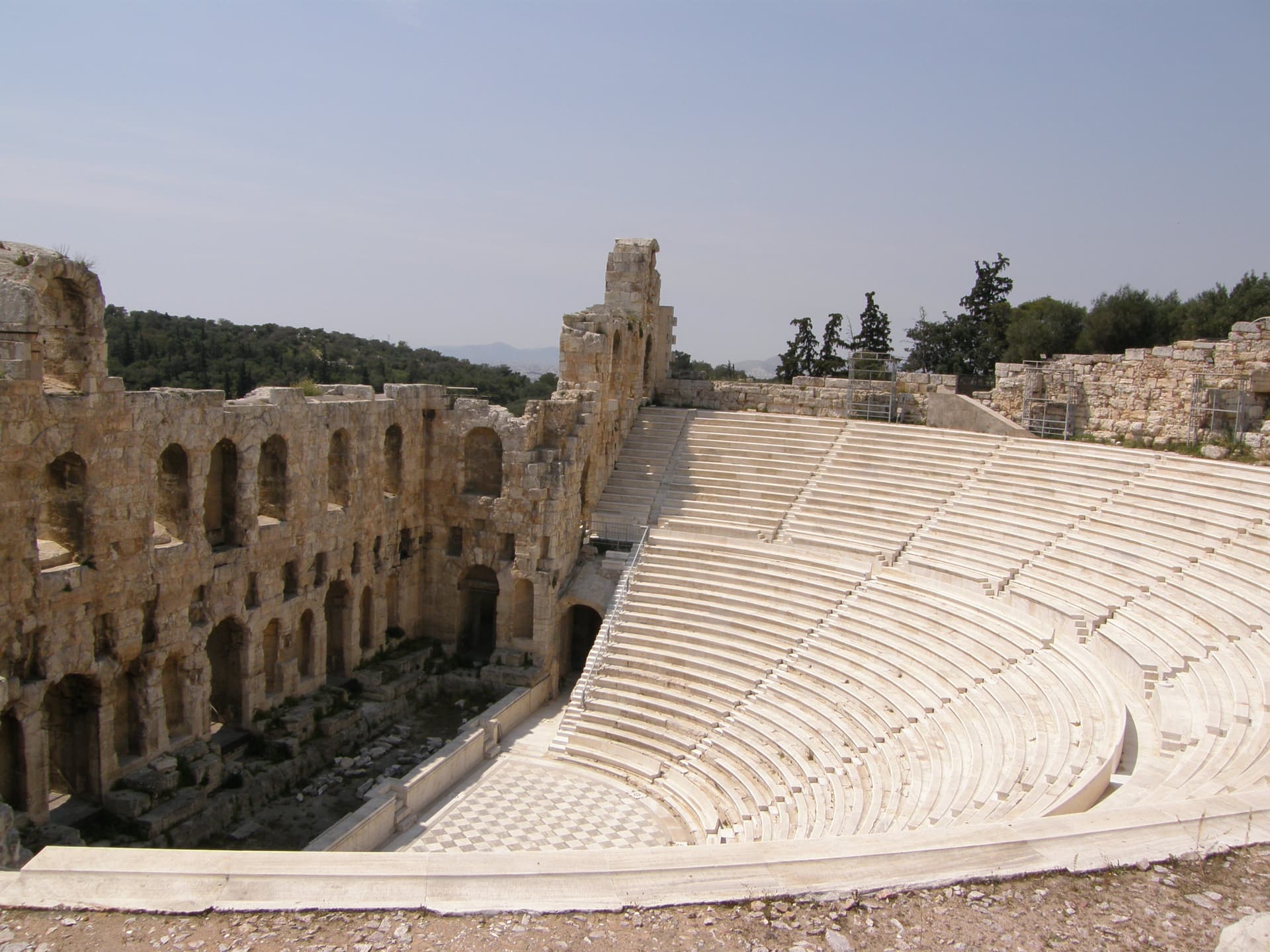
Visitors often confuse the Theater of Dionysus with the Odeion of Herodes Atticus (pictured here), especially when they enter the Acropolis archaeological park from the west. The Odeion was commissioned in the second century CE by Herodes Atticus, an Athenian citizen (as well as a Roman one) who was renowned for his wealth and who rose high in the Roman imperial hierarchy. Designed as a music or recital hall and built on the west end of the Acropolis' southern slope, it was, fundamentally, a much different structure than the Theater—most notably because it originally had a roof, while the Theater was open to the air.
The seating area and the orchestra of the Odeion have both been reconstructed to house modern performances. The structure consequently looks a great deal flashier than the Theater of Dionysus. These days, the facility is used frequently as a concert venue during the annual Athens-Epidaurus Festival.
The Theater of Epidaurus
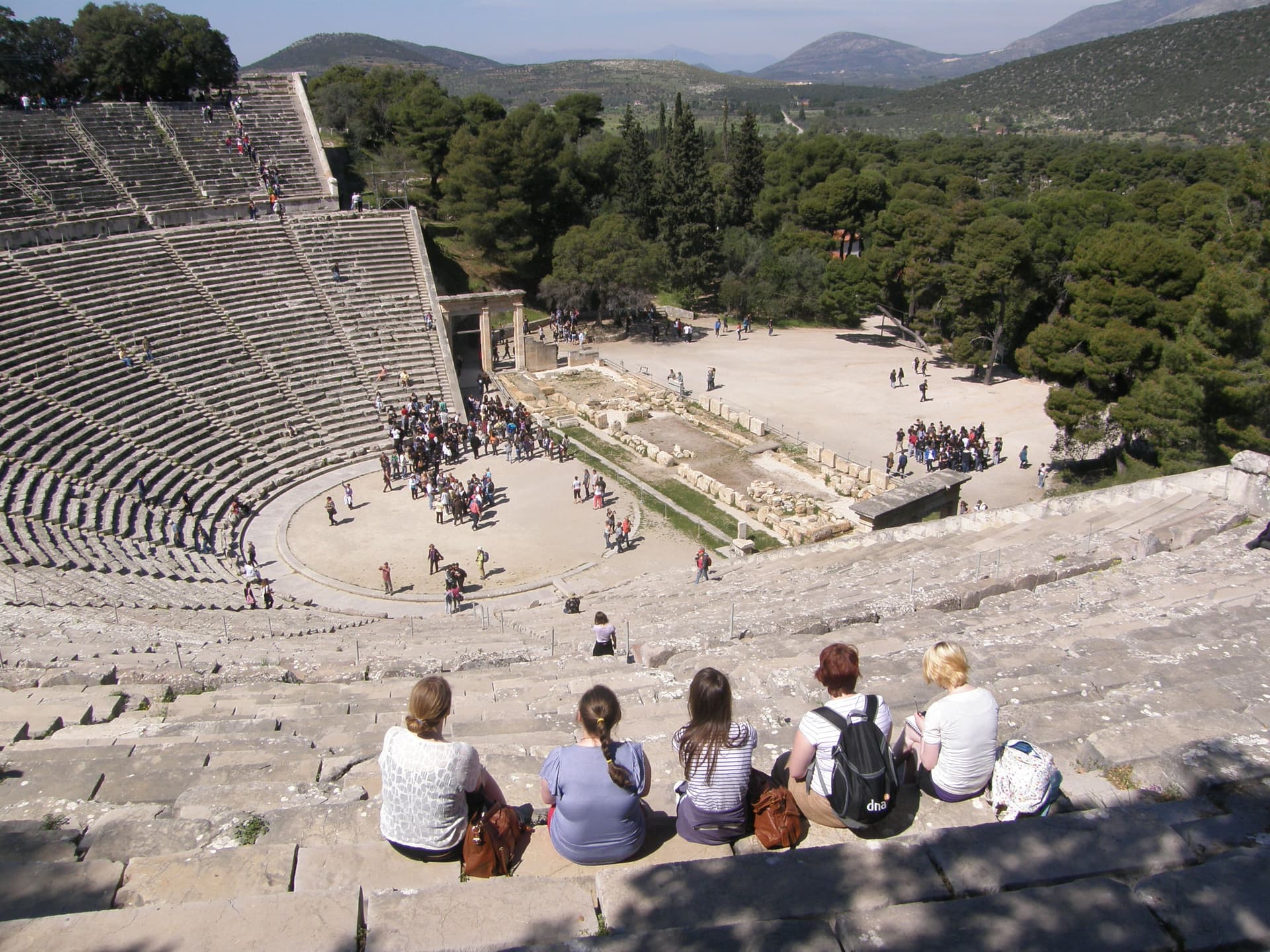
We'll end with a photo of a close cousin of the Theater of Dionysus: the famous theater at Epidaurus, which is in the northern Peloponnese (across the Saronic gulf from Athens). Nestled on a hillside in a sanctuary dedicated to the healing god, Asklepios, the theater hosted performances in that god's honor during his festival, which drew visitors from all over the Ancient Greek world. Like the Odeion in Athens, the Theater of Epidaurus is now a venue for the annual Athens-Epidaurus festival. It hosts works by modern playwrights as well as revivals of ancient drama.
Built in the fourth century BCE (like the original stone Theater of Dionysus at Athens), the Theater of Epidaurus is a marvel of late-classical Greek engineering. At the bottom of the spectacularly well-preserved and acoustically live seating area is a circular orchestra, from which actors can project even low voices. To the right of the orchestra are the remains of a stone skēnē, of the Hellenistic or Roman period (which featured a narrow stage or proskēnē), and one of the two paradoi (side entrances) can be seen between the skēnē and the edge of the seating area.
The Theater at Epidaurus is evidence that drama, though born at Athens in a very specific context (the worship of Dionysus), quickly exploded in popularity, and found new homes across the ancient Mediterranean.
(Cross-posted to Balloon Juice as part of the On the Road series)