In Part Two of a two-part series on the Athens Marathon, Emily and Cam talk about what it’s like to participate in the Athens Marathon today. They discuss the first marathon race at the 1896 Olympic Games in Athens; the development of the marathon as a marquee sporting event; and the route of the contemporary Athens marathon.
Links:
Visit our homepage to subscribe and to find us on social media:
----------
00:12 - Introduction
01:04 - The First Modern Marathon
01:11 - The early Olympic movement: de Coubertin, Bréal, and the push for a long-distance race
03:52 - Picking a route: the major routes from Marathon to Athens, in the ancient world and now (with a digression on the Athenian army in 490 BC and the walk of NGL Hammond)
08:28 - The first marathon: the achievements of Spyridon Louis and Stamata Revithi
12:40 - Going the distance: 26 miles, 385 yards
13:07 - The impromptu conditions of early marathons
14:01 - Refinements at the 1906 intercalated games in Athens
14:49 - Setting the official distance at the 1921 IAAF Conference and the story of the 1908 London Olympics
17:34 - The “Authentic” Athens Marathon
17:45 - The history of the Athens Marathon from 1955 to the present
18:37 - Following in the footsteps of Pheidippes, or footsteps of Grigoris Lambrakis?
19:49 - The first 8km: the Marathon plain, the ancient Tomb of the Athenians, and the enthusiasm of the spectators
21:30 - The next 10km: the road to Rafina, the statue of the Runners, and the lost statue of Pheidippides
23:56 - From 18km to 31km: “The Hill”, and the barefoot runner Idomeneas Avromakis
26:27 - The final 10km: the Attic Basin, the statue of the Runner, and the finish in the Panathenaic Stadium of Herodes Atticus
32:22 - Final Thoughts
Hello. Welcome to Have Toga, Will Travel, a podcast exploring the Mediterranean world, ancient and modern, through the eyes of two former classics professors. I'm Emily.
Cam:I'm Cam.
Emily:And we're your hosts.
Cam:And we're back for a second episode. We survived the last one.
Emily:We did. Last time we talked about the legends surrounding the origins of the marathon and the historical context of the actual events of 490 and how maybe it's not so much Pheidippides, but the Athenian army whose path we're mimicking.
Cam:In this episode, we'll dig into this a little bit more. We'll talk about three things. First of all, the first modern marathon and its route. Second, the evolution of the marathon as a competitive and athletic event. And third and finally, the modern Athens marathon course and what it's like to participate in a marathon.
Emily:So when was the first marathon race as an athletic event? And the answer here is the 1896 Olympics, the first modern Olympic Games. Now, this is a really interesting period in the 19th century, where Olympism as a movement is happening. And in a lot of places in Europe, there's been sort of an obsession, fascination with the ancient Greek and Roman worlds. And several people have these ideas that they want to bring back the Olympics, both because of the athletic competition and seeing physical education as an important thing, and also wanting to emulate the Greeks. And so you get a few figures here. There's a man named William Penny Brooks in England. There's a Greek man, Evangelis or Evangelos Zappas in Greece, and then Pierre de Coubertin in France. Now, if you've heard of these men, you've probably heard of Pierre de Coubertin, because he is sort of the founder of the modern Olympics movement that we have inherited. Although it is worth mentioning the Greek man Zappas, because he actually does succeed in holding some games in Greece. His idea is to do them every four years. They don't quite happen on that schedule, but he does hold a few sets of games. They die out, but he does do something. But Pierre de Coubertin really gets the modern Olympic movement going, and they pick Athens as the site for the first modern Olympics in 1896. Now, when they're planning the schedule of events for the Olympics, they want to add in a long distance run. And this is another movement that's been happening in the 19th century, is this increasing interest in long distance running and hiking.
Cam:Right. Long distance running was not an event in the classical Greek Olympics.
Emily:No, it most definitely was not. The longest one was basically...
Cam:About 3,000 meters.
Emily:Yeah. So there is no ancient model that they can look back to for this very long distance race. And a man named Michel Bréal suggests a run from Marathon to Athens to recreate the run of Pheidippides. And part of what he's trying to do here, other than provide a long distance run, to provide a long distance run that draws from Greek history to boost enthusiasm among the people of the host country for hosting the games, right? We're going to take this thing from your history. It's going to be this big marquee event to get people on board. And so that's what the Olympic organizers decide to go with.
Cam:Now that left them with a question to answer. What would the route of that first race be. And here it's worth revisiting briefly the description of Attica that we provided in the last episode. If you remember, we described Attica as an upside down triangle. Marathon would be situated near the northeast corner, Athens itself near the northwest corner, and on the south tip you have Cape Sounion. Now, the fact of the matter is you can't run directly from Marathon to Athens because there's a spine of mountains that runs from north to south down the Attic Peninsula. There are two main mountains here. The one further north is Mount Penteli. The one to the south is Mount Ymittos. Anybody running from Marathon to Athens has to go either over, around, or through these mountains.
Emily:Through is not really an option right now.
Cam:Not really an option. Before paved roads, there were two main routes from Marathon to Athens. The first route, the Penteli route, began on the western edge of the Marathon plain near modern Vranas. It headed west around one of the north shoulders of Penteli before entering the Kifissos Valley and heading south down to Athens itself along that valley. This was the shorter of the two main routes. It was about 34 kilometers long, roughly 21 miles, but it was pretty steep. Its high point is at about 385 meters. That's 1,260 feet for those of you who prefer your measurements in Imperial. And for a walker or runner heading west from Marathon, that route is incredibly steep. Most of that elevation gain is made within less than two miles early in the route.
Emily:Now the other route, which we'll call the Pallini route, essentially follows the coast from Marathon south to modern day Rafina roughly, and then it cuts west. It crosses the mountains at the site of ancient Pallini, which is why we call it the Pallini route. And Pallini sat at a saddle between Mount Penteli and Mount Ymittos. And so you're crossing at a low point, relatively speaking, in the mountains. Now, this is a longer route than the Penteli route. It's about 25 miles, but it's nowhere near as steep as the other route. The high point here is roughly 245 meters or 800 feet.
Cam:It's not clear which route was followed by the Athenians in 490 BCE. It seems probable that they followed the Pallini route. That route was a more practicable for an army. And actually, we have a couple of historical examples of armies following that route. Just by way of example, if you remember our friend Hippias from the last episode, the strongman ruler whom Darius hoped to install in Athens, his father had done something similar way back in 546 BC, staging a march from Marathon to Athens. He took the Pallini route and in fact had to fight a battle against the rest of the Athenians at Pallini right in that saddle. Most people have argued that this is probably the route that the Athenians would have followed, but the other route has had its advocates. The most famous was a British scholar, NGL Hammond, who was a graduate student in Greece during the 1930s. Later, he'd go on to serve in the British Special Forces during World War II, but even in the 30s, he was a pretty active guy, and one day he decided to prove that the Penteli route was practical by walking out and back in the same day. He made it from Athens to Marathon in six hours, turned around, came back by the same route in seven hours. No big deal, I guess, for somebody who would end up in the British Special Forces. The organizers of the 1896 games ultimately opted for the Pallini route. It's not entirely clear why. The main reason may have simply been that that route had better developed roads, But the other consideration was probably that the distance was a more satisfying number. It was roughly 25 miles. That is 40 kilometers.
Emily:So whether you were imperial or metric in your measurements, you had a nice round number of 40 or 25. As opposed to the shorter route, which would have given you 34 kilometers and 21 miles. So the 40, 25 seemed like a more appealing number. At least that's what some people have speculated.
Cam:Right. Now let's talk a little bit about the craziness of that first marathon.
Emily:Yeah, the first marathon was unlike anything I think people had seen before. So one, right, there are no paved roads. Nobody has supported a race like this before. So there's no clue how to do it. And of course, you're dealing with an era where messages are coming in based on horseback or people in buggies. So most people don't know what's happening in the race unless you're actually there on the course watching it, right? And nobody can watch the whole thing. So there's 17 runners total. Most of them are Greek, but nobody actually expects a Greek to win. Now, imagine you're the people sitting at the finish line in a newly built stadium called the Panathenaic Stadium. And they're actually having the pole vaulting event while they're waiting for the marathon to finish because nobody knows how long this is going to take or when it's going to actually end. The King of Greece and the Crown Prince of Greece are there in the stands. And the updates that have come in have shared the current leader when the update was obtained, however long earlier that was. And it's been, you know, mostly Europeans in the lead. So I think it's been at this point over an hour since they've gotten any updates on the race and into the stadium runs Spyridon Louis, a Greek man, not a trained athlete. He delivered ice for a living and he is the first one to run into the stadium. And the king and the crown prince actually come down and run with him for the last lap. This was a huge moment for Greece and for Greeks in this revival of the Olympic Games, right? One of their people has won the premier event that's drawing on Greek history. And there's some funny stories about Spyridon Louis.
Cam:My favorite is the story about how he stopped at Pikermi, roughly a third of the way along the route, to put back a full glass of wine and ask for updates from the tavern keeper about the runners ahead of him.
Emily:Yeah. And then he's like, oh, no problem. I've got this in hand. And he did.
Cam:Now, to be fair, there's still plenty of places along the route where you can do exactly this if you feel you need something fortifying on your run.
Emily:Yes. We did not take advantage of that. And I actually want to take a moment here in terms of talking about the 1896 Olympics to actually mention the women who tried to participate in the race. So there are one or two women. It's unclear whether we have two stories about the same woman or stories about two different women. But there were two Greek women who tried to run in the marathon. One had run the distance and showed up at marathon the day before the race to say, I want to compete. I've done this. Let me in. And she was banned from the race because she was a woman. There was the other story is about a woman named Stamata Revithi. She'd been a long distance runner as a child. And someone had told her, you know how you can really get some money is if you run the marathon and win. So she's like, well, I used to like running. She tries to get in. They say no. So what she does is the day after the marathon, she goes to marathon. She has the mayor of the town sign an affidavit asserting when she starts running. She runs to Athens. She gets the mayor of Athens to attest to when she arrived. And she presented this as a petition to be given credit for doing the marathon. And she was denied because it wasn't sanctioned and she was a woman. And it will actually be 100 years until women are allowed to run the marathon at the Olympics. So it's not until the 1984 games in Los Angeles that women are allowed to compete in the marathon. But there were one, arguably two Greek women who did it at the first one and were denied. Anyway, but we should get back to the marathon as a developing form of competition.
Cam:Right. So let's talk about the distance of that first marathon. If you were paying attention, you probably heard the distance 25 miles, which if you know anything about the modern marathon today, you will know is not the distance that is run during a marathon competition. That distance is 26 miles, 385 yards. So the question is, how do we get from our first marathon to that particular distance? That's a bit of a complicated story, but the important thing that we need to say is that the early marathons in the first few years of the competition were pretty chaotic. They didn't have a lot of infrastructure. There was minimal support for runners. Courses were often poorly marked, and they were sometimes outright dangerous because there would often be traffic using the routes that runners were taking. At the same time, there was no standardized distance. These things only changed gradually as the marathon exploded in popularity as a marquee or competitive event at big athletic competitions, and the race evolved.
Emily:Yeah. I mean, the marathon became so popular that the year 1896 Olympics happen, marathons start happening all over the world as standalone events. So it really does explode quite quickly.
Cam:Including the Boston Marathon.
Emily:The Boston, New York, Paris. Yeah.
Cam:The 1906 Intercalary Games in Athens give a good example of the early evolution of the marathon. This was a race run during an off year for the Olympics at a moment when the Greek government and the young International Olympic Committee were arguing about where the Olympics should take place every four years. At those games, there was a real effort to produce some better support infrastructure in the form of, for instance, dedicated aid stations along the route and handlers who accompanied all of the runners. And the race was longer than it had been in 1896. The 1896 race was about 40 kilometers long. The 1906 race was 42 kilometers long. They added a little bit of distance, probably by looping around the tomb of the Athenians, which we'll come back to in a bit.
Emily:Yeah. We don't really know. And also, of course, there's not a good way of measuring these long distances at this point in time either, but that's the guess. Now, the distance of the marathon as we know it, isn't actually formalized until 1921. So prior to 1921, every marathon was a slightly different distance. 1921, there's an organization that has formed a few years earlier that was then called the International Amateur Athletic Federation, now known as World Athletics. And at their conference to plan the 1924 games in Paris, that is where they set the distance. Now, 26 miles, 385 yards, is a very odd distance to pick. Where they're taking this distance from is from the London Olympics in 1908. Now, why did the London Olympics such a weird route? Well, they didn't really. It wasn't supposed to be that length. The route was initially supposed to be 26 miles. The plan was they were going to start at Windsor Castle. They were going to run to the stadium. They were going to do a lap in the stadium to get to the Royal Box. And that's where the race would end, right in front of the Royal Box. However, shortly before the event, the Princess of Wales wants the start point to move further back so that it starts under the windows of the Royal Nursery, So the children who are in the nursery can look out and see all the hoopla around the start of the race, which the Princess of Wales was participating in. And so they move the start back, but they don't adjust the end point because you have to end in front of the royal box. So instead of 26 miles, we end up with a race that is 26 miles, 385 yards. Now, why does the 1921 conference pick this race? as the distance? We don't know. There's no records that survive. It's possible that it had something to do with the extensive publicity that surrounded the 1908 race. There was a whole drama at the end of that race. It's also possible that there was just a lot of British influence among the members of the committee who specifically set track and field events. We don't know. But nonetheless, that is the moment where the distance of the marathon is codified from there until eternity. So that's how we get to the distance of the marathon as we know it today. So let's turn back to the Athens marathon. Now, just because the Olympics aren't happening in Greece doesn't mean that people stop running that marathon as an event.
Cam:That's right. There have been regular organized marathon races along more or less the original Olympic course since about 1955. At first, that route was used as the route of the Greek National Championships. But from 1972 onward, it also hosted a number of different popular marathons for any crazy person who decided he wanted or she wanted to try that route.
Emily:People like us who are never going to win a marathon.
Cam:People like us will never win a marathon. The most recent iteration of the marathon began in 1983 when the organization of the race was taken up by the Hellenic Athletic Federation, known by its acronym SEGAS. They rebranded the race as the Authentic Marathon.
Emily:O Avthentikos Marathonios.
Cam:And it now serves both as the Greek National Championships and as a popular international marathon.
Emily:Now, this race is marketed pretty heavily as a recreation of Pheidippides' run, but the race itself is actually formally dedicated to a man named Grigoris Lambrakis. Now, most of you have probably not heard of Grigoris Lambrakis, unless you are Greek. And he was a politician. He was a left-wing politician at a time when most left-wing political parties in Greece had been banned after the Greek Civil War in the late 1940s. So he was a politician and he was a peace activist. And he was assassinated in 1963 in a politically motivated assassination. But about a month before he died, he rather famously led a one-man peace march from Marathon to Athens. Now, this was not supposed to be a one-man peace march, but the government basically said anyone who participates in this will be arrested. Now, Lambrakis, who was a member of parliament at the time, was immune from arrest as a member of parliament. And so he did the march by himself. And the race is formally dedicated to him for these actions.
Cam:So let's talk a little bit about what it's like to do the marathon today. The course has a number of well-defined sections. The first is about eight kilometers long, roughly five miles, and it's a nice gentle stroll across the marathon plain. Its highlight is a loop around the Tomb of the Athenians, which has been added to the original course to get the distance up from 40 kilometers to the 42.2 kilometers that now meets international standards. The Tomb of the Athenians is an earth mound that was raised over the cremated remains of the Athenians who died in the Battle of Marathon in 490 BCE. In antiquity, it was monumentalized, so it would have been topped by a number of stones recording the names of the 192 Athenians who are said to have died in the battle. Those unfortunately have long since been plundered, but what's left is a mound in what is now a nicely wooded park. And if you're lucky, you can get a glimpse of that mound as you do the loop around on the modern road.
Emily:Yeah, if you know to look for it, it's easy to see, but if you don't realize what you're running around, yeah, you might miss it.
Cam:The other interesting feature about this stretch of the race is that a lot of Greeks like to come out to watch right near the turnoff to the tomb itself. And when we went past, they were handing out olive branches to everybody who ran past.
Emily:So many olive branches. And like fresh from the tree, olive branches, like leaves and fruit on them. But yeah, so they had bags of olive branches they were passing out. And this is not official and organized. This is just people doing this.
Cam:Yeah, it was a nice touch. You know, the locals along the route get really, really excited about the race.
Emily:Yeah, no, they were incredible. No, I don't think anything could have prepared me for what that was like. So the next segment of the race, once you've come around there, about 10 kilometers or six miles, takes the runner south along the coast to the port of Rafina. And here you've got some gentle rise in the ground, nothing too bad. And you go through different local communities. And it's, it's actually really quite charming, because the locals are like sitting out having their Sunday coffee, hanging out at cafes, like cheering the runners on, you know, the aid stations have DJs going and it's just it's like a little party on a Sunday morning. It was a little chilly that morning, but locals were still out in their like puffy coats having their coffee, you know, cheering you on little kids, little kids are super excited about the race and they like want to run with you for a bit and high five you and like there's nothing cuter than a little kid in greek shouting "pame paidia" which is "let's go kids" in greek at you. It was, it was adorable. In between the communities you get these stretches where you have a really cool view of mount penteli on your right and on the other side the sea and you can see the island of Evia off the coast of Athens. And right towards the end of this stretch, right before you make the turn inland, there's a sculpture there. It's called the Runners, and it shows three runners in the Olympic medal colors. So there's gold, silver, and bronze. Now this is a relatively new statue. It was put up in 2017, and it actually replaces an older statue that had been there for a while that was called Nenikekamen, which was a depiction of Pheidippides. And if you look online, online will tell you that the statue is still there, and you'll find all sorts of pictures of it. It's not true, because this statue was stolen in the middle of the night in 2016, right off its plinth in the middle of the night. Nobody knows who took it, how they took it, where it went. It just disappeared.
Cam:This was a major project because the statue weighed at least 500 kilograms. So you need some serious equipment to take that off of its plinth. I'm sure that it ended up in some oligarch's garden somewhere.
Emily:Probably. Maybe one day we'll find this statue of Pheidippides. But as of now, it is missing.
Cam:Once you're past its replacement, the three runners, you enter the segment known affectionately, I guess, as "The Hill."
Emily:The hill, capital T, capital H.
Cam:This is a fairly long section which runs from the 18 kilometer mark to the 31 kilometer mark. And it's called the hill because this is where you make a lot of the elevation gain for which the Athens course is notorious. Over that 13 kilometer stretch, runners ascend from about 40 meters to 247 meters. That's a gain of just over 200 meters or almost 700 feet as you climb toward the saddle between Penteli and Ymittos. Now, a gain of 700 feet might not seem like a lot if you're a seasoned hiker, but when you're trying to make that kind of elevation gain while also trying to cover distance quickly, it's actually really, really fatiguing. And that hill is part of the reason why Athens is not a super popular international marathon. It tends to drag down average finishing times.
Emily:Yeah, I've seen people describe it as the hardest of the major marathons because of this elevation gain. And the hill is, it's tough at moments. I had some special moments on the last stretch of the hill because the steepest stretch is that last kilometer, like 30 to 31 kilometers there. I'm just glad no one had a recording device on me in that moment.
Cam:You may actually be on a recording device somewhere, because one of the cool things that happened as we approached the top of the hill is we encountered...
Emily:I really hope I'm not.
Cam:We encountered a 73-year-old contestant, a Cretan runner, Idomeneas Avramakis, who was then competing in his 18th marathon.
Emily:Yeah, we see him, and he is fully kitted out like an ancient hoplite. I mean, it's costume pieces. And he's got a plastic helmet, sword, plastic shield doing it.
Cam:And more importantly, he's running barefoot.
Emily:Barefoot. And later we found news articles about him talking about how he got into marathoning, why he does it. And I am now really excited that we actually got to see him on the route. Like that now feels like a really special moment.
Cam:Right. And clearly the locals all know him. He's a real fixture of the race.
Emily:Yeah. Barefoot. Oh, my God.
Cam:Barefoot.
Emily:The only other person we saw barefoot on the route was someone who clearly blistered so badly they couldn't keep wearing their shoes and were carrying their shoes.
Cam:There were a couple people like that.
Emily:This person never intended to do it with shoes on. Once you hit the top of the hill, then you've got the last 10 kilometers to the finish. You know, about six miles. And from here, it's literally all downhill.
Cam:It's a nice descent into what's usually called the Attic Basin with some pretty spectacular views of the far side of the mountains.
Emily:Yeah. And you're now in like the outskirts, the outer municipalities of greater Athens, things start to feel more like a city. And the scenery becomes increasingly urban, even as you're coming at the top of the hill, you have these sort of nice views of the attic basin. And gradually, you know, you make your way into Athens proper. There's a kind of cool moment a couple kilometers from the end. You go around this very large, monumental even statue that's made of sheets of glass that is informally called the Runner. It's actually called Xenos. And it used to stand in Omonoia Square, but it got moved to this location, which happened to put it on the marathon route. And it does look like a runner, even though that's not what it was initially meant to depict. Now for us, at this point, we'd been on the course for over seven hours. The route had been pretty dead the last little bit for us. Like most of the crowds had gone home. You know, we were some of the stragglers coming up at the end.
Cam:Nobody stays around to watch the slowpokes at the end of the marathon.
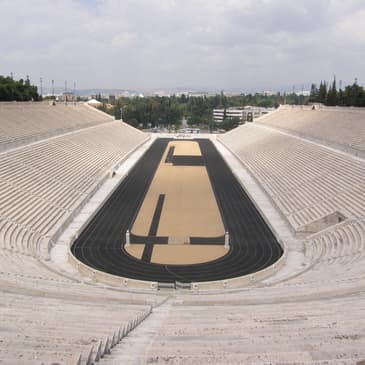
Emily:No, but what people did do was come out around that statue. There was still what to me felt like big crowds around the statue, cheering people on, encouraging you. And I was not having a great time at that point in the marathon. I was cold. I had IT band pain going on. We'd had to slow down a lot because I had not been able to keep up pace. So I was struggling. And to hit this point with this sort of beautiful statue and all of these people encouraging you really helped get me through it. And I actually started like tearing up with all of these people like telling me that I could do this when I was really struggling. And as after you pass that statue, you're, I mean, a part of Athens that we know fairly well. And then you have this really spectacular ending in the Panathenaic Stadium, more commonly known as Kalimarmaro. And this is an elongated horseshoe-shaped, all marble stadium that sits in a valley between two hills in the Pangrati neighborhood of Athens, which is one of the oldest neighborhoods in Athens. And it's a neighborhood that we tend to stay in when we go to Athens. So it's a bit like home. Now, this stadium is actually pretty cool, not just because it's entirely made of marble. The site it sits on has probably had a stadium going back to the mid-4th century BCE.
Cam:At least, yeah.
Emily:Now that stadium, the original stadium would have been mostly using the natural hillside, maybe wooden seating, nothing permanent. But in the second century CE, it gets monumentalized and turned into an all marble stadium by a man named Herodes Atticus, who was a wealthy Athenian citizen who rose very high up in the ranks of the Roman imperial administration, and he spends a lot of money beautifying his hometown of Athens. You know, he's the local boy who made it big and came back and poured tons of money into his city.
Cam:He's sort of like the Rockefeller of the day. Yeah.
Emily:The modern stadium is built on the foundations of Herodes Atticus's stadium, which had been excavated in the mid-19th century by Zappas for some of the games that he wanted to do. And he excavated, but he didn't really build much there. And so for the 1896 Olympics, they commission a rebuild of Herodes Atticus's stadium. And so this modern stadium sits on those foundations and purports to recreate Herodes Atticus's stadium. It's all marble. It maintains the same shape. And it can give you a very real, tangible sense of what a Greek stadium in the Roman era might have looked like in all its glory. And so you come down into the stadium, you walk in, you're there, you hit the finish line. It's really a lot to take in in that moment.
Cam:This is, of course, also the stadium where the very first marathon ended in 1896. So you literally recreate the final lap run by Spyridon Louis.
Emily:And the king and the prince with him. And actually every marathon that Athens has hosted in the modern era has ended at this stadium. And so you're really, there's a real sense of connecting through time and history with all of these other athletes who've come before you. And I want to give just a shout out to the guy who gave us our medals at the end of the race. And I was really done. And everyone who'd been there, like I said, they've been there for hours. We are the stragglers. And there was one young man who he was very focused on his job, giving out the medals. And he had such energy when everyone around him was fading. And he, he made the medal presentation feel special. And he was there for you and he was focused and that was just really um his him being present in the moment helped me be present in the moment when i was exhausted and really just wanted to sit down.
Cam:A lot of the volunteers were really really great.
Emily:Yeah.
Cam:All along the route.
Emily:Yeah.
Cam:So there you have it. We initially went into this race because we wanted to you know experience the route followed by the Athenians in 490. Maybe we did, maybe we didn't; as we've seen there's a little bit of dispute over the route that those Athenians followed. But at the very least, the modern course gives you a really up close and personal view of a route that's been used by thousands of years by people moving back and forth throughout Attica. And there's a lot to see along the way. So I really encourage you to run it if you get a chance.
Emily:Or walk it. Walking's okay too.
Cam:Or walk it, yes, as we did.
Emily:So we wanted to wrap up by sharing one last story about our experience and how we commemorated our walk. As we mentioned, the stadium sits between two hills. On the western hill, there is a small public park that you can go wandering around. And if you wander up to the top of the hill, you will find the remains of a temple there dedicated to the goddess Tyche, the goddess of fortune. That temple was built by Herodes Atticus when he was building the stadium.
Cam:It remains a very evocative place, even if there's not much left of the temple itself. Only a couple of blocks, but it gives you a fantastic view across the stadium, the IlisSos River Valley, and up the hill towards Likavitos.
Emily:So a couple days after the race, we climbed up this park to the remains of this temple, and we brought our olive branches with us. The olive branches that we'd been given at the very start of the race, that we had carried with us to the end of the race. And we took them up there, and we dedicated our olive branches there to the goddess as thanks for our success, as a tribute to the marathonomachoi, as a tribute to all of those other athletes who finished in that stadium from antiquity till today. And I have no doubt that many of those athletes in antiquity made that same journey up to that temple as either offerings of Thanksgiving or with prayers for help in a successful race. And we also dedicated those olive branches with a hope for peace and for brighter days ahead. And it was a really moving and emotional moment for the two of us to be up there on this hill looking out over this place in the city that we love after accomplishing something that neither one of us ever thought we would do and to really feel connection to the history and the place and the moment all in that one one gesture.
Cam:I have nothing to say.
Emily:One of us has the soul of a poet, and it's...
Cam
Not me?
Emily:Not Cam! So that's that's our story of the marathon. If you're interested we did do a little travel photo essay um for a a small blog; we'll put the link in the show notes for our two chapters in that if you're interested in some of the pictures and reading a bit more about what we did. Otherwise, that's all for today.
Cam:Right. Look forward in another couple of weeks when we're back with episode three. That episode will focus on "The Return," the 2024 movie directed by Uberto Pasolini, starring Ralph Fiennes and Juliette Binoche, based on Homer's Odyssey.
Emily:Yes. Very excited to talk about that movie. That's all for us today. I'm Emily.
Cam:I'm Cam.
Emily:And this has been Have Toga, Will Travel. You can subscribe to our show wherever you get your favorite podcasts and follow us at havetogawilltravel.com or on all the socials.
Cam:Thanks for listening, everybody.
Emily:Bye.