In this episode—the final episode in a three-part series on gladiators—Emily and Cam focus on Spartacus, the most famous gladiator of all. They first discuss the causes of Spartacus’ rebellion against the Romans, and then explore how Spartacus has been represented in modern literature and film.
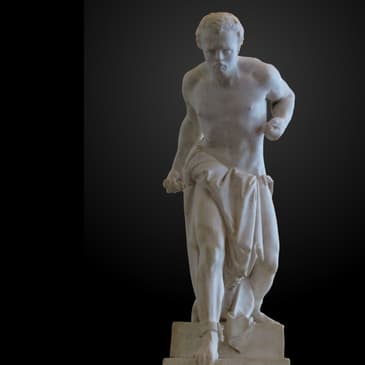
- Cover image: Vincenzo Vela, Spartacus (1848); photograph by Rama (Wikimedia commons)
Links:
- “I am Spartacus”: an iconic scene from Kirk Douglas’ 1960 film
- Pepsi’s “Spartacus” commercial
- “The Son of Spartacus”: an unofficial 1962 sequel to the Kirk Douglas movie, starring Steve Reeves
Visit our homepage to subscribe and to find us on social media:
If you liked this episode, buy us a coffee:
----------
00:10 - Introduction
01:11 - The sources: what can we know about Spartacus?
02:58 - Spartacus: a basic biography
- 03:05 - Spartacus' origin in Thrace, among the Maidi
- 03:16 - Spartacus' brief career as a Roman auxiliary and as a latro
- 03:49 - Spartacus enslaved and sold to the ludus of Lentulus Batiatus
- 04:44 - The gladiators escape from Batiatus’ ludus, seek refuge on Mount Vesuvius, and defeat several forces sent to suppress them
- 07:07 - As the rebellion gathers steam, Spartacus and his supporters drive north, and defeat three Roman armies along the way
- 10:04 - After Spartacus’ army turns south again, winning yet another major battle, the Romans entrust Crassus with the responsibility of ending the rebellion
- 11:49 - The Romans outmaneuver Spartacus and defeat the rebels
15:31 - Why did Spartacus and his supporters rebel?
- 15:51 - Enslaved people and small-scale resistance
- 17:28 - What made large-scale rebellions so difficult
- 18:40 - Poor living conditions as a motivation for rebellion: gladiators, enslaved herdsmen, enslaved agricultural workers
- 21:16 - Poor prospects for winning manumission as a further motivation for rebellion
- 23:03 - Many of the rebels had been enslaved only recently and longed to reclaim their freedom
24:52 - What were Spartacus and his supporters attempting to accomplish?
- 25:15 - To escape from Italy, or not? The sources and the problem of reconstructing Spartacus’ plans
- 27:01 - Modern approaches: (1) The sources had it right; (2) Spartacus had a larger agenda—whether to destroy the hegemony of Rome in Italy, or to end slavery
- 28:15 - A critique of these approaches, and an alternative: staying together was the best guarantee of freedom
31:16 - The ongoing resonance of Spartacus in modern literature, film, and television
- 32:29 - The discovery of Spartacus by French and Italian thinkers in the 18th and 19th centuries
- 33:35 - The Marxist and communist take on Spartacus
- 35:40 - 20th century novels: Koestler’s “The Gladiators” and Fast’s “Spartacus”
- 38:20 - Spartacus goes to Hollywood: Kirk Douglas’ 1960 film and Spartacus as social revolutionary
- 49:08 - A Spartacus for the 20th century: Andy Whitfield as Spartacus
51:05 - Wrap-up
Hello. Welcome to Have Toga, Will Travel, a podcast exploring the Mediterranean world, ancient and modern, through the eyes of two former classics professors. I'm Emily.
Cam:I'm Cam.
Emily:And we're your hosts. Now, in the last couple of episodes, we have looked at gladiators and their world. And today we're going to turn to arguably the most famous gladiator and one who fought back against the system, Spartacus. Now I have to say, I am a little excited about this episode. Dare I say, I tingle.
Cam:That's a deep cut that nobody is going to appreciate.
Emily:That joke is for certain particular people and they know who they are when they hear it. Anyhow, so today what we're going to talk about is what we know about Spartacus, who he was, what he did, and also why he continues to fascinate people in the modern era. The first question we have to contend with is who was Spartacus and what do we really know about him?
Cam:Yeah, and the answer, unfortunately, is that we know far less than most people probably think. The problem we face is that the sources for Spartacus are really not great. The two most detailed sources, those of Plutarch and Appian, are both pretty late. Plutarch was writing in the late 1st century CE, early 2nd century AD, and Appian was writing about a generation later. Now, part of the problem here is that they were both interested in Spartacus, not for Spartacus's own sake, but because Spartacus and his story intersected with other things they were interested in talking about. So Plutarch writes about Spartacus in his life of Crassus, who emerges as Spartacus's main antagonist late in Spartacus's revolt. Appian was writing a story essentially about the collapse of the Roman Republic in the first century BC, and touched on Spartacus only as a symptom of much larger political problems. And the same can be said for other minor sources that deal with Spartacus in passing, all of which also are pretty late. Now, these sources all do go back to an earlier author, a guy named Sallust, who was writing about a generation after Spartacus's lifetime in the late 40s or early 30s BCE. Like Appian, he was interested mostly in larger political problems in the late Republic and touched on Spartacus for that reason. That said, his account seems to have been pretty extensive and pretty detailed. And it would be great if we still had it, but we don't.
Emily:Common problem.
Cam:Common problem. It's survived only in fragments. So we have little bits and pieces, enough to sort of get a feel for what it probably felt like, but the detail is just not there.
Emily:So based on these sources that we have, we can say a little bit about Spartacus himself. It seems that he was a Thracian, so from Thrace in the Balkans. It's possible that he was from a people known as the Maidi. Appian tells us that he was an auxiliary in the Roman military, which means that he fought with units that were drawn from Rome's allies, but not part of the Roman army proper. One of our other fragmentary sources, who's late, a writer named Florus, calls Spartacus a latro, which in Latin can mean either bandit, which is the traditional meaning of the word, or it can be used of someone who rejects Roman authority. So some sort of equivalent to like rebel or insurgent or something like that. Now, it seems that at some point, whatever Spartacus's background was, he is enslaved, he is brought to Rome, and he is sold to a gladiatorial school, a ludus. He may have been married. Plutarch tells us he had a Thracian wife who escaped with him. She may have been someone who was enslaved with him or someone he met in Rome. And those are the basic details of what we know about Spartacus as a person.
Cam:According to Plutarch, the gladiatorial school to which Spartacus was sold was a school owned by a guy named Lentulus Batiatus. He owned a gladiatorial school in Capua, a city in the Bay of Naples, about 15 miles north of Naples itself. We have almost no information at all about Spartacus' career as a gladiator or what his life in the Ludus was like. But what we do know is that he and about 70 other gladiators who were part of Batiatus' school broke out sometime in 73 BC. What we're told is that they broke into the kitchen, grabbed a bunch of knives and things like that, and used that to fight their way out of the gladiatorial school. Then, happily, they stumbled across a wagon load of real gladiatorial weapons on the road just outside of Capua and were able to arm themselves. They headed south to Mount Vesuvius, where they hoped to find refuge. About 20 miles away from Capua, they climbed up near the summit and were told that's when they sort of sat down to worry about the problem of organization. And they chose some leaders for themselves. Spartacus was one, and according to some of the other surviving sources, there were two others, Crixus and Oenomaeus, who were both from Gaul.
Emily:While they are camped out on Vesuvius, of course, this is not going unnoticed. So the Romans initially deploy a force from Capua, which is sort of a hastily assembled ad hoc force to deal with them. That force is pretty easily defeated by the gladiators. And then a man named Glaber, who was probably a praetor, one of the elected magistrates at Rome, who, among other powers, had the power to command an army, comes in with a force of about 3,000 men. So not a full Roman legion. And these were also probably freshly levied troops, so inexperienced. And the gladiators also managed to rout that force as well. So by late summer of 73, they are still on Vesuvius. They are raiding aggressively in Campania, the area around Naples, and into Lucania, which is an area south of Campania, for supplies and plunder. But also with each victory that they've had against these Roman forces, other enslaved peoples have now been leaving to join them, as well as some of the free rural poor. So their forces are starting to swell, which was probably not planned for. It's something that's just happening. And then finally, in autumn of 73, there's yet another major Roman force led by another praetor, in this case, Varinius, whom they also managed to defeat.
Cam:With the defeat of Varinius, Spartacus' rebellion really started to snowball. By the late autumn of 73, or the early winter of 72 BCE, he and his forces moved south into Lucania. That's the instep of southern Italy. There, they raided the countryside for provisions, but they also probably captured several towns, including the cities of Thurii and Metapontum. These were old Greek cities that had been colonized by the Romans in the 2nd century BCE. There, Spartacus and the rebels spent the winter recruiting more and more fugitives, enslaved people who sort of flocked to join their cause, and apparently devoted some time to training and to figuring out how they might react to more Roman armies, which at that point they were certain would come.
Emily:And that's what happens. So at this point, the Romans have figured out that they actually have to take this rebellion seriously or more seriously than they had. And so at the start of 72, we have two new consuls who were elected, who are the top of the Roman political structure at this point in time, Lentulus and Gellius. And they are sent against the rebels with a consular army each. So consular army would be two legions, and that's between 8,000 and 10,000 soldiers. At this point, Spartacus and the rebel forces are moving north. They've divided into two columns, one commanded by Spartacus and one commanded by Crixus. Some historians think that this reflects some sort of division, infighting amongst the rebels, but there is a more practical explanation, which is that when you've got that many people, dividing up your forces makes it easier to feed them because they're relying primarily on foraging. And so if you can cover more ground, you have more ability to forage and it's easier to feed your people. Because at this point, the army could be as large as 40,000 or 50,000 people. There's been an incredible growth. And there then, of course, also have been non-combatants, people's spouses, families, etc., that are also joining along. Now, as they march north, they are confronted by these consular armies. Crixus's column is mostly destroyed in this fight. However, Spartacus manages to defeat both consuls' armies and continue to push north.
Cam:At that point, he ran into another major army, this one commanded by the Roman governor of Cisalpine Gaul (basically northern Italy). That governor, a guy named Cassius Longinus, was the father of the more famous Cassius, who later becomes one of the assassins of Caesar. He commanded probably two more legions, and he met Spartacus near Mutina, modern Modena, in the Po Valley. Once again, Spartacus and his supporters were victorious.
Emily:Now, after this, things take a weird turn in that instead of continuing north, Spartacus and his army reverse course, and they start heading south again. We don't know why. Possibly they were thinking they might attack Rome. But what does happen is that they run into the consular armies again, and he again defeats them. And after that victory, they continue on further south back into Lucania, which is where we find them again in the summer of 72.
Cam:Now, at this point, the Romans are getting a little bit frustrated, obviously, and concerned since Spartacus has defeated Roman armies in at least four battles in a row, if we don't count the smaller Praetorian forces that he defeated in 73. They decided to tackle the problem by creating a special command for Crassus, an important political and military figure of the first century BCE. Crassus raised an additional six legions. That's a force of somewhere between 25,000 and 30,000 soldiers, and also took command of the four legions that had been commanded in the previous year by the consuls. That gave him what was for the time a pretty massive army, 10 legions, which could have been almost as many as 40,000 soldiers. So a force that was on numerical parity, probably with Spartacus's own forces. Not wanting to leave anything to chance, the Romans also sent orders to a couple of other generals who were fighting abroad at the time. Pompey the Great, who was fighting in Spain against a rebel Roman general named Sertorius, and Lucullus, who had been tackling Mithridates, the ruler of a kingdom in what is now Turkey. Both of these commanders were ordered to come back to Italy in order to provide further support.
Emily:So in 71, Crassus, with his new command, moves south. And his first move is to try to hem Spartacus in In Bruttium, which is the toe of the boot of Italy. And Spartacus actually attempts to get out of Italy. They attempt to go to Sicily with the help of Cilician pirates. But this fails. The pirates basically abandoned them. And so instead, Spartacus is like, gotta turn back around and manages to break through the fortifications that Crassus was putting up to try to pen them in. And Spartacus and his army drive back towards Lucania.
Cam:At this point, Spartacus's forces again split up a little bit. Bruttium and Lucania are both pretty rough parts of Italy, lots of hills, lots of valleys, things like this. It's tough to keep a large force supplied. So once again, we find Spartacus's forces moving in several columns. Crassus was quick to take advantage of this, and he was able to isolate and destroy a column commanded by a couple of Spartacus's allies. Spartacus, starting to feel the pressure a little bit, attempted to open negotiations with Crassus, but Crassus refused. So Spartacus drove east towards Brundisium on the heel of Italy, only to turn around when it became clear that the general Lucullus was on his way back to Italy and was at that moment landing at Brundisium itself. In a last gambit, Spartacus chose to confront the army of Crassus before Lucullus and Pompey's forces could reinforce him. And this led to a final battle, which probably took place in the spring of 71, roughly 20, 25 miles south of Salerno, a battle which finally the Romans managed to win.
Emily:It was a hard-fought battle, and it seems that Spartacus died in the fighting. We don't really know. His body was never identified in the aftermath. And so this definitely allows for some myth-making around the figure of Spartacus and how he might have met his end. Now, of course, lots of the rebel forces were killed in the battle. However, several thousand do manage to escape to the north where, they get cut off by Pompey, and several thousand are captured. And as the story goes, they are crucified along the Appian Way, which is the road from Rome to Capua. And the sources say that there were 6,000 people executed by crucifixion along the Appian way, which is pretty horrific. It was done to dissuade other people from rebelling. It was sending a very strong message. That was their goal. That said, there were actually other people who did manage to escape into the hills of Campania and Lucania and managed to survive there near Thurii, which is one of the cities they had captured, for over 10 years after the end of the revolt. And eventually, in about 60 BCE, Gaius Octavius, the father of Augustus, is going to defeat the remains of Spartacus' forces down there in Thurii.
Cam:Yeah, part of what made Lucania attractive to rebels is, of course, the fact that it's rugged and hilly and basically difficult to control. So it makes it perfect ground for bandits and rebels, latrones, as the Romans would call them. So that's basically an overview of Spartacus's career, if you will, as a rebel commander. That bare bones outline, though, does leave a couple of questions unanswered. And those are the questions we want to turn to next. And the first big question is, why did Spartacus and the other gladiators from Batiatus's school rebel in the first place? And why did that rebellion grow so large, given that this kind of large-scale violent rebellion was not all that common in the Roman world? The answer to that question is complicated. First, it's important to acknowledge that we need to be a little careful here with our terms. Specifically, what is resistance when we're thinking about the point of view of enslaved people? Large-scale violent resistance may have been rare, but no doubt small-scale resistance was a lot more common, and it could take a variety of different forms. In our last episode, we looked at a couple of tombstones set up by or for gladiators, and in particular we looked at the tombstone of Urbicus, set up by his wife, who acknowledges a whole bunch of family relationships. That sort of assertion of basic humanity was itself an act of resistance, since enslaved people had no formal claims to family, had no ability to have a family that had to be recognized by slaveholders. Enslaved people also resist in a variety of other ways, basically by engaging in small acts of sabotage— you know, ruining some of the crops, spitting in their master's food and so on, up to and including trying to run away.
Emily:Now, that said, escape was not as common, nor was violent resistance like what we see with Spartacus. And it is temptin to think that the better question is not why do people rebel, but why don't they rebel all the time? But there's a lot of hurdles and barriers to that. In the case of Spartacus' rebellion, it was only the third and the last major rebellion led by enslaved people in the Roman world. The earlier two had been in Sicily and were also not successful.
Cam:Right. And a valid question is, why do these large-scale rebellions happen so rarely? And ultimately, there are a couple of problems. One is that they're just really difficult to coordinate. Roman slaveholders, like slaveholders in other societies, were really good at creating rivalries and fissures between the enslaved people that they controlled. They set up a lot of power hierarchies, complicated systems of rewards and punishments, and so forth, all in an effort to prevent enslaved people from uniting in any way that could threaten their power. And in the Roman context, there were also a whole bunch of differences in culture and language between enslaved people that Roman slaveholders were only too eager to exploit. One of our sources from the period, a Roman author named Varro, specifically advised slaveholders to make sure that the enslaved people who worked their estates were recruited from all sorts of different ethnic groups, specifically so that they wouldn't feel inclined to band together. And of course, these large-scale acts of resistance are incredibly risky. It's sort of an all-or-nothing gambit. By rebelling, you are inviting reprisals, and if things don't go well for you, that's it.
Emily:So given the difficulty, how do we explain Spartacus's rebellion? Now, the first factor is the poor living conditions and treatment of gladiators. As we discussed a bit last time, life as a gladiator is particularly harsh. I mean, yes, they could be granted some privileges, but they constantly faced a risk of death, And they were vulnerable to punishment and humiliation as part of their training in a way that was unique for most people who were enslaved.
Cam:The same can be said for a couple of other groups of enslaved people who provided early support for Spartacus' revolt. So one of the things we're told in our sources is that as Spartacus and his friends from Batiatus' school were sheltering on the slopes of Mount Vesuvius, they were joined by a whole bunch of enslaved herdsmen who ran away from their slaveholders. Herdsmen in the ancient world, kind of an interesting case. These were enslaved people who had a lot of autonomy in the sense that they were spending weeks at a time up in the hills with flocks belonging to owners who were just sort of not really paying attention to what was going on. But it was a high-risk job since herdsmen had to constantly deal with bandits or with herdsmen of other slaveholders who would try to raid the flocks. They also had to deal with animals, wolves and things like this, trying to prey on the sheep. And they had to endure some pretty tough living conditions. They had to sort of fend for themselves for the most part, and it was really probably not a good life.
Emily:And then the other category of people who lend their support to the rebellion early are enslaved workers on these large agricultural estates that were growing in Campania and southern Italy at the time. So these large estates were called Lati fundia in Latin, and they were significantly larger than your typical farm, if you will. And they were typically run by absentee landlords. So there was a real disconnect between the estate and the owner. And the conditions on these latifundia were pretty dire, even relative to other agricultural situations. There's very poor living standards. And again, a lot of strict discipline and punishment to keep people in line, partly because of their size and distance from the owner of the property. And so these are the three main categories of people we see showing up in Spartacus as first as early on. And they all really do have stronger reason to rebel than others might.
Cam:Especially since enslaved people in all three of these groups probably enjoyed much worse chances of ever regaining their freedom than other kinds of enslaved people in the Roman world. Roman society was interesting because slaveholders at Rome had a lot of leeway to set their slaves free by manumitting them. A lot of Roman slaveholders used the prospect of manumission to really incentivize behaviors that they wanted from the enslaved people under their control. They could do this in a couple of different ways. On a very basic level, they could say, hey, you know, if you do a good job for me over the next 10 years, then maybe I'll set you free at some point. Or in some cases, they would permit enslaved people in their power to accumulate a little money on their own, from side hustles, from tips, from things like this, and eventually to use that money to barter for their freedom.
Emily:But this option was more available to some enslaved people than to others. Generally speaking, those who were performing highly skilled labor or work that was difficult for slaveholders to supervise closely were more likely to be offered manumission or be bribed with manumission than others. And in particular, herdsmen and agricultural workers had really poor prospects of being offered manumission. Now, in theory, gladiators had a better prospect of manumission than herders and agricultural workers would have. But as we talked about last week, their odds of long-term survival to make it to that moment of manumission were not so good.
Cam:Then a third and really important reason why Spartacus's rebellion broke out when it did is because the early first century BCE was still a period of intense Roman warfare and imperial conquest abroad. And that warfare produced a lot of people who were captured in war and sold into slavery, people who until recently had been free.
Emily:And this will contrast with later periods of Roman history when an increasingly large percentage of people who are enslaved were born into that condition rather than having been born and lived a life as a free person and then being enslaved.
Cam:Right. So what you end up with is a situation in which there are plenty of people new to enslavement, forced to do some pretty unpleasant work, resentful of the fact that they'd recently lost their freedom, and really driven to regain it. This is probably true in particular among gladiators, many of whom were men of fighting age captured in battle. And we know just because of what we're told in our sources that Spartacus's core group of gladiators who broke out from Batiatus's school were primarily Thracians, Gauls, and Germans, all of whom had probably been captured relatively recently and sold into slavery as gladiators. So you end up with a pretty potent mix of factors here that made a wide range of enslaved people more likely to revolt at this particular moment in time and in this particular context than in, say, later periods of Roman history. And more importantly, once something like this ignites, it can snowball really quickly, as both Spartacus's own rebellion shows and as a couple of earlier outbreaks of slave rebellion on Sicily demonstrated pretty clearly.
Emily:And this leads us to the other big question. What was Spartacus trying to do? Now, of course, the really obvious answer is not to be enslaved anymore. And that's a perfectly valid answer. But it raises the question of, you know, did he have a larger agenda? And maybe, maybe not. We really don't know. Our ancient sources, that is Plutarch and Appian, say that Spartacus' initial plan after defeating Varinius was to drive north to the Alps and get out of Italy. But for some reason, that plan changes after Spartacus defeats Cassius at Mutina.
Cam:Yeah, according to Plutarch, the problem was dissension within the ranks of the rebels. Spartacus wanted to break out of Italy altogether, but most of the other members of his rebel army, according to Plutarch, wanted to pillage Italy instead. And so the army turned south. Appian adds the detail that they had decided to march against Rome itself, but abandoned that plan when they failed to form alliances with cities in Italy that could provide support. All of these arguments probably come ultimately from Sallust, who seems to have been the primary source relied on by both Plutarch and Appian.
Emily:And of course, this raises the question, did Sallust have good information about the motivations of Spartacus? And the answer is, probably not. Or, it seems unlikely. Now, part of this is that anyone who had insider knowledge of what Spartacus and the other commanders in his army were thinking all ended up dead. So Sallust could have easily talked to Roman veterans of these fights, but talking to people on the other side was not happening. So it's probable that what Sallust is doing is drawing inferences from the movements of the rebel armies about what their motivations might have been. So no, he probably doesn't have good information about what they're doing and is trying to do what everyone else is doing, looking at their movements and making a best guess as to what he thinks might be going on.
Cam:Yeah, and that's exactly how modern historians have tried to attack this problem. Basically, by trying to infer motivation from what it was that we can see Spartacus doing. As a result, modern historians tend to split into at least two different groups. First, there are those who essentially agree with the ancient sources. Spartacus wanted to break out of Italy, but was thwarted by other members of the rebel force who had different goals, different aims. On the other hand, there are those who see the odd movements of the army— the march north to Mutina, about 400 miles, the reversal and the march back to the south, another 400 miles— as evidence that Spartacus must have been leading an army that had larger ambitions, some kind of plan. What that plan is, is a matter of dispute among the historians who adopt this line. There are those that think basically you had a bunch of people who were carrying out their grievances against Rome and attempting to destroy the hegemony of Rome in Italy. And then from time to time, you run into people who argue that Spartacus and his supporters were actually trying to eradicate slavery in Roman Italy altogether, that they dreamed of a society without slaves.
Emily:Now, there is no affirmative evidence for either of these positions in the ancient sources. And, you know, as I mentioned, this is really a product of trying to understand the rather unusual movements of Spartacus's army. But part of the reason that we get some of these arguments is that Spartacus doesn't seem to behave like leaders of the other slave rebellions in Sicily. And in particular, he doesn't adopt this model of Hellenistic kingship that the leaders of those other rebellions do once they are in control of their forces. And so this leads to this idea that maybe Spartacus and his people had a more egalitarian outlook on the world and a more egalitarian approach. And this is what leads to or contributes to the belief that maybe they were looking to eradicate slavery. But we don't have any concrete evidence for that other than this basically argument from absence of these other kinds of behaviors.
Cam:Yeah, it seems a real stretch to argue that eliminating slavery was the goal. Even if we accept the argument that Spartacus was more egalitarian in his approach to leadership than other leaders of rebellions in Sicily had been, that doesn't mean that that egalitarianism extended to eliminating slavery. There are plenty of ancient cultures, Greek and Roman, where you had a fundamental idea of citizen egalitarianism existing perfectly happy alongside enslavement. So it's kind of a weak argument. The view that they were attempting to destroy the hegemony of Rome is maybe a little bit more plausible, since all of these people would have been people with grudges against the Roman state for various reasons. But also because, you know, on a certain level, I'm sure many of them realized that they couldn't go home. A lot of them probably didn't have homes to return to. A lot of them had basically ended up, I'm sure, in slavery, simply because they were on the losing side of local struggles among powerful people, some of whom sided with Romans, some of whom didn't. So simply returning home for many probably didn't seem as a viable solution.
Emily:Now that said, there's another possible explanation, although we can't know for sure in the end. But another possibility is that they realize that their best hope for preserving freedom basically rested in staying together.
Cam:Yeah, and they could do that in one of at least two ways. One, they could go the route of the rebels in Sicily in the previous century, who tended to retreat to, you know, mountainous places in the center of the island and set up fortified positions where they hoped to continue resisting reprisals by the Romans. The other option is basically to be, you know, an army constantly on the move, much in the spirit of Hannibal in the late third century BCE, who basically spent 15 years roaming around in southern Italy, daring the Romans to try to fight him and to confine him.
Emily:So given how little we really know about Spartacus and what motivated him, it does raise this question of why and how does Spartacus gain resonance in the modern era?
Cam:Why is he the most famous gladiator from antiquity?
Emily:Why is he the most famous gladiator? Why is he the most famous leader of a rebellion against Rome? I mean, lots of people rebelled against Rome. Why is Spartacus the one who carries the resonance?
Cam:Boudicca might have words to say about that.
Emily:Okay, no. Yeah Boudicca is pretty cool too. Okay, one of the most famous. How about that? Now, one is because we have so few concrete answers about Spartacus and so little information about him and what his goals were, this allows people to project all sorts of views onto him and to adopt him as a malleable symbol. And in the end, you know, Spartacus stands as a figure who was oppressed and is defying the system that oppresses him, without seemingly to implement the same oppressive system himself. And so he becomes a really easy figure to latch onto and to project onto.
Cam:And that's a trend that we see starting from the 18th century, when French thinkers in the decades before the French Revolution really seized on Spartacus as an example of somebody who championed individual freedom. A perspective on Spartacus that led directly to his adoption by Toussaint Louverture, the leader of the Haitian Revolution, who would go on to identify himself as a black Spartacus.
Emily:Additionally, in Italy in the 19th century, during what's called the Italian Risorgimento, leaders of this movement, which is a political and social movement that basically leads to the unification of Italy. At the time, Italy was fragmented. It had been parts of various outside imperial structures. And there's this movement to (A), be independent and (B) , to organize Italy into a single state. And they also adopt Spartacus as a sort of model of national liberation. And in particular, Garibaldi sees Spartacus as a model here. And then the big one.
Cam:Yeah, it's really in the work of the 19th and 20th century socialists and communists that Spartacus becomes, I guess, an icon, if you will. We have a funny story about Marx himself. Apparently, at one point—I think it was his birthday—his daughter asked, you know, "who is your hero?" And Marx's answer was, "I have two heroes. One is Kepler, the astronomer, and the other is Spartacus." And he went on to elaborate about Spartacus both then and in his later writings. And it's pretty clear that he saw Spartacus as really the archetypical representative of the struggle between the proletariat and everybody else.
Emily:Now, this adoption of Spartacus as a symbol, as an icon by communists in particular, becomes the real sort of touchstone for this figure as we get into the 20th century. So in Germany in the 1910s, the forerunner of the Communist Party of Germany was actually called the Spartacus League. And in the aftermath of World War I, where the German Empire has collapsed and there is this sort of struggle to establish a new government, there's basically a conflict between a party espousing social democracy and a party espousing what they call a council republic, similar to what the Bolsheviks had done in Russia. And there's a uprising of the more left-wing side of that debate, the council republic side, who are attempting to overthrow the provisional government, basically. And this is referred to as the "Spartacist Uprising." This is very short-lived because there's actually not a lot of support among the populace for military action. Despite whatever support they may have offered to things like strikes, labor strikes, people really weren't interested in pushing that further. And so with all of these uses of Spartacus in France and Italy, in Europe in general, with the communist movement, Spartacus really does get attached to what we might call left-wing political causes.
Cam:Yeah, and that becomes a through line in the way that popular media explores Spartacus in the middle of the 20th century. So one example is the book "The Gladiators" by a German author, Arthur Koestler. We have not read this. No, we have not read this. Nor really has anybody else probably in the English-speaking world. It is not well known in the English-speaking world. A major plot point of the novel turns on Spartacus's attempt to forcefully create a society in which everybody is equal, while taking the title of Imperator for himself— a title which really emphasized the military authority of Roman generals. Now, Koestler himself had been a member of the German Communist Party, and a lot of critics argue that this novel is basically an expression of his own disillusionment.
Emily:Yeah, I mean, Koestler is looking to what happens in Russia and in the Soviet Union, and is really exploring whether this kind of revolution can even be successful and the compromises that you have to make. And do you end up just replicating the oppressive systems in a different way when you do this sort of thing? So he's, while sympathetic, has become incredibly disillusioned.
Cam:Better known is Howard Fast's 1951 novel Spartacus, which among other things inspired the Kirk Douglas movie, which we'll come back to in a few minutes.
Emily:Now, Howard Fast had worked with the Communist Party in the US, and he's actually imprisoned during McCarthyism for not naming names. And his Spartacus novel is really written as a reaction and a reflection on this imprisonment. Now, nobody wanted to publish this. He actually had to self-publish the book. And in contrast with Koestler, you know, we don't see the disillusionment in the Fast novel. He really does dig into this idea that Spartacus was creating this new egalitarian society. And this is something that Fast said about his work. Here's a quote. "A time would come when Rome would be torn down, not by the slaves alone, but by the slaves and serfs and peasants and by free barbarians who joined with them. And so long as men labored and other men took and used the fruit of those who labored, the name of Spartacus would be remembered, whispered sometimes, and shouted loud and clear at other times."
Cam:It's almost like the ghost of Marx was whispering in his ear right at that particular moment.
Emily:Yeah, yeah. So a much more idealized view of Spartacus than the Koestler novel.
Cam:But that does feed right into the Kirk Douglas movie in the sense that Kirk Douglas's Spartacus too is a Spartacus who is fundamentally a revolutionary at heart.
Emily:Which, of course, isn't that surprising because, of course, the Douglas film is an adaptation of Fast's novel. And Fast himself was supposed to write the screenplay, well, until he couldn't do it. And this actually leads to a kind of interesting thing about the movie, which is that Kirk Douglas brings in Dalton Trumbo to write the screenplay when Fast isn't up for it. And Dalton Trumbo had been blacklisted during McCarthyism. And putting him on this movie and giving him credit is part of what helped break the Hollywood blacklist.
Cam:Now, the movie does make some choices that differ from Howard Fast's original novel. And one thing it does is dial down the class conflict element a little bit. Doesn't eliminate it entirely, of course, but it puts a lot more emphasis on the general danger of autocracy than I think the novel does, primarily by depicting Crassus at somebody who is aiming to become the sole ruler of Rome and going about it in a fairly ruthless and violent way.
Emily:Yeah. And there's an ideological component in the movie to that of this, like the idea of Rome and this must be protected at the expense of human beings.
Cam:Yeah. Which gets expressed not just by Crassus, but also pretty strongly by the Caesar character.
Emily:Yeah.
Cam:Who is actually an addition to the film. Caesar doesn't really show up in the novel.
Emily:Yeah. And then on the other hand, you have the Gracchus character who in the film is, while an aristocrat, is still not so ideologically minded that he isn't practical or isn't able to respond to humanity in a way that the Crassus and Caesar characters are so driven by the ideology that they can't or won't or don't.
Cam:Right. And he ultimately decides to resist that drive to autocracy, which is not quite the way that that character plays out in the novel itself.
Emily:Although I do have a soft spot for the Gracchus character. He is, I mean, he's a very just delightfully played character in the film. I mean, he's just a much more likable character than Crassus or Caesar characters are.
Cam:Well, Crassus for sure, yes.
Emily:Yeah.
Cam:He's more likable than Caesar too, by a long way.
Emily:Yeah.
Cam:Anyway, in spite of this emphasis on autocracy, the movie ensures that Spartacus himself really does sort of remain a representative of the common man. So it approaches the class element that you find in the novel that way a little bit. So, you know, as one example, in both the novel and in the movie, Spartacus is depicted as somebody who was born into slavery.
Emily:Which is not what we think was actually true in history.
Cam:Right. We actually think that Spartacus probably came from, you know, what would have been a relatively high status background in Thrace.
Emily:Yeah.
Cam:But in the movie, he's the grandson of a slave, actually, born into servitude. And that gives him undeniable credibility, I guess, as a representative of the common people.
Emily:Yeah.
Cam:He also dreams, of course, of a society in which there is no slavery. And that's a theme that draws directly on Howard Fast's novel and an idea which has, I think, you know, just sort of affected a lot of the way in which people see Spartacus today.
Emily:Yeah. Yeah. It's encapsulated in the scene with the representative of the Cilician Pirates who shows up and they immediately free his litter bearers and are like, "There's no slaves here. You know, no one is enslaved. And so if you bring people into our camp, our world, they are freed by default." And the Cilician pirate is a little taken aback at that.
Cam:Just a little bit, yes. And there are other ways this theme gets played out in the film. You know, there are a bunch of scenes in which you see the rebel army functioning as a community.
Emily:Yeah, because it's not just fighters. There's young people, there's old people, you know, there's women who are doing the daily labor of feeding and clothing this many people and there are small children and like everyone's sort of contributing what they can.
Cam:Yeah, so it really sort of leans into the idea that these people are working together for the common good, essentially.
Emily:Yeah.
Cam:And, you know, the movie hints a couple of times that this is a movement with much broader appeal. So there is one scene where the army marches through town in Italy and the local population comes out and cheers for them. And that's, you know, that's a detail that might be questionable from a historical standpoint, since, you know, the army of Spartacus in real life was probably doing what armies often do, which is living off the land by looting and pillaging as they moved across southern and central Italy.
Emily:Yeah. But yeah, there's a real, what I've seen called a focus on the like nobility of the common man, nobility of the everyday person. And of course, we can't not mention in this context, the most famous scene from the movie, the "I Am Spartacus" scene, which is an invention of the movie. It's not in the book. It's definitely not in the historical record. So if you haven't seen the movie, spoiler alert, after the battle, all of the people who've been captured are being sort of held captive and Crassus wants to know who Spartacus is. Nobody has found his body, right, which is accurate to the historical record (his body was never identified). But Spartacus in this case has survived and he's one of the captives and Crassus basically says, if someone here will identify Spartacus, then I'll let everyone go basically. And I'll just kill Spartacus. So Spartacus stands up to admit who he is to save everyone else. And of course, next thing you know, people start jumping up before he can say anything to claim that "I am Spartacus. No, I am Spartacus. No, I am Spartacus." And you end up with the whole mass of people all claiming to be Spartacus, and so everyone dies.
Cam:In a pretty gruesome way.
Emily:In a pretty gruesome way. They're all crucified.
Cam:Crucified along the Appian way, yes.
Emily:Which, again, crucifying the rebels is what happened in antiquity. But this really speaks to, you know, the power of Spartacus. Well, the power of Spartacus and his vision to motivate people and to give people something to give their lives for. So yes, they're dying for Spartacus, but they're not actually dying for Spartacus. They're dying for this vision. And it's partly about, in the moment, them all doing this together, right? That there's this commitment to one another that Crassus can't understand in the scene. Like, you see him just, like, be perplexed at what he's just witnessed. And of course, the first person to jump up in this case is Tony Curtis's character.
Cam:Antoninus.
Emily:Antoninus. Yes, his name is escaping me. Antoninus, who when he shows up to join Spartacus's army, they're like, "What can you do?" He's like, "I sing songs and tell stories." And the vibe is, "There's a place for you here too. We need the arts just as much as we need everything else," which, you know, I find particularly kind of moving in its own way.
Cam:Well, especially in the present circumstances, yes.
Emily:Yeah. And he's the first person to jump up and be willing to die for this. It's a really, it's a really impactful scene. I've seen it, you know, several times and it gets you every time, right? Like there's real pathos there. And it does speak to the kind of inspiration that Spartacus has created.
Cam:And then finally, there's one last scene that's relevant to this theme. It's the scene in which Varinia, Spartacus's wife, encounters him outside the gates of Rome, as he is literally hanging on a cross. And this scene allows the movie a chance to end with a bit of a coda that takes away some of the bleakness of what otherwise is a pretty dispiriting and depressing ending. And it's an ending that in a certain sense echoes the language of Fast at the end of his book. What Varinia says to Spartacus in the movie is that, you know, she will ensure that his son learns about who he was. And the movie doesn't really dwell on the significance of that, but it's a way to sort of allude to the way Fast concludes his book with this idea that although the rebellion failed in the moment, it's set in trained forces that will eventually culminate in the future.
Emily:And if anyone's curious, there's a Steve Reeves movie called The Son of Spartacus as a sequel to this. If anyone's into like, you know, Italian made 20th century sword and sandals flick with Steve Reeves. It's right there. You can find it on YouTube.
Cam:I don't know that I can say I recommend it. But you know, if you've if you've got a couple hours to spare some afternoon...
Emily:If that kind of movie is your thing.
Cam:Yes. The Kirk Douglas movie is much better.
Emily:Yes, the Kirk Douglas movie is much better. But I felt like I couldn't like not mention that that movie does exist—like that that gets picked up on. And that idea gets gets run with even in the film industry. No, it's not as good a movie by any stretch of the imagination, but it has its place. But the fact that there was a sequel does speak to another issue, which is what a massive cultural touchstone this movie was. I mean, yeah, it won awards and all of that, but it's something that continues to be referenced. Like, I think the I Am Spartacus scene is like in the American cultural repertoire, even for people who haven't seen the movie. That's sort of up there with the, "We're not in Kansas anymore."
Cam:Right. Most famously, it was used in a Pepsi commercial during the Super Bowl, I believe, in 2005, where the setup is basically the scene in which Spartacus and his fellow rebels have been captured and Crassus is offering freedom, except you sub out Crassus for a Roman soldier who notifies everybody that he's found a lunch bag with a can of Pepsi in it with the name Spartacus on the lunch bag. Who is Spartacus?
Emily:It's so, oh, it's so ridiculous. And yet, but like, that's a commercial that came out 45 years after this movie. And the fact that they felt like they could still use it for a Super Bowl commercial, and it was still going to resonate, like says something about just the longevity of this movie and what it represents.
Cam:More seriously, though, it seems that Spartacus, the film, was one of these projects that actually helped loosen some of the confines of McCarthyism.
Emily:Yeah, yeah.
Cam:And break the Hollywood blacklist. We've sort of touched on that already.
Emily:Yeah. And that's not an insignificant thing. And part of that was, you know, Kirk Douglas being both the lead actor, but also being the producer. And it was his production company that did it. And he could basically say, "This is how things are going to go," and then make sure they happen. And he put a lot into this movie on a lot of fronts, and it led to help breaking the Hollywood blacklist, for sure.
Cam:Douglas's movie may have been the lens through which a lot of people encountered Spartacus in the second half of the 20th century. But the character still does have resonance. And most recently, there was a Spartacus series on Starz.
Emily:It was Starz, yeah.
Cam:Which began in 2010, starring the late Andy Whitfield as Spartacus himself. And You have thoughts.
Emily:I mean, if you're going to watch one thing, watch the Douglas movie.
Cam:Yes. Full disclosure, we only watched the first season of the Starz series. And I don't know that we're strongly motivated to watch the rest of it.
Emily:In all fairness, we weren't motivated to watch all the first season either.
Cam:But what I thought the first season did well—it does a number of things well—
Emily:Yeah, you can tell they did their research.
Cam:Yes. And it doesn't shy away from depicting some of the horrors of slavery. But what I found interesting is the way in which it sort of reimagines Spartacus as somebody struggling against oppression by slightly redefining the terms of oppression in a way that's very 2010s. For me, anyway, one of the main themes there is the way that being enslaved and being made a gladiator subjects Spartacus to a system that tries to strip away his identity and convince him that his past doesn't matter, that who he was doesn't matter, and wipe out the Thracian in him. And so there's this interesting internal dynamic in which his act of resistance is mostly actually about rejecting that effort in the scene in which he's wounded, gets an infection, and while he's sort of feverish, he sees his deceased wife who calls him to remember who he was. And that episode ends with Spartacus back on the training ground and Batiatus sees him from the balcony up top and says something like, oh, Spartacus, I see you're feeling better. And Spartacus says, "Yes, I am myself again." Dun, dun, dun.
Emily:It's sad that show has so much potential. Like I said, they did their research, you know, but it gets buried in a lot of like, over-the-top nonsense.
Cam:They can't all be winners.
Emily:No, they can't all be winners. But what you bring up here, like, does actually touch on something that is pertinent to Spartacus and pertinent to the ancient world more broadly. that the interest in Spartacus and how he's presented often says more about the current society and its concerns and issues than it does about Spartacus himself. And because Spartacus is such a rich figure for thinking about issues of oppression, there's very little doubt that people are going to continue to interact with Spartacus and interpret him through their own lens in that moment.
Cam:We, however, will not be doing this. We're going to move on next week. We're going to return to the Greek world with a couple of episodes on the Athenian Acropolis. So stay tuned for that.
Emily:So I've been Emily.
Cam:I'm Cam.
Emily:And this has been Have Toga, Will Travel. Like and subscribe wherever you get your favorite podcasts. And you can follow us at havetogawilltravel.com or on all the socials. And if you have questions or topics for us, please feel free to reach out to us and let us know. We'd be happy to engage with them.
Cam:And if you like this episode, tell a friend about us.
Emily:Yes.
Cam:Thanks for listening, everybody.