Emily and Cam tackle “A Funny Thing Happened on the Way to the Forum”—an uproarious adaptation of Plautus’ Roman comedy.
Visit our homepage to subscribe, to find us on social media, and to contact us by email:
Some plays of Plautus referenced in this episode:
Cover Image:
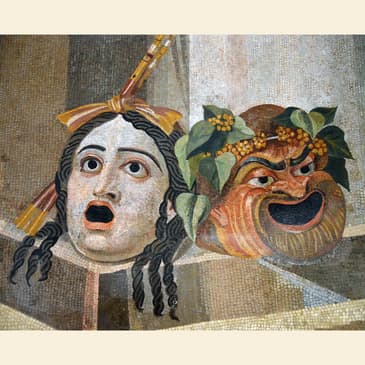
- Mosaic of Masks. Second or third century CE. Found on the Aventine, possibly on the site of the ancient Thermae Decianae; now held in the Capitoline Museums. Photo by Carole Raddato, Wikimedia Commons.
----------
00:11 - Introduction
- 00:38 - A Funny thing Happened on the Way to the Forum: Sonheim’s Musical and the 1966 film
03:19 - Our approach to reviewing adaptations of ancient literature
05:20 - Plautus and Roman Comedy
- 05:29 - What we know about Plautus himself (his dates, his name, his background)
- 09:41 - Plautus' style: Roman comedy, exotic settings, stock plots, and stock characters
17:56 - A Funny Thing Happened on the Way to the Forum: Plautus on Screen
- 18:51 - The setting: “A less fashionable suburb of Rome”
- 19:44 - The characters (Pseudolus, Hysterium, Marcus Lycus, Hero, Philia, Miles Gloriosus, and others)
- 23:33 - The plot, in all of its messiness
- 27:15 - The movie’s sources: Plautus’ Pseudolus, Mostellaria, Miles Gloriosus, and other plays
- 33:01 - Metatheatre in Plautus and in A Funny Thing
- 36:25 - The movie’s departures from Plautus: More is more! (Expansive sets, elaborate scenes, and exaggerated physical comedy)
43:36 - Cam and Emily discuss their reactions (and we learn the dirty secrets of Emily’s history with this film!
49:01 – Wrap-up
Hello. Welcome to Have Toga, Will Travel, a podcast exploring the Mediterranean world, ancient and modern, through the eyes of two former classics professors. I'm Emily.
Cam:I'm Cam.
Emily:And we're your hosts.
Cam:This is our first episode back after doing the marathon again in Athens.
Emily:It is.
Cam:We're a little tired, because this is also the day after Thanksgiving for us. Thanks to the marathon, we're a little bit behind on our production schedule.
Emily:The marathon went well, though.
Cam:It did. What we'd like to do today is talk about A Funny Thing Happened on the Way to the Forum. This is a 1966 film based on a Broadway musical, which itself was a mashup of Roman comedies written by the Roman author Plautus. And as we'll see as we talk about this today, the movie takes elements from several different plays by Plautus and recombines them into a new piece, which, you know, as we'll see, is pretty funny.
Emily:Yeah. The title's not just a clever title. So the musical itself, the Broadway musical, was written by Stephen Sondheim, and it carries the distinction of being the first musical for which Stephen Sondheim wrote both the music and the lyrics. Now, the musical premiered on Broadway in 1962. It was fairly successful: it went on to win six Tonys, including Best Musical, Best Actor, Best Supporting Actor, Best Book, and Best Director.
Cam:I guess that counts as moderate success.
Emily:I think that's moderately successful, yes.
Cam:Right. So the film came out in 1966, and two of the main actors from the stage play reprised their role from the Broadway production for this movie. That's Zero Mostel, who played the star character, I guess, Pseudolus, and Jack Gilford, who played his sidekick, Hysterium.
Emily:Yeah. The film also stars Phil Silvers, who is a comedian for whom the role of Pseudolus was actually originally written. But because he wore glasses, he actually wasn't comfortable doing the role without glasses on because his vision was so bad. So the role ended up going to Zero Mostel in the end. It also has Michael Crawford. You might know him. He really shot to fame with Phantom of the Opera. When that premiered, he played the Phantom. And then one of my favorites, Buster Keaton, the silent film actor and performer (his is his last film role) plays the character Erroneous. And he actually died between when the film was shot and when it was released. And then for those of you who are into Doctor Who, in a small part, the third Doctor, John Pertwee, plays a character named Crassus. Although John Pertwee, in the London premiere of the musical in 1963, had actually played Marcus Lycus, who is our pimp. I mean, that's what he is, right? In the show. So lots of well-known actors who show up in the movie or have gone through the stage version of the play.
Cam:Remind me, John Pertwee's brother wrote part of the script.
Emily:John Pertwee's brother, Michael, co-wrote the screenplay for the movie.
Cam:Right. Yeah. So, yeah, lots of weird connections there.
Emily:Yep.
Cam:All right. Well, let's talk a little bit about this. Before we really dive into the movie, though, we want to talk once again a little bit about adaptation and how we usually think about adaptations of ancient pieces of literature. We've talked about this a little bit in the past, specifically in our episode about The Return, a movie which you should really go see if you haven't seen it already. And of course, you should really listen to our episode about that movie too, if you haven't already.
Emily:It's episode three.
Cam:Right. And as we suggested there, a good adaptation is really a balancing act between two things: an effort to be faithful to the original material and its spirit, while nevertheless building on that original material in an interesting and significant new way that allows you to create a piece of art that can really stand in its own right.
Emily:Now, unlike with something like The Return, the creators of funny thing, have a lot of flexibility. And there are a few reasons for that. One, Plautus himself is actually creating adaptations or new versions of Greek comedic plays. If we want to get technical, it's Greek new comedy, so this is not Aristophanes. It's people like Menander. So the source material is already adapted source material on some level, if we want to think of it that way. Two, Plautus plays—and this goes for Roman comedy, this goes for the Greek comedy that Plautus was drawing on—t hese plays feature a lot of stock elements, stock characters, kind of stock plot types. And so the details of the plot are a lot less important than the overall vibe and style. So because of these stock elements, the creators of Funny Thing can create an adaptation that draws on several plays and kind of plugs these things together in a way that still, I think, honors the spirit and vibe of Plautus, even if it's this kind of pastiche of lots of different Plautus plays.
Cam:Right. With that's of the way, let's talk a little bit about Plautus himself and about what little we can know about him, which at the end of the day is actually not a lot. We know that he was probably active from the very end of the third century, let's say from 205 BCE to about the 180s BCE. Only a couple of his 20 or so surviving plays can actually be dated. One, we know, was performed at a festival in 191 BCE. The normal context for the production of comedies like this was at a festival. And then we have another which refers to events that take place in 186 BCE. So it's really those two plays that sort of position Plautus for us in time.
Emily:And this time when Plautus is writing is a fairly turbulent time in Roman history. So, you know, this is way pre-Julius Caesar and all of that stuff. So it's a time people may not know as much about, but it was actually a time of a lot of upheaval. Rome had relatively recently become the predominant power in Italy. It was expanding its influence aggressively in Spain and Greece. And the Roman world was becoming increasingly cosmopolitan—lots of influx of both wealth people from these areas where Rome was expanding.
Cam:Right. And what we know of Plautus and his texts reflects this. He was definitely fluent in Latin, definitely fluent in Greek, really well-versed in Greek literature, especially the new comedy from which he was adapting his own works. And according to some ancient authors, and this may or may not be true, he was from a place called Sassina in Northern Italy in what was then ancient Umbria. And if that's the case, then he probably spoke Umbrian as well. So he's somebody who was fluent probably in three languages. So somebody with a lot of linguistic and artistic skill.
Emily:Now, we actually don't know a lot about his identity otherwise, because even his name is arguably a stage name. Now, his full name is Titus Maccius Plautus. And all of these names might have been made up. Now, Titus is a proper Roman praenomen or given name, but Titus is also a name that can be slang for penis, much like the name Dick—
Cam:Or Johnson.
Emily:—is today. Yes, Johnson. So it could be a name he adopted because it has this potential for humor. His nomen, Maccius, which is like the family name, means something like son of Maccus. And Maccus is one of the names of a character from Roman farce, or what's known as Atellan farce. And this was the name of the stock clown character. And then finally, Plautus, Plautus means flat or flat footed. And it's often used of actors in Roman mime, which is a different kind of theatrical performance, who typically perform barefooted. So we have a name that could be Dick Flatfooted Clown Son.
Cam:Yeah, something like that. Yes.
Emily:So this is why people think that the name we know Plautus as might be a stage name and not his real given name.
Cam:It's a little too much on the nose.
Emily:A little bit. Yeah. For someone who's performing and writing comedy. Yeah.
Cam:Yes. And that's really sort of the sum total of what we actually concretely know about Plautus. Yeah. There are a bunch of things that get said about Plautus by later authors, but it's really hard to know if they actually knew anything or if they were just making guesses of their own. So one of the arguments that gets made by later authors in the Roman world itself is that Plautus had at one point been enslaved. This is an argument that starts from the claim made by some of these later authors that Plautus was himself a working actor for a while. That's potentially significant because in the Roman world, acting seems to have been a relatively low status profession that was often in the hands of people who were enslaved or formerly enslaved, in contrast to, say, drama at Athens, which was a profession pursued by the freeborn. But at the end of the day, we really don't know. It could be that he was a formerly enslaved person. He could be a member of a local municipal elite. We just really can't tell because we don't even know his real name.
Emily:Yes. So since we can't know much about him, we're going to turn to his style. What did he write? So Plautus wrote, as we mentioned, Roman comedy, and the technical term for the kind of plays he wrote is fabula palliata, which basically means a play in Greek dress. And this is because Plautus is adapting Greek originals from new comedy, and Plautus' plays would have been set in Greece, and so the characters would be wearing Greek dress. But he's also infusing them with a lot of influence from Roman mime. And where the real key contributions from Roman mime are in his plays is the addition of song and dance. So the Greek plays didn't really have a lot of song and dance, or at least the ones he's adapting from. And Plautus adds a lot more to it. At the same times, Plautus' plays are full of constant action on stage, lots of verbal cleverness, wordplay, puns, jokes, etc. And then also this big musical element with some characters singing as much as two-thirds of their dialogue. And we can tell the singing based on the meter that the play is written in, because all these plays would have been written in verse and poetry.
Cam:These plays also had little to no concept of a fourth wall and were often very consciously metatheatrical. So a lot of the times the actors on stage would speak in character or out of character sometimes directly to the audience. Everybody's aware that there is a play happening. The actors are making jokes sometimes about dramatic convention, that sort of thing. And this on one level, I guess, just kind of reflects the history of Roman mime and pantomime, but also the small and intimate settings in which these kinds of performances took place. These plays were usually performed in temporary open air theaters set up for festivals that weren't very big, that didn't leave a lot of space between actor and audience. And we have to imagine these performances were pretty lively with, you know, not just the actors making a lot of noise and carrying on, but also probably lots of people in the audience shouting at them and things like that. And that contributes to what is sometimes called a more is more ethic.
Emily:Yeah, you'll see this in a lot of modern people who comment on Plautus. More is more is his just general vibe.
Cam:Right, and sort of captures the spirit of some of these plays.
Emily:Now, I mentioned that these plays were set in Greece, having people wear Greek dress. Not necessarily in Greece, but in the Greek world, which encompasses a wider swath of the Eastern Mediterranean at that time than it does today.
Cam:Right, like the western coast of Turkey, Sicily, places like this.
Emily:Yeah. The actors would have been dressed in Greek dress. They would have been wearing masks, as you did in Greek drama. And the characters all have Greek names. Now, some of these names are real Greek names, but some are not.
Cam:No, you can get some names that are clearly invented to basically make a pun, right? Or to capture some quality of the character. So, you know, the best example is probably the arrogant soldier character in Plautus' play Milis Gloriosus, who has the name Pyrgopolynices. It's a cobbled together name that means something like the guy who sacked a lot of towers, I guess. That's sort of a loose translation. Another great example is the character Pseudolus. That's the name used by the main character in the movie we're about to discuss. It, again, is a made-up name, and it seems to mean something like tricksy little guy or little liar or something like that.
Emily:And I think one of the things that's interesting about putting it all in the Greek world is that there's a sense of foreignness to the play. And that foreignness of setting and character creates a perceived distance from the audience and the action of the play. And it probably does in a way that actually facilitates the ability to execute the comedy and even critique, right? Oh, it's not us, the Romans, who are doing all this crazy, weird stuff. It's the Greeks, right?
Cam:Those crazy Greeks.
Emily:Yeah. We would never do that. I mean, we want to watch people do that and we're interested in that, but we don't have to watch ourselves do that, right? So it creates this distance that I think makes it safer for the audience.
Cam:In addition to these exotic settings, a lot of Plautus' plays feature what we could call stock plots, elements that would have been familiar that support ridiculous plots and something very much like modern situational comedy. Basic setup of a lot of Plautus' plays involves a competition between characters to get what they want, or at least between one character and just plain old bad luck that keeps complicating his, sometimes her, efforts to accomplish his goals in the course of the play.
Emily:So some pretty common elements that you get, right, include competition over money or over women between two male characters. One of them is usually the play's protagonist or is assisted by the play's protagonist, who is often but not always a slave. And then some of the plays also include a lot of mistaken or false identity or forgotten identities. One sort of very famously features identical twins who don't know about one another. This is the Menaechmi, which famously becomes the basis for Shakespeare's Comedy of Errors.
Cam:Hilarity ensues.
Emily:Hilarity ensues, yes. You have situations where there are characters who are enslaved, but who turn out to actually be freeborn and re-finding that identity as part of the play and et cetera, et cetera. So this mistaken identity becomes a key thing as well.
Cam:In some plays anyway, yeah. And on top of the stock plots, you often get stock characters or character types that were instantly kind of recognizable to the audience. So for example, a lot of Plautus's plays feature a lovely young woman who could be freeborn or could be enslaved, often unjustly, because she turns out in a lot of these plays to be a freeborn person who was, say, kidnapped by pirates at a young age. The lovely young woman is often still a virgin. She's the object of love or lust on the part of male characters in the play. Sometimes she also turns out to be a long-lost daughter or something like that. And in plays that feature this lovely young woman character, you'll also find the young man, in Latin, the Adulescens Amans, who is infatuated with the lovely young woman character and who spends much of the play trying to work that out.
Emily:Some of the other stock character types you get is the pimp or the slave dealer, basically people who make their living by selling or sexually exploiting women under his control. Similarly, another character type is the lecherous and or greedy older man, often the head of the family of which the young man is a member. And this character is usually one of the antagonists in any given play who must be kind of outmaneuvered by our
Cam:protagonists, as is the pimp character as well. Then you'll often also find a character called the parasite. This is somebody who's usually driven by a desire for material comforts. He wants money, he wants food, he wants fancy dinners, that kind of thing. And he basically tries to get what he wants by sucking up to other characters in the play. And finally, the most recognizable stock—
Emily:Or helps. He sometimes helps.
Cam:He sometimes helps, yes. He sometimes becomes actually the protagonist, as it were, or at least a character who can facilitate the Adulescens Amans’ efforts to get the girl. But finally, the most recognizable stock character of all in Plautus' plays is without question the so-called clever slave, the Servus Callidus, who is the main protagonist of a whole bunch of Plautus' plays, and who often goes about accomplishing his objectives, which usually revolve around helping the hapless young man get the girl, in spite of the opposition of other characters in the play, like the lecherous old Pater Familias or the pimp or what have you.
Emily:Yeah. And the Servus Callidus was usually recognizable by his mask.
Cam:Yes.
Emily:He had red hair.
Cam:Yes.
Emily:I don't know why, but that was one of his identifying features.
Cam:Along, apparently, with a pot belly and really comically enormous feet.
Emily:So that's a bit about Plautus and what his plays were like, generally speaking. But let's now transition to the movie we're here to talk about, A Funny Thing Happened on the Way to the Forum. As we mentioned, this movie and the play that preceded it are not an adaptation of any single play, but a pastiche of elements from several Plautus plays. The big three plays here are the Pseudolus, the Miles Gloriosus, and the Mostellaria. And we'll talk more about that in a little bit. But I will say for the film, it really is a film that gives a modern audience a real feel for the spirit of Plautine comedy, while nevertheless consciously positioning itself as a movie for a contemporary audience with elements that really can only exist on film. Things that Plautus would never have been able to do in his plays, but I bet if he could, he would have.
Cam:Yes. So let's talk about how the movie does this. And let's start by talking a little bit about the setting. Here, the movie, like a lot of the plays, adopts a foreign or an exotic setting. But instead of situating the action in Greece like Plautus' plays, the movie just situates the action in Rome. In particular, in what the characters call a less fashionable suburb of Rome.
Emily:A less fashionable suburb of Rome.
Cam:Precisely. Now, this is a departure from Plautus, but in the film, it accomplishes the same thing that a setting in Greece accomplishes in the original plays. It distances the action from the viewer's contemporary milieu, so it accomplishes a bit of a sense of alienation or foreignness, especially since people, when they think about Rome, usually think about debauchery and extravagance and stuff like that anyway.
Emily:Now, when it comes to characters, the film and the show make use of all of these stock character types from Plautus that we've talked about. Also like Plautus, the show either makes up its own pseudo-Latin names for the characters that tell us something about their character, or it draws on names already in Plautus.
Cam:So, for example, the protagonist of the film is Pseudolus. That is a name lifted straight from one of Plautus' plays, the Pseudolus, where it's the name of a clever slave character who is the protagonist of that play. And as we mentioned, it means something very specific. It means little trickster, little liar.
Emily:Then we have Pseudolus' sidekick?
Cam:Sidekick?
Emily:Colleague?
Cam:Yeah. His fellow enslaved person.
Emily:Who is a foil to Pseudolus to a certain extent. In this case, his name is Hysterium. Now, Hysterium is a little high strung and is a little worried about everything. And how are things going to go wrong? Thus the name. Hysterium, right? Makes us think of hysterical.
Cam:His most distinguishing characteristic, of course, is his collection of erotic pottery.
Emily:We never see—
Cam:We do see! We do see it briefly in one scene.
Emily:That's very briefly in the background, yes.
Cam:Yes. The next character worth talking about is Hero, our amorous young man, whose name suggests that he's supposed to be the protagonist. But of course, we as well-versed observers of Plautine comedy know otherwise.
Emily:Yeah. Then we have Senex, who is Hero's father, our lecherous old man. And Senex literally means old man in Latin. Senex's wife is named Domina, which means mistress or lady in Latin. She is the lady of the household. She is also a bit, what's the word I want? She is no nonsense and does not take any crap from anybody. And she runs that household.
Cam:Yes. Our lovely young woman is Philia.
Emily:Which is a pun in two languages.
Cam:Right. In Latin, Filia spelled with an F means daughter. There's a bit of a joke there because when we first encounter this character in the movie, she is actually enslaved and not really anybody's obvious daughter. But the other joke is that in Greek, her name spelled with a P-H is derived from a word for love.
Emily:And of course, when we meet her, she is in a brothel. And by the end of the play, she turns out to be someone's daughter. And then we have our character Miles Gloriosus, which in Latin means boastful soldier. He is exactly that. He is a soldier who can't stop talking about how amazing he is. And the show takes this name directly from a play of Plautus that is called Miles Gloriosus, that we've mentioned before.
Cam:The stock Plautine pimp or slave dealer character in this particular film is Marcus Lycus, played by the inestimable Phil Silvers.
Emily:Yes.
Cam:I don't know how intentional this is, but the name Lycus comes from the Greek word for wolf. So it has this sense of predator, but also in Latin, the Latin word for wolf, lupa, could be used of sex workers. So there's another weird connection here with that name.
Emily:Yeah. And then we have some characters who are not what we might call stock characters that show up in the movie who still have names that riff on what they're doing. So we have the character Erronius. This is the Buster Keaton character. He's been wandering for many years looking for his children and the name Erronius is drawing on the Latin verb for to wander. And then there's a bunch of other minor characters whose names turn out to be like little puns about them and the little bits they do.
Cam:I guess we should tackle the plot now.
Emily:Yeah, the plot. Okay.
Cam:This will be messy. We're going to warn you.
Emily:This is going to be messy. Yeah. So Plautus' plots in general get really complicated. And the film, because it's pulling together plots from lots of different plays, is even more complicated than your typical Plautus play, but more is more.
Cam:Indeed.
Emily:So we're just going to give you a summary of the plot as best we can, and we are going to do our best to be brief. So we have a young man, Hero, who has fallen in love with a woman in the brothel next door. This is Philia. Now, Pseudolus, who is one of Hero's family's slaves, hatches a plan to help Hero get the girl in exchange for his freedom. However, circumstances continuously throw wrenches into the plans, and Pseudolus continues to improvise new plans on the fly to reach the goal. Now, one of the major problems that they encounter is that the woman, Philia, has already been sold to a soldier, Miles Gloriosus, and she insists that she must honor that contract, regardless of her own feelings.
Cam:Now, in spite of that complication, Pseudolus manages to get Philia smuggled out of the brothel and stashes her in Hero's house. Unfortunately for him, however, Hero's father, Senex, comes home unexpectedly and concludes that Philia is the new maid, while she herself thinks that he is the soldier to whom she's been promised. So hilarity, complications, all that stuff. To get Senex out of the way, Pseudolus proposes that he take a bath and arrange a rendezvous in the house next door, Erronius's house, because Erronius is off wandering the world looking for children stolen in infancy by pirates. When Erronius himself also happens to return home unexpectedly after Pseudolus has stashed Senex in his house, Pseudolus tells Erronius that his home has become haunted and he has to run around the seven hills of Rome seven times in order to be able to drive the ghost out.
Emily:And after all this, then our soldier, Miles Gloriosus, arrives himself to claim Philia. And Pseudolus, who is now pretending to be her pimp Marcus Lycus, claims that she has died of the plague. He gets his fellow slave Hysterium to impersonate the supposedly dead Philia, until Miles decides that he wants to cut her heart out to have it as a keepsake. At which point, Hysterium is no longer down with impersonating the dead body, And a massive chariot race ensues all over the Roman countryside. And this is a rather lengthy, involved chase scene. Until at the end, everyone is brought back to Hero's house. And then in the final scene, Philia and Miles discover that they are the children of Erronius, who had been stolen in infancy by pirates, and are thus brother and sister.
Cam:And that Philia is freeborn.
Emily:And so thus Philia is freeborn. So Philia is now free to marry Hero, and Pseudolus wins his freedom.
Cam:Yeah, it's a crazy convoluted plot, and we've really only touched on, I think, sort of the main beats, right?
Emily:Yeah, we've cut a lot out.
Cam:There are a lot of weird subplots that are thrown in there for comedy's sake. Other things we could discuss, and perhaps we'll touch on as we move through the rest of what we want to talk about here today. Let's start by talking a little bit about how the movie adapts and builds on the source material. The movie, and the Broadway production on which it's based, is based primarily on three of Plautus' plays. Pseudolus, Mostellaria, and Miles Gloriosus.
Emily:The first part of the show draws its plot pretty heavily from the Pseudolus. In the Pseudolus, a hapless young man is in love with an enslaved girl who belongs to the pimp next door, and she has been purchased by a soldier whose agent is coming to take possession of her. So Pseudolus orchestrates a complex scheme to have the pimp turn the girl over to an imposter agent before the soldier's real representative arrives, and then she is handed over to the young man who sets her free. Happy ending for everyone.
Cam:Now, the thing is, Pseudolus the play was written basically for connoisseurs of Roman comedy. It has a very metatheatrical plot, even by the standards of Plautus' plays. Basically, you know, the Pseudolus character flails a little bit at the beginning of the play. But once the plot gets going, he takes control of it. He explicitly compares himself to a playwright bringing the reality he wants to see into existence. And it involves a lot of weird metatheatrical jokes like recruiting somebody else to play a clever slave character in his own scheme, and so on. And you can imagine how this is the sort of play that would really appeal to a Roman audience that knew all of these conventions. Maybe not so to a contemporary North American audience.
Emily:Yeah. Although we do get a bit of that because in the show, Pseudolus opens the show with a monologue to the audience where he's talking directly to the audience. He's explaining the story. He's explaining the set. So he does kind of present himself as the—director might be a strong word.
Cam:Yeah, the showrunner in some way.
Emily:Yes, yes. And he talks about his own part as a part.
Cam:Yes, and stresses that, of course, he is the most talented.
Emily:Of the performers, yeah. But the movie really, I think, leans into the complication elements in a way that the Pseudolus doesn't. And we have all these sort of comedically timed complications that threatened to derail the plans of Pseudolus and company. And the complications are where we start getting the other plays introduced, and where we then move beyond the plot of the Pseudolus. So we mentioned the character Erronius, who comes home. And this is where we get the influence of the play The Mostellaria, which is a play where the protagonist, in order to hide the shenanigans they've gotten up to in the home of the old man character while he's been away, they convince him that his house is haunted to get him to get out of the way. So when Erronius arrives back, as we mentioned, Senex is in his house waiting to have an assignation with the new maid who's not a maid. And so Pseudolus and Hysterium need to get Erronius out, so they decide to convince him that his house is haunted. So that's where we pull in the Mostellaria with the Erronius plotline.
Cam:Yeah, and this part features just like an absolute gem of a scene in which Zero Mostel is sort of his frantic best when he's pretending to be a soothsayer, trying to convince Erronius that yes, there really is a ghost. And the only way to do this is to run around the seven hills of Rome seven times.
Emily:Yeah.
Cam:Likewise, the play Miles Gloriosus inspires the depiction of the Miles Gloriosus character, who is based on that play's antagonist, this guy we've mentioned already, Pyrgopolynices, whose name translates to something silly like the guy who sacked lots of towers. In the play, the Miles Gloriosus, the other characters have to deceive the soldier who holds the young woman character as a slave so that the young lovers can be together. And this really inspires the second half or so of the movie in which Hysterium and Pseudolus try to basically deceive the Miles Gloriosus character in the movie.
Emily:But these aren't the only plays that come into play here. There are a lot of little elements that are borrowed from other plays by Plautus. So in at least two of Plautus's extant plays, There are subplots where the father and the son are both pursuing the same woman, much like Senex is trying to arrange an assignation with Philia, and Philia is also whom his son is in love with.
Cam:These never work out in favor of the creepy old man in Plautus' plays.
Emily:No.
Cam:You know, I guess good, surprising, but good.
Emily:Yeah.
Cam:And then finally, there's a recognition scene at the very end of Funny Thing. This is the scene in which Miles Gloriosus and Philia discover, first of all, that they're both the children of Erronius, which means that they are therefore siblings, and Miles Gloriosus can't really do what he wants to do with Philia. But it also means that Philia is freeborn. She is unjustly enslaved because she was kidnapped by pirates and sold. And that's what leads to their happy ending. But the device which makes it possible for them to recognize each other is the fact that they all have rings depicting a gaggle of geese. And this is a device, again, that comes out of a different Plautus play, the Curculio.
Emily:Yeah. In that case, I mean, the rings don't have geese on them, but rings allow the recognition to happen.
Cam:Right. The only reason they have geese here is because it gives Zero Mostel the opportunity to scream, gaggle!
Emily:Yeah. It's also just funny. A gaggle of geese is just funny to say, right? Now, like a lot of Plautus' plays, this film is very much consciously metatheatrical. We talked about Pseudolus' opening monologue, but not only that, after his monologue, we lead into our opening musical number, Comedy Tonight. And this musical number very actively plays with the film's nature as a pastiche by referencing some of the things that are going to happen. Pirates, courtesans, eunuchs, philanderers, right? And the chorus reiterates something for everyone, a comedy tonight. Tragedy tomorrow, comedy tonight. Put aside all of those things you're going to worry about. We're not doing this, we're not doing this, we're not doing this. No royal curse, no Trojan horse, and there's a happy ending, of course. So this opening number is very self-conscious about this is a comedy, this is what you're seeing. It's also just a great song too.
Cam:And we're going to throw everything you can conceivably imagine in a comedy at you.
Emily:Yes.
Cam:That's the other subcurrent of that particular number.
Emily:Sorry. So my brain went to this bit in the funeral sequence. They've got Hysterium disguised as the supposedly dead Philia laying on like a stone table. Not even table, like whatever.
Cam:A bier.
Emily:Bier, yeah. And at some point, I think it's Miles, flops his head down, and you see the whole thing rock and shake and shift slightly, because it's, of course, a prop. It's not actually a stone. And they just leave that in, like the whole meta-theatrical thing.
Cam:There are a lot of other weird meta-theatrical moments in this play, too. The one that I like is the joke about the island of the silent women.
Emily:Which is only a joke in the film and not in the stage play.
Cam:Right. And here, basically what happens is that a woman, an enslaved woman, one of the courtesans in the house of Marcus Lycus, who ends up becoming Pseudolus' love interest, is from the island of silent women and doesn't talk. She just communicates in gestures. And I think this has got to be a joke. It's got to be a clear reference to a number of Plautus plays in which the love interest character doesn't actually get any lines at all. That's not true of all Plautus plays, but there are a bunch where the male characters are, you know, trying to get away with the girl at the end and she doesn't get to say a single thing.
Emily:The irony is that in the stage version, that character, Gymnasia, is the only courtesan other than Philia who actually gets a line of dialogue.
Cam:So it's like metatheatrical on two different levels simultaneously. And again, that has to be intentional. That has to be a joke in both ways.
Emily:One would think. The other thing that's very much a feature of the film is they had a problem with flies on set. There was like a massive infestation of flies. And you can actually see them in some of the scenes, just like everywhere, particularly a scene that happens in Hysterium's bedroom when they are dressing him up to impersonate the supposedly dead Philia.
Cam:That's the scene in which the erotic pottery makes an appearance.
Emily:That is a scene in which the erotic pottery makes an appearance. So for the closing credits, the filmmakers sort of play with this. And the animation over the end credit sequence are just flies everywhere, buzzing in, buzzing out, bothering the animated characters.
Cam:Dancing around, yeah.
Emily:Yeah, it just flies everywhere. And so that was just the film taking advantage of this less pleasant aspect of their filming experience and making a joke about it.
Cam:So what this means is that the movie very much is an adaptation in the spirit of Plautus that leans into a lot of features that make Plautus' plays pretty funny.
Emily:More is more.
Cam:More is more. It does depart from the source material in various ways, mostly in ways that reflect the fact that this is a film and that film is a very different genre than a stage production, and among other things, allows for a much wider range of settings, action between characters, and that sort of thing. Here, it's just worth stressing that the original plays when they were performed in Plautus' own day took place against probably a very simple backdrop, which represented two, sometimes three buildings or houses. And the action took place mostly in front of that backdrop and what was often conceptualized in many of these plays as the street.
Emily:Now film, of course, we can change set locations. And so Funny Thing takes advantage of that ability to break free of that restriction. So of course, we get interior scenes and the houses, we get exterior scenes and multiple locations and not just our street in front of the three houses, although that is where we start. But yeah, then we move on, there's scenes in a temple, there's scenes in an arena, there's scenes in a bath, all sorts of stuff. And they actually have some really nice set pieces, partly because a lot of this was filmed in Spain on sets originally made for the movie Fall of the Roman Empire. The movie did not do well. And honestly, I've seen it, and—
Cam:We understand why.
Emily:I understand why. Although, although what I did understand from watching that movie was the whole vibe of Christopher Plummer outside the sound of music. I'll just put it that way.
Cam:You're not going to elaborate on that?
Emily:I see now why his reputation is what it was in a positive way. But like, oh, that's what they're talking about.
Cam:Okay.
Emily:Anyway, other than using those sets, it was also filmed in and around Madrid. Now, a lot of the scenes do honor the sort of street scene that's familiar from Plautus' plays, but the film actually fleshes it out in some really nice ways. It really creates this gritty, noisy, dirty even world. There are people everywhere. There are animals everywhere. There's things just constantly happening. People are living their lives outside, as they would have in antiquity. And so the film is able to capture that vibe in a really neat way. And I think it does give you some sense of what it would have seen and looked like to be in a Roman city. Not what it smelled like, but you could probably guess.
Cam:Right. Especially since this is a less fashionable suburb of Rome.
Emily:A less fashionable suburb of Rome, yeah.
Cam:But actually, I mean, that sequence—or the sequences in which we really get to see Rome remind me really strongly of the first time I went to Naples. And it's the same chaotic mix of people and animals and vehicles just sort of milling around in the street, all trying to use this space, people trying to sell you stuff, people playing games, just a total mess.
Emily:It's incredible. It's lovely.
Cam:Yes. The movie does, however, field some also very elaborate scenes that just couldn't be staged in the same way in live theater. So one that leaps immediately to mind is the entrance of the soldiers when the Miles Gloriosus makes his appearance. This is a pretty ridiculous scene in which he and his soldiers sort of parade through the streets. And Miles Gloriosus, of course, gets a song about how great and awesome and fantastic he is. You know, and the people on the street are reacting. Some in horror, women are swooning.
Emily:I would actually contend that the cartoon Aladdin for Aladdin's entrance as Prince Ali draws on the Miles Gloriosus entrance from this movie.
Cam:I can see that. Yeah, no, you're right.
Emily:I haven't studied them both close enough together to like make a good argument there, but I get similar vibes from both.
Cam:Very similar in spirit.
Emily:There's even like the three women sighing in the window.
Cam:Yes, yes.
Emily:Yeah.
Cam:Yeah. So it's, again, this big, elaborate, ridiculous scene that you just can't pull off in quite the same way in theater.
Emily:I've tried. It doesn't work quite as well.
Cam:And the other one is what is arguably the movie's strongest musical number, the song Everybody Wants to Have a Maid.
Emily:Everybody Ought to Have a Maid. Everybody Ought to Have a Maid.
Cam:Everybody Ought to Have a Working Girl. Yeah. It's a totally ridiculous song. It's ridiculous and fun, even though it's also kind of creepy. It's a big dance number to the extent that any of the lead actors can dance.
Emily:Yeah.
Cam:Which is not a lot.
Emily:It is one of the few things that has like real choreography.
Cam:Yes.
Emily:Yeah.
Cam:And one of the things that strikes me about it is the way that the scene constantly shifts from interior space to the balcony to exterior space. And there's even a bit where you can see the four leads sort of dancing along the top of the aqueduct in Segovia. So it just adds this crazy feel to the number that once again, you can't really replicate in a theater context in the same way.
Emily:No, you definitely can't just move them from place to place and then throw them on top of an aqueduct.
Cam:Right.
Emily:And then this ties into a lot of what the film is doing with its physical comedy, right? It's just making it more and bigger and bigger than Plautus. Slapstick is incredibly central to Plautine humor. And the film makes great use of this physical humor, including a somewhat legendary pratfall by Buster Keaton. As we mentioned, this was his last film. He was very old and not in great health when he shot this movie. And there was a moment where his character is supposed to run into a tree branch and fall over. And apparently the director had come to the conclusion that they couldn't get anyone to do a pratfall like Buster Keaton that would read like Buster Keaton. And I think without a lot of warning, like he just ran up and did it, and they weren't prepared for it. He just like bonked his head and fell on the ground and like, there he is and kind of shocked the crew a bit. But it's in the film and it's...
Cam:It's well done.
Emily:It's so well done.
Cam:It's a great pratfall.
Emily:Looking at someone who's like, legendary performer like that still has it all those years later. But then we get other things. We get, you know, people getting tossed out of windows and like climbing up buildings and things that you just would have a hard time doing on stage or at least doing safely on stage. And then we get chase sequences. So we get chase sequences inside the home where one of Miles' minions is chasing Gymnasia. And then we get this big chariot chase at the end that we've mentioned, which entails multiple chariots, multiple people, people being tossed from one chariot to another. At one point, Pseudolus waterskis. I mean, it's just a whole, it's a whole thing. And of course, never could have done that on stage.
Cam:Yeah, it gives the movie a very different feel than the plays. And I guess one could argue that Plautus would have appreciated it precisely in that spirit. More is more. This is the sort of crazy stuff that maybe Plautus wished he could have pulled off in the theater.
Emily:And film allows them that freedom to expand and grow the more is more aesthetic. So that's our overview of the film and what it's doing, how it's interacting with Plautus, where we see these points of commonality, these points of divergence. So Cam, what are your thoughts or takeaways about the film?
Cam:I think most of the movie works because most of the movie leans into sort of the frantic and frenetic pace that characterizes a lot of Plautus' plays and makes pretty good use of those stock characters. In particular, Pseudolus and Marcus Lycus get some good scenes with each other, as do Pseudolus and Hysterium. So for the most part, I think this is great. It's a really fun time. The thing I don't like so much is the chariot chase at the end. And here I think, in my head anyway, what happened is that the cast and crew got to Madrid. They started poking around the studio. They opened up a storage shed and discovered a bunch of chariots. And were like, whoa, cool, we got to do something with these. And they do, but it doesn't really feel all that well integrated into the rest of the movie to me.
Emily:I think that's wrong. That scene took a lot of scripting and planning to do. So I think you're probably wrong there.
Cam:All right. What are some of your thoughts?
Emily:Well, so you know that this is one of my, like, on some level, one of my favorite movies. I can watch this movie over and over again. I have watched this movie over and over again repeatedly. I can do whole chunks of dialogue. I mean, I dare say the film is amazing.
Cam:Fantastic.
Emily:Yes, exactly.
Cam:That's an inside joke. If you've seen the movie, you'll get it.
Emily:If you've seen the movie. And I will say, I had the opportunity to be in the stage version some years ago. And I think I enjoy the film more. But that's probably because the film cuts out a lot of the songs, and I can get kind of bored with... that. But I think just the way that the film is able to be even more over the top and dig into all of that comedy more, just fits my—I just kind of like that better. Yeah, I just love this movie. And Cam will probably have to deal with me quoting it at him for the rest of the evening.
Cam:What Emily's not telling you here is that she worked for many years in a summer program teaching Latin to high school students, in which this movie was sort of like, I don't know, the common cultural referent for all of the teachers. And all of the teachers would quote it relentlessly to themselves, to each other every day for whatever it was, six solid weeks of the program. Three solid weeks of the program.
Emily:This was also the first film we would show the students in the program. And yeah, there was one year we had someone new working with us on staff. And before the program started, the director said, okay, if there's one thing you need to do before coming is you need to watch A Funny Thing Happened on the Way to the Forum. He did not watch it. And so a lot was lost on him once we got there and started interacting. And then he sort of realized, oh, that's why. I even in my dissertation acknowledgments thanked my fellow staff at that program because I'd worked there through much of grad school and even threw a Forum reference into my thanking of them and my acknowledgments, which is like just the most inside joke thing I could do. I'm having to hold back so hard right now from just doing bits from the movie.
Cam:Yes, I know. You know all the dialogue. You know all the songs.
Emily:You have a father? I have a father. Okay. Anyway, I don't know. I may not even be able to see this movie with like clear eyes because it's just such a part of my life in a kind of weird way.
Cam:Yeah.
Emily:I think it holds up.
Cam:I think it holds up relatively well. I mean, you know, it was produced in the 60s. So it does reflect the social climate of the 60s in some way.
Emily:Yeah.
Cam:So, you know, the male characters are served better than the female characters in a lot of ways.
Emily:But that's also true in Plautus.
Cam:In Plautus as well. I did like the fact that both Hero and Philia are presented as equally dumb.
Emily:Oh, yeah. Well, and then you get their little ballad, but then you get that reprised between Pseudolus and Hysterium, and it's just completely mocked.
Cam:Yeah. And I also really like the fact that, you know, the silent woman, Gymnasia—and we've already sort of mentioned why that whole character is a joke in the movie—she actually ends up being pretty important because she becomes Pseudolus's co-conspirator. She saves him at a really crucial point in the movie. So not only is she sort of making a joke about the silent character writ large in Plautine comedy, she's also actually doing things that are important in this movie.
Emily:Yeah. Yeah. You know, well, things like Domina, right? She is sort of the domineering wife, but the film also tries to give a reason for why she's like that, right? She herself was basically bullied by her mother.
Cam:Yeah. But she also knows that her husband is a philandering creep.
Emily:Yeah. Yeah. There's a great moment where like there are soldiers guarding the entrance to the home and aren't supposed to let anyone in. And she shows up and just breezes in. And she's like, if you're the new gardeners get off those tools and use them properly and they're so like— her tone is so commanding that they all of a sudden like jump to obey her before they realize that they were actually supposed to stop her from entering, at that point she's gone off and in and— i actually think she gets a better deal in the film than the character does in the stage play, from what I from what i remember of the stage play. But we should probably wrap up. Okay. I mean I could talk about this movie—you know if you let me just give my opinion and talk about it I can do it for a long time, and I probably shouldn't.
Cam:No, we should—you're right, we should probably wrap up. We'd love to tell you what we're doing next episode, but we haven't sorted that out yet.
Emily:No, we haven't.
Cam:As we've mentioned, we've been busy this month, so our production schedule is a little bit behind. So our next episode is going to be a surprise for us as well as for you, dear listeners.
Emily:Yes. So until then, I'm Emily.
Cam:I'm Cam.
Emily:And this has been Have Toga, Will Travel. Subscribe to our show wherever you get your favorite podcasts and follow us at havetogawilltravel.com or on all the socials. And if you have any questions for us or other topics you'd like to see us cover, please feel free to reach out to us and let us know. And if you like this episode, tell a friend about us.
Cam:Thanks for listening, everybody.